REVIEW 6 minor 93 references
Out of equilibrium mean field dynamics in the transverse field Ising model
T0 review · 0 major / 6 minor · reviewed 2026-08-14 · deepseek-v4-flash
Pith's one-line read After a quantum quench in the fully connected transverse-field Ising model, the leading 1/N corrections put the magnetization variance into four distinct regimes, set mean-field validity at times ~sqrt(N), and reduce the bipartite…
desk verdict Solid semiclassical quench analysis for the LMG model: the variance classification and harmonic-oscillator entanglement Hamiltonian are genuine advances, and the main caveat is a heuristic rather than controlled breakdown-time estimate. read the letter →
The pith
A machine-rendered reading of the paper's core claim, the machinery that carries it, and where it could break.
The reading
What carries the argument
The engine is the inverse-system-size expansion of the rate function $f(n_+)$ in a large-deviation ansatz $\psi(n_+)\asymp e^{-Nf(n_+)}$ (Eq. (3)). Its time-dependent curvature $f_2(t)$ obeys a closed Riccati-type ordinary differential equation (Eq. (7)) equivalent to evolving a Gaussian covariance under the linearized classical flow, $C(t)=S(t)C(0)S(t)^T$ (Eq. (8)). For periodic orbits, Floquet theory splits $S(t)=P(t)M(t)$ into a periodic part and a shear matrix with shear factor $\alpha=\|H'\|^2 T'(E_0)$; this shear is the mechanism behind periodically enhanced squeezing and spreading. On the entanglement side, the same covariance, reduced to a subsystem, has a Gaussian Wigner function, and the star-exponential of a quadratic form converts this into a quadratic entanglement Hamiltonian whose spectrum is fixed by the symplectic eigenvalue $\lambda=\sqrt{\det\Sigma_A}$ through the Williamson decomposition.
What would settle it
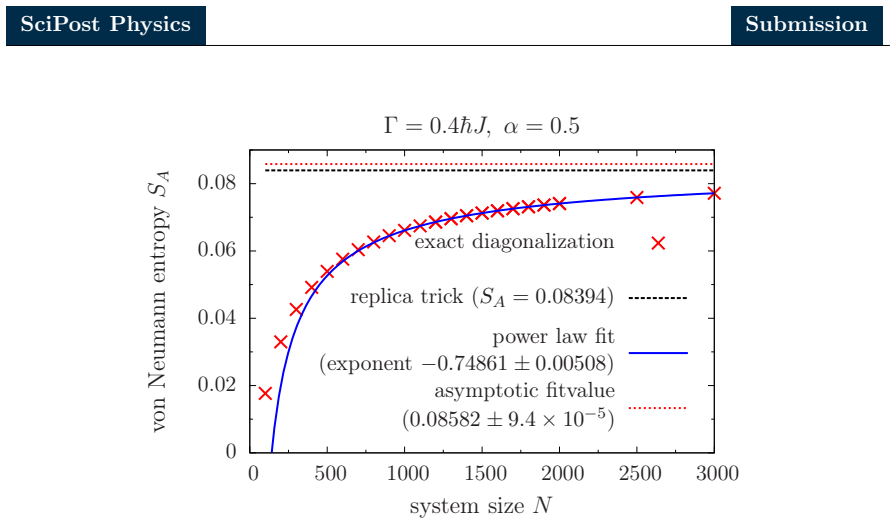
Use numerically exact time evolution for $N=10^3$ and $N=10^4$ on quenches in each of the four regimes and locate the first time $t_*$ at which $N\,\mathrm{var}(n_+)$ deviates from the semiclassical result by a fixed threshold; the claim is falsified if $t_*$ does not scale as $\sqrt{N}$ in regimes III and IV and as $\log N$ in regime I. A second check is the entanglement spectrum of the reduced density matrix: it must be equidistant with spacing $\omega=2\,\mathrm{arctanh}[1/(2\lambda)]$ as long as the semiclassical approximation holds.
Extended reading notes
Core claim
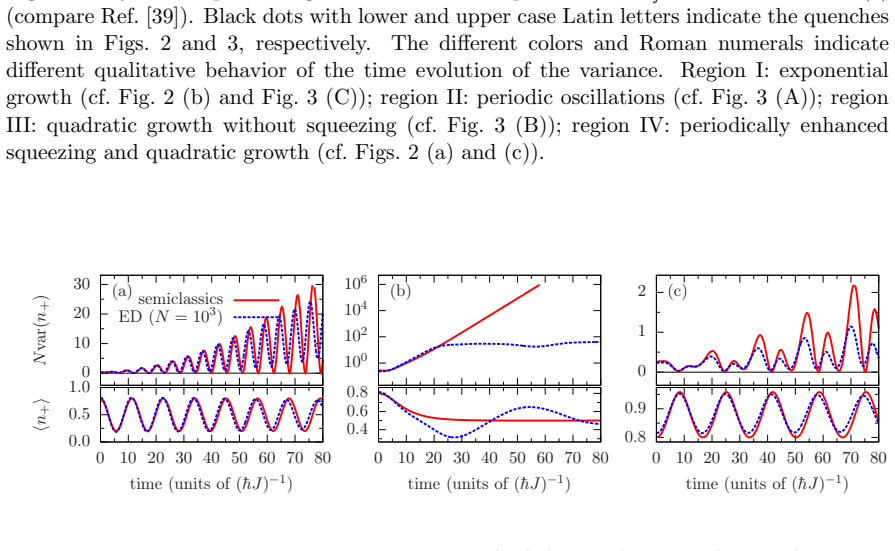
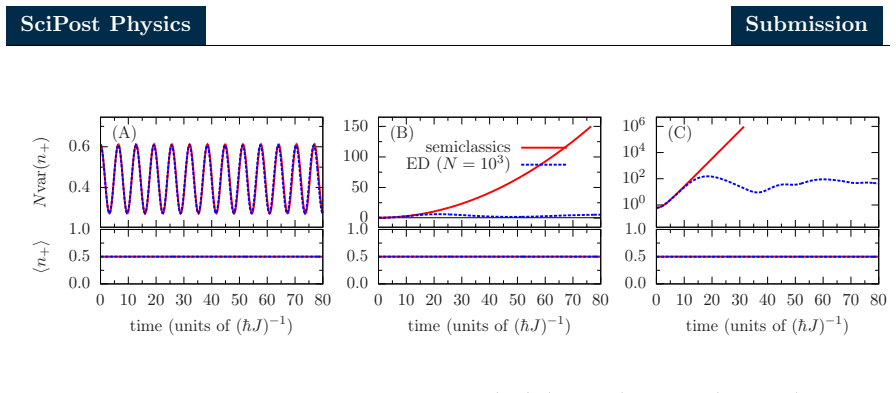
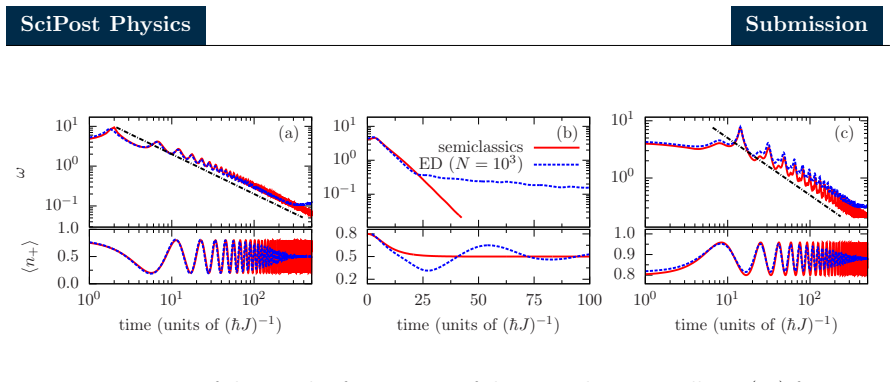
The paper claims that for a sudden quench $\Gamma_i \to \Gamma_f$ in the fully connected transverse-field Ising model, the leading $1/N$ corrections to mean-field dynamics are captured by a quadratic rate-function curvature $f_2$ obeying $i df_2/dt = -(1, if_2) H''(1, if_2)$ (Eq. (7)), equivalently by a Gaussian covariance $C(t)=S(t)C(0)S(t)^T$ (Eq. (8)) transported along the classical orbit. From this single object the magnetization variance falls into four qualitatively different regimes — exponential growth (I), periodic oscillations (II), quadratic growth (III), and periodically enhanced squeezing (IV) — that cannot be distinguished by the mean magnetization alone. The same Gaussian covariance, after tracing out a subsystem, yields a reduced density matrix whose entanglement Hamiltonian is exactly quadratic, i.e. a time-dependent harmonic oscillator whose frequency $\omega(t)$ is fixed by the symplectic eigenvalue $\lambda = \sqrt{\det \Sigma_A}$ of the covariance matrix; all Rényi entropies follow from $\lambda$, and $\lambda$ is itself a function of the spin-squeezing parameter $\xi_S$. Because the wave packet spreads, the semiclassical description ceases to be valid at an Ehrenfest time $t_* \sim \sqrt{N}$ in regimes III and IV and $t_* \sim \log N$ in regime I, with $t_* \sim N$ near a stable fixed point.
Load-bearing premise
The predictions rest on the assumption that the time-evolved state remains, to leading order in $1/N$, a Gaussian wave packet whose phase-space width stays of order $1/\sqrt{N}$, so that the flow around the classical orbit can be linearized and anharmonic terms neglected for the times considered.
Editorial extensions
If this is right
- In regimes III and IV the mean-field approximation is trustworthy only up to $t_*\sim\sqrt{N}$, and in regime I only up to $t_*\sim\log N$, so large finite fully connected spin systems should show measurable departures from mean-field predictions on these timescales.
- Because the variance distinguishes four regions of the dynamical phase diagram that the mean order parameter alone cannot, measuring $\mathrm{var}(n_+)$ (or a squeezing parameter built from it) is a sharper probe of dynamical phase transitions than the magnetization.
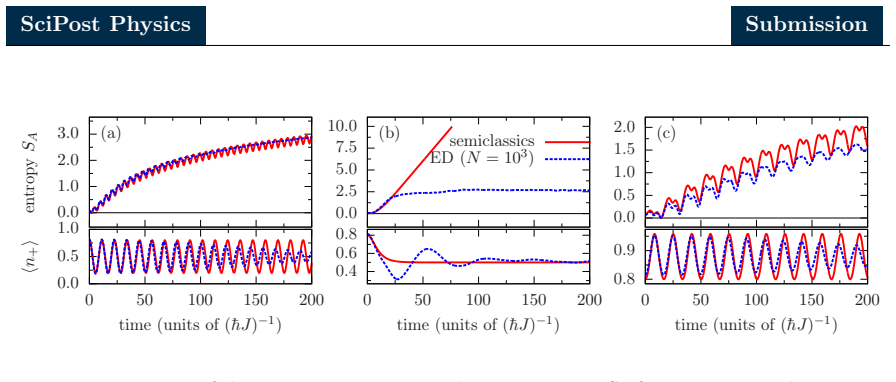
- Entanglement growth after a quench is linear when the variance grows exponentially (regime I), logarithmic when the variance grows quadratically (regimes III and IV), and bounded when the variance oscillates (regime II); all cases follow from one formula for the symplectic eigenvalue.
- Since the entanglement Hamiltonian is a harmonic oscillator, all Rényi entropies are known analytically from the single number $\lambda$, and $\lambda$ is itself determined by the spin-squeezing parameter $\xi_S$.
- The periodically enhanced squeezing mechanism requires only a periodic reference orbit with nearby orbits of different periods, so the same four-regime variance phenomenology should appear in other fully connected mean-field models such as the Bose-Hubbard dimer.
Reading between the lines
- Going beyond the paper, the Ehrenfest-time scalings imply that effective single-particle or semiclassical descriptions of fully connected quenches should be treated as reliable only up to $O(\sqrt{N})$ ($O(\log N)$ near hyperbolic points), even when the mean magnetization looks stable; finite-size dephasing is not a small correction but sets the practical validity window.
- A cold-atom dimer experiment that can prepare the effective Hamiltonian and read out $N\,\mathrm{var}(n_+)$ could test the sharpest prediction here: in regime IV the squeezing minima should decay like $1/t^2$ before the Ehrenfest time, a signature that does not depend on model details.
- The same single-scalar description opens the door to designing explicit LOCC conversion protocols for collective-spin states, since the target majorization ordering is controlled entirely by $\lambda(t)$.
Signed reviews
Editorial analysis
A structured set of objections, weighed in public.
Referee Report
Summary. This paper analyzes quantum quenches in the fully connected transverse-field Ising model (Lipkin-Meshkov-Glick) using a rate-function (WKB) expansion in the inverse system size. The authors derive a leading-order ODE for the curvature f2 of the rate function (Eq. (7)), prove its equivalence to the nearby-orbit covariance evolution (Appendix C), and use it to classify the time dependence of the order-parameter variance into four regimes: exponential, periodic, quadratic, and periodically enhanced squeezing. They further estimate the breakdown time of the mean-field approximation (t* ~ sqrt(N) for polynomial spreading, t* ~ log N near hyperbolic points) and derive the bipartite entanglement Hamiltonian, which in the semiclassical limit is a time-dependent harmonic oscillator whose symplectic eigenvalue determines all Rényi entropies. The analytical results are compared with exact diagonalization for systems up to N=10^4 spins.
Significance. If correct, the paper provides a parameter-free leading-order analytical description of a benchmark mean-field model, with no fitted parameters: initial conditions are fixed by the WKB ground state, the variance follows from Eq. (7), and the entanglement spectrum follows from the Gaussian covariance. The equivalence proof in Appendix C and the replica calculation in Appendix G are careful and internally consistent, and the numerical checks for the variance and entropy support the central claims. The identification of the fourth regime (periodically enhanced squeezing) and the connection between spin squeezing and the entire entanglement spectrum are valuable contributions. The main limitation, as the paper itself states in Sec. 4.5, is that the Gaussian (nearby-orbit) approximation is valid only up to the Ehrenfest time, so the harmonic-oscillator entanglement Hamiltonian is a leading-order statement in 1/N; the stress-test concern about uncontrolled f3/f4 corrections is real but is explicitly acknowledged by the authors and does not undermine the central derivation.
minor comments (6)
- [Sec. 4.5 and Sec. 5.2] The paper should state explicitly that the harmonic-oscillator form (19) is a leading-order-in-1/N statement valid for t much less than t*, and that corrections from f3 and f4 (Eq. (32)) to the symplectic eigenvalue (24) are not computed; the t* estimate is heuristic and threshold-dependent (Fig. 5).
- [Sec. 4.4 and Appendix D] The assertion that P(t)^T v traverses all directions in each period is used to explain the variance minima, but no proof is given; please add a short argument or qualify the statement as an observation supported by the numerical examples.
- [Eq. (20)] The notation N0 omega is unclear; it should be n omega with n in N0, or N0 should be defined explicitly.
- [Fig. 10 caption] The caption says 'rho_A(t1) and rho_A(t1)' and should read 'rho_A(t1) and rho_A(t2)'.
- [Reference [54]] The citation gives a placeholder title 'E. Heller, title'; a complete bibliographic entry is needed.
- [Throughout] There are several typos, e.g. 'fascilitated' in Sec. 5.4; the manuscript would benefit from a final proofread.
Circularity Check
No significant circularity: all predictions follow from fixed WKB initial data and the Hamiltonian; ED benchmarking is external.
full rationale
The paper's derivation chain is self-contained and not circular in any of the flagged patterns. The variance dynamics follows from the rate-function curvature ODE (Eq. 7), which is derived in Appendix B from the Taylor expansion of the complex rate-function PDE (Eq. 30); the initial curvature is fixed by the WKB ground-state condition (Eq. 11c), not fitted to data. Appendix C explicitly proves equivalence between this large-deviation result and the nearby-orbit covariance evolution (Eq. 8), so the two semiclassical routes are independent derivations of the same object. The entanglement Hamiltonian is obtained by taking the reduced density matrix of a Gaussian wave function (Eqs. 16-18), then applying the known star-exponential identity for quadratic functions (Eq. 19), which is a mathematical result cited from the literature rather than an imported conclusion. All quantitative comparisons to exact diagonalization are benchmarks and do not set any parameter. The only self-citation, Ref. [24], appears in a contextual list of dynamical phase transitions and is not load-bearing for the paper's central claims. The paper's central approximation, persistence of Gaussian localization to leading order in 1/N, is explicitly stated and its breakdown time is estimated heuristically; an approximation that limits validity is not an input disguised as a prediction. No fitted parameter is renamed as a prediction, no uniqueness theorem is imported from the authors' prior work, and no known result is merely renamed as a new derivation.
Assumptions & free parameters
assumptions (5)
- domain assumption The time-evolved state remains a Gaussian wave packet in phase space with covariance evolving under the linearized classical flow (nearby orbit approximation).
- domain assumption The initial state has the large-deviation form exp(-N f(n+)) with a unique global minimum of Re f, and spin-flip symmetry is broken by an infinitesimal longitudinal field.
- domain assumption The Dicke-subspace Schrödinger equation can be replaced by the continuum effective Hamiltonian (29), neglecting O(1/N) terms and the non-Hermitian artifact.
- standard math Standard Gaussian-state results: Williamson theorem, Wigner function of a Gaussian density, and the star-exponential formula for quadratic Hamiltonians.
- standard math Floquet theorem applied to the linearized flow around periodic orbits, with a degenerate monodromy matrix in shear form for 2D autonomous Hamiltonians.
Cite this review
Pith. "Pith review of Out of equilibrium mean field dynamics in the transverse field Ising model." pith.science (2026). https://pith.science/paper/22PJZ7AO
@misc{pith2026190802596,
  author       = {Pith},
  title        = {Pith review of: Out of equilibrium mean field dynamics in the transverse field Ising model},
  year         = {2026},
  howpublished = {\url{https://pith.science/paper/22PJZ7AO}},
  note         = {Machine review of arXiv:1908.02596}
}
read the original abstract
We investigate the quench dynamics of the transverse field Ising model on a finite fully connected lattice as a prime example of non-equilibrium mean field dynamics. Using a rate function approach we compute the leading order corrections to the mean field behavior analytically. Our focus is threefold: i) We analyze the validity of the mean field approximation and observe that deviations can occur quickly even for large systems. ii) We study the variance of the order parameter and identify four qualitative different regions that cannot be distinguished by solely looking at its mean. iii) We derive the complete entanglement Hamiltonian for a bipartition of the lattice, which remarkably turns out to be a time-dependent harmonic oscillator within the validity of the mean field analysis.
Figures

Figures from the paper (7 more)




Reference graph
Works this paper leans on
-
[1]
A. Einstein, B. Podolsky and N. Rosen, Can quantum-mechanical description of physical reality be considered complete?, Phys. Rev. 47, 777 (1935), doi:10.1103/PhysRev.47.777
-
[2]
E. Schr¨ odinger, Discussion of probability relations between separated systems , Mathematical Proceedings of the Cambridge Philosophical Society 31, 555 (1935), doi:10.1017/S0305004100013554
-
[3]
S. R. White, Density matrix formulation for quantum renormalization groups , Phys. Rev. Lett. 69, 2863 (1992), doi:10.1103/PhysRevLett.69.2863
-
[4]
A. J. Daley, C. Kollath, U. Schollw¨ ock and G. Vidal, Time-dependent density-matrix renormalization-group using adaptive effective hilbert spaces , Journal of Statistical Mechanics: Theory and Experiment 2004(04), P04005 (2004), doi:10.1088/1742- 5468/2004/04/p04005
doi:10.1088/1742- 2004
-
[5]
Schollw¨ ock, The density-matrix renormalization group , Rev
U. Schollw¨ ock, The density-matrix renormalization group , Rev. Mod. Phys. 77, 259 (2005), doi:10.1103/RevModPhys.77.259
-
[6]
U. Schollw¨ ock, The density-matrix renormalization group in the age of matrix product states , Annals of Physics 326(1), 96 (2011), doi:https://doi.org/10.1016/j.aop.2010.09.012, January 2011 Special Issue
-
[7]
J. Eisert and T. J. Osborne, General entanglement scaling laws from time evolution , Phys. Rev. Lett. 97, 150404 (2006), doi:10.1103/PhysRevLett.97.150404
-
[8]
J. L. Cardya, Entanglement entropy in extended quantum systems , The European Phys- ical Journal B 64(3), 321 (2008), doi:10.1140/epjb/e2008-00102-5
Show all 93 references
-
[9]
Calabrese and J
P. Calabrese and J. Cardy, Entanglement entropy and conformal field theory , Journal of Physics A: Mathematical and Theoretical 42(50), 504005 (2009), doi:10.1088/1751- 8113/42/50/504005
2009 doi
-
[10]
Kim and D
H. Kim and D. A. Huse, Ballistic spreading of entanglement in a diffusive nonintegrable system, Phys. Rev. Lett. 111, 127205 (2013), doi:10.1103/PhysRevLett.111.127205
2013 doi
-
[11]
R. G. Unanyan and M. Fleischhauer, Entanglement dynamics in harmonic-oscillator chains, Phys. Rev. A 89, 062330 (2014), doi:10.1103/PhysRevA.89.062330
2014 doi
-
[12]
Srednicki, Entropy and area , Phys
M. Srednicki, Entropy and area , Phys. Rev. Lett. 71, 666 (1993), doi:10.1103/PhysRevLett.71.666
1993 doi
-
[13]
Calabrese and J
P. Calabrese and J. Cardy, Entanglement entropy and quantum field theory , Jour- nal of Statistical Mechanics: Theory and Experiment 2004(06), P06002 (2004), doi:10.1088/1742-5468/2004/06/p06002. 42 SciPost Physics Submission
2004 doi
-
[14]
M. B. Plenio, J. Eisert, J. Dreißig and M. Cramer, Entropy, entanglement, and area: Analytical results for harmonic lattice systems , Phys. Rev. Lett. 94, 060503 (2005), doi:10.1103/PhysRevLett.94.060503
2005 doi
-
[15]
Fradkin and J
E. Fradkin and J. E. Moore, Entanglement entropy of 2d conformal quantum critical points: Hearing the shape of a quantum drum , Phys. Rev. Lett. 97, 050404 (2006), doi:10.1103/PhysRevLett.97.050404
2006 doi
-
[16]
Eisert, M
J. Eisert, M. Cramer and M. B. Plenio, Colloquium: Area laws for the entanglement entropy, Rev. Mod. Phys. 82, 277 (2010), doi:10.1103/RevModPhys.82.277
2010 doi
-
[17]
W. W. Ho and D. A. Abanin, Entanglement dynamics in quantum many-body systems , Phys. Rev. B 95, 094302 (2017), doi:10.1103/PhysRevB.95.094302
2017 doi
-
[18]
Schachenmayer, B
J. Schachenmayer, B. P. Lanyon, C. F. Roos and A. J. Daley, Entanglement growth in quench dynamics with variable range interactions , Phys. Rev. X 3, 031015 (2013), doi:10.1103/PhysRevX.3.031015
2013 doi
-
[19]
Singh, R
R. Singh, R. Moessner and D. Roy, Effect of long-range hopping and interactions on entanglement dynamics and many-body localization , Phys. Rev. B 95, 094205 (2017), doi:10.1103/PhysRevB.95.094205
2017 doi
-
[20]
Alba and F
V. Alba and F. Heidrich-Meisner, Entanglement spreading after a geometric quench in quantum spin chains, Phys. Rev. B 90, 075144 (2014), doi:10.1103/PhysRevB.90.075144
2014 doi
-
[21]
J. H. Bardarson, F. Pollmann and J. E. Moore, Unbounded growth of entangle- ment in models of many-body localization , Phys. Rev. Lett. 109, 017202 (2012), doi:10.1103/PhysRevLett.109.017202
2012 doi
-
[22]
Serbyn, Z
M. Serbyn, Z. Papi´ c and D. A. Abanin, Universal slow growth of entanglement in interacting strongly disordered systems , Phys. Rev. Lett. 110, 260601 (2013), doi:10.1103/PhysRevLett.110.260601
2013 doi
-
[23]
D. A. Huse, R. Nandkishore and V. Oganesyan, Phenomenology of fully many-body- localized systems, Phys. Rev. B 90, 174202 (2014), doi:10.1103/PhysRevB.90.174202
2014 doi
-
[24]
Homrighausen, N
I. Homrighausen, N. O. Abeling, V. Zauner-Stauber and J. C. Halimeh, Anomalous dynamical phase in quantum spin chains with long-range interactions , Phys. Rev. B 96, 104436 (2017), doi:10.1103/PhysRevB.96.104436
2017 doi
-
[25]
J. Lang, B. Frank and J. C. Halimeh, Dynamical quantum phase transitions: A geometric picture, Phys. Rev. Lett. 121, 130603 (2018), doi:10.1103/PhysRevLett.121.130603
2018 doi
-
[26]
J. Lang, B. Frank and J. C. Halimeh, Concurrence of dynamical phase transitions at finite temperature in the fully connected transverse-field ising model , Phys. Rev. B 97, 174401 (2018), doi:10.1103/PhysRevB.97.174401
2018 doi
-
[27]
A. S. Buyskikh, M. Fagotti, J. Schachenmayer, F. Essler and A. J. Daley, Entanglement growth and correlation spreading with variable-range interactions in spin and fermionic tunneling models, Phys. Rev. A 93, 053620 (2016), doi:10.1103/PhysRevA.93.053620. 43 SciPost Physics Submission
2016 doi
-
[28]
Pappalardi, A
S. Pappalardi, A. Russomanno, B. ˇZunkoviˇ c, F. Iemini, A. Silva and R. Fazio,Scrambling and entanglement spreading in long-range spin chains , Phys. Rev. B 98, 134303 (2018), doi:10.1103/PhysRevB.98.134303
2018 doi
-
[29]
Hillery and M
M. Hillery and M. S. Zubairy, Entanglement conditions for two-mode states , Phys. Rev. Lett. 96, 050503 (2006), doi:10.1103/PhysRevLett.96.050503
2006 doi
-
[30]
P´ erez-Campos, J
C. P´ erez-Campos, J. R. Gonz´ alez-Alonso, O. Castanos and R. L´ opez-Pena,Entanglement and localization of a two-mode bose–einstein condensate , Annals of Physics 325(2), 325 (2010), doi:https://doi.org/10.1016/j.aop.2009.09.015
2010 doi
-
[31]
Hennig, D
H. Hennig, D. Witthaut and D. K. Campbell, Global phase space of coherence and entanglement in a double-well bose-einstein condensate , Phys. Rev. A 86, 051604 (2012), doi:10.1103/PhysRevA.86.051604
2012 doi
-
[32]
Pudlik, H
T. Pudlik, H. Hennig, D. Witthaut and D. K. Campbell, Tunneling in the self-trapped regime of a two-well BEC , ArXiv e-prints (2014), 1409.0769
2014 arXiv
-
[33]
Lerose and S
A. Lerose and S. Pappalardi, Origin of the slow growth of entanglement entropy in long-range interacting systems, arXiv e-prints arXiv:1811.05505 (2018), 1811.05505
2018 arXiv
-
[34]
Albiez, R
M. Albiez, R. Gati, J. F¨ olling, S. Hunsmann, M. Cristiani and M. K. Oberthaler, Di- rect observation of tunneling and nonlinear self-trapping in a single bosonic josephson junction, Phys. Rev. Lett. 95, 010402 (2005), doi:10.1103/PhysRevLett.95.010402
2005 doi
-
[35]
Est` eve, C
J. Est` eve, C. Gross, A. Weller, S. Giovanazzi and M. K. Oberthaler, Squeez- ing and entanglement in a bose-einstein condensate , Nature 455, 1216 EP (2008), doi:10.1038/nature07332
2008 doi
-
[36]
Vidal, G
J. Vidal, G. Palacios and C. Aslangul, Entanglement dynamics in the lipkin-meshkov-glick model, Phys. Rev. A 70, 062304 (2004), doi:10.1103/PhysRevA.70.062304
2004 doi
-
[37]
K. R. A. Hazzard, M. van den Worm, M. Foss-Feig, S. R. Manmana, E. G. Dalla Torre, T. Pfau, M. Kastner and A. M. Rey, Quantum correlations and en- tanglement in far-from-equilibrium spin systems , Phys. Rev. A 90, 063622 (2014), doi:10.1103/PhysRevA.90.063622
2014 doi
-
[38]
Lipkin, N
H. Lipkin, N. Meshkov and A. Glick, Validity of many-body approximation methods for a solvable model: (i). exact solutions and perturbation theory , Nuclear Physics 62(2), 188 (1965), doi:http://dx.doi.org/10.1016/0029-5582(65)90862-X
1965 doi
-
[39]
Sciolla and G
B. Sciolla and G. Biroli, Dynamical transitions and quantum quenches in mean-field models, Journal of Statistical Mechanics: Theory and Experiment 2011(11), P11003 (2011), doi:10.1088/1742-5468/2011/11/p11003
2011 doi
-
[40]
J¨ a¨ askel¨ ainen and P
M. J¨ a¨ askel¨ ainen and P. Meystre,Coherence dynamics of two-mode condensates in asym- metric potentials, Phys. Rev. A 73, 013602 (2006), doi:10.1103/PhysRevA.73.013602
2006 doi
-
[41]
Bodet, J
C. Bodet, J. Est` eve, M. K. Oberthaler and T. Gasenzer, Two-mode bose gas: Beyond classical squeezing, Phys. Rev. A 81, 063605 (2010), doi:10.1103/PhysRevA.81.063605. 44 SciPost Physics Submission
2010 doi
-
[42]
Jordan, Der zusammenhang der symmetrischen und linearen gruppen und das mehrk¨ orperproblem, Zeitschrift f¨ ur Physik94(7), 531 (1935), doi:10.1007/BF01330618
P. Jordan, Der zusammenhang der symmetrischen und linearen gruppen und das mehrk¨ orperproblem, Zeitschrift f¨ ur Physik94(7), 531 (1935), doi:10.1007/BF01330618
1935 doi
-
[43]
Schwinger, On angular momentum , USAEC Report NYO-3071 (1952), doi:10.2172/4389568
J. Schwinger, On angular momentum , USAEC Report NYO-3071 (1952), doi:10.2172/4389568
1952 doi
-
[44]
Q. Y. He, M. D. Reid, T. G. Vaughan, C. Gross, M. Oberthaler and P. D. Drum- mond, Einstein-podolsky-rosen entanglement strategies in two-well bose-einstein conden- sates, Phys. Rev. Lett. 106, 120405 (2011), doi:10.1103/PhysRevLett.106.120405
2011 doi
-
[45]
Kitagawa and M
M. Kitagawa and M. Ueda, Squeezed spin states , Phys. Rev. A 47, 5138 (1993), doi:10.1103/PhysRevA.47.5138
1993 doi
-
[46]
Sørensen, L
A. Sørensen, L. M. Duan, J. I. Cirac and P. Zoller, Many-particle entanglement with Bose-Einstein condensates, Nature 409(6816), 63 (2001), doi:10.1038/35051038
2001 doi
-
[47]
T´ oth, C
G. T´ oth, C. Knapp, O. G¨ uhne and H. J. Briegel,Spin squeezing and entanglement, Phys. Rev. A 79, 042334 (2009), doi:10.1103/PhysRevA.79.042334
2009 doi
-
[48]
Vitagliano, I
G. Vitagliano, I. Apellaniz, I. n. L. Egusquiza and G. T´ oth, Spin squeez- ing and entanglement for an arbitrary spin , Phys. Rev. A 89, 032307 (2014), doi:10.1103/PhysRevA.89.032307
2014 doi
-
[49]
J. Ma, X. Wang, C. Sun and F. Nori, Quantum spin squeezing, Physics Reports 509(2), 89 (2011), doi:https://doi.org/10.1016/j.physrep.2011.08.003
2011 doi
-
[50]
Smerzi, S
A. Smerzi, S. Fantoni, S. Giovanazzi and S. R. Shenoy, Quantum coherent atomic tun- neling between two trapped bose-einstein condensates , Phys. Rev. Lett. 79, 4950 (1997), doi:10.1103/PhysRevLett.79.4950
1997 doi
-
[51]
Raghavan, A
S. Raghavan, A. Smerzi, S. Fantoni and S. R. Shenoy, Coherent oscillations between two weakly coupled bose-einstein condensates: Josephson effects, π oscil- lations, and macroscopic quantum self-trapping , Phys. Rev. A 59, 620 (1999), doi:10.1103/PhysRevA.59.620
1999 doi
-
[52]
V. S. Shchesnovich and M. Trippenbach, Fock-space wkb method for the boson josephson model describing a bose-einstein condensate trapped in a double-well potential, Phys. Rev. A 78, 023611 (2008), doi:10.1103/PhysRevA.78.023611
2008 doi
-
[53]
R. G. Littlejohn, The semiclassical evolution of wave packets , Physics Reports 138(4-5), 193 (1986), doi:http://dx.doi.org/10.1016/0370-1573(86)90103-1
1986 doi
-
[54]
Heller, title, In M.-J
E. Heller, title, In M.-J. Giannoni, A. Voros and J. Zinn-Justin, eds.,Chaos and Quantum Physics, Les Houches Lecture Series LII. North-Holland, Amsterdam (1991)
1991
-
[55]
J. H. V. Vleck, The correspondence principle in the statistical interpretation of quantum mechanics, Proceedings of the National Academy of Sciences of the United States of America 14(2), 178 (1928)
1928
-
[56]
J. B. Keller, Corrected bohr-sommerfeld quantum conditions for nonseparable systems , Annals of Physics 4(2), 180 (1958), doi:https://doi.org/10.1016/0003-4916(58)90032-0. 45 SciPost Physics Submission
1958 doi
-
[57]
Morse and H
P. Morse and H. Feshbach, Methods of theoretical physics , No. Bd. 1 in International series in pure and applied physics. McGraw-Hill (1953)
1953
-
[58]
R. S. Ellis, An overview of the theory of large deviations and applications to statistical mechanics , Scandinavian Actuarial Journal 1995(1), 97 (1995), doi:10.1080/03461238.1995.10413952, http://dx.doi.org/10.1080/03461238.1995. 10413952
1995
-
[59]
Touchette, The large deviation approach to statistical mechanics , Physics Reports 478(1-3), 1 (2009), doi:http://dx.doi.org/10.1016/j.physrep.2009.05.002
H. Touchette, The large deviation approach to statistical mechanics , Physics Reports 478(1-3), 1 (2009), doi:http://dx.doi.org/10.1016/j.physrep.2009.05.002
2009 doi
-
[60]
Wigner, On the quantum correction for thermodynamic equilibrium , Phys
E. Wigner, On the quantum correction for thermodynamic equilibrium , Phys. Rev. 40, 749 (1932), doi:10.1103/PhysRev.40.749
1932 doi
-
[61]
J. E. Moyal, Quantum mechanics as a statistical theory , Mathematical Proceedings of the Cambridge Philosophical Society 45(1), 99 (1949), doi:10.1017/S0305004100000487
1949 doi
-
[62]
M. V. Berry, Semi-classical mechanics in phase space: A study of wigner’s function , Philosophical Transactions of the Royal Society of London A: Mathematical, Physical and Engineering Sciences 287(1343), 237 (1977), doi:10.1098/rsta.1977.0145
1977
-
[63]
Hillery, R
M. Hillery, R. O’Connell, M. Scully and E. Wigner, Distribution functions in physics: Fundamentals, Physics Reports 106(3), 121 (1984), doi:https://doi.org/10.1016/0370- 1573(84)90160-1
1984 doi
-
[64]
Polkovnikov, Phase space representation of quantum dynamics , Annals of Physics 325(8), 1790 (2010), doi:http://dx.doi.org/10.1016/j.aop.2010.02.006
A. Polkovnikov, Phase space representation of quantum dynamics , Annals of Physics 325(8), 1790 (2010), doi:http://dx.doi.org/10.1016/j.aop.2010.02.006
2010 doi
-
[65]
E. J. Heller, Wigner phase space method: Analysis for semiclassical applications , The Journal of Chemical Physics 65(4), 1289 (1976), doi:10.1063/1.433238, https://doi. org/10.1063/1.433238
1976 doi
-
[66]
E. J. Heller, Time-dependent approach to semiclassical dynamics, The Journal of Chem- ical Physics 62(4), 1544 (1975), doi:http://dx.doi.org/10.1063/1.430620
1975 doi
-
[67]
E. J. Heller, Wavepacket path integral formulation of semiclassical dynamics , Chemical Physics Letters 34(2), 321 (1975), doi:http://dx.doi.org/10.1016/0009-2614(75)85284-5
1975 doi
-
[68]
E. J. Heller, Classical s-matrix limit of wave packet dynamics , The Journal of Chemical Physics 65(11), 4979 (1976), doi:http://dx.doi.org/10.1063/1.432974
1976 doi
-
[69]
Huber and E
D. Huber and E. J. Heller, Generalized gaussian wave packet dynamics , The Journal of Chemical Physics 87(9), 5302 (1987), doi:http://dx.doi.org/10.1063/1.453647
1987 doi
-
[70]
Huber, E
D. Huber, E. J. Heller and R. G. Littlejohn, Generalized gaussian wave packet dynamics, schroedinger equation, and stationary phase approximation , The Journal of Chemical Physics 89(4), 2003 (1988), doi:http://dx.doi.org/10.1063/1.455714
1988 doi
-
[71]
M. A. M. de Aguiar, M. Baranger, L. Jaubert, F. Parisio and A. D. Ribeiro, Semiclassical propagation of wavepackets with complex and real trajectories , Journal of Physics A: Mathematical and General 38(21), 4645 (2005), doi:10.1088/0305-4470/38/21/010. 46 SciPost Physics Submission
2005 doi
-
[72]
Parisio and M
F. Parisio and M. A. M. de Aguiar, A regular semiclassical approximation for the prop- agation of wave packets with complex trajectories , Journal of Physics A: Mathematical and General 38(42), 9317 (2005), doi:10.1088/0305-4470/38/42/011
2005 doi
-
[73]
R. N. P. Maia, F. Nicacio, R. O. Vallejos and F. Toscano, Semiclassical propagation of gaussian wave packets , Phys. Rev. Lett. 100, 184102 (2008), doi:10.1103/PhysRevLett.100.184102
2008 doi
-
[74]
Schubert, R
R. Schubert, R. O. Vallejos and F. Toscano, How do wave packets spread? time evolution on ehrenfest time scales , Journal of Physics A: Mathematical and Theoretical 45(21), 215307 (2012), doi:10.1088/1751-8113/45/21/215307
2012 doi
-
[75]
M. V. Berry, Evolution of semiclassical quantum states in phase space, Journal of Physics A: Mathematical and General 12(5), 625 (1979), doi:10.1088/0305-4470/12/5/012
1979 doi
-
[76]
Hepp, The classical limit for quantum mechanical correlation functions , Communica- tions in Mathematical Physics 35(4), 265 (1974), doi:10.1007/BF01646348
K. Hepp, The classical limit for quantum mechanical correlation functions , Communica- tions in Mathematical Physics 35(4), 265 (1974), doi:10.1007/BF01646348
1974 doi
-
[77]
W. H. Zurek, Decoherence, chaos, quantum-classical correspondence, and the algorithmic arrow of time , Physica Scripta T76(1), 186 (1998), doi:10.1238/physica.topical.076a00186
1998 doi
-
[78]
J. I. Latorre, R. Or´ us, E. Rico and J. Vidal,Entanglement entropy in the lipkin-meshkov- glick model, Phys. Rev. A 71, 064101 (2005), doi:10.1103/PhysRevA.71.064101
2005 doi
-
[79]
Barthel, S
T. Barthel, S. Dusuel and J. Vidal, Entanglement entropy beyond the free case , Phys. Rev. Lett. 97, 220402 (2006), doi:10.1103/PhysRevLett.97.220402
2006 doi
-
[80]
Holstein and H
T. Holstein and H. Primakoff, Field dependence of the intrinsic domain magnetization of a ferromagnet , Phys. Rev. 58, 1098 (1940), doi:10.1103/PhysRev.58.1098
1940 doi
-
[81]
R. G. Unanyan, C. Ionescu and M. Fleischhauer, Many-particle entanglement in the gaped antiferromagnetic lipkin model , Phys. Rev. A 72, 022326 (2005), doi:10.1103/PhysRevA.72.022326
2005 doi
-
[82]
Filippone, S
M. Filippone, S. Dusuel and J. Vidal, Quantum phase transitions in fully con- nected spin models: An entanglement perspective , Phys. Rev. A 83, 022327 (2011), doi:10.1103/PhysRevA.83.022327
2011 doi
-
[83]
Wilms, J
J. Wilms, J. Vidal, F. Verstraete and S. Dusuel, Finite-temperature mutual information in a simple phase transition , Journal of Statistical Mechanics: Theory and Experiment 2012(01), P01023 (2012), doi:10.1088/1742-5468/2012/01/p01023
2012 doi
-
[84]
M. G. Nezhadhaghighi and M. A. Rajabpour, Entanglement dynamics in short- and long-range harmonic oscillators , Phys. Rev. B 90, 205438 (2014), doi:10.1103/PhysRevB.90.205438
2014 doi
-
[85]
Bayen, M
F. Bayen, M. Flato, C. Fronsdal, A. Lichnerowicz and D. Sternheimer, Quantum me- chanics as a deformation of classical mechanics , Letters in Mathematical Physics 1(6), 521 (1977), doi:10.1007/BF00399745. 47 SciPost Physics Submission
1977 doi
-
[86]
de Gosson, Symplectic Methods in Harmonic Analysis and in Mathematical Physics , Pseudo-Differential Operators
M. de Gosson, Symplectic Methods in Harmonic Analysis and in Mathematical Physics , Pseudo-Differential Operators. Springer Basel, ISBN 9783764399924 (2011)
2011
-
[87]
A. S. Holevo, M. Sohma and O. Hirota, Capacity of quantum gaussian channels , Phys. Rev. A 59, 1820 (1999), doi:10.1103/PhysRevA.59.1820
1999 doi
-
[88]
Giovannetti, S
V. Giovannetti, S. Lloyd and L. Maccone, Quantum-enhanced measurements: Beating the standard quantum limit , Science 306(5700), 1330 (2004), doi:10.1126/science.1104149, http://science.sciencemag.org/content/306/5700/1330.full.pdf
2004 doi
-
[89]
Nielsen and I
M. Nielsen and I. Chuang, Quantum Computation and Quantum Information: 10th Anniversary Edition, Cambridge University Press, ISBN 9781139495486 (2010)
2010
-
[90]
Verhulst, Nonlinear Differential Equations and Dynamical Systems , Universitext
F. Verhulst, Nonlinear Differential Equations and Dynamical Systems , Universitext. Springer Berlin Heidelberg, ISBN 9783642614538 (2012)
2012
-
[91]
Bombelli, R
L. Bombelli, R. K. Koul, J. Lee and R. D. Sorkin, Quantum source of entropy for black holes, Phys. Rev. D 34, 373 (1986), doi:10.1103/PhysRevD.34.373
1986 doi
-
[92]
Callan and F
C. Callan and F. Wilczek, On geometric entropy , Physics Letters B 333(1), 55 (1994), doi:https://doi.org/10.1016/0370-2693(94)91007-3
1994 doi
-
[93]
Boettcher and S
A. Boettcher and S. Grudsky, Spectral Properties of Banded Toeplitz Matrices , Other Titles in Applied Mathematics. Society for Industrial and Applied Mathematics, ISBN 9780898717853 (2005). 48
2005
Reviewed August 14, 2026 · model on record in the stance chip above.
Discussion (0). Continue with ORCID to comment.