VChain: Chain-of-Visual-Thought for Reasoning in Video Generation
Pith reviewed 2026-05-22 13:15 UTC · model grok-4.3
The pith
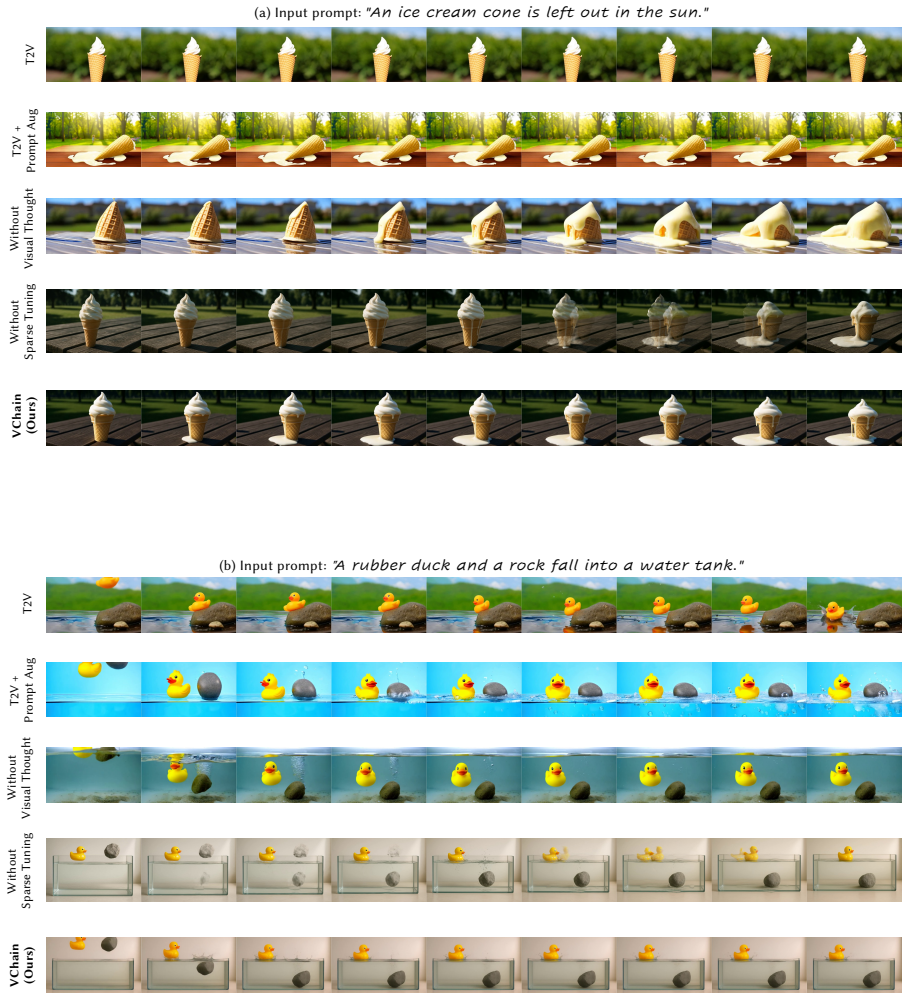
VChain uses sparse keyframes from multimodal models to guide pre-trained video generators toward coherent multi-step dynamics.
A machine-rendered reading of the paper's core claim, the machinery that carries it, and where it could break.
Core claim
VChain is an inference-time chain-of-visual-thought framework that directs large multimodal models to produce a sparse set of critical keyframes as visual-state snapshots; these snapshots then steer the sparse visual-state adaptation of a pre-trained video generator exclusively at the identified key moments, yielding more coherent modeling of state transitions and consequences.
What carries the argument
The VChain pipeline that extracts sparse critical keyframes via multimodal reasoning and applies them for targeted inference-time visual-state adaptation.
If this is right
- Video quality improves on complex multi-step scenarios without retraining the base generator.
- The approach remains tuning-efficient and adds only minimal inference overhead.
- Dense per-frame supervision is no longer required to enforce visual consistency.
- State transitions and future visual outcomes become more reliably modeled.
Where Pith is reading between the lines
- The same sparse-keyframe guidance pattern could be applied to other generative domains such as 3D animation or interactive simulation.
- Allowing users to edit or supply the keyframes themselves would add direct control over narrative outcomes.
- Adaptive selection of how many keyframes to request based on scene complexity could extend the method to longer clips.
Load-bearing premise
That the keyframes produced by multimodal models will accurately identify and represent the critical visual states and transitions required for coherent long-term video sequences.
What would settle it
A controlled test set of multi-step action videos where the generated output using VChain still shows incoherent state changes at moments between or beyond the supplied keyframes.
Figures




read the original abstract
Recent video generation models can produce smooth and visually appealing clips, but they often struggle to synthesize complex dynamics with a coherent chain of consequences. Accurately modeling visual outcomes and state transitions over time remains a core challenge. In contrast, large language and multimodal models (e.g., GPT-4o) exhibit strong visual state reasoning and future prediction capabilities. To bridge these strengths, we introduce VChain, a novel inference-time chain-of-visual-thought framework that injects visual reasoning signals from multimodal models into video generation. Specifically, VChain contains a dedicated pipeline that leverages large multimodal models to generate a sparse set of critical keyframes as snapshots, which are then used to guide the sparse inference-time visual-state adaptation of a pre-trained video generator only at these key moments. Our approach is tuning-efficient, introduces minimal overhead and avoids dense supervision. Extensive experiments on complex, multi-step scenarios show that VChain significantly enhances the quality of generated videos.
Editorial analysis
A structured set of objections, weighed in public.
Referee Report
Summary. The paper introduces VChain, an inference-time chain-of-visual-thought framework that leverages large multimodal models to generate a sparse set of critical keyframes. These keyframes guide sparse visual-state adaptation in a pre-trained video generator only at key moments, with the goal of improving coherence and consequence chains in complex multi-step video generation scenarios. The method is presented as tuning-efficient with minimal overhead, and the abstract claims that extensive experiments demonstrate significant quality enhancements.
Significance. If the empirical claims hold, the approach offers a practical way to inject reasoning signals from MLLMs into frozen video generators without retraining or dense supervision, which could help address drift in long-horizon dynamics. The emphasis on sparse guidance and efficiency is a potential strength for scalable applications in controllable video synthesis.
major comments (2)
- [Abstract] Abstract: the claim that 'extensive experiments on complex, multi-step scenarios show that VChain significantly enhances the quality of generated videos' is unsupported by any reported metrics, baselines, implementation details, or error analysis, leaving the central empirical claim unverifiable from the provided text.
- [Method] Method pipeline: the description of 'sparse inference-time visual-state adaptation' provides no concrete mechanism (e.g., latent injection, cross-attention at specific denoising steps, or state resetting), which is load-bearing for the claim that sparse keyframe guidance alone can produce coherent long-term state transitions without dense signals or retraining.
minor comments (1)
- [Abstract] Abstract: the relation between 'chain-of-visual-thought' and prior chain-of-thought or visual reasoning literature could be briefly contextualized to clarify novelty.
Simulated Author's Rebuttal
We thank the referee for the constructive feedback on our work. We address each major comment point by point below, clarifying aspects of the manuscript and outlining revisions to enhance verifiability and detail.
read point-by-point responses
-
Referee: [Abstract] Abstract: the claim that 'extensive experiments on complex, multi-step scenarios show that VChain significantly enhances the quality of generated videos' is unsupported by any reported metrics, baselines, implementation details, or error analysis, leaving the central empirical claim unverifiable from the provided text.
Authors: We agree that the abstract, as a concise summary, does not embed specific quantitative metrics or implementation details. The full manuscript reports these in the Experiments section, including coherence metrics, baseline comparisons, and error analysis on multi-step scenarios. To directly address verifiability from the abstract, we will revise it to include a brief statement of key results (e.g., relative improvements in coherence and consequence consistency). revision: yes
-
Referee: [Method] Method pipeline: the description of 'sparse inference-time visual-state adaptation' provides no concrete mechanism (e.g., latent injection, cross-attention at specific denoising steps, or state resetting), which is load-bearing for the claim that sparse keyframe guidance alone can produce coherent long-term state transitions without dense signals or retraining.
Authors: We appreciate this observation on the need for explicit mechanism details. The current method section describes the overall pipeline and sparse guidance principle but does not fully specify the adaptation implementation. We will revise the manuscript by adding a dedicated subsection detailing the concrete mechanism, including latent-space injection of keyframe features at targeted denoising timesteps and state management to maintain transitions without retraining or dense signals. revision: yes
Circularity Check
No circularity: VChain proposes external-model-guided sparse adaptation without self-referential reduction
full rationale
The paper presents VChain as a new inference-time pipeline that calls pre-trained multimodal models to produce sparse keyframes and then applies those keyframes for sparse visual-state adaptation inside a frozen video generator. No equations, parameter-fitting steps, or self-citations are shown that would make the claimed quality gains equivalent to the method's own inputs by construction. The central contribution is an empirical technique that depends on independent external models and a novel guidance schedule; the derivation chain therefore remains self-contained and does not collapse into tautology.
Axiom & Free-Parameter Ledger
axioms (1)
- domain assumption Large multimodal models exhibit strong visual state reasoning and future prediction capabilities suitable for generating critical keyframes.
Lean theorems connected to this paper
-
IndisputableMonolith/Foundation/RealityFromDistinction.leanreality_from_one_distinction unclear?
unclearRelation between the paper passage and the cited Recognition theorem.
VChain contains a dedicated pipeline that leverages large multimodal models to generate a sparse set of critical keyframes as snapshots, which are then used to guide the sparse inference-time visual-state adaptation of a pre-trained video generator only at these key moments.
-
IndisputableMonolith/Cost/FunctionalEquation.leanwashburn_uniqueness_aczel unclear?
unclearRelation between the paper passage and the cited Recognition theorem.
We only use these keyframes as supervision, treating them as anchor points that encode important state changes... Lvchain(θ) = E ... ∥uθ(xt, t,c)−vt∥2
What do these tags mean?
- matches
- The paper's claim is directly supported by a theorem in the formal canon.
- supports
- The theorem supports part of the paper's argument, but the paper may add assumptions or extra steps.
- extends
- The paper goes beyond the formal theorem; the theorem is a base layer rather than the whole result.
- uses
- The paper appears to rely on the theorem as machinery.
- contradicts
- The paper's claim conflicts with a theorem or certificate in the canon.
- unclear
- Pith found a possible connection, but the passage is too broad, indirect, or ambiguous to say the theorem truly supports the claim.
Forward citations
Cited by 6 Pith papers
-
CollabVR: Collaborative Video Reasoning with Vision-Language and Video Generation Models
CollabVR improves video reasoning performance by coupling vision-language models and video generation models in a closed-loop step-level collaboration that detects and repairs generation failures.
-
Agentic World Modeling: Foundations, Capabilities, Laws, and Beyond
Proposes a levels x laws taxonomy for world models in AI agents, defining L1-L3 capabilities across physical, digital, social, and scientific regimes while reviewing over 400 works to outline a roadmap for advanced ag...
-
Video Models Can Reason with Verifiable Rewards
VideoRLVR uses SDE-GRPO optimization, dense decomposed rewards, and Early-Step Focus to train video diffusion models on verifiable reasoning tasks, outperforming supervised fine-tuning and other video generators on Ma...
-
DiffHDR: Re-Exposing LDR Videos with Video Diffusion Models
DiffHDR converts LDR videos to HDR by formulating the task as generative radiance inpainting in a video diffusion model's latent space, using Log-Gamma encoding and synthesized training data to achieve better fidelity...
-
Phantom: Physics-Infused Video Generation via Joint Modeling of Visual and Latent Physical Dynamics
Phantom generates visually realistic and physically consistent videos by jointly modeling visual content and latent physical dynamics via an abstract physics-aware representation.
-
Phantom: Physics-Infused Video Generation via Joint Modeling of Visual and Latent Physical Dynamics
Phantom jointly models visual content and latent physical dynamics via a physics-aware video representation to generate physically consistent videos.
Reference graph
Works this paper leans on
-
[1]
Accessed March 31, 2025 [Online] https://www.langchain.com
Langchain. Accessed March 31, 2025 [Online] https://www.langchain.com
work page 2025
-
[2]
Accessed August 31, 2024 [On- line]https://hailuoai.com/
Minmax team. Accessed August 31, 2024 [On- line]https://hailuoai.com/
work page 2024
-
[3]
Accessed June 17, 2024 [On- line] https://runwayml.com/research/ introducing-gen-3-alpha
Gen-3. Accessed June 17, 2024 [On- line] https://runwayml.com/research/ introducing-gen-3-alpha
work page 2024
-
[4]
Accessed December 9, 2024 [Online] https://klingai.kuaishou.com/
Kling. Accessed December 9, 2024 [Online] https://klingai.kuaishou.com/. Niket Agarwal, Arslan Ali, Maciej Bala, Yogesh Balaji, Erik Barker, Tiffany Cai, Prithvijit Chattopadhyay, Yongxin Chen, Yin Cui, Yifan Ding, and 1 others
work page 2024
-
[5]
Cosmos World Foundation Model Platform for Physical AI
Cosmos world foundation model platform for physical ai.arXiv preprint arXiv:2501.03575. Andreas Blattmann, Tim Dockhorn, Sumith Ku- lal, Daniel Mendelevitch, Maciej Kilian, Dominik Lorenz, Yam Levi, Zion English, Vikram V oleti, Adam Letts, and 1 others. 2023. Stable video dif- fusion: Scaling latent video diffusion models to large datasets.arXiv preprint...
work page internal anchor Pith review Pith/arXiv arXiv 2023
-
[6]
An Image is Worth 16x16 Words: Transformers for Image Recognition at Scale
Cogview2: Faster and better text-to-image generation via hierarchical transformers. InNeurIPS. Alexey Dosovitskiy, Lucas Beyer, Alexander Kolesnikov, Dirk Weissenborn, Xiaohua Zhai, Thomas Unterthiner, Mostafa Dehghani, Matthias Minderer, Georg Heigold, Sylvain Gelly, and 1 others. 2020. An image is worth 16x16 words: Transformers for image recognition at...
work page internal anchor Pith review Pith/arXiv arXiv 2020
-
[7]
Gemini: A Family of Highly Capable Multimodal Models
U-net: Convolutional networks for biomedical image segmentation. InInternational Conference on Medical image computing and computer-assisted intervention. Jascha Sohl-Dickstein, Eric Weiss, Niru Mah- eswaranathan, and Surya Ganguli. 2015. Deep un- supervised learning using nonequilibrium thermody- namics. InICML. Jiaming Song, Chenlin Meng, and Stefano Er...
work page internal anchor Pith review Pith/arXiv arXiv 2015
-
[8]
Context Frame:A richly detailed prompt used to generate the first frame in theChain of Vi- sual Thoughts
-
[9]
Concise Prompt:A concise version of the Context Frame prompt (the full version is too long, so the first image is paired with this concise prompt during sparse inference-time tuning)
-
[10]
The Context Frame is passed to GPT’s gpt-image-1 API to produce the corresponding image
Consequences:A sequence of inferred physi- cal outcomes that define the expected trajec- tory of the generated video. The Context Frame is passed to GPT’s gpt-image-1 API to produce the corresponding image. To generate subsequent keyframes in theChain of Visual Thoughts, we concatenate all previously generated images in our chain into a single compos- ite...
-
[11]
Concentrated sulfuric acid is poured onto a wooden table
an image-editing instruction and 2) a boolean flag indicating whether a terminal state has been reached. We pass the same inputs as before along with the editing instruction to the gpt-image-1 API to generate the next keyframe. We repeat this process iteratively, where we predict the next key moment and generate the corresponding image, un- til the boolea...
work page 2025
-
[12]
Infer the objects/people/elements present in the scene, the perspective of the camera, the spatial relationship between the objects in the scene as well as details not explicitly mentioned in the text prompt
-
[13]
Create a detailed, movie-like description of the scene that evokes visuals with strong detail and composition cues. This is the Context Frame. It should clearly describe the objects/people/elements present in the scene, the perspective of the camera, and the spatial relationships between the objects in it as well as the details not explicitly mentioned in...
-
[14]
This should be a short, one-sentence description of the context frame
Create a concise version of the context frame. This should be a short, one-sentence description of the context frame
-
[15]
A cat pushes a glass of water off a table
Infer a sequence of consequences/changes from the text prompt, even if it is not explicitly mentioned. Use assertive languange to clearly describe the changes in appearance, shape, color, size, and position that may occur as a result. Example: ————– Input Prompt: "A cat pushes a glass of water off a table." Thoughts: In order for the cat to tip the glass ...
discussion (0)
Sign in with ORCID, Apple, or X to comment. Anyone can read and Pith papers without signing in.