REVIEW 2 major objections 42 references
Retrieving and Refining Winning Noise Tickets for Diffusion-Based Motion Generation
T0 review · 2 major / 0 minor · reviewed 2026-07-10 · grok-4.5
Pith's one-line read Certain initial noises already encode motion meaning; retrieving and refining them improves text-to-motion alignment without retraining the diffusion model.
desk verdict Solid, training-free lever for text–motion alignment: null-prompt noise tickets work in practice; novelty is incremental, empirics are the real strength. read the letter →
The pith
A machine-rendered reading of the paper's core claim, the machinery that carries it, and where it could break.
The reading
What carries the argument
Winning Noise Retrieval and Optimization (WINRO): a null-prompt noise dictionary mapped into a text–motion embedding space, followed by frame-adjusted retrieval and KL-regularized seed refinement (optionally amortized by a LoRA residual predictor).
What would settle it
Build the same null-prompt dictionary, then measure how often the top-retrieved seed fails to rank highly under the true text-conditioned similarity score across a held-out prompt set; if that transfer rate is near chance, the retrieval stage collapses.
Extended reading notes
Core claim
Within the Gaussian noise space of a frozen diffusion motion generator there exist winning noise tickets: seeds that carry latent structure biasing the entire denoising trajectory toward coherent motion semantics even under a null prompt. Selecting the ticket best aligned with a text query and refining it under a KL-regularized text–motion similarity objective measurably improves alignment and long-horizon consistency without retraining the base model.
Load-bearing premise
A seed that looks good under a blank prompt will still look good once text is turned on, because the text only nudges the motion features a little in embedding space.
Editorial extensions
If this is right
- Text–motion fidelity on existing diffusion backbones can be raised at inference time by seed selection alone, with no weight updates.
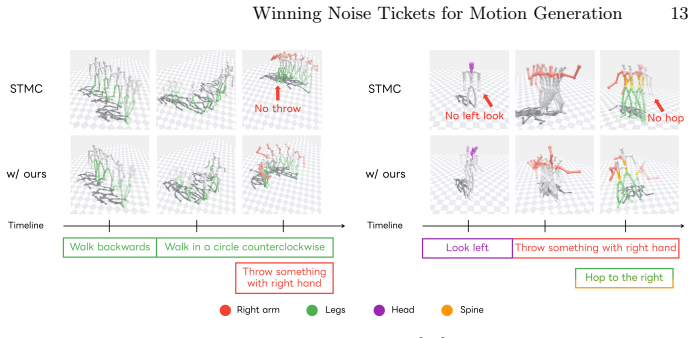
- Long multi-action timelines become more segment-faithful when the same seed is refined against interval-level text constraints.
- Style-specific or constraint-aware dictionaries can be swapped in without redesigning the generator.
- A trained LoRA noise refiner can keep most of the gain while cutting per-query cost to roughly one generation pass.
Reading between the lines
- If noise tickets truly form smooth semantic regions, denser dictionaries or learned density models over noise could replace best-of-N retrieval for rare prompts.
- The same null-prompt dictionary idea may transfer to other scarce-data diffusion domains (e.g., gesture, facial motion) where models are equally seed-sensitive.
- Temporal localization in the retrieval encoder could let tickets encode segment-level rather than whole-sequence semantics, tightening multi-track control.
Editorial analysis
A structured set of objections, weighed in public.
Referee Report
Summary. The paper argues that in diffusion-based text-to-motion models, certain initial Gaussian noises ("winning noise tickets") already bias the denoising trajectory toward particular motion semantics, even under null prompts. It introduces WINRO: a training-free, model-agnostic pipeline that (i) builds a null-prompt noise dictionary whose entries are motion features from a frozen retrieval model, (ii) retrieves the best-aligned seed for a query text (with frame-adjusted retrieval for variable length), and (iii) optionally refines that seed by maximizing text–motion cosine similarity under a KL regularizer that keeps the noise near N(0,I). An optional LoRA adapter amortizes the iterative refinement. Empirically, WINRO improves R-Precision, MMDist, and FID on HumanML3D for MDM-50step and MotionLCM, helps long-horizon multi-track generation on MTT, and transfers to stylization and spatial control without retraining the base generator.
Significance. If the result holds, it reframes initial noise in motion diffusion as a controllable semantic prior rather than unstructured randomness, and supplies a practical, training-free lever that improves alignment on scarce motion data without touching base weights. Strengths include multi-backbone and multi-task evidence (MDM, MotionLCM; HumanML3D, KIT-ML, MTT, stylization, spatial constraints), 95% CIs over 20 runs, null-prompt isolation of the ticket effect (Table 1), ablations on dictionary size, λ, retrieval backbone, and LoRA rank, plus a clear modular design (retrieval vs. optimization vs. amortized LoRA). The formal smoothness and transfer propositions (Sec. 3.2, Props. 1–3) give a coherent justification for why dictionary search and local KL-refined steps are well-posed.
major comments (2)
- The load-bearing transfer claim (Prop. 3 / Sec. 3.2 and 4.1) asserts that conditioning induces only a bounded feature shift ||Φ_c(x_T)−Φ_∅(x_T)||≤δ(c), so high null alignment implies high conditional alignment. Table 1 strongly supports intrinsic semantics under pure null generation, and Table 2 shows the same seeds help under text conditioning, but the manuscript never measures or bounds δ(c) (e.g., mean/quantile of ||Φ_c−Φ_∅|| over the dictionary, or correlation of null vs. conditional scores). Without that diagnostic, it remains unclear when retrieval can select the wrong seed for hard or compositional prompts. A short measurement or failure-case analysis would make the hinge assumption falsifiable rather than only empirically plausible.
- Both dictionary construction and the refinement loss L_sim (Eqs. 9–11) optimize cosine similarity in the same TMR embedding used for retrieval. HumanML3D R-Precision/FID/MMDist use a separate evaluation protocol, and the PartTMR ablation (Table 9) plus rare-prompt split (Table 12) partially address metric-chasing, but the paper does not report cross-metric correlation (TMR vs. evaluation encoder) or any independent human preference study. For claims of “semantic fidelity” beyond chasing one retrieval space—especially on rare or multi-track prompts—this is a residual load-bearing gap that should be closed or more carefully scoped.
Circularity Check
No significant circularity: winning-ticket claims are empirically isolated (null-prompt Table 1) and evaluated with encoders independent of the TMR objective used for retrieval/refinement.
full rationale
WINRO is a method paper, not a first-principles derivation that claims to predict a quantity from fitted inputs. The definition of a winning noise ticket (˜S_c(x_T) ≥ γ under null conditioning) is operational, not a self-definitional loop that forces the reported HumanML3D/MTT gains. Retrieval builds a dictionary from null-prompt motions; refinement maximizes TMR cosine similarity plus a KL prior term; evaluation R-Precision/FID/MMDist use a separate evaluation protocol that the paper states is independent of TMR, and an alternate retrieval backbone (PartTMR) still helps. Table 1 further isolates intrinsic noise semantics by generating under null prompts after text-based retrieval, so alignment cannot be an artifact of text-conditioned optimization. Propositions 1–5 are standard Lipschitz/Grönwall, sampling-probability, bounded-shift, and Lagrangian arguments under stated assumptions (especially Prop. 3’s δ(c) bound); none reduce a claimed prediction to a fitted parameter or to a load-bearing self-citation uniqueness theorem. Related self-citations (e.g., PINO) appear only as prior noise-optimization context, not as the hinge that forces the central claim. Residual metric-chasing risk (optimizing a retrieval similarity related in spirit to R-Precision) is a correctness/evaluation concern, not circularity by construction under the required reduction test.
Assumptions & free parameters
free parameters (4)
- KL weight λ =
5000 / 250 / 50000
- Noise dictionary size N =
10000
- Perturbation σ and top-k =
σ=0.5, k=1 or 150
- LoRA rank / α / residual λ =
r=64, α=64, λ=0.5
assumptions (4)
- domain assumption Deterministic DDIM/ODE sampling yields a continuous, locally Lipschitz map from initial noise to motion, so high-alignment seeds form regions rather than isolated points.
- ad hoc to paper Conditioning induces only a bounded shift in the retrieval feature space, so null-prompt alignment transfers to text-conditioned alignment.
- domain assumption A pretrained contrastive text-motion encoder (TMR or PartTMR) provides a reliable shared embedding for both retrieval and the refinement objective.
- ad hoc to paper Empirical mean/variance KL to N(0,1) is a sufficient trust-region regularizer to keep optimized noise inside the diffusion prior.
invented entities (2)
-
Winning noise ticket (motion)
independent evidence
-
Null-prompt noise dictionary with frame-adjusted retrieval (FAR)
independent evidence
Cite this review
Pith. "Pith review of Retrieving and Refining Winning Noise Tickets for Diffusion-Based Motion Generation." pith.science (2026). https://pith.science/paper/22RWFDEG
@misc{pith2026260706843,
  author       = {Pith},
  title        = {Pith review of: Retrieving and Refining Winning Noise Tickets for Diffusion-Based Motion Generation},
  year         = {2026},
  howpublished = {\url{https://pith.science/paper/22RWFDEG}},
  note         = {Machine review of arXiv:2607.06843}
}
read the original abstract
Diffusion-based text-to-motion models synthesize realistic human motions but often exhibit semantic drift from the input text. Motion is inherently temporal, especially in compositional and long-duration sequences that require semantic consistency across multiple action segments and smooth kinematic transitions throughout the trajectory. We posit that the initial noise is central to this consistency: within the Gaussian noise space, certain instances, i.e. winning noise tickets, carry latent structure that biases denoising toward particular motion semantics, even under null prompts. We propose WInning Noise Retrieval and Optimization (WINRO), a training-free, model-agnostic framework that improves text-motion alignment by selecting and refining such tickets before diffusion sampling. WINRO maps random noises to motion features generated under null prompts, retrieves the best-aligned noise for a given text, and refines it via a KL-regularized objective that reduces the residual semantic gap while preserving the Gaussian prior. An optional LoRA-based adapter amortizes this refinement into a single forward pass. WINRO consistently improves text-motion fidelity across different base models, MDM and MotionLCM, on HumanML3D without retraining, improves temporal robustness on the MTT benchmark, and generalizes to applications such as motion stylization and spatial constraint satisfaction.
Figures


Figures from the paper (10 more)




Reference graph
Works this paper leans on
-
[1]
Athanasiou, N., Petrovich, M., Black, M.J., Varol, G.: Teach: Temporal action composition for 3d humans. In: 3DV (2022)
work page 2022
-
[2]
Chen, C., Yang, L., Yang, X., Chen, L., He, G., Wang, C., Li, Y.: Find: Fine- tuning initial noise distribution with policy optimization for diffusion models. In: ACMMM (2024)
work page 2024
-
[3]
Chen, X., Jiang, B., Liu, W., Huang, Z., Fu, B., Chen, T., Yu, G.: Executing your commands via motion diffusion in latent space. In: CVPR (2023)
work page 2023
-
[4]
Dai, W., Chen, L.H., Wang, J., Liu, J., Dai, B., Tang, Y.: Motionlcm: Real-time controllable motion generation via latent consistency model. In: ECCV (2024)
work page 2024
-
[5]
Eyring, L., Karthik, S., Dosovitskiy, A., Ruiz, N., Akata, Z.: Noise hypernetworks: Amortizing test-time compute in diffusion models. In: NeurIPS (2025)
work page 2025
-
[6]
Eyring, L., Karthik, S., Roth, K., Dosovitskiy, A., Akata, Z.: Reno: Enhancing one- step text-to-image models through reward-based noise optimization. In: NeurIPS (2024)
work page 2024
-
[7]
Frankle, J., Carbin, M.: The lottery ticket hypothesis: Finding sparse, trainable neural networks. In: ICLR (2019)
work page 2019
-
[8]
Fujiwara, K., Tanaka, M., Yu, Q.: Chronologically accurate retrieval for temporal grounding of motion-language models. In: ECCV (2024)
work page 2024
Show all 42 references
-
[9]
In: ICCV (2021)
Ghosh, A., Cheema, N., Oguz, C., Theobalt, C., Slusallek, P.: Synthesis of compo- sitional animations from textual descriptions. In: ICCV (2021)
2021
-
[10]
In: CVPR (2022)
Guo, C., Zou, S., Zuo, X., Wang, S., Ji, W., Li, X., Cheng, L.: Generating diverse and natural 3d human motions from text. In: CVPR (2022)
2022
-
[11]
In: CVPR (2024)
Guo, X., Liu, J., Cui, M., Li, J., Yang, H., Huang, D.: Initno: Boosting text-to- image diffusion models via initial noise optimization. In: CVPR (2024)
2024
-
[12]
Holden,D.,Kanoun,O.,Perepichka,M.,Popa,T.:Learnedmotionmatching.TOG 39(4), 53–1 (2020)
2020
-
[13]
In: CVPR (2025)
Hong, S., Kim, C., Yoon, S., Nam, J., Cha, S., Noh, J.y.: Salad: Skeleton-aware latent diffusion for text-driven motion generation and editing. In: CVPR (2025)
2025
-
[14]
In: ICLR (2022)
Hu, E.J., Shen, Y., Wallis, P., Allen-Zhu, Z., Li, Y., Wang, S., Wang, L., Chen, W., et al.: Lora: Low-rank adaptation of large language models. In: ICLR (2022)
2022
-
[15]
In: NeurIPS (2023)
Jiang, B., Chen, X., Liu, W., Yu, J., Yu, G., Chen, T.: Motiongpt: Human motion as a foreign language. In: NeurIPS (2023)
2023
-
[16]
arXiv preprint arXiv:2211.15603 (2022)
Kalakonda, S.S., Maheshwari, S., Sarvadevabhatla, R.K.: Action-gpt: Leveraging large-scale language models for improved and generalized zero shot action genera- tion. arXiv preprint arXiv:2211.15603 (2022)
2022 arXiv
-
[17]
In: CVPR (2024)
Karunratanakul, K., Preechakul, K., Aksan, E., Beeler, T., Suwajanakorn, S., Tang, S.: Optimizing diffusion noise can serve as universal motion priors. In: CVPR (2024)
2024
-
[18]
In: CVPR (2020)
Kocabas, M., Athanasiou, N., Black, M.J.: Vibe: Video inference for human body pose and shape estimation. In: CVPR (2020)
2020
-
[19]
arXiv preprint arXiv:2508.02605 (2025)
Li, Z., Wang, S., Zhang, Z., Tang, H.: Remomask: Retrieval-augmented masked motion generation. arXiv preprint arXiv:2508.02605 (2025)
2025
-
[20]
In: CVPR (2024)
Liu, H., Zhan, X., Huang, S., Mu, T.J., Shan, Y.: Programmable motion generation for open-set motion control tasks. In: CVPR (2024)
2024
-
[21]
In: ACMMM (2023)
Mao, J., Wang, X., Aizawa, K.: Guided image synthesis via initial image editing in diffusion model. In: ACMMM (2023)
2023
-
[22]
In: ECCV (2024) Winning Noise Tickets for Motion Generation 17
Mao, J., Wang, X., Aizawa, K.: The lottery ticket hypothesis in denoising: Towards semantic-driven initialization. In: ECCV (2024) Winning Noise Tickets for Motion Generation 17
2024
-
[23]
Proceedings of the ACM on Computer Graphics and Interactive Techniques (2022)
Mason, I., Starke, S., Komura, T.: Real-time style modelling of human locomotion via feature-wise transformations and local motion phases. Proceedings of the ACM on Computer Graphics and Interactive Techniques (2022)
2022
-
[24]
In: ICCV (2025)
Ota, S., Yu, Q., Fujiwara, K., Ikehata, S., Sato, I.: Pino: Person-interaction noise optimization for long-duration and customizable motion generation of arbitrary- sized groups. In: ICCV (2025)
2025
-
[25]
In: ICCV (2021)
Petrovich, M., Black, M.J., Varol, G.: Action-conditioned 3d human motion syn- thesis with transformer vae. In: ICCV (2021)
2021
-
[26]
In: ICCV (2023)
Petrovich, M., Black, M.J., Varol, G.: Tmr: Text-to-motion retrieval using con- trastive 3d human motion synthesis. In: ICCV (2023)
2023
-
[27]
In: CVPRW (2024)
Petrovich, M., Litany, O., Iqbal, U., Black, M.J., Varol, G., Peng, X.B., Rempe, D.: Multi-track timeline control for text-driven 3d human motion generation. In: CVPRW (2024)
2024
-
[28]
Big Data 4(4), 236–252 (2016)
Plappert, M., Mandery, C., Asfour, T.: The kit motion-language dataset. Big Data 4(4), 236–252 (2016)
2016
-
[29]
In: CVPR (2024)
Shin, S., Kim, J., Halilaj, E., Black, M.J.: WHAM: Reconstructing world-grounded humans with accurate 3D motion. In: CVPR (2024)
2024
-
[30]
In: ICLR (2021)
Song, J., Meng, C., Ermon, S.: Denoising diffusion implicit models. In: ICLR (2021)
2021
-
[31]
In: ICLR (2023)
Tevet, G., Raab, S., Gordon, B., Shafir, Y., Cohen-Or, D., Bermano, A.H.: Human motion diffusion model. In: ICLR (2023)
2023
-
[32]
arXiv preprint arXiv:2412.05101 (2024)
Wang, R., Huang, H., Zhu, Y., Russakovsky, O., Wu, Y.: The silent prompt: Ini- tial noise as implicit guidance for goal-driven image generation. arXiv preprint arXiv:2412.05101 (2024)
2024 arXiv
-
[33]
arXiv preprint arXiv:2405.14828 (2024)
Xu, K., Zhang, L., Shi, J.: Good seed makes a good crop: Discovering secret seeds in text-to-image diffusion models. arXiv preprint arXiv:2405.14828 (2024)
2024 arXiv
-
[34]
In: ICCV (2023)
Xu, L., Song, Z., Wang, D., Su, J., Fang, Z., Ding, C., Gan, W., Yan, Y., Jin, X., Yang, X., Zeng, W., Wu, W.: Actformer: A gan-based transformer towards general action-conditioned 3d human motion generation. In: ICCV (2023)
2023
-
[35]
In: CVPR (2023)
Ye, V., Pavlakos, G., Malik, J., Kanazawa, A.: Decoupling human and camera motion from videos in the wild. In: CVPR (2023)
2023
-
[36]
In: CVPR (2024)
Yu, Q., Tanaka, M., Fujiwara, K.: Exploring vision transformers for 3d human motion-language models with motion patches. In: CVPR (2024)
2024
-
[37]
In: AAAI (2025)
Yu,Q.,Tanaka,M.,Fujiwara,K.:Remogpt:Part-levelretrieval-augmentedmotion- language models. In: AAAI (2025)
2025
-
[38]
In: ECCV (2020)
Yuan, Y., Kitani, K.: Dlow: Diversifying latent flows for diverse human motion prediction. In: ECCV (2020)
2020
-
[39]
In: CVPR (2023)
Zhang, J., Zhang, Y., Cun, X., Huang, S., Zhang, Y., Zhao, H., Lu, H., Shen, X.: T2m-gpt: Generating human motion from textual descriptions with discrete representations. In: CVPR (2023)
2023
-
[40]
IEEE TPAMI (2024)
Zhang, M., Cai, Z., Pan, L., Hong, F., Guo, X., Yang, L., Liu, Z.: Motiondiffuse: Text-driven human motion generation with diffusion model. IEEE TPAMI (2024)
2024
-
[41]
In: ICCV (2023)
Zhang, M., Guo, X., Pan, L., Cai, Z., Hong, F., Li, H., Yang, L., Liu, Z.: Remod- iffuse: Retrieval-augmented motion diffusion model. In: ICCV (2023)
2023
-
[42]
In: ECCV (2024) 18 S
Zhong, L., Xie, Y., Jampani, V., Sun, D., Jiang, H.: Smoodi: Stylized motion diffusion model. In: ECCV (2024) 18 S. Ota et al. Supplementary Material Retrieving and Refining Winning Noise Tickets for Diffusion-Based Motion Generation A Theoretical Perspective on Winning Noise ...
2024
Reviewed July 10, 2026 · model on record in the stance chip above.
Discussion (0). Sign in to comment.