Note on the evaluation of one type scalar three-point integral extracted from the Higgs boson decay
Pith reviewed 2026-05-24 10:33 UTC · model grok-4.3
The pith
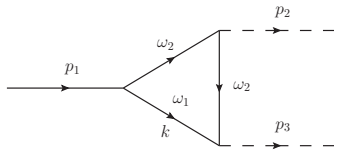
Complete analytic expressions are given for the 1/x log(quadratic) integral from the one-loop Higgs to gg amplitude with two internal masses.
A machine-rendered reading of the paper's core claim, the machinery that carries it, and where it could break.
Core claim
The integral of the form (1/x) log(quadratic) admits complete analytic results when the quadratic has either no real roots or exactly two different real roots, obtained directly from the one-loop three-point diagram with unequal masses.
What carries the argument
The integral whose integrand is the reciprocal of the integration variable times the logarithm of a quadratic function of that variable, evaluated by cases on the roots of the quadratic.
If this is right
- The one-loop amplitude for Higgs decay to two gluons becomes fully analytic when the two internal masses differ.
- The same closed forms apply without modification to the radiative decays of heavy quarks in the Standard Model.
- The expressions can be inserted into calculations of the corresponding processes in a singlet vector-like model.
Where Pith is reading between the lines
- The case distinction on real roots may simplify numerical checks of related loop integrals that contain similar logarithms.
- If the method extends beyond this specific diagram, it could reduce the need for numerical libraries in other Higgs and quark decay channels.
- The two-root case may connect to known dilogarithm reductions that appear in other one-loop calculations.
Load-bearing premise
The integrand must take exactly the form of the reciprocal of the integration variable multiplied by the logarithm of a quadratic function, as it arises in this specific scalar one-loop diagram.
What would settle it
Perform a direct numerical quadrature of the integral for concrete parameter choices in each root case and compare the result to the claimed closed-form expression.
Figures
read the original abstract
Motivated by the Higgs boson decaying to $gg$ at leading order approximation, the amplitude of scalar one loop three-point diagram with two different internal masses are evaluated and fully analytic results are obtained. The main ingredient of the evaluation is a integral in which the integrand is product of the reciprocal of the integral variable and a logarithm whose argument is a quadratic function of the general form. Complete analytic results for the two cases that there is no real root and there are two different real roots for the logarithm are presented. Applications of the results in this paper to radiative decays of the heavy quarks in the Standard Model and in the singlet vector-like model are discussed.
Editorial analysis
A structured set of objections, weighed in public.
Referee Report
Summary. The manuscript evaluates a scalar one-loop three-point integral with two different internal masses arising in the leading-order Higgs boson decay to gluons. The central object is the integral whose integrand is (1/x) times the logarithm of a quadratic polynomial in the integration variable; fully analytic closed-form results are presented for the two cases in which this quadratic has no real roots or two distinct real roots.
Significance. If the derivations are correct, the results supply exact analytic expressions for a class of integrals that appear in Higgs phenomenology and in radiative decays of heavy quarks, both in the Standard Model and in singlet vector-like extensions. Such closed forms can reduce reliance on numerical integration in precision calculations.
major comments (1)
- [Abstract] Abstract: the paper explicitly limits its 'complete analytic results' to the no-real-root and two-distinct-real-roots cases, yet omits the repeated-root case (discriminant D=0). Because the applications to Higgs and heavy-quark decays can reach kinematic points where D=0, the omission leaves the utility of the results for the stated applications incomplete.
Simulated Author's Rebuttal
We thank the referee for the careful reading of our manuscript and for the constructive comment regarding the scope of the analytic results. We address the point raised below.
read point-by-point responses
-
Referee: [Abstract] Abstract: the paper explicitly limits its 'complete analytic results' to the no-real-root and two-distinct-real-roots cases, yet omits the repeated-root case (discriminant D=0). Because the applications to Higgs and heavy-quark decays can reach kinematic points where D=0, the omission leaves the utility of the results for the stated applications incomplete.
Authors: We agree that the repeated-root case (D=0) is relevant for a complete treatment, since certain kinematic points in the Higgs boson decay to gluons and in radiative heavy-quark decays can reach this boundary. In the revised manuscript we will add the corresponding closed-form expression, which follows either by taking the appropriate limit of the two-distinct-roots result or by direct integration when the quadratic polynomial possesses a double root. This addition will ensure the results cover all three possible configurations of the logarithm argument. revision: yes
Circularity Check
Direct analytic evaluation of defined integral; no circularity
full rationale
The paper derives closed-form expressions for a specific integral (reciprocal times log of quadratic) by case analysis on the discriminant of the quadratic argument. This is a standard, self-contained mathematical evaluation using elementary methods; no parameters are fitted to data and then relabeled as predictions, no self-definitional loops appear, and no load-bearing results are imported solely via self-citation. The two cases treated (no real roots, two distinct real roots) are explicitly delimited by the problem statement itself. The omitted D=0 case is a completeness gap but does not create circularity in the presented derivations.
Axiom & Free-Parameter Ledger
axioms (1)
- standard math Standard techniques exist for analytic evaluation of Feynman integrals of the form involving 1/x times log of quadratic
Reference graph
Works this paper leans on
-
[1]
(10) The remaining work is the evaluation of the last integral in Eq.(10)
+ ω2 2 − iε (9) The integral over y in Eq.(9) is trivial, combining with Eq.(A1), we arrive at the following intermediate result I = i 16π2m2 1 ∫ 1 0 dx 1 x [ ln ( m2 1 ω2 2 x2 − m2 1 − ω2 1 + ω2 2 ω2 2 x + 1 − iε ) − ln ( ω2 1 − ω2 2 ω2 2 x + 1 − iε )] = i 16π2m2 1 [ Li2 ( 1 − ω2 1 ω2 2 ) + ∫ 1 0 dx 1 x ln ( m2 1 ω2 2 x2 − m2 1 − ω2 1 + ω2 2 ω2 2 x + 1 −...
-
[2]
(38) In order to apply the result in Eq.(38) correctly, the following comme nts are necessary
< 0, where λ(x, y, z) is the well-known K¨allen function λ(x, y, z) = x2 + y2 + z2 − 2xy − 2xz − 2yz, (37) By employing Eq.(32), yields the following explicit result I = 1 m2 1 {1 2 Li2 ( 1 − ω2 1 ω2 2 ) − ( arcsin m2 1 − ω2 1 + ω2 2 2m1ω2 ) 2 − 2 arcsin m2 1 − ω2 1 + ω2 2 2m1ω2 arctan m2 1 + ω2 1 − ω2 2 √ λ(m2 1, ω2 1, ω2 2) + m4 1 − (ω2 1 − ω2 2)2 8m2 1...
-
[3]
< 0, the masses must obey m2 1 > ω 2 1 − ω2 2, (39) Second, since Eq.(38) is summed over hypergeometric functions, a crucial issue is that if the summation of the infinite series is convergent. Due to λ(m2 1, ω2 1, ω2
-
[4]
< 0, it is obvious that 0 < (m2 1 − ω2 1 + ω2 2)2 4m2 1ω2 1 < 1. (40) and the hypergeometric functions are always taking finite value, th us the summation is conver- gent. Finally, in considering the analytic property of the dilogarithm in Eq.(A2), a question is that if Eq.(38) can develop imaginary part. In other words, if the ar gument of the dilogarithm...
-
[5]
8 In the case b2 − 4a > 0, this implies that λ(m2 1, ω2 1, ω2
< 1 is always satisfied, therefore there is no imaginary part can be dev eloped. 8 In the case b2 − 4a > 0, this implies that λ(m2 1, ω2 1, ω2
-
[6]
> 0, exploiting Eq.(35) we get I = 1 m2 1 {1 2 Li2(1 − ω2 1 ω2 2 ) − Li2[ 1 x+ − iε sgn(x+)] − Li2[ 1 x− + iε sgn(x− )] } , (41) where x+ = (m2 1 − ω2 1 + ω2
-
[7]
+ λ1/2(m2 1, ω2 1, ω2 2) 2m2 1 , x− = (m2 1 − ω2 1 + ω2
-
[8]
− λ1/2(m2 1, ω2 1, ω2 2) 2m2 1 , (42) Since m2 1 > ω 2 1 − ω2 2 as presented in Eq.(39), both x+ and x− are positive definite, thus Eq.(41) simplified to I = 1 m2 1 [ 1 2 Li2(1 − ω2 1 ω2 2 ) − Li2( 1 x+ − iε) − Li2( 1 x− + iε) ] . (43) In order to explore phenomenological implications of the results pre sented in Eq.(38) and Eq.(43), it is instructive to co...
- [9]
-
[10]
W. Beenakker, H. Kuijf, W. L. van Neerven et al ., Phys. Rev. D 40, 54(1989)
work page 1989
- [11]
- [12]
-
[13]
J. F. Gunion, H. E. Haber, G. Kane, S. Dawson, The Higgs Hunter’s Guide (Perseus Publishing, Cambridge, Massachusetts, 1990)
work page 1990
-
[14]
B. A. Kniehl, Phys. Rept. 240, 211(1994)
work page 1994
- [15]
- [16]
-
[17]
M. Carena, C. Grojean, M. Kado et al , “Status of Higgs Boson Physics”, R. L. Workman et al.(Particle Data Group), Prog. Theor. Exp. Phys. 2022, 083C0 1(2022)
work page 2022
-
[18]
M. Roth, A. Denner, Nucl. Phys. B 479, 495(1996)
work page 1996
-
[19]
J. R. Ellis, M. K. Gaillard and D. V. Nanopoulos, Nucl. Ph ys. B 106, 292(1976)
work page 1976
-
[20]
T. G. Rizzo, Phys. Rev. D 22, 178(1980), Phys. Rev. D 22, 1824(1980)
work page 1980
-
[21]
A. I. Vainshtein, M. B. Voloshin, V. I. Zakharov et al , Sov. J. Nucl. Phys. 30, 711(1979)
work page 1979
-
[22]
L. B. Okun, Leptons and Quarks(North-Holland, Amsterd am, 1982)
work page 1982
-
[23]
J. F. Gunion and H. E. Haber, Nucl. Phys. B 278, 449(1986), Erratum: Nucl. Phys. B 402, 569(1993)
work page 1986
-
[24]
R. K. Ellis, I. Hinchliffe, M. Soldate et al , Nucl. Phys. B 297, 221(1988)
work page 1988
- [25]
-
[26]
M. Shifman, A. Vainshtein, M. B. Voloshin, V. Zakharov, Phys. Rev. D 85, 013015(2012)
work page 2012
-
[27]
W. J. Marciano, C. Zhang and S. Willenbrock, Phys. Rev. D 85, 013002(2012)
work page 2012
-
[28]
H. E. Haber and D. Wyler, Nucl. Phys. B 323, 257(1989)
work page 1989
-
[29]
H. B. Dwight, Tables of Integrals and Other Mathematical Data (The Macmillan Company, New York, 1957), Third edition. 12
work page 1957
-
[30]
Lewin, Polylogarithms and Associated Functions (North Holland, New York, 1981), Second Edition
L. Lewin, Polylogarithms and Associated Functions (North Holland, New York, 1981), Second Edition
work page 1981
-
[31]
I. S. Gradshteyn I. M. Ryzhik, Table of Integrals, Series, and Products (Academic Press, London, 2014), Eighth Edition
work page 2014
-
[32]
M. Abramowitz and I. Stegun, Handbook of Mathematical Functions with formulas, Graphs a nd Mathematical Tables (Dover Publications, New York, 1972)
work page 1972
-
[33]
Erdelyi, Higher Transcendental Functions, Vol
A. Erdelyi, Higher Transcendental Functions, Vol. I (McGrill-Hall Book Company, New York, 1953)
work page 1953
-
[34]
Z. X. Wang, D. R. Guo, Special Functions(World Scientific, Singapore, 1989). 13
work page 1989
discussion (0)
Sign in with ORCID, Apple, or X to comment. Anyone can read and Pith papers without signing in.