LISA and γ-ray telescopes as multi-messenger probes of a first-order cosmological phase transition
Pith reviewed 2026-05-24 07:36 UTC · model grok-4.3
The pith
A first-order phase transition between 1 GeV and 10^6 GeV produces both LISA-detectable gravitational waves and MAGIC-compatible magnetic fields if sound waves convert to MHD turbulence.
A machine-rendered reading of the paper's core claim, the machinery that carries it, and where it could break.
Core claim
For turbulence conversion fractions of 0.1 and 1, the paper provides ranges of phase transition parameters that yield an observable SGWB in LISA and an IGMF compatible with MAGIC. In the limit of very small fractions down to 10^{-13} for helical or 10^{-9} for non-helical fields, the SGWB comes only from sound waves but the IGMF is still generated. The magnetic field strength at recombination could also induce baryon clumping relevant to the Hubble tension.
What carries the argument
The fraction ε_turb of kinetic energy in sound waves converted to MHD turbulence, which determines the strength of both the gravitational wave signal and the resulting magnetic fields.
If this is right
- Observable SGWB in LISA for phase transitions at 1-10^6 GeV with appropriate strength and duration.
- IGMF strength and correlation length compatible with MAGIC lower bound for the same transitions.
- Magnetic fields at recombination that may cause baryon clumping and affect the Hubble tension.
- SGWB sourced only by sound waves when ε_turb is extremely small but still producing detectable IGMF.
Where Pith is reading between the lines
- If confirmed, this would constrain the temperature and strength of any first-order phase transition in that energy range using combined LISA and MAGIC data.
- Other gamma-ray telescopes or future magnetic field probes could provide additional tests of the same phase transition parameters.
- The assumption of specific evolutionary paths for magnetic fields could be tested by varying the turbulence conversion efficiency.
Load-bearing premise
A non-zero fraction of the sound-wave kinetic energy converts into MHD turbulence, and the magnetic fields follow the assumed evolutionary paths in the radiation-dominated era.
What would settle it
Observation of a stochastic gravitational wave background by LISA with parameters corresponding to a phase transition temperature in 1-10^6 GeV but no detection of intergalactic magnetic fields above the MAGIC bound.
Figures


read the original abstract
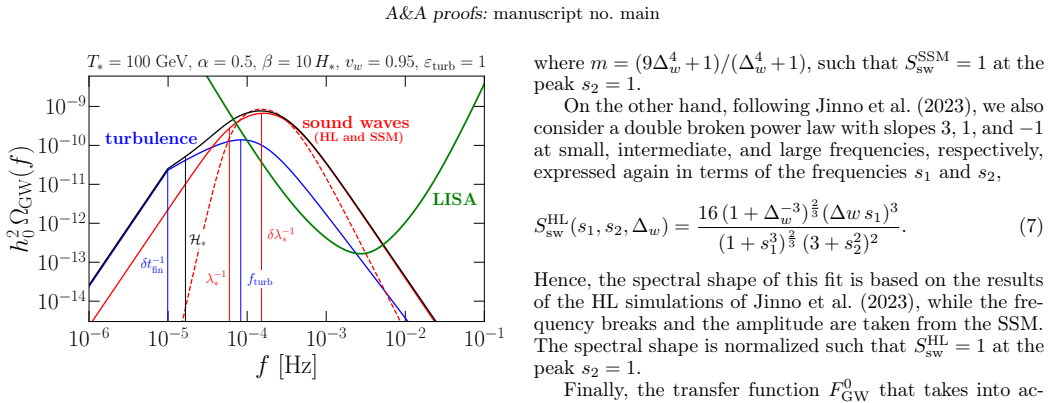
We study two possible cosmological consequences of a first-order phase transition in the temperature range of 1 GeV to $10^3$ TeV: the generation of a stochastic gravitational wave background (SGWB) within the sensitivity of the Laser Interferometer Space Antenna (LISA) and, simultaneously, primordial magnetic fields that would evolve through the Universe's history and could be compatible with the lower bound from $\gamma$-ray telescopes on intergalactic magnetic fields (IGMF) at present time. We find that, if even a small fraction of the kinetic energy in sound waves is converted into MHD turbulence, a first-order phase transition occurring at a temperature between 1 and $10^6$ GeV can give rise to an observable SGWB signal in LISA and, at the same time, an IGMF compatible with the lower bound from the $\gamma$-ray telescope MAGIC, for all proposed evolutionary paths of the magnetic fields throughout the radiation-dominated era (i.e., for both helical and non-helical magnetic fields). For the following fractions of energy density converted into turbulence, $\varepsilon_{\rm turb}=0.1$ and $1$, we provide the range of first-order phase transition parameters, together with the corresponding range of magnetic field strength $B$ and correlation length $\lambda$, that would lead to the SGWB and IGMF observable with LISA and MAGIC. The resulting magnetic field strength at recombination can also correspond to the one that has been proposed to induce baryon clumping, previously suggested as a possible way to ease the Hubble tension. In the limiting case $\varepsilon_{\rm turb} \ll 1$, the SGWB is only sourced by sound waves, but an IGMF is still generated. We find that for values as small as $\varepsilon_{\rm turb} \sim 10^{-13}$ or $10^{-9}$, respectively helical or non-helical magnetic fields can provide IGMF compatible with MAGIC's lower bound.
Editorial analysis
A structured set of objections, weighed in public.
Referee Report
Summary. The paper claims that a first-order phase transition (FOPT) at temperatures 1 GeV–10^6 GeV can simultaneously source a LISA-detectable stochastic gravitational wave background (SGWB) and an intergalactic magnetic field (IGMF) compatible with the MAGIC lower bound. This occurs if a fraction ε_turb of sound-wave kinetic energy converts to MHD turbulence, for all proposed magnetic-field evolutionary paths in the radiation-dominated era (both helical and non-helical). Explicit ranges of FOPT parameters, B, and λ are given for ε_turb = 0.1 and 1; in the limiting case ε_turb ≪ 1 the SGWB is sound-wave sourced while IGMF remains viable down to ε_turb ∼ 10^{-13} (helical) or 10^{-9} (non-helical). The resulting field at recombination is also noted as potentially relevant for baryon clumping and the Hubble tension.
Significance. If the small ε_turb values are physically attainable and the assumed evolutionary paths hold, the work supplies a concrete multi-messenger connection between LISA and γ-ray observations that can jointly constrain FOPT parameters. The explicit treatment of both helical/non-helical cases and multiple evolution paths adds robustness. The additional link to baryon clumping offers a possible tie to the Hubble tension. The manuscript does not claim these signals are inevitable, only that they remain possible even for minute turbulence conversion efficiencies.
major comments (2)
- [limiting-case discussion (abstract and corresponding results section)] The central claim that ε_turb ∼ 10^{-13} (helical) or 10^{-9} (non-helical) suffices for MAGIC-compatible IGMF while preserving a LISA signal rests on the realizability of these efficiencies from sound-wave kinetic energy. No microphysical derivation, simulation reference, or scaling argument is supplied to show why such minute conversion fractions are attainable; the values appear selected to saturate the MAGIC bound rather than derived from the underlying MHD dynamics.
- [magnetic-field evolution subsection] The statement that the result holds “for all proposed evolutionary paths” assumes the magnetic fields follow exactly the cited radiation-era evolution without additional damping or amplification channels. No sensitivity test or reference to possible unaccounted mechanisms (e.g., ambipolar diffusion, inverse-cascade modifications) is provided to quantify robustness.
minor comments (2)
- The abstract states ranges for ε_turb = 0.1 and 1 but does not tabulate the corresponding FOPT parameters (α, β/H_*, T_*); a compact table would improve readability.
- Notation for the turbulence fraction is introduced as ε_turb without an explicit equation defining its relation to the total kinetic energy density; adding Eq. (X) early in the text would clarify usage.
Simulated Author's Rebuttal
We thank the referee for the thorough review and valuable comments on our manuscript. We provide point-by-point responses to the major comments below.
read point-by-point responses
-
Referee: The central claim that ε_turb ∼ 10^{-13} (helical) or 10^{-9} (non-helical) suffices for MAGIC-compatible IGMF while preserving a LISA signal rests on the realizability of these efficiencies from sound-wave kinetic energy. No microphysical derivation, simulation reference, or scaling argument is supplied to show why such minute conversion fractions are attainable; the values appear selected to saturate the MAGIC bound rather than derived from the underlying MHD dynamics.
Authors: Our study is a phenomenological exploration of the multi-messenger signatures of FOPTs. The small ε_turb values are the minimal thresholds at which the IGMF would still satisfy the MAGIC lower bound, while the SGWB is sourced solely by sound waves (for ε_turb ≪ 1). We do not assert that these efficiencies are necessarily realized in nature or provide a derivation from MHD dynamics; instead, we show that the connection between LISA and MAGIC signals remains possible even for extremely small turbulence conversion fractions. We agree that a microphysical justification would be desirable but lies outside the scope of this work, which focuses on the cosmological consequences assuming such conversion occurs. We will revise the abstract and results section to explicitly state that these are threshold values for viability rather than predicted efficiencies. revision: partial
-
Referee: The statement that the result holds “for all proposed evolutionary paths” assumes the magnetic fields follow exactly the cited radiation-era evolution without additional damping or amplification channels. No sensitivity test or reference to possible unaccounted mechanisms (e.g., ambipolar diffusion, inverse-cascade modifications) is provided to quantify robustness.
Authors: The evolutionary paths we consider are the standard ones proposed in the literature for magnetic field evolution during the radiation-dominated era, as referenced in the manuscript (both helical and non-helical cases). Our statement is that under these assumptions, the results hold. We note that mechanisms like ambipolar diffusion are primarily relevant after recombination and do not significantly impact the radiation-era evolution for the scales and strengths considered here. However, to enhance robustness, we will add a short paragraph discussing potential additional effects and clarifying that our conclusions are conditional on the validity of the cited evolutionary models. revision: partial
- A first-principles or simulation-based demonstration that ε_turb values as low as 10^{-13} or 10^{-9} are physically attainable from the conversion of sound-wave kinetic energy in FOPTs.
Circularity Check
No circularity; parameter compatibility study is self-contained
full rationale
The paper computes ranges of FOPT parameters (T*, α, β/H*) that simultaneously satisfy LISA SGWB sensitivity and MAGIC IGMF lower bound for fixed ε_turb values (0.1, 1, and limiting cases ~10^{-13}/10^{-9}). These are direct forward calculations under stated assumptions about turbulence conversion and magnetic-field evolution paths; no equation reduces to its own input by construction, no fitted parameter is relabeled as a prediction, and no load-bearing step relies on self-citation or imported uniqueness. The derivation chain remains independent of the target observables.
Axiom & Free-Parameter Ledger
free parameters (2)
- ε_turb =
0.1, 1, or ~10^{-13}/10^{-9}
- phase transition temperature =
1 to 10^6 GeV
axioms (2)
- domain assumption Standard radiation-dominated era evolution of magnetic fields for helical and non-helical cases
- domain assumption Sound waves and MHD turbulence source SGWB and magnetic fields from phase transition
Forward citations
Cited by 3 Pith papers
-
Gravitational Wave-Induced Freeze-In of Fermionic Dark Matter
Stochastic gravitational waves induce 1-loop freeze-in production of fermionic dark matter via in-in formalism, potentially explaining the observed abundance more efficiently than conventional mechanisms.
-
Primordial Magnetogenesis and Gravitational Waves from ALP-assisted Phase Transition
ALP-assisted first-order phase transitions can explain observed intergalactic magnetic fields and produce detectable gravitational waves, linking cosmology with particle physics searches.
-
Primordial black holes and magnetic fields in conformal neutrino mass models
Conformal U(1)' seesaw models produce PBHs contributing to dark matter and helical magnetic fields at seesaw scales of 10^4-10^11 GeV, with observable GW, microlensing, and Hawking signals at LISA, Roman, and future g...
Reference graph
Works this paper leans on
-
[1]
Acciari, V. A. et al. 2023, Astron. Astrophys., 670, A145
work page 2023
-
[2]
Ade, P. A. R. et al. 2016, Astron. Astrophys., 594, A19
work page 2016
-
[3]
Afzal, A. et al. 2023, Astrophys. J. Lett., 951, L11
work page 2023
-
[4]
Agazie, G. et al. 2023, Astrophys. J. Lett., 951 [ arXiv:2306.16213]
work page internal anchor Pith review Pith/arXiv arXiv 2023
-
[5]
Amaro-Seoane, P. et al. 2017 [ arXiv:1702.00786]
work page internal anchor Pith review Pith/arXiv arXiv 2017
-
[6]
Antoniadis, J. et al. 2023a [ arXiv:2306.16214]
work page internal anchor Pith review Pith/arXiv arXiv
- [7]
-
[8]
Auclair, P., Caprini, C., Cutting, D., et al. 2022, JCAP, 09, 029
work page 2022
- [9]
- [10]
-
[11]
Brandenburg, A., Clarke, E., He, Y., & Kahniashvili, T. 2021, Phys. Rev. D, 104, 043513
work page 2021
- [12]
-
[13]
Brandenburg, A., Kahniashvili, T., & Tevzadze, A. G. 2015, Phys. Rev. Lett., 114, 075001
work page 2015
-
[14]
Cai, R.-G., Wang, S.-J., & Yuwen, Z.-Y. 2023 [ arXiv:2305.00074]
- [15]
-
[16]
Caprini, C. et al. 2016, JCAP, 04, 001
work page 2016
-
[17]
Caprini, C. et al. 2020, JCAP, 03, 024
work page 2020
-
[18]
Dolag, K., Kachelriess, M., Ostapchenko, S., & Tomàs, R. 2011, ApJ, 727, L4
work page 2011
- [19]
- [20]
-
[21]
Ellis, J., Lewicki, M., & No, J. M. 2020, JCAP, 07, 050
work page 2020
-
[22]
Espinosa, J. R., Konstandin, T., No, J. M., & Servant, G. 2010, JCAP, 06, 028
work page 2010
-
[23]
Galli, S., Pogosian, L., Jedamzik, K., & Balkenhol, L. 2022, Phys. Rev. D, 105, 023513
work page 2022
- [24]
- [25]
- [26]
-
[27]
J., Rummukainen, K., & Weir, D
Hindmarsh, M., Huber, S. J., Rummukainen, K., & Weir, D. J. 2014, Phys. Rev. Lett., 112, 041301
work page 2014
-
[28]
J., Rummukainen, K., & Weir, D
Hindmarsh, M., Huber, S. J., Rummukainen, K., & Weir, D. J. 2017, Phys. Rev. D, 96, 103520, [Erratum: Phys.Rev.D 101, 089902 (2020)]
work page 2017
-
[29]
B., Lüben, M., Lumma, J., & Pauly, M
Hindmarsh, M. B., Lüben, M., Lumma, J., & Pauly, M. 2021, SciPost Phys. Lect. Notes, 24, 1
work page 2021
- [30]
- [31]
- [32]
-
[33]
Jinno, R., Konstandin, T., Rubira, H., & Stomberg, I. 2023, JCAP, 02, 011
work page 2023
-
[34]
Kahniashvili, T., Clarke, E., Stepp, J., & Brandenburg, A. 2022, Phys. Rev. Lett., 128, 221301
work page 2022
-
[35]
Kahniashvili, T., Tevzadze, A. G., & Ratra, B. 2011, Astrophys. J., 726, 78
work page 2011
-
[36]
Kajantie, K., Laine, M., Rummukainen, K., & Shaposhnikov, M. E. 1996, Nucl. Phys. B, 466, 189
work page 1996
-
[37]
Kamionkowski, M., Kosowsky, A., & Turner, M. S. 1994, Phys. Rev. D, 49, 2837
work page 1994
- [38]
-
[39]
Korochkin, A., Kalashev, O., Neronov, A., & Semikoz, D. 2021, As- trophys. J., 906, 116
work page 2021
-
[40]
Neronov, A., Semikoz, D., & Kalashev, O. 2021 [ arXiv:2112.08202]
- [41]
-
[42]
Pshirkov, M. S., Tinyakov, P. G., & Urban, F. R. 2016, Phys. Rev. Lett., 116, 191302
work page 2016
-
[43]
Reardon, D. J. et al. 2023, Astrophys. J. Lett., 951 [arXiv:2306.16215] Roper Pol, A., Caprini, C., Neronov, A., & Semikoz, D. 2022a, Phys. Rev. D, 105, 123502 Roper Pol, A., Mandal, S., Brandenburg, A., & Kahniashvili, T. 2022b, JCAP, 04, 019 Roper Pol, A., Mandal, S., Brandenburg, A., Kahniashvili, T., &
work page internal anchor Pith review Pith/arXiv arXiv 2023
- [44]
-
[45]
Shvartsman, V. F. 1969, Pisma Zh. Eksp. Teor. Fiz., 9, 315
work page 1969
-
[46]
Sigl, G., Olinto, A. V., & Jedamzik, K. 1997, Phys. Rev. D, 55, 4582
work page 1997
-
[47]
Stephanov, M. A. 2006, PoS, LAT2006, 024
work page 2006
- [48]
-
[49]
Vachaspati, T. 2021, Rept. Prog. Phys., 84, 074901 von Kármán, T. 1948, Proceedings of the National Academy of Sci- ences, 34, 530
work page 2021
-
[50]
Xu, H. et al. 2023 [ arXiv:2306.16216]
work page internal anchor Pith review Pith/arXiv arXiv 2023
-
[51]
Zhou, H., Sharma, R., & Brandenburg, A. 2022, J. Plasma Phys., 88, 905880602 Article number, page 10 of 10
work page 2022
discussion (0)
Sign in with ORCID, Apple, or X to comment. Anyone can read and Pith papers without signing in.