Near-Minimal Gate Set Tomography Experiment Designs
Pith reviewed 2026-05-24 07:37 UTC · model grok-4.3
The pith
Analyzing germ sensitivities removes redundancy from GST experiments, yielding near-minimal designs with preserved precision scaling.
A machine-rendered reading of the paper's core claim, the machinery that carries it, and where it could break.
Core claim
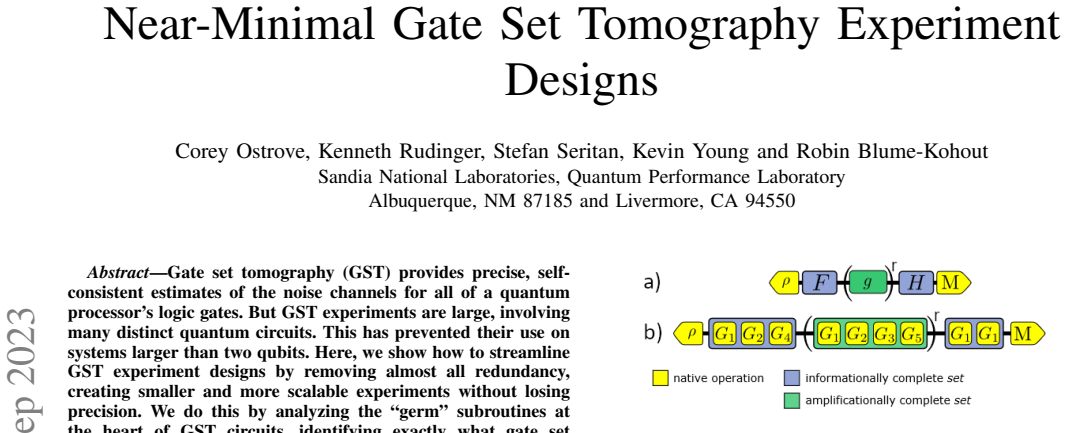
We show how to streamline GST experiment designs by removing almost all redundancy, creating smaller and more scalable experiments without losing precision. We do this by analyzing the germ subroutines at the heart of GST circuits, identifying exactly what gate set parameters they are sensitive to, and leveraging this information to remove circuits that duplicate other circuits' sensitivities. We apply this technique to two-qubit GST experiments, generating streamlined experiment designs that contain only slightly more circuits than the theoretical minimum bounds, but still achieve Heisenberg-like scaling in precision as demonstrated via simulation and a theoretical analysis using Fisher信息.
What carries the argument
Sensitivity analysis of germ subroutines, which maps each germ to the gate set parameters it probes to enable removal of redundant circuits.
If this is right
- Streamlined designs contain only slightly more circuits than theoretical minimum bounds.
- Designs still achieve Heisenberg-like scaling in precision.
- New designs match the precision of previous GST experiments with significantly fewer circuits.
- The technique creates prospects for extending GST to three-qubit systems.
Where Pith is reading between the lines
- Fewer circuits could make GST practical for characterizing processors with more than two qubits.
- The pruning method might extend to other forms of quantum process tomography.
- Reduced experimental overhead could speed up noise characterization during quantum device calibration.
- Exact minimum circuit counts might be reachable with further refinement of the sensitivity mapping.
Load-bearing premise
The sensitivity analysis of germ subroutines accurately identifies all redundancies such that removing duplicate circuits does not degrade overall parameter estimation precision.
What would settle it
A simulation comparing the streamlined two-qubit GST design to the original that shows lower precision or incomplete parameter recovery in the reduced set.
Figures


read the original abstract
Gate set tomography (GST) provides precise, self-consistent estimates of the noise channels for all of a quantum processor's logic gates. But GST experiments are large, involving many distinct quantum circuits. This has prevented their use on systems larger than two qubits. Here, we show how to streamline GST experiment designs by removing almost all redundancy, creating smaller and more scalable experiments without losing precision. We do this by analyzing the "germ" subroutines at the heart of GST circuits, identifying exactly what gate set parameters they are sensitive to, and leveraging this information to remove circuits that duplicate other circuits' sensitivities. We apply this technique to two-qubit GST experiments, generating streamlined experiment designs that contain only slightly more circuits than the theoretical minimum bounds, but still achieve Heisenberg-like scaling in precision (as demonstrated via simulation and a theoretical analysis using Fisher information). In practical use, the new experiment designs can match the precision of previous GST experiments with significantly fewer circuits. We discuss the prospects and feasibility of extending GST to three-qubit systems using our techniques.
Editorial analysis
A structured set of objections, weighed in public.
Referee Report
Summary. The paper claims that gate set tomography (GST) experiment designs can be streamlined by analyzing the parameter sensitivities of germ subroutines to identify and remove redundant circuits, yielding near-minimal two-qubit GST designs (only slightly above theoretical bounds) that preserve Heisenberg-like precision scaling. This is supported by simulations and Fisher information analysis, enabling equivalent precision with significantly fewer circuits than prior designs, with discussion of extension to three-qubit systems.
Significance. If the central claims hold, the work substantially advances the practicality of GST by addressing its primary scalability limitation (experiment size), potentially enabling self-consistent noise characterization on systems beyond two qubits. Strengths include the use of both numerical simulation and analytic Fisher information to verify scaling, and the focus on a concrete, falsifiable reduction in circuit count while targeting full-rank information matrices.
major comments (2)
- [§3.2] §3.2 (germ sensitivity analysis): The procedure identifies per-germ sensitivities to prune duplicate circuits, but the manuscript does not demonstrate that this first-order sensitivity map is complete with respect to cross-germ parameter correlations; if higher-order dependencies exist for certain two-qubit Pauli noise channels, the reduced design could lose rank in the Fisher information matrix without detection.
- [§4] §4 (Fisher information analysis): The claim that the pruned designs achieve the same Heisenberg scaling relies on the reduced information matrix remaining full rank and well-conditioned, yet no explicit eigenvalue comparison or condition-number bound between the original and pruned matrices is provided to quantify any precision degradation.
minor comments (2)
- Figure 2 caption: the legend for 'original' vs 'pruned' circuit counts is unclear on whether the plotted values include or exclude the fiducial circuits.
- Notation in Eq. (7): the definition of the sensitivity vector s_g for a germ g should explicitly state whether it is computed via the derivative of the process matrix or via the superoperator action on the Pauli basis.
Simulated Author's Rebuttal
We thank the referee for their careful reading and constructive feedback on our manuscript. The two major comments raise important points about the completeness of our sensitivity analysis and the quantitative validation of the pruned designs. We address each below and indicate revisions that will be incorporated.
read point-by-point responses
-
Referee: [§3.2] §3.2 (germ sensitivity analysis): The procedure identifies per-germ sensitivities to prune duplicate circuits, but the manuscript does not demonstrate that this first-order sensitivity map is complete with respect to cross-germ parameter correlations; if higher-order dependencies exist for certain two-qubit Pauli noise channels, the reduced design could lose rank in the Fisher information matrix without detection.
Authors: We appreciate the referee's observation regarding potential cross-germ correlations. The sensitivity analysis in §3.2 computes first-order parameter derivatives per germ to identify redundant circuits. While this is a first-order map, the subsequent step in our workflow explicitly constructs and checks the full Fisher information matrix of the pruned experiment design. This matrix incorporates all parameter correlations (including cross-germ terms) and any higher-order effects implicit in the model. In all cases examined, the pruned matrices remain full rank. To strengthen the presentation, we will revise §3.2 to include an explicit statement that the final rank check serves as the completeness verification, and we will add a brief analysis showing that, for the two-qubit Pauli noise models considered, no rank loss occurred despite the first-order pruning heuristic. revision: partial
-
Referee: [§4] §4 (Fisher information analysis): The claim that the pruned designs achieve the same Heisenberg scaling relies on the reduced information matrix remaining full rank and well-conditioned, yet no explicit eigenvalue comparison or condition-number bound between the original and pruned matrices is provided to quantify any precision degradation.
Authors: We agree that direct quantitative comparison of the information matrices would make the scaling claim more rigorous. The current manuscript demonstrates preservation of Heisenberg scaling via both Monte Carlo simulations and the analytic Fisher information rank, but does not tabulate eigenvalue spectra or condition numbers. In the revised version we will add a supplementary table (or figure) that reports the smallest nonzero eigenvalues and condition numbers for representative original and pruned two-qubit designs. This will allow readers to assess any minor degradation in conditioning while confirming that the scaling behavior remains intact. revision: yes
Circularity Check
No circularity: method uses independent sensitivity analysis with external validation
full rationale
The paper's core procedure—germ-by-germ sensitivity analysis to identify and prune redundant circuits—is presented as a distinct computational step whose output (reduced experiment designs) is then validated separately via simulation and Fisher-information scaling analysis. No quoted equations or claims reduce a prediction to a fitted input by construction, invoke self-citations as load-bearing uniqueness theorems, or smuggle ansatzes. The derivation chain remains self-contained against the stated external benchmarks (simulations, information-matrix rank checks) and does not collapse to tautology.
Axiom & Free-Parameter Ledger
axioms (1)
- standard math Standard assumptions of quantum mechanics and linear algebra for parameter estimation in GST.
Reference graph
Works this paper leans on
-
[1]
R. Blume-Kohout, J. K. Gamble, E. Nielsen, K. Rudinger, J. Mizrahi, K. Fortier, and P. Maunz, “Demonstration of qubit operations below a rigorous fault tolerance threshold with gate set tomography,” Nat. Commun., vol. 8, Feb. 2017
work page 2017
-
[2]
Probing context-dependent errors in quantum processors,
K. Rudinger, T. Proctor, D. Langharst, M. Sarovar, K. Young, and R. Blume-Kohout, “Probing context-dependent errors in quantum processors,” Phys. Rev. X, vol. 9, p. 021045, Jun 2019. [Online]. Available: https://link.aps.org/doi/10.1103/PhysRevX.9.021045
-
[3]
Quantum logic with spin qubits crossing the surface code threshold,
X. Xue, M. Russ, N. Samkharadze, B. Undseth, A. Sammak, G. Scap- pucci, and L. M. Vandersypen, “Quantum logic with spin qubits crossing the surface code threshold,” Nature, vol. 601, no. 7893, pp. 343–347, 2022
work page 2022
-
[4]
Precision tomography of a three-qubit donor quantum processor in silicon,
M. T. M ˛ adzik, S. Asaad, A. Youssry, B. Joecker, K. M. Rudinger, E. Nielsen, K. C. Young, T. J. Proctor, A. D. Baczewski, A. Laucht et al., “Precision tomography of a three-qubit donor quantum processor in silicon,” Nature, vol. 601, no. 7893, pp. 348–353, 2022
work page 2022
-
[5]
Benchmarking characterization methods for noisy quantum circuits,
M. L. Dahlhauser and T. S. Humble, “Benchmarking characterization methods for noisy quantum circuits,” arXiv preprint arXiv:2201.02243, 2022
-
[6]
E. Nielsen, J. K. Gamble, K. Rudinger, T. Scholten, K. Young, and R. Blume-Kohout, “Gate Set Tomography,”Quantum, vol. 5, p. 557, Oct
-
[7]
Available: https://doi.org/10.22331/q-2021-10-05-557
[Online]. Available: https://doi.org/10.22331/q-2021-10-05-557
-
[8]
Two-qubit gate set tomography with fewer circuits,
K. Rudinger, C. Ostrove, S. Seritan, M. Grace, E. Nielsen, R. Blume- Kohout, and K. Young, “Two-qubit gate set tomography with fewer circuits,” arXiv preprint arxiv:2307.15767, 2023
-
[9]
Characterization of addressability by simultaneous randomized benchmarking [supplementary material],
J. M. Gambetta, A. D. Córcoles, S. T. Merkel, B. R. Johnson, J. A. Smolin, J. M. Chow, C. A. Ryan, C. Rigetti, S. Poletto, T. A. Ohki, M. B. Ketchen, and M. Steffen, “Characterization of addressability by simultaneous randomized benchmarking [supplementary material],” Phys. Rev. Lett., vol. 109, p. 240504, Dec 2012. [Online]. Available: https://link.aps.o...
-
[10]
Column subset selection is np-complete,
Y . Shitov, “Column subset selection is np-complete,” Linear Algebra and its Applications, vol. 610, pp. 52–58, 2021
work page 2021
-
[11]
Regularized greedy column subset selection,
B. Ordozgoiti, A. Mozo, and J. G. L. de Lacalle, “Regularized greedy column subset selection,” Information Sciences, vol. 486, pp. 393–418, 2019
work page 2019
-
[12]
A note on subset selection for matrices,
F. De Hoog and R. Mattheij, “A note on subset selection for matrices,” Linear algebra and its applications, vol. 434, no. 8, pp. 1845–1850, 2011
work page 2011
-
[13]
Faster subset selection for matrices and applications,
H. Avron and C. Boutsidis, “Faster subset selection for matrices and applications,” SIAM Journal on Matrix Analysis and Applications, vol. 34, no. 4, pp. 1464–1499, 2013
work page 2013
-
[14]
A taxonomy of small markovian errors,
R. Blume-Kohout, M. P. da Silva, E. Nielsen, T. Proctor, K. Rudinger, M. Sarovar, and K. Young, “A taxonomy of small markovian errors,” PRX Quantum, vol. 3, p. 020335, May 2022. [Online]. Available: https://link.aps.org/doi/10.1103/PRXQuantum.3.020335
-
[15]
Quantum circuits with mixed states,
D. Aharonov, A. Kitaev, and N. Nisan, “Quantum circuits with mixed states,” in Proceedings of the thirtieth annual ACM symposium on Theory of computing, 1998, pp. 20–30
work page 1998
-
[16]
A tutorial on fisher information,
A. Ly, M. Marsman, J. Verhagen, R. P. Grasman, and E.-J. Wagenmakers, “A tutorial on fisher information,” Journal of Mathematical Psychology, vol. 80, pp. 40–55, 2017
work page 2017
-
[17]
C. W. Warren, J. Fernández-Pendás, S. Ahmed, T. Abad, A. Bengtsson, J. Biznárová, K. Debnath, X. Gu, C. Križan, A. Osman et al., “Extensive characterization and implementation of a family of three-qubit gates at the coherence limit,” npj Quantum Information, vol. 9, no. 1, p. 44, 2023
work page 2023
-
[18]
Benchmarking verified logic operations for fault tolerance,
A. Hashim, S. Seritan, T. Proctor, K. Rudinger, N. Goss, R. K. Naik, J. M. Kreikebaum, D. I. Santiago, and I. Siddiqi, “Benchmarking verified logic operations for fault tolerance,” arXiv preprint arXiv:2207.08786, 2022
-
[19]
High-fidelity three- qubit i toffoli gate for fixed-frequency superconducting qubits,
Y . Kim, A. Morvan, L. B. Nguyen, R. K. Naik, C. Jünger, L. Chen, J. M. Kreikebaum, D. I. Santiago, and I. Siddiqi, “High-fidelity three- qubit i toffoli gate for fixed-frequency superconducting qubits,” Nature Physics, vol. 18, no. 7, pp. 783–788, 2022
work page 2022
-
[20]
Pukelsheim, Optimal design of experiments
F. Pukelsheim, Optimal design of experiments. SIAM, 2006
work page 2006
-
[21]
Generalized inversion of modified matrices,
C. D. Meyer, Jr, “Generalized inversion of modified matrices,” Siam journal on applied mathematics, vol. 24, no. 3, pp. 315–323, 1973
work page 1973
-
[22]
An extension of the matrix inversion lemma,
N. Minamide, “An extension of the matrix inversion lemma,” SIAM Journal on Algebraic Discrete Methods, vol. 6, no. 3, pp. 371–377, 1985
work page 1985
-
[23]
Some applications of the rank revealing qr factorization,
T. F. Chan and P. C. Hansen, “Some applications of the rank revealing qr factorization,” SIAM Journal on Scientific and Statistical Computing, vol. 13, no. 3, pp. 727–741, 1992
work page 1992
-
[24]
Rank degeneracy and least squares problems,
G. Golub, V . Klema, and G. W. Stewart, “Rank degeneracy and least squares problems,” Stanford Univ. Dept. Of Computer Science, Tech. Rep., 1976
work page 1976
-
[25]
G. H. Golub and C. F. Van Loan, Matrix computations, 3rd edition. JHU press, 1996. APPENDIX A. Column Subset Selection Heuristics As discussed in Section III-B, the first stage of the per- germ global FPR algorithm wherein we select for each germ a subset of its amplified parameters to require sensitivity to can be reduced to a problem known as the column...
work page 1996
-
[26]
Greedy Search: Given as input the matrix of concate- nated right singular vectors for each germ’s twirled derivative, J = Vg0 Vg1 · · · VgNg , (17) our goal is to select a submatrix of J, Jmin, formed from its columns such that Jmin has a column-rank equal to the number of amplifiable parameters and is well-conditioned. For the greedy search heuristic we ...
-
[27]
Rank-Revealing QR Decompositions: Another class of heuristics that has seen significant development for column subset selection is based on the application of the rank- revealing QR decomposition [22]. An advantage of this class of protocols is that (at least for the simpler variants) they can be phrased entirely linear-algebraically, and as such allow us...
discussion (0)
Sign in with ORCID, Apple, or X to comment. Anyone can read and Pith papers without signing in.