Exceptional point induced quantum phase synchronization and entanglement dynamics in mechanically coupled gain-loss oscillators
Pith reviewed 2026-05-24 06:59 UTC · model grok-4.3
The pith
An exceptional point in coupled gain-loss oscillators produces steady phase synchronization and entanglement above a critical driving power.
A machine-rendered reading of the paper's core claim, the machinery that carries it, and where it could break.
Core claim
In a system of mechanically coupled gain-loss oscillators, where gain and loss are engineered by blue- and red-detuned lasers, the exceptional point induces steady phase synchronization dynamics along with entanglement phenomena in the effective weak coupling regime above a critical driving power.
What carries the argument
The exceptional point arising from balanced gain and loss rates, which drives self-sustained oscillations and generates quantum correlations in the quadrature fluctuations.
If this is right
- Steady phase synchronization dynamics emerge in the weak coupling regime above critical driving power.
- Bipartite Gaussian entanglement forms among the quadrature fluctuations of the oscillators.
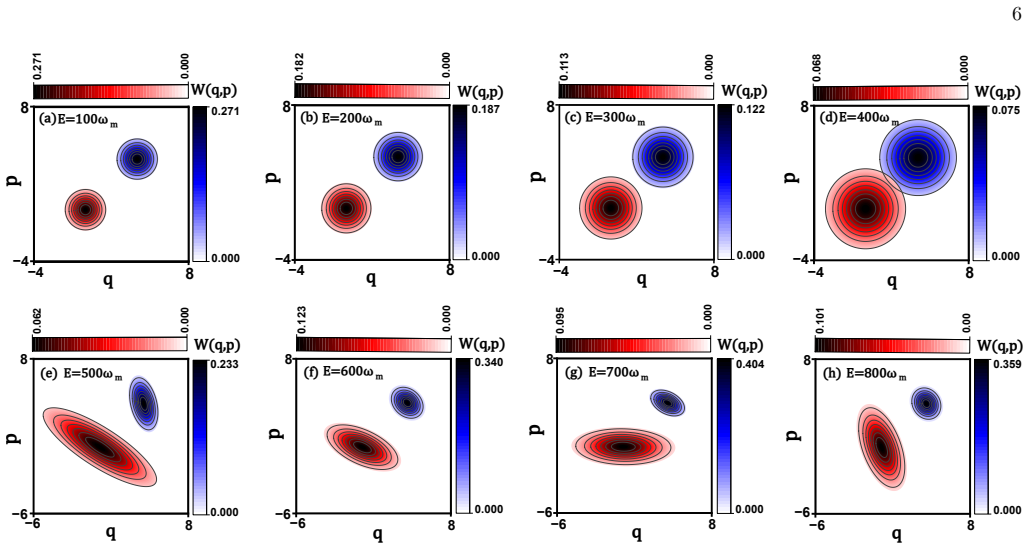
- Mechanical squeezing and phase-space rotations appear in the Wigner distributions of the modes.
- Frequency mismatches between oscillators and thermal phonon decoherence modify the synchronization and entanglement.
Where Pith is reading between the lines
- The setup may support phonon-based protocols for quantum communication by harnessing the induced correlations.
- Exceptional-point control could be tested in other non-Hermitian optomechanical arrays to generate resources without strong coupling.
- Thermal effects and detuning mismatches provide a route to quantify robustness limits in real devices.
Load-bearing premise
Gain and loss rates can be independently engineered by blue- and red-detuned laser drives while the system remains in an effective weak-coupling regime where the exceptional point controls the dynamics.
What would settle it
If no steady phase synchronization or entanglement appears when driving power exceeds the critical threshold, or if the phenomena occur without satisfying the exceptional point condition, the central claim would be falsified.
Figures




read the original abstract
The optomechanical cavity (OMC) system has been a paradigm in the manifestation of continuous variable quantum information over the past decade. This paper investigates how quantum phase synchronization relates to bipartite Gaussian entanglement in coupled gain-loss mechanical oscillators, where the gain and loss rates are engineered by driving the cavity with blue and red detuned lasers, respectively. We examine the role of exceptional point in a deterministic way of producing self-sustained oscillations that induce robust quantum correlations among quadrature fluctuations of the oscillators. Particularly, steady phase synchronization dynamics along with the entanglement phenomena are observed in the effective weak coupling regime above a critical driving power. These phenomena are further verified by observing the mechanical squeezing and phase space rotations of the Wigner distributions. Additionally, we discuss how the oscillators frequency mismatches and decoherence due to thermal phonons impact the system dynamics. These findings hold promise for applications in phonon-based quantum communication and information processing.
Editorial analysis
A structured set of objections, weighed in public.
Referee Report
Summary. The manuscript examines quantum phase synchronization and bipartite Gaussian entanglement in mechanically coupled gain-loss oscillators within an optomechanical cavity, where gain and loss are engineered by blue- and red-detuned laser drives. It claims that an exceptional point induces self-sustained oscillations leading to steady phase synchronization and entanglement in the effective weak-coupling regime above a critical drive power. These are verified numerically via quadrature fluctuations, mechanical squeezing, Wigner function rotations, and robustness checks against frequency mismatch and thermal decoherence.
Significance. If the central claims hold, the work provides a concrete demonstration of EP-controlled steady-state synchronization and Gaussian entanglement in a standard optomechanical setup, with potential relevance to phonon-based quantum information tasks. The approach relies on linearized equations under RWA and explicit parameter choices maintaining weak coupling, which are standard but here tied to observable synchronization and entanglement metrics.
minor comments (2)
- The condition defining the 'effective weak coupling regime' (mentioned in the abstract and results) should be stated explicitly with the relevant inequality or parameter range in the methods or results section to allow direct verification of the regime where the EP controls the dynamics.
- Figure captions for the Wigner distributions and phase-space plots would benefit from explicit labels indicating the quadrature axes and the specific parameter values (e.g., drive power relative to critical value) used in each panel.
Simulated Author's Rebuttal
We thank the referee for their positive summary and significance assessment of our manuscript on exceptional-point-induced quantum phase synchronization and entanglement in mechanically coupled gain-loss oscillators. We note the recommendation for minor revision. As the report contains no specific major comments, we have no points requiring rebuttal or clarification at this stage.
Circularity Check
No significant circularity identified
full rationale
The derivation chain proceeds from standard linearized optomechanical equations under the rotating-wave approximation, with explicit parameter selection to enforce the weak-coupling regime below the exceptional point threshold, followed by direct numerical integration of the resulting stochastic differential equations. No step reduces a claimed prediction to a fitted input by construction, invokes a self-citation as the sole justification for a uniqueness theorem, or renames an empirical pattern as a first-principles result. The gain-loss engineering via detuned drives is introduced as an independent modeling choice whose consequences are then computed, rather than presupposed. The central observations of phase synchronization and Gaussian entanglement therefore remain independent of the inputs and are externally falsifiable via the reported Wigner-function and squeezing diagnostics.
Axiom & Free-Parameter Ledger
Lean theorems connected to this paper
-
IndisputableMonolith/Foundation/AbsoluteFloorClosure.leanreality_from_one_distinction unclear?
unclearRelation between the paper passage and the cited Recognition theorem.
eigen frequencies ... phase transition ... at J = (Γm1 + Γm2)/2, which is also known as the exceptional point (EP)
-
IndisputableMonolith/Cost/FunctionalEquation.leanwashburn_uniqueness_aczel unclear?
unclearRelation between the paper passage and the cited Recognition theorem.
Sp(t) = 1/2 ⟨δp′−(t)²⟩−1 ... En = max[0, −log(2ν−)]
What do these tags mean?
- matches
- The paper's claim is directly supported by a theorem in the formal canon.
- supports
- The theorem supports part of the paper's argument, but the paper may add assumptions or extra steps.
- extends
- The paper goes beyond the formal theorem; the theorem is a base layer rather than the whole result.
- uses
- The paper appears to rely on the theorem as machinery.
- contradicts
- The paper's claim conflicts with a theorem or certificate in the canon.
- unclear
- Pith found a possible connection, but the passage is too broad, indirect, or ambiguous to say the theorem truly supports the claim.
Reference graph
Works this paper leans on
-
[1]
Christiaan, Oeuvres compl` etes de Christiaan Huy- gens
H. Christiaan, Oeuvres compl` etes de Christiaan Huy- gens. Publi´ ees par la Soci´ et´ e hollandaise des sciences, Vol. 1 (La Haye, M. Nijhoff, 1888-1950) p. 658, https://www.biodiversitylibrary.org/bibliography/21031
work page 1950
-
[2]
A. Pikovsky, M. Rosenblum, and J. Kurths, Synchroniza- tion - a universal concept in nonlinear sciences, in Cam- bridge Nonlinear Science Series (2001)
work page 2001
-
[3]
A. Mari, A. Farace, N. Didier, V. Giovannetti, and R. Fazio, Measures of quantum synchronization in con- tinuous variable systems, Phys. Rev. Lett. 111, 103605 (2013)
work page 2013
-
[4]
W. Li, F. Zhang, C. Li, and H. Song, Quantum synchro- nization in a star-type cavity qed network, Communica- tions in Nonlinear Science and Numerical Simulation 42, 121 (2017)
work page 2017
-
[5]
M. Xu, D. A. Tieri, E. C. Fine, J. K. Thompson, and M. J. Holland, Synchronization of two ensembles of atoms, Phys. Rev. Lett. 113, 154101 (2014)
work page 2014
- [6]
-
[7]
A. Roulet and C. Bruder, Quantum synchronization and entanglement generation, Phys. Rev. Lett. 121, 063601 (2018)
work page 2018
-
[8]
G. L. Giorgi, F. Galve, G. Manzano, P. Colet, and R. Zambrini, Quantum correlations and mutual synchro- nization, Phys. Rev. A 85, 052101 (2012)
work page 2012
-
[9]
R. Quan, Y. Zhai, M. Wang, F. Hou, S. Wang, X. Xi- ang, T. Liu, S. Zhang, and R. Dong, Demonstration of quantum synchronization based on second-order quan- tum coherence of entangled photons, Scientific reports 6, 30453 (2016)
work page 2016
-
[10]
D. Witthaut, S. Wimberger, R. Burioni, and M. Timme, Classical synchronization indicates persistent entangle- ment in isolated quantum systems, Nature communica- tions 8, 14829 (2017)
work page 2017
-
[11]
M. Aspelmeyer, T. J. Kippenberg, and F. Marquardt, Cavity optomechanics, Reviews of Modern Physics 86, 1391 (2014)
work page 2014
-
[12]
W. Li, C. Li, and H. Song, Quantum synchronization in an optomechanical system based on lyapunov control, Physical Review E 93, 062221 (2016)
work page 2016
- [13]
- [14]
-
[15]
L. Ying, Y.-C. Lai, and C. Grebogi, Quantum manifes- tation of a synchronization transition in optomechanical systems, Physical Review A 90, 053810 (2014)
work page 2014
- [16]
-
[17]
G.-j. Qiao, H.-x. Gao, H.-d. Liu, and X. Yi, Quantum synchronization of two mechanical oscillators in coupled optomechanical systems with kerr nonlinearity, Scientific reports 8, 15614 (2018)
work page 2018
-
[18]
G. Qiao, X. Liu, H. Liu, C. Sun, and X. Yi, Quan- tum ϕ synchronization in a coupled optomechanical sys- tem with periodic modulation, Physical Review A 101, 053813 (2020)
work page 2020
-
[19]
D. Garg, S. Dasgupta, A. Biswas, et al. , Quantum syn- chronization and entanglement of indirectly coupled me- chanical oscillators in cavity optomechanics: A numerical study, Physics Letters A 457, 128557 (2023)
work page 2023
-
[20]
F. Schmolke and E. Lutz, Noise-induced quantum syn- chronization, Phys. Rev. Lett. 129, 250601 (2022)
work page 2022
- [21]
-
[22]
N. L¨ orch, S. E. Nigg, A. Nunnenkamp, R. P. Tiwari, and C. Bruder, Quantum synchronization blockade: Energy quantization hinders synchronization of identical oscilla- tors, Phys. Rev. Lett. 118, 243602 (2017)
work page 2017
-
[23]
G. Wang, L. Huang, Y.-C. Lai, and C. Grebogi, Nonlinear 10 dynamics and quantum entanglement in optomechanical systems, Physical review letters 112, 110406 (2014)
work page 2014
-
[24]
C.-G. Liao, R.-X. Chen, H. Xie, M.-Y. He, and X.-M. Lin, Quantum synchronization and correlations of two me- chanical resonators in a dissipative optomechanical sys- tem, Physical Review A 99, 033818 (2019)
work page 2019
-
[25]
Manju, S. Dasgupta, and A. Biswas, Entanglement boosts quantum synchronization between two oscillators in an optomechanical setup, Physics Letters A , 129039 (2023)
work page 2023
-
[26]
S ¸. K.¨Ozdemir, S. Rotter, F. Nori, and L. Yang, Parity– time symmetry and exceptional points in photonics, Na- ture materials 18, 783 (2019)
work page 2019
-
[27]
K. G. Makris, R. El-Ganainy, D. Christodoulides, and Z. H. Musslimani, Beam dynamics in p t symmetric opti- cal lattices, Physical Review Letters 100, 103904 (2008)
work page 2008
-
[28]
A. Guo, G. Salamo, D. Duchesne, R. Morandotti, M. Volatier-Ravat, V. Aimez, G. Siviloglou, and D. Christodoulides, Observation of p t-symmetry break- ing in complex optical potentials, Physical review letters 103, 093902 (2009)
work page 2009
- [29]
- [30]
-
[31]
H. L¨ u, C. Wang, L. Yang, and H. Jing, Optomechanically induced transparency at exceptional points, Physical Re- view Applied 10, 014006 (2018)
work page 2018
-
[32]
S. Mondal and K. Debnath, Controllable optical- sideband generation and synchronization in a mechani- cal gain-loss optomechanical system, Phys. Rev. A 108, 023517 (2023)
work page 2023
- [33]
-
[34]
P. Djorw´ e, Y. Pennec, and B. Djafari-Rouhani, Self- organized synchronization of mechanically coupled res- onators based on optomechanics gain-loss balance, Phys- ical Review B 102, 155410 (2020)
work page 2020
-
[35]
S. Chakraborty and A. K. Sarma, Delayed sudden death of entanglement at exceptional points, Physical Review A 100, 063846 (2019)
work page 2019
-
[36]
C. Tchodimou, P. Djorwe, and S. N. Engo, Distant entan- glement enhanced in pt-symmetric optomechanics, Phys- ical Review A 96, 033856 (2017)
work page 2017
-
[37]
R. Simon, Peres-horodecki separability criterion for con- tinuous variable systems, Physical Review Letters 84, 2726 (2000)
work page 2000
-
[38]
C. Gardiner and P. Zoller, Quantum noise: a handbook of Markovian and non-Markovian quantum stochastic meth- ods with applications to quantum optics (Springer Science & Business Media, 2004)
work page 2004
-
[39]
R. Benguria and M. Kac, Quantum langevin equation, Physical review letters 46, 1 (1981)
work page 1981
- [40]
-
[41]
W. Li, C. Li, and H. Song, Theoretical realization and ap- plication of parity-time-symmetric oscillators in a quan- tum regime, Phys. Rev. A 95, 023827 (2017)
work page 2017
-
[42]
R.-X. Chen, L.-T. Shen, Z.-B. Yang, H.-Z. Wu, and S.-B. Zheng, Enhancement of entanglement in distant mechan- ical vibrations via modulation in a coupled optomechan- ical system, Physical Review A 89, 023843 (2014)
work page 2014
-
[43]
S. L. Braunstein and P. van Loock, Quantum informa- tion with continuous variables, Rev. Mod. Phys. 77, 513 (2005)
work page 2005
-
[44]
G. Vidal and R. F. Werner, Computable measure of en- tanglement, Phys. Rev. A 65, 032314 (2002)
work page 2002
-
[45]
P. van Loock and A. Furusawa, Detecting genuine multi- partite continuous-variable entanglement, Phys. Rev. A 67, 052315 (2003)
work page 2003
-
[46]
S. Chakraborty and A. K. Sarma, Entanglement dynam- ics of two coupled mechanical oscillators in modulated optomechanics, Physical Review A 97, 022336 (2018)
work page 2018
-
[47]
Q.-J. Tong, J.-H. An, H.-G. Luo, and C. H. Oh, Mech- anism of entanglement preservation, Phys. Rev. A 81, 052330 (2010)
work page 2010
-
[48]
Q. X. Meng, Z. J. Deng, Z. Zhu, and L. Huang, Quan- tum signatures of transitions from stable fixed points to limit cycles in optomechanical systems, Physical Review A 101, 023838 (2020)
work page 2020
-
[49]
S. Olivares, Quantum optics in the phase space: a tuto- rial on gaussian states, The European Physical Journal Special Topics 203, 3 (2012)
work page 2012
-
[50]
C. Weedbrook, S. Pirandola, R. Garc´ ıa-Patr´ on, N. J. Cerf, T. C. Ralph, J. H. Shapiro, and S. Lloyd, Gaus- sian quantum information, Reviews of Modern Physics 84, 621 (2012)
work page 2012
-
[51]
S. E. Nigg, Observing quantum synchronization blockade in circuit quantum electrodynamics, Phys. Rev. A 97, 013811 (2018)
work page 2018
-
[52]
M. A. Nielsen and I. L. Chuang, Quantum Computation and Quantum Information: 10th Anniversary Edition (Cambridge University Press, 2010)
work page 2010
-
[53]
I. Wilson-Rae, N. Nooshi, W. Zwerger, and T. J. Kip- penberg, Theory of ground state cooling of a mechanical oscillator using dynamical backaction, Phys. Rev. Lett. 99, 093901 (2007)
work page 2007
-
[54]
F. Marquardt, J. P. Chen, A. A. Clerk, and S. M. Girvin, Quantum theory of cavity-assisted sideband cooling of mechanical motion, Phys. Rev. Lett. 99, 093902 (2007)
work page 2007
-
[55]
C. M. Bender, B. K. Berntson, D. Parker, and E. Samuel, Observation of pt phase transition in a simple mechanical system, American Journal of Physics 81, 173 (2013)
work page 2013
-
[56]
C. A. Holmes, C. P. Meaney, and G. J. Milburn, Synchro- nization of many nanomechanical resonators coupled via a common cavity field, Phys. Rev. E 85, 066203 (2012)
work page 2012
- [57]
-
[58]
G. Manzano, F. Galve, G. L. Giorgi, E. Hern´ andez- Garc´ ıa, and R. Zambrini, Synchronization, quantum cor- relations and entanglement in oscillator networks, Scien- tific Reports 3, 1439 (2013)
work page 2013
-
[59]
T. E. Lee, C.-K. Chan, and S. Wang, Entanglement tongue and quantum synchronization of disordered os- cillators, Physical Review E 89, 022913 (2014)
work page 2014
- [60]
discussion (0)
Sign in with ORCID, Apple, or X to comment. Anyone can read and Pith papers without signing in.