Robust Model Reductions for the Boundary Feedback Stabilization of Magnetizable Piezoelectric Beams
Pith reviewed 2026-05-24 06:45 UTC · model grok-4.3
The pith
An order-reduction finite difference scheme stabilizes magnetizable piezoelectric beams with decay rates independent of the discretization parameter.
A machine-rendered reading of the paper's core claim, the machinery that carries it, and where it could break.
Core claim
The order-reduction finite-difference scheme preserves enough of the original coupling structure and dissipativity that a single Lyapunov functional produces an exponential decay rate independent of the discretization parameter; the modeling error between reduced and full systems also decays exponentially and the discrete energy converges uniformly to the continuous energy.
What carries the argument
The order-reduction finite-difference scheme that eliminates spurious high-frequency modes while retaining the essential mechanical-electric-magnetic coupling and boundary dissipation.
If this is right
- Exponential stability holds with a decay rate that stays fixed when the spatial mesh is refined.
- The modeling error between the reduced system and the original continuous system decays exponentially in time.
- The total energy of the reduced model converges uniformly to the energy of the full system as the reduction parameter tends to zero.
- Numerical filtering is no longer required, removing the need for full spectral decomposition at each design step.
Where Pith is reading between the lines
- The same reduction idea may apply directly to other coupled hyperbolic systems whose standard discretizations produce spurious modes.
- Because the decay rate is mesh-independent, the reduced model can be used for real-time feedback design without retuning when spatial resolution changes.
- The constructed eigenpair separation algorithm could be reused for any filtering-based method on similar beams.
Load-bearing premise
The reduced finite-difference scheme preserves the essential coupling structure and dissipativity properties of the original system well enough for a Lyapunov argument to deliver a decay rate independent of mesh size.
What would settle it
Numerical computation of the closed-loop decay rate on successively refined grids; if the observed rate decreases as the mesh is refined, the independence claim fails.
Figures
read the original abstract
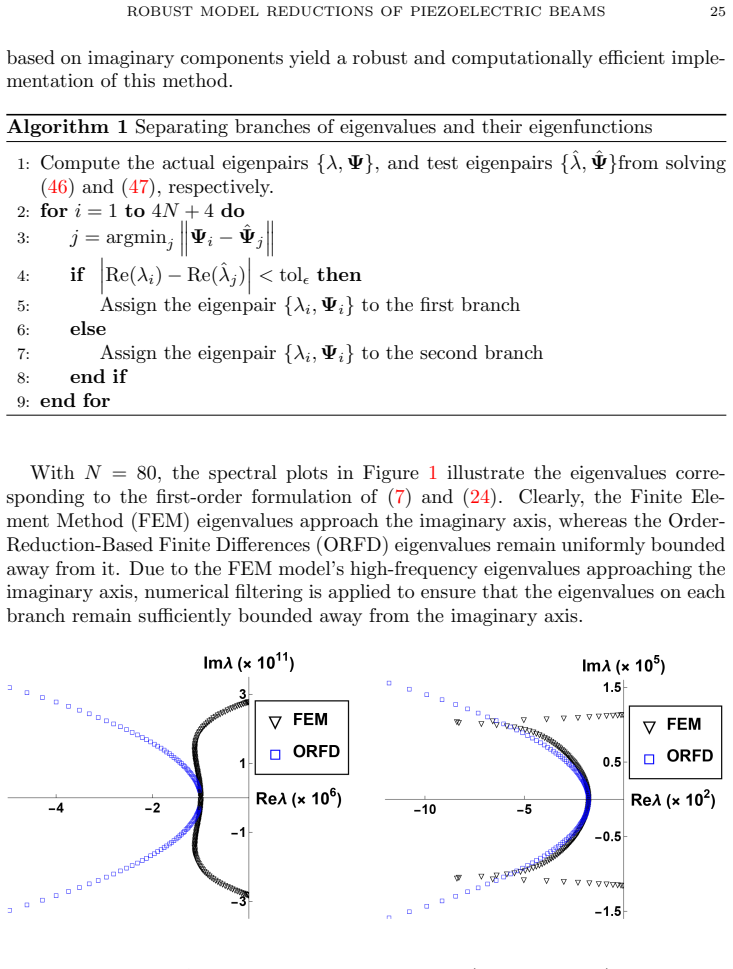
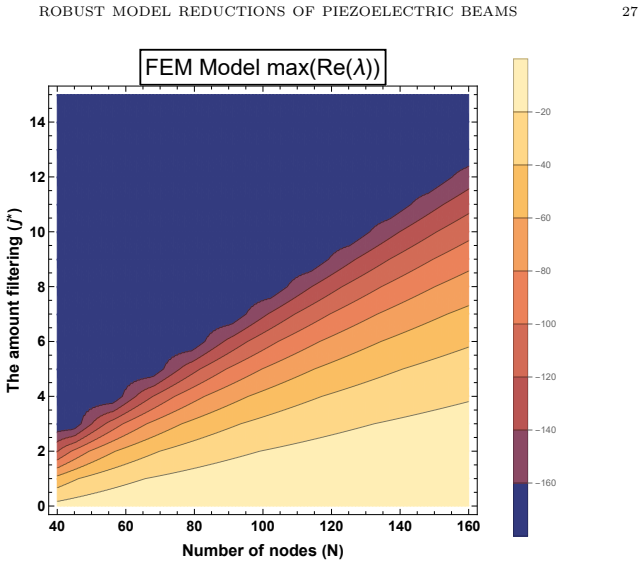
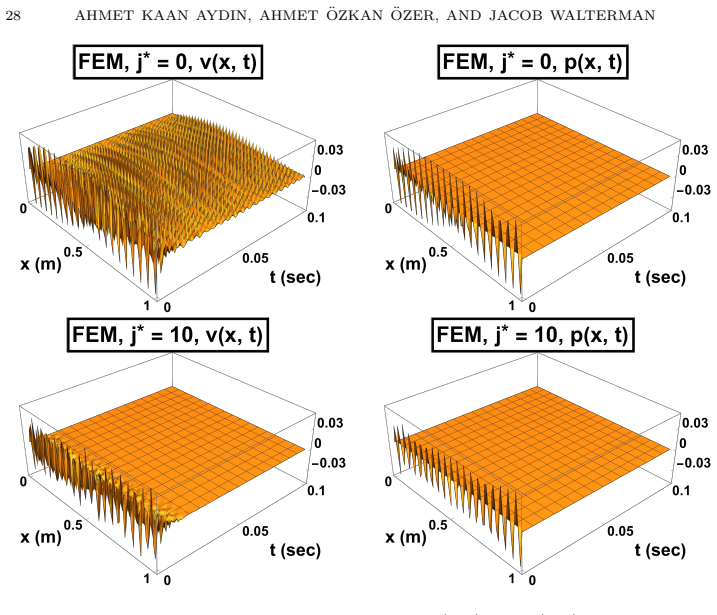
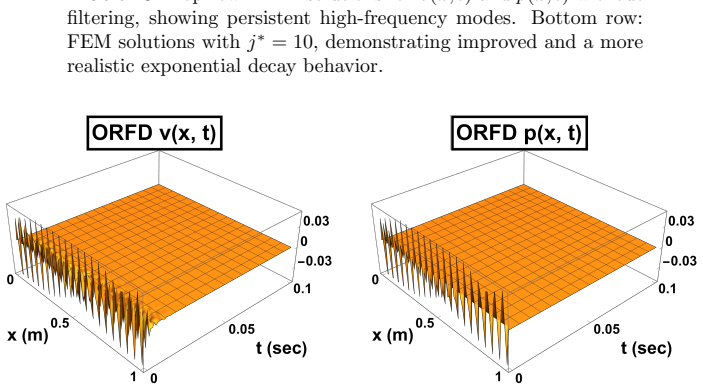
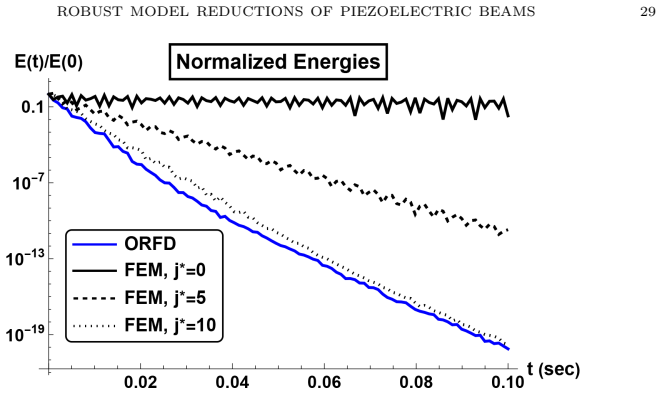
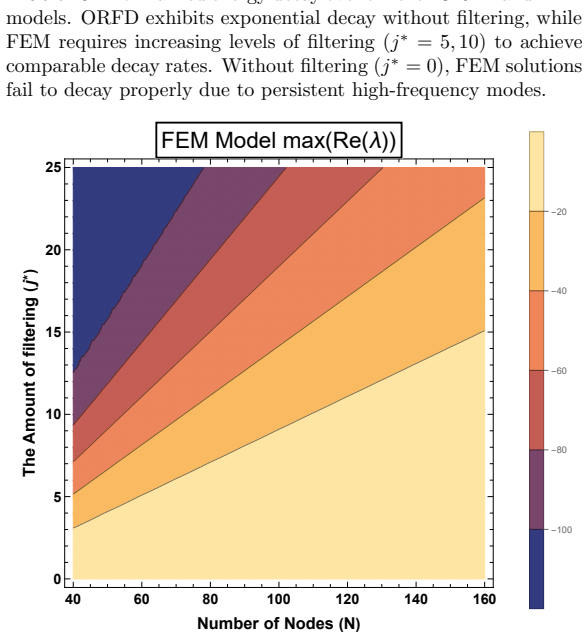
Magnetizable piezoelectric beams exhibit strong couplings between mechanical, electric, and magnetic fields, significantly affecting their high-frequency vibrational behavior. Ensuring exponential stability under boundary feedback controllers is challenging due to the uneven distribution of high-frequency eigenvalues in standard Finite Difference models. While numerical filtering can mitigate instability as the discretization parameter tends to zero, its reliance on explicit spectral computations is computationally demanding. This work introduces two novel model reduction techniques for stabilizing magnetizable piezoelectric beams. First, a Finite Element discretization using linear splines is developed, improving numerical stability over standard Finite Differences. However, this method still requires numerical filtering to eliminate spurious high-frequency modes, necessitating full spectral decomposition. Numerical investigations further reveal a direct dependence of the optimal filtering threshold on feedback amplifiers. To overcome these limitations, an alternative order-reduction Finite Difference scheme is proposed, eliminating the need for numerical filtering. Using a Lyapunov-based framework, we establish exponential stability with decay rates independent of the discretization parameter. The reduced model also exhibits exponential error decay and uniform energy convergence to the original system. Numerical simulations validate the effectiveness of the proposed methods, and we construct an algorithm for separating eigenpairs for the proper application of the numerical filtering. Comparative spectral analyses and energy decay results confirm the superior stability and efficiency of the proposed approach, providing a robust framework for model reduction in coupled partial differential equation systems.
Editorial analysis
A structured set of objections, weighed in public.
Referee Report
Summary. The paper develops two model reduction techniques for boundary feedback stabilization of magnetizable piezoelectric beams governed by coupled mechanical-electric-magnetic PDEs. A finite-element discretization based on linear splines is first introduced and shown to improve stability relative to standard finite differences, though it still requires numerical filtering of spurious high-frequency modes. An alternative order-reduction finite-difference scheme is then proposed that eliminates the need for filtering. Lyapunov analysis is used to establish exponential stability of the reduced model with decay rates independent of the discretization parameter h, together with exponential error decay between the reduced and full models and uniform energy convergence. Numerical simulations, spectral comparisons, and an algorithm for eigenpair separation are provided to validate the claims.
Significance. If the uniform-in-h Lyapunov estimates and convergence results hold, the work supplies a practical, filtering-free reduction framework for a class of strongly coupled PDE control problems where standard discretizations produce non-uniform high-frequency spectra. The explicit construction of a discretization-independent decay rate and the reported uniform energy convergence constitute concrete advances over existing filtering-based approaches that rely on full spectral decompositions.
minor comments (3)
- The abstract states that the optimal filtering threshold depends on the feedback amplifiers, yet the manuscript does not quantify this dependence or provide a systematic procedure for choosing the threshold when the FE method is used; a brief remark or table entry would clarify the practical scope of the first method.
- Notation for the discrete energy inner product and the precise form of the order-reduction operator should be introduced earlier (ideally in §2 or the beginning of §4) to make the subsequent Lyapunov derivative calculations easier to follow without repeated back-references.
- Figure captions for the energy-decay plots should explicitly state the values of the feedback gains and the range of h used, so that the claimed independence of the decay rate from h can be verified by the reader at a glance.
Simulated Author's Rebuttal
We thank the referee for the careful reading and positive assessment of our manuscript on robust model reductions for boundary feedback stabilization of magnetizable piezoelectric beams. The recommendation for minor revision is appreciated, and we note that no specific major comments were provided in the report. We will incorporate any minor editorial or presentational improvements in the revised version.
Circularity Check
No significant circularity detected
full rationale
The paper's central claims rely on a Lyapunov-based stability analysis applied to a structure-preserving order-reduction Finite Difference discretization of the coupled PDE system. Exponential stability with discretization-independent decay rates, error decay, and uniform energy convergence are established via energy estimates and dissipativity preservation, without any reduction of the target results to fitted parameters, self-definitions, or load-bearing self-citations. The derivation chain remains self-contained against the continuous model and standard functional-analytic techniques.
Axiom & Free-Parameter Ledger
axioms (1)
- domain assumption The continuous magnetizable piezoelectric beam model is well-posed and exponentially stabilizable by boundary feedback.
Reference graph
Works this paper leans on
-
[1]
M. Akil, S. Nicaise, A. ¨O. ¨Ozer, and H. Saleh. Advancing insights into the stabilization of novel serially-connected magnetizable piezoelectric and elastic beams. SIAM Journal on Control and Optimization , 2025. in print
work page 2025
-
[2]
M. Akil, A. O. ¨Ozer, A. Ramos, and H. Wilson. Stability results for novel serially-connected magnetizable piezoelectric and elastic smart-system designs. Applied Mathematics & Opti- mization, 89(3):64, 2024
work page 2024
-
[3]
A. K. Aydın, M. Z. Haider, and A. ¨O. ¨Ozer. A new semi-discretization of the fully clamped euler-bernoulli beam preserving boundary observability uniformly. IEEE Control Systems Letters, 2024
work page 2024
-
[4]
A. K. Aydın, A. ¨O. ¨Ozer, and J. Walterman. A novel finite difference-based model reduction and a sensor design for a multilayer smart beam with arbitrary number of layers.IEEE Control Systems Letters, 7:1548–1553, 2023
work page 2023
-
[5]
H. T. Banks. A functional analysis framework for modeling, estimation and control in science and engineering. CRC Press, 2012
work page 2012
-
[6]
H. T. Banks, K. Ito, and C. Wang. Exponentially stable approximations of weakly damped wave equations. In Estimation and Control of Distributed Parameter Systems: Proceedings of an International Conference on Control and Estimation of Distributed Parameter Systems, Vorau, July 8–14, 1990 , pages 1–33. Springer, 1991
work page 1990
-
[7]
C. Baur, D. J. Apo, D. Maurya, S. Priya, and W. Voit. Advances in piezoelectric polymer composites for vibrational energy harvesting. In Polymer composites for energy harvesting, conversion, and storage, pages 1–27. ACS Publications, 2014
work page 2014
-
[8]
A. Darinskii, E. Le Clezio, and G. Feuillard. The role of electromagnetic waves in the reflection of acoustic waves in piezoelectric crystals. Wave Motion, 45(4):428–444, 2008. ROBUST MODEL REDUCTIONS OF PIEZOELECTRIC BEAMS 31
work page 2008
-
[9]
M. C. de Jong, K. C. Kosaraju, and J. M. Scherpen. On control of voltage-actuated piezoelec- tric beam: A krasovskii passivity-based approach. European Journal of Control , 69:100724, 2023
work page 2023
-
[10]
H. El Boujaoui, H. Bouslous, and L. Maniar. Boundary stabilization for 1-d semi-discrete wave equation by filtering technique. Bull. TICMI , 17(1):1–18, 2013
work page 2013
-
[11]
B. Feng and A. ¨O. ¨Ozer. Exponential stability results for the boundary-controlled fully- dynamic piezoelectric beams with various distributed and boundary delays. Journal of Math- ematical Analysis and Applications , 508(1):125845, 2022
work page 2022
-
[12]
B. Feng and A. ¨O. ¨Ozer. Long-time behavior of a nonlinearly damped rao-nakra sandwich beam. Applied Mathematics and Optimization , 87:Article number: 19 (52 pages), 2023
work page 2023
-
[13]
B. Feng and A. ¨O. ¨Ozer. Stability results for piezoelectric beams with long-range memory effects in the boundary. Mathematische Nachrichten, 296(9):4206–4235, 2023
work page 2023
-
[14]
M. Freitas, A. ¨O. ¨Ozer, and A. Ramos. Long time dynamics and upper semi-continuity of attractors for piezoelectric beams with nonlinear boundary feedback. ESAIM: Control, Opti- misation and Calculus of Variations , 28:39, 2022
work page 2022
-
[15]
J. A. Infante and E. Zuazua. Boundary observability for the space semi-discretizations of the 1–d wave equation. ESAIM: Mathematical Modelling and Numerical Analysis, 33(2):407–438, 1999
work page 1999
-
[16]
A. Kong, C. Nonato, W. Liu, M. J. d. Santos, and C. Raposo. Equivalence between exponential stabilization and observability inequality for magnetic effected piezoelectric beams with time- varying delay and time-dependent weights.Discrete & Continuous Dynamical Systems-Series B, 27(6), 2022
work page 2022
-
[17]
L. Le´ on and E. Zuazua. Boundary controllability of the finite-difference space semi- discretizations of the beam equation. ESAIM: Control, Optimisation and Calculus of Varia- tions, 8:827–862, 2002
work page 2002
-
[18]
P. Lissy and I. Rovent ¸a. Optimal filtration for the approximation of boundary controls for the one-dimensional wave equation using a finite-difference method.Mathematics of Computation, 88(315):273–291, 2019
work page 2019
-
[19]
J. Liu and B.-Z. Guo. A novel semi-discrete scheme preserving uniformly exponential stability for an euler–bernoulli beam. Systems & Control Letters , 134:104518, 2019
work page 2019
-
[20]
J. Liu and B.-Z. Guo. A new semidiscretized order reduction finite difference scheme for uniform approximation of one-dimensional wave equation. SIAM Journal on Control and Optimization, 58(4):2256–2287, 2020
work page 2020
-
[21]
J. Liu and B.-Z. Guo. Uniformly semidiscretized approximation for exact observability and controllability of one-dimensional euler–bernoulli beam. Systems & Control Letters , 156:105013, 2021
work page 2021
-
[22]
K. A. Morris and A. ¨O. ¨Ozer. Modeling and stabilizability of voltage-actuated piezoelectric beams with magnetic effects. SIAM Journal on Control and Optimization , 52(4):2371–2398, 2014
work page 2014
-
[23]
A. ¨O. ¨Ozer. Further stabilization and exact observability results for voltage-actuated piezoelec- tric beams with magnetic effects. Mathematics of Control, Signals, and Systems , 27(2):219– 244, 2015
work page 2015
-
[24]
A. ¨O. ¨Ozer. Modeling and controlling an active constrained layer (acl) beam actuated by two voltage sources with/without magnetic effects. IEEE Transactions on Automatic Control , 62(12):6445–6450, 2017
work page 2017
-
[25]
A. ¨O. ¨Ozer. Potential formulation for charge or current-controlled piezoelectric smart compos- ites and stabilization results: electrostatic versus quasi-static versus fully-dynamic approaches. IEEE Transactions on Automatic Control , 64(3):989–1002, 2018
work page 2018
-
[26]
A. ¨O. ¨Ozer. Uniform boundary observability of semi-discrete finite difference approximations of a rayleigh beam equation with only one boundary observation. In 2019 IEEE 58th Con- ference on Decision and Control (CDC) , pages 7708–7713. IEEE, 2019
work page 2019
-
[27]
A. ¨O. ¨Ozer. Stabilization results for well-posed potential formulations of a current- controlled piezoelectric beam and their approximations. Applied Mathematics & Optimiza- tion, 84(1):877–914, 2021
work page 2021
-
[28]
A. ¨O. ¨Ozer and A. K. Aydın. Robust-filtering of sensor data for the finite difference model reduction of a piezoelectric sandwich beam. In 2022 IEEE 61st Conference on Decision and Control (CDC), pages 6535–6541. IEEE, 2022. 32 AHMET KAAN AYDIN, AHMET ¨OZKAN ¨OZER, AND JACOB WALTERMAN
work page 2022
-
[29]
A. ¨O. ¨Ozer, A. K. Aydın, and R. Emran. Exponential stability and design of sensor feedback amplifiers for fast stabilization of magnetizable piezoelectric beam equations. IEEE Transac- tions on Automatic Control , 2024
work page 2024
- [30]
-
[31]
A. ¨O. ¨Ozer and W. Horner. Uniform boundary observability of finite difference approximations of non-compactly coupled piezoelectric beam equations. Applicable Analysis , 101(5):1571– 1592, 2022
work page 2022
-
[32]
A. ¨O. ¨Ozer and M. Khenner. An alternate numerical treatment for nonlinear pde models of piezoelectric laminates. In Active and Passive Smart Structures and Integrated Systems XIII , volume 10967, pages 441–460. SPIE, 2019
work page 2019
-
[33]
A. ¨O. ¨Ozer, U. Rasaq, and I. Khalilullah. Boundary output feedback stabilization for a novel magnetizable piezoelectric beam model. In IEEE American Control Conference (ACC), pages 3448–3453. IEEE, 2024
work page 2024
- [34]
- [35]
-
[36]
A. J. Ramos, C. S. Gon¸ calves, and S. S. Corrˆ ea Neto. Exponential stability and numerical treatment for piezoelectric beams with magnetic effect. ESAIM: Mathematical Modelling and Numerical Analysis, 52(1):255–274, 2018
work page 2018
-
[37]
R. C. Smith. Smart material systems: model development . SIAM, 2005
work page 2005
-
[38]
D. Tallarico, N. Movchan, A. Movchan, and M. Camposaragna. Propagation and filtering of elastic and electromagnetic waves in piezoelectric composite structures.Mathematical Methods in the Applied Sciences , 40(9):3202–3220, 2017
work page 2017
-
[39]
L. T. Tebou and E. Zuazua. Uniform boundary stabilization of the finite difference space discretization of the 1- d wave equation. Advances in Computational Mathematics , 26:337– 365, 2007
work page 2007
-
[40]
J. Walterman, A. K. Aydın, S. Leveridge, and A. ¨O. ¨Ozer. Dynamics of a longitudinal piezo- electric beam. Wolfram Demonstrations Project, 2023
work page 2023
-
[41]
J. Yang. Fully dynamic theory. In Special Topics in the Theory of Piezoelectricity , pages 247–280. Springer, 2009
work page 2009
-
[42]
H.-E. Zhang, G.-Q. Xu, and Z.-J. Han. Stability and eigenvalue asymptotics of multi- dimensional fully magnetic effected piezoelectric system with friction-type infinite memory. SIAM Journal on Applied Mathematics , 83(2):510–529, 2023
work page 2023
-
[43]
E. Zuazua. Controllability of partial differential equations . PhD thesis, Optimization and Control, 2006
work page 2006
discussion (0)
Sign in with ORCID, Apple, or X to comment. Anyone can read and Pith papers without signing in.