Quantum Physics · arXiv:2310.11505 v1 · submitted 17 Oct 2023 · 69 references
Showcasing a Barren Plateau Theory Beyond the Dynamical Lie Algebra
The paper says
“Barren plateaus have emerged as a pivotal challenge for variational quantum computing. Our understanding of this phenomenon underwent a transformative shift with the recent introduction of a Lie algebraic theory capable of explaining most sources of barren plateaus.”
more of the abstract
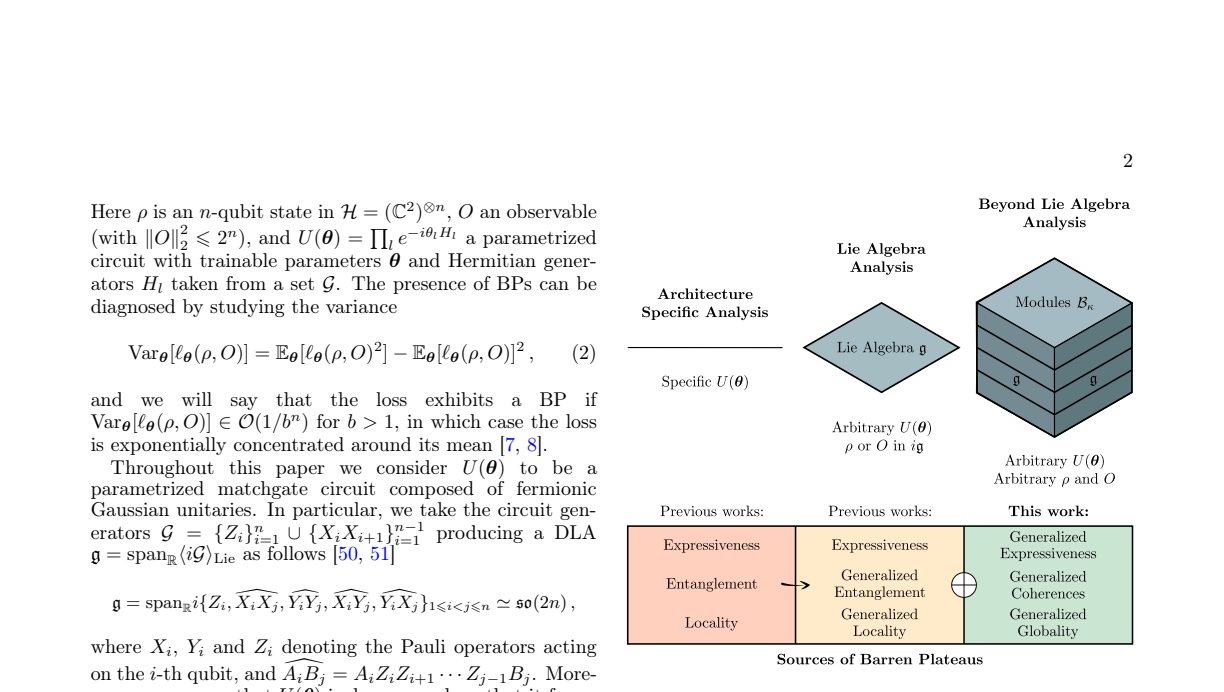
However, this theory requires either initial states or observables that lie in the circuit's Lie algebra. Focusing on parametrized matchgate circuits, in this work we are able to go beyond this assumption and provide an exact formula for the loss function variance that is valid for arbitrary input states and measurements. Our results reveal that new phenomena emerge when the Lie algebra constraint is relaxed. For instance, we find that the variance does not necessarily vanish inversely with the Lie algebra's dimension. Instead, this measure of expressiveness is replaced by a generalized expressiveness quantity: The dimension of the Lie group modules. By characterizing the operators in these modules as products of Majorana operators, we can introduce a precise notion of generalized globality and show that measuring generalized-global operators leads to barren plateaus. Our work also provides operational meaning to the generalized entanglement as we connect it with known fermionic entanglement measures, and show that it satisfies a monogamy relation. Finally, while parameterized matchgate circuits are not efficiently simulable in general, our results suggest that the structure allowing for trainability may also lead to classical simulability.
from the abstract
Pith says
Machine review · deepseek-v4.1-flash · 30 Oct 2026 · what was read was not recorded · not checked by a person
Reviewed in 2026 with later literature in view.
It can be wrong. Challenge this review or reply to it.
Holds up, with conditions. The exact variance formula for matchgate circuits with arbitrary states and measurements is real and well-derived; the 'monogamy' claim in the abstract is a sum rule dressed up as an inequality and should be fixed. This line is wrong
3 major objections · 7 minor
How often objections from reviews like this one are right: not yet measured
Not checked: figures, code, what the 69 references say.
The paper says, at Abstract (abstract:s8) and Discussion, paragraph on monogamy
The review did not quote this passage.
Pith says: Objection 1 of 3 · major
The abstract states that the generalized entanglement 'satisfies a monogamy relation,' and the Discussion supports this with the identity sum_{κ=0}^{2n} P_κ(ρ)=Tr[ρ²]/2^n, arguing that if some P_κ are small others must be large. As written this is a partition-of-unity/orthogonality identity, not a monogamy inequality of the Coffman–Kundu–Wootters type, which constrains how entanglement can be shared among complementary subsystems.
more of objection 1
The manuscript does not state an inequality relating purities across a partition of the system, nor does it derive one from the fermionic entanglement measure of Sec. VII. The word 'monogamy' in the abstract therefore overstates what is proven. This is load-bearing for one of the four advertised results (abstract:s8), so it should either be substantiated with an actual inequality or reframed as a sum rule / trade-off relation. The central variance formula is unaffected.
The paper says, at Background, 2-design assumption; Fig. 2 caption
The review did not quote this passage.
Pith says: Objection 2 of 3 · major
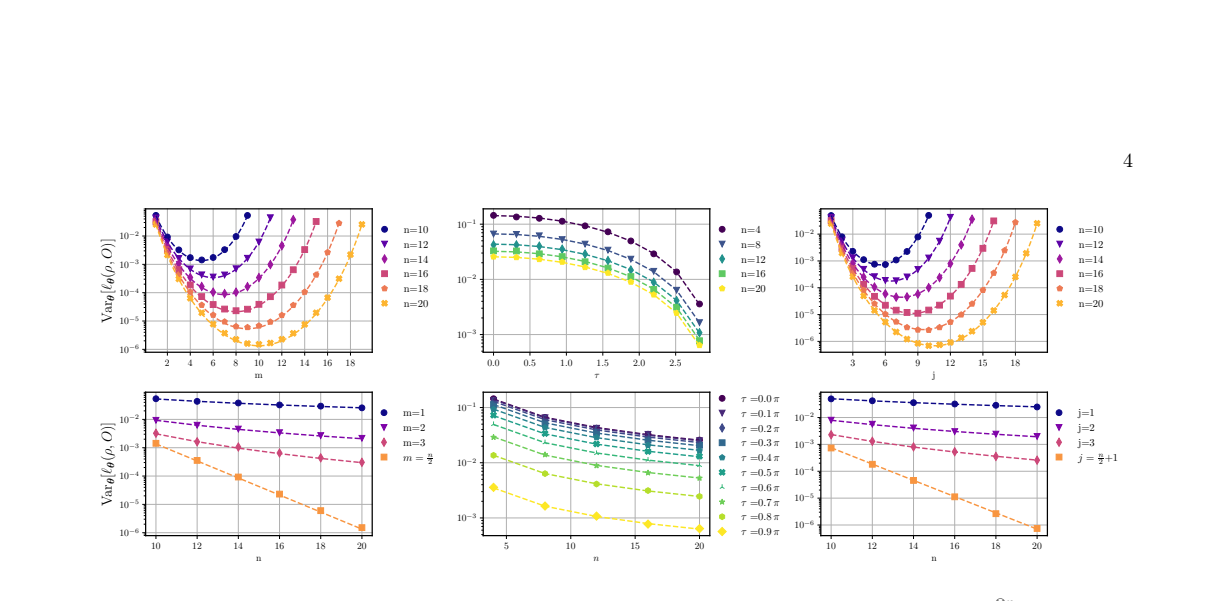
The exact variance formula relies on U(θ) forming a 2-design over G, stated in the Background with a citation to Theorem 2 of Ref. [41]. The numerical simulations use L=n² layers 'to ensure good convergence to an approximate 2-design,' but no quantitative bound on the deviation from an exact 2-design is given, and the agreement between the dashed analytic curves and the dots is presented as confirmation.
more of objection 2
Since the paper's central claim is an exact formula, it would strengthen the work to state explicitly how the finite-depth deviation enters the variance (e.g., a bound in terms of the 2-design gap) or, at minimum, to show empirically that the variance is stable as L is increased beyond n². This is a correctness-risk concern about the scope of 'exact,' not a challenge to the derivation under the stated assumption.
The paper says, at Sec. VIII C (magic states) and Sec. IX
The review did not quote this passage.
Pith says: Objection 3 of 3 · major
The claim that the magic-state model is 'trainable for any π−τ ∈ Ω(1/poly(n))' is supported by Var = n cos²(τ/2)/dim(g), which is polynomially small only when cos²(τ/2) is not exponentially small. The subsequent discussion in Sec. IX then argues that trainability may coincide with classical simulability, invoking g-sim and the exponential extent ξ=[1+sin(τ/2)]^{n/4}.
more of objection 3
The simulability argument is explicitly presented as a conjecture/open direction, which is appropriate, but the text should be careful not to let the variance formula alone carry the trainability claim: a polynomially small variance still requires polynomially many shots, and the optimization landscape statement is about concentration, not about convergence of a particular optimizer. I recommend tightening the language so that 'trainable' is clearly tied to the variance criterion used throughout the paper.
7 minor objections
The paper says, at Abstract and Fig. 1
Pith says: minor objection 1 of 7
The phrase 'generalized globality' is introduced via κ mod n, but the modulo convention is only explained in the Results section; a one-sentence definition in the abstract or Fig. 1 caption would help the reader.
The paper says, at Corollary 1
Pith says: minor objection 2 of 7
The statement excludes κ=n; it would be useful to note explicitly that for κ=n the coherence term can be nonzero and is handled by Theorem 1, so the reader does not mistake the exclusion for an oversight.
show 5 more
The paper says, at Theorem 1, Eq. (5)
Pith says: minor objection 3 of 7
The notation ⟨M_1,M_2⟩_Γ = Tr[Γ M_1† M_2] is defined after it is used in Eqs. (4)–(5); moving the definition earlier would improve readability.
The paper says, at Sec. VII, Supplemental Lemma 12
Pith says: minor objection 4 of 7
The relation P_g(ρ)=(n−S_2(ρ))/d is a nice result; it would be worth stating in the main text as a displayed equation, since it is the operational bridge between the variance and fermionic entanglement.
The paper says, at Fig. 2
Pith says: minor objection 5 of 7
The three panels use different horizontal variables (m, τ, j) and different vertical ranges; adding a common annotation of which module B_κ is being probed in each panel would make the figure self-contained.
The paper says, at References
Pith says: minor objection 6 of 7
Refs. [40] and [41] are cited as arXiv preprints; given that the present work builds directly on their framework, the authors may wish to note whether those results have since appeared in a journal.
The paper says, at Sec. IX
Pith says: minor objection 7 of 7
The sentence 'If having low fermionic entanglement always allows for an efficient classical method... there seems to be no room for quantum advantage' is appropriately hedged, but the logical status of the implication could be stated more explicitly as a conjecture.
What would settle it
Check whether the relation sum_{κ=0}^{2n} P_κ(ρ) = Tr[ρ^2]/2^n is a nontrivial inequality or just a sum rule. If it is just a sum rule, the monogamy claim should be reframed as a partition-of-unity identity. A concrete check: compute the generalized purities P_κ(ρ) for a state that is highly entangled in one module and see whether the relation imposes any constraint beyond the sum rule. If no additional constraint is found, the monogamy claim is an overclaim.
from the skeptic's reading
How the review went
4 readings by deepseek-v4.1-flash · 30 Oct 2026
- Reader holds up, with conditions
- Skeptic partly agrees
- Editor wrote the verdict above
- Referee minor revision: 3 major objections, 7 minor
Not run on this paper: the simulated authors' defence.
Pith did not check this review's objections against the paper.
The review in full
The review in brief, machine-written
The thing worth your time here is Theorem 1: an exact closed-form variance for parametrized matchgate circuits that holds for any input state and any observable, not just those living in the DLA. That genuinely extends Ragone et al. and Fontana et al., and the derivation is not hand-wavy. Supplemental Theorem 2 gives an explicit orthonormal basis for the quadratic symmetries of the matchgate DLA, which is the technical engine, and it looks correct. The numerics in Fig. 2 track the analytic curves across three quite different regimes, including a magic state with exponential extent. The bridge to Gigena-Rossignoli fermionic entanglement (Lemma 12, Pg = (n - S2)/d) is a clean piece of work and gives the module purities real operational content. The Xj versus Zj example is a nice concrete punchline: one extra rotation at the end of the circuit turns a trainable loss into a barren one. That is the kind of statement people will quote. On the soft spots: the abstract's claim that the generalized entanglement 'satisfies a monogamy relation' does not survive contact with the Discussion. What is actually shown is that sum_kappa P_kappa(rho) = Tr[rho2]/2n, i.e. the module purities partition the total purity. That is an orthogonality identity, not a monogamy inequality of the Coffman-Kundu-Wootters type. It is a framing problem in one sentence, not a load-bearing error, but it should be corrected or reframed before this circulates. The classical-simulability discussion in Sec. IX is speculative, and the authors say so ('by no means complete or thorough'), so I would not hold it against them, but it should not be read as a result. The 2-design assumption is stated explicitly and is fine; the L = n2 layers in the simulations is a reasonable proxy. The 'generalized globality' notion is somewhat definitional (kappa mod n small versus large), but it does produce falsifiable predictions, so I will not call it empty. Who should read it: anyone working on barren plateaus, and anyone thinking about matchgate/fermionic variational models. It deserves a serious referee. Send it out, and ask the referee specifically about the monogamy sentence and about whether the module-dimension expressiveness claim can be pushed beyond matchgates.
The strongest objection
The paper claims (abstract:s8) that the generalized entanglement 'satisfies a monogamy relation.' The supporting argument in the Discussion is that sum_{κ=0}^{2n} P_κ(ρ) = Tr[ρ^2]/2^n, so if some P_κ are small, others must be large. This is a partition of the total purity into modules, not a monogamy inequality. A true monogamy relation (e.g., C(A:BC) ≥ C(A:B) + C(A:C)) restricts how entanglement can be distributed among subsystems; it is not a sum rule. The paper's relation is a trivial consequence of the orthogonality of the modules, not a nontrivial constraint. This overclaim should be corrected or reframed. The central variance formula (Theorem 1) is not affected by this issue; it is well-supported under the stated 2-design assumption.
The central formula is well-supported. The 2-design assumption is acknowledged. The monogamy overclaim is a real issue that should be corrected. The classical simulability discussion is speculative but acknowledged. I agree with the reader's verdict (CONDITIONAL) but I think the load-bearing concern is the monogamy overclaim, not the 2-design assumption. The 2-design assumption is a limitation, not a flaw. The monogamy overclaim is a correctness issue.
The referee's report
If correct, the result is a genuine extension of the Lie-algebraic barren-plateau theory of Refs. [40,41]: it removes the assumption that the state or observable lies in the DLA and replaces dim(g) by the module dimension as the expressiveness quantity. The explicit commutant basis (Supplemental Theorem 1 and 2) is a reusable technical contribution, and the identification of P_2 with a known fermionic entanglement entropy gives operational meaning to the generalized entanglement. The paper is carefully organized, the derivations are given in the Supplemental Information, and the numerical checks in Fig. 2 are consistent with the closed forms. The discussion of trainability versus simulability is speculative but clearly framed as an open question rather than a claim.
Pith's reading of the paper (a machine's summary, not the authors')
The paper asks why variational quantum circuits sometimes flatten into barren plateaus, loss landscapes so flat that training gradients vanish, and gives an exact answer for one family: parametrized matchgate circuits, the qubit circuits equivalent to fermionic Gaussian operations. Earlier Lie-algebraic theory could predict the variance only when the initial state or measured observable lived inside the circuit's dynamical Lie algebra. The authors remove that restriction by decomposing all operators into modules labelled by the number of Majorana factors, then summing purity and coherence terms divided by module dimension. The payoff is a sharper expressiveness measure: a measurement spread across a large module produces an exponentially small variance even when the algebra dimension alone would not predict it. The same decomposition gives generalized entanglement an operational fermionic meaning and a monogamy bound.
What carries the argument. The load-bearing mechanism is a decomposition of the full operator space into invariant modules $mathcal B=bigoplus_{kappa=0}^{2n}mathcal B_kappa$, where $mathcal B_kappa$ is spanned by products of $kappa$ distinct Majorana operators, those $2n$ Pauli strings that anticommute pairwise. Each module is invariant under the matchgate group, and the commutant of the tensor-square representation has a basis indexed by these modules. That basis lets the authors evaluate the Haar average over the circuit group with Weingarten calculus and obtain a closed variance formula in terms of module-resolved purities and coherences. The same structure turns generalized globality into a precise statement: an observable with many Majorana factors lives in a large module and therefore has a small variance.
Core claim. For a loss $ell_theta(rho,O)=operatorname{Tr}[U(theta)rho U^dagger(theta)O]$ with $U$ a deep parametrized matchgate circuit, the variance over parameters is exactly $operatorname{Var}_theta[ell_theta(rho,O)]=sum_{kappa=1}^{2n-1}frac{mathcal P_kappa(rho)mathcal P_kappa(O)+mathcal C_kappa(rho)mathcal C_kappa(O)}{dim(mathcal B_kappa)}$. Here $mathcal B_kappa$ is the module spanned by products of $kappa$ distinct Majorana operators, $dim(mathcal B_kappa)=binom{2n}{kappa}$, $mathcal P_kappa$ is the $kappa$-purity, and $mathcal C_kappa$ is the $kappa$-coherence. The mean is carried only by $kappa=0$ and $kappa=2n$. When $O$ lies in a single module $mathcal B_kappa$, the variance reduces to $mathcal P_kappa(rho)mathcal P_kappa(O)/dim(mathcal B_kappa)$, so the relevant expressiveness is the module dimension, not the dynamical Lie algebra dimension. For $kappa$ not equal to $2$ or $2n-2$, this contradicts the earlier conjecture that variance scales inversely with $dim(mathfrak g)$. Operators built from many Majoranas are called generalized-global and are shown to produce barren plateaus. For the algebra module $kappa=2$, the generalized purity is tied to fermionic entanglement entropy, $mathcal P_2(rho)=(n-S_2(rho))/d$, so more fermionic entanglement means smaller variance, and the module purities satisfy a monogamy relation $sum_{kappa=0}^{2n}mathcal P_kappa(rho)=operatorname{Tr}[rho^2]/2^n$.
The premise it rests on. The exact variance formula assumes the circuit is deep enough to form a 2-design over the matchgate group, so that parameter averaging can be replaced by a Haar average.
If the paper is right (Pith's inferences, not the authors')
For matchgate circuits, the expressiveness that predicts a barren plateau is the dimension of the operator module, not the dimension of the dynamical Lie algebra.
An observable built from many Majorana factors can induce a barren plateau even when it looks local in the qubit layout, because generalized globality is measured by Majorana weight.
The generalized entanglement appearing in the variance is connected to fermionic entanglement entropy, and the module purities satisfy a monogamy relation bounded by the state's purity.
A single extra qubit rotation can move a measurement between modules and turn a loss with no barren plateau into one with a barren plateau.
The authors suggest that the same structure enabling trainability in these models may also enable classical simulation, though they present this as an open direction rather than a proof.
Editorial inference: if module dimension is the right expressiveness measure for matchgate circuits, the same commutator-graph decomposition could be tested in other Pauli-string dynamical Lie algebras to see whether module-resolved barren-plateau predictions carry over.
Editorial inference: the monogamy relation suggests module purities could be used as entanglement witnesses, so a variational model that concentrates weight in a few large modules may be both trainable and classically simulable.
Editorial inference: the qubit-to-fermion dictionary gives practitioners a design rule for loss functions, namely choose observables by Majorana weight rather than by spatial locality when trying to avoid barren plateaus.
Check this review
Pith stored no record of this review's passes and took no fingerprint of it. Reviews made by code from 13 Nov 2026 on carry both.
How often reviews like this one are right
Reviews like this one: written by deepseek-v4.1-flash, where what was read was not recorded.
How often objections from reviews like this one are right: not yet measured
Reviews by people
This review was written by a machine. No person has reviewed this paper on Pith yet. A scientist listed on Pith can review it for a fee, and their review is published here whatever it concludes.
The paper
Abstract
Barren plateaus have emerged as a pivotal challenge for variational quantum computing. Our understanding of this phenomenon underwent a transformative shift with the recent introduction of a Lie algebraic theory capable of explaining most sources of barren plateaus. However, this theory requires either initial states or observables that lie in the circuit's Lie algebra. Focusing on parametrized matchgate circuits, in this work we are able to go beyond this assumption and provide an exact formula for the loss function variance that is valid for arbitrary input states and measurements. Our results reveal that new phenomena emerge when the Lie algebra constraint is relaxed. For instance, we find that the variance does not necessarily vanish inversely with the Lie algebra's dimension. Instead, this measure of expressiveness is replaced by a generalized expressiveness quantity: The dimension of the Lie group modules. By characterizing the operators in these modules as products of Majorana operators, we can introduce a precise notion of generalized globality and show that measuring generalized-global operators leads to barren plateaus. Our work also provides operational meaning to the generalized entanglement as we connect it with known fermionic entanglement measures, and show that it satisfies a monogamy relation. Finally, while parameterized matchgate circuits are not efficiently simulable in general, our results suggest that the structure allowing for trainability may also lead to classical simulability.
The paper's own sentences, arranged, kept beside the review and separate from it. Each label is drawn from a closed vocabulary; the number beside it is the probability the classifier gave that label. No sentence in this record was written by a model.
abstract compiled · 2026-09-23
The authors' main claim, as the classifier picked it out 0.48
“Our results reveal that new phenomena emerge when the Lie algebra constraint is relaxed.”
How the main claim is stated: asserted 0.97
What the abstract itself states, as probabilities: claims first 0.09 · states limitation 0.92 · human participants 0.02 · controlled comparison 0.10 · randomized assignment 0.01 · states quantitative result 0.31 · compares with prior results 0.88 · mentions code or data availability 0.02
The abstract, sentence by sentence
This table labels the abstract only (arXiv listing abstract v1). The number is the probability the classifier gave the label.
| Sentence | Role | The authors' own work | States the main conclusion | Strength |
|---|---|---|---|---|
| Barren plateaus have emerged as a pivotal challenge for variational quantum computing. | background 1.00 | 0.04 | 0.02 | asserted 1.00 |
| Our understanding of this phenomenon underwent a transformative shift with the recent introduction of a Lie algebraic theory capable of explaining most sources of barren plateaus. | background 1.00 | 0.05 | 0.04 | asserted 1.00 |
| However, this theory requires either initial states or observables that lie in the circuit's Lie algebra. | gap 0.67 | 0.05 | 0.04 | asserted 1.00 |
| Focusing on parametrized matchgate circuits, in this work we are able to go beyond this assumption and provide an exact formula for the loss function variance that is valid for arbitrary input states and measurements. | contribution 1.00 | 0.96 | 0.35 | asserted 1.00 |
| Our results reveal that new phenomena emerge when the Lie algebra constraint is relaxed. | result 0.79 | 0.84 | 0.19 | asserted 0.97 |
| For instance, we find that the variance does not necessarily vanish inversely with the Lie algebra's dimension. | result 0.98 | 0.94 | 0.12 | asserted 0.84 |
| Instead, this measure of expressiveness is replaced by a generalized expressiveness quantity: The dimension of the Lie group modules. | result 0.72 | 0.89 | 0.23 | asserted 1.00 |
| By characterizing the operators in these modules as products of Majorana operators, we can introduce a precise notion of generalized globality and show that measuring generalized-global operators leads to barren plateaus. | result 0.61 | 0.93 | 0.19 | asserted 1.00 |
| Our work also provides operational meaning to the generalized entanglement as we connect it with known fermionic entanglement measures, and show that it satisfies a monogamy relation. | result 0.64 | 0.91 | 0.07 | asserted 1.00 |
| Finally, while parameterized matchgate circuits are not efficiently simulable in general, our results suggest that the structure allowing for trainability may also lead to classical simulability. | interpretation 0.78 | 0.50 | 0.12 | hedged possibility 1.00 |
What kind of paper the classifier reports this is: theoretical result 1.00 · evidence from proof or derivation 1.00
What was examined, and what was not
Sources read
- arXiv listing abstract v1
Not examined
- full text
- figures and tables
- references and citing sentences
- relations to other papers
Levels run
- P abstract
Not run
- S sections
- T body sentences
- C citations
- R cross-paper relations
How the labels were made
Compiled by classifier-1.13.0 via TypeSafe API, question bank abstract-p1-20260923, 2026-09-23: 1 request, 7,553 input tokens.
Every quoted sentence on this record is the authors'. Every label is from Pith's closed vocabulary, with the probability shown beside it. This record as JSON
Figures (2)
Figures are the authors', reproduced from the paper.
References (69)
- [41] M. Ragone, B. N. Bakalov, F. Sauvage, A. F. Kemper, C. O. Marrero, M. Larocca, and M. Cerezo, A unified the- ory of barren plateaus for deep parametrized quantum cir- cuits, arXiv preprint arXiv:2309.09342 (2023) on PithPith's reviewarXiv
- [1] M. Cerezo, A. Arrasmith, R. Babbush, S. C. Benjamin, S. Endo, K. Fujii, J. R. McClean, K. Mitarai, X. Yuan, L. Cincio, and P. J. Coles, Variational quantum algorithms, Nature Reviews Physics3, 625–644 (2021). 6 on Pith
- [2] K. Bharti, A. Cervera-Lierta, T. H. Kyaw, T. Haug, S. Alperin-Lea, A. Anand, M. Degroote, H. Heimonen, J. S. Kottmann, T.Menke, et al.,Noisyintermediate-scalequan- tum algorithms, Reviews of Modern Physics 94, 015004 (2022) on Pith
- [3] S. Endo, Z. Cai, S. C. Benjamin, and X. Yuan, Hybrid quantum-classical algorithms and quantum error mitiga- tion, Journal of the Physical Society of Japan90, 032001 (2021) on Pith
- [4] M. Schuld, I. Sinayskiy, and F. Petruccione, An introduc- tion to quantum machine learning, Contemporary Physics 56, 172 (2015) on Pith
- [5] J. Biamonte, P. Wittek, N. Pancotti, P. Rebentrost, N. Wiebe, and S. Lloyd, Quantum machine learning, Na- ture 549, 195 (2017) on Pith
- [6] V. Havlíček, A. D. Córcoles, K. Temme, A. W. Harrow, A. Kandala, J. M. Chow, and J. M. Gambetta, Super- vised learning with quantum-enhanced feature spaces, Na- ture 567, 209 (2019) on Pith
- [7] J. R. McClean, S. Boixo, V. N. Smelyanskiy, R. Babbush, and H. Neven, Barren plateaus in quantum neural network training landscapes, Nature Communications9, 1 (2018) on Pith
- [8] M. Cerezo, A. Sone, T. Volkoff, L. Cincio, and P. J. Coles, Cost function dependent barren plateaus in shal- low parametrized quantum circuits, Nature Communica- tions 12, 1 (2021) on Pith
- [9] C.O.Marrero, M.Kieferová,andN.Wiebe,Entanglement- induced barren plateaus, PRX Quantum2, 040316 (2021) on Pith
- [10] K. Sharma, M. Cerezo, L. Cincio, and P. J. Coles, Train- ability of dissipative perceptron-based quantum neural net- works, Physical Review Letters128, 180505 (2022) on Pith
- [11] T. L. Patti, K. Najafi, X. Gao, and S. F. Yelin, Entangle- ment devised barren plateau mitigation, Physical Review Research 3, 033090 (2021) on Pith
- [12] A. Pesah, M. Cerezo, S. Wang, T. Volkoff, A. T. Sorn- borger,andP.J.Coles,Absenceofbarrenplateausinquan- tum convolutional neural networks, Physical Review X11, 041011 (2021) on Pith
- [13] A. Uvarov and J. D. Biamonte, On barren plateaus and cost function locality in variational quantum algorithms, Journal of Physics A: Mathematical and Theoretical54, 245301 (2021) on Pith
- [14] M.CerezoandP.J.Coles,Higherorderderivativesofquan- tum neural networks with barren plateaus, Quantum Sci- ence and Technology6, 035006 (2021) on Pith
- [15] A. Uvarov, J. D. Biamonte, and D. Yudin, Variational quantumeigensolverforfrustratedquantumsystems,Phys- ical Review B102, 075104 (2020) on Pith
- [16] S. Wang, E. Fontana, M. Cerezo, K. Sharma, A. Sone, L. Cincio, and P. J. Coles, Noise-induced barren plateaus in variational quantum algorithms, Nature Communications 12, 1 (2021) on Pith
- [17] A. Abbas, D. Sutter, C. Zoufal, A. Lucchi, A. Figalli, and S. Woerner, The power of quantum neural networks, Na- ture Computational Science1, 403 (2021) on Pith
- [18] A. Arrasmith, Z. Holmes, M. Cerezo, and P. J. Coles, Equivalence of quantum barren plateaus to cost concentra- tion and narrow gorges, Quantum Science and Technology 7, 045015 (2022) on Pith
- [19] M. Larocca, P. Czarnik, K. Sharma, G. Muraleedharan, P. J. Coles, and M. Cerezo, Diagnosing Barren Plateaus with Tools from Quantum Optimal Control, Quantum6, 824 (2022) on Pith
show 49 more
- [20] Z. Liu, L.-W. Yu, L.-M. Duan, and D.-L. Deng, The pres- ence and absence of barren plateaus in tensor-network based machine learning, Physical Review Letters 129, 270501 (2022) on Pith
- [21] Z. Holmes, K. Sharma, M. Cerezo, and P. J. Coles, Con- necting ansatz expressibility to gradient magnitudes and barren plateaus, PRX Quantum3, 010313 (2022) on Pith
- [22] C. Zhao and X.-S. Gao, Analyzing the barren plateau phe- nomenon in training quantum neural networks with the ZX-calculus, Quantum5, 466 (2021) on Pith
- [23] M. Kieferova, O. M. Carlos, and N. Wiebe, Quantum gen- erative training using rényi divergences, arXiv preprint arXiv:2106.09567 (2021) on PithPith's reviewarXiv
- [24] S. Thanaslip, S. Wang, N. A. Nghiem, P. J. Coles, and M. Cerezo, Subtleties in the trainability of quantum ma- chine learning models, Quantum Machine Intelligence5, 21 (2023) on Pith
- [25] J. Lee, A. B. Magann, H. A. Rabitz, and C. Arenz, Progress toward favorable landscapes in quantum combinatorial op- timization, Physical Review A104, 032401 (2021) on Pith
- [26] R. Shaydulin and S. M. Wild, Importance of kernel band- width in quantum machine learning, Physical Review A 106, 042407 (2022) on Pith
- [27] Z. Holmes, A. Arrasmith, B. Yan, P. J. Coles, A. Albrecht, and A. T. Sornborger, Barren plateaus preclude learning scramblers, Physical Review Letters126, 190501 (2021) on Pith
- [28] C. Leadbeater, L. Sharrock, B. Coyle, and M. Benedetti, F-divergences and cost function locality in generative mod- elling with quantum circuits, Entropy23, 1281 (2021) on Pith
- [29] E. C. Martín, K. Plekhanov, and M. Lubasch, Barren plateaus in quantum tensor network optimization, arXiv preprint arXiv:2209.00292 (2022) on PithPith's reviewarXiv
- [30] H. R. Grimsley, N. J. Mayhall, G. S. Barron, E. Barnes, and S. E. Economou, Adaptive, problem-tailored vari- ational quantum eigensolver mitigates rough parameter landscapes and barren plateaus, npj Quantum Information 9, 19 (2023) on Pith
- [31] L. Leone, S. F. Oliviero, L. Cincio, and M. Cerezo, On the practical usefulness of the hardware efficient ansatz, arXiv preprint arXiv:2211.01477 (2022) on PithPith's reviewarXiv
- [32] S. H. Sack, R. A. Medina, A. A. Michailidis, R. Kueng, and M. Serbyn, Avoiding barren plateaus using classical shadows, PRX Quantum3, 020365 (2022) on Pith
- [33] M. Kashif and S. Al-Kuwari, The impact of cost function globality and locality in hybrid quantum neural networks on nisq devices, Machine Learning: Science and Technology 4, 015004 (2023) on Pith
- [34] L. Friedrich and J. Maziero, Quantum neural network cost function concentration dependency on the parametrization expressivity, Scientific Reports13, 9978 (2023). 7 on Pith
- [35] D. García-Martín, M. Larocca, and M. Cerezo, Deep quantum neural networks form gaussian processes, arXiv preprint arXiv:2305.09957 (2023) on PithPith's reviewarXiv
- [36] A. Kulshrestha and I. Safro, Beinit: Avoiding barren plateaus in variational quantum algorithms, in2022 IEEE International Conference on Quantum Computing and En- gineering (QCE) (IEEE, 2022) pp. 197–203 on Pith
- [37] T. J. Volkoff, Efficient trainability of linear optical modules in quantum optical neural networks, Journal of Russian Laser Research42, 250 (2021) on Pith
- [38] M. Kashif and S. Al-Kuwari, The unified effect of data encoding, ansatz expressibility and entanglement on the trainability of hqnns, International Journal of Parallel, Emergent and Distributed Systems38, 362 (2023) on Pith
- [39] L. Monbroussou, J. Landman, A. B. Grilo, R. Kukla, and E. Kashefi, Trainability and expressivity of hamming- weight preserving quantum circuits for machine learning, arXiv preprint arXiv:2309.15547 (2023) on PithPith's reviewarXiv
- [40] E. Fontana, D. Herman, S. Chakrabarti, N. Kumar, R. Yalovetzky, J. Heredge, S. Hari Sureshbabu, and M. Pistoia, The adjoint is all you need: Characteriz- ing barren plateaus in quantum ansätze, arXiv preprint arXiv:2309.07902 (2023) on PithPith's reviewarXiv
- [42] R. Jozsa and A. Miyake, Matchgates and classical simula- tion of quantum circuits, Proceedings of the Royal Society A: Mathematical, Physical and Engineering Sciences464, 3089 (2008) on Pith
- [43] K.Wan, W.J.Huggins, J.Lee,andR.Babbush,Matchgate shadows for fermionic quantum simulation, arXiv preprint arXiv:2207.13723 (2022) on PithPith's reviewarXiv
- [44] F. De Melo, P. Ćwikliński, and B. M. Terhal, The power of noisy fermionic quantum computation, New Journal of Physics 15, 013015 (2013) on Pith
- [45] M. Oszmaniec, N. Dangniam, M. E. Morales, and Z. Zim- borás, Fermion sampling: a robust quantum computational advantage scheme using fermionic linear optics and magic input states, PRX Quantum3, 020328 (2022) on Pith
- [46] E. A. Cherrat, S. Raj, I. Kerenidis, A. Shekhar, B. Wood, J. Dee, S. Chakrabarti, R. Chen, D. Herman, S. Hu,et al., Quantum deep hedging, arXiv preprint arXiv:2303.16585 (2023) on PithPith's reviewarXiv
- [47] N. Gigena and R. Rossignoli, Entanglement in fermion sys- tems, Physical Review A92, 042326 (2015) on Pith
- [48] N. Gigena, M. Di Tullio, and R. Rossignoli, One-body en- tanglement as a quantum resource in fermionic systems, Physical Review A102, 042410 (2020) on Pith
- [49] N. Gigena, M. Di Tullio, and R. Rossignoli, Many-body entanglement in fermion systems, Physical Review A103, 052424 (2021) on Pith
- [50] E. Kökcü, T. Steckmann, Y. Wang, J. Freericks, E. F. Du- mitrescu, and A. F. Kemper, Fixed depth hamiltonian sim- ulation via cartan decomposition, Physical Review Letters 129, 070501 (2022) on Pith
- [51] R. Wiersema, E. Kökcü, A. F. Kemper, and B. N. Bakalov, Classification of dynamical lie algebras for translation- invariant 2-local spin systems in one dimension, arXiv preprint arXiv:2309.05690 (2023) on PithPith's reviewarXiv
- [52] E. Lieb, T. Schultz, and D. Mattis, Two soluble models of an antiferromagnetic chain, Annals of Physics16, 407 (1961) on Pith
- [53] M. Ragone, Q. T. Nguyen, L. Schatzki, P. Braccia, M. Larocca, F. Sauvage, P. J. Coles, and M. Cerezo, Repre- sentation theory for geometric quantum machine learning, arXiv preprint arXiv:2210.07980 (2022) on PithPith's reviewarXiv
- [54] A. A. Mele, Introduction to haar measure tools in quan- tum information: A beginner’s tutorial, arXiv preprint arXiv:2307.08956 (2023) on PithPith's reviewarXiv
- [55] R. Somma, G. Ortiz, H. Barnum, E. Knill, and L. Viola, Nature and measure of entanglement in quantum phase transitions, Physical Review A70, 042311 (2004) on Pith
- [56] R. D. Somma, Quantum computation, complexity, and many-body physics, arXiv preprint quant-ph/0512209 (2005) on PithPith's reviewarXiv
- [57] M. Larocca, N. Ju, D. García-Martín, P. J. Coles, and M. Cerezo, Theory of overparametrization in quantum neu- ral networks, Nature Computational Science3, 542 (2023) on Pith
- [58] S. Efthymiou, S. Ramos-Calderer, C. Bravo-Prieto, A. Pérez-Salinas, D. García-Martín, A. Garcia-Saez, J. I. Latorre, and S. Carrazza, Qibo: a framework for quantum simulation with hardware acceleration, Quantum Science and Technology7, 015018 (2021) on Pith
- [59] S. Efthymiou, M. Lazzarin, A. Pasquale, and S. Carrazza, Quantum simulation with just-in-time compilation, Quan- tum 6, 814 (2022) on Pith
- [60] V. Coffman, J. Kundu, and W. K. Wootters, Distributed entanglement, Physical Review A61, 052306 (2000) on Pith
- [61] M. Hebenstreit, R. Jozsa, B. Kraus, S. Strelchuk, and M. Yoganathan, All pure fermionic non-gaussian states are magic states for matchgate computations, Physical review letters 123, 080503 (2019) on Pith
- [62] O. Reardon-Smith, M. Oszmaniec, and K. Korzekwa, Improved simulation of quantum circuits dominated by free fermionic operations, arXiv preprint arXiv:2307.12702 (2023) on PithPith's reviewarXiv
- [63] B.DiasandR.Koenig,Classicalsimulationofnon-gaussian fermionic circuits, arXiv preprint arXiv:2307.12912 (2023) on PithPith's reviewarXiv
- [64] J. Cudby and S. Strelchuk, Gaussian decomposition of magic states for matchgate computations, arXiv preprint arXiv:2307.12654 (2023) on PithPith's reviewarXiv
- [65] O. Bratteli and D. W. Robinson, Operator algebras and quantum statistical mechanics: Volume 1: C*-and W*-Algebras. Symmetry Groups. Decomposition of States (Springer Science & Business Media, 2012) on Pith
- [66] A. De Pasquale and P. Facchi, X y model on the circle: Diagonalization, spectrum, andforerunnersofthequantum phase transition, Physical Review A80, 032102 (2009) on Pith
- [67] S. Bravyi, Lagrangian representation for fermionic linear optics, Quantum Info. Comput.5, 216–238 (2005) on Pith
- [68] M. L. Goh, M. Larocca, L. Cincio, M. Cerezo, and F. Sauvage, Lie-algebraic classical simulations 8 for variational quantum computing, arXiv preprint arXiv:2308.01432 (2023). 9 SUPPLEMENTAL INFORMATION FOR “SHOWCASING A BARREN PLATEAU THEORY BEYOND THE DYNAMICAL LIE ALGEBRA” I.... on PitharXiv
- [69] must be small. Crucially, this realization begs the question:If the amount of resource is small (and the model is trainable), is it also classical simulable?In Section VIII we explore this question as well as the subtle connection between entanglement, trainability, and simula... on Pith
Cited by 25 Pith papers
Reviewed papers on Pith that cite this one. OpenAlex reports about 91 citations worldwide. The full citation record
- A Representation-Theoretic Framework for Characterizing Barren Plateaus quant-ph · Sep 2026
- Krylov-Lie Algebras for Variational Quantum Algorithms: Geometric, Depth-Aware Insights into Expressivity and Trainability quant-ph · Jul 2026
- Barren Plateaus in Quantum Linear Combinations: Interference and Lie-Algebraic Control quant-ph · Oct 2026
- Complexity separations for optimal matchgate-Clifford synthesis quant-ph · Oct 2026
- Free fermionic black holes as polarised mirrors quant-ph · Oct 2026
- Avoiding Exponentially Large Groups with Open Quantum System Technology quant-ph · Oct 2026
- Dissipation accelerates quantum and classical simulation of open-system dynamics quant-ph · Sep 2026
- Trainability of Parametrised Linear Combinations of Unitaries quant-ph · Jun 2025
- No-go theorems for sublinear-depth group designs quant-ph · Jun 2025
- Optimal Haar random fermionic linear optics circuits quant-ph · May 2025
- Full classification of Pauli Lie algebras quant-ph · Jul 2024
- A Lie Algebraic Theory of Barren Plateaus for Deep Parameterized Quantum Circuits quant-ph · Sep 2023
- The cost of simulating classically tractable quantum circuits and dynamics quant-ph · Sep 2026
- Dynamical Lie Algebras Cannot Describe Shallow QAOA: Cragged Terrains, Barren Plateaus, and Empirical Hardness Models quant-ph · Aug 2026
- Stacking the Deck: Tunable Trainability in Stacked LCUs quant-ph · Jul 2026
- Concentration-Free Quantum Kernel Learning in the Rydberg Blockade cond-mat.str-el · Aug 2025
- Pitfalls when tackling the exponential concentration of parameterized quantum models quant-ph · Jul 2025
- A unified approach to quantum resource theories and a new class of free operations quant-ph · Jul 2025
- Characterizing quantum resourcefulness via group-Fourier decompositions quant-ph · Jun 2025
- Does provable absence of barren plateaus imply classical simulability? quant-ph · Dec 2023
- Symmetry-resolved fermionic correlations in iron-oxide ground spaces quant-ph · Oct 2026
- From Barren Plateaus to SPSA Optimization in Variational Quantum Eigensolvers quant-ph · Aug 2026
- Barren-plateau free variational quantum simulation of Z2 lattice gauge theories quant-ph · Jul 2025
- Barren Plateaus in Variational Quantum Computing quant-ph · May 2024
- Deep Learning in Classical and Quantum Physics quant-ph · Aug 2025
How the literature uses it
49 arXiv papers cite this in 115 sentences
Papers citing it · 78 sentences without a confident label
Builds on it 1 paper
-
Our framework encompasses the results in [ref] as special cases, but also the resource theories in Refs. [ref] , for which we explicitly derive $$.
A unified approach to quantum resource theories and a new class of free operations · Introduction · 0.80
Uses its method or tool 2 papers
-
To design such an algorithm, we used Hamming weight (HW) preserving quantum circuits [ref] , a particular type of subspace preserving framework that allows one to avoid BP [ref] by considering a Hilbert space of polynomial size at the cost of having only a polynomial advantage, that could be of high degree.
Subspace Preserving Quantum Convolutional Neural Network Architectures · Introduction · 0.88
-
We leverage the work of [ref] in <ref> to obtain $E[m_i^2], E[m_i]^2$.
Trainability of Parametrised Linear Combinations of Unitaries · Linear combinations of fermionic Gaussian unitaries / matchgate circuits · 0.93
Compares with it 3 papers
-
Unlike existing BP analyses [ref] , which are primarily based on concentration arguments, our analysis is based on deterministic convergence theory and characterizes the trainability of the product-unitary objective through its optimization dynamics.
Geometric Analysis of Variational Quantum Eigensolver · Product-Unitary Formulation · 0.98
-
It is important to note that these results [ref] cannot be directly applied in our setting for different reasons, such as $𝔤$ being real, $ρ,O∉𝔤$, or the considered is a specific one that differs from ours.
Towards determining the presence of barren plateaus in some chemically inspired variational quantum algorithms · Separation between single and double excitation rotations · 0.83
-
Using the Clifford formalism, we provide a basis for the adjoint commutant for Pauli Lie algebras, which is a counterpart to the square commutant described in [ref] via the commutator graph formalism.
From Pauli Strings to Quantum Dynamics: A Unified Characterization · Key Results in Context · 0.92
Cites it as support 2 papers
-
In Ref. [ref] , it is shown that each module contributes independently to the variance of the loss gradient,
Reachability Constraints in Variational Quantum Circuits: Optimization within Polynomial Group Module · Variational optimization and barren plateau · 0.98
-
In addition, it is worth noting that in the quantum setting, the BP phenomenon can be intimately tied to what $ρ$ and $O$ are, as different initial states and measurements can lead to a model having (or not having) exponentially concentrated loss functions [ref] .
Barren Plateaus in Variational Quantum Computing · Link with vanishing gradient problem · 0.96
Cites it as background 22 papers
-
By assuming that the quantum circuit forms an approximate unitary 2-design over an ambient Lie group, recent work has derived closed-form expressions for the variance of the loss landscape and loss landscape gradients [ref] .
Dynamical Lie Algebras Cannot Describe Shallow QAOA: Cragged Terrains, Barren Plateaus, and Empirical Hardness Models · Introduction · 0.87
-
While the study of barren plateaus was initially limited to case-by-case analyses, recent results have transformed our understanding of this phenomenon [ref] .
Does provable absence of barren plateaus imply classical simulability? · What leads to absence of barren plateaus? · 1.00
-
The promise of near-term applicability has sparked extensive studies of the promises and challenges of QKMs [ref] .
Concentration-Free Quantum Kernel Learning in the Rydberg Blockade · Introduction · 0.99
What it cites · 15 sentences without a confident label
Uses the method or tool of 3 papers
-
This result, along with the previous lemmas, allow us to compute the variance of the loss function via the Weingarten calculus [ref] , and prove the following theorem: The loss function in Eq. [ref] has mean [equation] and variance [equation] Here we defined the $κ$-purity of an operator $M∈$ as $_κ(M)=⟨M_κ,M_κ⟩_𝕀$, and its $κ$-coherence as $_κ(M)=i^κ mod 2⟨M_κ,M_2n-κ⟩_P$.
Representation Theory for Geometric Quantum Machine Learning · Introduction · 0.95
-
This result, along with the previous lemmas, allow us to compute the variance of the loss function via the Weingarten calculus [ref] , and prove the following theorem: The loss function in Eq. [ref] has mean [equation] and variance [equation] Here we defined the $κ$-purity of an operator $M∈$ as $_κ(M)=⟨M_κ,M_κ⟩_𝕀$, and its $κ$-coherence as $_κ(M)=i^κ mod 2⟨M_κ,M_2n-κ⟩_P$.
Quantum neural networks form Gaussian processes · Introduction · 0.95
-
This result, along with the previous lemmas, allow us to compute the variance of the loss function via the Weingarten calculus [ref] , and prove the following theorem: The loss function in Eq. [ref] has mean [equation] and variance [equation] Here we defined the $κ$-purity of an operator $M∈$ as $_κ(M)=⟨M_κ,M_κ⟩_𝕀$, and its $κ$-coherence as $_κ(M)=i^κ mod 2⟨M_κ,M_2n-κ⟩_P$.
Introduction to Haar Measure Tools in Quantum Information: A Beginner's Tutorial · Introduction · 0.95
Cites as support 2 papers
-
They also have an exponential “extent” [ref] for any fixed $τ∈(0,π]$, meaning that their expansion in Gaussian states requires exponentially many terms leading to nonsimulable loss functions via Wick's theorem.
Gaussian decomposition of magic states for matchgate computations · Introduction · 0.96
-
They also have an exponential “extent” [ref] for any fixed $τ∈(0,π]$, meaning that their expansion in Gaussian states requires exponentially many terms leading to nonsimulable loss functions via Wick's theorem.
Classical simulation of non-Gaussian fermionic circuits · Introduction · 0.96
Cites as background 7 papers
-
As conceptually explained in [ref] (and as conjectured in [ref] ), a central object to BPs is the Dynamical Lie Algebra (DLA) $$ which quantifies the ultimate expressiveness of a parametrized circuit.
A Lie Algebraic Theory of Barren Plateaus for Deep Parameterized Quantum Circuits · Introduction · 0.95
-
Recently, two independent works [ref] presented the mathematical foundations for a unified Lie algebraic theory of BPs.
The Adjoint Is All You Need: Characterizing Barren Plateaus in Quantum Ans\"atze · Introduction · 0.92
-
Over the past few years, researchers have started to unravel the different sources of BPs through case-specific analyses [ref] .
On the practical usefulness of the Hardware Efficient Ansatz · Introduction · 0.93
Challenges and discussion
Disagree with the review, or know something it missed? Leave a comment, or challenge this review formally: a challenge becomes a permanent entry in this paper's record, and its decision is published here.
Come back by email
A short list of the week's newly reviewed papers. Nothing is sent until you confirm from your inbox, and every email has a link that stops it. No account.
No comments yet.
Sign in to comment