Scalable and Efficient Continual Learning from Demonstration via a Hypernetwork-generated Stable Dynamics Model
Pith reviewed 2026-05-24 05:41 UTC · model grok-4.3
The pith
A hypernetwork generates parameters for a stable neural ODE that lets robots learn sequences of motion skills from demonstration without forgetting earlier ones and with linear total training time.
A machine-rendered reading of the paper's core claim, the machinery that carries it, and where it could break.
Core claim
The central claim is that a hypernetwork can produce the full parameter set of a clock-augmented sNODE consisting of a trajectory-learning neural ODE and a trajectory-stabilizing Lyapunov function, and that adding stochastic regularization over a single uniformly sampled task embedding is sufficient to learn N tasks sequentially, reducing cumulative training cost from quadratic to linear in N while preserving stability guarantees and without degrading real-world performance.
What carries the argument
Hypernetwork-generated clock-augmented sNODE: the hypernetwork maps a task embedding to the weights of both the neural ODE dynamics model and its associated Lyapunov function, with an explicit clock input that enables stable forward integration of demonstrated trajectories.
If this is right
- Robots can acquire and execute long sequences of motion skills from demonstration without storing or retraining on past data.
- Total training cost for N skills scales linearly rather than quadratically.
- Stability of the learned dynamics measurably improves continual-learning metrics, especially inside compact chunked hypernetworks.
- The same architecture handles trajectories from 2 to 32 dimensions and real position-plus-orientation robot tasks.
Where Pith is reading between the lines
- The single-embedding regularization could support smooth interpolation between learned skills if the embedding space is treated as continuous.
- The stability-continual-learning link may transfer to other dynamical-system domains that require guaranteed convergence.
- Extending the clock input to variable-speed or event-triggered clocks could enlarge the class of admissible trajectories without retraining the hypernetwork.
Load-bearing premise
A single uniformly sampled task embedding plus stochastic regularization is sufficient to block interference across tasks while preserving the stability guarantees of every previously generated Lyapunov function.
What would settle it
A sequence of 20 or more tasks in which either total training time grows quadratically, or stability metrics degrade, or trajectory reproduction error rises above the reported baselines would falsify the O(N) claim and the non-interference guarantee.
Figures





read the original abstract
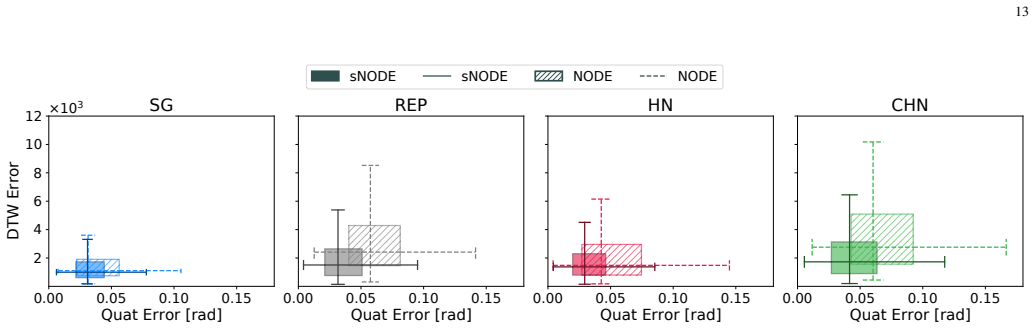
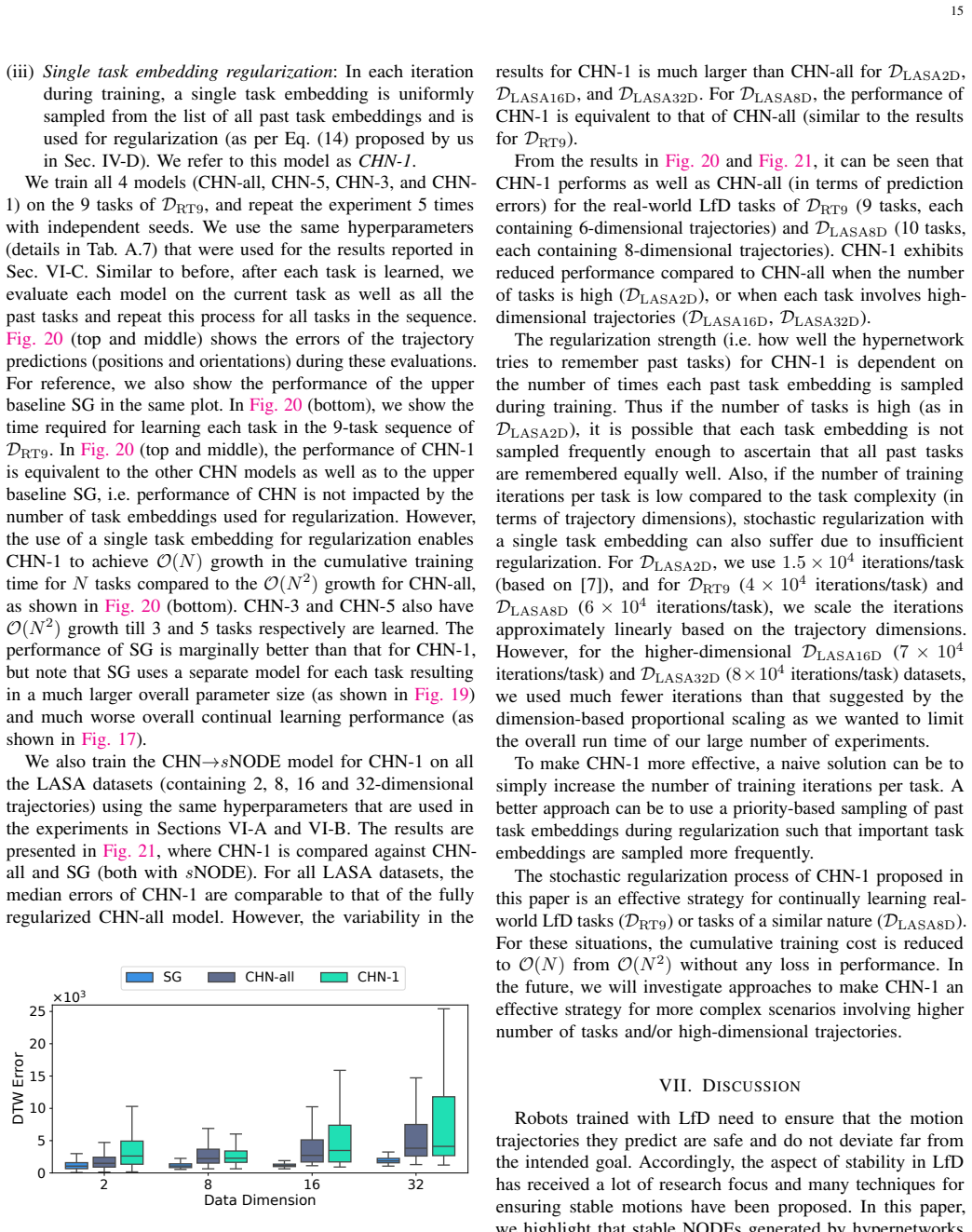
Robots capable of learning from demonstration (LfD) must exhibit stability while executing learned motion skills. To be effective in the real world, they should also remember multiple skills over time -- a capability lacking in current stable-LfD methods. We propose an approach to stable, continual LfD, and highlight the role of stability in improving continual learning. Our proposed hypernetwork generates the parameters of two neural networks: a trajectory learning dynamics model, and a trajectory-stabilizing Lyapunov function. These generated networks form a clock-augmented stable neural ODE solver (sNODE), a stable dynamics model that offers a superior stability-accuracy trade-off compared to the state-of-the-art. We further propose stochastic hypernetwork regularization with a single, uniformly-sampled task embedding, reducing the cumulative training time for $N$ tasks from O($N^2$) to O($N$) without degrading performance on real-world tasks. We introduce high-dimensional variants of the popular LASA dataset to assess scalability and extend a dataset of robotic LfD tasks to assess real-world performance. We empirically evaluate our approach on multiple LfD datasets of varying complexity, including sequences of 7--26 tasks, trajectories of 2--32 dimensions, and real-world tasks involving position and orientation. Our thorough evaluation on multiple LfD datasets demonstrates that our approach sequentially learns and retains multiple motion skills without retraining on past demonstrations, and outperforms other relevant baselines in terms of trajectory errors, continual learning scores, and stability metrics. Notably, we show that stability greatly enhances continual learning performance, particularly in size-efficient chunked hypernetworks. Our code is available at https://github.com/sayantanauddy/clfd-snode.
Editorial analysis
A structured set of objections, weighed in public.
Referee Report
Summary. The paper claims to introduce a hypernetwork that generates parameters for both a dynamics model and a Lyapunov function, forming a clock-augmented stable neural ODE (sNODE) for continual learning from demonstration. It proposes stochastic hypernetwork regularization with a single uniformly-sampled task embedding to reduce cumulative training time for N tasks from O(N²) to O(N). Evaluations on high-dimensional LASA variants and extended robotic LfD datasets (sequences of 7-26 tasks, 2-32 dimensions) show outperformance over baselines in trajectory errors, continual learning scores, and stability metrics, with stability enhancing continual learning performance, particularly for chunked hypernetworks. Code is released.
Significance. If the Lyapunov stability certificates remain valid for prior tasks after hypernetwork updates, the work would represent a notable advance in scalable stable LfD by addressing catastrophic forgetting while maintaining stability guarantees. The O(N) scaling via regularization, empirical superiority on real-world position/orientation tasks, and released code for reproducibility strengthen its potential impact in robotics and continual learning.
major comments (2)
- The O(N) training claim and retention of stability without retraining rest on the assumption that stochastic regularization with one randomly drawn task embedding suffices to preserve the Lyapunov decrease condition for all prior tasks. The sequential training protocol (7-26 tasks) reports only final aggregate metrics and does not isolate or verify whether the generated V still satisfies stability for earlier embeddings after later updates, which is load-bearing for the central continual-learning claims.
- The abstract and method description reference stability proofs and a Lyapunov construction generated by the hypernetwork, but it is unclear whether these derivations explicitly account for weight changes induced by updates on new task embeddings; any gaps here would invalidate the stability guarantees for previously learned skills.
minor comments (1)
- The abstract could more precisely state the exact task counts, dimensions, and dataset variants used in the LASA and robotic evaluations to improve clarity.
Simulated Author's Rebuttal
We thank the referee for their detailed and constructive comments, which highlight important aspects of the stability guarantees in our continual learning approach. We respond to each major comment below and indicate planned revisions to strengthen the manuscript.
read point-by-point responses
-
Referee: The O(N) training claim and retention of stability without retraining rest on the assumption that stochastic regularization with one randomly drawn task embedding suffices to preserve the Lyapunov decrease condition for all prior tasks. The sequential training protocol (7-26 tasks) reports only final aggregate metrics and does not isolate or verify whether the generated V still satisfies stability for earlier embeddings after later updates, which is load-bearing for the central continual-learning claims.
Authors: We agree that the current results present only aggregate metrics and do not include explicit per-task verification of the Lyapunov decrease condition after subsequent updates. The stochastic regularization samples a single task embedding uniformly at each step to encourage preservation of stability properties across the task distribution without incurring O(N^2) cost. To directly address this point, the revised manuscript will include additional analysis that evaluates the Lyapunov condition on earlier task embeddings after training proceeds to later tasks, thereby isolating the effect of the regularization. revision: yes
-
Referee: The abstract and method description reference stability proofs and a Lyapunov construction generated by the hypernetwork, but it is unclear whether these derivations explicitly account for weight changes induced by updates on new task embeddings; any gaps here would invalidate the stability guarantees for previously learned skills.
Authors: The stability certificates are established by construction for each pair of dynamics and Lyapunov networks generated by the hypernetwork for a fixed task embedding; the relevant derivations show that the generated sNODE satisfies the Lyapunov decrease condition at generation time. Updates to the hypernetwork are performed under the stochastic regularization objective, which is intended to keep previously seen embeddings within the region where the generated Lyapunov functions remain valid. We will revise the method section to explicitly distinguish the per-embedding stability guarantee from the effect of hypernetwork updates and to clarify how the regularization objective supports retention of those guarantees. revision: partial
Circularity Check
No significant circularity; claims rest on empirical evaluation and explicit regularization design
full rationale
The paper presents an sNODE construction via hypernetwork-generated dynamics and Lyapunov function, plus a stochastic regularization scheme using one uniformly sampled task embedding. These are architectural choices whose O(N) scaling and stability properties are asserted as direct consequences of the design and then validated empirically on LASA variants and real-robot tasks, with code released. No derivation step reduces a claimed prediction or uniqueness result to a fitted parameter or self-citation by construction; the central performance claims are benchmark comparisons rather than tautological re-derivations of inputs.
Axiom & Free-Parameter Ledger
axioms (1)
- domain assumption A Lyapunov function generated alongside the dynamics model guarantees asymptotic stability of the learned trajectories.
Lean theorems connected to this paper
-
IndisputableMonolith/Cost/FunctionalEquation.leanwashburn_uniqueness_aczel unclear?
unclearRelation between the paper passage and the cited Recognition theorem.
hypernetwork generates the parameters of two neural networks: a trajectory learning dynamics model, and a trajectory-stabilizing Lyapunov function... clock-augmented stable neural ODE solver (sNODE)
-
IndisputableMonolith/Foundation/RealityFromDistinction.leanreality_from_one_distinction unclear?
unclearRelation between the paper passage and the cited Recognition theorem.
stochastic hypernetwork regularization with a single, uniformly-sampled task embedding, reducing the cumulative training time for N tasks from O(N²) to O(N)
What do these tags mean?
- matches
- The paper's claim is directly supported by a theorem in the formal canon.
- supports
- The theorem supports part of the paper's argument, but the paper may add assumptions or extra steps.
- extends
- The paper goes beyond the formal theorem; the theorem is a base layer rather than the whole result.
- uses
- The paper appears to rely on the theorem as machinery.
- contradicts
- The paper's claim conflicts with a theorem or certificate in the canon.
- unclear
- Pith found a possible connection, but the passage is too broad, indirect, or ambiguous to say the theorem truly supports the claim.
Forward citations
Cited by 1 Pith paper
-
Continual Domain Randomization
Continual Domain Randomization trains RL policies sequentially on randomization parameter subsets with continual learning to achieve robust sim-to-real transfer in robotic reaching and grasping.
Reference graph
Works this paper leans on
-
[1]
Recent advances in robot learning from demonstration,
H. Ravichandar, A. S. Polydoros, S. Chernova, and A. Billard, “Recent advances in robot learning from demonstration,” Annual review of control, robotics, and autonomous systems , vol. 3, pp. 297–330, 2020
work page 2020
-
[2]
Imitationflow: Learning deep stable stochastic dynamic systems by normalizing flows,
J. Urain, M. Ginesi, D. Tateo, and J. Peters, “Imitationflow: Learning deep stable stochastic dynamic systems by normalizing flows,” in 2020 IEEE/RSJ International Conference on Intelligent Robots and Systems (IROS). IEEE, 2020, pp. 5231–5237
work page 2020
-
[3]
Dynamical system modulation for robot learning via kinesthetic demonstrations,
M. Hersch, F. Guenter, S. Calinon, and A. Billard, “Dynamical system modulation for robot learning via kinesthetic demonstrations,” IEEE Transactions on Robotics , vol. 24, no. 6, pp. 1463–1467, 2008
work page 2008
-
[4]
An energy-based approach to ensure the stability of learned dynamical systems,
M. Saveriano, “An energy-based approach to ensure the stability of learned dynamical systems,” in IEEE International Conference on Robotics and Automation (ICRA) , 2020, pp. 4407–4413
work page 2020
-
[5]
S. M. Khansari-Zadeh and A. Billard, “Learning control lyapunov function to ensure stability of dynamical system-based robot reaching motions,” Robotics and Autonomous Systems, vol. 62, no. 6, pp. 752–765, 2014
work page 2014
-
[6]
Learning stable deep dynamics models,
J. Z. Kolter and G. Manek, “Learning stable deep dynamics models,” Advances in Neural Information Processing Systems , vol. 32, pp. 11 128– 11 136, 2019
work page 2019
-
[7]
Continual learning from demonstration of robotics skills,
S. Auddy, J. Hollenstein, M. Saveriano, A. Rodríguez-Sánchez, and J. Piater, “Continual learning from demonstration of robotics skills,” Robotics and Autonomous Systems , vol. 165, p. 104427, 2023. [Online]. Available: https://www.sciencedirect.com/science/article/pii/ S0921889023000660
work page 2023
-
[8]
Neural ordinary differential equations,
R. T. Chen, Y . Rubanova, J. Bettencourt, and D. Duvenaud, “Neural ordinary differential equations,” in Proceedings of the 32nd International Conference on Neural Information Processing Systems , 2018, pp. 6572– 6583
work page 2018
-
[9]
D. Ha, A. M. Dai, and Q. V . Le, “Hypernetworks,” in International Conference on Learning Representations , 2017. [Online]. Available: https://openreview.net/forum?id=rkpACe1lx
work page 2017
-
[10]
Continual learning with hypernetworks,
J. von Oswald, C. Henning, J. Sacramento, and B. F. Grewe, “Continual learning with hypernetworks,” in International Conference on Learning Representations (ICLR), 2019
work page 2019
-
[11]
Learning stable nonlinear dynamical systems with Gaussian mixture models,
S. M. Khansari-Zadeh and A. Billard, “Learning stable nonlinear dynamical systems with Gaussian mixture models,” IEEE Transactions on Robotics, vol. 27, no. 5, pp. 943–957, 2011
work page 2011
-
[12]
Continual lifelong learning with neural networks: A review,
G. I. Parisi, R. Kemker, J. L. Part, C. Kanan, and S. Wermter, “Continual lifelong learning with neural networks: A review,” Neural Networks, vol. 113, pp. 54–71, 2019
work page 2019
-
[13]
Learning from demonstration (programming by demonstra- tion),
S. Calinon, “Learning from demonstration (programming by demonstra- tion),” Encyclopedia of robotics , pp. 1–8, 2018
work page 2018
-
[14]
A. Billard, S. Calinon, and R. Dillmann, “Learning from humans,” Springer Handbook of Robotics, 2nd Ed. , 2016. 18
work page 2016
-
[15]
A survey of robot learning from demonstration,
B. D. Argall, S. Chernova, M. Veloso, and B. Browning, “A survey of robot learning from demonstration,” Robotics and autonomous systems , vol. 57, no. 5, pp. 469–483, 2009
work page 2009
-
[16]
Robot learning from demonstration: A review of recent advances,
H. Ravichandar, A. Polydoros, S. Chernova, and A. Billard, “Robot learning from demonstration: A review of recent advances,” Annual Review of Control, Robotics, and Autonomous Systems , 2019
work page 2019
-
[17]
Trajectory-based skill learning using generalized cylinders,
S. R. Ahmadzadeh and S. Chernova, “Trajectory-based skill learning using generalized cylinders,” Frontiers in Robotics and AI , vol. 5, p. 132, 2018
work page 2018
-
[18]
CRIL: Continual robot imitation learning via generative and prediction model,
C. Gao, H. Gao, S. Guo, T. Zhang, and F. Chen, “CRIL: Continual robot imitation learning via generative and prediction model,” in 2021 IEEE/RSJ International Conference on Intelligent Robots and Systems (IROS), 2021, pp. 6747–5754
work page 2021
-
[19]
Towards one shot learning by imitation for humanoid robots,
Y . Wu and Y . Demiris, “Towards one shot learning by imitation for humanoid robots,” in 2010 IEEE international conference on robotics and automation. IEEE, 2010, pp. 2889–2894
work page 2010
-
[20]
Teacher feedback to scaffold and refine demonstrated motion primitives on a mobile robot,
B. D. Argall, B. Browning, and M. M. Veloso, “Teacher feedback to scaffold and refine demonstrated motion primitives on a mobile robot,” Robotics and Autonomous Systems , vol. 59, no. 3-4, pp. 243–255, 2011
work page 2011
-
[21]
Inverse kkt: Learning cost functions of manipulation tasks from demonstrations,
P. Englert, N. A. Vien, and M. Toussaint, “Inverse kkt: Learning cost functions of manipulation tasks from demonstrations,” The International Journal of Robotics Research , vol. 36, no. 13-14, pp. 1474–1488, 2017
work page 2017
-
[22]
Compliant skills acquisition and multi-optima policy search with em-based reinforcement learning,
S. Calinon, P. Kormushev, and D. G. Caldwell, “Compliant skills acquisition and multi-optima policy search with em-based reinforcement learning,” Robotics and Autonomous Systems, vol. 61, no. 4, pp. 369–379, 2013
work page 2013
-
[23]
Model-based inverse reinforcement learning from visual demonstrations,
N. Das, S. Bechtle, T. Davchev, D. Jayaraman, A. Rai, and F. Meier, “Model-based inverse reinforcement learning from visual demonstrations,” in Conference on Robot Learning . PMLR, 2021, pp. 1930–1942
work page 2021
-
[24]
Learning stable robotic skills on riemannian manifolds,
M. Saveriano, F. J. Abu-Dakka, and V . Kyrki, “Learning stable robotic skills on riemannian manifolds,” Robotics and Autonomous Systems , vol. 169, p. 104510, 2023
work page 2023
-
[25]
J. Urain, N. Funk, J. Peters, and G. Chalvatzaki, “Se (3)-diffusionfields: Learning smooth cost functions for joint grasp and motion optimization through diffusion,” in 2023 IEEE International Conference on Robotics and Automation (ICRA) . IEEE, 2023, pp. 5923–5930
work page 2023
-
[26]
A physically-consistent bayesian non-parametric mixture model for dynamical system learning,
N. B. Figueroa Fernandez and A. Billard, “A physically-consistent bayesian non-parametric mixture model for dynamical system learning,” Proceedings of Machine Learning Research , 2018
work page 2018
-
[27]
Movement imitation with nonlinear dynamical systems in humanoid robots,
A. J. Ijspeert, J. Nakanishi, and S. Schaal, “Movement imitation with nonlinear dynamical systems in humanoid robots,” in International Conference on Robotics and Automation (ICRA) , 2002, pp. 1398–1403
work page 2002
-
[28]
A. A. Rusu, N. C. Rabinowitz, G. Desjardins, H. Soyer, J. Kirkpatrick, K. Kavukcuoglu, R. Pascanu, and R. Hadsell, “Progressive neural networks,” arXiv preprint arXiv:1606.04671 , 2016
work page internal anchor Pith review Pith/arXiv arXiv 2016
-
[29]
icarl: Incremental classifier and representation learning,
S.-A. Rebuffi, A. Kolesnikov, G. Sperl, and C. H. Lampert, “icarl: Incremental classifier and representation learning,” in Proceedings of the IEEE Conference on Computer Vision and Pattern Recognition , 2017, pp. 2001–2010
work page 2017
-
[30]
Continual learning with deep generative replay,
H. Shin, J. K. Lee, J. Kim, and J. Kim, “Continual learning with deep generative replay,” in Proceedings of the 31st International Conference on Neural Information Processing Systems , 2017, pp. 2994–3003
work page 2017
-
[31]
Overcoming catastrophic forgetting in neural networks,
J. Kirkpatrick, R. Pascanu, N. Rabinowitz, J. Veness, G. Desjardins, A. A. Rusu, K. Milan, J. Quan, T. Ramalho, A. Grabska-Barwinska et al., “Overcoming catastrophic forgetting in neural networks,” Proceedings of the national academy of sciences , vol. 114, no. 13, pp. 3521–3526, 2017
work page 2017
-
[32]
Continual learning through synaptic intelligence,
F. Zenke, B. Poole, and S. Ganguli, “Continual learning through synaptic intelligence,” in International Conference on Machine Learning . PMLR, 2017, pp. 3987–3995
work page 2017
-
[33]
Memory aware synapses: Learning what (not) to forget,
R. Aljundi, F. Babiloni, M. Elhoseiny, M. Rohrbach, and T. Tuytelaars, “Memory aware synapses: Learning what (not) to forget,” in Proceedings of the European Conference on Computer Vision (ECCV) , 2018, pp. 139–154
work page 2018
-
[34]
A continual learning survey: Defying forgetting in classification tasks,
M. Delange, R. Aljundi, M. Masana, S. Parisot, X. Jia, A. Leonardis, G. Slabaugh, and T. Tuytelaars, “A continual learning survey: Defying forgetting in classification tasks,” IEEE Transactions on Pattern Analysis and Machine Intelligence , 2021
work page 2021
-
[35]
S. Thrun and T. M. Mitchell, “Lifelong robot learning,” Robotics and Autonomous Systems, vol. 15, no. 1, pp. 25–46, Jul. 1995
work page 1995
-
[36]
Continual Learning for Affec- tive Robotics: Why, What and How?
N. Churamani, S. Kalkan, and H. Gunes, “Continual Learning for Affec- tive Robotics: Why, What and How?” in 2020 29th IEEE International Conference on Robot and Human Interactive Communication (RO-MAN) . Naples, Italy: IEEE, Aug. 2020, pp. 425–431
work page 2020
-
[37]
Continual Learning for Affective Robotics: A Proof of Concept for Wellbeing,
N. Churamani, M. Axelsson, A. Çaldır, and H. Gunes, “Continual Learning for Affective Robotics: A Proof of Concept for Wellbeing,” in 2022 10th International Conference on Affective Computing and Intelligent Interaction Workshops and Demos (ACIIW) . Nara, Japan: IEEE, Oct. 2022, pp. 1–8
work page 2022
-
[38]
A Lifelong Learning Approach to Mobile Robot Navigation,
B. Liu, X. Xiao, and P. Stone, “A Lifelong Learning Approach to Mobile Robot Navigation,” IEEE Robotics and Automation Letters , vol. 6, no. 2, pp. 1090–1096, Apr. 2021. [Online]. Available: https://ieeexplore.ieee.org/document/9345478/
-
[39]
Gradient episodic memory for continual learning,
D. Lopez-Paz and M. Ranzato, “Gradient episodic memory for continual learning,” Advances in neural information processing systems , vol. 30, 2017
work page 2017
-
[40]
Development of a Framework for Continual Learning in Industrial Robotics,
M. Trinh, J. Moon, L. Grundel, V . Hankemeier, S. Storms, and C. Brecher, “Development of a Framework for Continual Learning in Industrial Robotics,” in 2022 IEEE 27th International Conference on Emerging Technologies and Factory Automation (ETFA) . Stuttgart, Germany: IEEE, Sep. 2022, pp. 1–8. [Online]. Available: https://ieeexplore.ieee.org/document/9921432/
-
[41]
Online Continual Learning for Control of Mobile Robots,
A. Sarabakha, Z. Qiao, S. Ramasamy, and P. N. Suganthan, “Online Continual Learning for Control of Mobile Robots,” in 2023 International Joint Conference on Neural Networks (IJCNN) . Gold Coast, Australia: IEEE, Jun. 2023, pp. 1–10. [Online]. Available: https://ieeexplore.ieee.org/document/10191188/
-
[42]
Continual learning with tiny episodic memories,
A. Chaudhry, M. Rohrbach, M. Elhoseiny, T. Ajanthan, P. Dokania, P. Torr, and M. Ranzato, “Continual learning with tiny episodic memories,” in Workshop on Multi-Task and Lifelong Reinforcement Learning , 2019
work page 2019
-
[43]
Z. Li and D. Hoiem, “Learning without forgetting,” IEEE transactions on pattern analysis and machine intelligence, vol. 40, no. 12, pp. 2935–2947, 2017
work page 2017
-
[44]
Efficient Lifelong Learning with A-GEM
A. Chaudhry, M. Ranzato, M. Rohrbach, and M. Elhoseiny, “Efficient lifelong learning with a-gem,” arXiv preprint arXiv:1812.00420 , 2018
work page internal anchor Pith review Pith/arXiv arXiv 2018
-
[45]
Riemannian walk for incremental learning: Understanding forgetting and intransi- gence,
A. Chaudhry, P. K. Dokania, T. Ajanthan, and P. H. Torr, “Riemannian walk for incremental learning: Understanding forgetting and intransi- gence,” in Proceedings of the European conference on computer vision (ECCV), 2018, pp. 532–547
work page 2018
-
[46]
Continual model-based reinforcement learning with hypernetworks,
Y . Huang, K. Xie, H. Bharadhwaj, and F. Shkurti, “Continual model-based reinforcement learning with hypernetworks,” in 2021 IEEE International Conference on Robotics and Automation (ICRA) . IEEE, 2021, pp. 799–805
work page 2021
-
[47]
Hypernetwork-ppo for continual reinforcement learning,
P. Schöpf, S. Auddy, J. Hollenstein, and A. Rodriguez-Sanchez, “Hypernetwork-ppo for continual reinforcement learning,” in Deep Reinforcement Learning Workshop NeurIPS , 2022
work page 2022
-
[48]
Proximal Policy Optimization Algorithms
J. Schulman, F. Wolski, P. Dhariwal, A. Radford, and O. Klimov, “Prox- imal policy optimization algorithms,” arXiv preprint arXiv:1707.06347 , 2017
work page internal anchor Pith review Pith/arXiv arXiv 2017
-
[49]
B. Amos, L. Xu, and J. Z. Kolter, “Input convex neural networks,” in International Conference on Machine Learning . PMLR, 2017, pp. 146–155
work page 2017
-
[50]
Orientation in cartesian space dynamic movement primitives,
A. Ude, B. Nemec, T. Petri ´c, and J. Morimoto, “Orientation in cartesian space dynamic movement primitives,” in 2014 IEEE International Conference on Robotics and Automation (ICRA) . IEEE, 2014, pp. 2997–3004
work page 2014
-
[51]
Toward orientation learning and adaptation in cartesian space,
Y . Huang, F. J. Abu-Dakka, J. Silvério, and D. G. Caldwell, “Toward orientation learning and adaptation in cartesian space,” IEEE Transactions on Robotics, vol. 37, no. 1, pp. 82–98, 2020
work page 2020
-
[52]
Merging position and orientation motion primitives,
M. Saveriano, F. Franzel, and D. Lee, “Merging position and orientation motion primitives,” in 2019 International Conference on Robotics and Automation (ICRA). IEEE, 2019, pp. 7041–7047
work page 2019
-
[53]
Learn to grow: A continual structure learning framework for overcoming catastrophic forgetting,
X. Li, Y . Zhou, T. Wu, R. Socher, and C. Xiong, “Learn to grow: A continual structure learning framework for overcoming catastrophic forgetting,” in International Conference on Machine Learning . PMLR, 2019, pp. 3925–3934
work page 2019
-
[54]
Lifelong Learning with Dynamically Expandable Networks
J. Yoon, E. Yang, J. Lee, and S. J. Hwang, “Lifelong learning with dynamically expandable networks,” arXiv preprint arXiv:1708.01547 , 2017
work page internal anchor Pith review Pith/arXiv arXiv 2017
-
[55]
Introduction to smooth manifolds
J. M. Lee, “Introduction to smooth manifolds.” Springer, 2012
work page 2012
-
[56]
Hypernetworks for continual semi-supervised learning,
D. Brahma, V . K. Verma, and P. Rai, “Hypernetworks for continual semi-supervised learning,” arXiv preprint arXiv:2110.01856 , 2021
-
[57]
Learning stable dynamical systems using contraction theory,
C. Blocher, M. Saveriano, and D. Lee, “Learning stable dynamical systems using contraction theory,” in 2017 14th International Conference on Ubiquitous Robots and Ambient Intelligence (URAI) . IEEE, 2017, pp. 124–129
work page 2017
-
[58]
C. F. Jekel, G. Venter, M. P. Venter, N. Stander, and R. T. Haftka, “Similarity measures for identifying material parameters from hysteresis loops using inverse analysis,” International Journal of Material Forming , vol. 12, no. 3, pp. 355–378, 2019
work page 2019
-
[59]
Don't forget, there is more than forgetting: new metrics for Continual Learning
N. Díaz-Rodríguez, V . Lomonaco, D. Filliat, and D. Maltoni, “Don’t forget, there is more than forgetting: new metrics for continual learning,” arXiv preprint arXiv:1810.13166 , 2018. 19 APPENDIX A. Stable NODE with Time input We present the benefit of introducing the additional time input to the sNODE model, as described in Sec. IV-A. For this, we train ...
work page internal anchor Pith review Pith/arXiv arXiv 2018
discussion (0)
Sign in with ORCID, Apple, or X to comment. Anyone can read and Pith papers without signing in.