Long-lived Particles Anomaly Detection with Parametrized Quantum Circuits
Pith reviewed 2026-05-24 04:51 UTC · model grok-4.3
The pith
A parametrized quantum circuit can detect anomalies in particle detector data from long-lived particle decays.
A machine-rendered reading of the paper's core claim, the machinery that carries it, and where it could break.
Core claim
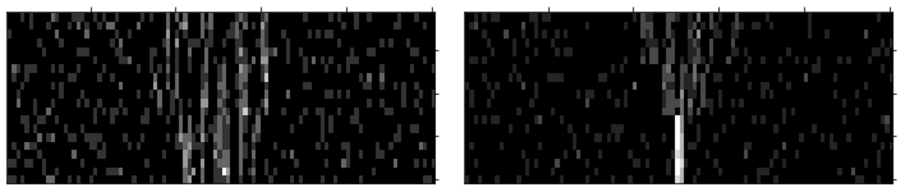
A parametrized quantum circuit, after classical training and hardware adaptations, performs anomaly detection on amplitude-encoded classical data; it identifies both simple digit anomalies on real NISQ devices and simulated long-lived-particle decay patterns in detector data, although noise prevents any performance gain over classical deep networks.
What carries the argument
Parametrized quantum circuit with amplitude encoding, adapted for anomaly scoring on NISQ hardware.
If this is right
- Quantum circuits become a viable tool for anomaly detection once hardware noise drops enough to support amplitude encoding.
- The same circuit architecture can be reused for other collider signatures that produce localized detector anomalies.
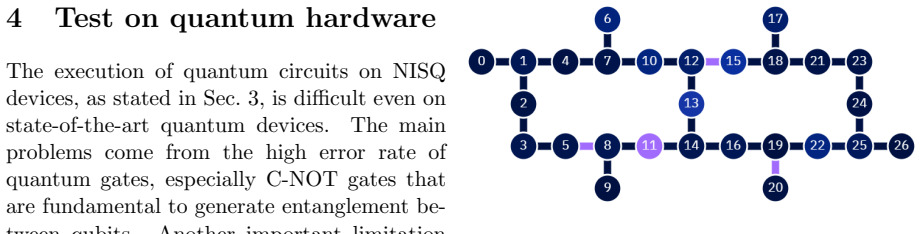
- Hardware-specific adaptations such as circuit recompilation become standard steps when moving quantum ML models to real devices.
Where Pith is reading between the lines
- Lower-noise quantum processors could remove the current performance gap and allow direct comparison on the full particle dataset.
- The encoding step may be replaceable by other data-loading methods that avoid amplitude encoding altogether.
Load-bearing premise
Amplitude encoding of classical detector data into a quantum state remains feasible and useful despite the noise levels on current NISQ hardware.
What would settle it
A side-by-side run of the same long-lived-particle dataset on both the quantum circuit and a classical deep network, or successful execution of the full circuit on hardware with substantially lower noise, that shows a clear performance difference.
Figures






read the original abstract
We investigate the possibility to apply quantum machine learning techniques for data analysis, with particular regard to an interesting use-case in high-energy physics. We propose an anomaly detection algorithm based on a parametrized quantum circuit. This algorithm has been trained on a classical computer and tested with simulations as well as on real quantum hardware. Tests on NISQ devices have been performed with IBM quantum computers. For the execution on quantum hardware specific hardware driven adaptations have been devised and implemented. The quantum anomaly detection algorithm is able to detect simple anomalies like different characters in handwritten digits as well as more complex structures like anomalous patterns in the particle detectors produced by the decay products of long-lived particles produced at a collider experiment. For the high-energy physics application, performance is estimated in simulation only, as the quantum circuit is not simple enough to be executed on the available quantum hardware. This work demonstrates that it is possible to perform anomaly detection with quantum algorithms, however, as amplitude encoding of classical data is required for the task, due to the noise level in the available quantum hardware, current implementation cannot outperform classic anomaly detection algorithms based on deep neural networks.
Editorial analysis
A structured set of objections, weighed in public.
Referee Report
Summary. The manuscript proposes an anomaly detection algorithm based on parametrized quantum circuits (PQCs). The algorithm is trained on classical hardware and tested on handwritten digit data executed on IBM NISQ devices (with hardware-specific adaptations) as well as on simulated high-energy physics data for detecting anomalous patterns from long-lived particle decays. The authors conclude that anomaly detection is feasible with quantum methods but that amplitude encoding of classical data combined with current NISQ noise levels prevents the approach from outperforming classical deep neural network methods.
Significance. If the results hold, the work supplies a concrete, hardware-validated demonstration of PQC-based anomaly detection on a simple task together with simulation-based evidence for a HEP use case. The explicit discussion of practical limitations arising from amplitude encoding and NISQ noise provides a realistic assessment that is valuable for the field. The combination of classical training, hardware execution for digits, and simulation for the collider application offers a balanced feasibility study.
minor comments (2)
- [Abstract] Abstract: the summary states that the quantum implementation 'cannot outperform' classical DNN methods but provides no quantitative performance numbers, error bars, or direct comparison metrics; including at least headline figures from the digit and HEP tests would strengthen the abstract.
- The description of the PQC architecture and the specific hardware-driven adaptations would benefit from an accompanying circuit diagram or pseudocode to improve reproducibility and clarity for readers.
Simulated Author's Rebuttal
We thank the referee for the constructive and positive review. The assessment accurately captures the scope of our work, including the hardware execution on IBM devices for the digit task, the simulation-based HEP application, and the explicit discussion of limitations due to amplitude encoding and NISQ noise. We appreciate the recommendation for minor revision and will incorporate clarifications where appropriate.
Circularity Check
No significant circularity identified
full rationale
The paper reports an empirical machine-learning demonstration: a parametrized quantum circuit is trained on classical hardware to perform anomaly detection, then evaluated on simulated HEP data and (for simpler tasks) on IBM NISQ hardware. No derivation chain, uniqueness theorem, or first-principles result is presented that reduces to its own fitted parameters or to a self-citation by construction. Performance metrics are obtained from explicit training and testing runs; the abstract explicitly caveats that amplitude encoding plus current noise prevents any claimed advantage over classical DNNs. The argument is therefore self-contained against external benchmarks and contains none of the enumerated circularity patterns.
Axiom & Free-Parameter Ledger
free parameters (1)
- PQC variational parameters
axioms (1)
- domain assumption Quantum circuit model with amplitude encoding of classical data
Lean theorems connected to this paper
-
IndisputableMonolith/Cost/FunctionalEquation.leanwashburn_uniqueness_aczel unclear?
unclearRelation between the paper passage and the cited Recognition theorem.
We propose an anomaly detection algorithm based on a parametrized quantum circuit... amplitude encoding of classical data is required... current implementation cannot outperform classic anomaly detection algorithms based on deep neural networks.
-
IndisputableMonolith/Foundation/AlexanderDuality.leanalexander_duality_circle_linking unclear?
unclearRelation between the paper passage and the cited Recognition theorem.
Tests on NISQ devices have been performed with IBM quantum computers... For the high-energy physics application, performance is estimated in simulation only
What do these tags mean?
- matches
- The paper's claim is directly supported by a theorem in the formal canon.
- supports
- The theorem supports part of the paper's argument, but the paper may add assumptions or extra steps.
- extends
- The paper goes beyond the formal theorem; the theorem is a base layer rather than the whole result.
- uses
- The paper appears to rely on the theorem as machinery.
- contradicts
- The paper's claim conflicts with a theorem or certificate in the canon.
- unclear
- Pith found a possible connection, but the passage is too broad, indirect, or ambiguous to say the theorem truly supports the claim.
Reference graph
Works this paper leans on
-
[1]
Biamonte Jacob et al. “Quantum machine learning”. In: Nature 549.7671 (Sept. 2017), pp. 195–202. doi: 10 . 1038 / nature23474 . url: https : / / doi . org / 10 . 1038 % 202Fnature23474
work page 2017
- [2]
-
[3]
Quantum optical neural networks
R. S. Gregory et al. “Quantum optical neural networks”. In: npj Quantum Inf. 5 (2019), p. 60. doi: 10.1038/s41534-019-0174-7
-
[4]
An introduction to quantum machine learn- ing
M. Schuld, I. Sinayskiy, and F. Petruccione. “An introduction to quantum machine learn- ing”. In: Contemporary Physics 56.2 (2015), pp. 172–185. doi: 10 . 1080 / 00107514 . 2014.964942. eprint: https://doi.org/10.1080/00107514.2014.964942. url: https: //doi.org/10.1080/00107514.2014.964942
-
[5]
Dor Bank, Noam Koenigstein, and Raja Giryes. Autoencoders. 2020. doi: 10 . 48550 / ARXIV.2003.05991. url: https://arxiv.org/abs/2003.05991
-
[6]
Ganggang Dong et al. “A Review of the Autoencoder and Its Variants: A Comparative Perspective from Target Recognition in Synthetic-Aperture Radar Images”. In: IEEE Geoscience and Remote Sensing Magazine 6.3 (2018), pp. 44–68. doi: 10.1109/MGRS. 2018.2853555
-
[7]
Reducing the Dimensionality of Data with Neural Networks
G. E. Hinton and R. R. Salakhutdinov. “Reducing the Dimensionality of Data with Neural Networks”. In: Science 313.5786 (2006), pp. 504–507. doi: 10.1126/science.1127647 . eprint: https://www.science.org/doi/pdf/10.1126/science.1127647 . url: https: //www.science.org/doi/abs/10.1126/science.1127647
-
[8]
Variational Quantum Algorithms,
M. Cerezo et al. “Variational quantum algorithms”. In: Nature Reviews Physics 3.9 (Aug. 2021), pp. 625–644. doi: 10.1038/s42254-021-00348-9 . url: https://doi.org/10. 1038%202Fs42254-021-00348-9
-
[9]
Expressive power of parametrized quantum circuits
Yuxuan Du et al. “Expressive power of parametrized quantum circuits”. In: Phys. Rev. Research 2 (3 July 2020), p. 033125. doi: 10.1103/PhysRevResearch.2.033125 . url: https://link.aps.org/doi/10.1103/PhysRevResearch.2.033125
-
[10]
Capacity and Quantum Geometry of Parametrized Quantum Circuits
Tobias Haug, Kishor Bharti, and M.S. Kim. “Capacity and Quantum Geometry of Parametrized Quantum Circuits”. In: PRX Quantum 2 (5 Oct. 2021), p. 040309. doi: 10 . 1103 / PRXQuantum . 2 . 040309. url: https : / / link . aps . org / doi / 10 . 1103 / PRXQuantum.2.040309
work page 2021
-
[11]
Quantum Machine Learning for b-jet charge identification
Alessio Gianelle et al. “Quantum Machine Learning for b-jet charge identification”. In: Journal of High Energy Physics 2022.8 (Aug. 2022). doi: 10.1007/jhep08(2022)014 . url: https://doi.org/10.1007/jhep08(2022)014
-
[12]
Quantum Anomaly Detection for Collider Physics
Sulaiman Alvi, Christian Bauer, and Benjamin Nachman. Quantum Anomaly Detection for Collider Physics . 2022. doi: 10.48550/ARXIV.2206.08391 . url: https://arxiv. org/abs/2206.08391. 17
-
[13]
Christian W. Bauer et al. Quantum Simulation for High Energy Physics . 2022. doi: 10. 48550/ARXIV.2204.03381. url: https://arxiv.org/abs/2204.03381
-
[14]
Solving a Higgs optimization problem with quantum annealing for machine learning
A. Mott et al. “Solving a Higgs optimization problem with quantum annealing for machine learning”. In: Nature 550.7676 (Oct. 2017), pp. 375–379.doi: 10.1038/nature24047. url: https://ideas.repec.org/a/nat/nature/v550y2017i7676d10.1038_nature24047. html
-
[15]
Quantum machine learning for particle physics using a variational quantum classifier
A. Blance and M. Spannowsky. “Quantum machine learning for particle physics using a variational quantum classifier”. In: Journal of High Energy Physics 2021.2 (Feb. 2021). doi: 10.1007/jhep02(2021)212 . url: https://doi.org/10.1007%5C%2Fjhep02%5C% 282021%5C%29212
-
[16]
Event Classification with Quantum Machine Learning in High-Energy Physics
K. Terashi et al. “Event Classification with Quantum Machine Learning in High-Energy Physics”. In: Computing and Software for Big Science 5.1 (Jan. 2021). doi: 10.1007/ s41781-020-00047-7. url: https://doi.org/10.1007%2Fs41781-020-00047-7
work page 2021
-
[17]
Quantum Convolutional Neural Networks for High Energy Physics Data Analysis
Samuel Yen-Chi Chen et al. Quantum Convolutional Neural Networks for High Energy Physics Data Analysis . 2020. doi: 10.48550/ARXIV.2012.12177. url: https://arxiv. org/abs/2012.12177
-
[18]
Sau Lan Wu et al. “Application of quantum machine learning using the quantum vari- ational classifier method to high energy physics analysis at the LHC on IBM quantum computer simulator and hardware with 10 qubits”. In: Journal of Physics G: Nuclear and Particle Physics 48.12 (Oct. 2021), p. 125003. doi: 10.1088/1361- 6471/ac1391 . url: https://doi.org/10...
-
[19]
Sau Lan Wu et al. “Application of quantum machine learning using the quantum kernel algorithm on high energy physics analysis at the LHC”. In: Physical Review Research 3.3 (Sept. 2021). doi: 10.1103/physrevresearch.3.033221 . url: https://doi.org/10. 1103%2Fphysrevresearch.3.033221
-
[20]
Style-based quantum generative adversarial networks for Monte Carlo events
Carlos Bravo-Prieto et al. “Style-based quantum generative adversarial networks for Monte Carlo events”. In: Quantum 6 (Aug. 2022), p. 777. doi: 10 . 22331 / q - 2022 - 08-17-777. url: https://doi.org/10.22331%2Fq-2022-08-17-777
work page 2022
-
[21]
Anomaly detec- tion in high-energy physics using a quantum autoencoder
Vishal S. Ngairangbam, Michael Spannowsky, and Michihisa Takeuchi. “Anomaly detec- tion in high-energy physics using a quantum autoencoder”. In: Physical Review D 105.9 (May 2022). doi: 10.1103/physrevd.105.095004 . url: https://doi.org/10.1103% 2Fphysrevd.105.095004
-
[22]
Noisy intermediate-scale quantum algorithms
Kishor Bharti et al. “Noisy intermediate-scale quantum algorithms”. In: Rev. Mod. Phys. 94 (1 Feb. 2022), p. 015004. doi: 10.1103/RevModPhys.94.015004. url: https://link. aps.org/doi/10.1103/RevModPhys.94.015004
-
[23]
Machine learning applications for noisy intermediate-scale quantum comput- ers
Brian Coyle. Machine learning applications for noisy intermediate-scale quantum comput- ers. 2022. doi: 10.48550/ARXIV.2205.09414 . url: https://arxiv.org/abs/2205. 09414
-
[24]
Frank Arute et al. “Quantum supremacy using a programmable superconducting pro- cessor”. In: Nature 574.7779 (Oct. 2019), pp. 505–510. issn: 1476-4687. doi: 10.1038/ s41586-019-1666-5. url: http://dx.doi.org/10.1038/s41586-019-1666-5. 18
-
[25]
A Survey of NISQ Era Hybrid Quantum-Classical Machine Learning Research
Gennaro De Luca. “A Survey of NISQ Era Hybrid Quantum-Classical Machine Learning Research”. In: Journal of Artificial Intelligence and Technology 2.1 (Dec. 2021), pp. 9–15. doi: 10.37965/jait.2021.12002. url: https://ojs.istp-press.com/jait/article/ view/60
-
[26]
https://quantum-computing.ibm.com/. 2021
work page 2021
-
[27]
Power of data in quantum machine learning
Hsin-Yuan Huang et al. “Power of data in quantum machine learning”. In: Nature Com- munications 12.1 (May 2021). doi: 10.1038/s41467-021-22539-9 . url: https://doi. org/10.1038%2Fs41467-021-22539-9
-
[28]
Lyndon Evans and Philip Bryant. “LHC Machine”. In: JINST 3 (2008), S08001. doi: 10.1088/1748-0221/3/08/S08001
-
[29]
Receiver Operating Characteristic (ROC) Curves
Tilmann Gneiting and Peter Vogel. Receiver Operating Characteristic (ROC) Curves
-
[30]
Receiver Operating Characteristic (ROC) Curves
doi: 10.48550/ARXIV.1809.04808. url: https://arxiv.org/abs/1809.04808
work page internal anchor Pith review Pith/arXiv arXiv doi:10.48550/arxiv.1809.04808
-
[31]
Classification with Quantum Machine Learning: A Survey
Zainab Abohashima et al. Classification with Quantum Machine Learning: A Survey
-
[32]
url: https://arxiv.org/abs/2006.12270
doi: 10.48550/ARXIV.2006.12270. url: https://arxiv.org/abs/2006.12270
-
[33]
Data Encoding Patterns for Quantum Computing
Manuela Weigold et al. “Data Encoding Patterns for Quantum Computing”. In: Proceed- ings of the 27th Conference on Pattern Languages of Programs . PLoP ’20. Virtual Event: The Hillside Group, 2022. isbn: 9781941652169
work page 2022
-
[34]
Effect of data encoding on the expressive power of variational quantum-machine-learning models
Maria Schuld, Ryan Sweke, and Johannes Jakob Meyer. “Effect of data encoding on the expressive power of variational quantum-machine-learning models”. In: Phys. Rev. A 103 (3 Mar. 2021), p. 032430. doi: 10 . 1103 / PhysRevA . 103 . 032430. url: https : //link.aps.org/doi/10.1103/PhysRevA.103.032430
-
[35]
Principles of quantum computation and information-volume I: Basic concepts
Giuliano Benenti, Giulio Casati, and Giuliano Strini. Principles of quantum computation and information-volume I: Basic concepts . World scientific, 2004
work page 2004
-
[36]
Ra´ ul Rojas. “The Backpropagation Algorithm”. In: Neural Networks: A Systematic In- troduction. Berlin, Heidelberg: Springer Berlin Heidelberg, 1996, pp. 149–182. isbn: 978- 3-642-61068-4. doi: 10.1007/978-3-642-61068-4_7 . url: https://doi.org/10.1007/ 978-3-642-61068-4_7
-
[37]
Quantum autoencoders with enhanced data encoding
Carlos Bravo-Prieto. “Quantum autoencoders with enhanced data encoding”. In: Machine Learning: Science and Technology 2.3 (July 2021), p. 035028. doi: 10.1088/2632-2153/ ac0616. url: https://doi.org/10.1088%2F2632-2153%2Fac0616
-
[38]
Qibo: a framework for quantum simulation with hardware accel- eration
Stavros Efthymiou et al. “Qibo: a framework for quantum simulation with hardware accel- eration”. In: Quantum Science and Technology 7.1 (Dec. 2021), p. 015018. doi: 10.1088/ 2058-9565/ac39f5. url: https://doi.org/10.1088%202F2058-9565%202Fac39f5
work page 2021
-
[39]
Software available from tensorflow.org
Mart´ ın Abadi, Ashish Agarwal, and Paul Barham et al.TensorFlow: Large-Scale Machine Learning on Heterogeneous Systems . Software available from tensorflow.org. 2015. url: https://www.tensorflow.org/
work page 2015
-
[40]
Barren plateaus in quantum neural network training land- scapes
Jarrod R. McClean et al. “Barren plateaus in quantum neural network training land- scapes”. In: Nature Communications 9.1 (Nov. 2018). doi: 10.1038/s41467-018-07090-
-
[41]
url: https://doi.org/10.1038%202Fs41467-018-07090-4. 19
-
[42]
Cost function dependent barren plateaus in shallow parametrized quan- tum circuits
M. Cerezo et al. “Cost function dependent barren plateaus in shallow parametrized quan- tum circuits”. In: Nature Communications 12.1 (Mar. 2021). doi: 10.1038/s41467-021- 21728-w. url: https://doi.org/10.1038%202Fs41467-021-21728-w
-
[43]
Synthesis of quantum-logic circuits
V. V. Shende, S. S. Bullock, and I. L. Markov. “Synthesis of quantum-logic circuits”. In: IEEE Transactions on Computer-Aided Design of Integrated Circuits and Systems 25.6 (June 2006), pp. 1000–1010. doi: 10.1109/tcad.2005.855930. url: https://doi.org/ 10.1109%202Ftcad.2005.855930
-
[44]
Adam: A Method for Stochastic Optimization
Diederik P. Kingma and Jimmy Ba. Adam: A Method for Stochastic Optimization . 2014. doi: 10.48550/ARXIV.1412.6980. url: https://arxiv.org/abs/1412.6980
work page internal anchor Pith review Pith/arXiv arXiv doi:10.48550/arxiv.1412.6980 2014
-
[45]
Hidden Higgs decaying to lepton jets
A. Falkowski et al. “Hidden Higgs decaying to lepton jets”. In: J. High Energ. Phys. 2010.77 (2010). doi: 10.1007/JHEP05(2010)077 . url: https://doi.org/10.1007/ JHEP05(2010)077
-
[46]
Echoes of a hidden valley at hadron colliders
M. J. Strassler and K. M. Zurek. “Echoes of a hidden valley at hadron colliders”. In: J. High Energ. Phys. 651.5-6 (2007). doi: 10.1016/j.physletb.2007.06.055 . url: https://doi.org/10.1016/j.physletb.2007.06.055
-
[47]
The ATLAS Experiment at the CERN Large Hadron Collider
ATLAS Collaboration. “The ATLAS Experiment at the CERN Large Hadron Collider”. In: JINST 3 (2008), S08003. doi: 10.1088/1748-0221/3/08/S08003
-
[48]
Standalone vertex finding in the ATLAS muon spectrometer
ATLAS Collaboration. “Standalone vertex finding in the ATLAS muon spectrometer”. In: JINST 9 (2014), P02001. doi: 10.1088/1748-0221/9/02/P02001. arXiv: 1311.7070 [hep-ex]
work page internal anchor Pith review Pith/arXiv arXiv doi:10.1088/1748-0221/9/02/p02001 2014
-
[49]
ATLAS Collaboration. “Search for long-lived neutral particles produced in pp collisions at √s = 13 TeV decaying into displaced hadronic jets in the ATLAS inner detector and muon spectrometer”. In: Phys. Rev. D 101 (5 Mar. 2020), p. 052013. doi: 10 . 1103 / PhysRevD.101.052013 . url: https://link.aps.org/doi/10.1103/PhysRevD.101. 052013
-
[50]
Layerwise learning for quantum neural networks
Andrea Skolik et al. “Layerwise learning for quantum neural networks”. In: Quantum Machine Intelligence 3.1 (Jan. 2021). doi: 10.1007/s42484-020-00036-4 . url: https: //doi.org/10.1007%5C%2Fs42484-020-00036-4
-
[51]
The quantum technologies roadmap: a European community view
Antonio Ac´ ı n et al. “The quantum technologies roadmap: a European community view”. In: New Journal of Physics 20.8 (Aug. 2018), p. 080201. doi: 10 . 1088 / 1367 - 2630 / aad1ea. url: https://doi.org/10.1088%2F1367-2630%2Faad1ea
work page 2018
-
[52]
Quantum Computing: A Taxonomy, Systematic Review and Future Directions
Sukhpal Singh Gill et al. “Quantum Computing: A Taxonomy, Systematic Review and Future Directions”. In: (2020). doi: 10.48550/ARXIV.2010.15559. url: https://arxiv. org/abs/2010.15559
-
[53]
Rainer Kaltenbaek et al. “Quantum technologies in space”. In: Experimental Astronomy 51.3 (June 2021), pp. 1677–1694. doi: 10 . 1007 / s10686 - 021 - 09731 - x. url: https : //doi.org/10.1007%5C%2Fs10686-021-09731-x
work page 2021
-
[54]
Quantum technologies in particle physics
Bass Steven D. and Zohar Erez. “Quantum technologies in particle physics”. In: Phil. Trans. R. Soc. A.380 (Dec. 2021). doi: https://doi.org/10.1098/rsta.2021.0072. 20
-
[55]
Quantum Systems for Enhanced High Energy Particle Physics Detectors
M. Doser et al. “Quantum Systems for Enhanced High Energy Particle Physics Detectors”. In: Frontiers in Physics 10 (2022). issn: 2296-424X. doi: 10.3389/fphy.2022.887738 . url: https://www.frontiersin.org/articles/10.3389/fphy.2022.887738. 21 Abbreviations The following abbreviations are used in this manuscript: QML Quantum machine learning NISQ Noisy int...
discussion (0)
Sign in with ORCID, Apple, or X to comment. Anyone can read and Pith papers without signing in.