pith. sign in

arxiv: 2312.14951 · v1 · submitted 2023-12-09 · ❄️ cond-mat.mtrl-sci

Bachelorthesis: Calculation of the magnetic properties of quarternary ThMn₁₂-type compounds with Zr as a substitution for Nd

Pith reviewed 2026-05-24 04:53 UTC · model grok-4.3

classification ❄️ cond-mat.mtrl-sci
keywords ThMn12-type compoundsZr substitutionNd substitutionDFT calculationsmagnetic anisotropy energyCurie temperaturesaturation magnetizationrare-earth lean magnets
0
0 comments X

The pith

Partial Zr substitution for Nd in ThMn12 compounds yields promising magnetic properties for Nd-lean magnets.

A machine-rendered reading of the paper's core claim, the machinery that carries it, and where it could break.

The paper employs density functional theory calculations to evaluate the magnetic properties of ThMn12-type compounds where zirconium partially replaces neodymium. This is done to find alternatives to the standard Nd2Fe14B magnet amid concerns over rare earth scarcity. Properties such as saturation magnetization, Curie temperature, and magnetic anisotropy energy are computed for various compositions including the quaternary (Zr0.5Nd0.5)Fe11Ti and the quinary with cobalt. The study pays special attention to the treatment of Nd 4f-electrons and their interaction with 3d-electrons. It concludes that the Nd-lean quaternary compound has promising properties for engineering applications.

Core claim

Density functional theory calculations on binary to quinary RFe12-yTiy compounds with R = Nd, Zr, Zr0.5Nd0.5 and y from 0 to 1, plus the Co variant, identify the quaternary (Zr0.5Nd0.5)Fe11Ti as having promising magnetic properties suitable for engineering applications as an Nd-lean alternative.

What carries the argument

DFT calculations of Ms, Tc, and MAE in ThMn12 structure with Zr-Nd substitution, including special treatment of Nd 4f-electrons and 3d-electron interactions.

If this is right

  • Halving the Nd content via Zr substitution maintains useful magnetic characteristics in the ThMn12 phase.
  • Ti substitution stabilizes the structure across the studied concentration range.
  • Co addition in the quinary compound influences both stability and magnetic properties.
  • The computational results are consistent with experimental data where available for non-Zr compounds.
  • The calculations support further investigation of the identified quaternary compound for practical use.

Where Pith is reading between the lines

These are editorial extensions of the paper, not claims the author makes directly.

  • The substitution method could be extended to other transition metals or structures to further reduce rare earth dependency.
  • Experimental synthesis of the quaternary compound would allow direct validation of the predicted properties.
  • This work highlights the potential of computational screening for discovering new magnet compositions.

Load-bearing premise

The DFT treatment of Nd 4f-electrons and their interaction with 3d-electrons is sufficiently accurate to yield reliable predictions of MAE, Tc, and Ms for the substituted compounds.

What would settle it

Direct experimental measurement of the magnetic properties in synthesized (Zr0.5Nd0.5)Fe11Ti that significantly differs from the calculated values would challenge the accuracy of the DFT approach.

Figures
Figures reproduced from arXiv: 2312.14951 by Nico Yannik Merkt.

Figure 1
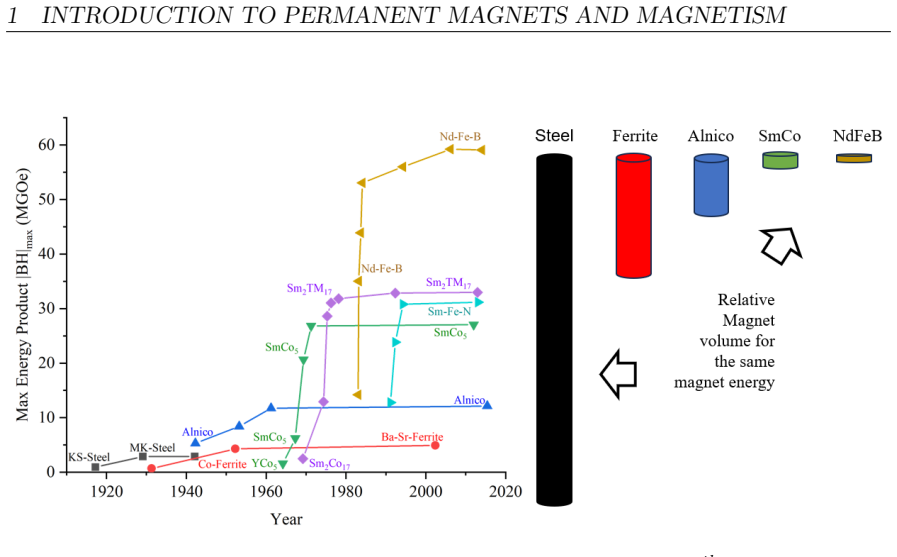
Figure 1. Figure 1: Development of the different types of magnets in the 20th century and the beginning of the 21st century. The origin of the information presented is the source [7]. The 20th century started with the development of steel magnets [8] in 1917. These magnets have a very low maximum energy product |BH|max of 8 kJ/m3 (1 MGOe). Sub￾sequently, steel magnets were improved with tungsten, chromium and an iron-carbon a… view at source ↗
Figure 2
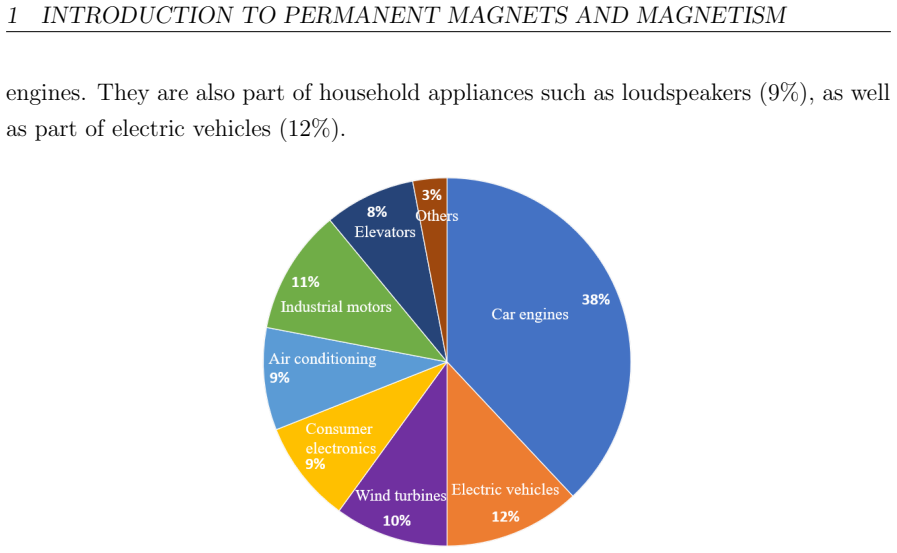
Figure 2. Figure 2: Application of permanent magnets by market share in 2021. The image was created from data of Rizos et al. [20]. Among the used magnets, the sintered Nd-Fe-B magnet is very common with a total share of 65.8% (see [PITH_FULL_IMAGE:figures/full_fig_p013_2.png] view at source ↗
Figure 3
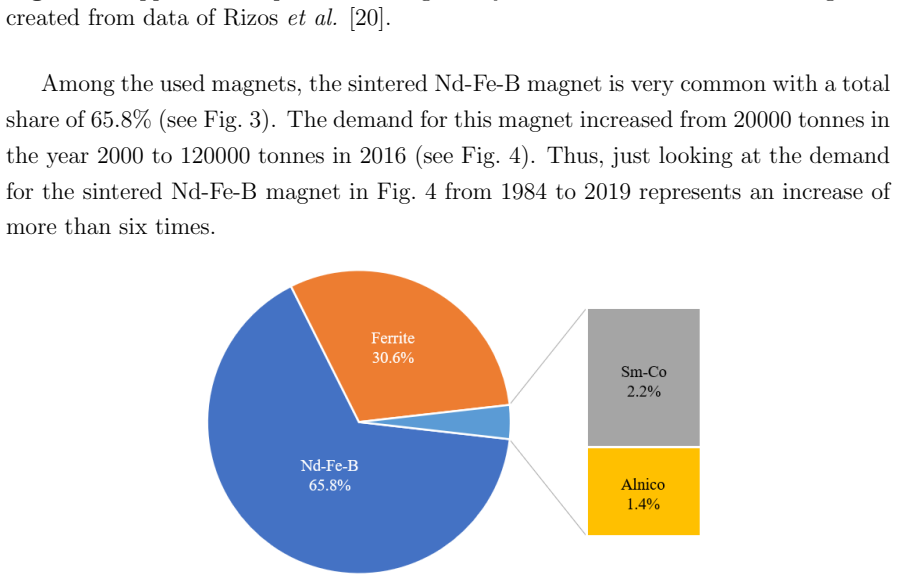
Figure 3. Figure 3: Percentage sales of major permanent magnet alloy types in 2022 in the global market. The image is based on data from [20]. To get a complete picture of the demand for hard magnets, [PITH_FULL_IMAGE:figures/full_fig_p013_3.png] view at source ↗
Figure 4
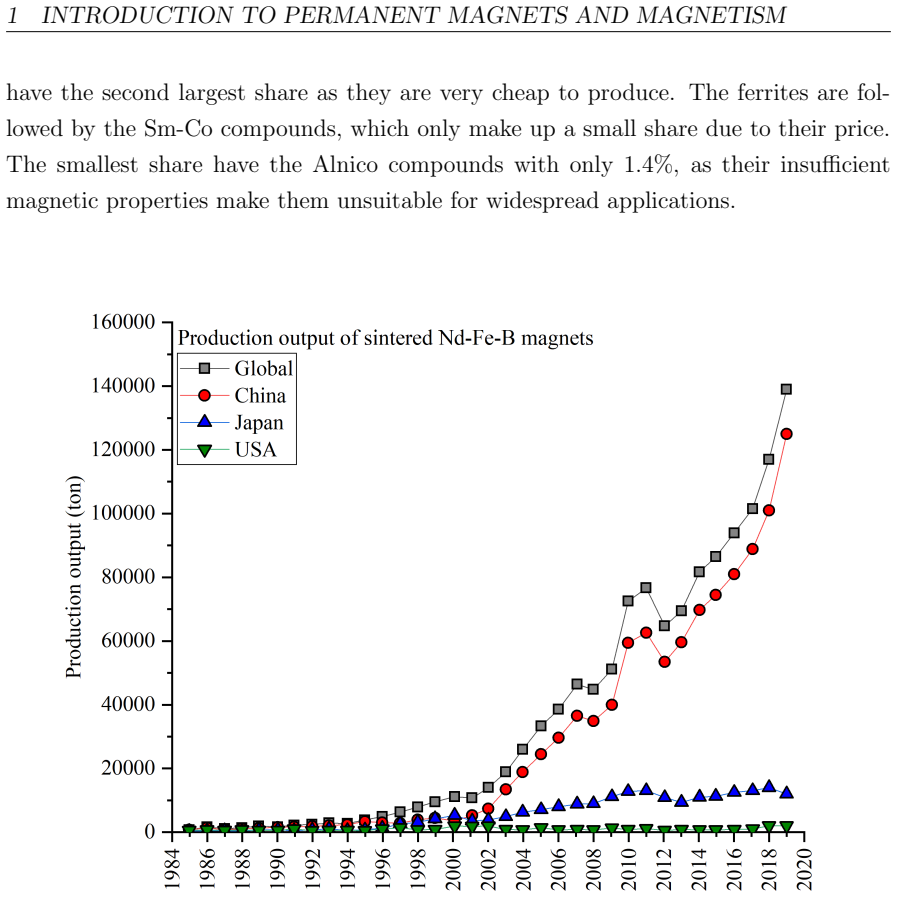
Figure 4. Figure 4: Worldwide production of sintered Nd-Fe-B magnets from 1984 to 2019. The picture is based on data taken from [21, 22]. As [PITH_FULL_IMAGE:figures/full_fig_p014_4.png] view at source ↗
Figure 5
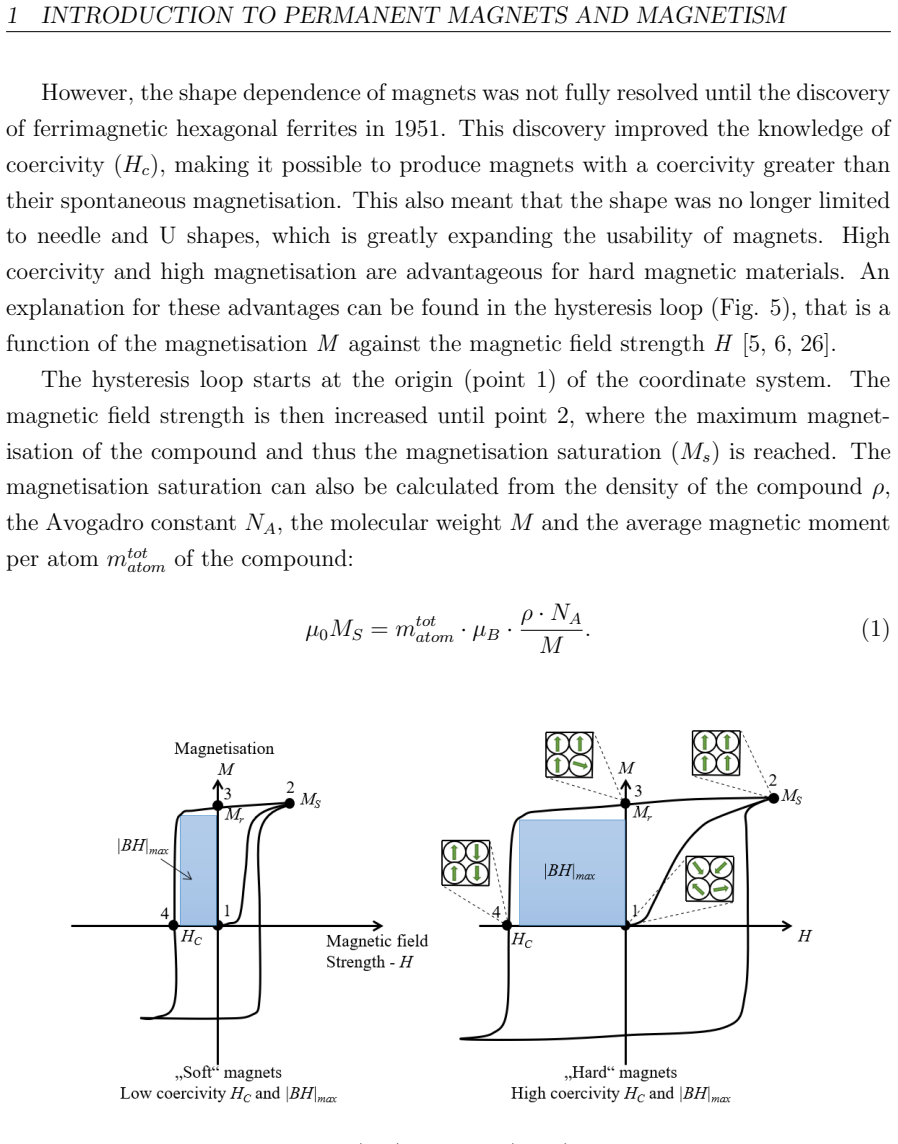
Figure 5. Figure 5: Hysteresis loop for soft (left) and hard (right) magnetic materials. Important magnetic properties like the magnetisation saturation MS are marked and the maximum energy product |BH|max is depicted as a blue square in the second quadrant. The image is based on data from [27]. At point 1 before the magnetic field strength is increased, the magnetic domains all align in different directions to minimise the e… view at source ↗
Figure 6
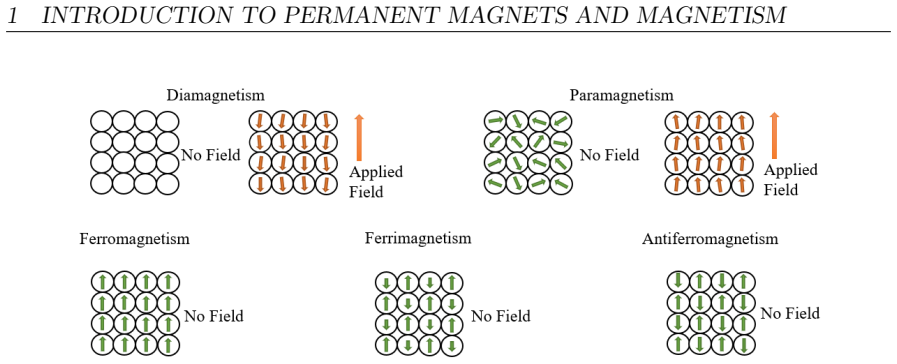
Figure 6. Figure 6: Different magnetic domain configurations for the different types of magnet￾ism with and without external field application. The image is based on data from [28]. In contrast to diamagnetism, paramagnetism has finite local magnetic moments. Without an applied external field, all domains are pointing in different directions, res￾ulting in a total magnetic moment of zero. When the external field is applied, a… view at source ↗
Figure 7
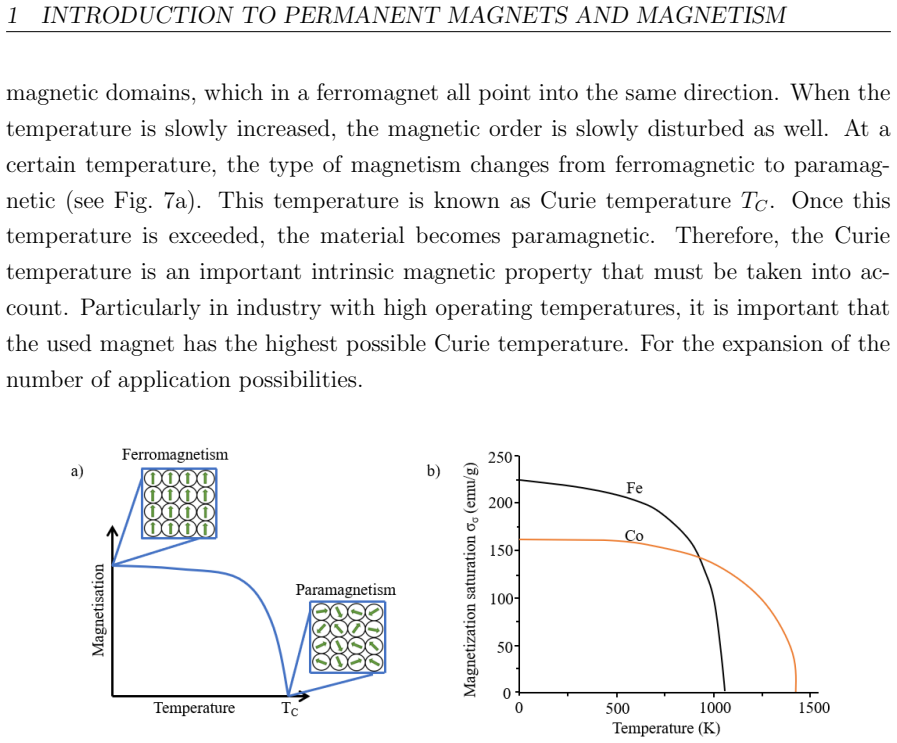
Figure 7. Figure 7: a) Change of the magnetic ordering from ferro- to paramagnetism with increasing temperature up to the Curie temperature TC; b) Finite temperature mag￾netisation curves for the elements Fe and Co up to their TC’s of 1044 and 1388 K. Image a) is based on data from [29] and b) on [26]. Fig. 7b shows the magnetisation behaviour of iron and cobalt as the temperature increases. Furthermore, the finite temperatur… view at source ↗
Figure 8
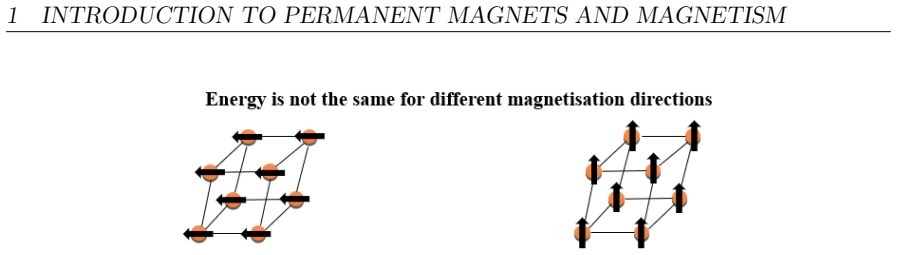
Figure 8. Figure 8: Unequal energies for the different magnetisation directions. Image based on [29]. According to the Bohr definition, a charge shift and thus the movement of electrons causes magnetism. It can be concluded that this is a result of the circulating electron currents. Due to the nature of electron currents, energy is equal in opposite directions for a given magnetisation distribution (in other words M(r) = −M(r… view at source ↗
Figure 9
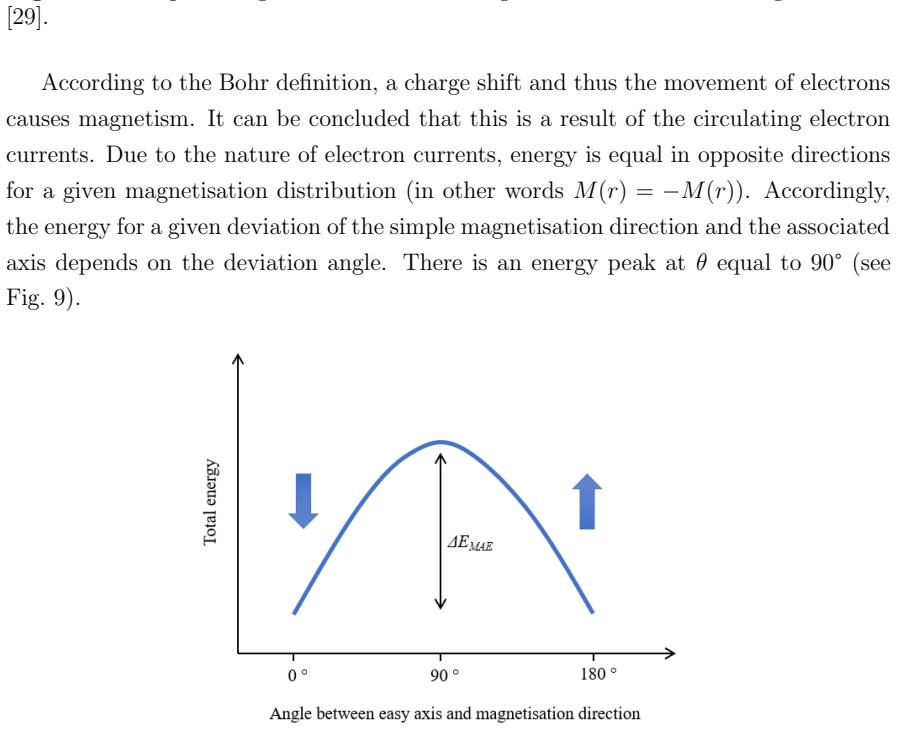
Figure 9. Figure 9: ) [PITH_FULL_IMAGE:figures/full_fig_p020_9.png] view at source ↗
Figure 10
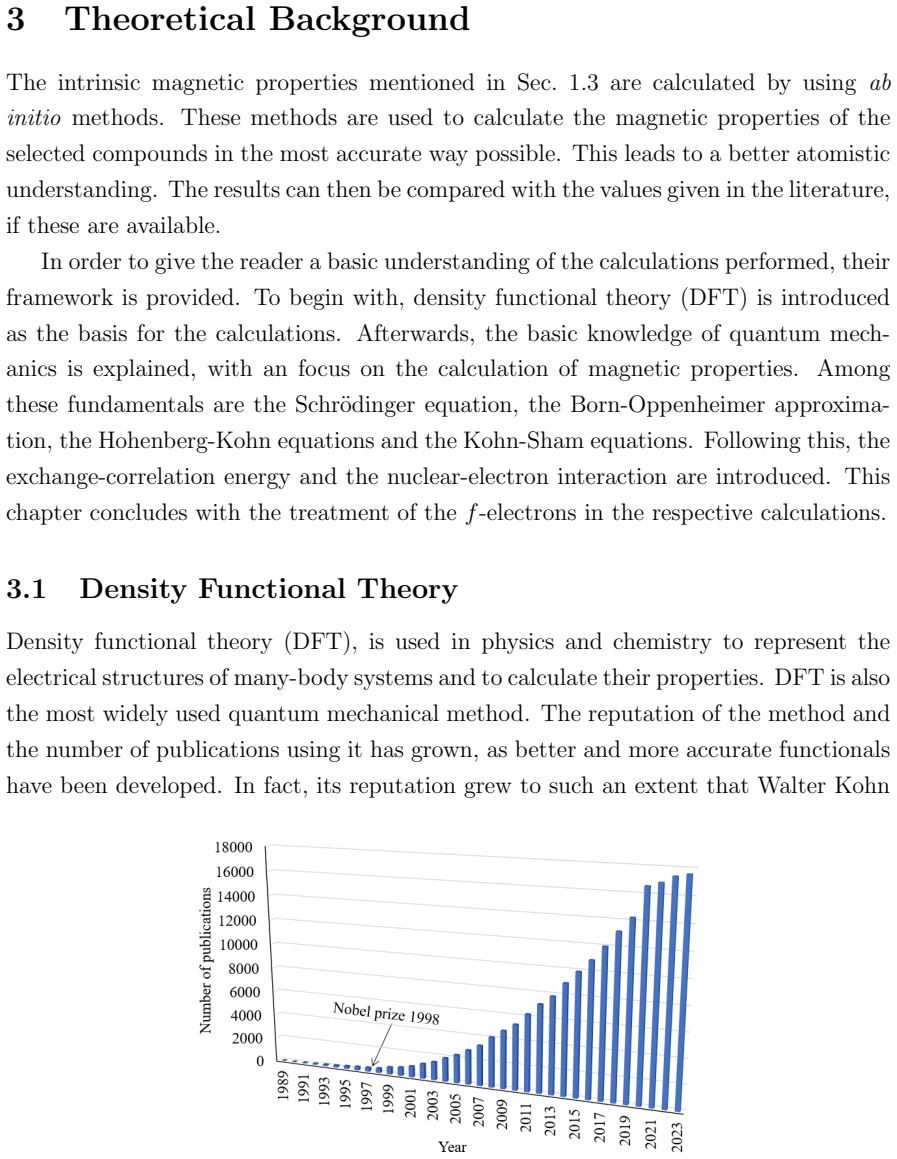
Figure 10. Figure 10: Increasing number of publications using DFT. The Nobel prize in chemistry is marked in accordance to the year. The values for the years 1989-2019 are taken from the source [49]. The values for 2020-2023 (as of 09/10/2023) are based on the search ”DFT density functional theory” in google scholar. 25 [PITH_FULL_IMAGE:figures/full_fig_p025_10.png] view at source ↗
Figure 11
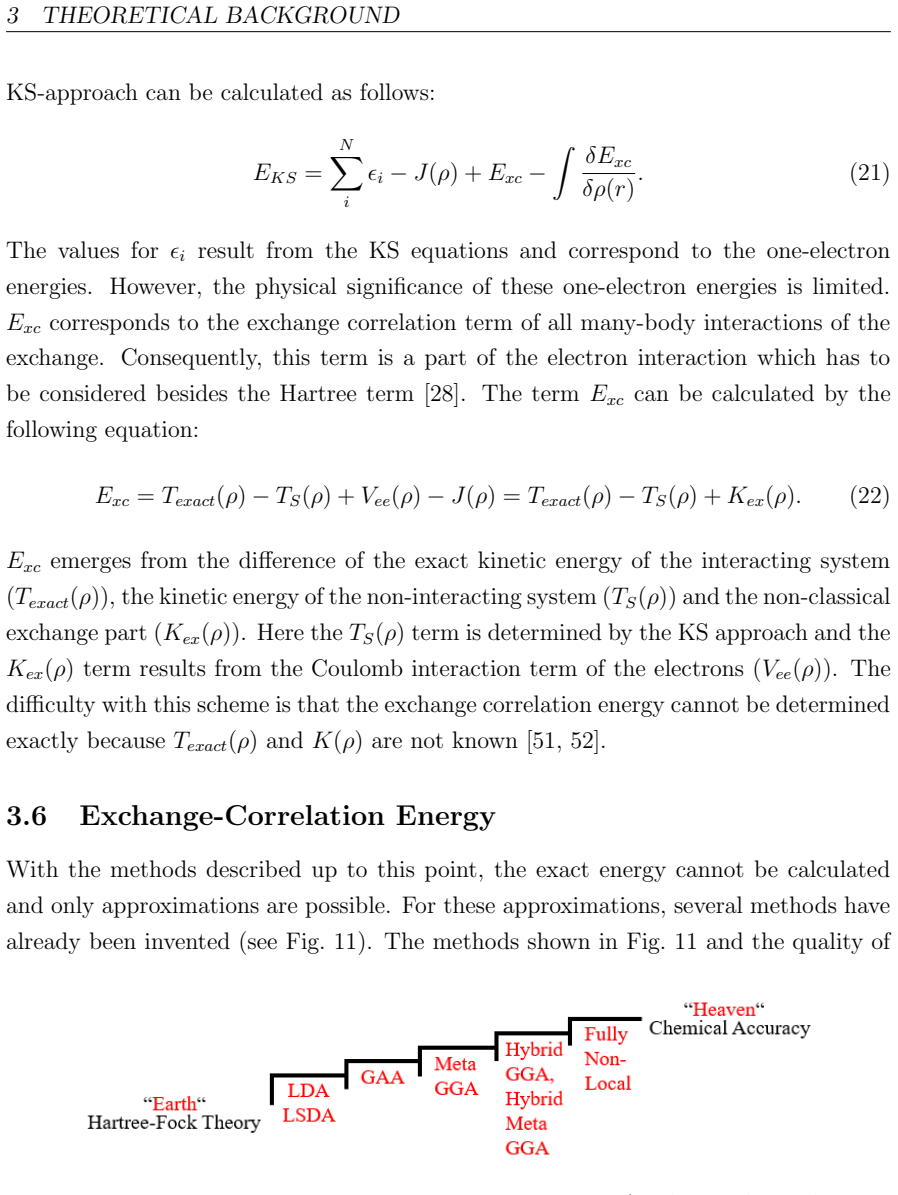
Figure 11. Figure 11: Jacob’s ladder showing the different functionals (LDA, LSDA, GGA, Meta GGA, Hybrid GGA, Hybrid Meta GGA and Fully Non-Local) leading to increases of the accuracy of calculations. The image is adapted from [57]. the resulting values vary considerably depending on the system. It is therefore required to find the most appropriate method for the system considered. It should be noted that 31 [PITH_FULL_IMAGE:… view at source ↗
Figure 12
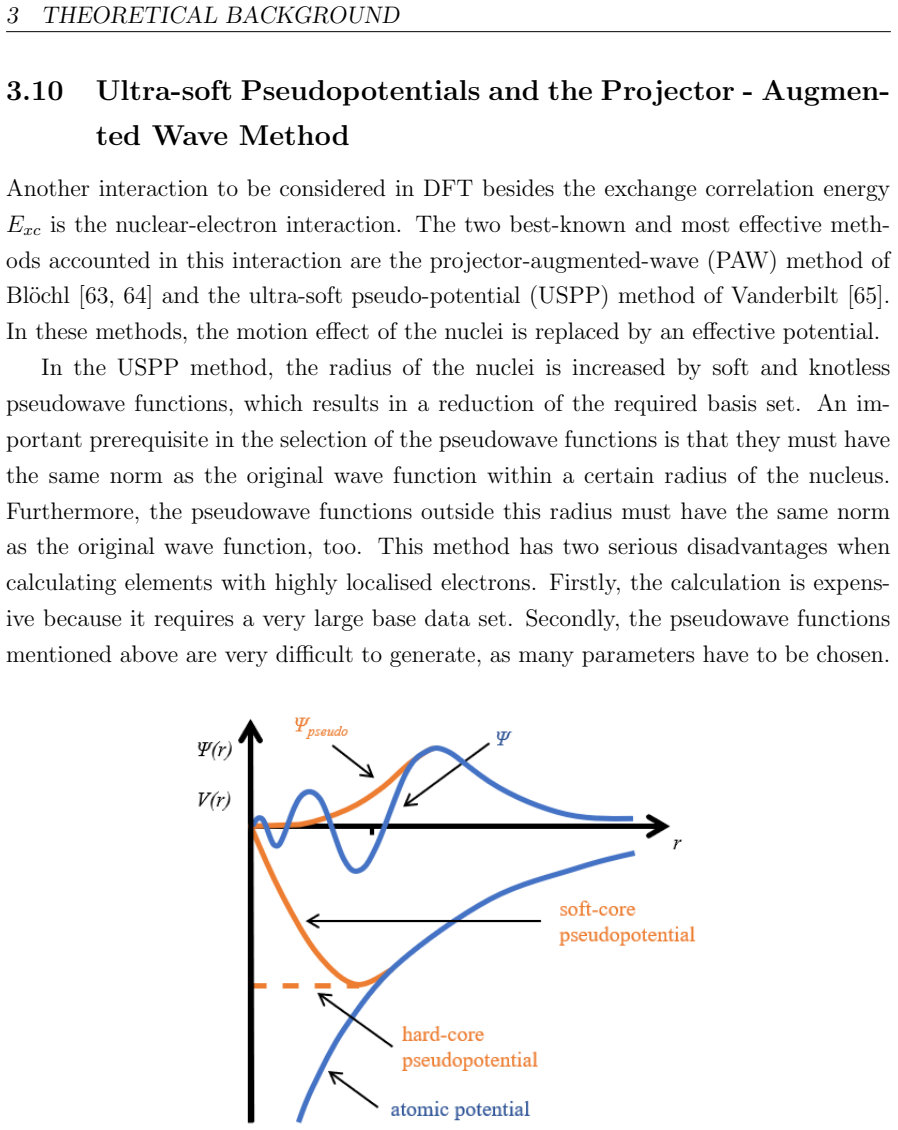
Figure 12. Figure 12: Radial dependence of typical pseudopotentials compared to the atomic Coulomb potential (blue). In the lower part a soft-core pseudopotential and a hard￾core pseudopotential are shown with the solid and dashed orange curves, respectively. In the upper part the wave functions and the pseudo wave function resulting from the atomic (blue) and the pseudopotential (orange) are shown. Note that both wave functio… view at source ↗
Figure 13
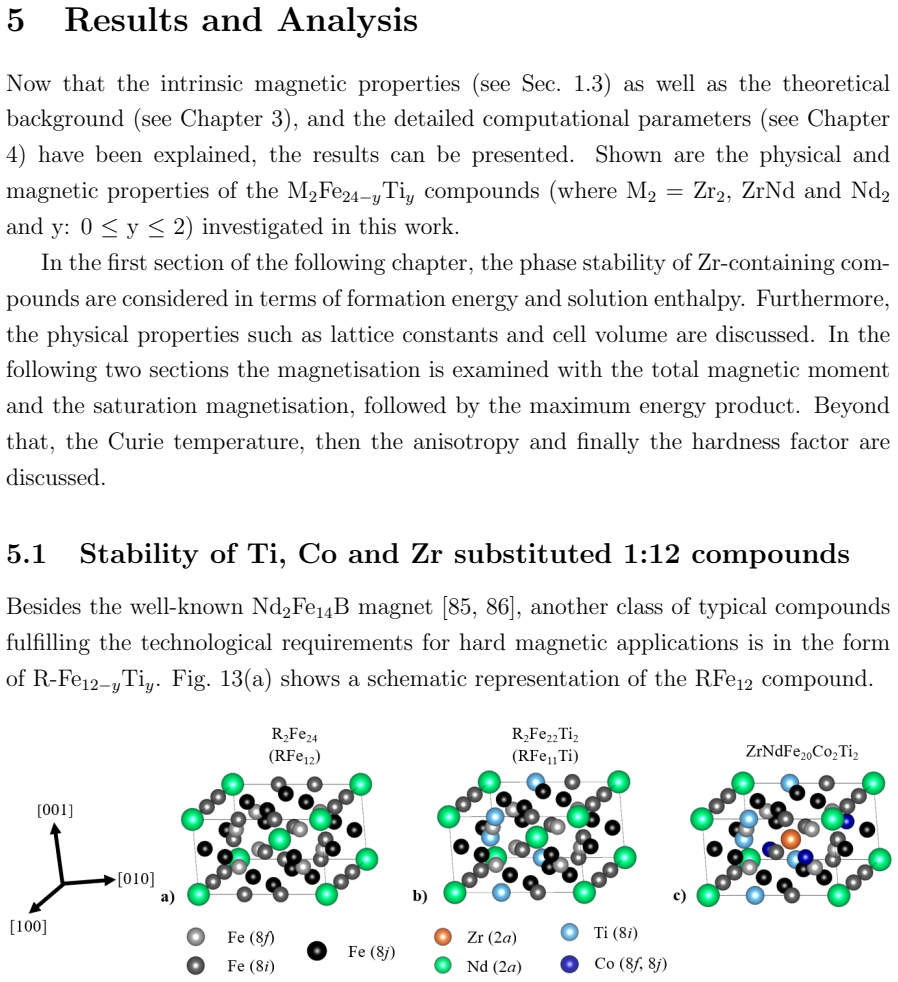
Figure 13. Figure 13: Schematic representation of the 2 formula unit (f.u.) (26 atoms) body￾center-tetragonal ThMn12 (I4/mmm, space group number 139) 1:12 phases. (a) Un￾stable RFe12, (b) 2 Ti atom substituted (7.7 at.%) R2Fe22Ti2 (RFe11Ti) and (c) 2 Ti and 2 Co substituted (each 7.7 at.%) supercell RFe10CoTi (R2Fe20Co2Ti2). Ti atoms are substituted in energetically favorable 8i sites and Co atoms are substituted in en￾ergetic… view at source ↗
Figure 14
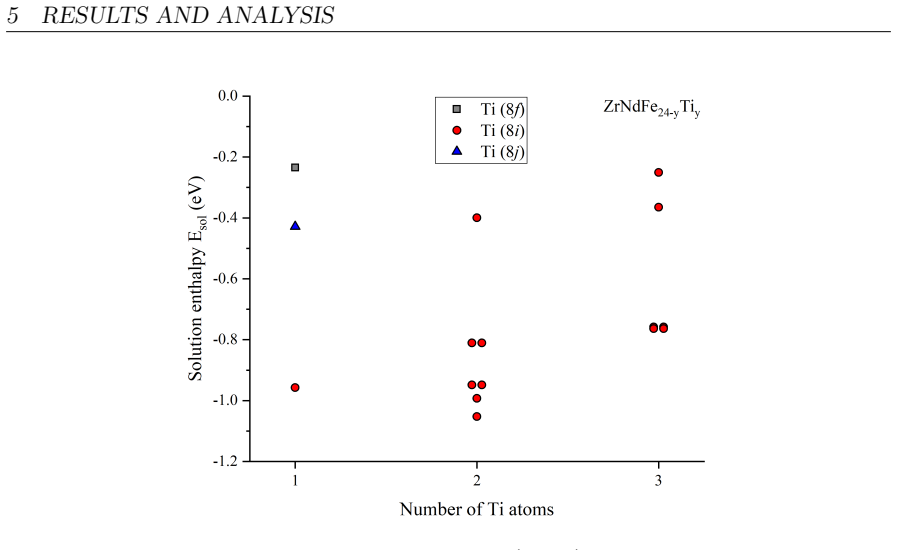
Figure 14. Figure 14: Calculated Ti solution enthalpies for (ZrNd)Fe24−yTiy according to Eq. 38. The first Ti atom is checked in 8i, 8j and 8f sites one by one. Then the remaining Ti atoms are substituted on 8i site due to the lower solution enthalpy and all possible configurations are considered. Although Ti stabilises the Zr substituted 1:12 compounds, it reduces the total mag￾netic moment due to its nonmagnetic (NM) nature.… view at source ↗
Figure 15
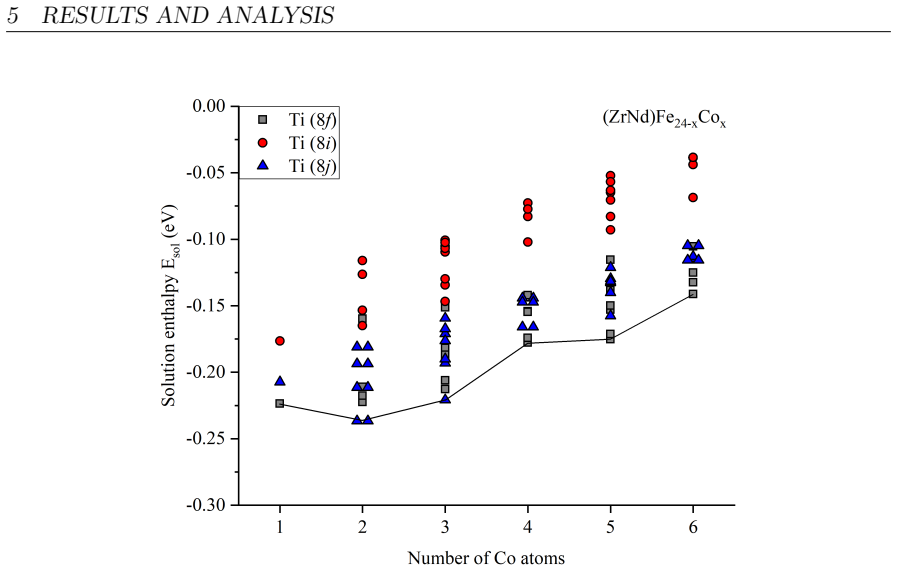
Figure 15. Figure 15: Calculated Co solution enthalpies for chemical compositions with the formula (ZrNd)Fe24−xCox according to Eq. 38. As can be seen in [PITH_FULL_IMAGE:figures/full_fig_p044_15.png] view at source ↗
Figure 16
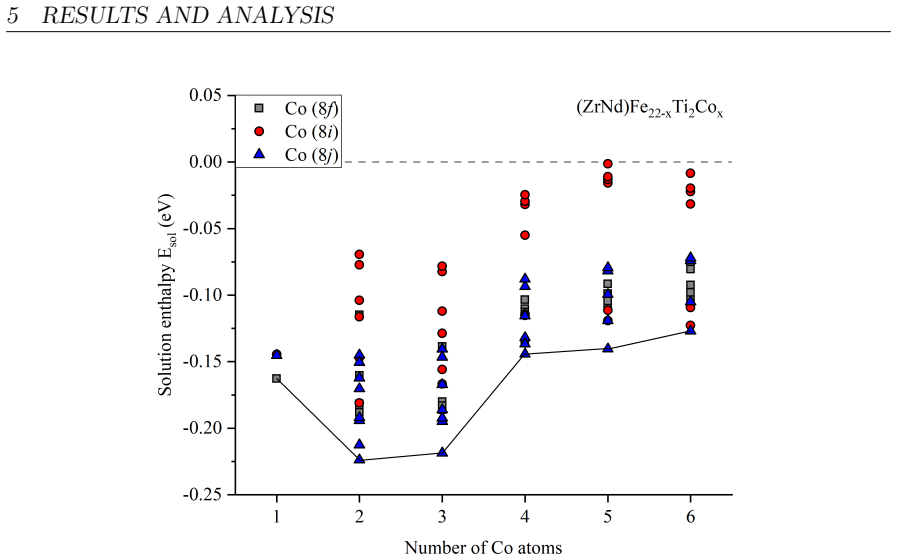
Figure 16. Figure 16: Calculated Co solution enthalpies for chemical compositions with the formula (ZrNd)Fe22−xTi2Cox according to Eq. 38. 6 Co atoms. Note, that this increase (decrease) becomes visible only with the substi￾tution of the 4th Co atom. Thus, Co in its equilibrium concentration has only a minor effect on the magnetic properties. The substitution of a Ti or Co atom into (ZrNd)Fe24 leads to a stabilisation of -0.96… view at source ↗
Figure 17
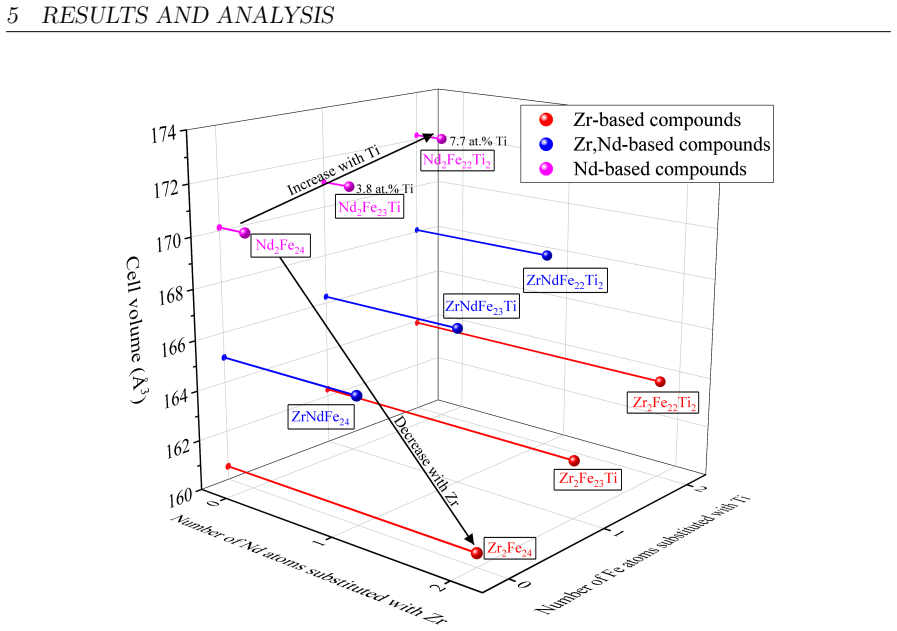
Figure 17. Figure 17: Schematic representation of cell volume evolution for two different substi￾tutions, namely substitution of Ti into the Fe sublattice and substitution of Zr into the Nd sublattice, using GGA calculations. Pure Nd-containing compounds are shown in pink while compounds containing only Zr are shown in red. The quaternary compounds containing Zr and Nd are shown in blue. The calculated physical properties of t… view at source ↗
Figure 18
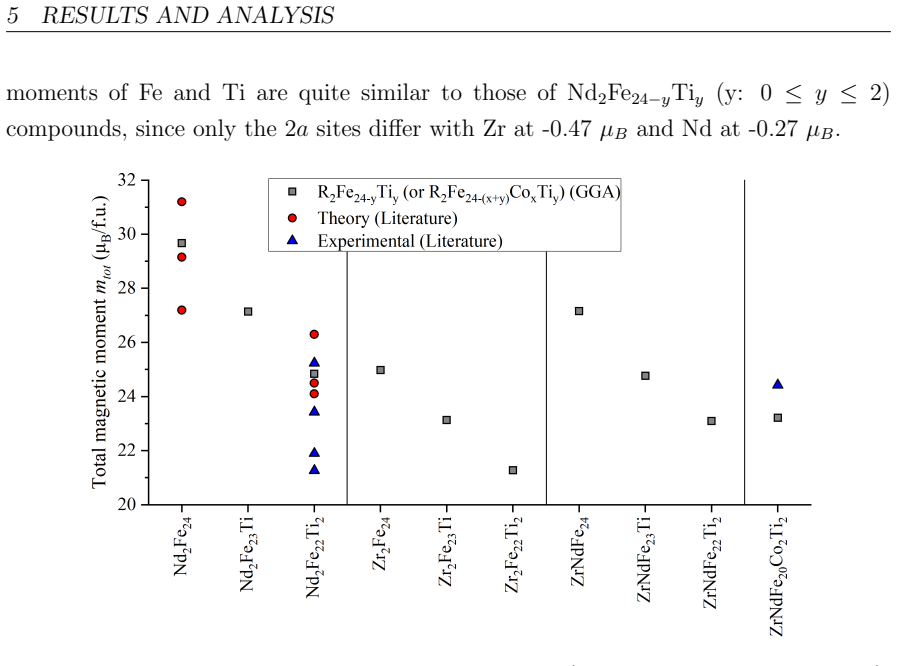
Figure 18. Figure 18: Total magnetic moments of R2Fe24 yTiy (R: Zr and Nd; y: 0 ≤ y ≤ 2). Since GGA+U calculations do not change the results significantly, only GGA results are given. The red circles show theoretical data [86, 103–105] for the alloys from others and the blue triangles show experimental data [36, 74, 99, 106, 107] for the alloys. Here all literature values correspond to the same compounds. Only the experimental… view at source ↗
Figure 18
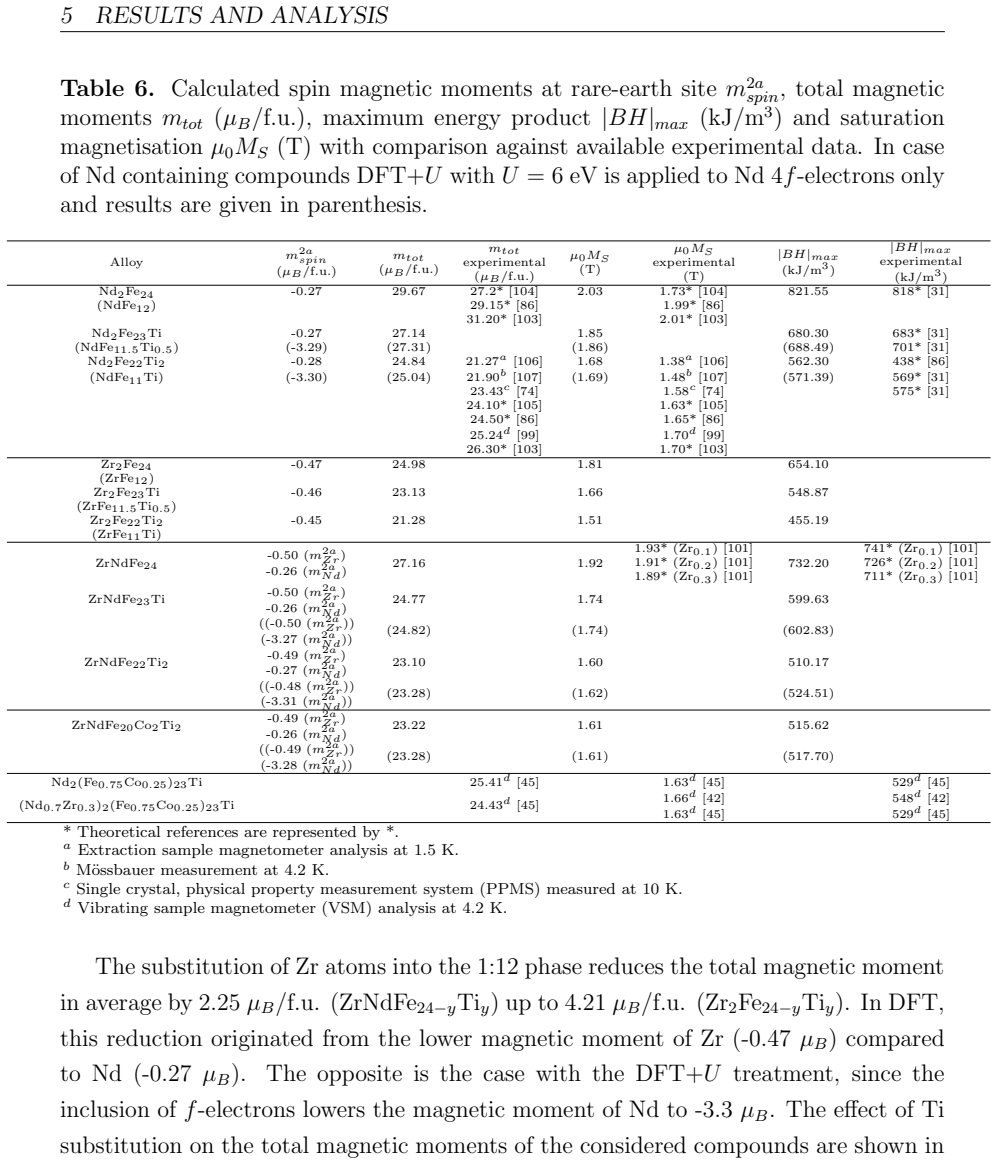
Figure 18. Figure 18: In GGA and GGA+U the total magnetisation of Ti atoms is about -1.1 µB. This is due to the antiferromagnetic orientation of Ti atoms relative to Fe atoms. It can be seen that the total magnetic moment decreases with more Ti in a compound. The trend of the values from the Nd2Fe24−yTiy (y: 0 ≤ y ≤ 2) compounds shows the same tendency as in the work of Erdmann et al. [31]. The development of the values of all… view at source ↗
Figure 19
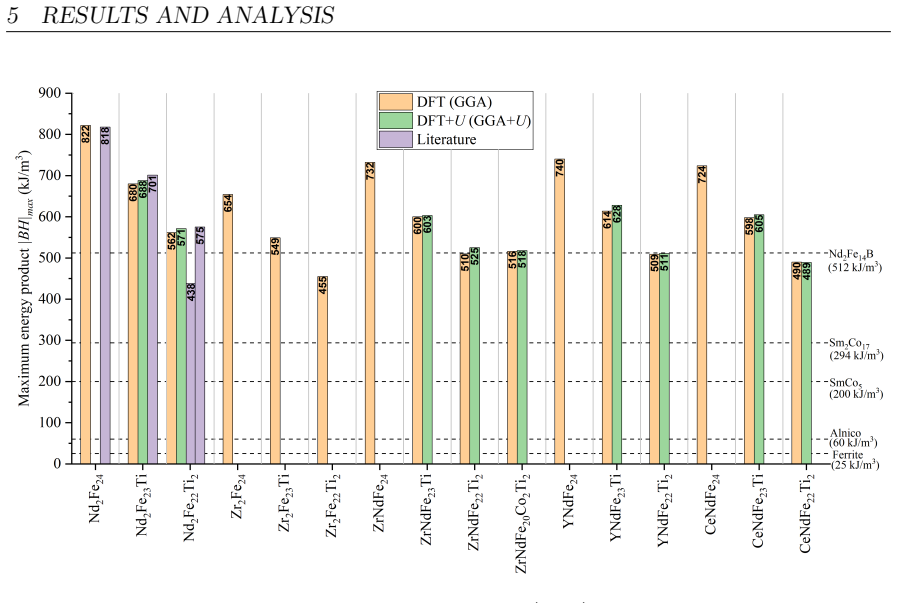
Figure 19. Figure 19: Theoretical maximum energy product |BH|max values for the compounds considered and the literature for comparison [31, 86]. In addition to conventional DFT, DFT+U with U = 6 eV has been considered for stable Nd containing alloys. Experi￾mental values [17, 109] of the most common hard magnets are given as horizontal dotted lines. value then the calculated one of 562 kJ/m3 in this thesis. Furthermore, the ca… view at source ↗
Figure 20
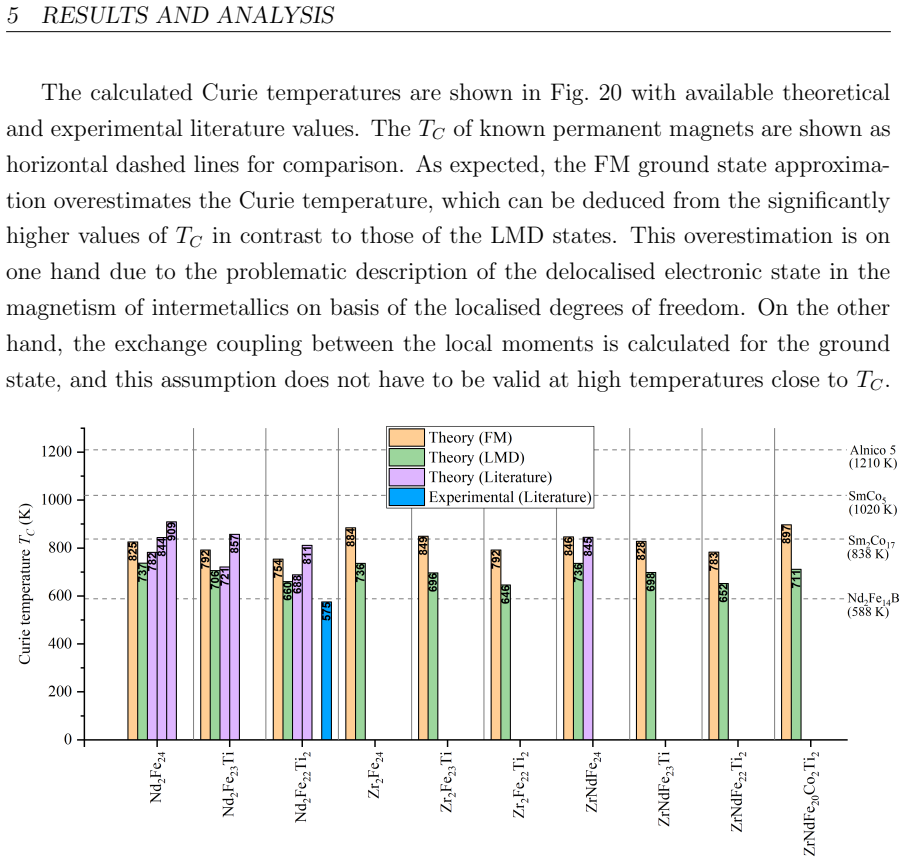
Figure 20. Figure 20: Calculated Curie temperatures TC for all considered 1:12 phases. The exchange interaction energies have been calculated for both ordered ferromagnetic (FM) and disordered local momentum (LMD) states, and the lattice information comes from the theoretically relaxed calculations (see Tab. 5). The experimental data is taken from [31, 101, 106]. In the work of Erdmann et al. [31], a good agreement with Miyake… view at source ↗
Figure 21
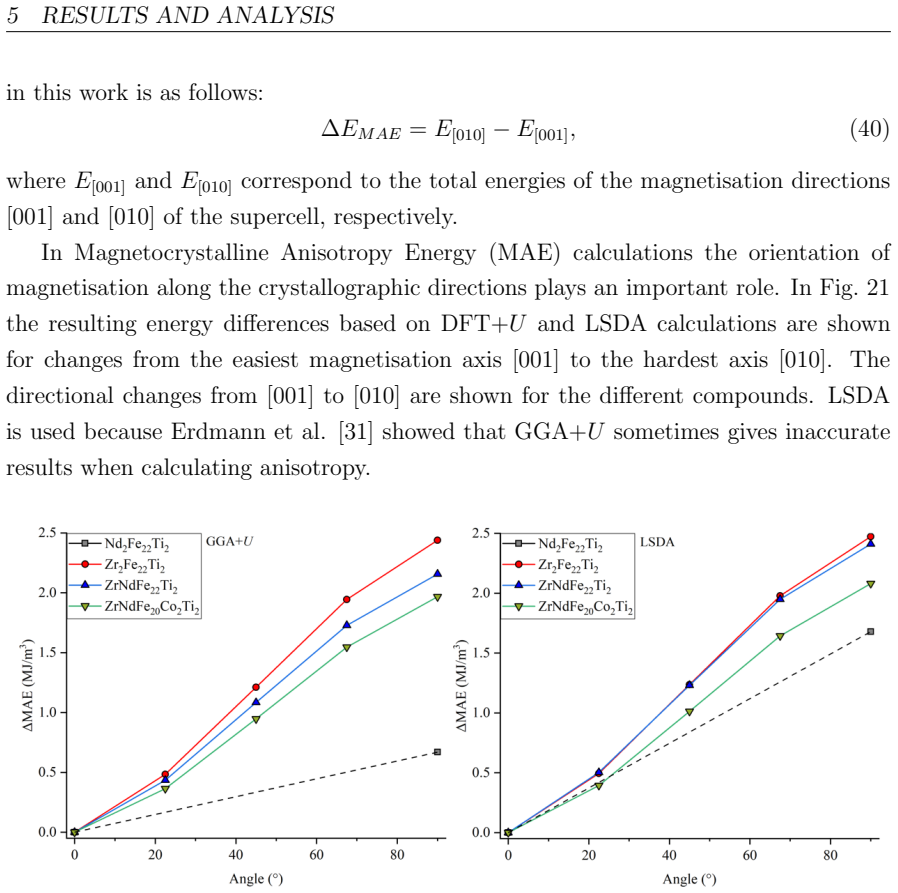
Figure 21. Figure 21: Calculated energy differences of magnetocrystalline energy for the shift of the crystallographic direction from [001] to [010] for all compounds considered in MAE calculation. LSDA results are shown on the left and DFT+U results on the right. For the change from [001] to [010], angles 0, 22.5, 45, 67.5 and 90° are taken into consideration. For NdFe11Ti only the values of the angles 0 and 90° are shown. Fr… view at source ↗
Figure 22
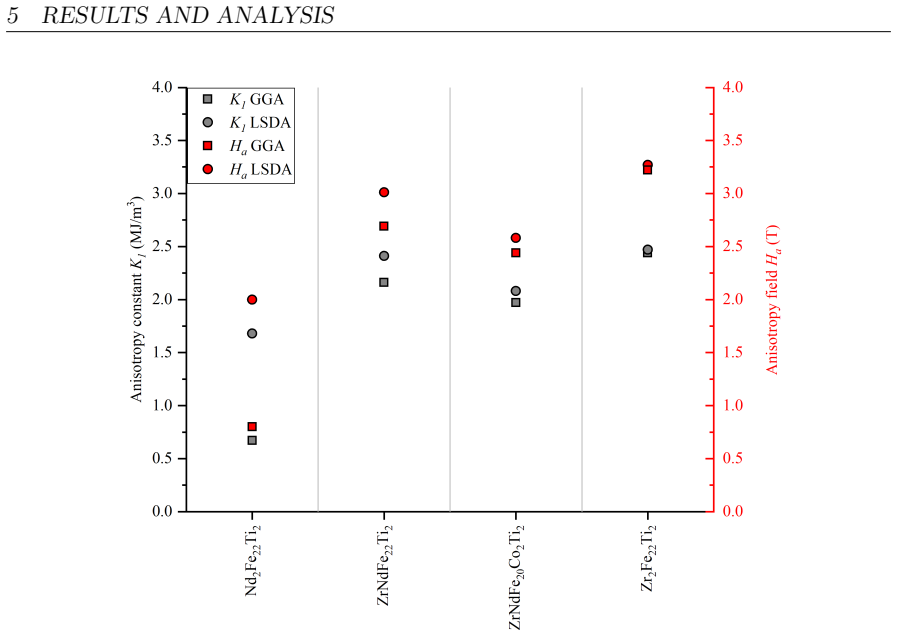
Figure 22. Figure 22: The values of the anisotropy constant K1 and the anisotropy field Ha are shown in black and red, respectively. The values calculated with the GGA+U functional are shown as circles, while those using the LSDA functional are shown as squares. (Zr,Nd)Fe10CoTi, the GGA+U (and LSDA) treatments yielded values of 3.22 (3.27), 2.69 (3.01) and 2.44 (2.58) T, respectively. These values follow the same mentioned tre… view at source ↗
Figure 23
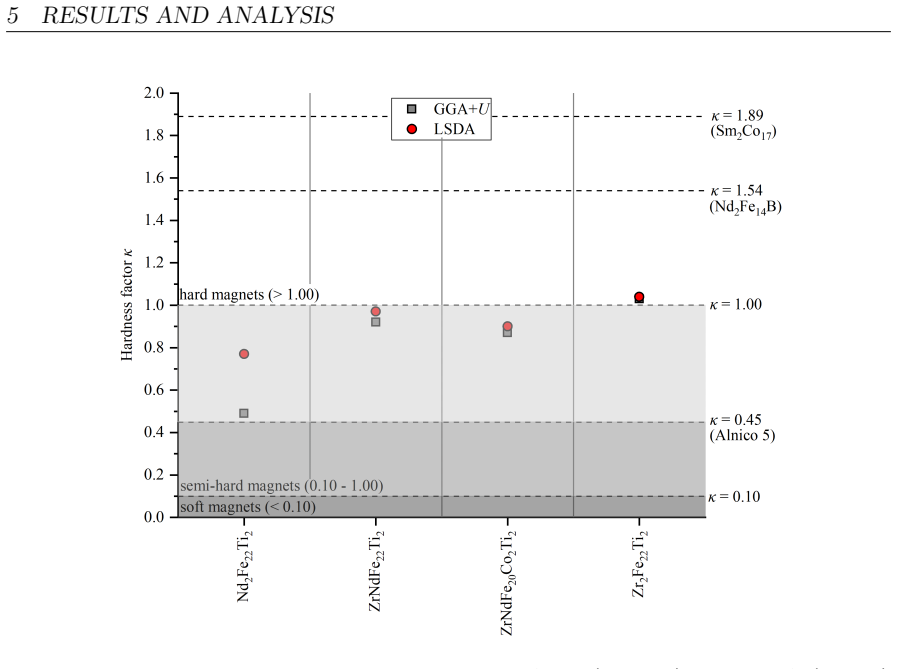
Figure 23. Figure 23: Calculated hardness factors κ for GGA+U (squares) and LSDA (circles) functionals. The magnetic hardness factors of well known magnets are shown by hori￾zontal dashed lines. this work are significantly higher than those of the mentioned literature compound. The deviations can be explained by a higher Zr content as well as a higher Ti and lower Co concentration of the chosen compounds. Thus, a good accordan… view at source ↗
read the original abstract

This research aims to identify an alternative solution for the Nd$_2$Fe$_{14}$B magnet in light of the scarcity of rare earth (RE) resources. The investigation uses density functional theory (DFT) calculations to assess the effect of partial substitution of Nd with the transition metal (TM) Zr within the ThMn$_{12}$ structure, focusing specifically on the (Zr$_{0.5}$Nd$_{0.5}$)Fe$_{11}$Ti compound. In order to gain a comprehensive understanding, an investigation of intrinsic and magnetic properties, including saturation magnetisation ($M_S$), Curie temperature ($T_C$) and magnetic anisotropy energy (MAE), is carried out on binary to quinary compounds RFe$_{11-y}$Ti$_{y}$ (R: Nd, Zr and Zr$_{0.5}$Nd$_{0.5}$, y: $0 \leq y \leq 1$) and (Zr$_{0.5}$Nd$_{0.5}$)Fe$_{10}$CoTi. The substitution of Ti at different concentrations for thermodynamic stabilisation is studied in ternary and quaternary compounds RFe$_{12-y}$Ti$_y$ ($0 \leq y \leq 1$). In addition, the influence of Co on phase stability and intrinsic magnetic properties is studied in the quinary compound (Zr$_{0.5}$Nd$_{0.5}$)Fe$_{10}$CoTi. Special attention is given to the treatment of the 4$f$-electrons of Nd and their interaction with the 3$d$-electrons. Theoretical results are compared with available experimental data, although the limited availability of data, especially for Zr-containing compounds, limits the scope of such comparisons. Based on the literature and the calculations of binary and ternary compounds, the calculations of quaternary and quinary compounds are encouraged. Promising magnetic properties of an Nd-lean quaternary compound suitable for engineering applications have been identified.

Editorial analysis

A structured set of objections, weighed in public.

Desk editor's note, referee report, simulated authors' rebuttal, and a circularity audit. Tearing a paper down is the easy half of reading it; the pith above is the substance, this is the friction.

Referee Report

2 major / 2 minor

Summary. This bachelor's thesis uses DFT calculations to investigate the effect of partial Zr substitution for Nd in ThMn12-type structures, computing intrinsic magnetic properties (Ms, Tc, MAE) for binary through quinary compounds RFe12-yTiy (R = Nd, Zr, Zr0.5Nd0.5; 0 ≤ y ≤ 1) and (Zr0.5Nd0.5)Fe10CoTi. Special attention is given to the treatment of Nd 4f electrons and their interaction with 3d electrons; results are compared to limited experimental data, and the work concludes that the Nd-lean quaternary compound (Zr0.5Nd0.5)Fe11Ti exhibits promising properties for engineering applications as an alternative to Nd2Fe14B.

Significance. If the computed MAE, Tc, and Ms values prove reliable, the identification of an Nd-lean quaternary ThMn12 compound with competitive magnetic properties would address a timely materials challenge in reducing rare-earth content for permanent magnets. The systematic exploration from binary to quinary compositions provides a useful computational map, though its impact depends on validation against experiment.

major comments (2)
  1. [Abstract] Abstract: The central claim that 'promising magnetic properties of an Nd-lean quaternary compound suitable for engineering applications have been identified' rests on the accuracy of the MAE, Tc, and Ms predictions for (Zr0.5Nd0.5)Fe11Ti. The abstract states that special attention was given to the 4f–3d interaction, yet provides no explicit description of the chosen method (Hubbard U value, open-core approximation, or hybrid functional) nor any benchmark of computed MAE against measured values for the reference compound NdFe11Ti. Given that MAE is typically only a few meV/f.u. and is known to be highly sensitive to the positioning of Nd 4f states, this omission is load-bearing for the claim.
  2. [Comparison with experimental data] Section on comparison with experimental data: The manuscript notes that 'limited availability of data, especially for Zr-containing compounds, limits the scope of such comparisons.' Without quantitative error bars, sensitivity analysis to the 4f treatment, or direct validation of the quaternary predictions against any measured MAE or Tc, the error margin on the reported properties for (Zr0.5Nd0.5)Fe11Ti and (Zr0.5Nd0.5)Fe10CoTi remains unknown and prevents a robust assessment of whether they are truly 'promising.'
minor comments (2)
  1. [Title] Title: 'quarternary' is misspelled and should read 'quaternary.'
  2. [Abstract] Abstract: The notation 'RFe11-yTiy' and 'RFe12-yTiy' is used inconsistently with the stated range 0 ≤ y ≤ 1; clarify whether the Ti substitution index is y or 11-y/12-y in the text.

Simulated Author's Rebuttal

2 responses · 1 unresolved

We thank the referee for their detailed review and constructive comments on our bachelor's thesis. We respond to the major comments point by point below.

read point-by-point responses
  1. Referee: The central claim that 'promising magnetic properties of an Nd-lean quaternary compound suitable for engineering applications have been identified' rests on the accuracy of the MAE, Tc, and Ms predictions for (Zr0.5Nd0.5)Fe11Ti. The abstract states that special attention was given to the 4f–3d interaction, yet provides no explicit description of the chosen method (Hubbard U value, open-core approximation, or hybrid functional) nor any benchmark of computed MAE against measured values for the reference compound NdFe11Ti. Given that MAE is typically only a few meV/f.u. and is known to be highly sensitive to the positioning of Nd 4f states, this omission is load-bearing for the claim.

    Authors: We agree that the abstract would be improved by a brief explicit reference to the 4f treatment. The full manuscript describes the approach to the Nd 4f electrons and their interaction with 3d electrons in the computational methods section, along with comparisons to available experimental data for NdFe11Ti. We will revise the abstract to include a concise statement on the method used. revision: yes

  2. Referee: The manuscript notes that 'limited availability of data, especially for Zr-containing compounds, limits the scope of such comparisons.' Without quantitative error bars, sensitivity analysis to the 4f treatment, or direct validation of the quaternary predictions against any measured MAE or Tc, the error margin on the reported properties for (Zr0.5Nd0.5)Fe11Ti and (Zr0.5Nd0.5)Fe10CoTi remains unknown and prevents a robust assessment of whether they are truly 'promising.'

    Authors: We acknowledge that the limited experimental data, already noted in the manuscript, constrains direct validation. Comparisons for Ms, Tc and MAE are provided for binary and ternary compounds where data exist. Quaternary results are evaluated via trends from these validated cases. We will add a note on estimated uncertainties derived from the observed variations in the benchmarked compositions. A full sensitivity analysis lies outside the current thesis scope. revision: partial

standing simulated objections not resolved
  • Direct experimental measurements for the specific quaternary and quinary compounds are not available in the literature, preventing direct validation of those predictions.

Circularity Check

0 steps flagged

No circularity: direct DFT computations on compounds yield independent property predictions

full rationale

The paper's chain consists of standard DFT calculations (with noted attention to 4f treatment) to obtain Ms, Tc and MAE for binary through quinary ThMn12-type compounds, followed by comparison to sparse experimental data and literature. No equations, fitted parameters or self-citations are shown that reduce the reported quaternary/quinary results to prior inputs by construction; the outputs are generated from the electronic-structure method applied to each composition. This is the normal case of a self-contained computational study.

Axiom & Free-Parameter Ledger

0 free parameters · 1 axioms · 0 invented entities

The central claim rests on the domain assumption that standard DFT functionals can capture the relevant magnetic energetics once 4f electrons are treated appropriately; no free parameters or invented entities are named in the abstract.

axioms (1)
  • domain assumption DFT calculations with appropriate treatment of Nd 4f electrons yield reliable values for Ms, Tc, and MAE in these compounds
    Invoked throughout the abstract as the basis for all property assessments and comparisons to experiment.

pith-pipeline@v0.9.0 · 5896 in / 1259 out tokens · 18401 ms · 2026-05-24T04:53:39.170676+00:00 · methodology

discussion (0)

Sign in with ORCID, Apple, or X to comment. Anyone can read and Pith papers without signing in.