Magnon Damping as a Probe of Kondo Coupling in Magnetically Ordered Systems
Pith reviewed 2026-05-24 05:42 UTC · model grok-4.3
The pith
Magnon damping in Fe_{3-x}GeTe_2 diverges at low and high temperatures due to Kondo coupling via spin-flip electron-magnon scattering.
A machine-rendered reading of the paper's core claim, the machinery that carries it, and where it could break.
Core claim
The observed magnon damping diverges at both low and high temperatures and exhibits a minimum at an intermediate temperature; these behaviours are described by a formula that combines logarithmic and power-law terms, representing the dominant contributions from Kondo coupling and thermal fluctuations, respectively, and can be explained by electron-magnon scattering of spin-flip type within the ferromagnetic Kondo-Heisenberg lattice model, distinct from the original Kondo effect which only considers the coupling between itinerant electrons and isolated impurity spins.
What carries the argument
Ferromagnetic Kondo-Heisenberg lattice model, in which spin-flip electron-magnon scattering produces the logarithmic contribution to damping.
If this is right
- Magnon linewidth measurements can serve as a probe of Kondo coupling strength in other metallic magnets with long-range order.
- The electron-magnon interaction in ordered Kondo-Heisenberg systems produces damping behavior different from the conventional single-impurity Kondo effect.
- Temperature-dependent damping data can distinguish the relative weight of Kondo and thermal-fluctuation channels in itinerant magnets.
Where Pith is reading between the lines
- Similar damping minima should appear in other van der Waals ferromagnets that host both itinerant electrons and local moments.
- Varying carrier density while holding magnetic order fixed would test whether the logarithmic term scales with Kondo temperature.
- Extending the same analysis to antiferromagnetic or frustrated Kondo lattices could reveal whether the spin-flip channel is universal.
Load-bearing premise
The low-temperature upturn in damping arises specifically from spin-flip electron-magnon scattering induced by Kondo coupling rather than from other scattering channels or experimental effects.
What would settle it
A direct test would be whether the measured damping follows the specific combined logarithmic-plus-power-law form over the full temperature range or whether the low-temperature divergence vanishes in a control sample lacking Kondo coupling.
Figures


read the original abstract
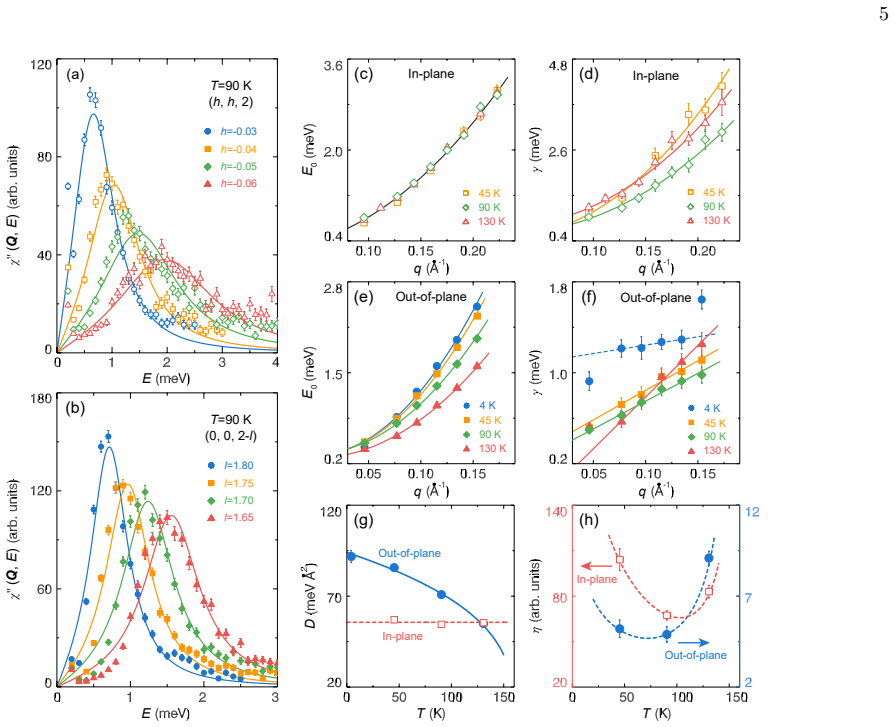
In $d$-electron systems, there can also be intricate interplay between Kondo coupling and magnetic interactions as that in $f$-electron systems, but the underlying mechanism remains elusive. Here, using inelastic neutron scattering, we investigate the temperature evolution of the low-energy spin waves (magnons) in a metallic van der Waals ferromagnet Fe$_{3-x}$GeTe$_{2}$, and observe that the magnon damping diverges at both low and high temperatures and exhibits a minimum at an intermediate temperature. These behaviours are described by a formula that combines logarithmic and power-law terms, representing the dominant contributions from Kondo coupling and thermal fluctuations, respectively. These findings can be explained by considering electron-magnon scattering of spin-flip type within the ferromagnetic Kondo-Heisenberg lattice model, distinct from the original Kondo effect which only considers the coupling between itinerant electrons and isolated impurity spins. These results unveil the intriguing interplay between itinerant electrons and spin waves in metallic 3$d$-electron systems with magnetic order, and provide magnon damping as a new effective probe of Kondo coupling in metallic quantum magnets, thereby opening new avenues for exploring Kondo physics from the magnon perspective.
Editorial analysis
A structured set of objections, weighed in public.
Referee Report
Summary. The manuscript reports inelastic neutron scattering measurements on the metallic van der Waals ferromagnet Fe_{3-x}GeTe_2 showing that magnon damping diverges at both low and high temperatures with a minimum at intermediate temperature. These data are described by a phenomenological formula combining a logarithmic term (attributed to Kondo coupling) and a power-law term (thermal fluctuations). The behaviors are stated to arise from spin-flip electron-magnon scattering within the ferromagnetic Kondo-Heisenberg lattice model, distinct from the impurity Kondo effect, thereby positioning magnon damping as a probe of Kondo coupling in ordered d-electron systems.
Significance. If the specific microscopic attribution holds, the work would establish magnon damping as an experimental handle on Kondo physics in magnetically ordered 3d systems, extending beyond f-electron cases and providing a falsifiable link between neutron spectra and the Kondo-Heisenberg model. The non-monotonic temperature dependence itself is a clear experimental result worth reporting; the interpretive mapping to Kondo spin-flip scattering, however, remains the load-bearing step.
major comments (1)
- [Abstract] Abstract: the statement that the observed low-T damping upturn 'can be explained by considering electron-magnon scattering of spin-flip type within the ferromagnetic Kondo-Heisenberg lattice model' is presented without derivation of the logarithmic term from the model Hamiltonian (e.g., via explicit self-energy calculation) or quantitative exclusion of alternative channels such as magnon-phonon, disorder, or anharmonic magnon-magnon scattering. This attribution is therefore interpretive rather than derived, directly affecting the central claim.
Simulated Author's Rebuttal
We thank the referee for the detailed reading and for highlighting the interpretive nature of our central claim. We address the single major comment below. We agree that the manuscript presents a phenomenological fit and model-based attribution rather than a first-principles derivation, and we will revise the abstract and discussion to reflect this more precisely while preserving the experimental observation of non-monotonic damping.
read point-by-point responses
-
Referee: [Abstract] Abstract: the statement that the observed low-T damping upturn 'can be explained by considering electron-magnon scattering of spin-flip type within the ferromagnetic Kondo-Heisenberg lattice model' is presented without derivation of the logarithmic term from the model Hamiltonian (e.g., via explicit self-energy calculation) or quantitative exclusion of alternative channels such as magnon-phonon, disorder, or anharmonic magnon-magnon scattering. This attribution is therefore interpretive rather than derived, directly affecting the central claim.
Authors: We agree that the attribution is interpretive. The logarithmic term is motivated by the known result that spin-flip electron-magnon scattering in the ferromagnetic Kondo-Heisenberg lattice produces a logarithmic divergence in the magnon self-energy at low T (as derived in prior theoretical literature on the Kondo lattice, e.g., works on magnon damping in Kondo-Heisenberg systems). Our manuscript does not contain a new microscopic self-energy calculation; the fit is phenomenological, guided by the expected functional forms from the model. We will revise the abstract to replace 'can be explained by' with 'is consistent with' and add a short paragraph in the discussion section that (i) cites the relevant theoretical derivations of the log term and (ii) qualitatively contrasts the expected T-dependences of magnon-phonon, disorder, and anharmonic magnon-magnon channels with the observed non-monotonic behavior. Quantitative exclusion of every alternative channel is not feasible within the present data set and is therefore not claimed. revision: yes
Circularity Check
No significant circularity; experimental fit and model attribution remain interpretive without reduction to inputs
full rationale
The paper reports inelastic neutron scattering data on magnon damping in Fe_{3-x}GeTe_2, notes divergence at low and high T with a minimum in between, and states that these are described by a combined logarithmic plus power-law formula. It then offers that the behaviors can be explained by spin-flip electron-magnon scattering in the ferromagnetic Kondo-Heisenberg lattice model. No equations, self-citations, or steps are shown that define the functional form or the low-T attribution in terms of the data fit itself, nor is any uniqueness theorem or prior author result invoked to force the interpretation. The central claim is therefore an experimental observation plus post-hoc assignment rather than a closed derivation that reduces to its own inputs by construction.
Axiom & Free-Parameter Ledger
free parameters (1)
- coefficients in log + power-law damping formula
axioms (2)
- standard math Inelastic neutron scattering measures the imaginary part of the dynamic spin susceptibility that directly reports magnon damping.
- domain assumption The ferromagnetic Kondo-Heisenberg lattice model applies to itinerant electrons coupled to ordered local moments in Fe3-xGeTe2.
Reference graph
Works this paper leans on
-
[1]
and [001] directions are plotted in Fig. 4(a) and (b), respectively. As Q increases, we observe a gradual shift in the peak center to higher energy, accompanied by a broadening of the linewidth and a weakening of the scat- tering intensities, indicating the nature of damped spin waves. We perform DHO fittings to these scans at var- ious Qs to extract and ...
-
[2]
Resistance Minimum in Dilute Magnetic Alloys,
Jun Kondo, “Resistance Minimum in Dilute Magnetic Alloys,” Prog. Theor. Phys. 32, 37–49 (1964)
work page 1964
-
[3]
Alexander Cyril Hewson, The Kondo problem to heavy fermions (Cambridge University Press, Cambridge, Eng- land, 1993)
work page 1993
-
[4]
Piers Coleman, Introduction to many-body physics (Cam- bridge University Press, Cambridge, England, 2015)
work page 2015
-
[5]
Eva Pavarini, Piers Coleman, and Erik Koch, Many- body physics: from Kondo to Hubbard (Theoretische Na- noelektronik, J¨ ulich, Germany, 2015)
work page 2015
-
[6]
G. R. Stewart, “Heavy-fermion systems,” Rev. Mod. Phys. 56, 755–787 (1984)
work page 1984
-
[7]
Colloquium: Heavy-electron quantum criticality and single-particle spectroscopy,
Stefan Kirchner, Silke Paschen, Qiuyun Chen, Steffen Wirth, Donglai Feng, Joe D. Thompson, and Qimiao Si, “Colloquium: Heavy-electron quantum criticality and single-particle spectroscopy,” Rev. Mod. Phys. 92, 011002 (2020)
work page 2020
-
[8]
Fermi-liquid instabilities at magnetic quantum phase transitions,
Hilbert v. L¨ ohneysen, Achim Rosch, Matthias Vojta, 7 and Peter W¨ olfle, “Fermi-liquid instabilities at magnetic quantum phase transitions,” Rev. Mod. Phys. 79, 1015– 1075 (2007)
work page 2007
-
[9]
Onset of antiferromagnetism in heavy- fermion metals,
A. Schr¨ oder, G. Aeppli, R. Coldea, M. Adams, O. Stock- ert, H.v. L¨ ohneysen, E. Bucher, R. Ramazashvili, and P. Coleman, “Onset of antiferromagnetism in heavy- fermion metals,” Nature 407, 351–355 (2000)
work page 2000
-
[10]
Magnetic-Field Induced Quantum Critical Point in YbRh2Si2,
P. Gegenwart, J. Custers, C. Geibel, K. Neumaier, T. Tayama, K. Tenya, O. Trovarelli, and F. Steglich, “Magnetic-Field Induced Quantum Critical Point in YbRh2Si2,” Phys. Rev. Lett. 89, 056402 (2002)
work page 2002
-
[11]
The break-up of heavy electrons at a quantum critical point,
J. Custers, P. Gegenwart, H. Wilhelm, K. Neumaier, Y. Tokiwa, O. Trovarelli, C. Geibel, F. Steglich, C. P´ epin, and P. Coleman, “The break-up of heavy electrons at a quantum critical point,” Nature 424, 524–527 (2003)
work page 2003
-
[12]
Strange-metal behaviour in a pure ferromagnetic Kondo lattice,
Bin Shen, Yongjun Zhang, Yashar Komijani, Michael Nicklas, Robert Borth, An Wang, Ye Chen, Zhiyong Nie, Rui Li, Xin Lu, et al., “Strange-metal behaviour in a pure ferromagnetic Kondo lattice,” Nature 579, 51–55 (2020)
work page 2020
-
[13]
Non-Fermi-liquid behavior in d- and f- electron metals,
G. R. Stewart, “Non-Fermi-liquid behavior in d- and f- electron metals,” Rev. Mod. Phys. 73, 797–855 (2001)
work page 2001
-
[14]
Orbital- Selective Kondo Entanglement and Antiferromagnetic Order in USb 2,
Q. Y. Chen, X. B. Luo, D. H. Xie, M. L. Li, X. Y. Ji, R. Zhou, Y. B. Huang, W. Zhang, W. Feng, Y. Zhang, L. Huang, Q. Q. Hao, Q. Liu, X. G. Zhu, Y. Liu, P. Zhang, X. C. Lai, Q. Si, and S. Y. Tan, “Orbital- Selective Kondo Entanglement and Antiferromagnetic Order in USb 2,” Phys. Rev. Lett. 123, 106402 (2019)
work page 2019
-
[15]
Ioannis Giannakis, Justin Leshen, Mariam Kavai, Sheng Ran, Chang-Jong Kang, Shanta R. Saha, Y. Zhao, Z. Xu, J. W. Lynn, Lin Miao, L. Andrew Wray, Gabriel Kotliar, Nicholas P. Butch, and Pegor Aynajian, “Orbital- selective Kondo lattice and enigmatic f electrons emerg- ing from inside the antiferromagnetic phase of a heavy fermion,” Sci. Adv. 5, eaaw9061 (2019)
work page 2019
-
[16]
Underscreened Kondo lattice model ap- plied to heavy fermion uranium compounds,
N. B. Perkins, M. D. N´ u˜ nez Regueiro, B. Coqblin, and J. R. Iglesias, “Underscreened Kondo lattice model ap- plied to heavy fermion uranium compounds,” Phys. Rev. B 76, 125101 (2007)
work page 2007
-
[17]
Dual Nature of Magnetism in a Uranium Heavy-Fermion System,
Jooseop Lee, Masaaki Matsuda, John A. Mydosh, Igor Zaliznyak, Alexander I. Kolesnikov, Stefan S¨ ullow, Jacob P. C. Ruff, and Garrett E. Granroth, “Dual Nature of Magnetism in a Uranium Heavy-Fermion System,” Phys. Rev. Lett. 121, 057201 (2018)
work page 2018
-
[18]
Coexistence of supercon- ductivity and ferromagnetism in URhGe,
Dai Aoki, Andrew Huxley, Eric Ressouche, Daniel Braithwaite, Jacques Flouquet, Jean-Pascal Brison, Elsa Lhotel, and Carley Paulsen, “Coexistence of supercon- ductivity and ferromagnetism in URhGe,” Nature 413, 613–616 (2001)
work page 2001
-
[19]
Superconducting phases of f- electron compounds,
Christian Pfleiderer, “Superconducting phases of f- electron compounds,” Rev. Mod. Phys. 81, 1551–1624 (2009)
work page 2009
-
[20]
The Kondo lattice and weak antiferromag- netism,
S. Doniach, “The Kondo lattice and weak antiferromag- netism,” Physica B+C 91, 231–234 (1977)
work page 1977
-
[21]
Yi-feng Yang, Zachary Fisk, Han-Oh Lee, J. D. Thomp- son, and David Pines, “Scaling the Kondo lattice,” Na- ture 454, 611–613 (2008)
work page 2008
-
[22]
LiV 2O4: A Heavy Fermion Transition Metal Oxide,
S. Kondo, D. C. Johnston, C. A. Swenson, F. Borsa, A. V. Mahajan, L. L. Miller, T. Gu, A. I. Goldman, M. B. Maple, D. A. Gajewski, E. J. Freeman, N. R. Dilley, R. P. Dickey, J. Merrin, K. Kojima, G. M. Luke, Y. J. Uemura, O. Chmaissem, and J. D. Jorgensen, “LiV 2O4: A Heavy Fermion Transition Metal Oxide,” Phys. Rev. Lett. 78, 3729–3732 (1997)
work page 1997
-
[23]
C. Urano, M. Nohara, S. Kondo, F. Sakai, H. Takagi, T. Shiraki, and T. Okubo, “LiV 2O4 Spinel as a Heavy- Mass Fermi Liquid: Anomalous Transport and Role of Geometrical Frustration,” Phys. Rev. Lett. 85, 1052– 1055 (2000)
work page 2000
-
[24]
A Novel Heavy- Fermion State in CaCu3Ru4O12,
Wataru Kobayashi, Ichiro Terasaki, Jun-ichi Takeya, Ichiro Tsukada, and Yoichi Ando, “A Novel Heavy- Fermion State in CaCu3Ru4O12,” J. Phys. Soc. Jpn. 73, 2373–2376 (2004)
work page 2004
-
[25]
J.-G. Cheng, J.-S. Zhou, Y.-F Yang, H. D. Zhou, K. Mat- subayashi, Y. Uwatoko, A. MacDonald, and J. B. Goodenough, “Possible Kondo Physics near a Metal- Insulator Crossover in the A-Site Ordered Perovskite CaCu3Ir4O12,” Phys. Rev. Lett. 111, 176403 (2013)
work page 2013
-
[26]
Emergent Kondo Lattice Behavior in Iron-Based Superconductors AFe2As2 (A = K, Rb, Cs),
Y. P. Wu, D. Zhao, A. F. Wang, N. Z. Wang, Z. J. Xi- ang, X. G. Luo, T. Wu, and X. H. Chen, “Emergent Kondo Lattice Behavior in Iron-Based Superconductors AFe2As2 (A = K, Rb, Cs),” Phys. Rev. Lett.116, 147001 (2016)
work page 2016
-
[27]
Unconventional Temperature Enhanced Magnetism in Fe1.1Te,
Igor A. Zaliznyak, Zhijun Xu, John M. Tranquada, Genda Gu, Alexei M. Tsvelik, and Matthew B. Stone, “Unconventional Temperature Enhanced Magnetism in Fe1.1Te,” Phys. Rev. Lett. 107, 216403 (2011)
work page 2011
-
[28]
Hisashi Kotegawa, Masaaki Matsuda, Feng Ye, Yuki Tani, Kohei Uda, Yoshiki Kuwata, Hideki Tou, Eiichi Matsuoka, Hitoshi Sugawara, Takahiro Sakurai, Hitoshi Ohta, Hisatomo Harima, Keiki Takeda, Junichi Hayashi, Shingo Araki, and Tatsuo C. Kobayashi, “Helimag- netic Structure and Heavy-Fermion-Like Behavior in the Vicinity of the Quantum Critical Point in Mn...
work page 2020
-
[29]
Signature of Kondo hybridisation with an orbital-selective Mott phase in 4d Ca2−xSrxRuO4,
Minsoo Kim, Junyoung Kwon, Choong H. Kim, Youn- sik Kim, Daun Chung, Hanyoung Ryu, Jongkeun Jung, Beom Seo Kim, Dongjoon Song, Jonathan D. Denlinger, Moonsup Han, Yoshiyuki Yoshida, Takashi Mizokawa, Wonshik Kyung, and Changyoung Kim, “Signature of Kondo hybridisation with an orbital-selective Mott phase in 4d Ca2−xSrxRuO4,” npj Quantum Mater. 7, 59 (2022)
work page 2022
-
[30]
Emergence of Kondo lattice behav- ior in a van der Waals itinerant ferromagnet, Fe3GeTe2,
Yun Zhang, Haiyan Lu, Xiegang Zhu, Shiyong Tan, Wei Feng, Qin Liu, Wen Zhang, Qiuyun Chen, Yi Liu, Xue- bing Luo, Donghua Xie, Lizhu Luo, Zhengjun Zhang, and Xinchun Lai, “Emergence of Kondo lattice behav- ior in a van der Waals itinerant ferromagnet, Fe3GeTe2,” Sci. Adv. 4, eaao6791 (2018)
work page 2018
-
[31]
Kondo Holes in the Two-Dimensional Itinerant Ising Ferromag- net Fe3GeTe2,
Mengting Zhao, Bin-Bin Chen, Yilian Xi, Yanyan Zhao, Hang Xu, Hongrun Zhang, Ningyan Cheng, Haifeng Feng, Jincheng Zhuang, Feng Pan, Xun Xu, Weichang Hao, Wei Li, Si Zhou, Shi Xue Dou, and Yi Du, “Kondo Holes in the Two-Dimensional Itinerant Ising Ferromag- net Fe3GeTe2,” Nano Lett. 21, 6117–6123 (2021)
work page 2021
-
[32]
Song Bao, Wei Wang, Yanyan Shangguan, Zhengwei Cai, Zhao-Yang Dong, Zhentao Huang, Wenda Si, Zhen Ma, Ryoichi Kajimoto, Kazuhiko Ikeuchi, Shin-ichiro Yano, Shun-Li Yu, Xiangang Wan, Jian-Xin Li, and Jinsheng Wen, “Neutron Spectroscopy Evidence on the Dual Na- ture of Magnetic Excitations in a van der Waals Metal- lic Ferromagnet Fe2.72GeTe2,” Phys. Rev. X...
work page 2022
-
[33]
Gate-tunable room-temperature ferro- magnetism in two-dimensional Fe 3GeTe2,
Yujun Deng, Yijun Yu, Yichen Song, Jingzhao Zhang, Nai Zhou Wang, Zeyuan Sun, Yangfan Yi, Yi Zheng Wu, Shiwei Wu, Junyi Zhu, Jing Wang, Xian Hui Chen, and Yuanbo Zhang, “Gate-tunable room-temperature ferro- magnetism in two-dimensional Fe 3GeTe2,” Nature 563, 94–99 (2018)
work page 2018
-
[34]
Two-dimensional itinerant ferromagnetism in atomi- cally thin Fe3GeTe2,
Zaiyao Fei, Bevin Huang, Paul Malinowski, Wenbo 8 Wang, Tiancheng Song, Joshua Sanchez, Wang Yao, Di Xiao, Xiaoyang Zhu, Andrew F May, Weida Wu, H. David Cobden, Jiun-Haw Chu, and Xiaodong Xu, “Two-dimensional itinerant ferromagnetism in atomi- cally thin Fe3GeTe2,” Nat. Mater. 17, 778–782 (2018)
work page 2018
-
[35]
Light-Tunable Ferromagnetism in Atomically Thin Fe3GeTe2 Driven by Femtosecond Laser Pulse,
Bo Liu, Shanshan Liu, Long Yang, Zhendong Chen, Enze Zhang, Zihan Li, Jing Wu, Xuezhong Ruan, Faxian Xiu, Wenqing Liu, Liang He, Rong Zhang, and Yongbing Xu, “Light-Tunable Ferromagnetism in Atomically Thin Fe3GeTe2 Driven by Femtosecond Laser Pulse,” Phys. Rev. Lett. 125, 267205 (2020)
work page 2020
-
[36]
Gate- Tuned Interlayer Coupling in van der Waals Ferromag- net Fe3GeTe2 Nanoflakes,
Guolin Zheng, Wen-Qiang Xie, Sultan Albarakati, Meri Algarni, Cheng Tan, Yihao Wang, Jingyang Peng, James Partridge, Lawrence Farrar, Jiabao Yi, Yimin Xiong, Mingliang Tian, Yu-Jun Zhao, and Lan Wang, “Gate- Tuned Interlayer Coupling in van der Waals Ferromag- net Fe3GeTe2 Nanoflakes,” Phys. Rev. Lett. 125, 047202 (2020)
work page 2020
-
[37]
Tunneling spin valves based on Fe 3GeTe2/hBN/Fe3GeTe2 van der Waals het- erostructures,
Zhe Wang, Deepak Sapkota, Takashi Taniguchi, Kenji Watanabe, David Mandrus, and Al- berto F Morpurgo, “Tunneling spin valves based on Fe 3GeTe2/hBN/Fe3GeTe2 van der Waals het- erostructures,” Nano Lett. 18, 4303–4308 (2018)
work page 2018
-
[38]
Current-driven magnetization switching in a van der Waals ferromagnet Fe 3GeTe2,
Xiao Wang, Jian Tang, Xiuxin Xia, Congli He, Junwei Zhang, Yizhou Liu, Caihua Wan, Chi Fang, Chenyang Guo, Wenlong Yang, Yao Guang, Xiaomin Zhang, Hongjun Xu, Jinwu Wei, Mengzhou Liao, Xiaobo Lu, Jiafeng Feng, Xiaoxi Li, Yong Peng, Hongxiang Wei, Rong Yang, Dongxia Shi, Xixiang Zhang, Zheng Han, Zhidong Zhang, Guangyu Zhang, Guoqiang Yu, and Xi- ufeng Han...
work page 2019
-
[39]
Electronic correlation and magnetism in the ferromagnetic metal Fe3GeTe2,
Jian-Xin Zhu, Marc Janoschek, D. S. Chaves, J. C. Cezar, Tomasz Durakiewicz, Filip Ronning, Yasmine Sassa, Martin Mansson, B. L. Scott, N. Wakeham, Eric D. Bauer, and J. D. Thompson, “Electronic correlation and magnetism in the ferromagnetic metal Fe3GeTe2,” Phys. Rev. B 93, 144404 (2016)
work page 2016
-
[40]
Electronic correlations in the van der Waals ferromagnet Fe 3GeTe2 revealed by its charge dynamics,
M. Corasaniti, R. Yang, K. Sen, K. Willa, M. Merz, A. A. Haghighirad, M. Le Tacon, and L. Degiorgi, “Electronic correlations in the van der Waals ferromagnet Fe 3GeTe2 revealed by its charge dynamics,” Phys. Rev. B 102, 161109 (2020)
work page 2020
-
[41]
Magnetic Properties of Layered Itin- erant Electron Ferromagnet Fe 3GeTe2,
Bin Chen, JinHu Yang, HangDong Wang, Masaki Imai, Hiroto Ohta, Chishiro Michioka, Kazuyoshi Yoshimura, and MingHu Fang, “Magnetic Properties of Layered Itin- erant Electron Ferromagnet Fe 3GeTe2,” J. Phys. Soc. Jpn. 82, 124711 (2013)
work page 2013
-
[42]
Signature for non- stoner ferromagnetism in the van der waals ferromagnet Fe3GeTe2,
X. Xu, Y. W. Li, S. R. Duan, S. L. Zhang, Y. J. Chen, L. Kang, A. J. Liang, C. Chen, W. Xia, Y. Xu, P. Ma- linowski, X. D. Xu, J.-H. Chu, G. Li, Y. F. Guo, Z. K. Liu, L. X. Yang, and Y. L. Chen, “Signature for non- stoner ferromagnetism in the van der waals ferromagnet Fe3GeTe2,” Phys. Rev. B 101, 201104 (2020)
work page 2020
-
[43]
S. Calder, A. I. Kolesnikov, and A. F. May, “Mag- netic excitations in the quasi-two-dimensional ferromag- net Fe3−xGeTe2 measured with inelastic neutron scatter- ing,” Phys. Rev. B 99, 094423 (2019)
work page 2019
-
[44]
Xiaojian Bai, Frank Lechermann, Yaohua Liu, Yongqiang Cheng, Alexander I. Kolesnikov, Feng Ye, Travis J. Williams, Songxue Chi, Tao Hong, Garrett E. Granroth, Andrew F. May, and Stuart Calder, “Antiferromagnetic fluctuations and orbital-selective Mott transition in the van der Waals ferromagnet Fe 3−xGeTe2,” Phys. Rev. B 106, L180409 (2022)
work page 2022
-
[45]
Spin-Wave Lifetimes Throughout the Brillouin Zone,
S. P. Bayrakci, T. Keller, K. Habicht, and B. Keimer, “Spin-Wave Lifetimes Throughout the Brillouin Zone,” Science 312, 1926–1929 (2006)
work page 1926
-
[46]
SIKA—the multiplexing cold-neutron triple-axis spec- trometer at ANSTO,
C.-M. Wu, G. Deng, J.S. Gardner, P. Vorderwisch, W.-H. Li, S. Yano, J.-C. Peng, and E. Imamovic, “SIKA—the multiplexing cold-neutron triple-axis spec- trometer at ANSTO,” J. Inst. 11, P10009 (2016)
work page 2016
-
[47]
Cur- rent Status of the Taiwanese Cold Triple Axis Spectrom- eter, SIKA, at ANSTO,
S. Yano, G. N. Iles, J.-Ch. Peng, and Ch.-M. Wu, “Cur- rent Status of the Taiwanese Cold Triple Axis Spectrom- eter, SIKA, at ANSTO,” J. Surf. Investig. 14, S207–S212 (2020)
work page 2020
-
[48]
Spin waves and magnetic exchange interactions in CaFe2As2,
Jun Zhao, D. T. Adroja, Dao-Xin Yao, R. Bewley, Shil- iang Li, X. F. Wang, G. Wu, X. H. Chen, Jiangping Hu, and Pengcheng Dai, “Spin waves and magnetic exchange interactions in CaFe2As2,” Nat. Phys. 5, 555–560 (2009)
work page 2009
-
[49]
Un- conventional Hund metal in a weak itinerant ferromag- net,
Xiang Chen, Igor Krivenko, Matthew B. Stone, Alexan- der I. Kolesnikov, Thomas Wolf, Dmitry Reznik, Kevin S. Bedell, Frank Lechermann, and Stephen D. Wilson, “Un- conventional Hund metal in a weak itinerant ferromag- net,” Nat. Commun. 11, 3076 (2020)
work page 2020
-
[50]
Neutron scattering from the Heisenberg ferromagnets EuO and EuS. III. Spin dynamics of EuO,
O. W. Dietrich, J. Als-Nielsen, and L. Passell, “Neutron scattering from the Heisenberg ferromagnets EuO and EuS. III. Spin dynamics of EuO,” Phys. Rev. B14, 4923– 4945 (1976)
work page 1976
-
[51]
Scaling Laws for Dynamic Critical Phenomena,
B. I. Halperin and P. C. Hohenberg, “Scaling Laws for Dynamic Critical Phenomena,” Phys. Rev. 177, 952–971 (1969)
work page 1969
-
[52]
Criti- cal behavior of the van der Waals bonded ferromagnet Fe3−xGeTe2,
Yu Liu, V. N. Ivanovski, and C. Petrovic, “Criti- cal behavior of the van der Waals bonded ferromagnet Fe3−xGeTe2,” Phys. Rev. B 96, 144429 (2017)
work page 2017
-
[53]
J. Qi, T. Durakiewicz, S. A. Trugman, J.-X. Zhu, P. S. Riseborough, R. Baumbach, E. D. Bauer, K. Gofryk, J.- Q. Meng, J. J. Joyce, A. J. Taylor, and R. P. Prasanku- mar, “Measurement of Two Low-Temperature Energy Gaps in the Electronic Structure of Antiferromagnetic USb2 Using Ultrafast Optical Spectroscopy,” Phys. Rev. Lett. 111, 057402 (2013)
work page 2013
-
[54]
Hybridization Dynamics in CeCoIn 5 Revealed by Ultrafast Optical Spectroscopy,
Y. P. Liu, Y. J. Zhang, J. J. Dong, H. Lee, Z. X. Wei, W. L. Zhang, C. Y. Chen, H. Q. Yuan, Yi-feng Yang, and J. Qi, “Hybridization Dynamics in CeCoIn 5 Revealed by Ultrafast Optical Spectroscopy,” Phys. Rev. Lett. 124, 057404 (2020)
work page 2020
-
[55]
Lattice Dynamics, Phonon Chirality, and Spin-Phonon Coupling in 2D Itinerant Ferromagnet Fe3GeTe2,
Luojun Du, Jian Tang, Yanchong Zhao, Xiaomei Li, Rong Yang, Xuerong Hu, Xueyin Bai, Xiao Wang, Kenji Watanabe, Takashi Taniguchi, Dongxia Shi, Guoqiang Yu, Xuedong Bai, Tawfique Hasan, Guangyu Zhang, and Zhipei Sun, “Lattice Dynamics, Phonon Chirality, and Spin-Phonon Coupling in 2D Itinerant Ferromagnet Fe3GeTe2,” Adv. Funct. Mater. 29, 1904734
-
[56]
Ming Tang, Junwei Huang, Feng Qin, Kun Zhai, Toshiya Ideue, Zeya Li, Fanhao Meng, Anmin Nie, Linglu Wu, Xi- angyu Bi, Caorong Zhang, Ling Zhou, Peng Chen, Caiyu Qiu, Peizhe Tang, Haijun Zhang, Xiangang Wan, Lin Wang, Zhongyuan Liu, Yongjun Tian, Yoshihiro Iwasa, and Hongtao Yuan, “Continuous manipulation of mag- netic anisotropy in a van der Waals ferroma...
work page 2023
-
[57]
Magnon Damping Minimum and Log- arithmic Scaling in a Kondo-Heisenberg Ferromagnet,
Yuan Gao, Junsen Wang, Qiaoyi Li, Qing-Bo Yan, Tao Shi, and Wei Li, “Magnon Damping Minimum and Log- arithmic Scaling in a Kondo-Heisenberg Ferromagnet,” in submission
discussion (0)
Sign in with ORCID, Apple, or X to comment. Anyone can read and Pith papers without signing in.