REVIEW 3 major objections 5 minor 86 references
Studies of Bi-layers Growth Mechanism of Silver Bromide Molecular Clusters Prepared Via Electroporation of Vesicles and Quantum Confinement Effects Applications of Molecular Clusters
T0 review · 3 major / 5 minor · reviewed 2026-08-14 · deepseek-v4-flash
Pith's one-line read Silver bromide clusters grow in two layers on vesicle membranes, and a single λ curve describes their size-dependent energy gap.
desk verdict A speculative bilayer-growth mechanism built on a fitted quantum-confinement curve and an untested CH2CH3 adduct assumption; the evidence does not support the central claims. read the letter →
The pith
A machine-rendered reading of the paper's core claim, the machinery that carries it, and where it could break.
The reading
What carries the argument
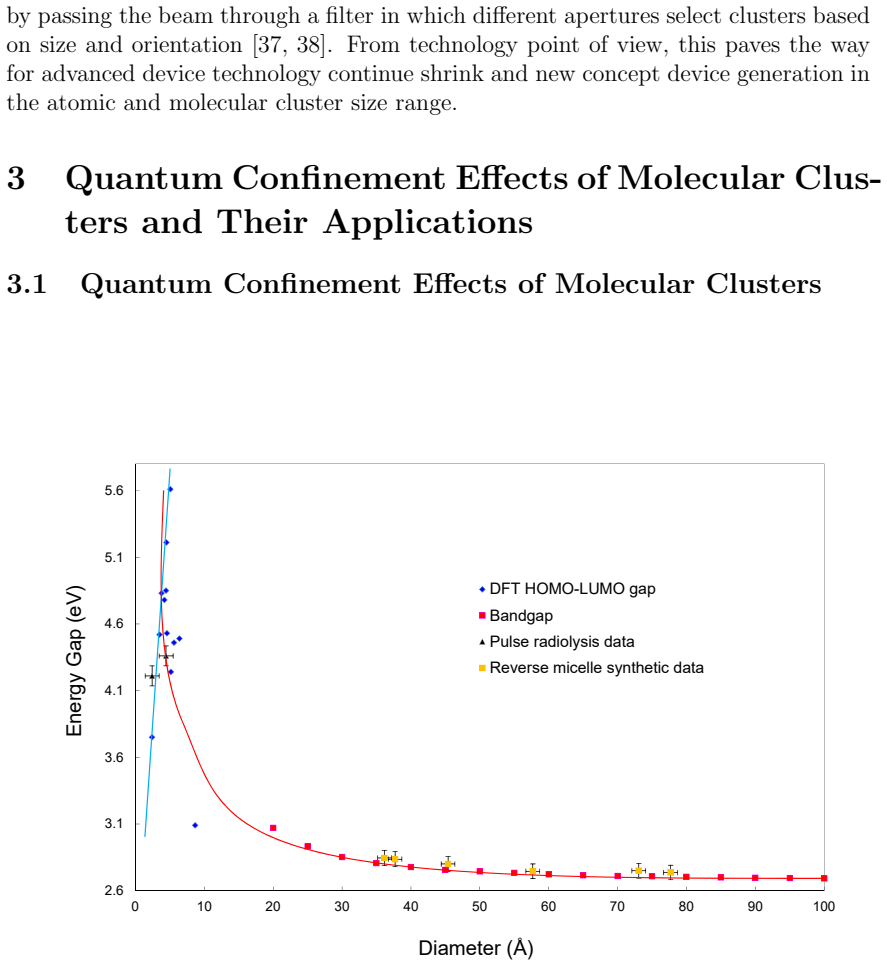
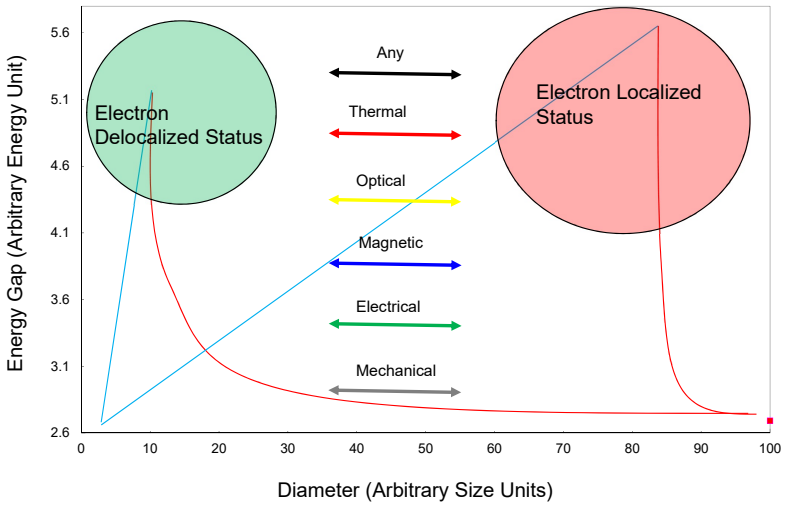
The load-bearing object is the λ curve of energy gap versus confinement radius, $\Delta E = \pi h^2 N_0/(6\mu V)\,\zeta R$ from Equation (7). For small clusters the gap grows linearly with R, and for larger sizes the familiar $1/R^2$ particle-in-a-box branch takes over; the parameter ζ measures electron delocalization, with ζ=1 (delocalized) and ζ=0 (localized) as the extremes. The growth argument is carried by a second mechanism: the bilayer growth picture in which a surface layer of clusters forms on the DOPC membrane during electroporation and a bulk layer forms from clusters that escape, with the observed +29/+58 mass offsets explained by CH2CH3 residuals from the membrane. A third component, the symmetry and probability principle, selects tetramer (Td) and octamer (D2d) as the only stable clusters in the observed range, because the lower-symmetry pentamer, hexamer, and heptamer decompose into the tetramer plus smaller fragments. These pieces are tied together by the EDS/ELS switch, or quantum confinement switch, defined as any interaction that toggles ζ between 1 and 0.
What would settle it
Run the same DLD-MS experiment on vesicles made from deuterated lipid; if the 780 and 1560 peaks shift by the mass expected for deuterated C2H5 fragments, the membrane-adduct hypothesis is confirmed, and if they do not shift, the bilayer-adduct explanation fails.
Extended reading notes
Core claim
The paper's central claim is that silver bromide clusters grown by electroporation of vesicles form in two distinct layers: a first layer on the vesicle membrane surface, where Ag+ ions released through the electroporation channel meet Br− and build up (AgBr)n units, followed by a bulk layer, where some surface clusters escape into solution and continue to grow. The experimental marker for this is that the DLD mass spectra show peaks at 780 and 1560 rather than at the calculated (AgBr)4 and (AgBr)8 isotopic centers 751 and 1502; the offsets of 29 and 58 are read as one and two CH2CH3 fragments picked up from the DOPC membrane. The same symmetry and probability principles used earlier for small clusters explain why only tetramer (Td) and octamer (D2d) appear: intermediate pentamer, hexamer, and heptamer are predicted but decompose into the stable tetramer plus smaller fragments. In the quantum-confinement part, the paper argues that the energy gap ΔE versus sphere size R follows a single λ curve—Equation (7), $\Delta E = \pi h^2 N_0/(6\mu V)\,\zeta R$, gives the blue-shift branch linear in R for the molecular cluster regime, and Equation (8), $\Delta E \sim 1/R^2$, gives the red-shift branch for larger sizes—and that this curve, once anchored at the turn-around point, is the right description of molecular cluster quantum confinement.
Load-bearing premise
The bilayer-growth story rests on the unverified assumption that the 29-unit and 58-unit mass offsets are CH2CH3 fragments detached from the vesicle membrane and carried by the tetramer and octamer; the paper offers no control experiment, no independent carbon detection, and no test of alternative assignments.
Editorial extensions
If this is right
- The DLD-MS offset of 29 per tetramer and 58 per octamer becomes a built-in mass tag: clusters that grew in the surface layer carry membrane fragments, so the mass spectrum can distinguish surface-layer from bulk-layer products.
- Only tetramer and octamer survive in this growth range, so a vesicle-based cluster source can be tuned to deliver these two high-symmetry species; pentamer through heptamer are transient and decompose.
- Once the turn-around point is measured, the λ curve fixes the electron-hole-pair delocalization constant ζ, making energy-gap predictions in the molecular cluster regime essentially parameter-free.
- The EDS/ELS switch provides a principle for a single-cluster transistor: a cluster confined in a channel switches between conducting (delocalized) and insulating (localized) states under thermal, optical, magnetic, electric, or mechanical stimuli.
- Cation, anion, and neutral cluster sources can all be prepared—cation and neutral by electroporation, anion by the polybromoargentate route—so selective deposition of molecular clusters becomes possible.
Reading between the lines
- An implication the author leaves implicit: the +29 adduct, if real, could serve as a deliberate mass label; choosing vesicle lipids with different head or tail chemistry would shift the adduct mass and make the layer origin of each cluster readable in the mass spectrum.
- The λ curve should be testable on a second material system, such as silver chloride grown the same way, since the model is not AgBr-specific; a measured turn-around point in another compound would show whether ζ is material-dependent or universal.
- A high-resolution, isotope-resolved mass spectrum of the 780 and 1560 peaks would settle the CH2CH3 hypothesis directly: the exact mass of C2H5 is 29.039 u, while the measured 29 offset could also be explained by a protonated or hydrated species, a control the paper does not run.
- The bilayer mechanism implies that the vesicle membrane is not just a passive container but an active reactant; if so, changing the membrane lipid should change both the cluster size distribution and the adduct mass, a testable prediction that follows from the paper's picture.
Signed reviews
Editorial analysis
A structured set of objections, weighed in public.
Referee Report
Summary. The manuscript reviews quasi-elastic light scattering (QELS), Fourier-transform infrared (FTIR), and direct laser desorption mass spectrometry (DLD-MS) measurements of silver bromide clusters prepared by electroporation of vesicles, and uses these data to argue for a bilayer growth mechanism in which a surface layer of (AgBr)4 tetramers combines into (AgBr)8 octamers, with the observed mass offsets of 29 and 58 Da attributed to CH2CH3 residuals from the DOPC membrane. In parallel, the paper restates a quantum confinement model in which the lowest excited-state energy gap is given by Eq. (7), containing an adjustable electron delocalization constant ζ that is anchored to the spectral turn-around point, and claims that the resulting "λ curve" of ΔE versus sphere size R has been proved to describe molecular cluster quantum confinement. The paper also introduces the concepts of Electron Delocalized Status (EDS), Electron Localized Status (ELS), and a quantum confinement switch (QCS), and sketches device applications for these ideas.
Significance. If the bilayer growth mechanism and the λ-curve description were well supported, they would be of considerable interest to cluster synthesis and to models of quantum confinement in the molecular cluster regime. The manuscript does contain original experimental material: the DLD-MS observation of two broad peaks near m/z 780 and 1560 (Figure 3 and Table 2) and the FTIR data on ion−DOPC interactions (Section 2.2, Table 1) are potentially useful pieces of data. However, the central claims are not backed by the evidence presented. The mass-peak assignment depends on an untested ad hoc assumption about CH2CH3 adducts, the stability argument for tetramers and octamers is a post hoc application of unpublished "symmetry and probability principles," and the quantum confinement "proof" is circular because the adjustable parameter is fixed by the very data the curve is supposed to predict. The paper contains no machine-checked proofs, no reproducible code, no parameter-free derivation, and no quantitative falsifiable predictions beyond the data to which the model is already fitted.
major comments (3)
- [Section 3.1, Eq. (7) and Figure 8] The claim that the λ curve "had been proved to be a right curve" (Abstract, Section 3.1, and Conclusion) is not supported. Equation (7) defines ΔE in terms of the adjustable parameter ζ, and the text states that ζ is "anchored to a definite value through the known transition energy at the spectra turn-around point." Consequently, the model reproduces the turn-around point by construction, and the blue and red lines in Figure 8 are fits, not independent predictions. A proof would require either a first-principles derivation of Eq. (7) or a demonstration that the curve, with ζ fixed a priori, predicts multiple experimental points that were not used in the fit. As written, this is curve fitting labeled as proof.
- [Section 2.4, mass offset argument] The assignment of the 29 and 58 Da DLD-MS offsets to CH2CH3 residuals is introduced as an assumption: "we can assume the tetramer cluster bring a CH2CH3 residuals, which has a mass close to 29." No control experiment, MS/MS fragmentation, high-resolution mass spectrum, or independent detection of carbon-containing fragments is provided. Moreover, Table 2 shows that the observed peak centers (780 and 1560) differ from the calculated values (751.286 and 1502.571) by 28.7 and 57.4 Da, not exactly 29 and 58 Da, and the peaks are broad and low intensity with no resolved isotopic envelope. Many alternative adducts or cluster compositions could produce a similar low-resolution offset. Since this assumption is the only direct experimental link between the mass spectra and the bilayer growth mechanism, the proposed mechanism is not established.
- [Section 2.4, stability of tetramer and octamer] The explanation for observing only tetramer and octamer in the DLD-MS, despite DFT predictions of stable pentamer, hexamer, and heptamer (Figure 4), relies on the "symmetry and probability principles in molecular cluster growth range" that are the author's own proposals from previous papers. The manuscript gives no quantitative criterion for why the Cs, C2h, and Cs structures of the pentamer through heptamer are unstable while the Td tetramer and D2d octamer are stable, nor any estimate of relative formation or decomposition rates. This is a post hoc rationalization rather than a tested mechanistic model. A falsifiable prediction, such as expected intensity ratios or temperature dependence, would be needed to support the growth mechanism.
minor comments (5)
- [Throughout] The manuscript contains numerous typos and grammatical errors that impede readability, for example "lager" for "larger," "MALTI" for "MALDI," "charlenge" for "challenge," "throsheld" for "threshold," and "Turnal" for "Tunnel." A careful language edit is needed.
- [Section 2.3, Table 2] The table lists "MS exp value" of 780 and 1560 and "Calculated value" of 751.286 and 1502.571, but no uncertainty or peak-width information is given for the experimental centers. The reader cannot assess whether the 28.7 and 57.4 Da differences are significant at the instrument's resolution.
- [References] Reference [36] is listed as "Nature, September, 2012, unpublished." An unpublished and undated citation is not verifiable and should be removed or replaced with a published source or a detailed preprint citation.
- [Section 3.1, Eq. (7)] The notation "h2" is ambiguous; it should be written as h^2 (Planck constant squared) or ℏ^2 as appropriate, and the derivation leading to Eq. (7) should be provided or cited, because the equation does not follow from standard particle-in-a-sphere results presented in Eq. (8).
- [Figure 8] The figure overlays multiple data sets without error bars or a clear legend identifying which symbols correspond to which experiment or calculation; the dashed/solid lines are described as fitting lines, but the fitting procedure and the number of free parameters are not stated.
Circularity Check
The λ-curve and the bilayer-growth mass argument both rely on fitted/assumed inputs, while the cluster-selection explanation is imported from the author's own prior work.
-
fitted input called prediction
[Abstract and Section 3.1, Eq. (7) and Fig. 8.]
"This expression contains an electron-hole-pair (EHP) delocalization constantζ as an adjustable parameter which, however, can be anchored to a definite value through the known transition energy at the spectra turn-around point. ... As experimental method can enable to synthesize heavy monomer and dimer molecular clusters such as silver bromide clusters, this λ curve had been proved to be a right curve to describe the molecular cluster quantum confinement behavior."
The model's only free parameter, ζ, is anchored to the known transition energy at the turn-around point, so Eq. (7) necessarily reproduces that datum. Calling the resulting λ curve 'proved to be a right curve' presents the anchored fit as independent confirmation, but the turn-around point is an input by construction. The blue and red lines in Fig. 8 are described as 'fitting lines', so the curve is not an independent prediction of the data it is fitted to.
-
fitted input called prediction
[Section 2.4, DLD-MS offset explanation; Section 2.3 and Table 2.]
"In our case, we can assume the tetramer cluster bring a CH 2CH 3 residuals, which has a mass close to 29. Two these kinds of tetramers form the octamer will have 58 mass difference compare to pure octamer silver bromide clusters. This is exactly we observed in our DLD-Mass spectra experiments."
The observed DLD-MS centers (780 and 1560) differ from the calculated (AgBr)4 and (AgBr)8 envelope centers (751.286 and 1502.571) by about 28.7 and 57.4 Da. The paper resolves this offset by assuming a CH2CH3 adduct of mass 'close to 29', with no MS/MS, resolved isotope envelope, or control experiment demonstrating carbon-containing fragments. This assumed adduct is then used as evidence that clusters carry DOPC carbon residuals, i.e., the bilayer mechanism. The observation and the mechanism are thus matched by an adjustable assumption rather than by an independently tested prediction.
1 more flagged steps
-
self citation load bearing
[Section 2.3, applied in Section 2.4.]
"All these can be explained by symmetry and probability principle in molecular cluster growth range we proposed in the previous work."
The principle used to explain the observed cluster distribution—unsymmetrical finger peaks, only tetramer and octamer appearing in the larger mass range, and the low intensity of large clusters—is the author's own prior proposal (arXiv:1905.11315). No external theorem, machine-checked derivation, or independent falsification is supplied. The argument that tetramer and octamer are favored because of the author's symmetry/probability principle is a self-citation chain rather than an independently grounded explanation.
full rationale
The paper contains real experimental material: QELS sizing, FTIR band shifts, the UV absorption turn-around, and DLD-MS peaks, and the earlier assignment of the turn-around cluster to (Ag3Br2)+ is an experimental result from prior work. However, the two central interpretive claims are not independently derived. First, Eq. (7) contains an adjustable ζ anchored to the turn-around transition energy, so the resulting λ curve passes through that point by construction; calling the fitted curve 'proved to be a right curve' is a fitted-input-as-confirmation statement rather than a prediction. Second, the bilayer-growth mechanism's main mass-spectrometric evidence is the 29/58 Da offset between observed and calculated (AgBr)4/(AgBr)8 peaks; the paper bridges that gap by assuming a CH2CH3 fragment of mass close to 29, with no independent detection of the fragment. The offset is thereby absorbed by the very mechanism it is supposed to support. Third, the selection rules explaining why only tetramer and octamer are seen are imported from the author's own earlier symmetry/probability proposal. These three items make the central conclusions partially circular: the quantum-confinement curve and the mass-spectral support for bilayer growth reduce to fitted or self-cited inputs. QELS and FTIR data are independent observations, and the manuscript's core experimental findings are not themselves fabricated, but the interpretive chain is substantially circular. Score 7.
Assumptions & free parameters
free parameters (1)
- ζ (EHP delocalization constant) =
anchored to the observed turn-around point at 269 nm
assumptions (3)
- domain assumption Electrons are confined to a spherical potential well and clusters are made of basic units.
- ad hoc to paper The symmetry and probability principles in molecular cluster growth range determine cluster stability and abundance.
- ad hoc to paper The CH2CH3 residual mass is the origin of the 29/58 mass shift.
invented entities (1)
-
CH2CH3 residual attached to (AgBr)4
Cite this review
Pith. "Pith review of Studies of Bi-layers Growth Mechanism of Silver Bromide Molecular Clusters Prepared Via Electroporation of Vesicles and Quantum Confinement Effects Applications of Molecular Clusters." pith.science (2026). https://pith.science/paper/23XPPOO6
@misc{pith2026190808969,
  author       = {Pith},
  title        = {Pith review of: Studies of Bi-layers Growth Mechanism of Silver Bromide Molecular Clusters Prepared Via Electroporation of Vesicles and Quantum Confinement Effects Applications of Molecular Clusters},
  year         = {2026},
  howpublished = {\url{https://pith.science/paper/23XPPOO6}},
  note         = {Machine review of arXiv:1908.08969}
}
read the original abstract
Our previous work show that in the molecular cluster regime, the band blue shift associated with cluster growth can be understood by a model that assume electrons are confined to a spherical potential well and the clusters are made of some basic units. A formula is given for the lowest excited electronic state energy. This expression contains an electron-hole-pair (EHP) delocalization constant as an adjustable parameter which, however, can be anchored to a definite value through the known transition energy at the spectra turn-around point. We also proposed symmetry and probability principles in molecular cluster growth range to explain the molecular cluster electron absorption spectra turn-around phenomena and unusual isotopic properties of small silver bromide clusters. In this paper, based on systematical review of Quasi-Elastic Light Scattering (QELS), Fourier-transform infrared spectroscopy (FTIR) and Direct Laser Desorption Mass Spectra (DLD-MS) experiments of silver bromide clusters prepared via the electroporation of vesicles, we show how the symmetry and probability principles in molecular cluster growth range can be used to explain the lager silver bromide molecular cluster formation in a bilayer formation mechanism. The turn round curve of energy gap vs confine sphere size had been proved to be a right curve to describe the molecular cluster quantum confinement behavior. We also defined Electron Delocalized Status (EDS), Electron Localized Status (ELS), and EDS/ELS switch or quantum confinement switch (QCS) in the quantum confine system. These studies pave the theoretical and technical ways for advanced device technology continue shrink and new concept device generation in the atomic and molecular cluster size range.
Figures


Figures from the paper (9 more)




Reference graph
Works this paper leans on
-
[1]
& Brus L
Rossetti R., Nakahara S. & Brus L. E., Quantum size effects in the redox po- tentials. resonance Raman spectra, and electronic spectra of .CdS crystallites in aqueous solution. J. Chem. Phys., 79, 1086-1088(1983)
1983
-
[2]
Ekimov A. I. & Onushchenko A. A., Quantum size effect in three-dimensional microscopic semiconductor crystals. JETP letter, 34, 345-348(1981)
1981
-
[3]
A., Koh A
Scholl J. A., Koh A. L. & Dionne J. A., Quantum plasmon resonances of indi- vidual metallic nanoparticles. Nature. 483, 421–427 (2012)
2012
-
[4]
et al., Superconductivity Modulated by Quantum Size Effects
Guo Y. et al., Superconductivity Modulated by Quantum Size Effects. Science 306, 1915-1917 (2004)
2004
-
[5]
Cullis A. G. & Canham L. T., Visible light emission due to quantum size effects in highly porous crystalline silicon. Nature, 353, 335-338(1991)
1991
-
[6]
et al., Ultrasensitive solution-cast quantum dot photodetectors
Konstantatos G. et al., Ultrasensitive solution-cast quantum dot photodetectors. Nature , 442, 180-183 (2006)
2006
-
[7]
et al., The Active Site of Methanol Synthesis over Cu/ZnO/Al2O3 Industrial Catalysts
Behrens M. et al., The Active Site of Methanol Synthesis over Cu/ZnO/Al2O3 Industrial Catalysts. Science , 336, 893-897 (2012)
work page 2012
-
[8]
Quantum Confinement Effects for Semiconductor Clusters in the Molecular Regime
Zhang John H, Quantum Confinement Effects for Semiconductor Clusters in the Molecular Regime. arXiv:1904.03666 [physics.chem-ph],2019
work page Pith review arXiv 1904
Show all 86 references
-
[9]
arXiv:1905.11315 [physics.chem-ph],2019
Zhang John H, Studies of Silver Bromide Clusters Isotopic Properties and Their Applications. arXiv:1905.11315 [physics.chem-ph],2019
1905 arXiv
-
[10]
P., Semiconductor clusters, nanocrystals, and quantum dots
Alivisatos A. P., Semiconductor clusters, nanocrystals, and quantum dots. Sci- ence, 271, 933-937(1996)
1996
-
[11]
P., Perspectives on the physical chemistry of semiconductor nanoc- tystals
Alivisatos A. P., Perspectives on the physical chemistry of semiconductor nanoc- tystals. J. Phys. Chem., 100, 13226-13239(1996)
1996
-
[12]
C., Herhoid A
Chen C. C., Herhoid A. B., Johnson C. S. & Alivisatos A. P., Size depen- dence of structural metastability in semiconductor nanocrystals. Science, 276, 398-401(1997)
1997
-
[13]
H., The Theory of the Photographic Process (Macmillan, 1977)
James T. H., The Theory of the Photographic Process (Macmillan, 1977)
1977
-
[14]
Zhang John H., US9748356B2 2017-08-29 Threshold adjustment for quantum dot array devices with metal source and drain 26
2017
-
[15]
Zhang John H., US10199505B2 2019-02-05 Transistors incorporating metal quan- tum dots into doped source and drain regions
2019
-
[16]
Tadaaki T., Photographic Sensitivity (Oxford University Press,1995)
1995
-
[17]
H., The kinetic processes of formation and electron-trapping efficien- cies of quantum-sized silver bromide clusters
Ehrlich S. H., The kinetic processes of formation and electron-trapping efficien- cies of quantum-sized silver bromide clusters. J.Imaging Sci.&Tech., 38, 201- 216(1994)
1994
-
[18]
et al., Size dependence of radiative rates in the indirect band gap material AgBr
Chen W. et al., Size dependence of radiative rates in the indirect band gap material AgBr. J. Am. Chem. Soc., 116, 1585-1586 (1994)
1994
-
[19]
Masumoto Y., Kawamura, T., Ohzeki T.& Urabe S., Lifetime of indirect excitons in AgBr quantum dots. Phys. Rev. B., 46,1827-1830(1992)
1992
-
[20]
P., McLendon G
Johannson K. P., McLendon G. L. & Marchetti A. P., The effect of size restriction on silver bromide. A dramatic enhancement of free exciton luminescence. Chem. Phys. Lett., 179, 321-324(1991)
1991
-
[21]
P., Johannson K
Marchetti A. P., Johannson K. P. & McLendon G. L., AgBr photophysics from optical studies of quantum confined crystals. Phys. Rev. B, 47, 4268-4275(1993)
1993
-
[22]
& Tadakuma Y., Indirect exciton confinement and impurity isolation in ultrafine particles of silver bromide
Kanzaki H. & Tadakuma Y., Indirect exciton confinement and impurity isolation in ultrafine particles of silver bromide. Solid State Commun., 80, 33-36(1991)
1991
-
[23]
I., Marchetti A
Freedhoff M. I., Marchetti A. P. & McLendon G. L., Optical properties of nanocrystalline silver halides. J. Luminescence, 70, 400-413(1996)
1996
-
[24]
& Stolz H., Localized exciton states in silver halides
von der Osten W. & Stolz H., Localized exciton states in silver halides. J. Phys. Chem. Solids, 51, 765-791(1990)
1990
-
[25]
& von der Osten W., Resonant Raman scattering and lumi- nescence from size-quantized indirect exciton states in AgBr microcrystals
Scholle U., Stolz H. & von der Osten W., Resonant Raman scattering and lumi- nescence from size-quantized indirect exciton states in AgBr microcrystals. Solid State Commun., 86, 657-661(1993)
1993
-
[26]
& von der Osten, W., Exciton-phonon coupling in indirect gap AgBr nanocrystals
Vogelsang H., Stolz H. & von der Osten, W., Exciton-phonon coupling in indirect gap AgBr nanocrystals. J. Luminescence, 70, 414-420(1996)
1996
-
[27]
Tanaka T., Matsubara T., Saeki H.& Heda H., Optical absorption studies of the growth of miccrocrystals in nascent suspensions. I. Silver chloride hydrosols. Photogr. Sci. Eng., 20, 213-219(1976)
1976
-
[28]
& Liu F., QSE of nanomer size semiconductor AgBr, Chin
He T., Wang P., Zhang X. & Liu F., QSE of nanomer size semiconductor AgBr, Chin. J. Chem. Phys., 8, 23-27(1995). 27
1995
-
[29]
& Mostafavi M., UV-Absorption Observation of the Silver Bromide Growth from a Single Molecule to the Crystal in Solution
Zhang H. & Mostafavi M., UV-Absorption Observation of the Silver Bromide Growth from a Single Molecule to the Crystal in Solution. J. Phys. Chem. B, 101, 8443-8448 (1997)
1997
-
[30]
E., Electron-electron and electron-hole interactions in small semiconduc- tor crystallites
Brus L. E., Electron-electron and electron-hole interactions in small semiconduc- tor crystallites. J. Chem. Phys., 80, 4403-4409(1984)
1984
-
[31]
et al., Luminnescence properties of indirect bandgap semiconductors: nanocrystals of silver bromide
Chen W. et al., Luminnescence properties of indirect bandgap semiconductors: nanocrystals of silver bromide. Mot. Clyst. Lig. Cryst., 252, 79-86(1994)
1994
-
[32]
M., Zhang H
Correa N. M., Zhang H. & Schelly Z. A., Preparation of AgBr quantum dots via electroporation of vesicles. J. Am. Chem. Soc., 122, 6432-6434(2000)
2000
-
[33]
& Matsubara T., Optical absorption studies of the growth of microcrystals in nascent suspensions
Tanaka T., Saijo H. & Matsubara T., Optical absorption studies of the growth of microcrystals in nascent suspensions. III Absorption spectra of nascent iodide hydrosols. J. Photogr. Sci., 27, 60-65(1979)
1979
-
[34]
A., & Marynick D
Zhang H., Schelly Z. A., & Marynick D. S. Theoretical Study of the Molecular and Electronic Structures of Neutral Silver Bromide Clusters (AgBr)n, n = 1-9. J. Phys. Chem. A, 104, 6287-6294(2000)
2000
-
[35]
Thesis (PhD)
Zhang Hongguang, Theoretical and experimental studies of silver bromide clus- ters. Thesis (PhD). The University of Texas at Arlington, Source DAI-B 61/05, p. 2556, Nov 2000, 115 pages. http://adsabs.harvard.edu/abs/2000PhDT........18Z
2000
-
[36]
Schelly, Dennis S
Zhang John H, Zoltan A. Schelly, Dennis S. Marynick & Gary R. Kinsel, Quan- tum size effect studies of isotopic and electronic properties of silver bromide ionic clusters. Nature, September, 2012, unpublished
2012
-
[37]
Zhang John H., US10002938B2 2018-06-19 Atomic layer deposition of selected molecular clusters
2018
-
[38]
Zhang John H., US9214622B2 2015-12-15 Size-controllable opening and method of making same
2015
-
[39]
Langmuir 15, 6643-6651(1999)
Hideyuki Minami & Tohru Inoue, Aggregation of Dipalmitoylphosphatidyl- choline Vesicles Induced by Some Metal Ions with High Activity for Hydrolysis. Langmuir 15, 6643-6651(1999)
1999
-
[40]
& Focardi C., Ther- modynamic and spectroscopic properties of mixtures of β Mactoglobulin and dioleylphosphatidylcholine
Korchowiec B., Puggelli, M., Gabrielli G., Nocentini M. & Focardi C., Ther- modynamic and spectroscopic properties of mixtures of β Mactoglobulin and dioleylphosphatidylcholine. Colloid Polym Sci, 275, 860-868 (1997)
1997
-
[41]
B., Hanneman, R
Chung J. B., Hanneman, R. E. & Franses E. I., Surface analysis of lipid layers at the A/W interface. Langmuir 6, 1647–1655(1990). 28
1990
-
[42]
& Plant A.L., Assessing the Molecular Struc- ture of Alkanethiol Monolayers in Hybrid Bilayer Membranes with Vibrational Spectroscopies
Meuse C.W., Niaura G., Lewis M.L. & Plant A.L., Assessing the Molecular Struc- ture of Alkanethiol Monolayers in Hybrid Bilayer Membranes with Vibrational Spectroscopies. Langmuir, 14, 1604-1611(1998)
1998
-
[43]
Biochemistry, 20, 7359-7366(1981)
Akutsu H., Direct determination by Raman scattering of the conformation of the choline group in phospholipid bilayers. Biochemistry, 20, 7359-7366(1981)
1981
-
[44]
& Kyogoku Y.,Influence of metal ions and a local anesthetic on the conformation of the choline group of phosphatidyl- choline bilayers studied by Raman spectroscopy
Akutsu H., Suezaki Y., Yoshikawa W. & Kyogoku Y.,Influence of metal ions and a local anesthetic on the conformation of the choline group of phosphatidyl- choline bilayers studied by Raman spectroscopy. Biochim. Biophys. Acta, 854, 213-218(1986)
1986
-
[45]
M., Kinsel G
Gimon-Kinsel M., Preston-Schaffter L. M., Kinsel G. R. & Russell D. H., Effects of Matrix Structure/Acidity on Ion Formation in Matrix-Assisted Laser Desorp- tion Ionization Mass Spectrometry. J. Am. Chem. Soc., 119, 2534–2540(1997)
1997
-
[46]
& Iwasaki M
Tanaka T. & Iwasaki M. The multistage process of formation of ultrafine silver bromide particles as revealed by multichannel spectrophotometry. J. Imaging Sci., 29, 86-92 (1985)
1985
-
[47]
Zhang H, Xin H., He T. & Liu F. Time dependent surface enhanced Raman spectroscopy of pyridine in AgBr sol. Spectrochimica Acta A , 47, 927-932(1991)
1991
-
[48]
Thesis (PhD)
Zhang Hongguang, Studies on Topological and Fractal Properties of High Tc Superconductors and Colloids. Thesis (PhD). Univer- sity of Science and Technology of China, May 1992, 118 pages, 108.ndlc.2.1100009031010001/T3F24.012002631352,O511
1992
-
[49]
& Xin H., Time dependent UV-absorption spectra and surface enhanced Raman spectroscopy of pyridine in AgCl sol
Zhang H, Liu F., He T. & Xin H., Time dependent UV-absorption spectra and surface enhanced Raman spectroscopy of pyridine in AgCl sol. Spectrochimica Acta A, 51, 1903-1908(1995)
1995
-
[50]
& Xin H, A study of relationship between universality in fractal colloids aggregation and time dependent SERS
Zhang H., Liu F., He T. & Xin H, A study of relationship between universality in fractal colloids aggregation and time dependent SERS. Science in China B, 37, 395-401(1994)
1994
-
[51]
Science, 360, 778–783 (2018)
Cheng Chang et al., 3D charge and 2D phonon transports leading to high out- of-plane ZT in n-type SnSe crystals. Science, 360, 778–783 (2018)
2018
-
[52]
Dudin Y. O. & Kuzmich A., Strongly Interacting Rydberg Excitations of a Cold Atomic Gas. Science, 336, 887-889(2012)
2012
-
[53]
et al.,Reading and writing single-atom magnets
Natterer Fabian D. et al.,Reading and writing single-atom magnets. Nature, 543, 226-228(2017). 29
2017
-
[54]
Nature, 572, 358-362(2019)
Koepsell Joannis et al., Imaging magnetic polarons in the doped Fermi–Hubbard model. Nature, 572, 358-362(2019)
2019
-
[55]
et al., Parallel programming of an ionic floating-gate memory array for scalable neuromorphic computing
Fuller Elliot J. et al., Parallel programming of an ionic floating-gate memory array for scalable neuromorphic computing. Science, 364, 570–574 (2019)
2019
-
[56]
Nature, 569, 388- 392(2019)
Valle Javier del et al.,Subthreshold firing in Mott nanodevices. Nature, 569, 388- 392(2019)
2019
-
[57]
Science, 360, 706–707(2018)
Eichler Alexander, Little is lost-Nanostrings can exploit strain engineering for unprecedented mechanical performance. Science, 360, 706–707(2018)
2018
-
[58]
Zhang John H., US9882025B1 2018-01-30 Methods of simultaneously forming bottom and top spacers on a vertical transistor device
2018
-
[59]
Zhang John H., US9997463B2 2018-06-12 Modular interconnects for gate-all- around transistors
2018
-
[60]
Zhang John H., US9385195B1 2016-07-05 Vertical gate-all-around TFET
2016
-
[61]
Zhang John H., Cheng Kangguo, Clevenger Lawrence A & Pranatharthiharan Balasubramanian S, US20170330934A1 2017-11-16 Devices and methods of form- ing self-aligned uniform nano sheet spacers
2017
-
[62]
Cheng Kangguo, Clevenger Lawrence A, Pranatharthiharan Balasubramanian S & Zhang John H., US20180114834A1 2018-04-26 Nanosheet transistors with sharp junctions
2018
-
[63]
Cheng Kangguo, Clevenger Lawrence A, Pranatharthiharan Balasubramanian S & Zhang John H., US9660028B1 2017-05-23, Stacked transistors with different channel widths
2017
-
[64]
Zhang John H., US9116319B2 2015-08-25 Photonic integrated circuit having a plurality of lenses
2015
-
[65]
Zhang John H., US10247881B2 2019-04-02 Hybrid photonic and electronic inte- grated circuits
2019
-
[66]
Zhang John H., US9730596B2 2017-08-15 Low power biological sensing system
2017
-
[67]
Zhang John H., US8564137B2 2013-10-22 System for relieving stress and im- proving heat management in a 3D chip stack having an array of inter-stack connections. 30
2013
-
[68]
Clevenger, Carl Radens, Yiheng Xu & Zhang John H., US10304815B2 2019-05-28 Self-aligned three dimensional chip stack and method for making the same
Lawrence A. Clevenger, Carl Radens, Yiheng Xu & Zhang John H., US10304815B2 2019-05-28 Self-aligned three dimensional chip stack and method for making the same
2019
-
[69]
Zhang, John H, Clevenger, Lawrence A, Radens, Carl, Yiheng, XU and Wornyo, Edem US8829670B1 2014-09-09 Through silicon via structure for internal chip cooling
2014
-
[70]
US10249568B2 2019-04-02 Method for making semiconductor device with stacked analog components in back end of line (BEOL) regions
Zhang,John H. US10249568B2 2019-04-02 Method for making semiconductor device with stacked analog components in back end of line (BEOL) regions
2019
-
[71]
Liu Qing & Zhang John H., US10319647B2 2019-06-11 Semiconductor structure with overlapping fins having different directions, and methods of fabricating the same
2019
-
[72]
& Huang Haigou, US9837553B1 2017-12-05 Vertical field effect transistor
Wu Xusheng,Zhang John H. & Huang Haigou, US9837553B1 2017-12-05 Vertical field effect transistor
2017
-
[73]
Zhang John H., US9947772B2 2018-04-17 SOI FinFET transistor with strained channel
2018
-
[74]
Zhang John H., US20150318285A1 2015-11-05 Dram interconnect structure hav- ing ferroelectric capacitors
2015
-
[75]
Zhang John H., US9825055B2 2017-11-21 FinFETs suitable for use in a high density SRAM cell
2017
-
[76]
Zhang,John H., US9136473B2 2015-09-15 Semiconductor device with PCM mem- ory cells and nanotubes and related methods
2015
-
[77]
Zhang,John H., US10128327B2 2018-11-13 DRAM interconnect structure having ferroelectric capacitors exhibiting negative capacitance
2018
-
[78]
Liu, Qing & Zhang,John H., US10211257B2 2019-02-19 High density resistive random access memory (RRAM)
2019
-
[79]
Zhang John H., US9853163B2 2017-12-26 Gate all around vacuum channel tran- sistor
2017
-
[80]
Clevenger Lawrence A., Radens Carl, Xu Yiheng & Zhang John H., US10026849B2 2018-07-17 Structure and process for overturned thin film device with self-aligned gate and SD contacts. 31
2018
-
[81]
Zhang John H, Clevenger Lawrence A., Radens Carl, Xu Yiheng, Kim Youp & Kleemeier Walter , US9646939B2 2017-05-09 Multilayer structure in an inte- grated circuit for damage prevention and detection and methods of creating the same
2017
-
[82]
Zhang John H, Clevenger Lawrence A., Radens Carl, Xu Yiheng & Wornyo Edem, US9240375B2 2016-01-19 Modular fuses and antifuses for integrated cir- cuits
2016
-
[83]
Zhang John H.,Clevenger Lawrence A, Radens Carl & Xu Yiheng, US8970004B2 2015-03-03 Electrostatic discharge devices for integrated circuits
2015
-
[84]
& Morin Pierre, US9224845B1 2015-12-29 Silicon carbide static induction transistor and process for making a silicon carbide static induction transistor
Zhang John H. & Morin Pierre, US9224845B1 2015-12-29 Silicon carbide static induction transistor and process for making a silicon carbide static induction transistor
2015
-
[85]
Zhang John H., Kleemeier Walter & Goldberg Cindy, US8987780B2 2015-03-24 Graphene capped HEMT device
2015
-
[86]
Liu Qing & Zhang John H., US9466452B1 2016-10-11 Integrated cantilever switch. 32
2016
Reviewed August 14, 2026 · model on record in the stance chip above.
Discussion (0). Continue with ORCID to comment.