Randomized Approach to Matrix Completion: Applications in Recommendation Systems and Image Inpainting
Pith reviewed 2026-05-24 02:50 UTC · model grok-4.3
The pith
CSMC reduces computational cost for completing large asymmetric matrices by first selecting key columns then solving convex low-rank problems.
A machine-rendered reading of the paper's core claim, the machinery that carries it, and where it could break.
Core claim
CSMC combines Column Subset Selection with Low-Rank Matrix Completion to reconstruct incomplete matrices efficiently. Each stage solves a convex optimization problem. Two algorithmic variants are given for different problem scales. Under assumptions of low rank, incoherence or sampling conditions, the method recovers the original matrix exactly with high probability. On synthetic and real data the approach delivers runtime improvements while maintaining accuracy competitive with leading convex methods.
What carries the argument
Columns Selected Matrix Completion (CSMC), which performs column subset selection followed by convex low-rank matrix completion.
If this is right
- Runtime scales better with the larger matrix dimension than full convex completion.
- Solution quality remains comparable to state-of-the-art convex methods on tested data.
- Two implementations allow adaptation to small and large problem sizes.
- Exact recovery holds with high probability when the matrix meets the stated assumptions.
- The method applies directly to recommendation systems and image inpainting tasks.
Where Pith is reading between the lines
- Faster completion could support repeated runs on streaming or frequently updated datasets.
- The column-selection step might be swapped for other randomized sampling schemes to explore further speed-accuracy trade-offs.
- In domains where one matrix dimension grows faster than the other, CSMC could become a default preprocessing step before downstream learning.
Load-bearing premise
The input matrix must satisfy low-rank, incoherence or sampling conditions that guarantee high-probability exact recovery after column selection.
What would settle it
A matrix obeying the stated low-rank assumption but violating the incoherence or sampling conditions on which recovery probability is shown, where CSMC nevertheless fails to recover the matrix with the claimed high probability.
Figures


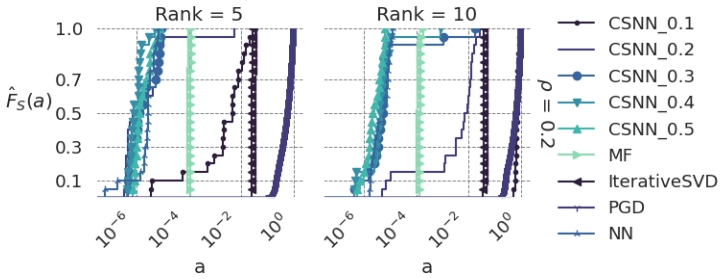


read the original abstract
We present a novel method for matrix completion, specifically designed for matrices where one dimension is significantly larger than the other. Our Columns Selected Matrix Completion (CSMC) method combines Column Subset Selection with Low-Rank Matrix Completion to efficiently reconstruct incomplete datasets. CSMC substantially reduces computational cost while preserving the solution quality of state-of-the-art convex matrix completion techniques. Each stage of CSMC involves solving a convex optimization problem. We introduce two algorithmic implementations of CSMC, each tailored to problems of different scales. A formal analysis is provided, outlining the necessary assumptions and the probability of exact recovery. To evaluate the impact of matrix size, rank, and the ratio of missing entries on solution quality and runtime, we conducted experiments on synthetic data. The method was also applied to two real-world tasks: recommendation systems and image inpainting. Our results show that CSMC achieves substantial runtime improvements while maintaining competitive accuracy compared to leading convex optimization-based methods.
Editorial analysis
A structured set of objections, weighed in public.
Referee Report
Summary. The manuscript introduces Columns Selected Matrix Completion (CSMC), which first applies column subset selection and then solves a convex low-rank matrix completion problem on the reduced matrix. The central claims are that this yields substantial runtime reductions for tall matrices while preserving the solution quality of standard convex methods, that a formal analysis supplies the necessary assumptions and exact-recovery probability, and that synthetic and real-world experiments (recommendation systems, image inpainting) confirm competitive accuracy.
Significance. If the formal analysis correctly shows that column selection preserves the incoherence and sampling conditions required for nuclear-norm recovery, the method would offer a practical speed-up for large-scale matrix completion without sacrificing guarantees. The reported experiments on real tasks provide some empirical support, but the significance is limited by the absence of explicit recovery conditions that would allow independent verification of the quality-preservation claim.
major comments (1)
- [formal analysis section (and Abstract)] Abstract and the section presenting the formal analysis: the manuscript states that the analysis 'outlines the necessary assumptions and the probability of exact recovery' after column selection, yet supplies none of their content (e.g., incoherence bounds on the selected columns, the restricted isometry constant of the reduced matrix, or the adjusted sampling rate). Without these explicit conditions it is impossible to confirm that the standard convex recovery guarantees transfer, which directly undermines the headline claim that solution quality is preserved.
minor comments (2)
- The description of the two algorithmic implementations could be expanded with pseudocode or explicit differences in how they scale the convex subproblems for different matrix sizes.
- Synthetic experiments vary matrix size, rank and missing-entry ratio but do not report whether the column-selection step itself satisfies the (unstated) recovery assumptions on the reduced matrix.
Simulated Author's Rebuttal
We thank the referee for the careful reading and the constructive major comment. We address the concern about the formal analysis point by point below.
read point-by-point responses
-
Referee: Abstract and the section presenting the formal analysis: the manuscript states that the analysis 'outlines the necessary assumptions and the probability of exact recovery' after column selection, yet supplies none of their content (e.g., incoherence bounds on the selected columns, the restricted isometry constant of the reduced matrix, or the adjusted sampling rate). Without these explicit conditions it is impossible to confirm that the standard convex recovery guarantees transfer, which directly undermines the headline claim that solution quality is preserved.
Authors: We agree that the current formal analysis section supplies only a high-level outline and does not contain the explicit conditions (incoherence bounds after column selection, RIP constant of the reduced matrix, or the modified sampling rate) needed to verify that standard nuclear-norm recovery guarantees carry over. This is a substantive gap. In the revision we will expand the section with the required assumptions and probability bounds, and we will revise the abstract to reflect the actual level of detail provided. These changes will be made so that the transfer of guarantees can be independently checked. revision: yes
Circularity Check
No circularity detected; method combines existing techniques with external validation
full rationale
The provided abstract and description present CSMC as a combination of column subset selection and convex low-rank matrix completion, supported by experiments on synthetic and real data. No equations, fitted parameters renamed as predictions, or self-citation chains are exhibited that would reduce the recovery probability or quality claims to a definition by construction. The formal analysis is invoked but its content is not shown to create any of the enumerated circular patterns. This is a standard non-finding for a paper whose central claims rest on empirical results rather than a closed derivation loop.
Axiom & Free-Parameter Ledger
axioms (1)
- domain assumption Necessary assumptions on the input matrix that enable the stated probability of exact recovery after column selection
Reference graph
Works this paper leans on
-
[1]
Tianxi Cai, T. Cai, and Anru Zhang. Structured matrix completion with applications to genomic data integration. Journal of the American Statistical Association, 111, 04 2015
work page 2015
-
[2]
Structured gradient descent for fast robust low-rank hankel matrix completion
Hanqin Cai, Jian-Feng Cai, and Juntao You. Structured gradient descent for fast robust low-rank hankel matrix completion. SIAM Journal on Scientific Computing, 45(3):A1172–A1198, 2023
work page 2023
-
[3]
Matrix completion with cross-concentrated sampling: Bridging uniform sampling and cur sampling
HanQin Cai, Longxiu Huang, Pengyu Li, and Deanna Needell. Matrix completion with cross-concentrated sampling: Bridging uniform sampling and cur sampling. IEEE Transactions on Pattern Analysis and Machine Intelligence, 2023
work page 2023
-
[4]
Light field inpainting propagation via low rank matrix completion
Mikael Le Pendu, Xiaoran Jiang, and Christine Guillemot. Light field inpainting propagation via low rank matrix completion. IEEE Transactions on Image Processing, 27(4):1981–1993, 2018
work page 1981
-
[5]
Algorithmic Aspects of Machine Learning
Ankur Moitra. Algorithmic Aspects of Machine Learning. Cambridge University Press, USA, 1st edition, 2018
work page 2018
-
[6]
Orthogonal subspace exploration for matrix completion
Hongyuan Zhang, Ziheng Jiao, and Xuelong Li. Orthogonal subspace exploration for matrix completion. Pattern Recognition, 153:110456, 2024
work page 2024
-
[7]
Robust rank-one matrix completion with rank estimation
Ziheng Li, Feiping Nie, Rong Wang, and Xuelong Li. Robust rank-one matrix completion with rank estimation. Pattern Recognition, 142:109637, 2023
work page 2023
-
[8]
Benjamin Recht, Maryam Fazel, and Pablo A. Parrilo. Guaranteed minimum-rank solutions of linear matrix equations via nuclear norm minimization. SIAM Review, 52(3):471–501, 2010
work page 2010
-
[9]
A simpler approach to matrix completion
Benjamin Recht. A simpler approach to matrix completion. J. Mach. Learn. Res., 12(null):3413–3430, dec 2011
work page 2011
-
[10]
Yudong Chen and Yuejie Chi. Harnessing structures in big data via guaranteed low-rank matrix estimation: Recent theory and fast algorithms via convex and nonconvex optimization. IEEE Signal Processing Magazine, 35(4):14–31, 2018
work page 2018
- [11]
-
[12]
Computational methods for sparse solution of linear inverse problems
Joel A Tropp and Stephen J Wright. Computational methods for sparse solution of linear inverse problems. Proceedings of the IEEE, 98(6):948–958, 2010
work page 2010
-
[13]
Faster least squares approximation
Petros Drineas, Michael Mahoney, Senthilmurugan Muthukrishnan, and Tamas Sarlos. Faster least squares approximation. Numerische Mathematik, 117, 10 2007
work page 2007
-
[14]
Low-rank matrix completion using alternating minimization
Prateek Jain, Praneeth Netrapalli, and Sujay Sanghavi. Low-rank matrix completion using alternating minimization. In Proceedings of the Forty-Fifth Annual ACM Symposium on Theory of Computing, STOC ’13, page 665–674, New York, NY , USA, 2013. Association for Computing Machinery
work page 2013
-
[15]
Spectral regularization algorithms for learning large incomplete matrices
Rahul Mazumder, Trevor Hastie, and Robert Tibshirani. Spectral regularization algorithms for learning large incomplete matrices. Journal of Machine Learning Research, 11(80):2287–2322, 2010
work page 2010
-
[16]
A singular value thresholding algorithm for matrix completion
Jian-Feng Cai, Emmanuel J Candès, and Zuowei Shen. A singular value thresholding algorithm for matrix completion. SIAM Journal on optimization, 20(4):1956–1982, 2010
work page 1956
-
[17]
Exact matrix completion via convex optimization
Emmanuel Candès and Benjamin Recht. Exact matrix completion via convex optimization. Commun. ACM, 55(6):111–119, jun 2012. 19
work page 2012
-
[18]
Emmanuel J. Candes and Terence Tao. The power of convex relaxation: Near-optimal matrix completion. IEEE Transactions on Information Theory, 56(5):2053–2080, 2010
work page 2053
-
[19]
Understanding alternating minimization for matrix completion
Moritz Hardt. Understanding alternating minimization for matrix completion. 2014 IEEE 55th Annual Symposium on Foundations of Computer Science, pages 651–660, 2014
work page 2014
-
[20]
Low-rank matrix completion by riemannian optimization
Bart Vandereycken. Low-rank matrix completion by riemannian optimization. SIAM Journal on Optimization, 23(2):1214–1236, 2013
work page 2013
-
[21]
Scaled gradients on grassmann manifolds for matrix completion
Thanh Ngo and Yousef Saad. Scaled gradients on grassmann manifolds for matrix completion. In F. Pereira, C.J. Burges, L. Bottou, and K.Q. Weinberger, editors, Advances in Neural Information Processing Systems, volume 25. Curran Associates, Inc., 2012
work page 2012
-
[22]
Robust low-rank matrix completion by riemannian optimization
Léopold Cambier and P-A Absil. Robust low-rank matrix completion by riemannian optimization. SIAM Journal on Scientific Computing, 38(5):S440–S460, 2016
work page 2016
-
[23]
A preconditioned riemannian gradient descent algorithm for low-rank matrix recovery
Fengmiao Bian, Jian-Feng Cai, and Rui Zhang. A preconditioned riemannian gradient descent algorithm for low-rank matrix recovery. SIAM Journal on Matrix Analysis and Applications, 45(4):2075–2103, 2024
work page 2075
-
[24]
A singular value thresholding algorithm for matrix completion
Jian-Feng Cai, Emmanuel Candès, and Zuowei Shen. A singular value thresholding algorithm for matrix completion. SIAM Journal on Optimization, 20:1956–1982, 03 2010
work page 1956
-
[25]
Revisiting Frank-Wolfe: Projection-free sparse convex optimization
Martin Jaggi. Revisiting Frank-Wolfe: Projection-free sparse convex optimization. In Sanjoy Dasgupta and David McAllester, editors, Proceedings of the 30th International Conference on Machine Learning, volume 28 of Proceedings of Machine Learning Research, pages 427–435, Atlanta, Georgia, USA, 17–19 Jun 2013. PMLR
work page 2013
-
[26]
Robert Freund, Paul Grigas, and Rahul Mazumder. An extended frank–wolfe method with “in-face” directions, and its application to low-rank matrix completion. SIAM Journal on Optimization, 27, 11 2015
work page 2015
-
[27]
Sketchy decisions: Convex low-rank matrix optimization with optimal storage
Alp Yurtsever, Madeleine Udell, Joel Tropp, and V olkan Cevher. Sketchy decisions: Convex low-rank matrix optimization with optimal storage. In Artificial intelligence and statistics, pages 1188–1196. PMLR, 2017
work page 2017
-
[28]
Local minima and convergence in low-rank semidefinite programming
Samuel Burer and Renato Monteiro. Local minima and convergence in low-rank semidefinite programming. Mathematical Programming, 103:427–444, 07 2005
work page 2005
-
[29]
Matrix approximation and projective clustering via volume sampling
Amit Deshpande, Luis Rademacher, Santosh Vempala, and Grant Wang. Matrix approximation and projective clustering via volume sampling. Theory of Computing, 2:225–247, 01 2006
work page 2006
-
[30]
Relative-errorcur matrix decompositions
Petros Drineas, Michael Mahoney, and Senthilmurugan Muthukrishnan. Relative-errorcur matrix decompositions. SIAM Journal on Matrix Analysis and Applications, 30:844–881, 05 2008
work page 2008
-
[31]
A deim induced cur factorization
Danny C Sorensen and Mark Embree. A deim induced cur factorization. SIAM Journal on Scientific Computing, 38(3):A1454–A1482, 2016
work page 2016
-
[32]
Perspectives on cur decompositions
Keaton Hamm and Longxiu Huang. Perspectives on cur decompositions. Applied and Computational Harmonic Analysis, 48(3):1088–1099, 2020
work page 2020
-
[33]
Efficient algorithms for cur and interpolative matrix decompositions
Sergey V oronin and Per-Gunnar Martinsson. Efficient algorithms for cur and interpolative matrix decompositions. Advances in Computational Mathematics, 43:495–516, 2017
work page 2017
-
[34]
Optimal cur matrix decompositions
Christos Boutsidis and David P Woodruff. Optimal cur matrix decompositions. In Proceedings of the forty-sixth annual ACM symposium on Theory of computing, pages 353–362, 2014
work page 2014
-
[35]
The pseudoinverse of A = CR is A+ = R+ + C+(?)
Michal P Karpowicz and Gilbert Strang. The pseudoinverse of A = CR is A+ = R+ + C+(?). arXiv preprint arXiv:2305.01716, 2023
-
[36]
Stability of sampling for cur decompositions.arXiv preprint arXiv:2001.02774, 2020
Keaton Hamm and Longxiu Huang. Stability of sampling for cur decompositions.arXiv preprint arXiv:2001.02774, 2020
-
[37]
Provably correct algorithms for matrix column subset selection with selectively sampled data
Yining Wang and Aarti Singh. Provably correct algorithms for matrix column subset selection with selectively sampled data. J. Mach. Learn. Res., 18(1):5699–5740, jan 2017
work page 2017
-
[38]
MC2: a two-phase algorithm for leveraged matrix completion
Armin Eftekhari, Michael B Wakin, and Rachel A Ward. MC2: a two-phase algorithm for leveraged matrix completion. Information and Inference: A Journal of the IMA, 7(3):581–604, 02 2018
work page 2018
-
[39]
On the Power of Adaptivity in Matrix Completion and Approximation
Akshay Krishnamurthy and Aarti Singh. On the power of adaptivity in matrix completion and approximation. CoRR, abs/1407.3619, 2014
work page internal anchor Pith review Pith/arXiv arXiv 2014
-
[40]
Low-rank matrix and tensor completion via adaptive sampling
Akshay Krishnamurthy and Aarti Singh. Low-rank matrix and tensor completion via adaptive sampling. In C.J. Burges, L. Bottou, M. Welling, Z. Ghahramani, and K.Q. Weinberger, editors,Advances in Neural Information Processing Systems, volume 26. Curran Associates, Inc., 2013
work page 2013
-
[41]
Cur algorithm for partially observed matrices
Miao Xu, Rong Jin, and Zhi-Hua Zhou. Cur algorithm for partially observed matrices. In Proceedings of the 32nd International Conference on International Conference on Machine Learning - Volume 37, ICML’15, page 1412–1421. JMLR.org, 2015. 20
work page 2015
-
[42]
Recovering low-rank matrices from few coefficients in any basis
David Gross. Recovering low-rank matrices from few coefficients in any basis. IEEE Transactions on Information Theory, 57(3):1548–1566, Mar 2011
work page 2011
-
[43]
Robust cur decomposition: Theory and imaging applications
HanQin Cai, Keaton Hamm, Longxiu Huang, and Deanna Needell. Robust cur decomposition: Theory and imaging applications. SIAM J. Imaging Sci., 14:1472–1503, 2021
work page 2021
-
[44]
Accelerating ill-conditioned low-rank matrix estimation via scaled gradient descent
Tian Tong, Cong Ma, and Yuejie Chi. Accelerating ill-conditioned low-rank matrix estimation via scaled gradient descent. Journal of Machine Learning Research, 22(150):1–63, 2021
work page 2021
-
[45]
Efficient volume sampling for row/column subset selection
Amit Deshpande and Luis Rademacher. Efficient volume sampling for row/column subset selection. In 2010 IEEE 51st Annual Symposium on Foundations of Computer Science, pages 329–338, 2010
work page 2010
-
[46]
A determinantal point process for column subset selection
Ayoub Belhadji, Rémi Bardenet, and Pierre Chainais. A determinantal point process for column subset selection. Journal of machine learning research, 21(197):1–62, 2020
work page 2020
-
[47]
Operator splitting for a homogeneous embedding of the linear complementarity problem
Brendan O’Donoghue. Operator splitting for a homogeneous embedding of the linear complementarity problem. SIAM Journal on Optimization, 31:1999–2023, August 2021
work page 1999
-
[48]
Charles R. Harris, K. Jarrod Millman, Stéfan J. van der Walt, Ralf Gommers, Pauli Virtanen, David Cournapeau, Eric Wieser, Julian Taylor, Sebastian Berg, Nathaniel J. Smith, Robert Kern, Matti Picus, Stephan Hoyer, Marten H. van Kerkwijk, Matthew Brett, Allan Haldane, Jaime Fernández del Río, Mark Wiebe, Pearu Peterson, Pierre Gérard-Marchant, Kevin Shepp...
work page 2020
-
[49]
Pytorch: An imperative style, high-performance deep learning library
Adam Paszke, Sam Gross, Francisco Massa, Adam Lerer, James Bradbury, Gregory Chanan, Trevor Killeen, Zeming Lin, Natalia Gimelshein, Luca Antiga, Alban Desmaison, Andreas Kopf, Edward Yang, Zachary DeVito, Martin Raison, Alykhan Tejani, Sasank Chilamkurthy, Benoit Steiner, Lu Fang, Junjie Bai, and Soumith Chintala. Pytorch: An imperative style, high-perfo...
work page 2019
-
[50]
Globally convergent type–I Anderson acceleration for non-smooth fixed-point iterations
Junzi Zhang, Brendan O’Donoghue, and Stephen Boyd. Globally convergent type–I Anderson acceleration for non-smooth fixed-point iterations. SIAM Journal on Optimization, 30(4):3170–3197, 2020
work page 2020
-
[51]
fancyimpute: An imputation library for python
Alex Rubinsteyn and Sergey Feldman. fancyimpute: An imputation library for python
-
[52]
A. W. van der Vaart. Asymptotic Statistics. Cambridge Series in Statistical and Probabilistic Mathematics. Cambridge University Press, 1998
work page 1998
-
[53]
A comparative study of pso and cma-es algorithms on black-box optimization benchmarks
Paweł Szynkiewicz. A comparative study of pso and cma-es algorithms on black-box optimization benchmarks. Journal of Telecommunications and Information Technology, 8, 01 2019
work page 2019
-
[54]
Cong Ma, Kaizheng Wang, Yuejie Chi, and Yuxin Chen. Implicit regularization in nonconvex statistical estimation: Gradient descent converges linearly for phase retrieval, matrix completion and blind deconvolution. Foundations of Computational Mathematics, 20, 11 2017
work page 2017
-
[55]
O. Troyanskaya, M. Cantor, G. Sherlock, P. Brown, T. Hastie, R. Tibshirani, D. Botstein, and R. Altman. Missing value estimation methods for dna microarrays. Bioinformatics, 17 6:520–5, 2001
work page 2001
-
[56]
F. Maxwell Harper and Joseph A. Konstan. The movielens datasets: History and context, dec 2015
work page 2015
-
[57]
Hilmi Yildirim and Mukkai S. Krishnamoorthy. A random walk method for alleviating the sparsity problem in collaborative filtering. In Proceedings of the 2008 ACM Conference on Recommender Systems, RecSys ’08, page 131–138, New York, NY , USA, 2008. Association for Computing Machinery
work page 2008
-
[58]
Stephen P Boyd and Lieven Vandenberghe. Convex optimization. Cambridge university press, 2004
work page 2004
-
[59]
Improved analysis of the subsamples randomized hadamard transform
Joel Tropp. Improved analysis of the subsamples randomized hadamard transform. Advances in Adaptive Data Analysis, 03, 11 2010. 21
work page 2010
discussion (0)
Sign in with ORCID, Apple, or X to comment. Anyone can read and Pith papers without signing in.