Quantum circuit synthesis for the preparation of arbitrary and highly sparse mixed quantum states
Pith reviewed 2026-05-24 03:26 UTC · model grok-4.3
The pith
Cholesky decomposition allows quantum circuits to prepare arbitrary and highly sparse mixed states with reduced complexity.
A machine-rendered reading of the paper's core claim, the machinery that carries it, and where it could break.
Core claim
A strategy based on the Cholesky decomposition of the target density matrix produces quantum circuits for mixed-state preparation that are substantially simpler when the matrix is highly or extremely sparse; incomplete Cholesky with threshold dropping supplies practical approximations whose circuit cost drops while fidelity loss remains negligible or mild.
What carries the argument
Cholesky decomposition of the density matrix, used to generate either a mixture of pure states or a purification for circuit construction.
If this is right
- Circuit depth and gate count decrease markedly for density matrices with many zero entries.
- Incomplete Cholesky yields controllable approximations whose fidelity can be tuned against circuit size.
- Both mixture and purification routes become more efficient under the same decomposition.
- Preprocessing time improves because the decomposition exploits sparsity directly.
Where Pith is reading between the lines
- The same decomposition idea might be applied to other matrix factorizations that preserve even more zeros.
- The technique could be combined with existing error-mitigation methods to prepare noisy mixed states on near-term devices.
- One could test the method on small experimental platforms by preparing known sparse thermal states and measuring gate savings.
Load-bearing premise
The target density matrix admits a Cholesky factorization that can be computed and exploited without losing the claimed sparsity advantages or incurring prohibitive preprocessing cost.
What would settle it
Synthesize circuits for a concrete highly sparse density matrix using both the new Cholesky method and a standard baseline, then compare total gate count and achieved fidelity on the same hardware or simulator.
Figures




read the original abstract
This paper addresses the challenge of preparing mixed quantum states -- both arbitrary states in general and highly sparse ones in particular -- an area that has received far less attention than the preparation of pure states. We present two classes of circuit-synthesis methods: one based on constructing the density matrix as a mixture of pure states and the other based on purification. To improve both preprocessing efficiency and the complexity of the resulting circuits, we propose a novel strategy based on the Cholesky decomposition, which offers significant advantages, especially when the target density matrix is highly or extremely sparse. Furthermore, by exploiting incomplete Cholesky decomposition with threshold dropping, we introduce a practical approach for constructing high-fidelity approximations of the target density matrix. This approach enables substantial reductions in circuit complexity at the cost of negligible or only mild fidelity loss.
Editorial analysis
A structured set of objections, weighed in public.
Referee Report
Summary. The paper presents two classes of methods for synthesizing quantum circuits to prepare mixed states: one constructing the density matrix as a mixture of pure states, and the other based on purification. It proposes a novel Cholesky-decomposition strategy claimed to improve preprocessing efficiency and reduce circuit complexity, with particular advantages for highly or extremely sparse target density matrices; incomplete Cholesky with threshold dropping is introduced to obtain high-fidelity approximations at reduced circuit cost.
Significance. If the claimed circuit-complexity reductions for sparse states are rigorously established, the work would address an under-studied problem in quantum state preparation and provide a practical route to approximate preparation via controlled approximation. The emphasis on sparsity exploitation and the explicit trade-off between fidelity and gate count are potentially useful strengths.
major comments (2)
- [description of the novel strategy (Cholesky section)] The central claim that the Cholesky-based approach yields substantial circuit-complexity reductions for highly sparse rho rests on the triangular factor L preserving sparsity after incomplete Cholesky with threshold dropping. No explicit bounds or scaling analysis is provided showing that nnz(L) after dropping remains proportional to nnz(rho) rather than the filled pattern; without this, the preprocessing and circuit advantages over mixture/purification baselines are not demonstrated for the targeted sparsity regimes.
- [Abstract and novel strategy description] The abstract and method descriptions state that incomplete Cholesky enables 'substantial reductions in circuit complexity at the cost of negligible or only mild fidelity loss,' yet no quantitative trade-off curves, error bounds, or verification on example sparse matrices are supplied to support the complexity claims or the post-hoc threshold choice.
minor comments (1)
- Notation for the density matrix and its factors should be introduced consistently at first use to aid readability.
Simulated Author's Rebuttal
We thank the referee for the constructive comments on our manuscript. We address each major comment below and indicate planned revisions.
read point-by-point responses
-
Referee: The central claim that the Cholesky-based approach yields substantial circuit-complexity reductions for highly sparse rho rests on the triangular factor L preserving sparsity after incomplete Cholesky with threshold dropping. No explicit bounds or scaling analysis is provided showing that nnz(L) after dropping remains proportional to nnz(rho) rather than the filled pattern; without this, the preprocessing and circuit advantages over mixture/purification baselines are not demonstrated for the targeted sparsity regimes.
Authors: We acknowledge that the manuscript provides no explicit theoretical bounds or scaling analysis proving that nnz(L) after threshold dropping remains proportional to nnz(rho). The Cholesky strategy is motivated by the structure of sparse rho and the ability of incomplete factorization to limit fill-in, but these advantages are not rigorously bounded. We will add a new subsection containing empirical scaling experiments on ensembles of randomly generated sparse density matrices across relevant sparsity regimes. These will document the observed nnz(L) versus nnz(rho) relationship and compare circuit costs to the mixture and purification baselines, thereby supplying the requested evidence for the targeted regimes while noting that a general fill-in bound remains an open question. revision: partial
-
Referee: The abstract and method descriptions state that incomplete Cholesky enables 'substantial reductions in circuit complexity at the cost of negligible or only mild fidelity loss,' yet no quantitative trade-off curves, error bounds, or verification on example sparse matrices are supplied to support the complexity claims or the post-hoc threshold choice.
Authors: We agree that the abstract and method claims regarding substantial complexity reductions with only mild fidelity loss are not accompanied by quantitative trade-off data, error bounds, or example verifications in the current version. The statements reflect the intended behavior of threshold dropping, but supporting numerical evidence is absent. In the revised manuscript we will insert a dedicated numerical section that presents trade-off curves (gate count versus fidelity) for several highly sparse example matrices under varying drop thresholds, together with a discussion of threshold selection criteria based on the resulting approximation error. This will directly substantiate the claims and the choice of threshold. revision: yes
Circularity Check
No significant circularity; derivation applies standard linear algebra to circuit synthesis
full rationale
The paper proposes circuit-synthesis methods for mixed states via mixture/purification constructions and a Cholesky-based strategy for sparse density matrices, with incomplete Cholesky for approximations. No equations or steps in the provided abstract or description reduce a claimed result to a fitted parameter or self-citation by construction. Cholesky decomposition is an external, standard technique from linear algebra, not redefined in terms of the target circuit complexity or fidelity. No load-bearing self-citations, uniqueness theorems, or ansatzes imported from prior author work are evident. The central claims rest on applying these techniques to quantum circuits, which remains independent of the outputs being derived. This is the expected non-finding for a methods paper grounded in established mathematics.
Axiom & Free-Parameter Ledger
Reference graph
Works this paper leans on
-
[1]
and in the quantum algorithm for linear systems of equati ons [10]. On the other hand, the preparation of arbitrary mixed quantu m states, which are characterized by density matrices, holds a distinctive significance [11]. While pure states represent the pristine form of quantum information, mixed states play a crucial rol e in representing the inherent un...
-
[2]
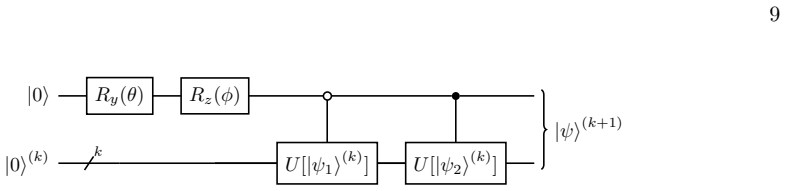
Method via a mixture of pure states Obviously, (4.1) can be understood as (2.3) with ρi = |ψ i⟩ ⟨ψ | for i = 0,...,ℓ − 1. Therefore, the circuit in Fig. 2 can be used to prepare ρ, if each ρi is provided with the pure state |ψ i⟩. The states |ψ i⟩ for i = 0,...ℓ − 1 can be prepared using the circuit discussed in Sec. III. Thi s circuit requires 2n + 1 qub...
-
[3]
Method via purification According to the purification theorem [1], any arbitrary state ρA in a finite-dimensional Hilbert space HA can always be purified into a pure state |ΨAB⟩ in an enlarged Hilbert space HAR ∼ = HA ⊗ H R such that ρA is a partial trace of |ΨAR⟩, i.e., ρA = TrR |ΨAR⟩ ⟨ΨAR|. Particularly, with the inclusion of m = ⌈log2ℓ⌉ ancilla qubits, the...
-
[4]
Cholesky decomposition In the Cholesky decomposition, if M is a d × d Hermitian positive semi-definite matrix, then it admits a factorization M =LL†, (4.13) where L is a d × d lower triangular matrix. Performing the Cholesky decompos ition upon ρ to obtainL and then removing the columns that contain all zeros from L, we obtain a 2 n × ℓ matrix, which obvio...
-
[5]
Incomplete Cholesky decomposition In many applications, it is good enough to prepare only an app roximate state ρ′ that is close enough to ρ, instead of ρ itself as originally specified. The incomplete Cholesky decomposition [49, 51] can be performed upon ρ to give rise to such approximation. For ad × d Hermitian positive semi-definite matrix M , the incomp...
-
[6]
M. A. Nielsen and I. L. Chuang, Quantum Computation and Quantum Information (Cambridge Uni- versity Press, 2010)
work page 2010
-
[7]
Ambainis, Quantum search algorithms, ACM SIGACT News 35, 22 (2004)
A. Ambainis, Quantum search algorithms, ACM SIGACT News 35, 22 (2004)
work page 2004
-
[8]
P. R. Giri and V. E. Korepin, A review on quantum search algorithm s, Quantum Information Processing 16, 1 (2017)
work page 2017
-
[9]
I. M. Georgescu, S. Ashhab, and F. Nori, Quantum simulation, Re v. Mod. Phys. 86, 153 (2014). 22
work page 2014
-
[10]
P. Wittek, Quantum Machine Learning: What Quantum Computing Means to D ata Mining (Aca- demic Press, 2014)
work page 2014
-
[11]
J. Biamonte, P. Wittek, N. Pancotti, P. Rebentrost, N. Wiebe, a nd S. Lloyd, Quantum machine learning, Nature 549, 195 (2017)
work page 2017
-
[12]
Jaeger, Quantum Information (Springer, 2007)
G. Jaeger, Quantum Information (Springer, 2007)
work page 2007
-
[13]
M. M. Wilde, Quantum Information Theory (Cambridge University Press, 2013)
work page 2013
- [14]
-
[15]
A. W. Harrow, A. Hassidim, and S. Lloyd, Quantum algorithm for lin ear systems of equations, Phys. Rev. Lett. 103, 150502 (2009)
work page 2009
-
[16]
D. Aharonov, A. Kitaev, and N. Nisan, Quantum circuits with mixe d states, in Proceedings of the thirtieth annual ACM symposium on Theory of computing (1998) pp. 20–30
work page 1998
- [17]
-
[18]
Y.-C. Liang, Y.-H. Yeh, P. E. Mendon¸ ca, R. Y. Teh, M. D. Reid, a nd P. D. Drummond, Quantum fidelity measures for mixed states, Reports on Progress in Physics 82, 076001 (2019)
work page 2019
-
[19]
N. A. Peters, T.-C. Wei, and P. G. Kwiat, Mixed-state sensitivity of several quantum-information benchmarks, Phys. Rev. A 70, 052309 (2004)
work page 2004
-
[20]
C. H. Bennett, D. P. DiVincenzo, J. A. Smolin, and W. K. Wootter s, Mixed-state entanglement and quantum error correction, Phys. Rev. A 54, 3824 (1996)
work page 1996
-
[21]
T.-C. Wei, K. Nemoto, P. M. Goldbart, P. G. Kwiat, W. J. Munro, a nd F. Verstraete, Maximal entanglement versus entropy for mixed quantum states, Phys. R ev. A 67, 022110 (2003)
work page 2003
-
[22]
A. Datta and G. Vidal, Role of entanglement and correlations in mix ed-state quantum computation, Phys. Rev. A 75, 042310 (2007)
work page 2007
-
[23]
M. Horodecki, P. Horodecki, and R. Horodecki, Mixed-state en tanglement and quantum communication, in Quantum Information: An Introduction to Basic Theoretical Concepts and Experiments (Springer Berlin Heidelberg, Berlin, Heidelberg, 2001) pp. 151–195
work page 2001
-
[24]
A. Datta and S. Gharibian, Signatures of nonclassicality in mixed- state quantum computation, Phys. Rev. A 79, 042325 (2009)
work page 2009
-
[25]
C. Macchiavello and M. F. Sacchi, Mixed-state certification of qu antum capacities for noisy communi- cation channels, Phys. Rev. A 97, 012303 (2018)
work page 2018
- [26]
-
[27]
C.-F. Chen, M. J. Kastoryano, F. G. S. L. Brand˜ ao, and A. Gily ´ en, Quantum thermal state preparation (2023), arXiv:2303.18224 [quant-ph]
work page internal anchor Pith review Pith/arXiv arXiv 2023
-
[28]
F. Fritzsch and T. c. v. Prosen, Eigenstate thermalization in du al-unitary quantum circuits: Asymp- 23 totics of spectral functions, Phys. Rev. E 103, 062133 (2021)
work page 2021
-
[29]
S. McArdle, S. Endo, A. Aspuru-Guzik, S. C. Benjamin, and X. Y uan, Quantum computational chem- istry, Rev. Mod. Phys. 92, 015003 (2020)
work page 2020
-
[30]
B. P. Lanyon, J. D. Whitfield, G. G. Gillett, M. E. Goggin, M. P. Alme ida, I. Kassal, J. D. Biamonte, M. Mohseni, B. J. Powell, M. Barbieri, et al. , Towards quantum chemistry on a quantum computer, Nature chemistry 2, 106 (2010)
work page 2010
-
[31]
Y. Cao, J. Romero, J. P. Olson, M. Degroote, P. D. Johnson, M . Kieferov´ a, I. D. Kivlichan, T. Menke, B. Peropadre, N. P. Sawaya, et al. , Quantum chemistry in the age of quantum comput- ing, Chemical reviews 119, 10856 (2019)
work page 2019
-
[32]
I. F. Araujo, D. K. Park, T. B. Ludermir, W. R. Oliveira, F. Petr uccione, and A. J. da Silva, Configurable sublinear circuits for quantum state preparation, Quantum Information Processing 22, 123 (2023)
work page 2023
-
[33]
P. Niemann, R. Datta, and R. Wille, Logic synthesis for quantum s tate generation, in 2016 IEEE 46th International Symposium on Multiple-Valued Logic (ISMVL) (2016) pp. 247–252
work page 2016
- [34]
-
[35]
M. Plesch and i. c. v. Brukner, Quantum-state preparation wit h universal gate decompositions, Phys. Rev. A 83, 032302 (2011)
work page 2011
-
[36]
R. Iten, R. Colbeck, I. Kukuljan, J. Home, and M. Christandl, Q uantum circuits for isometries, Phys. Rev. A 93, 032318 (2016)
work page 2016
-
[37]
M. M¨ ott¨ onen, J. J. Vartiainen, V. Bergholm, and M. M. Saloma a, Quantum circuits for general multi- qubit gates, Phys. Rev. Lett. 93, 130502 (2004)
work page 2004
-
[38]
V. Bergholm, J. J. Vartiainen, M. M¨ ott¨ onen, and M. M. Saloma a, Quantum circuits with uniformly controlled one-qubit gates, Phys. Rev. A 71, 052330 (2005)
work page 2005
-
[39]
M. M¨ ott¨ onen, J. J. Vartiainen, V. Bergholm, and M. M. Saloma a, Transformation of quantum states using uniformly controlled rotations, Quantum Info. Comput. 5, 467–473 (2005)
work page 2005
-
[40]
S. Druskat, Quantum computing library (qclib), https://github.com/qclib/qclib (2021), released: 2021-08-11
work page 2021
-
[41]
F. Mozafari, H. Riener, M. Soeken, and G. De Micheli, Efficient boo lean methods for preparing uniform quantum states, IEEE Transactions on Quantum Engineering 2, 1 (2021)
work page 2021
-
[42]
E. Malvetti, R. Iten, and R. Colbeck, Quantum circuits for spar se isometries, Quantum 5, 412 (2021)
work page 2021
-
[43]
N. Gleinig and T. Hoefler, An efficient algorithm for sparse quantu m state preparation, in 2021 58th ACM/IEEE Design Automation Conference (DAC) (2021) pp. 433–438
work page 2021
-
[44]
T. M. de Veras, L. D. da Silva, and A. J. da Silva, Double sparse qu antum state preparation, Quantum Information Processing 21, 204 (2022)
work page 2022
-
[45]
F. Mozafari, G. De Micheli, and Y. Yang, Efficient deterministic pre paration of quantum states using decision diagrams, Phys. Rev. A 106, 022617 (2022). 24
work page 2022
- [46]
- [47]
-
[48]
F. M. Creevey, C. D. Hill, and L. C. L. Hollenberg, GASP: a genetic algorithm for state preparation on quantum computers, Scientific Reports 13, 11956 (2023)
work page 2023
-
[49]
I. F. Araujo, C. Blank, I. C. S. Ara´ ujo, and A. J. da Silva, Low -rank quantum state preparation, IEEE Transactions on Computer-Aided Design of Integrated Circu its and Systems 43, 161 (2024)
work page 2024
-
[50]
Preskill, Quantum computing in the NISQ era and beyond, Quan tum 2, 79 (2018)
J. Preskill, Quantum computing in the NISQ era and beyond, Quan tum 2, 79 (2018)
work page 2018
-
[51]
Brooks, Beyond quantum supremacy: the hunt for useful quantum computers, Nature 574, 19 (2019)
M. Brooks, Beyond quantum supremacy: the hunt for useful quantum computers, Nature 574, 19 (2019)
work page 2019
-
[52]
L. N. Trefethen and D. Bau, Numerical Linear Algebra (Society for Industrial and Applied Mathematics, 1997)
work page 1997
-
[53]
J. E. Gentle, Numerical Linear Algebra for Applications in Statistics (Springer, 1998)
work page 1998
-
[54]
G. H. Golub and C. F. Van Loan, Matrix Computations , 4th ed. (Johns Hopkins University Press, Baltimore, 2013)
work page 2013
-
[55]
MATLAB function: chol — Cholesky factorization (2023), https://www.mathworks.com/help/matlab/ref/chol.html
work page 2023
-
[56]
MATLAB function: ichol — Incomplete Cholesky factorization (2023), https://www.mathworks.com/help/matlab/ref/ichol.html
work page 2023
-
[57]
Peres, Quantum Theory: Concepts and Methods (Kluwer Academic Publishers, New York, 2002)
A. Peres, Quantum Theory: Concepts and Methods (Kluwer Academic Publishers, New York, 2002)
work page 2002
-
[58]
A. D. C´ orcoles, M. Takita, K. Inoue, S. Lekuch, Z. K. Minev, J . M. Chow, and J. M. Gam- betta, Exploiting dynamic quantum circuits in a quantum algorithm with superconducting qubits, Phys. Rev. Lett. 127, 100501 (2021)
work page 2021
-
[59]
J. Blake, Bringing the full power of dynamic circuits to qiskit runt ime (2022), https://www.ibm.com/quantum/blog/quantum-dynamic-ci rcuits
work page 2022
-
[60]
N. J. Higham, Analysis of the Cholesky decomposition of a semi-de finite matrix, in Reliable Numerical Computation (Oxford University Press, 1990) pp. 161–185
work page 1990
- [61]
-
[62]
I. Ojalvo, Origins and advantages of Lanczos vectors for larg e dynamic systems, in International Modal Analysis Conference, 6th, Kissimmee, FL (1988) pp. 489–494
work page 1988
-
[63]
T. A. Davis, Cholesky Factorization, in Direct Methods for Sparse Linear Systems (2006) Chap. 4, pp. 37–68
work page 2006
-
[64]
S. Toledo, Computing the Cholesky Factorization of Sparse Mat rices, lecture note in https://www.tau.ac.il/~stoledo/Support/
-
[65]
C. Fuchs and J. van de Graaf, Cryptographic distinguishability m easures for quantum-mechanical 25 states, IEEE Transactions on Information Theory 45, 1216 (1999)
work page 1999
discussion (0)
Sign in with ORCID, Apple, or X to comment. Anyone can read and Pith papers without signing in.