Lattice-Driven Electronic Structure Reconstruction in the Commensurate CDW Phase of 1T-TaS₂
Pith reviewed 2026-05-24 02:18 UTC · model grok-4.3
The pith
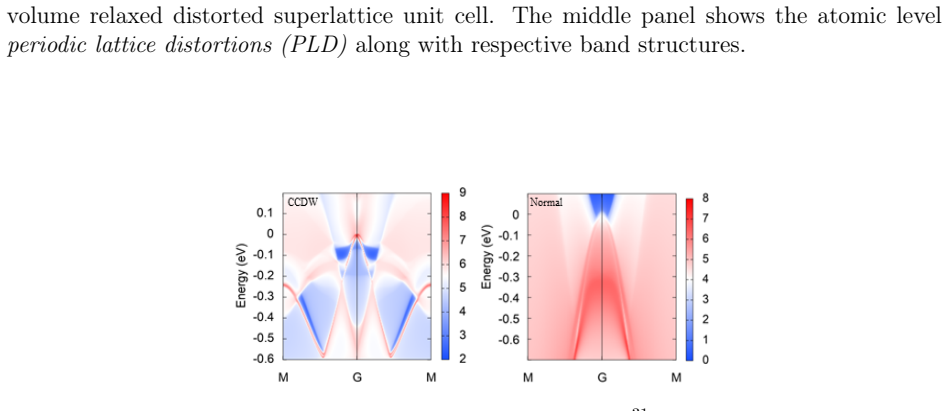
Lattice distortion in 1T-TaS2 drives band folding that reconstructs the electronic structure in the commensurate CDW phase.
A machine-rendered reading of the paper's core claim, the machinery that carries it, and where it could break.
Core claim
The central claim is that the electronic reconstruction in the CCDW phase, including apparent Fermi surface nesting features, emerges naturally from band folding due to the lattice distortion in the Star-of-David pattern, as shown by DFT relaxation and Wannier modeling, providing a consistent framework without explicit susceptibility calculations.
What carries the argument
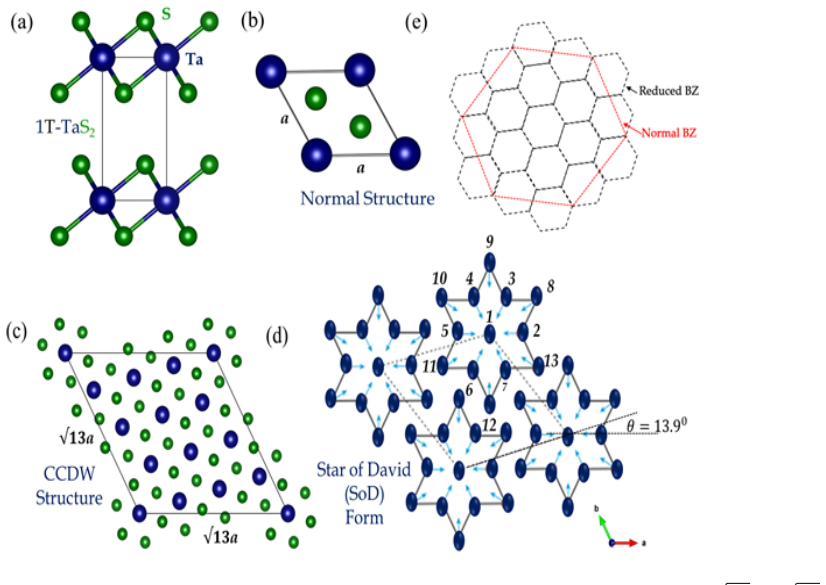
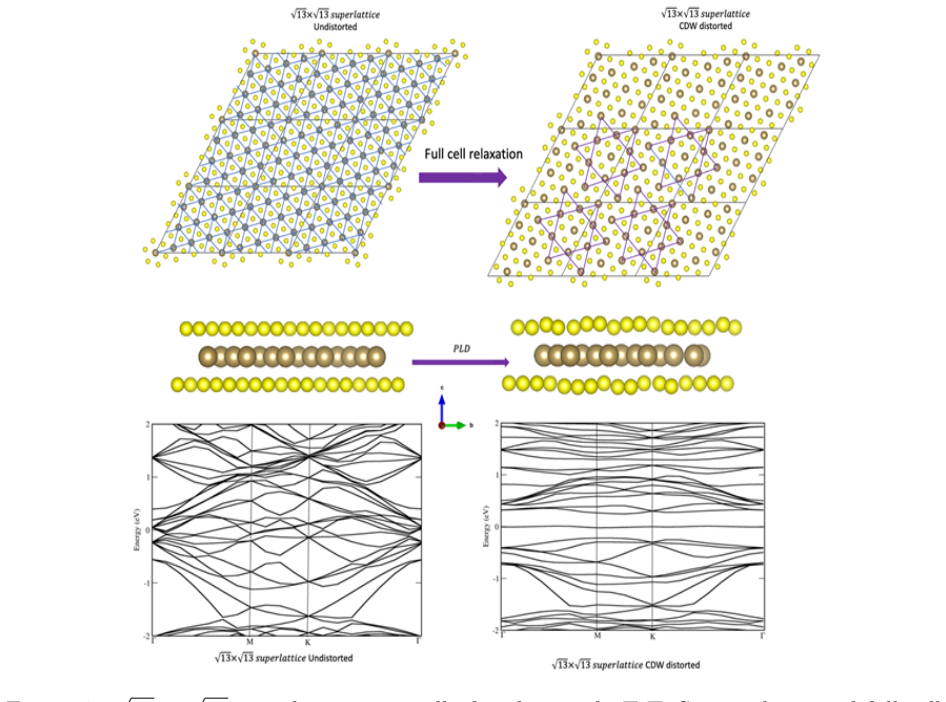
The sqrt(13) x sqrt(13) supercell relaxation leading to Star-of-David distortion, combined with Wannier-based tight-binding modeling to track band folding from Brillouin zone reduction.
If this is right
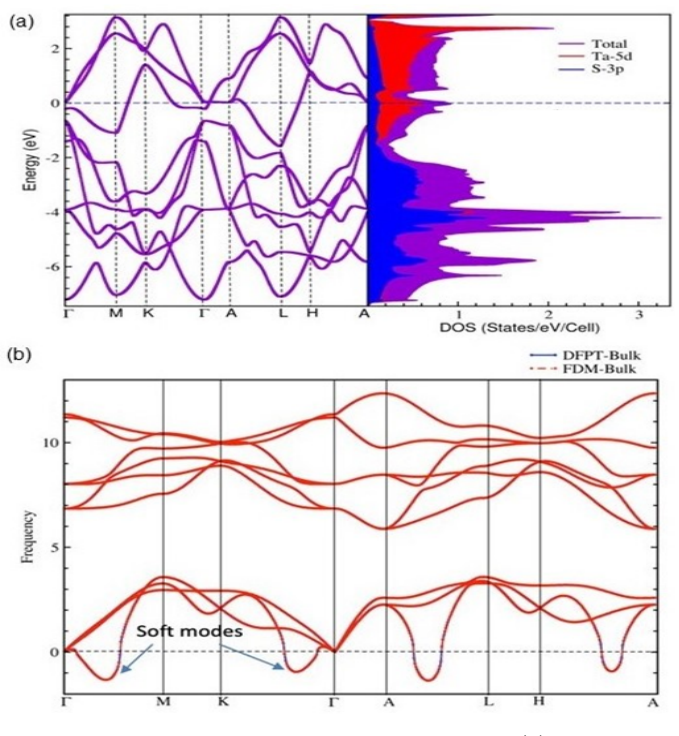
- The CCDW phase forms spontaneously from phonon softening in the undistorted phase.
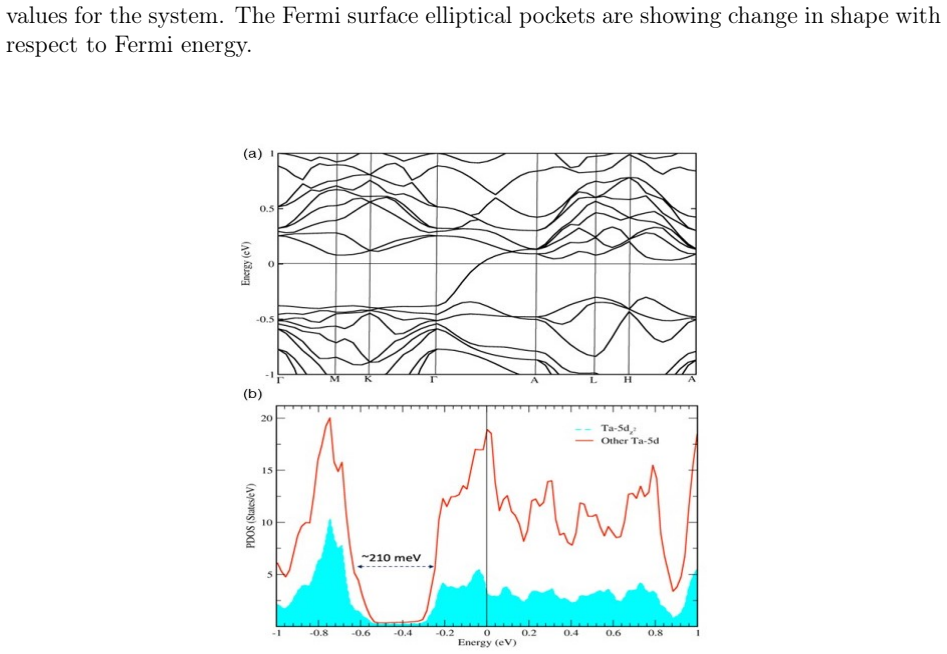
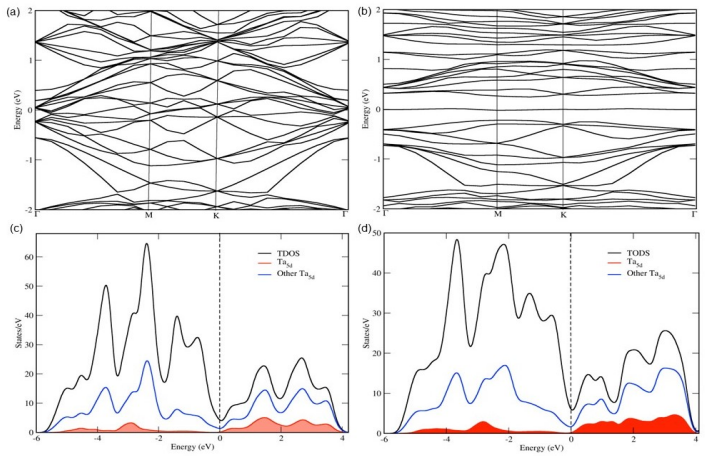
- Ta 5d bands narrow due to the zone folding from the supercell.
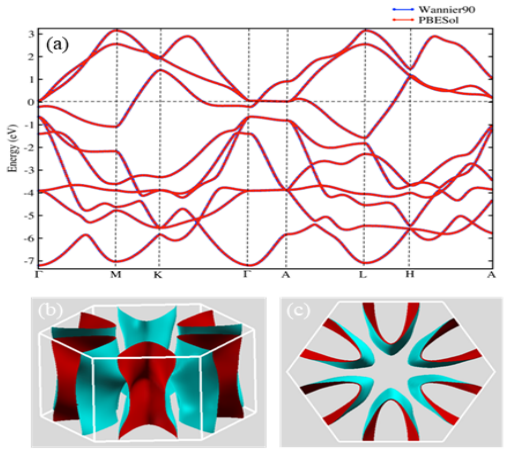
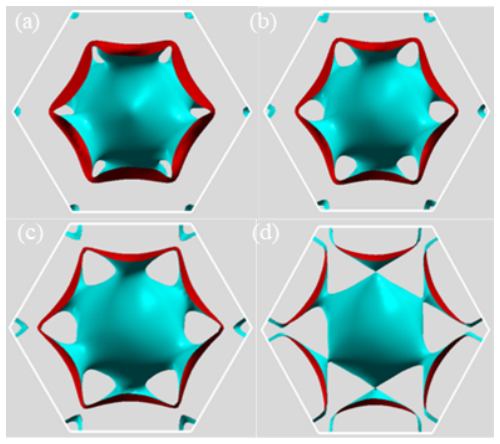
- Fermi surface reconstruction occurs directly from the Brillouin zone reduction.
- Features interpreted as nesting emerge from the lattice distortion instead.
- The electronic structure agrees qualitatively with reported ARPES measurements.
Where Pith is reading between the lines
- The same folding mechanism may operate in other layered materials that host commensurate CDW order.
- Dimensionality effects could be tested by comparing the monolayer and bulk reconstructions in greater detail.
- Adding explicit electron-phonon coupling calculations would provide a further check on the instability driving the distortion.
Load-bearing premise
The structural relaxation of the sqrt(13) x sqrt(13) supercell in standard density functional theory is assumed to capture the essential physics of the commensurate CDW phase without needing additional correlation corrections.
What would settle it
High-resolution ARPES data showing band dispersions or Fermi surface contours that cannot be reproduced by folding from the Star-of-David supercell would challenge the claim that lattice distortion accounts for the reconstruction.
Figures
read the original abstract
We investigate the structural and electronic reconstruction associated with the commensurate charge-density-wave (CCDW) phase in bulk and monolayer 1T-TaS2 using density functional theory (DFT) and Wannier-based tight-binding modeling. Structural relaxation of a sqrt(13) x sqrt(13) supercell leads spontaneously to the formation of the Star-of-David (SoD) distortion, consistent with phonon softening of the undistorted phase. We focus on establishing a direct connection between real-space lattice distortion and momentum-space electronic reconstruction. Using Wannier interpolation, we demonstrate how the CCDW-induced Brillouin zone reduction leads to band folding, narrowing of Ta 5d bands, and reconstruction of the Fermi surface. Our analysis shows that features often interpreted as Fermi surface nesting emerge naturally from band folding associated with lattice distortion. We compare our calculated electronic structure with previously reported angle-resolved photoemission spectroscopy (ARPES) results at a qualitative level. While we do not explicitly compute electronic susceptibility or electron-phonon coupling matrix elements, the results provide a consistent microscopic framework linking lattice instability and electronic structure reconstruction in 1T-TaS2.
Editorial analysis
A structured set of objections, weighed in public.
Referee Report
Summary. The manuscript claims that the commensurate CDW phase of 1T-TaS2 arises from spontaneous Star-of-David lattice distortion in a DFT-relaxed sqrt(13) x sqrt(13) supercell, and that the resulting Brillouin-zone folding, Ta 5d band narrowing, and Fermi-surface reconstruction fully account for ARPES features previously attributed to nesting. Wannier-interpolated bands from the relaxed geometry are compared qualitatively to experiment for both bulk and monolayer cases, providing a direct lattice-to-electronic mapping without explicit susceptibility or e-ph matrix elements.
Significance. If the standard-DFT description is representative, the work supplies a parameter-free microscopic link between the observed phonon softening, real-space SoD distortion, and momentum-space reconstruction, strengthening the case that nesting is not required. The spontaneous emergence of the distortion and the band-folding analysis are internally consistent and falsifiable via future ARPES or STM measurements on the folded contours.
major comments (2)
- [Methods] Methods/Computational Details: The structural relaxation and subsequent Wannier interpolation are performed with a standard semilocal functional (PBE or equivalent) without Hubbard U on Ta 5d orbitals. Because the CCDW phase is a Mott insulator, omission of U typically shifts the folded Ta 5d bands relative to EF, alters hybridization, and fails to open the observed gap; this directly affects which folded contours cross EF and therefore undermines the central claim that folding alone reproduces the ARPES Fermi-surface features.
- [Results] Results/ARPES comparison: The manuscript states that the comparison is 'at a qualitative level' only. No quantitative measures (RMS band-position deviation, Fermi-contour overlap, or gap-size error) are reported, nor are convergence tests with respect to k-mesh, supercell size, or functional choice provided; without these, it is impossible to judge whether residual discrepancies are due to missing correlation or to the folding mechanism itself.
minor comments (1)
- [Abstract] Abstract: The phrase 'we compare our calculated electronic structure with previously reported ARPES results' does not cite the specific experimental references or indicate which panels of which figure contain the overlay.
Simulated Author's Rebuttal
We thank the referee for the constructive comments on our manuscript. We address each major comment below and indicate the revisions we will make.
read point-by-point responses
-
Referee: [Methods] Methods/Computational Details: The structural relaxation and subsequent Wannier interpolation are performed with a standard semilocal functional (PBE or equivalent) without Hubbard U on Ta 5d orbitals. Because the CCDW phase is a Mott insulator, omission of U typically shifts the folded Ta 5d bands relative to EF, alters hybridization, and fails to open the observed gap; this directly affects which folded contours cross EF and therefore undermines the central claim that folding alone reproduces the ARPES Fermi-surface features.
Authors: We acknowledge that the CCDW phase exhibits Mott-insulating character and that a Hubbard U term on Ta 5d states would improve the quantitative description of the gap and band positions. Our calculations deliberately employ standard semilocal DFT to show that the Star-of-David distortion emerges spontaneously from lattice relaxation (consistent with the phonon softening reported in the literature) and that the resulting zone folding produces the observed Fermi-surface reconstruction. This establishes a direct, parameter-free connection between the lattice instability and the momentum-space features without invoking nesting. We will revise the Methods and Discussion sections to explicitly note this limitation of the functional and to clarify that the folding mechanism itself is robust to the addition of moderate U, while the precise gap size may require beyond-DFT corrections. This constitutes a partial revision. revision: partial
-
Referee: [Results] Results/ARPES comparison: The manuscript states that the comparison is 'at a qualitative level' only. No quantitative measures (RMS band-position deviation, Fermi-contour overlap, or gap-size error) are reported, nor are convergence tests with respect to k-mesh, supercell size, or functional choice provided; without these, it is impossible to judge whether residual discrepancies are due to missing correlation or to the folding mechanism itself.
Authors: We agree that quantitative benchmarks would strengthen the presentation. In the revised manuscript we will add convergence tests with respect to k-mesh density and supercell size, confirming that the folded Ta 5d contours and their nesting-like features remain stable. We will also report simple quantitative indicators, such as the average energy deviation of the folded bands near EF relative to published ARPES data, for the principal contours. A full RMS analysis over the entire surface or systematic functional scans lies outside the present scope, which centers on the mechanistic origin of the reconstruction rather than spectroscopic precision. These additions will be included in a new subsection of the Results. revision: yes
Circularity Check
Standard DFT relaxation + Wannier band folding; no self-referential reductions
full rationale
The derivation proceeds from input crystal structure to DFT relaxation of the sqrt(13) supercell (yielding SoD distortion), then Wannier interpolation of Ta 5d bands to exhibit folding and FS reconstruction. These steps are direct numerical outputs of the chosen functional and supercell geometry; no parameters are fitted to the target ARPES features, no equations are defined in terms of their own outputs, and no load-bearing uniqueness theorem or self-citation is invoked. The qualitative ARPES comparison is presented only as consistency, not as a fitted or self-defined prediction. The paper is therefore self-contained against external benchmarks.
Axiom & Free-Parameter Ledger
axioms (1)
- domain assumption Standard density functional theory (without Hubbard U or similar corrections) is sufficient to capture the lattice instability and resulting electronic reconstruction in 1T-TaS2.
Reference graph
Works this paper leans on
-
[1]
(1) Xi, X.; Berger, H.; Forró, L.; Shan, J.; Mak, K. F. Gate Tuning of Electronic Phase Transitions in Two-DimensionalNbSe2.Phys. Rev. Lett.2016,117, 106801. (2) Kvashnin, Y.; VanGennep, D.; Mito, M.; Medvedev, S. A.; Thiyagarajan, R.; Karis, O.; Vasiliev, A. N.; Eriksson, O.; Abdel-Hafiez, M. Coexistence of Superconductivity and Charge Density Waves in T...
work page 2016
-
[2]
M.; He, Y.; van Wezel, J.; Rahn, D
(19) Soumyanarayanan, A.; Yee, M. M.; He, Y.; van Wezel, J.; Rahn, D. J.; Rossnagel, K.; Hudson, E. W.; Norman, M. R.; Hoffman, J. E. Quantum phase transition from tri- angular to stripe charge order in NbSe<sub>2</sub>.Proceedings of the National Academy of Sciences2013,110, 1623–1627. (20) Blöchl, P. E. Projector augmented-wave method.Phys. Rev. B1994,5...
work page 1993
-
[3]
First principles phonon calculations in materials science.Scr
(30) Togo, A.; Tanaka, I. First principles phonon calculations in materials science.Scr. Mater.2015,108, 1–5. (31) Mostofi, A. A.; Yates, J. R.; Lee, Y.-S.; Souza, I.; Vanderbilt, D.; Marzari, N. wan- 18 nier90: A tool for obtaining maximally-localised Wannier functions.Computer Physics Communications2008,178, 685–699. (32) Grasset, R.; Gallais, Y.; Sacut...
work page 2015
discussion (0)
Sign in with ORCID, Apple, or X to comment. Anyone can read and Pith papers without signing in.