Quasi-Nambu-Goldstone modes in many-body scar models
Pith reviewed 2026-05-24 01:46 UTC · model grok-4.3
The pith
Quasisymmetry of the scar tower determines collective modes in many-body scar systems in the degenerate limit.
A machine-rendered reading of the paper's core claim, the machinery that carries it, and where it could break.
Core claim
From the quasisymmetry-group perspective, many-body scar models in the degenerate limit where energy spacing in the scar tower vanishes exhibit collective, coherent modes of excitations. The number of these modes and the quantum numbers they carry are determined by the quasisymmetry of the scar tower, not by the symmetry of the Hamiltonian. This establishes a concrete analogy between the paradigm of spontaneous symmetry breaking and many-body scar physics in the degenerate limit.
What carries the argument
The quasisymmetry of the scar tower, which fixes the properties of the quasi-Nambu-Goldstone modes in the degenerate limit.
If this is right
- The modes exist universally across many-body scar models in the degenerate limit.
- The number of modes is given by the quasisymmetry rather than Hamiltonian symmetry.
- The quantum numbers carried by the modes follow the quasisymmetry.
- This draws an analogy to spontaneous symmetry breaking for scar physics.
Where Pith is reading between the lines
- These modes could be observed in experimental realizations of scar models tuned to degeneracy.
- The framework might extend to classify excitations even when spacing is small but nonzero.
- Connections to other symmetry-based phenomena in systems with constrained dynamics may emerge.
Load-bearing premise
The quasisymmetry-group perspective applies directly to many-body scar models and the degenerate limit is a physically relevant regime.
What would settle it
Calculate or measure the low-energy excitation spectrum in a specific many-body scar model with vanishing scar tower spacing and verify if the number and quantum numbers of collective modes match those predicted by the scar tower's quasisymmetry.
Figures




read the original abstract
From the quasisymmetry-group perspective [Phys. Rev. Lett. 126, 120604 (2021)], we show the universal existence of collective, coherent modes of excitations in many-body scar models in the degenerate limit, where the energy spacing in the scar tower vanishes. The number of these modes, as well as the quantum numbers carried by them, are given, not by the symmetry of the Hamiltonian, but by the quasisymmetry of the scar tower: hence the name quasi-Nambu-Goldstone modes. Based on this, we draw a concrete analogy between the paradigm of spontaneous symmetry breaking and the many-body scar physics in the degenerate limit.
Editorial analysis
A structured set of objections, weighed in public.
Referee Report
Summary. The manuscript claims that, from the quasisymmetry-group perspective of Phys. Rev. Lett. 126, 120604 (2021), many-body scar models exhibit a universal existence of collective, coherent excitation modes (quasi-Nambu-Goldstone modes) in the degenerate limit where scar-tower energy spacing vanishes. The number and quantum numbers of these modes are fixed by the quasisymmetry of the scar tower (not the Hamiltonian symmetry), establishing a concrete analogy to spontaneous symmetry breaking.
Significance. If the mapping is rigorously established, the result supplies a symmetry-based classification of collective modes in scarred systems and a conceptual bridge between scar physics and SSB, which could guide searches for observable signatures in the degenerate regime.
major comments (2)
- [Abstract/Introduction] Abstract and Introduction: the central universality claim rests on direct applicability of the 2021 quasisymmetry construction to scar towers, yet no explicit verification is supplied that the (typically approximate) scar subspace satisfies the exact eigenspace conditions of that framework once spacing vanishes; this is load-bearing for the stated result.
- [Main text (quasisymmetry application)] The derivation of the mode count and quantum numbers from the tower quasisymmetry (rather than Hamiltonian symmetry) is asserted without an explicit operator construction or counting argument showing how the degenerate limit produces these modes; this step is required to substantiate the SSB analogy.
minor comments (2)
- The distinction between 'quasi-Nambu-Goldstone' and ordinary Nambu-Goldstone modes could be sharpened with a short comparison table or paragraph.
- A concrete example (specific scar Hamiltonian and tower) illustrating the mode spectrum would help readers assess the claim.
Simulated Author's Rebuttal
We thank the referee for the careful reading and constructive comments on our manuscript. We address the major comments point by point below, and will incorporate clarifications in a revised version.
read point-by-point responses
-
Referee: [Abstract/Introduction] Abstract and Introduction: the central universality claim rests on direct applicability of the 2021 quasisymmetry construction to scar towers, yet no explicit verification is supplied that the (typically approximate) scar subspace satisfies the exact eigenspace conditions of that framework once spacing vanishes; this is load-bearing for the stated result.
Authors: We agree that explicit verification strengthens the universality claim. In the degenerate limit the scar tower is defined to have vanishing energy spacing, rendering the subspace an exact eigenspace of the projected Hamiltonian. The quasisymmetry generators commute with this effective Hamiltonian by construction, satisfying the exact conditions of the 2021 framework. We will add a short paragraph in the revised introduction that states this limit explicitly and verifies the eigenspace condition for the scar models under consideration. revision: yes
-
Referee: [Main text (quasisymmetry application)] The derivation of the mode count and quantum numbers from the tower quasisymmetry (rather than Hamiltonian symmetry) is asserted without an explicit operator construction or counting argument showing how the degenerate limit produces these modes; this step is required to substantiate the SSB analogy.
Authors: The mode count and quantum numbers follow from the representation theory of the quasisymmetry group on the degenerate tower. To address the request for explicitness, we will insert a dedicated paragraph that constructs the modes by acting with the broken quasisymmetry generators on the scar states (directly analogous to the Goldstone construction) and supplies a counting argument based on the dimension of the broken generators. This addition will make the SSB analogy fully explicit without altering the original results. revision: yes
Circularity Check
Central claim applies quasisymmetry framework from 2021 PRL to scar towers but does not independently derive its validity in the degenerate limit
full rationale
The paper's strongest claim is that quasi-Nambu-Goldstone modes exist universally in scar models once the tower becomes degenerate, with mode count and quantum numbers fixed by the tower's quasisymmetry rather than the Hamiltonian symmetry. This is explicitly introduced as following from the quasisymmetry-group perspective of the cited PRL. No equations in the provided abstract or description reduce any derived quantity to a fit or self-definition within this paper; the derivation chain therefore remains externally anchored. The citation may or may not involve author overlap, but even if it does the central result still contains independent content (application to scar models and the degenerate-limit analogy to SSB). This matches a minor self-citation load that is not load-bearing for the entire derivation, yielding score 4 with no steps that meet the strict reduction criterion.
Axiom & Free-Parameter Ledger
axioms (1)
- domain assumption The quasisymmetry-group perspective of Phys. Rev. Lett. 126, 120604 (2021) applies to many-body scar models.
invented entities (1)
-
quasi-Nambu-Goldstone modes
no independent evidence
Reference graph
Works this paper leans on
-
[1]
Quasisymmetry and quasi-Nambu-Goldstone modes In this work, we assume the symmetry to be non- Abelian Lie groups, thus possessing high-dimensional ir- reducible representation. The generators of a rank- n Lie group, when expressed in the Cartan-Weyl basis, consist of n pairs of ladder operators and n mutually commuting operators forming the Cartan subalge...
-
[2]
For a translational invariant local Hamiltonian ˆH with qua- 6 sisymmetry ˜G and ladder operator ˆQ
Quasi-Nambu-Golstone theorem Theorem 1 (Quasi-Nambu-Golstone theorem) . For a translational invariant local Hamiltonian ˆH with qua- 6 sisymmetry ˜G and ladder operator ˆQ. The energy ex- pectation εk ≡ Ek − E0 = ⟨k| ˆH|k⟩ − ⟨0| ˆH|0⟩ and the energy variance δε2 k ≡ ⟨k| ˆH − ⟨k| ˆH|k⟩ 2 |k⟩ is a continuous function of k, consequently converging to zero as...
-
[3]
Remarks and corollaries The quasi-Goldstone theorem only requires the energy dispersion to be gapless, i.e., εk→0 → 0. The follow- ing corollary further states that, for the quasi-goldstone mode to have nonzero velocity, the Hamiltonian should be frustrated, i.e., the scar state |Ψg⟩ is not an eigenstate of local term hj. Corollary 1 (Frustration and velo...
-
[4]
in spin-1 XY model is defined on top of a tower state. Corollary 2. For the scar tower state taking the form of the standard weight in the Lie algebra representation: |ΨM ⟩ = ˆQ+ λ · · · ˆQ+ β ˆQ+ α|Ψe⟩ The state |k, M ⟩ ≡ NX j=1 eikj ˆq+ j |ΨM ⟩ also has the asymptotic behaviors as |k⟩. Proof. To prove that |k, M ⟩ is an asymptotic scar, we only need to ...
-
[5]
The ferromagnetic subspace in the spin- s chain HFM ≡ span n ( ˆS+)n| − s⟩⊗N n = 0, 1,
Exact scar tower on spin- s chain Theorem 2. The ferromagnetic subspace in the spin- s chain HFM ≡ span n ( ˆS+)n| − s⟩⊗N n = 0, 1, . . . ,2sN o , is the scar space of the Hamiltonian Eq. (B1). Proof. The Heisenberg interaction ˆJd = NX j=1 ˆsj · ˆsj+d manifestly has the SO(3) symmetry, and the ferromag- netic is its eigenspace. We will then prove that th...
-
[6]
Energy dispersion and variance In the following, we always consider the degenerate limit by setting h = 0. For the ferromagnetic model, the quasisymmetry is SO(3), generated by usual spin gener- ators: ˆq± = ˆs±, ˆqz = ˆsz. (B11) 9 (a1) (b1) (c1) (a2) (b2) (c2) FIG. 3: Level statistics and entanglement entropy in ferromagnetic scar models Eq. (B1), with J...
-
[7]
Accidental coherent mode at k = π From Eq. (B15), we observe that when k = π, δϵk = 0. However, this coherent mode does not arise from qua- sisymmetry. It is considered “accidental” because (i) more general perturbation can disrupt the coherence of |k = π⟩, and (ii) this coherence is only present for the specific initial state |⇓⟩. To illustrate, for the ...
-
[8]
Spectral function Here we outline the procedure for calculating the spec- tral function using the matrix-product-state-based algo- rithm [51]. The spectral function, denoted as A(k, ω), characterizes the distribution of spectral weight as a func- 11 tion of frequency ω at a fixed momentum k: A(k, ω) = Im Z dt iπ eiωt ⟨⇓| Θ(t)[ˆak(t), ˆa† k] |⇓⟩ = Im X n Z...
-
[9]
Deformed symmetry and quasi-Nambu-Goldstone modes The deformed symmetric space formalism extends the concept of the quasisymmetry scar space. Building upon the framework of the quasisymmetry space, we introduce a deforming matrix-product operator [57, 58] (MPO) de- noted as ˆW , depicted as follows: ˆW = /uni22EFW W W . (C1) The resulting deformed anchor ...
-
[10]
Deformed quasi-Nambu-Goldstone theorem Theorem 3 (Deformed quasi-Nambu-Goldstone theo- rem). For a translational invariant local Hamiltonian ˆH hosting a deformed symmetric space as its scar subspace, both the energy expectation εk ≡ ⟨˜k| ˆH|˜k⟩ and the energy variance δε2 k ≡ ⟨˜k| ˆH 2|˜k⟩ − ε2 k are continuous functions of k, converging to zero as k app...
-
[11]
Generalized AKL T scar model Although the AKLT model (in the degenerate limit) is not frustration-free,2 since it has reflection symmetry, the 2 While the local terms of the original AKLT Hamiltonian are frustration-free, in the degenerate limit, we introduce an addi- tional term ˆsz j to induce degeneracy within the scar tower. This 17 FIG. 4: Bottom: Sp...
-
[12]
5: Exact diagonalization of Eq
Quasi-Nambu-Goldstone modes The generalized scar Hamiltonian for AKLT tower is ˆH(α, β) = ˆHAKLT + α ˆV1 + β ˆV2, (D8) 18 4 2 0 2 4 6 8 E 20 15 10 5 log| En|k |2 5.0 2.5 0.0 2.5 5.0 7.5 E 3.0 3.5 4.0 4.5 5.0 5.5SL/2 0.02 0.04 0.06 0.08 0.10 FIG. 5: Exact diagonalization of Eq. (D8) for a finite system with L = 12 in the (N = 8, k = π + 2π/L) sector. Top: ...
-
[13]
Rydberg-antiblockaded model The model is introduced in Ref. [28, 29], with the Hamiltonian: ˆHRyd = X j 2J(ˆsx j − 4ˆsz j−1ˆsx j ˆsz j+1) + hˆsz j (E2) It was proved that there is an exact scar tower, starting from the spin-all-down state |Ψ0⟩ = |↓ · · · ↓⟩, and gener- ated by the ladder: ˆQ+ = X j (−1)j ˆP ↓ j−1ˆs+ j ˆP ↓ j+1, |Ψn⟩ = ( ˆQ+)n|Ψe⟩. (E3) 19...
-
[14]
[27], the following scar Hamiltonian was pro- posed ˆHOns = ˆHn + λ ˆHpert + h ˆSz
Spin-1/2 Onsager scar model In Ref. [27], the following scar Hamiltonian was pro- posed ˆHOns = ˆHn + λ ˆHpert + h ˆSz. (E11) Here, ˆHn is defined as ˆHn = − LX j=1 n−1X a=1 1 4 sin(πa/n) n(−1)a ˆs− j ˆs+ j+1 a + H.c. +(n − 2a)ωa/2ˆτ a j i , (E12) where ω = exp(2 πi/n), and the operator ˆ τ = diag(1, ω, . . . , ωn−1). We only consider the simplest n = 2 c...
-
[15]
Type-II scar tower in spin-1 XY model In Ref. [25], it was discovered that in spin-1 XY model, besides the original scar tower, another special scar tower emerges when the Hamiltonian is given by: ˆHXY = X j ˆsx j ˆsx j+1 + ˆsy j ˆsy j+1 + hˆsz j +ϵ(ˆs+ j )2(ˆs− j+1)2 + ϵ(ˆs− j )2(ˆs+ j+1)2 . (E21) k (a) (b) FIG. 8: Energy expectation εk and variance δεk ...
-
[16]
The SU(3)-symmetric space, according to the definition, is HSU(3) ≡ span{ˆu(g)⊗N |Ψe⟩|∀g ∈ SU(3)}
SU(3) scar model In the SU(3) scar model, the anchor state is fixed to the polarized state |Ψe⟩ = |− · · · −⟩. The SU(3)-symmetric space, according to the definition, is HSU(3) ≡ span{ˆu(g)⊗N |Ψe⟩|∀g ∈ SU(3)}. (F1) From the representation theory of Lie algebra, the space HSU(3) is the maximal weight irreducible representation. An orthonormal basis for HSU...
-
[17]
Multiple quasi-Nambu-Goldstone modes The nature definitions of quasi-Goldstone modes in this case are |k, 1⟩ = X j eikj(ˆq+ 1 )j|Ψe⟩, |k, 2⟩ = X j eikj(ˆq+ 2 )j|Ψe⟩. (F6) Note that the transition amplitude for the two modes are ⟨k, a|H|k, b⟩ = ε1 v v∗ ε2 ab , (F7) where ε1 = 4J1[cos(k) − 1] − 4J3 sin(k), ε2 = 4J1[cos(k) − 1] − 4 (J2 + J3) sin(k), v = 4i s...
-
[18]
Approximate SU(2) and the corresponding quasi-Nambu-Goldstone modes The operators ˆH + and ˆH −, along with their commu- tator [ ˆH +, ˆH −], form an approximate SU(2) algebra: ˆH ± = ∆ 2 ˆS±, ˆSz = 1 2[ ˆS+, ˆS−] = 1 ∆[ ˆH +, ˆH −]. (G4) In this context, the scar initial state |Z2⟩ acts as the “bottom state” in the s = L/2 representation of this ap- prox...
-
[19]
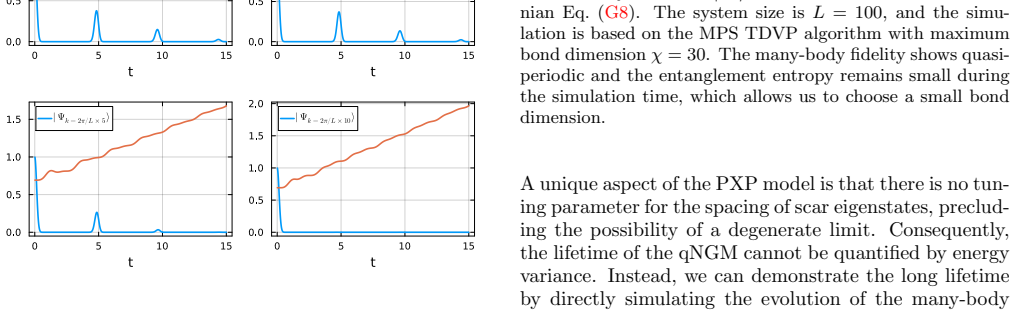
Deformed PXP model and its quasi-Nambu-Goldstone modes Although the forward scattering approximation pro- vides partial insight into the revival phenomena, it re- mains a coarse approximation for the PXP model. More- over, the PXP scar dynamics exhibit a relatively short lifetime, complicating the quantification of the qNGM lifetime. To address this, we e...
-
[20]
Spectrum We examine the qNGM with the smallest nonzero mo- mentum k = 2π L . Note that since the initial state is in- variant only under a two-site shift, it spans both k = 2π L and k = π + 2π L sectors: |Ψk⟩ = 1√ 2 (|Ψe k⟩ + |Ψo k⟩) , (G16) where |ke⟩ and |ko⟩ are projections of |k⟩ onto each sector. Specifically: |Ψe k⟩ ∝ X j∈odd eikj ˆσ− j |Z2⟩ + X j∈e...
-
[21]
Heisenberg, Zeitschrift f¨ ur Physik 49, 619 (1928), URL https://doi.org/10.1007/BF01328601
W. Heisenberg, Zeitschrift f¨ ur Physik 49, 619 (1928), URL https://doi.org/10.1007/BF01328601
-
[22]
Y. Nambu and G. Jona-Lasinio, Phys. Rev. 122, 345 (1961), URL https://link.aps.org/doi/10.1103/ PhysRev.122.345
work page 1961
-
[23]
J. Goldstone, A. Salam, and S. Weinberg, Phys. Rev. 127, 965 (1962), URL https://link.aps.org/doi/10. 1103/PhysRev.127.965
work page 1962
-
[24]
Y. Nambu, Rev. Mod. Phys. 81, 1015 (2009), URL https://link.aps.org/doi/10.1103/RevModPhys.81. 1015
-
[25]
H. Bernien, S. Schwartz, A. Keesling, H. Levine, A. Om- ran, H. Pichler, S. Choi, A. S. Zibrov, M. Endres, M. Greiner, et al., Nature 551, 579 (2017), URL https: //doi.org/10.1038/nature24622
-
[26]
I. Affleck, T. Kennedy, E. H. Lieb, and H. Tasaki, Phys. Rev. Lett. 59, 799 (1987), URL https://link.aps.org/ doi/10.1103/PhysRevLett.59.799
-
[27]
S. Moudgalya, S. Rachel, B. A. Bernevig, and N. Reg- nault, Phys. Rev. B 98, 235155 (2018), URL https: //link.aps.org/doi/10.1103/PhysRevB.98.235155
-
[28]
C. J. Turner, A. A. Michailidis, D. A. Abanin, M. Serbyn, and Z. Papi´ c, Nat. Phys. 14, 745 (2018), URL https: //doi.org/10.1038/s41567-018-0137-5
-
[29]
C. J. Turner, A. A. Michailidis, D. A. Abanin, M. Serbyn, and Z. Papi´ c, Phys. Rev. B 98, 155134 (2018), URL https://link.aps.org/doi/10. 1103/PhysRevB.98.155134
work page 2018
-
[30]
W. W. Ho, S. Choi, H. Pichler, and M. D. Lukin, Phys. Rev. Lett. 122, 040603 (2019), URL https://doi.org/ 26 10.1103/PhysRevLett.122.040603
-
[31]
S. Choi, C. J. Turner, H. Pichler, W. W. Ho, A. A. Michailidis, Z. Papi´ c, M. Serbyn, M. D. Lukin, and D. A. Abanin, Phys. Rev. Lett. 122, 220603 (2019), URL https://doi.org/10.1103/PhysRevLett.122.220603
- [32]
-
[33]
K. Bull, J.-Y. Desaules, and Z. Papi´ c, Phys. Rev. B 101, 165139 (2020), URL https://link.aps.org/doi/ 10.1103/PhysRevB.101.165139
-
[34]
V. Khemani, C. R. Laumann, and A. Chandran, Phys. Rev. B 99, 161101(R) (2019), URL https://link.aps. org/doi/10.1103/PhysRevB.99.161101
-
[35]
A. A. Michailidis, C. J. Turner, Z. Papi´ c, D. A. Abanin, and M. Serbyn, Phys. Rev. X 10, 011055 (2020), URL https://link.aps.org/doi/10.1103/PhysRevX. 10.011055
-
[36]
C. J. Turner, J.-Y. Desaules, K. Bull, and Z. Papi´ c, Phys. Rev. X 11, 021021 (2021), URL https://link.aps.org/ doi/10.1103/PhysRevX.11.021021
-
[37]
T. Iadecola, M. Schecter, and S. Xu, Phys. Rev. B 100, 184312 (2019), URL https://link.aps.org/doi/ 10.1103/PhysRevB.100.184312
- [38]
-
[39]
S. Moudgalya, N. Regnault, and B. A. Bernevig, Phys. Rev. B 98, 235156 (2018), URL https://link.aps.org/ doi/10.1103/PhysRevB.98.235156
-
[40]
D. K. Mark, C.-J. Lin, and O. I. Motrunich, Physical Rev. B 101, 195131 (2020), URL https://link.aps. org/doi/10.1103/PhysRevB.101.195131
-
[41]
Impurity spectra of graphene unde r electric and magnetic fields
S. Moudgalya, E. O’Brien, B. A. Bernevig, P. Fendley, and N. Regnault, Phys. Rev. B 102, 085120 (2020), URL https://link.aps.org/doi/10.1103/PhysRevB. 102.085120
-
[42]
N. Shiraishi, Journal of Statistical Mechanics: Theory and Experiment 2019, 083103 (2019), URL https:// doi.org/10.1088%2F1742-5468%2Fab342e
work page 2019
-
[43]
D. K. Mark and O. I. Motrunich, Phys. Rev. B 102, 075132 (2020), URL https://link.aps.org/doi/10. 1103/PhysRevB.102.075132
work page 2020
-
[44]
S. Moudgalya, N. Regnault, and B. A. Bernevig, Phys. Rev. B 102, 085140 (2020), URL https://link.aps. org/doi/10.1103/PhysRevB.102.085140
-
[45]
M. Schecter and T. Iadecola, Phys. Rev. Lett. 123, 147201 (2019), URL https://link.aps.org/doi/10. 1103/PhysRevLett.123.147201
work page 2019
-
[46]
S. Chattopadhyay, H. Pichler, M. D. Lukin, and W. W. Ho, Phys. Rev. B 101, 174308 (2020), URL https:// link.aps.org/doi/10.1103/PhysRevB.101.174308
-
[47]
N. Shibata, N. Yoshioka, and H. Katsura, Phys. Rev. Lett. 124, 180604 (2020), URL https://link.aps.org/ doi/10.1103/PhysRevLett.124.180604
-
[48]
Z.-C. Yang, F. Liu, A. V. Gorshkov, and T. Iadecola, Phys. Rev. Lett. 124, 207602 (2020), URL https:// link.aps.org/doi/10.1103/PhysRevLett.124.207602
-
[49]
T. Iadecola and M. Schecter, Phys. Rev. B 101, 024306 (2020), URL https://link.aps.org/doi/10. 1103/PhysRevB.101.024306
work page 2020
-
[50]
J. Wildeboer, C. M. Langlett, Z.-C. Yang, A. V. Gor- shkov, T. Iadecola, and S. Xu, Phys. Rev. B 106, 205142 (2022), URL https://link.aps.org/doi/10. 1103/PhysRevB.106.205142
work page 2022
-
[51]
C. M. Langlett, Z.-C. Yang, J. Wildeboer, A. V. Gor- shkov, T. Iadecola, and S. Xu, Phys. Rev. B 105, L060301 (2022), URL https://link.aps.org/doi/10. 1103/PhysRevB.105.L060301
work page 2022
-
[52]
K. Bull, I. Martin, and Z. Papi´ c, Phys. Rev. Lett. 123, 030601 (2019), URL https://link.aps.org/doi/ 10.1103/PhysRevLett.123.030601
-
[53]
A. Hudomal, I. Vasi´ c, N. Regnault, and Z. Papi´ c, Com- munications Physics 3, 1 (2020), URL https://doi.org/ 10.1038/s42005-020-0364-9
-
[54]
B. van Voorden, J. c. v. Min´ aˇ r, and K. Schoutens, Phys. Rev. B 101, 220305(R) (2020), URL https://link.aps. org/doi/10.1103/PhysRevB.101.220305
-
[55]
M. Iversen, J. H. Bardarson, and A. E. B. Nielsen, Phys. Rev. A 109, 023310 (2024), URL https://link.aps. org/doi/10.1103/PhysRevA.109.023310
- [56]
-
[57]
S. Moudgalya, B. A. Bernevig, and N. Regnault, Reports on Progress in Physics 85, 086501 (2022), URL https: //dx.doi.org/10.1088/1361-6633/ac73a0
-
[58]
Advances in Measuring the Environmental and Social Impacts of Environmental Programs
A. Chandran, T. Iadecola, V. Khemani, and R. Moess- ner, Annual Review of Condensed Matter Physics 14, 443 (2023), https://doi.org/10.1146/annurev- conmatphys-031620-101617, URL https://doi.org/10. 1146/annurev-conmatphys-031620-101617
-
[59]
J. Ren, C. Liang, and C. Fang, Phys. Rev. Lett. 126, 120604 (2021), URL https://link.aps.org/doi/10. 1103/PhysRevLett.126.120604
work page 2021
-
[60]
N. O’Dea, F. Burnell, A. Chandran, and V. Khemani, Phys. Rev. Res. 2, 043305 (2020), URL https://link. aps.org/doi/10.1103/PhysRevResearch.2.043305
-
[61]
Physical Review Letters 85(10), 2200–2203 (2000)
K. Pakrouski, P. N. Pallegar, F. K. Popov, and I. R. Klebanov, Phys. Rev. Lett. 125, 230602 (2020), URL https://link.aps.org/doi/10.1103/PhysRevLett. 125.230602
-
[62]
K. Pakrouski, P. N. Pallegar, F. K. Popov, and I. R. Klebanov, Phys. Rev. Res. 3, 043156 (2021), URL https://link.aps.org/doi/10.1103/ PhysRevResearch.3.043156
work page 2021
-
[63]
Z. Sun, F. K. Popov, I. R. Klebanov, and K. Pakrouski, Phys. Rev. Res. 5, 043208 (2023), URL https://link. aps.org/doi/10.1103/PhysRevResearch.5.043208
-
[64]
L. Gotta, S. Moudgalya, and L. Mazza, Phys. Rev. Lett. 131, 190401 (2023), URL https://link.aps.org/doi/ 10.1103/PhysRevLett.131.190401
-
[65]
S. Moudgalya and O. I. Motrunich,Symmetries as ground states of local superoperators (2023), 2309.15167
- [66]
-
[67]
H. Watanabe and H. Murayama, Phys. Rev. Lett. 108, 251602 (2012), URL https://link.aps.org/doi/10. 1103/PhysRevLett.108.251602
work page 2012
-
[68]
H. Watanabe and H. Murayama, Phys. Rev. X 4, 031057 (2014), URL https://link.aps.org/doi/10. 1103/PhysRevX.4.031057
work page 2014
-
[69]
H. Watanabe, Annual Review of Con- densed Matter Physics 11, 169 (2020), https://doi.org/10.1146/annurev-conmatphys- 27 031119-050644, URL https://doi.org/10.1146/ annurev-conmatphys-031119-050644
-
[70]
J. Herzog-Arbeitman, A. Chew, K.-E. Huhtinen, P. T¨ orm¨ a, and B. A. Bernevig,Many-body superconduc- tivity in topological flat bands (2022), 2209.00007
-
[71]
A. Holzner, A. Weichselbaum, I. P. McCulloch, U. Schollw¨ ock, and J. von Delft, Phys. Rev. B 83, 195115 (2011), URL https://link.aps.org/doi/10. 1103/PhysRevB.83.195115
work page 2011
-
[72]
R. A. Ewings, P. G. Freeman, M. Enderle, J. Kulda, D. Prabhakaran, and A. T. Boothroyd, Phys. Rev. B 82, 144401 (2010), URL https://link.aps.org/doi/ 10.1103/PhysRevB.82.144401
-
[73]
R. Chisnell, J. S. Helton, D. E. Freedman, D. K. Singh, R. I. Bewley, D. G. Nocera, and Y. S. Lee, Phys. Rev. Lett. 115, 147201 (2015), URL https://link.aps.org/ doi/10.1103/PhysRevLett.115.147201
-
[74]
M. Fannes, B. Nachtergaele, and R. F. Werner, Commu- nications in Mathematical Physics 144, 443 (1992), URL https://doi.org/10.1007/BF02099178
-
[75]
M. W. J. C. D. Perez-Garcia, F. Verstraete, Matrix prod- uct state representations (2007), quant-ph/0608197
work page internal anchor Pith review Pith/arXiv arXiv 2007
-
[76]
J. Ren, C. Liang, and C. Fang, Phys. Rev. Res. 4, 013155 (2022), URL https://link.aps.org/doi/10. 1103/PhysRevResearch.4.013155
work page 2022
- [77]
-
[78]
G. K.-L. Chan, A. Keselman, N. Nakatani, Z. Li, and S. R. White, The Journal of Chemical Physics 145, 014102 (2016), ISSN 0021-9606, https://pubs.aip.org/aip/jcp/article- pdf/doi/10.1063/1.4955108/14000039/014102 1 online.pdf, URL https://doi.org/10.1063/1.4955108
-
[79]
A. Weiße, G. Wellein, A. Alvermann, and H. Fehske, Rev. Mod. Phys. 78, 275 (2006), URL https://link. aps.org/doi/10.1103/RevModPhys.78.275
-
[80]
E. Chertkov and B. K. Clark, Phys. Rev. X 8, 031029 (2018), URL https://link.aps.org/doi/10. 1103/PhysRevX.8.031029
work page 2018
discussion (0)
Sign in with ORCID, Apple, or X to comment. Anyone can read and Pith papers without signing in.