Heterogeneous Graph Neural Networks with Post-hoc Explanations for Multi-modal and Explainable Land Use Inference
Pith reviewed 2026-05-23 23:47 UTC · model grok-4.3
The pith
Heterogeneous graph neural networks with explanations outperform standard models in inferring urban land use from mobility data.
A machine-rendered reading of the paper's core claim, the machinery that carries it, and where it could break.
Core claim
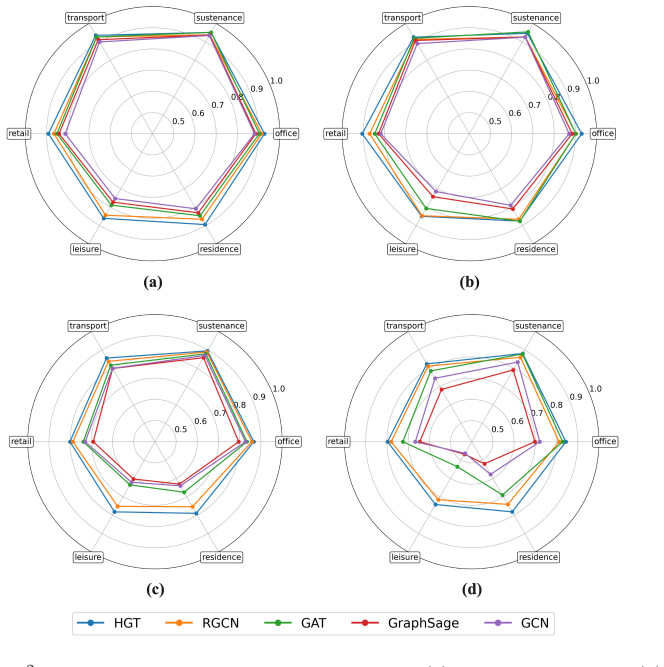
The proposed heterogeneous graph neural networks significantly outperform baseline graph neural networks for all six land-use indicators, especially in terms of 'office' and 'sustenance'. Feature attribution explanations show that the symmetrical nature of the 'residence' and 'work' categories aligns well with the commuter's 'work' and 'recreation' activities in London. Counterfactual explanations reveal that variations in node features and types are primarily responsible for the differences between the predicted land use distribution and the ideal mixed state.
What carries the argument
Heterogeneous graph neural networks combined with feature attribution and counterfactual explanations to capture spatial correlations and service heterogeneity in mobility data for land use inference.
If this is right
- The improved performance on office and sustenance categories indicates better capture of work-related land uses.
- Symmetry in residence and work predictions matches observed commuter patterns, supporting model validity.
- Counterfactual analysis identifies node features as key drivers, allowing targeted data improvements.
- Transparency from explanations facilitates use in urban policy where extrapolability is needed.
Where Pith is reading between the lines
- Applying this to other cities could test if the London-specific commuting alignment generalizes.
- Combining with additional data sources like social media might enhance the multi-modal aspect further.
- The method's focus on heterogeneity suggests it could apply to other domains with mixed entity types, such as recommendation systems.
Load-bearing premise
That modeling spatial correlations and service heterogeneity with heterogeneous graphs will produce better land use predictions and that the post-hoc explanations will provide sufficient transparency for policy decisions.
What would settle it
A study on similar multi-modal mobility data where standard graph neural networks match or exceed the heterogeneous version's accuracy on the land use indicators, or where explanations fail to align with known urban patterns.
Figures




read the original abstract
Urban land use inference is a critically important task that aids in city planning and policy-making. Recently, the increased use of sensor and location technologies has facilitated the collection of multi-modal mobility data, offering valuable insights into daily activity patterns. Many studies have adopted advanced data-driven techniques to explore the potential of these multi-modal mobility data in land use inference. However, existing studies often process samples independently, ignoring the spatial correlations among neighbouring objects and heterogeneity among different services. Furthermore, the inherently low interpretability of complex deep learning methods poses a significant barrier in urban planning, where transparency and extrapolability are crucial for making long-term policy decisions. To overcome these challenges, we introduce an explainable framework for inferring land use that synergises heterogeneous graph neural networks (HGNs) with Explainable AI techniques, enhancing both accuracy and explainability. The empirical experiments demonstrate that the proposed HGNs significantly outperform baseline graph neural networks for all six land-use indicators, especially in terms of 'office' and 'sustenance'. As explanations, we consider feature attribution and counterfactual explanations. The analysis of feature attribution explanations shows that the symmetrical nature of the `residence' and 'work' categories predicted by the framework aligns well with the commuter's 'work' and 'recreation' activities in London. The analysis of the counterfactual explanations reveals that variations in node features and types are primarily responsible for the differences observed between the predicted land use distribution and the ideal mixed state. These analyses demonstrate that the proposed HGNs can suitably support urban stakeholders in their urban planning and policy-making.
Editorial analysis
A structured set of objections, weighed in public.
Referee Report
Summary. The manuscript proposes an explainable framework that combines heterogeneous graph neural networks (HGNs) with post-hoc XAI methods (feature attribution and counterfactual explanations) to infer urban land use from multi-modal mobility data. It claims that the HGN approach significantly outperforms baseline graph neural networks across all six land-use indicators (with strongest gains for 'office' and 'sustenance'), and that the resulting explanations align with commuter activity patterns in London and highlight the role of node features and types in mixed-use predictions.
Significance. If the empirical superiority is confirmed with full quantitative results, ablations, and statistical tests, the work would offer a practical advance in applying heterogeneous graph models to urban mobility data while addressing the interpretability barrier that often limits adoption in policy contexts. The explicit linkage of explanations to real-world commuting behavior is a constructive element for stakeholder use.
major comments (2)
- [Abstract] Abstract: the central claim that 'the proposed HGNs significantly outperform baseline graph neural networks for all six land-use indicators' is presented without any numerical metrics, error bars, p-values, baseline descriptions, or dataset details. This absence makes the empirical contribution unverifiable from the provided text and is load-bearing for the paper's main result.
- [Experiments] Experiments section (referenced but not detailed in available text): the manuscript must supply tables or figures reporting performance on each of the six indicators, explicit baseline constructions, train/test splits, ablation removing the heterogeneity component, and significance testing; without these the outperformance statement cannot be evaluated.
Simulated Author's Rebuttal
We thank the referee for the constructive feedback highlighting the need for greater verifiability of our empirical claims. We agree that the abstract and experiments section require enhancements to include quantitative details, and we will revise the manuscript accordingly to strengthen the presentation of results while preserving the core contributions on heterogeneous GNNs and post-hoc explanations for land-use inference.
read point-by-point responses
-
Referee: [Abstract] Abstract: the central claim that 'the proposed HGNs significantly outperform baseline graph neural networks for all six land-use indicators' is presented without any numerical metrics, error bars, p-values, baseline descriptions, or dataset details. This absence makes the empirical contribution unverifiable from the provided text and is load-bearing for the paper's main result.
Authors: We acknowledge the abstract's brevity limits inclusion of full metrics. The full manuscript reports detailed results in the Experiments section on the London multi-modal mobility dataset. In revision, we will augment the abstract with concise quantitative highlights (e.g., accuracy/F1 gains per indicator, strongest for 'office' and 'sustenance'), reference to standard GNN baselines, and dataset context, while retaining focus on the HGN+XAI framework. This addresses verifiability without exceeding typical abstract constraints. revision: yes
-
Referee: [Experiments] Experiments section (referenced but not detailed in available text): the manuscript must supply tables or figures reporting performance on each of the six indicators, explicit baseline constructions, train/test splits, ablation removing the heterogeneity component, and significance testing; without these the outperformance statement cannot be evaluated.
Authors: We agree these details are essential for evaluation. The manuscript contains the underlying experiments on six land-use indicators from mobility data; we will expand the Experiments section in revision to explicitly provide: performance tables/figures for all indicators with error bars, descriptions of baseline GNN constructions, train/test split methodology, ablation studies isolating the heterogeneity component, and statistical significance tests (e.g., p-values from appropriate tests). This will fully substantiate the outperformance claims and align with the referee's requirements for practical advance in urban applications. revision: yes
Circularity Check
No circularity: empirical application of established HGN methods
full rationale
The paper applies heterogeneous graph neural networks and post-hoc XAI techniques to multi-modal mobility data for land-use inference. Its central claims rest on reported empirical outperformance versus baselines across six indicators, plus qualitative analysis of feature attributions and counterfactuals. No derivation chain, uniqueness theorem, ansatz, or prediction is shown to reduce by construction to fitted inputs or self-citations. The work is self-contained against external benchmarks (standard GNN baselines) and does not invoke load-bearing self-citations for its modeling choices. This is the expected non-finding for an applied empirical study.
Axiom & Free-Parameter Ledger
axioms (1)
- domain assumption Heterogeneous graph neural networks can effectively model spatial correlations and service heterogeneity in mobility data for land use inference.
Reference graph
Works this paper leans on
-
[1]
J. L. Toole, M. Ulm, D. Bauer, M. C. Gonzalez, Inferring land use from mobile phone activity, proceedings of the acm sigkdd international workshop on urban computing (2012). 35 Figure A.9: POI and population data for building the labels 36 Figure B.10: Special distribution of residual among six land use indicators 37 Figure B.11: Heatmap of the distributi...
work page 2012
-
[2]
J. Yuan, Y. Zheng, X. Xie, Discovering regions of different functions in a city using human mobility and pois, in: Acm Sigkdd International Conference on Knowledge Discovery & Data Mining, 2012, p. 186
work page 2012
-
[3]
J. Zhao, W. Fan, X. Zhai, Identification of land-use characteristics using bicycle sharing data: A deep learning approach, Journal of Transport Geography 82 (2020)
work page 2020
-
[4]
S. Gao, K. Janowicz, H. Couclelis, Extracting urban functional regions from points of interest and human activities on location-based social networks, Transactions in GIS 21 (3) (2017) 446–467
work page 2017
- [5]
-
[6]
F. Yuan, K. E. Sawaya, B. C. Loeffelholz, M. E. Bauer, Land cover clas- sification and change analysis of the twin cities (minnesota) metropoli- tan area by multitemporal landsat remote sensing, Remote sensing of Environment 98 (2-3) (2005) 317–328
work page 2005
-
[7]
B. Zhou, K. M. Kockelman, Neighborhood impacts on land use change: A multinomial logit model of spatial relationships, The Annals of Re- gional Science 42 (2008) 321–340
work page 2008
-
[8]
R. B. Matthews, N. G. Gilbert, A. Roach, J. G. Polhill, N. M. Gotts, Agent-based land-use models: a review of applications, Landscape Ecol- ogy 22 (2007) 1447–1459
work page 2007
-
[9]
C. M. de Almeida, M. Batty, A. M. V. Monteiro, G. Cˆ amara, B. S. Soares-Filho, G. C. Cerqueira, C. L. Pennachin, Stochastic cellular au- tomata modeling of urban land use dynamics: empirical development and estimation, Computers, environment and urban systems 27 (5) (2003) 481–509
work page 2003
-
[10]
M. A. Fadhel, A. M. Duhaim, A. Saihood, A. Sewify, M. N. Al- Hamadani, A. Albahri, L. Alzubaidi, A. Gupta, S. Mirjalili, Y. Gu, Com- prehensive systematic review of information fusion methods in smart cities and urban environments, Information Fusion (2024) 102317. 39
work page 2024
-
[11]
Sn´ aˇ sel, M.ˇStˇ epniˇ cka, V
V. Sn´ aˇ sel, M.ˇStˇ epniˇ cka, V. Ojha, P. N. Suganthan, R. Gao, L. Kong, Large-scale data classification based on the integrated fusion of fuzzy learning and graph neural network, Information Fusion 102 (2024) 102067
work page 2024
- [12]
-
[13]
J. Yuan, Y. Zheng, X. Xie, Discovering regions of different functions in a city using human mobility and pois, in: Proceedings of the 18th ACM SIGKDD international conference on Knowledge discovery and data mining, 2012, pp. 186–194
work page 2012
-
[14]
C. R. Bhat, S. Sen, N. Eluru, The impact of demographics, built environ- ment attributes, vehicle characteristics, and gasoline prices on household vehicle holdings and use, Transportation Research Part B: Methodolog- ical 43 (1) (2009) 1–18
work page 2009
- [15]
-
[16]
T. Yigitcanlar, N. Sipe, R. Evans, M. Pitot, A gis-based land use and public transport accessibility indexing model, Australian planner 44 (3) (2007) 30–37
work page 2007
-
[17]
S. Hu, S. Gao, L. Wu, Y. Xu, Z. Zhang, H. Cui, X. Gong, Urban function classification at road segment level using taxi trajectory data: A graph convolutional neural network approach, Computers, Environment and Urban Systems 87 (2021) 101619
work page 2021
-
[18]
J. Choi, W. No, M. Park, Y. Kim, Inferring land use from spatialtem- poral taxi ride data, Applied Geography 142 (2022) 102688
work page 2022
-
[19]
J. Kleinberg, H. Lakkaraju, J. Leskovec, J. Ludwig, S. Mullainathan, Human decisions and machine predictions, The quarterly journal of eco- nomics 133 (1) (2018) 237–293. 40
work page 2018
-
[20]
Z. Sun, Z. Peng, Y. Yu, H. Jiao, Deep convolutional autoencoder for urban land use classification using mobile device data, International Journal of Geographical Information Science 36 (11) (2022) 2138–2168
work page 2022
-
[21]
Y. Yuan, M. Raubal, Y. Liu, Correlating mobile phone usage and travel behavior – a case study of harbin, china, Computers Environment & Urban Systems 36 (2) (2012) 118–130
work page 2012
-
[22]
Z. Du, X. Zhang, W. Li, F. Zhang, R. Liu, A multi-modal transportation data-driven approach to identify urban functional zones: An exploration based on hangzhou city, china, Transactions in GIS 24 (1) (2020) 123– 141
work page 2020
-
[23]
Q. Liu, W. Huan, M. Deng, X. Zheng, H. Yuan, Inferring urban land use from multi-source urban mobility data using latent multi-view sub- space clustering, ISPRS International Journal of Geo-Information 10 (5) (2021) 274
work page 2021
-
[24]
Z. Deng, X. You, Z. Shi, H. Gao, X. Hu, Z. Yu, L. Yuan, Identification of urban functional zones based on the spatial specificity of online car- hailing traffic cycle, ISPRS International Journal of Geo-Information 11 (8) (2022) 435
work page 2022
-
[25]
H. Jiao, S. Huang, Y. Zhou, Understanding the land use function of station areas based on spatiotemporal similarity in rail transit ridership: A case study in shanghai, china, Journal of Transport Geography 109 (2023) 103568
work page 2023
-
[26]
M. G. Demissie, L. Kattan, Understanding the temporal and spatial interactions between transit ridership and urban land-use patterns: an exploratory study, Public Transport 14 (2) (2022) 385–417
work page 2022
- [27]
-
[28]
S. Ali, T. Abuhmed, S. H. A. El-Sappagh, K. Muhammad, J. M. Alonso- Moral, R. Confalonieri, R. Guidotti, J. D. Ser, N. D. Rodr´ ıguez, F. Her- rera, Explainable artificial intelligence (XAI): what we know and what 41 is left to attain trustworthy artificial intelligence, Inf. Fusion 99 (2023) 101805. doi:10.1016/J.INFFUS.2023.101805. URL https://doi.org/1...
-
[29]
Bender, Timnit Gebru, Angelina McMillan-Major, and Shmargaret Shmitchell
A. Jacovi, A. Marasovic, T. Miller, Y. Goldberg, Formalizing trust in artificial intelligence: Prerequisites, causes and goals of human trust in AI, in: FAccT ’21: 2021 ACM Conference on Fairness, Accountability, and Transparency, Virtual Event / Toronto, Canada, March 3-10, 2021, 2021, pp. 624–635. doi:10.1145/3442188.3445923. URL https://doi.org/10.1145...
-
[30]
J. Schoeffer, N. K¨ uhl, Y. Machowski, ”there is not enough information”: On the effects of explanations on perceptions of informational fairness and trustworthiness in automated decision-making, in: FAccT ’22: 2022 ACM Conference on Fairness, Accountability, and Transparency, Seoul, Republic of Korea, June 21 - 24, 2022, 2022, pp. 1616–1628. doi: 10.1145...
-
[31]
A. Ferrario, M. Loi, How explainability contributes to trust in AI, in: FAccT ’22: 2022 ACM Conference on Fairness, Accountability, and Transparency, Seoul, Republic of Korea, June 21 - 24, 2022, 2022, pp. 1457–1466. doi:10.1145/3531146.3533202. URL https://doi.org/10.1145/3531146.3533202
-
[32]
J. Zerilli, U. Bhatt, A. Weller, How transparency modulates trust in artificial intelligence, Patterns 3 (4) (2022) 100455. doi:10.1016/J. PATTER.2022.100455. URL https://doi.org/10.1016/j.patter.2022.100455
work page doi:10.1016/j 2022
-
[33]
C. Panigutti, A. Beretta, F. Giannotti, D. Pedreschi, Understanding the impact of explanations on advice-taking: a user study for ai-based clin- ical decision support systems, in: CHI ’22: CHI Conference on Human Factors in Computing Systems, New Orleans, LA, USA, 29 April 2022 - 5 May 2022, 2022, pp. 568:1–568:9. doi:10.1145/3491102.3502104. URL https://...
-
[34]
T. Papadakis, I. T. Christou, C. Ipektsidis, J. Soldatos, A. Amicone, Ex- plainable and transparent artificial intelligence for public policymaking, Data & Policy 6 (2024) e10. 42
work page 2024
-
[35]
C. Jin, T. Ruan, D. Wu, L. Xu, T. Dong, T. Chen, S. Wang, Y. Du, M. Wu, Hetgat: a heterogeneous graph attention network for freeway traffic speed prediction, Journal of Ambient Intelligence and Humanized Computing (2021) 1–12
work page 2021
-
[36]
G. Li, Z. Zhao, X. Guo, L. Tang, H. Zhang, J. Wang, Towards integrated and fine-grained traffic forecasting: A spatio-temporal heterogeneous graph transformer approach, Information Fusion 102 (2024) 102063
work page 2024
-
[37]
K. T. Chui, B. B. Gupta, R. W. Liu, P. Vasant, Handling data hetero- geneity in electricity load disaggregation via optimized complete ensem- ble empirical mode decomposition and wavelet packet transform, Sensors 21 (9) (2021) 3133
work page 2021
-
[38]
D. Wang, D. Zhong, A. Souri, Energy management solutions in the internet of things applications: Technical analysis and new research di- rections, Cognitive Systems Research 67 (2021) 33–49
work page 2021
-
[39]
N. Schwalbe, B. Wahl, Artificial intelligence and the future of global health, The Lancet 395 (10236) (2020) 1579–1586
work page 2020
- [40]
-
[41]
L. Du, R. Gao, P. N. Suganthan, D. Z. Wang, Bayesian optimization based dynamic ensemble for time series forecasting, Information Sciences 591 (2022) 155–175
work page 2022
-
[42]
Y. Wang, Y. Liu, Bayesian entropy network for fusion of different types of information, Reliability Engineering & System Safety 195 (2020) 106747
work page 2020
-
[43]
M. A. Ganaie, M. Hu, A. K. Malik, M. Tanveer, P. N. Suganthan, En- semble deep learning: A review, Engineering Applications of Artificial Intelligence 115 (2022) 105151
work page 2022
-
[44]
Y. Ren, L. Zhang, P. N. Suganthan, Ensemble classification and regression-recent developments, applications and future directions, IEEE Computational intelligence magazine 11 (1) (2016) 41–53. 43
work page 2016
- [45]
-
[46]
F. Zhou, T. Wang, T. Zhong, G. Trajcevski, Identifying user geolocation with hierarchical graph neural networks and explainable fusion, Infor- mation Fusion 81 (2022) 1–13
work page 2022
-
[47]
W. Hamilton, Z. Ying, J. Leskovec, Inductive representation learning on large graphs, Advances in neural information processing systems 30 (2017)
work page 2017
-
[48]
P. Veliˇ ckovi´ c, G. Cucurull, A. Casanova, A. Romero, P. Lio, Y. Bengio, Graph attention networks, arXiv preprint arXiv:1710.10903 (2017)
work page internal anchor Pith review Pith/arXiv arXiv 2017
-
[49]
C. Shi, B. Hu, W. X. Zhao, S. Y. Philip, Heterogeneous information net- work embedding for recommendation, IEEE transactions on knowledge and data engineering 31 (2) (2018) 357–370
work page 2018
-
[50]
Y. Wu, Y. Chen, Z. Yin, W. Ding, I. King, A survey on graph embedding techniques for biomedical data: Methods and applications, Information Fusion 100 (2023) 101909
work page 2023
-
[51]
X. Wang, D. Bo, C. Shi, S. Fan, Y. Ye, S. Y. Philip, A survey on heterogeneous graph embedding: methods, techniques, applications and sources, IEEE Transactions on Big Data 9 (2) (2022) 415–436
work page 2022
-
[52]
S. Yang, B. Yang, An inductive heterogeneous graph attention-based multi-agent deep graph infomax algorithm for adaptive traffic signal control, Information fusion 88 (2022) 249–262
work page 2022
-
[53]
M. Sundararajan, A. Taly, Q. Yan, Axiomatic attribution for deep net- works, in: International conference on machine learning, PMLR, 2017, pp. 3319–3328
work page 2017
-
[54]
S. M. Lundberg, S.-I. Lee, A unified approach to interpreting model pre- dictions, Advances in neural information processing systems 30 (2017)
work page 2017
-
[55]
Z. Yan, W. L. Hamilton, M. Blanchette, Graph neural representational learning of rna secondary structures for predicting rna-protein interac- tions, Bioinformatics 36 (Supplement 1) (2020) i276–i284. 44
work page 2020
-
[56]
Y. Bi, D. Xiang, Z. Ge, F. Li, C. Jia, J. Song, An interpretable prediction model for identifying n7-methylguanosine sites based on xgboost and shap, Molecular Therapy-Nucleic Acids 22 (2020) 362–372
work page 2020
-
[57]
M. Dobrojevic, M. Zivkovic, A. Chhabra, N. S. Sani, N. Bacanin, M. M. Amin, Addressing internet of things security by enhanced sine cosine metaheuristics tuned hybrid machine learning model and results inter- pretation based on shap approach, PeerJ Computer Science 9 (2023) e1405
work page 2023
-
[58]
S. Wachter, B. D. Mittelstadt, C. Russell, Counterfactual explanations without opening the black box: Automated decisions and the GDPR, Harv. JL & Tech. 31 (2017) 841
work page 2017
-
[59]
D. Numeroso, D. Bacciu, Meg: Generating molecular counterfactual explanations for deep graph networks, in: 2021 International Joint Con- ference on Neural Networks (IJCNN), IEEE, 2021, pp. 1–8
work page 2021
- [60]
- [61]
-
[62]
P. Pezeshkpour, S. Jain, S. Singh, B. C. Wallace, Combining feature and instance attribution to detect artifacts, CoRR abs/2107.00323 (2021). arXiv:2107.00323. URL https://arxiv.org/abs/2107.00323
-
[63]
C. Meng, L. Trinh, N. Xu, J. Enouen, Y. Liu, Interpretability and fair- ness evaluation of deep learning models on MIMIC-IV dataset, Scientific Reports 12 (2022)
work page 2022
-
[64]
Not Just a Black Box: Learning Important Features Through Propagating Activation Differences
A. Shrikumar, P. Greenside, A. Shcherbina, A. Kundaje, Not just a black box: Learning important features through propagating activation differences, arXiv preprint arXiv:1605.01713 (2016). 45
work page internal anchor Pith review Pith/arXiv arXiv 2016
-
[65]
M. Sundararajan, A. Taly, Q. Yan, Axiomatic attribution for deep net- works, in: D. Precup, Y. W. Teh (Eds.), Proceedings of the 34th Inter- national Conference on Machine Learning, ICML 2017, Sydney, NSW, Australia, 6-11 August 2017, Vol. 70 of Proceedings of Machine Learn- ing Research, PMLR, 2017, pp. 3319–3328. URL http://proceedings.mlr.press/v70/sun...
work page 2017
-
[66]
M. Ancona, E. Ceolini, C. ¨Oztireli, M. Gross, Towards better under- standing of gradient-based attribution methods for deep neural net- works, in: 6th International Conference on Learning Representations, ICLR 2018, Vancouver, BC, Canada, April 30 - May 3, 2018, Confer- ence Track Proceedings, OpenReview.net, 2018. URL https://openreview.net/forum?id=Sy21R9JAW
work page 2018
-
[67]
D. Balduzzi, M. Frean, L. Leary, J. Lewis, K. W.-D. Ma, B. McWilliams, The shattered gradients problem: If resnets are the answer, then what is the question?, in: International Conference on Machine Learning, PMLR, 2017, pp. 342–350
work page 2017
-
[68]
Z. Ying, D. Bourgeois, J. You, M. Zitnik, J. Leskovec, Gnnexplainer: Generating explanations for graph neural networks, in: H. M. Wallach, H. Larochelle, A. Beygelzimer, F. d’Alch´ e-Buc, E. B. Fox, R. Garnett (Eds.), Advances in Neural Information Processing Systems 32: Annual Conference on Neural Information Processing Systems 2019, NeurIPS 2019, Decemb...
work page 2019
-
[69]
M. A. Prado-Romero, B. Prenkaj, G. Stilo, F. Giannotti, A survey on graph counterfactual explanations: Definitions, methods, evalua- tion, and research challenges, ACM Comput. Surv. 56 (7) (2024) 171:1– 171:37. doi:10.1145/3618105. URL https://doi.org/10.1145/3618105
- [70]
- [71]
-
[72]
D. Brughmans, P. Leyman, D. Martens, Nice: an algorithm for near- est instance counterfactual explanations, Data mining and knowledge discovery (2023) 1–39
work page 2023
-
[73]
R. Poyiadzi, K. Sokol, R. Santos-Rodr´ ıguez, T. D. Bie, P. A. Flach, FACE: feasible and actionable counterfactual explanations, in: A. N. Markham, J. Powles, T. Walsh, A. L. Washington (Eds.), AIES ’20: AAAI/ACM Conference on AI, Ethics, and Society, New York, NY, USA, February 7-8, 2020, ACM, 2020, pp. 344–350. doi:10.1145/ 3375627.3375850. URL https://...
- [74]
-
[75]
Farr, Sustainable urbanism: Urban design with nature, John Wiley & Sons, 2011
D. Farr, Sustainable urbanism: Urban design with nature, John Wiley & Sons, 2011
work page 2011
-
[76]
S. Lehmann, Sustainable urbanism: towards a framework for quality and optimal density?, Future cities and environment 2 (2016) 1–13
work page 2016
-
[77]
T. N. Kipf, M. Welling, Semi-supervised classification with graph con- volutional networks, arXiv preprint arXiv:1609.02907 (2016)
work page internal anchor Pith review Pith/arXiv arXiv 2016
-
[78]
M. Schlichtkrull, T. N. Kipf, P. Bloem, R. Van Den Berg, I. Titov, M. Welling, Modeling relational data with graph convolutional networks, in: The semantic web: 15th international conference, ESWC 2018, Her- aklion, Crete, Greece, June 3–7, 2018, proceedings 15, Springer, 2018, pp. 593–607
work page 2018
-
[79]
Decoupled Weight Decay Regularization
I. Loshchilov, F. Hutter, Decoupled weight decay regularization, arXiv preprint arXiv:1711.05101 (2017)
work page internal anchor Pith review Pith/arXiv arXiv 2017
-
[80]
Z. Hu, Y. Dong, K. Wang, Y. Sun, Heterogeneous graph transformer, in: Proceedings of the web conference 2020, 2020, pp. 2704–2710. 47
work page 2020
discussion (0)
Sign in with ORCID, Apple, or X to comment. Anyone can read and Pith papers without signing in.