Deciphering interventional dynamical causality from non-intervention complex systems
Pith reviewed 2026-05-23 23:22 UTC · model grok-4.3
The pith
Interventional dynamical causality can be recovered from observational time series alone via embedding entropy without models or experiments.
A machine-rendered reading of the paper's core claim, the machinery that carries it, and where it could break.
Core claim
The central claim is that Interventional Embedding Entropy, defined as an intervened causal information flow computed in delay-embedding space, theoretically and numerically recovers interventional causal relations solely from non-interventional time-series observations, without any dynamical model knowledge or real interventions performed on the system.
What carries the argument
Interventional Embedding Entropy (IEE), which measures intervened causal information flow in the delay-embedding space reconstructed from observations.
If this is right
- IEE ranks causal effects by importance from observational data.
- It constructs causal networks while eliminating confounding effects.
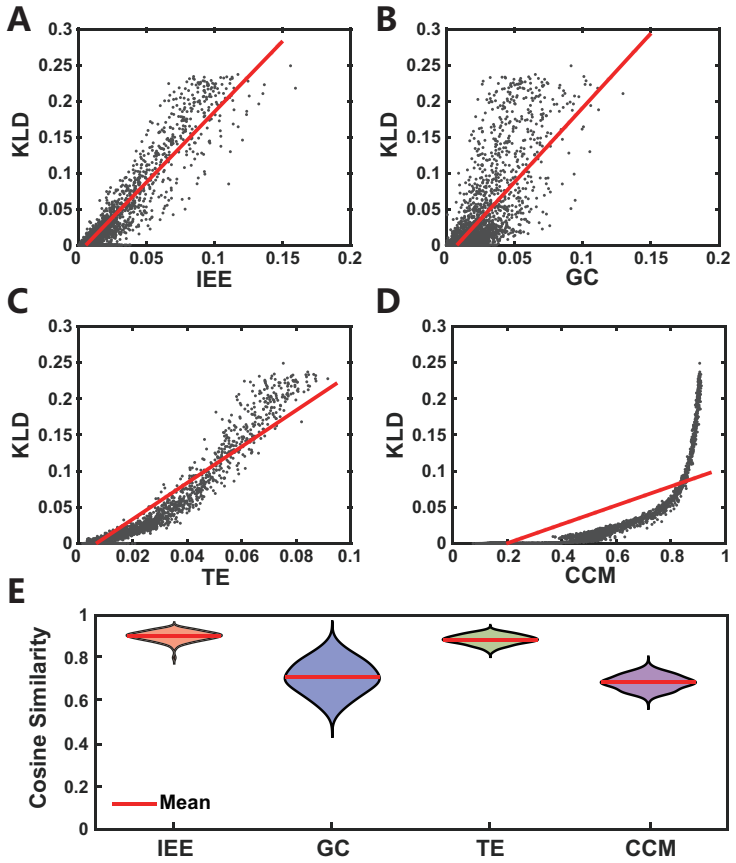
- It quantifies causal strength more robustly than indices such as Granger causality or transfer entropy.
- It applies directly to real-world observational tasks in complex systems.
Where Pith is reading between the lines
- If valid, the approach would enable causal ranking in domains where interventions are unethical or physically impossible, such as certain ecological or economic time series.
- One direct extension would be testing whether IEE remains stable when embedding parameters are chosen automatically rather than fixed in advance.
- The framework could be checked against partial-intervention data sets, where some variables are perturbed while others remain observational, to see whether the simulated effects align with the partial records.
Load-bearing premise
Delay-embedding reconstruction from observational data alone suffices to simulate interventional effects and isolate causal information flow.
What would settle it
Run IEE on time series from a controlled laboratory system with known ground-truth interventions, then compare the ranked causal strengths and network edges against the actual measured changes after performing those interventions; systematic mismatch would falsify the claim.
Figures


read the original abstract
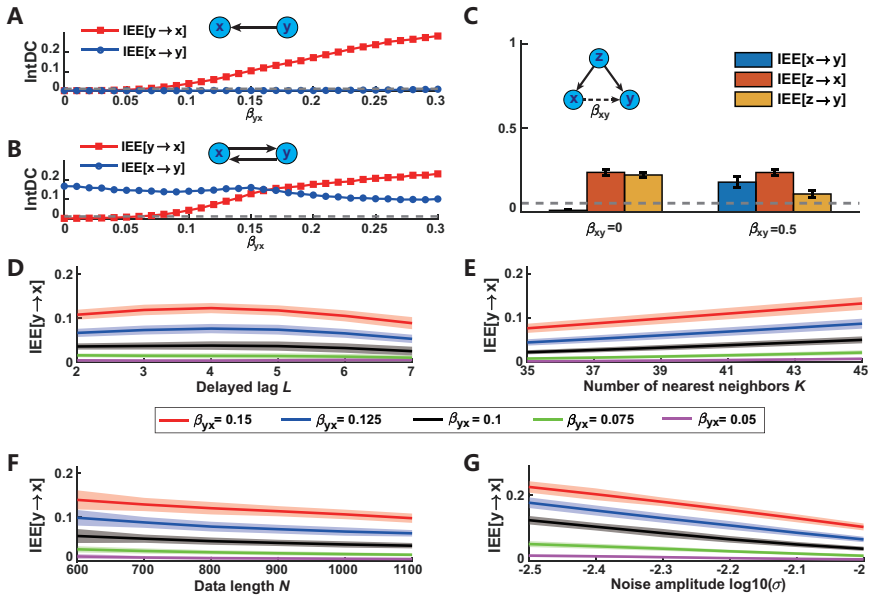
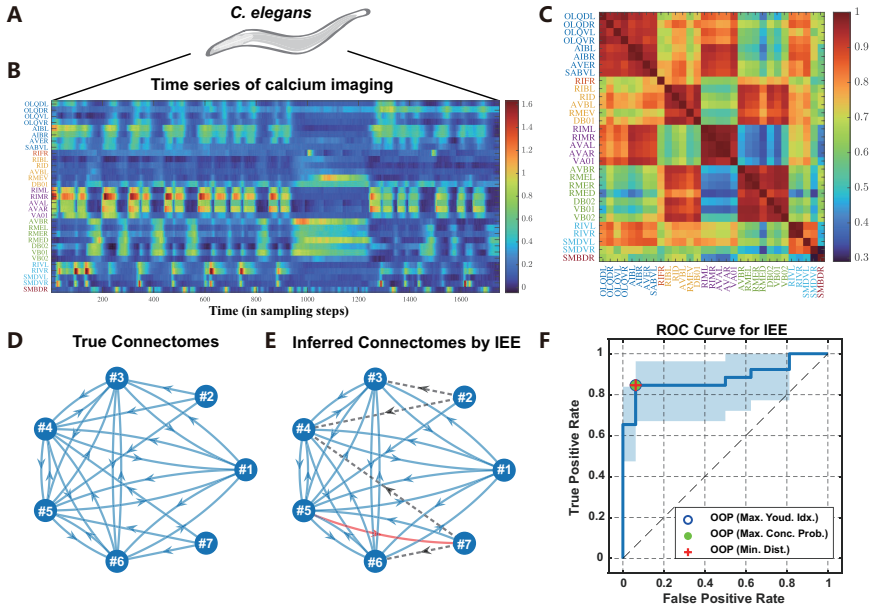
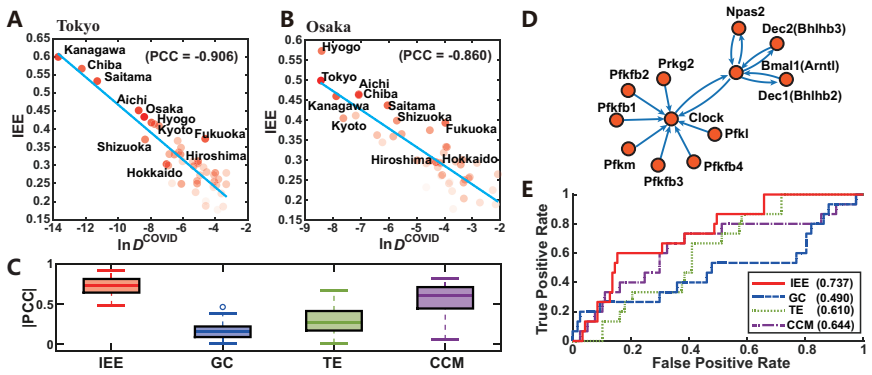
Detecting and quantifying causality is a focal topic in the fields of science, engineering, and interdisciplinary studies. However, causal studies on non-intervention systems attract much attention but remain extremely challenging. Delay-embedding technique provides a promising approach. In this study, we propose a framework named Interventional Dynamical Causality (IntDC) in contrast to the traditional Constructive Dynamical Causality (ConDC). ConDC, including Granger causality, transfer entropy and convergence of cross-mapping, measures the causality by constructing a dynamical model without considering interventions. A computational criterion, Interventional Embedding Entropy (IEE), is proposed to measure causal strengths in an interventional manner. IEE is an intervened causal information flow but in the delay-embedding space. Further, the IEE theoretically and numerically enables the deciphering of IntDC solely from observational (non-interventional) time-series data, without requiring any knowledge of dynamical models or real interventions in the considered system. In particular, IEE can be applied to rank causal effects according to their importance and construct causal networks from data. We conducted numerical experiments to demonstrate that IEE can find causal edges accurately, eliminate effects of confounding, and quantify causal strength robustly over traditional indices. We also applied IEE to real-world tasks. IEE performed as an accurate and robust tool for causal analyses solely from the observational data. The IntDC framework and IEE algorithm provide an efficient approach to the study of causality from time series in diverse non-intervention complex systems.
Editorial analysis
A structured set of objections, weighed in public.
Referee Report
Summary. The paper proposes the Interventional Dynamical Causality (IntDC) framework, contrasting it with Constructive Dynamical Causality (ConDC) measures such as Granger causality, transfer entropy, and cross-mapping convergence. It introduces Interventional Embedding Entropy (IEE) as a computational criterion that quantifies causal strengths via an 'intervened causal information flow' computed in delay-embedding space, claiming that IEE can recover IntDC, rank causal effects, and construct causal networks solely from observational time-series data without dynamical models or real interventions. Numerical experiments and real-world applications are presented to demonstrate superior accuracy, confounding elimination, and robustness relative to traditional indices.
Significance. If the central claim holds, the work would offer a notable contribution to causal discovery in non-interventional complex systems by extending delay-embedding methods to interventional semantics, potentially enabling model-free ranking of causal edges and network reconstruction where do-operators cannot be applied directly.
major comments (2)
- [IEE definition / theoretical justification] The definition of IEE (in the section introducing the computational criterion) must supply an explicit, non-circular mapping from purely observational delay embeddings to an intervened dynamics; standard Takens reconstruction recovers the joint attractor but does not automatically furnish a coordinate-wise intervention rule that isolates IntDC without reference to the unknown vector field. Without this step the distinction from ConDC collapses.
- [Numerical experiments] § on numerical experiments: the reported ability to 'find causal edges accurately' and 'eliminate effects of confounding' is asserted without visible derivations, error bounds, or full data-generation details; the abstract claims both theoretical and numerical support, yet the absence of these elements makes the load-bearing empirical validation unverifiable from the provided text.
minor comments (1)
- [Abstract] The abstract paragraph on IEE is overloaded; splitting the definition, theoretical claim, and application statements would improve readability.
Simulated Author's Rebuttal
We thank the referee for their constructive comments, which help clarify the presentation of the IntDC framework and IEE criterion. We address each major comment below and indicate planned revisions to strengthen the manuscript.
read point-by-point responses
-
Referee: The definition of IEE (in the section introducing the computational criterion) must supply an explicit, non-circular mapping from purely observational delay embeddings to an intervened dynamics; standard Takens reconstruction recovers the joint attractor but does not automatically furnish a coordinate-wise intervention rule that isolates IntDC without reference to the unknown vector field. Without this step the distinction from ConDC collapses.
Authors: We appreciate the referee's emphasis on making the interventional mapping explicit. The manuscript defines IEE as an information-flow measure computed after coordinate-wise modifications to the delay embeddings that simulate interventions on the cause while respecting the reconstructed joint attractor. In the revision we will add a dedicated subsection deriving this mapping step-by-step: we show how the embedding coordinates corresponding to the putative cause are replaced by their marginal distribution (or a controlled perturbation) drawn from the observational data, yielding the intervened conditional entropy without invoking the unknown vector field. This construction is non-circular because the intervention rule operates solely on the reconstructed states furnished by Takens' theorem and does not presuppose the original dynamics. We believe the expanded derivation will preserve the claimed distinction from ConDC measures. revision: yes
-
Referee: § on numerical experiments: the reported ability to 'find causal edges accurately' and 'eliminate effects of confounding' is asserted without visible derivations, error bounds, or full data-generation details; the abstract claims both theoretical and numerical support, yet the absence of these elements makes the load-bearing empirical validation unverifiable from the provided text.
Authors: We agree that the numerical section requires greater transparency to allow independent verification. In the revised manuscript we will append complete data-generation protocols for every simulated system (including equations, parameter values, noise levels, and embedding dimensions), explicit step-by-step derivations of the IEE values reported in the tables and figures, and quantitative error bounds together with statistical significance tests for the accuracy and confounding-elimination claims. These additions will directly support the empirical validation referenced in the abstract. revision: yes
Circularity Check
No circularity; derivation self-contained against external benchmarks
full rationale
The abstract presents IEE as a new computational criterion for IntDC but supplies no equations, definitions, or derivation chain. No self-citations, fitted inputs, or ansatzes are visible that could reduce the central claim to its own inputs by construction. Per the rules, circularity requires explicit quotes exhibiting reduction (e.g., Eq. X = Eq. Y); absent any such material in the provided text, the finding is no significant circularity (score 0). The framework is described as independent of models and interventions, with numerical experiments offered as external validation.
Axiom & Free-Parameter Ledger
Reference graph
Works this paper leans on
- [1]
-
[2]
S. J. Cook, et al., Nature 571, 63 (2019)
work page 2019
-
[3]
A. Banerjee, S. Chandra, E. Ott, Proceedings of the National Academy of Sciences U.S.A. 120, e2216030120 (2023)
work page 2023
-
[4]
Emmons Lab, Hermaphrodite and Male Connectomes (Adjacency Matrices), Adults (cor- rected July 2020), available at https://wormwiring.org/pages/adjacency. html (2020). Accessed: 2023-12-15
work page 2020
-
[5]
Ministry of Health, Labour and Welfare, Trend in the number of newly confirmed cases (daily), in Visualizing the data: information on COVID-19 infections, available athttps: //covid19.mhlw.go.jp/en/ (2023). Accessed: 2023-10-05
work page 2023
-
[6]
Geospatial Information Authority of Japan, Distances between prefectural offices, in Ge- ographic information of Japan (in Japanese), available at https://www.gsi.go.jp/ KOKUJYOHO/kenchokan.html (2023). Accessed: 2023-10-12
work page 2023
-
[7]
Ministry of Land, Infrastructure, Transport and Tourism, 2015 Inter-Regional Travel Survey in Japan, in National Trunk Line Passenger Net Flow Survey (in Japanese), available at https://www.mlit.go.jp/sogoseisaku/soukou/sogoseisaku_ soukou_fr_000016.html (2019). Accessed: 2023-10-11
work page 2015
-
[8]
Ministry of Land, Infrastructure, Transport and Tourism, 2015 Passenger Regional Flow Survey Dataset, in Portal Site of Official Statistics of Japan (eStat) (in Japanese), available at https://www.e-stat.go.jp/stat-search/files?tclass= 000001056011&cycle=8&year=20151 (2017). Accessed: 2023-10-04
work page 2015
-
[9]
Statistics Bureau of Japan, Population by Sex and Sex Ratio for Prefectures - Total population, Japanese population, October 1, 2021, in Portal Site of Official Statistics of Japan (eStat) (in Japanese), available at https://www.e-stat.go.jp/stat-search/files?page=1&toukei= 00200524&tstat=000000090001 (2022). Accessed: 2024-02-15
work page 2021
-
[10]
Leng, et al., Nature Communications 11, 1 (2020)
S. Leng, et al., Nature Communications 11, 1 (2020)
work page 2020
- [11]
-
[12]
Takens, Dynamical systems and turbulence, Warwick 1980 (Springer, 1981), pp
F. Takens, Dynamical systems and turbulence, Warwick 1980 (Springer, 1981), pp. 366– 381. 31
work page 1980
- [13]
- [14]
-
[15]
B. Cummins, T. Gedeon, K. Spendlove, SIAM Journal on Applied Dynamical Systems 14, 335 (2015)
work page 2015
-
[16]
A. Kraskov, H. St ¨ogbauer, P. Grassberger,Physical Review E 69, 066138 (2004)
work page 2004
-
[17]
L. Kozachenko, N. N. Leonenko, Problemy Peredachi Informatsii23, 9 (1987)
work page 1987
-
[18]
M. Lindner, R. Vicente, V . Priesemann, M. Wibral,BMC Neuroscience 12, 1 (2011)
work page 2011
- [19]
- [20]
-
[21]
C. W. J. Granger, Econometrica 37, 424 (1969)
work page 1969
- [22]
-
[23]
Sugihara, et al., Science 338, 496 (2012)
G. Sugihara, et al., Science 338, 496 (2012)
work page 2012
-
[24]
M. Rota, L. Antolini, M. G. Valsecchi, BMC Medical Research Methodology15, 24 (2015)
work page 2015
-
[25]
J. Shi, L. Chen, K. Aihara, Journal of the Royal Society Interface 19, 20210766 (2022)
work page 2022
-
[26]
Tao, et al., Fundamental Research (2023)
P. Tao, et al., Fundamental Research (2023). In press, available online 6 February 2023
work page 2023
-
[27]
Barbosa, et al., Physics Reports 734, 1 (2018)
H. Barbosa, et al., Physics Reports 734, 1 (2018)
work page 2018
-
[28]
G. K. Zipf, American Sociological Review 11, 677 (1946)
work page 1946
-
[29]
Kawaguchi, et al., Biochemical and Biophysical Research Communications 355, 555 (2007)
S. Kawaguchi, et al., Biochemical and Biophysical Research Communications 355, 555 (2007)
work page 2007
-
[30]
R. Morioka, et al. , The Second International Symposium on Optimization and Systems Biology (2008)
work page 2008
-
[31]
H. Ma, K. Aihara, L. Chen, Scientific Reports 4, 7464 (2014)
work page 2014
-
[32]
C. H. Ko, J. S. Takahashi, Human Molecular Genetics 15, R271 (2006)
work page 2006
-
[33]
H. R. Ueda, et al., Nature Genetics 37, 187 (2005). 32
work page 2005
discussion (0)
Sign in with ORCID, Apple, or X to comment. Anyone can read and Pith papers without signing in.