On crystallization in the plane for pair potentials with an arbitrary norm
Pith reviewed 2026-05-23 23:04 UTC · model grok-4.3
The pith
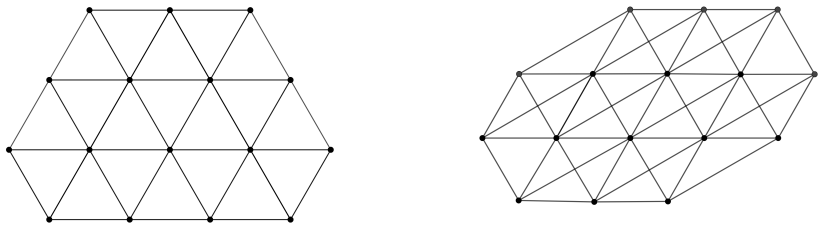
For the Heitmann-Radin sticky disk potential, minimal configurations in the plane are patches of the triangular or square lattice up to affine transform, for any fixed norm, classified by the norm's kissing number.
A machine-rendered reading of the paper's core claim, the machinery that carries it, and where it could break.
Core claim
For the Heitmann-Radin potential, crystallization occurs for every fixed norm on R^2: the minimizers are, up to affine transform, patches of the triangular lattice when the kissing number is at least 5 and patches of the square lattice otherwise, with the minimal energy likewise classified by that kissing number. The proof invokes Brass' result on minimal-energy configurations for the sticky disk potential, which the paper treats as extending without change to the arbitrary-norm setting.
What carries the argument
Brass' 1996 combinatorial geometry classification of minimal-energy point sets for the sticky disk potential, applied via the kissing number of the arbitrary norm to decide between triangular and square lattice patches.
If this is right
- Crystallization holds for the sticky disk potential under every norm on the plane.
- Minimizers are always affine images of triangular or square lattice patches, selected by the norm's kissing number.
- Any lattice arises as a minimizer for some explicitly constructed family of norms.
- Part of the constrained minimization problem on the integer lattice is solved.
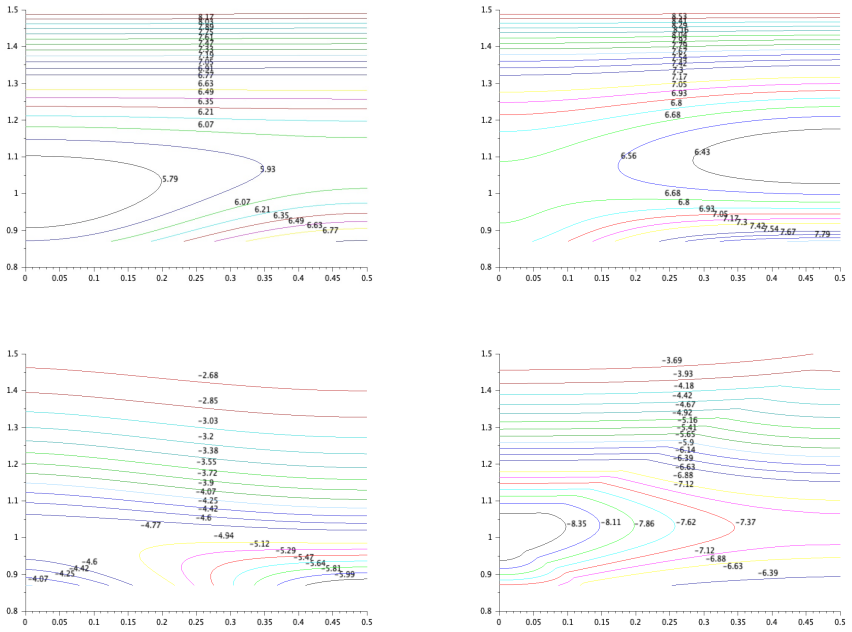
- Numerical evidence indicates a phase transition in optimal lattice type as the p-norm parameter changes for both Lennard-Jones and Epstein zeta energies.
Where Pith is reading between the lines
- Anisotropy can be introduced into crystallization models simply by changing the norm rather than the potential function itself.
- If analogous combinatorial classification results exist for other short-range potentials, the same norm-based approach would immediately yield crystallization statements in non-Euclidean geometries.
- The observed numerical phase transitions for non-sticky potentials suggest that the optimal lattice type may depend on both the potential range and the norm parameter in ways not captured by the sticky-disk case.
Load-bearing premise
Brass' 1996 result on minimal-energy configurations for the sticky disk potential carries over unchanged when the Euclidean norm is replaced by an arbitrary norm.
What would settle it
A finite point set whose pairwise distances under the given norm yield strictly lower total Heitmann-Radin energy than every patch of the triangular lattice (when kissing number >=5) or square lattice (otherwise) would falsify the classification.
Figures
read the original abstract
We investigate two-dimensional crystallization phenomena, i.e. minimality of a lattice's patch for interaction energies, with pair potentials of type $(x,y)\mapsto V(\|x-y\|)$ where $\|\cdot\|$ is an arbitrary norm on $\mathbb{R}^2$ and $V:\mathbb{R}_+^*\to\mathbb{R}$ is a function. For the Heitmann-Radin sticky disk potential $V=V_{\text{HR}}$, we prove, using Brass' key result from [\textit{Computational Geometry}, 6:195--214, 1996], that crystallization occurs for any fixed norm, with a classification of minimizers and minimal energies according to the kissing number associated to $\|\cdot\|$. The minimizer is proved to be, up to affine transform, a patch of the triangular or the square lattice, which shows how to easily get anisotropy in a crystallization phenomenon. We apply this result to the $p$-norms $\|\cdot\|_p$, $p\geq 1$, which allows us to construct an explicit family of norms for which crystallization holds on any given lattice. We also solve part of a crystallization problem studied in [\textit{Arch. Ration. Mech. Anal.}, 240:987--1053] where points are constrained to be on $\mathbb{Z}^2$. Moreover, we numerically investigate the minimization problem for the energy per point among lattices for the Lennard-Jones potential $V=V_{\text{LJ}}:r\mapsto r^{-12}-2r^{-6}$ as well as the Epstein zeta function associated to a $p$-norm $\|\cdot\|_p$, i.e. when $V=V_s:r\mapsto r^{-s}$, $s>2$. Our simulations show a new and unexpected phase transition for the minimizers with respect to $p$.
Editorial analysis
A structured set of objections, weighed in public.
Referee Report
Summary. The manuscript proves crystallization for the Heitmann-Radin sticky-disk potential V_HR with respect to an arbitrary norm on R^2: ground-state configurations are, up to affine transformation, finite patches of the triangular or square lattice, selected according to the kissing number of the norm. The argument invokes Brass' 1996 combinatorial-geometry theorem directly. The result is specialized to p-norms to realize crystallization on any prescribed lattice and is used to address a constrained minimization problem on Z^2. Separate numerical experiments minimize the energy per point over lattices for the Lennard-Jones potential and for Epstein zeta functions associated to p-norms, reporting a phase transition in the minimizing lattice as a function of p.
Significance. If the central claim is valid, the work supplies an explicit, norm-dependent mechanism that produces anisotropic crystallization and constructs a continuous family of norms for which any given lattice is a ground state. The numerical observation of a p-dependent transition between triangular and square lattices is of independent interest for norm-dependent lattice minimization.
major comments (1)
- [Proof invoking Brass (1996)] Proof of the main crystallization theorem (invocation of Brass 1996): the manuscript applies Brass' combinatorial result on minimal-energy configurations directly to an arbitrary norm without additional verification that the key intersection lemmas survive the change from Euclidean circles to boundaries of general centrally symmetric convex bodies. Brass' arguments rely on the fact that two circles intersect in at most two points; for a general norm the unit sphere is an arbitrary centrally symmetric convex curve and two such curves may intersect in four or more points. This extension is load-bearing for the classification of minimizers (triangular vs. square patches) and for the kissing-number criterion.
minor comments (1)
- [Numerical experiments] The numerical section would benefit from an explicit statement of the lattice-parameter search domain, convergence tolerance, and number of random initializations used for each p-value.
Simulated Author's Rebuttal
We thank the referee for the careful reading and for identifying the need to confirm that Brass' combinatorial lemmas extend beyond the Euclidean case. We address the point below and will revise the manuscript to include the required verification.
read point-by-point responses
-
Referee: [Proof invoking Brass (1996)] Proof of the main crystallization theorem (invocation of Brass 1996): the manuscript applies Brass' combinatorial result on minimal-energy configurations directly to an arbitrary norm without additional verification that the key intersection lemmas survive the change from Euclidean circles to boundaries of general centrally symmetric convex bodies. Brass' arguments rely on the fact that two circles intersect in at most two points; for a general norm the unit sphere is an arbitrary centrally symmetric convex curve and two such curves may intersect in four or more points. This extension is load-bearing for the classification of minimizers (triangular vs. square patches) and for the kissing-number criterion.
Authors: We agree that a direct invocation requires explicit justification when the unit ball is an arbitrary centrally symmetric convex body. The key lemmas in Brass (1996) use the at-most-two intersection property to control crossings in the contact graph and to classify rigid minimal configurations. For a general norm the boundaries remain simple closed curves, but convexity and central symmetry imply that any two distinct translates intersect in a way that preserves the planarity and degree bounds needed for the kissing-number classification; multiple intersection points cannot occur without interior overlap, which is forbidden by the sticky-disk condition. Nevertheless, to make this rigorous we will add a short appendix (or expanded remark in Section 2) that adapts the intersection argument using supporting lines of the convex bodies rather than relying on the Euclidean circle property. This will confirm that the triangular- and square-lattice patches remain the only minimizers and that the kissing-number criterion is unchanged. We view the addition as a clarification rather than a change of the result. revision: yes
Circularity Check
No circularity; central claim rests on external 1996 theorem plus independent numerics
full rationale
The paper's main analytic result for the Heitmann-Radin potential invokes Brass' 1996 combinatorial geometry theorem directly to classify minimizers according to the norm's kissing number. This is an external citation whose validity for general norms is asserted by the authors but does not reduce any equation or claim inside the paper to a self-fit or self-citation chain. The numerical minimization sections for Lennard-Jones and Epstein zeta functions are performed separately and do not feed back into the analytic classification. No derivation step equates a prediction to its own fitted input or renames an ansatz as a theorem. The derivation is therefore self-contained against external benchmarks.
Axiom & Free-Parameter Ledger
axioms (1)
- domain assumption Brass' combinatorial geometry theorem on minimal point configurations holds for any norm on R^2.
Lean theorems connected to this paper
-
IndisputableMonolith/Cost/FunctionalEquation.lean; Foundation/AlexanderDuality.leanwashburn_uniqueness_aczel; alexander_duality_circle_linking (D=3 from linking) echoes?
echoesECHOES: this paper passage has the same mathematical shape or conceptual pattern as the Recognition theorem, but is not a direct formal dependency.
For the Heitmann-Radin sticky disk potential V=V_HR, we prove, using Brass' key result..., that crystallization occurs for any fixed norm, with a classification of minimizers... according to the kissing number... The minimizer is proved to be, up to affine transform, a patch of the triangular or the square lattice.
-
IndisputableMonolith/Foundation/DimensionForcing.leanreality_from_one_distinction (8-tick period forces D=3 and coordination numbers) echoes?
echoesECHOES: this paper passage has the same mathematical shape or conceptual pattern as the Recognition theorem, but is not a direct formal dependency.
if ||·|| ∈ N6 then E=−⌊3N−√(12N−3)⌋ achieved only for patch of L (triangular); if ∈ N8 then E=−⌊4N−√(28N−12)⌋ (square/octagon).
What do these tags mean?
- matches
- The paper's claim is directly supported by a theorem in the formal canon.
- supports
- The theorem supports part of the paper's argument, but the paper may add assumptions or extra steps.
- extends
- The paper goes beyond the formal theorem; the theorem is a base layer rather than the whole result.
- uses
- The paper appears to rely on the theorem as machinery.
- contradicts
- The paper's claim conflicts with a theorem or certificate in the canon.
- unclear
- Pith found a possible connection, but the passage is too broad, indirect, or ambiguous to say the theorem truly supports the claim.
Reference graph
Works this paper leans on
-
[1]
L. B´ etermin. Two-dimensional Theta Functions and Crystallization among Bravais Lattices. SIAM J. Math. Anal., 48(5):3236–3269, 2016
work page 2016
-
[2]
L. B´ etermin. Local variational study of 2d lattice energies and application to Lennard-Jones type interactions. Nonlinearity, 31(9):3973–4005, 2018
work page 2018
-
[3]
L. B´ etermin. Effect of periodic arrays of defects on lattice energy minimizers. Annales Henri Poincar´ e, 22:2995– 3023, 2021
work page 2021
-
[4]
L. B´ etermin. On energy ground states among crystal lattice structures with prescribed bonds. J. Phys. A , 54(24):245202, 2021
work page 2021
-
[5]
L. B´ etermin. Optimality of the triangular lattice for Lennard–Jones type lattice energies: a computer-assisted method. Journal of Physics A: Mathematical and General , 56:145204, 2023
work page 2023
-
[6]
L. B´ etermin and M. Faulhuber. Maximal Theta Functions - Universal Optimality of the Hexagonal Lattice for Madelung-Like Lattice Energies. Journal d’Analyse Math´ ematique, 149:307–341, 2023
work page 2023
-
[7]
L. B´ etermin, L. De Luca, and M. Petrache. Crystallization to the square lattice for a two-body potential. Arch. Ration. Mech. Anal., 240:987–1053, 2021
work page 2021
-
[8]
L. B´ etermin and M. Petrache. Optimal and non-optimal lattices for non-completely monotone interaction potentials. Anal. Math. Phys. , 9(4):2033–2073, 2019
work page 2033
-
[9]
L. B´ etermin and P. Zhang. Minimization of energy per particle among Bravais lattices in R2: Lennard-Jones and Thomas-Fermi cases. Commun. Contemp. Math. , 17(6):1450049, 2015
work page 2015
-
[10]
X. Blanc and C. Le Bris. Periodicity of the infinite-volume ground state of a one-dimensional quantum model. Nonlinear Analysis T.M.A. , 48(6):791–803, 2002
work page 2002
-
[11]
X. Blanc and M. Lewin. The Crystallization Conjecture: A Review. EMS Surv. in Math. Sci. , 2:255–306, 2015
work page 2015
-
[12]
P. Brass. Erd¨ os distance problems in normed spaces. Computational Geometry, 6:195–214, 1996. 14
work page 1996
- [13]
-
[14]
J.W.S. Cassels. On a Problem of Rankin about the Epstein Zeta-Function. Proceedings of the Glasgow Mathe- matical Association, 4:73–80, 7 1959
work page 1959
-
[15]
M. Cicalese and G.P. Leonardi. Maximal Fluctuations on Periodic Lattices: An Approach via Quantitative Wulff Inequalities. Commun. Math. Phys. , 375:1931–1944, 2020
work page 1931
-
[16]
O. Ciftja. Results for an anisotropic Coulomb interaction potential. Results in Physics , 43:106052, 2022
work page 2022
-
[17]
L. De Luca and G. Friesecke. Crystallization in Two Dimensions and a Discrete Gauss–Bonnet Theorem. J. Nonlinear Sci., 28(1):69–90, 2018
work page 2018
-
[18]
P. H. Diananda. Notes on Two Lemmas concerning the Epstein Zeta-Function. Proceedings of the Glasgow Mathematical Association, 6:202–204, 7 1964
work page 1964
-
[19]
P. Engel. Geometric Crystallography. An Axiomatic Introduction to Crystallography . R. Reidel Publishing Compagny, 1942
work page 1942
-
[20]
V. Ennola. A Lemma about the Epstein Zeta-Function. Proceedings of The Glasgow Mathematical Association, 6:198–201, 1964
work page 1964
-
[21]
G. Friesecke, B. Schmidt, and Y. A. Yeung. Minimizing atomic configurations of short range pair potentials in two dimensions: crystallization in the Wulff shape. Calc. Var. Partial Differential Equations , 44(1-2):81–100, 2012
work page 2012
-
[22]
C. Furlanetto. R´ eseaux et cristallisation dans le plan pour un potentiel ` a sph` eres dures. Rapport de TIPE, Universit´ e Claude Bernard Lyon 1,https://licence-math.univ-lyon1.fr/lib/exe/fetch.php?media=tipe: furlanetto_tipe_final.pdf, 2024
work page 2024
-
[23]
C. S. Gardner and C. Radin. The Infinite-Volume Ground State of the Lennard-Jones Potential. Journal of Statistical Physics, 20:719–724, 1979
work page 1979
-
[24]
B. Gr¨ unbaum. On a conjecture of H. Hadwiger. Pacific J. Math. , 11:215–219, 1961
work page 1961
- [25]
-
[26]
R. C. Heitmann and C. Radin. The Ground State for Sticky Disks. J. Stat. Phys. , 22:281–287, 1980
work page 1980
-
[27]
J. Wei J. Sun and W. Zou. On lattice energy minimization problem for non-completely monotone functions and applications. To appear., 2024
work page 2024
-
[28]
X. Lamy. Uniaxial symmetry in nematic liquid crystals. Ann. I. H. Poincar´ e, 32:1125–1144, 2015
work page 2015
-
[29]
L. De Luca and G. Friesecke. Classification of Particle Numbers with Unique Heitmann–Radin Minimizer. J. Stat. Phys., 167:1586–1592, 2017
work page 2017
-
[30]
´E. Marcotte, F. H. Stillinger, and S. Torquato. Optimized monotonic convex pair potentials stabilize low- coordinated crystals. Soft Matter, 7:2332–2335, 2011
work page 2011
-
[31]
H. L. Montgomery. Minimal Theta Functions. Glasg. Math. J. , 30(1):75–85, 1988
work page 1988
-
[32]
C. Radin. The Ground State for Soft Disks. J. Stat. Phys. , 26(2):365–373, 1981
work page 1981
-
[33]
C. Radin. Low temperature and the origin of crystalline symmetry. International Journal of Modern Physics B , 1(5 and 6):1157–1191, 1987
work page 1987
-
[34]
R. A. Rankin. A Minimum Problem for the Epstein Zeta-Function. Proceedings of The Glasgow Mathematical Association, 1:149–158, 1953
work page 1953
- [35]
-
[36]
E. Sandier and S. Serfaty. From the Ginzburg-Landau Model to Vortex Lattice Problems. Comm. Math. Phys. , 313(3):635–743, 2012
work page 2012
-
[37]
T. Stensola, H. Stensola, M.B. Moser, and E.I. Moser. Shearing-induced asymmetry in entorhinal grid cells. Nature, 518:207–212, 2015
work page 2015
-
[38]
K. J. Swanepoel. Combinatorial Distance Geometry in Normed Spaces , pages 407–458. Springer Berlin Heidel- berg, Berlin, Heidelberg, 2018
work page 2018
-
[39]
F. Theil. A Proof of Crystallization in Two Dimensions. Comm. Math. Phys. , 262(1):209–236, 2006
work page 2006
- [40]
-
[41]
I. Travˇ enec and L.ˇSamaj. Two-dimensional Wigner crystals of classical Lennard-Jones particles. J. Phys. A: Math. Theor., 52(20):205002, 2019
work page 2019
-
[42]
W.J. Ventevogel. On the Configuration of Systems of Interacting Particle with Minimum Potential Energy per Particle. Physica A-statistical Mechanics and Its Applications , 92A:343, 1978
work page 1978
-
[43]
W.J. Ventevogel and B.R.A. Nijboer. On the Configuration of Systems of Interacting Particle with Minimum Potential Energy per Particle. Physica A-statistical Mechanics and Its Applications , 98A:274–288, 1979. 15
work page 1979
discussion (0)
Sign in with ORCID, Apple, or X to comment. Anyone can read and Pith papers without signing in.