Novel method to indirectly reconstruct neutrinos in collider experiments
Pith reviewed 2026-05-23 22:11 UTC · model grok-4.3
The pith
An asymptotically recursive vector sequence reconstructs the four-momentum of undetected neutrinos even when multiple neutrinos are present in a collider event.
A machine-rendered reading of the paper's core claim, the machinery that carries it, and where it could break.
Core claim
The central claim is that an asymptotically recursive vector sequence built from observable event kinematics converges to the four-momentum of any undetected particle such as a neutrino or K_L^0, supplying the first practical solution for events containing more than one neutrino and thereby enabling extraction of neutrino information in (semi-)leptonic decays.
What carries the argument
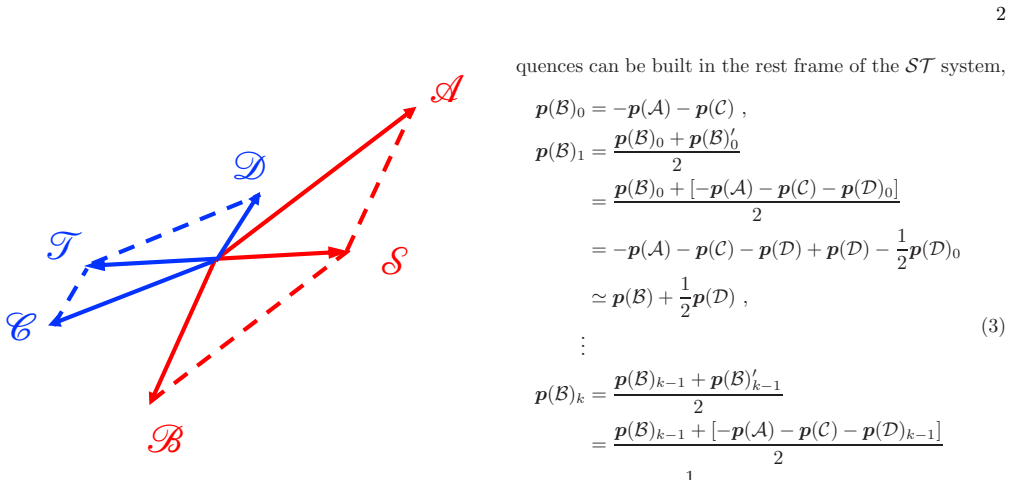
asymptotically recursive vector sequence: an iterative vector construction that starts from visible four-momenta and recursively adjusts until it isolates the total invisible four-momentum.
If this is right
- Enables the first extraction of neutrino four-momenta in events with multiple neutrinos.
- Raises the precision of Standard Model parameter measurements in the semi-leptonic sector using existing data samples.
- Opens new channels for searches for physics beyond the Standard Model in (semi-)leptonic decays.
- Transforms reconstruction techniques for collider experiments involving invisible particles.
Where Pith is reading between the lines
- The same sequence construction could be tested on other invisible particles such as dark-matter candidates.
- The iterative nature of the sequence may lend itself to hybrid implementations inside machine-learning pipelines for event reconstruction.
- If the method scales to high-multiplicity final states, it could increase the usable event yield at future high-luminosity colliders.
Load-bearing premise
An asymptotically recursive vector sequence can be defined from observable kinematics alone and will converge to the true four-momentum of the undetected particle without requiring model-dependent inputs or extra event information.
What would settle it
Generate a large sample of fully simulated collider events in which the true neutrino four-momenta are known from the generator level, apply the sequence, and check whether the reconstructed values agree with the generated values within detector resolution.
Figures
read the original abstract
Neutrinos play a crucial role in particle physics, but cannot be tracked in collider experiments. If more than one neutrino is present in a collision event, it is impossible to extract neutrinos' information using any of the traditional methods. In this Letter, we introduce an innovative inclusive-tagging scheme that is capable of capturing the four-momentum of an undetected particle on the signal side, such as a neutrino, $K_L^0$, etc., in collider experiments. This is the first proposed solution to the longstanding challenge outlined above. Our scheme, based on an asymptotically recursive vector sequence, has the potential to catalyze a significant transformation in the reconstruction techniques for (semi-)leptonic decays of collider experiments. The application and development of this scheme will greatly improve the precision of measurements of Standard Model parameters in the (semi-)leptonic sector with the same data samples, and could play a pivotal role in the search for new physics. Additionally, the asymptotically recursive (vector) sequence introduced in our scheme might also have promising applications in other fields, such as machine learning.
Editorial analysis
A structured set of objections, weighed in public.
Referee Report
Summary. The manuscript claims to introduce the first solution to reconstructing four-momenta of multiple undetected neutrinos (or similar invisible particles) in collider events via an inclusive-tagging scheme based on an asymptotically recursive vector sequence constructed solely from visible-particle kinematics; this is asserted to enable improved precision in (semi-)leptonic decay measurements and new-physics searches.
Significance. If the claimed convergence property holds and can be implemented without additional model assumptions, the method would address a long-standing limitation in multi-neutrino final states, potentially raising the precision of CKM elements, lepton-universality tests, and BSM searches with existing datasets. The suggested cross-field applications are secondary.
major comments (2)
- [Abstract] Abstract and throughout: the central claim that an asymptotically recursive vector sequence converges to the correct invisible four-momenta from visible kinematics alone is stated without any explicit recursion relation, fixed-point equation, convergence proof, or demonstration that the iteration selects the physical solution rather than an artifact in underconstrained events.
- [Abstract] Abstract: no simulated validation, error propagation, or comparison against existing techniques (e.g., missing transverse energy or kinematic fitting) is supplied to substantiate that the scheme functions for events containing more than one neutrino.
minor comments (1)
- [Abstract] The abstract refers to 'asymptotically recursive (vector) sequence' without defining the term or citing prior mathematical literature on such sequences.
Simulated Author's Rebuttal
We thank the referee for their careful reading of the manuscript. We acknowledge that the presentation of the method requires additional technical detail and validation to fully substantiate the claims. We address each major comment below and will revise the manuscript accordingly.
read point-by-point responses
-
Referee: [Abstract] Abstract and throughout: the central claim that an asymptotically recursive vector sequence converges to the correct invisible four-momenta from visible kinematics alone is stated without any explicit recursion relation, fixed-point equation, convergence proof, or demonstration that the iteration selects the physical solution rather than an artifact in underconstrained events.
Authors: We agree that the submitted version does not include the explicit recursion relation, fixed-point equation, or convergence proof. This was an oversight in the letter format. In the revised manuscript we will define the recursive sequence explicitly, state the fixed-point equation, sketch the convergence proof under the relevant kinematic assumptions, and include a worked example showing that the iteration selects the physical solution in an underconstrained multi-neutrino event. revision: yes
-
Referee: [Abstract] Abstract: no simulated validation, error propagation, or comparison against existing techniques (e.g., missing transverse energy or kinematic fitting) is supplied to substantiate that the scheme functions for events containing more than one neutrino.
Authors: The current manuscript is a concise theoretical proposal. We accept that validation is necessary to demonstrate functionality for multi-neutrino events. The revised version will add a dedicated section containing toy Monte Carlo simulations, error-propagation analysis, and direct comparisons to missing transverse energy and kinematic fitting methods. revision: yes
Circularity Check
No derivation chain or equations supplied; no circularity detectable
full rationale
The abstract asserts a novel inclusive-tagging scheme based on an asymptotically recursive vector sequence that captures undetected particle four-momenta, but supplies neither the recursion relation, convergence proof, nor any equations. No load-bearing steps exist in the provided text that could reduce by construction to fitted inputs or self-citations. Hard rule 1 prohibits claiming circularity without quotable paper text exhibiting a specific reduction; none is available. This is the expected honest non-finding for a high-level claim lacking explicit mathematics.
Axiom & Free-Parameter Ledger
invented entities (1)
-
asymptotically recursive vector sequence
no independent evidence
Reference graph
Works this paper leans on
-
[1]
and ( 9). The symbols without subscripts, p(B) and p(D), denote the corresponding truth values; the same applies hereinafter. As n becomes infinite, lim n→∞ p(B)n = lim n→∞ [p(B) + 1 2n p(D)] = p(B) . (5) That is, p(B)n is asymptotic to the truth p(B). It is ad- ditionally noteworthy that p(D) of the missed particle(s) will be “eaten” by infinite iterations...
work page 2000
-
[2]
A. J. Bevan et al. (BaBar and Belle Col- laborations), The Physics of the B Fac- tories, Eur. Phys. J. C 74, 3026 (2014) , arXiv:1406.6311 [hep-ex]
work page internal anchor Pith review Pith/arXiv arXiv 2014
- [3]
-
[4]
First measurement of $e^+ e^- \to pK^{0}_{S}\bar{n}K^{-} + c.c.$ above open charm threshold
M. Ablikim et al. (BESIII Collaboration), First mea- surement of e+e− → pK 0 S ¯nK− + c.c. above open charm threshold, Phys. Rev. D 98, 032014 (2018) , arXiv:1807.03468 [hep-ex]
work page internal anchor Pith review Pith/arXiv arXiv 2018
-
[5]
R. L. Workman et al. (Particle Data Group), Review of particle physics, Prog. Theor. Exp. Phys. 2022, 083C01 (2022)
work page 2022
-
[6]
Root::tgenphasespace class, https://root.cern.ch/doc/master/classTGenPhaseSpace.html, accessed: 2024-03-08
work page 2024
-
[7]
Adachiet al., Evidence for B+ → K+ν¯ν decays, Phys
I. Adachi et al. (Belle-II Collaboration), Evidence for B+→ K+νν /macron.ts1 decays, Phys. Rev. D 109, 112006 (2024) , arXiv:2311.14647 [hep-ex]
discussion (0)
Sign in with ORCID, Apple, or X to comment. Anyone can read and Pith papers without signing in.