Local Optimality of Dictator Functions with Applications to Courtade--Kumar and Li--M\'edard Conjectures
Pith reviewed 2026-05-23 19:09 UTC · model grok-4.3
The pith
Dictator functions are locally optimal in maximizing the Φ-stability of balanced Boolean functions.
A machine-rendered reading of the paper's core claim, the machinery that carries it, and where it could break.
Core claim
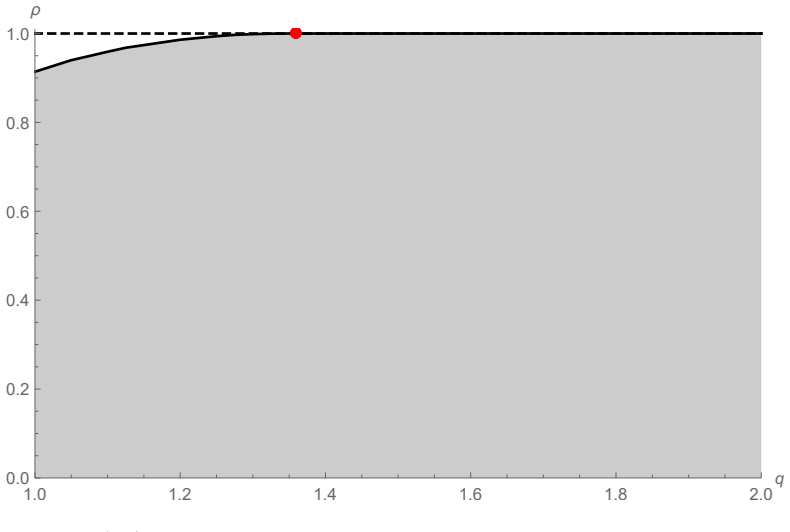
Given a convex function Φ from [0,1] to the reals, the Φ-stability of a Boolean function f is defined as the expectation of Φ applied to T_ρ f, where T_ρ is the Bonami-Beckner operator. Dictator functions are locally optimal for maximizing this quantity over all balanced Boolean functions. When restricted to symmetric q-stability, this local optimality plus a prior bound yields computer-assisted proofs that dictators achieve the global maximum for q=1 and ρ in [0,0.914], and for q in [1.36,2) with any ρ in [0,1].
What carries the argument
Majorization ordering of the Bonami-Beckner noise operators T_ρ together with hypercontractivity inequalities, used to establish local optimality under small perturbations of balanced functions.
If this is right
- Dictator functions maximize symmetric q-stability when q equals 1 and the noise parameter ρ is at most 0.914.
- Dictator functions maximize symmetric q-stability when q lies in [1.36,2) for every noise parameter ρ between 0 and 1.
- The balanced version of the Courtade-Kumar conjecture holds for all correlation coefficients up to 0.914.
- The symmetrized version of the Li-Médard conjecture holds for all q in [1.36,2).
Where Pith is reading between the lines
- The same local-optimality technique may extend to the full range of the conjectures if the majorization ordering can be verified for additional values of q and ρ.
- The approach could be adapted to prove global optimality for asymmetric stability measures once an appropriate majorization statement is established.
- Computer-assisted enumeration of low-degree or low-influence functions might become feasible for verifying the remaining parameter regimes.
Load-bearing premise
The function must be balanced with mean zero and the majorization ordering of the noise operators must hold for the chosen convex Φ.
What would settle it
Existence of any balanced Boolean function that is not a dictator yet attains strictly higher Φ-stability than a dictator, for some convex Φ and some ρ in the ranges where the computer check was performed.
Figures


read the original abstract
Given a convex function $\Phi:[0,1]\to\mathbb{R}$, the $\Phi$-stability of a Boolean function $f$ is defined as $\mathbb{E}[\Phi(T_{\rho}f(\mathbf{X}))]$, where $\mathbf{X}$ is a random vector uniformly distributed on the discrete cube $\{\pm1\}^{n}$ and $T_{\rho}$ is the Bonami-Beckner operator. In this paper, we prove that dictator functions are locally optimal in maximizing the $\Phi$-stability of $f$ over all balanced Boolean functions. When focusing on the symmetric $q$-stability, combining this result with our previous bound, we use computer-assisted methods to prove that dictator functions maximize the symmetric $q$-stability for $q=1$ and $\rho\in[0,0.914]$ or for $q\in[1.36,2)$ and all $\rho\in[0,1]$. In other words, we confirm the (balanced) Courtade--Kumar conjecture with the correlation coefficient $\rho\in[0,0.914]$ and the (symmetrized) Li--M\'edard conjecture with $q\in[1.36,2)$. We conjecture that dictator functions maximize both the symmetric and asymmetric $\frac{1}{2}$-stability over all balanced Boolean functions. Our proofs are based on majorization of noise operators and hypercontractivity inequalities.
Editorial analysis
A structured set of objections, weighed in public.
Referee Report
Summary. The paper proves that, for any convex Φ:[0,1]→R, dictator functions are locally optimal maximizers of the Φ-stability E[Φ(T_ρ f(X))] among all balanced Boolean functions f (E[f]=0). The argument proceeds by establishing a majorization ordering on the Bonami-Beckner operators T_ρ and invoking hypercontractivity. As an application, the local result is combined with a prior global bound and computer-assisted enumeration to show that dictators maximize symmetric q-stability for q=1 and ρ∈[0,0.914] and for q∈[1.36,2) with all ρ∈[0,1], thereby confirming the balanced Courtade–Kumar conjecture in the first range and the symmetrized Li–Médard conjecture in the second. The authors also conjecture optimality for the ½-stability case.
Significance. If the local-optimality statement holds, it supplies a clean structural tool for stability questions on the hypercube that does not depend on additional fitted parameters. The partial resolutions of the two conjectures are concrete and falsifiable; the computer-assisted ranges are explicitly delimited. The manuscript credits the majorization and hypercontractivity ingredients and isolates the new local claim from the numerical verification step.
major comments (1)
- [Applications section] Applications section (computer-assisted verification paragraph): the discretization grid, interval-arithmetic error bounds, and the precise statement of the enumerated inequalities are described only at high level. Because these checks are load-bearing for the claimed ranges ρ≤0.914 (q=1) and q≥1.36 (all ρ), the verification step requires an explicit listing of the grid size, the floating-point precision used, and either deposited code or a self-contained interval-arithmetic lemma.
minor comments (3)
- [Abstract] Abstract and introduction: the phrase “combining this result with our previous bound” should cite the exact prior theorem or paper so that the dependence is immediately clear.
- [Section 2 (definitions)] Notation: the domain of Φ is stated as [0,1] but the range of T_ρ f is [-1,1]; clarify whether Φ is extended symmetrically or whether the argument uses only the positive part.
- [Concluding remarks] The conjecture for ½-stability is stated without indicating whether the same majorization argument applies or whether a different obstruction appears; a one-sentence remark would help readers.
Simulated Author's Rebuttal
We thank the referee for the positive evaluation and for the constructive suggestion regarding the computer-assisted verification. We address the single major comment below and will incorporate the requested details in a revised version of the manuscript.
read point-by-point responses
-
Referee: [Applications section] Applications section (computer-assisted verification paragraph): the discretization grid, interval-arithmetic error bounds, and the precise statement of the enumerated inequalities are described only at high level. Because these checks are load-bearing for the claimed ranges ρ≤0.914 (q=1) and q≥1.36 (all ρ), the verification step requires an explicit listing of the grid size, the floating-point precision used, and either deposited code or a self-contained interval-arithmetic lemma.
Authors: We agree that the current description of the computer-assisted enumeration is at too high a level for a load-bearing step. In the revised manuscript we will expand the relevant paragraph (or add a short appendix) to state explicitly: (i) the discretization grid size and spacing used for the numerical search over low-degree polynomials, (ii) the floating-point or interval-arithmetic precision and the resulting rigorous error bounds, and (iii) either a self-contained lemma that certifies the enumerated inequalities or a pointer to publicly deposited code that implements the verification. This change will make the claimed ranges fully rigorous and reproducible without altering any of the mathematical claims. revision: yes
Circularity Check
Minor self-citation to prior bound; central local-optimality proof independent
full rationale
The derivation of local optimality for dictator functions proceeds from majorization of the Bonami-Beckner operators T_ρ together with hypercontractivity, under the explicitly stated assumptions that Φ is convex and E[f]=0. These steps rely on external inequalities rather than any internal redefinition or fitted parameter. The subsequent applications to the Courtade-Kumar and Li-Médard conjectures combine the new local result with a prior bound from the author's earlier work plus computer-assisted interval-arithmetic checks whose discretization is described in the manuscript. No equation reduces the target Φ-stability quantity to a quantity defined inside the paper by construction, and the self-citation is not load-bearing for the central local-optimality claim. The paper is therefore self-contained against external benchmarks.
Axiom & Free-Parameter Ledger
axioms (2)
- standard math Hypercontractivity inequalities for the Bonami-Beckner operator
- standard math Majorization ordering of noise operators
Reference graph
Works this paper leans on
-
[1]
V . Anantharam, A. Bogdanov, A. Chakrabarti, T. Jayaram, and C. Nair. A conjecture regarding optimality of the dictator function under Hellinger distance. In Information Theory and Applications Workshop) . Available at http://chandra.ie.cuhk.edu.hk/pub/papers/HC/hel-conj.pdf, 2017
work page 2017
-
[2]
V . Anantharam, A. A. Gohari, S. Kamath, and C. Nair. On hypercontractivity and the mutual information between Boolean functions. In Communication, Control, and Computing (Allerton), 2013 51th Annual Allerton Conference on , pages 13–19. IEEE, 2013
work page 2013
-
[3]
L. P. Barnes and A. Özgür. The Courtade-Kumar most informative Boolean function conjecture and a symmetrized Li- Médard conjecture are equivalent. In 2020 IEEE International Symposium on Information Theory (ISIT) , pages 2205–2209. IEEE, 2020
work page 2020
-
[4]
D. Beltran, P. Ivanisvili, and J. Madrid. On sharp isoperimetric inequalities on the hypercube. arXiv preprint arXiv:2303.06738, 2023
-
[5]
S. G. Bobkov and F. Götze. Discrete isoperimetric and Poincaré-type inequalities. Probability theory and related fields , 114:245–277, 1999
work page 1999
-
[6]
C. Borell. Geometric bounds on the Ornstein–Uhlenbeck velocity process. Probability Theory and Related Fields, 70(1):1– 13, 1985
work page 1985
-
[7]
M.-C. Chang. A polynomial bound in Freiman’s theorem. Duke mathematical journal , 113(3):399–419, 2002
work page 2002
-
[8]
Z. Chen and C. Nair. On the optimality of dictator functions and isoperimetric inequalities on boolean hypercubes. In 2024 IEEE International Symposium on Information Theory (ISIT) , pages 3380–3385. IEEE, 2024
work page 2024
-
[9]
T. A. Courtade and G. R. Kumar. Which Boolean functions maximize mutual information on noisy inputs? IEEE Trans. Inf. Theory, 60(8):4515–4525, 2014
work page 2014
- [10]
-
[11]
R. Eldan. A two-sided estimate for the Gaussian noise stability deficit. Inventiones Mathematicae, 201(2):561–624, 2015
work page 2015
- [12]
-
[13]
F.-W. Fu, V . K. Wei, and R. W. Yeung. On the minimum average distance of binary codes: Linear programming approach. Discrete Applied Mathematics , 111(3):263–281, 2001
work page 2001
-
[14]
P. Gács and J. Körner. Common information is far less than mutual information. Problems of Control and Information Theory, 2(2):149–162, 1973
work page 1973
-
[15]
J. Kahn and J. Park. An isoperimetric inequality for the Hamming cube and some consequences. Proceedings of the American Mathematical Society , 148(10):4213–4224, 2020
work page 2020
-
[16]
Remarks on the Most Informative Function Conjecture at fixed mean
G. Kindler, R. O’Donnell, and D. Witmer. Remarks on the most informative function conjecture at fixed mean. arXiv preprint arXiv:1506.03167, 2015
work page internal anchor Pith review Pith/arXiv arXiv 2015
-
[17]
E. N. Laguerre. Sur la théorie des équations numériques. Journal de Mathématiques pures et appliquées. [Online]. Available: http://sepwww.stanford.edu/oldsep/stew/laguerre.pdf, 1883
-
[18]
M. Ledoux. Semigroup proofs of the isoperimetric inequality in Euclidean and Gauss space. Bulletin des sciences mathématiques, 118(6):485–510, 1994
work page 1994
-
[19]
M. Ledoux. Remarks on Gaussian noise stability, Brascamp-Lieb and Slepian inequalities. In Geometric Aspects of Functional Analysis: Israel Seminar (GAFA) 2011-2013 , pages 309–333. Springer, 2014
work page 2011
- [20]
-
[21]
A. W. Marshall, I. Olkin, and B. C. Arnold. Inequalities: theory of majorization and its applications . Springer, New York, 2011
work page 2011
-
[22]
E. Mossel and R. O’Donnell. Coin flipping from a cosmic source: On error correction of truly random bits. Random Structures & Algorithms , 26(4):418–436, 2005
work page 2005
-
[23]
C. Nair. Equivalent formulations of hypercontractivity using information measures. In International Zurich Seminar (IZS) Workshop, 2014
work page 2014
- [24]
-
[25]
O. Ordentlich, O. Shayevitz, and O. Weinstein. An improved upper bound for the most informative Boolean function conjecture. In 2016 IEEE International Symposium on Information Theory (ISIT) , pages 500–504. IEEE, 2016
work page 2016
-
[26]
G. Pichler, P. Piantanida, and G. Matz. Dictator functions maximize mutual information. The Annals of Applied Probability, 28(5):3094–3101, 2018
work page 2018
-
[27]
Y . Polyanskiy, H. V . Poor, and S. Verdú. Channel coding rate in the finite blocklength regime. IEEE Trans. Inf. Theory , 56(5):2307–2359, 2010
work page 2010
-
[28]
A. Samorodnitsky. On the entropy of a noisy function. IEEE Trans. Inf. Theory , 62(10):5446–5464, 2016
work page 2016
- [29]
-
[30]
C. Tsallis. What are the numbers that experiments provide. Quimica Nova, 17(6):468–471, 1994
work page 1994
-
[31]
H. S. Witsenhausen. On sequences of pairs of dependent random variables. SIAM Journal on Applied Mathematics , 28(1):100–113, 1975
work page 1975
-
[32]
L. Yu. The Entropy Method . DOI: 10.13140/RG.2.2.26552.11527/1, 2023
-
[33]
L. Yu. On the Φ-stability and related conjectures. Probability Theory and Related Fields , 186(3):1045–1080, 2023
work page 2023
-
[34]
L. Yu. Matlab codes. https://lei-yu.github.io/, 2024
work page 2024
- [35]
- [36]
discussion (0)
Sign in with ORCID, Apple, or X to comment. Anyone can read and Pith papers without signing in.