Rotational excitation in sympathetic cooling of diatomic molecular ions by laser-cooled atomic ions
Pith reviewed 2026-05-23 18:31 UTC · model grok-4.3
The pith
Sympathetic cooling of diatomic molecular ions accumulates rotational excitation through Coulomb interactions during the process.
A machine-rendered reading of the paper's core claim, the machinery that carries it, and where it could break.
Core claim
The overall rotational excitation accumulated over sympathetic cooling is determined by summing estimates of rotational state changes in single collisions of diatomic ions with atomic ions, applied across the full cooling trajectory for both a co-trapped single atomic ion and a molecular ion immersed in a Coulomb crystal of atomic ions, together with an estimate of the required cooling time in each scenario.
What carries the argument
Integration of single-collision rotational state change estimates over the sympathetic cooling trajectory.
If this is right
- The final internal-state purity of the molecular ion depends on the number of collisions experienced during cooling.
- The single-ion trap scenario and the Coulomb-crystal scenario produce different total accumulated excitations.
- Cooling times can be estimated from the strength of the Coulomb interaction in each geometry.
- State purity after cooling can be predicted once the collision history is known.
Where Pith is reading between the lines
- Trap parameters that shorten the cooling time or reduce collision rates could keep rotational excitation below a chosen threshold.
- The same single-collision integration method might be applied to vibrational excitation or other internal degrees of freedom.
- State-selective readout after cooling would directly test whether the calculated excitation matches experiment.
Load-bearing premise
Single-collision rotational excitation estimates can be summed over the full cooling trajectory without significant extra contributions from trap dynamics or multi-ion effects.
What would settle it
A measurement of the final rotational state distribution of the molecular ion right after cooling that differs markedly from the summed single-collision prediction would show the integration method misses essential contributions.
Figures


read the original abstract
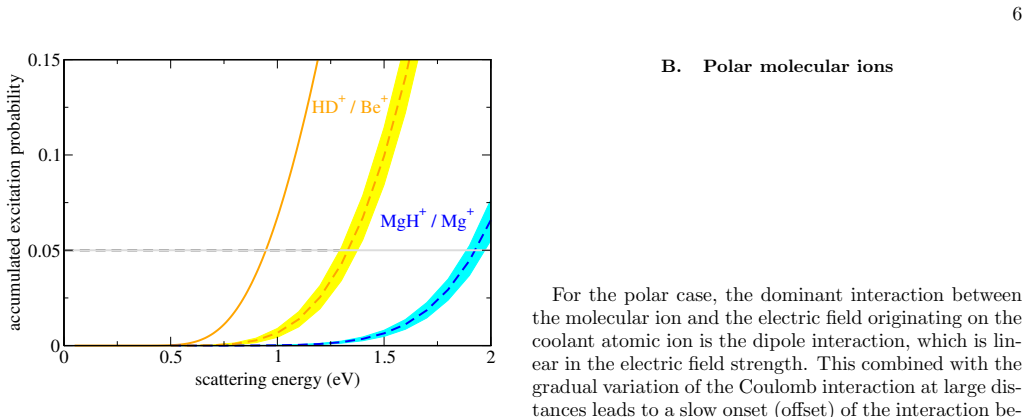
Sympathetic cooling of molecular ions through the Coulomb interaction with laser-cooled atomic ions is an efficient tool to prepare translationally cold molecules without, ideally, affecting the internal state of the molecular ions. However, the electric field due to the Coulomb interaction may induce rotational transitions that change the purity of initially quantum state prepared molecules. Here, we use estimates of rotational state changes in single collisions of diatomic ions with atomic ions [arXiv:1905.02130] to determine the overall rotational excitation accumulated over the sympathetic cooling. Considering two different experimental scenarios, that of a molecular ion co-trapped with a single atomic ion and a molecular ion immersed in a Coulomb crystal of atomic ions, we also estimate the cooling time.
Editorial analysis
A structured set of objections, weighed in public.
Referee Report
Summary. The manuscript uses estimates of rotational state changes in single collisions of diatomic molecular ions with atomic ions (taken from the cited arXiv:1905.02130) to compute the total accumulated rotational excitation over the course of sympathetic cooling. It considers two scenarios—a molecular ion co-trapped with a single atomic ion and a molecular ion immersed in a Coulomb crystal—and provides estimates of the cooling time in each case.
Significance. If the single-collision estimates can be integrated along the cooling trajectory without significant additional rotational transitions from trap fields or many-body effects, the work would supply useful quantitative bounds on internal-state purity for sympathetic cooling experiments. This is relevant for applications requiring quantum-state-prepared molecular ions. The explicit comparison of the single-ion and crystal geometries addresses two common laboratory configurations.
major comments (1)
- [Abstract and description of the two scenarios] The central result rests on summing or integrating per-collision rotational excitation probabilities taken from the external reference. No analysis is supplied to justify that continuous trap potentials or collective modes in the Coulomb crystal contribute negligibly to additional ΔJ transitions once velocities are low and ions occupy lattice sites; this assumption is load-bearing for the claim that total accumulated excitation remains limited in the crystal scenario.
Simulated Author's Rebuttal
We thank the referee for the careful review and constructive feedback on our manuscript. We respond to the major comment below.
read point-by-point responses
-
Referee: The central result rests on summing or integrating per-collision rotational excitation probabilities taken from the external reference. No analysis is supplied to justify that continuous trap potentials or collective modes in the Coulomb crystal contribute negligibly to additional ΔJ transitions once velocities are low and ions occupy lattice sites; this assumption is load-bearing for the claim that total accumulated excitation remains limited in the crystal scenario.
Authors: We agree that the manuscript relies on the assumption that binary collisions dominate the rotational excitation and does not supply explicit analysis of trap potentials or collective modes. The estimates are constructed solely by integrating the per-collision probabilities from arXiv:1905.02130 along the cooling trajectory. To strengthen the presentation we will add a short paragraph in the revised manuscript (in the discussion of the crystal scenario) that compares the electric-field gradients and timescales of the static trap and low-amplitude crystal modes against those encountered in the close binary collisions; this will make the modeling assumptions explicit. This is a partial revision. revision: partial
Circularity Check
No circularity: result built from external cited estimates without internal reduction
full rationale
The paper's central procedure applies single-collision rotational excitation estimates taken directly from the external reference arXiv:1905.02130, then sums or integrates those values along a sympathetic-cooling trajectory for the two scenarios. No equation inside the manuscript defines a quantity in terms of itself, no parameter is fitted to the paper's own outputs and then relabeled as a prediction, and the cited source is treated as an independent input rather than a self-citation chain. The cooling-time estimates likewise follow from the same external rates without introducing a definitional loop. The derivation therefore remains self-contained against external benchmarks.
Axiom & Free-Parameter Ledger
Reference graph
Works this paper leans on
- [1]
-
[2]
P. Bowe, L. Hornekær, C. Brodersen, M. Drewsen, J. S. Hangst, and J. P. Schiffer, Phys. Rev. Lett. 82, 2071 (1999)
work page 2071
-
[3]
J. C. J. Koelemeij, B. Roth, A. Wicht, I. Ernsting, and S. Schiller, Phys. Rev. Lett. 98, 173002 (2007)
work page 2007
-
[4]
P. F. Staanum, K. Højbjerre, R. Wester, and M. Drewsen, Phys. Rev. Lett. 100, 243003 (2008)
work page 2008
-
[5]
S. Willitsch, M. T. Bell, A. D. Gingell, S. R. Procter, and T. P. Softley, Phys. Rev. Lett. 100, 043203 (2008)
work page 2008
-
[6]
A. K. Hansen, M. A. Sørensen, P. F. Staanum, and M. Drewsen, Angew. Chemie Int. Ed. 51, 7960 (2012)
work page 2012
- [7]
-
[8]
X. Tong, A. H. Winney, and S. Willitsch, Phys. Rev. Lett. 105, 143001 (2010)
work page 2010
-
[9]
A. Ostendorf, C. B. Zhang, M. A. Wilson, D. Offenberg, 9 B. Roth, and S. Schiller, Phys. Rev. Lett. 97, 243005 (2006)
work page 2006
-
[10]
K. Højbjerre, D. Offenberg, C. Z. Bisgaard, H. Stapelfeldt, P. F. Staanum, A. Mortensen, and M. Drewsen, Phys. Rev. A 77, 030702 (2008)
work page 2008
-
[11]
M. Shi, P. F. Herskind, M. Drewsen, and I. L. Chuang, New Journal of Physics 15, 113019 (2013)
work page 2013
-
[12]
M. Sinhal, Z. Meir, K. Najafian, G. Hegi, and S. Willitsch, Science 367, 1213 (2020), https://www.science.org/doi/pdf/10.1126/science.aaz9837
- [13]
-
[14]
O. Dulieu and A. Osterwalder, eds., Cold Chemistry: Molecular Scattering and Reactivity Near Absolute Zero (The Royal Society of Chemistry, 2018)
work page 2018
-
[15]
Y. Wan, F. Gebert, F. Wolf, and P. O. Schmidt, Phys. Rev. A 91, 043425 (2015)
work page 2015
-
[16]
R. Rugango, J. E. Goeders, T. H. Dixon, J. M. Gray, N. B. Khanyile, G. Shu, R. J. Clark, and K. R. Brown, New J. Phys. 17, 035009 (2015)
work page 2015
-
[17]
F. Wolf, Y. Wan, J. C. Heip, F. Gebert, C. Shi, and P. O. Schmidt, Nature 530, 457–460 (2016)
work page 2016
-
[18]
C. wen Chou, C. Kurz, D. B. Hume, P. N. Plessow, D. R. Leibrandt, and D. Leibfried, Nature 545, 203 (2017)
work page 2017
-
[19]
Poulsen, Sideband Cooling of Atomic and Molecular Ions, Ph.D
G. Poulsen, Sideband Cooling of Atomic and Molecular Ions, Ph.D. thesis, Department of Physics and Astron- omy, Aarhus University (2011)
work page 2011
-
[20]
D. Schuster, L. S. Bishop, I. Chuang, D. DeMille, and R. Schoelkopf, Physical Review A 83, 012311 (2011)
work page 2011
-
[21]
Y. Lin, D. R. Leibrandt, D. Leibfried, and C.-w. Chou, Nature 581, 273 (2020)
work page 2020
-
[22]
C.-w. Chou, C. Kurz, D. B. Hume, P. N. Plessow, D. R. Leibrandt, and D. Leibfried, Nature 545, 203 (2017)
work page 2017
-
[23]
M. Deiß, S. Willitsch, and J. Hecker Denschlag, Nature Physics 20, 713
-
[24]
P. O. Schmidt, T. Rosenband, C. Langer, W. M. Itano, J. C. Bergquist, and D. J. Wineland, Science 309, 749 (2005), https://www.science.org/doi/pdf/10.1126/science.1114375
-
[25]
I. S. Vogelius, L. B. Madsen, and M. Drewsen, Phys. Rev. Lett. 89, 173003 (2002)
work page 2002
-
[26]
P. F. Staanum, K. Højbjerre, P. S. Skyt, A. K. Hansen, and M. Drewsen, Nature Phys. 6, 271 (2010)
work page 2010
-
[27]
T. Schneider, B. Roth, H. Duncker, I. Ernsting, and S. Schiller, Nature Phys. 6, 275 (2010)
work page 2010
-
[28]
N. Deb, B. R. Heazlewood, M. T. Bell, and T. P. Softley, Phys. Chem. Chem. Phys. 15, 14270 (2013)
work page 2013
-
[29]
A. K. Hansen, O. O. Versolato, L. K losowski, S. B. Kris- tensen, A. Gingell, M. Schwarz, A. Windberger, J. Ull- rich, J. R. C. L´ opez-Urrutia, and M. Drewsen, Nature 508, 76 (2014)
work page 2014
- [30]
-
[31]
M. H. Stockett, J. Houmøller, K. Støchkel, A. Svendsen, and S. Brøndsted Nielsen, Rev. Sci. Instrum. 87, 053103 (2016)
work page 2016
-
[32]
J. M. Berglund, M. Drewsen, and C. P. Koch, arXiv:1905.02130
work page internal anchor Pith review Pith/arXiv arXiv 1905
-
[33]
B. R. Heazlewood and T. P. Softley, Annu. Rev. Phys. Chem. 66, 475 (2015)
work page 2015
-
[34]
Goldstein, Classical Mechanics (Addison-Wesley, 1980)
H. Goldstein, Classical Mechanics (Addison-Wesley, 1980)
work page 1980
-
[35]
M. Bussmann, U. Schramm, D. Habs, V. Kolhinen, and J. Szerypo, Int. J. Mass Spectrom. 251, 179 (2006)
work page 2006
- [36]
- [37]
- [38]
- [39]
-
[40]
A. Hashemloo, C. M. Dion, and G. Rahali, Internat. J. Mod. Phys. C 27, 1650014 (2016)
work page 2016
discussion (0)
Sign in with ORCID, Apple, or X to comment. Anyone can read and Pith papers without signing in.