Assessing non-Gaussian quantum state conversion with the stellar rank
Pith reviewed 2026-05-23 19:04 UTC · model grok-4.3
The pith
The approximate stellar rank serves as an operational measure of non-Gaussianity for bounding approximate Gaussian state conversions.
A machine-rendered reading of the paper's core claim, the machinery that carries it, and where it could break.
Core claim
The paper claims that extending the stellar rank to the approximate stellar rank provides an operational measure of non-Gaussianity, enabling the derivation of bounds for Gaussian state conversion and distillation under approximate and probabilistic conditions, which in turn yield new no-go results for non-Gaussian state preparation.
What carries the argument
The approximate stellar rank, an extension of the stellar rank that quantifies non-Gaussianity in approximate settings and acts as a faithful measure for deriving conversion bounds.
Load-bearing premise
That the approximate stellar rank maintains its operational meaning as a faithful measure of non-Gaussianity capable of producing valid bounds on state conversions.
What would settle it
Finding a specific pair of states where the approximate stellar rank difference allows a conversion that the derived bound prohibits, or vice versa, would disprove the framework's validity.
Figures

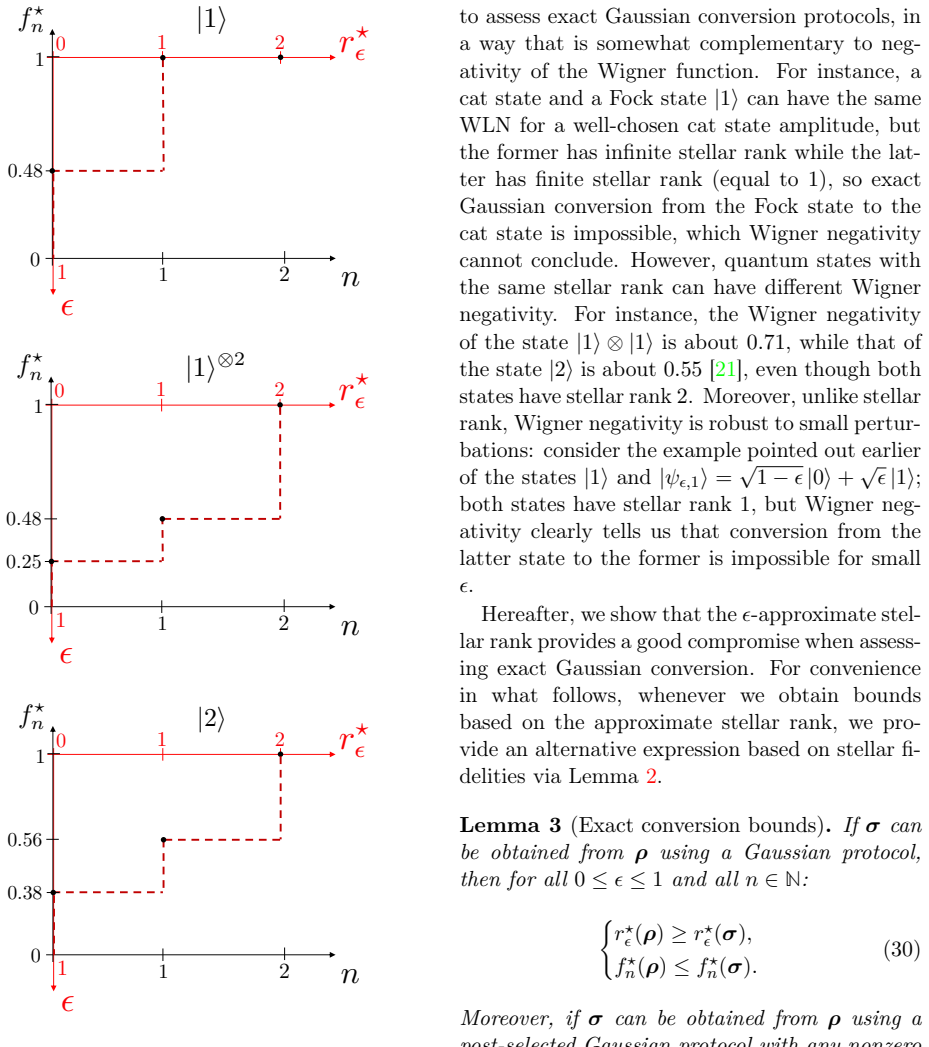


read the original abstract
State conversion is a fundamental task in quantum information processing. Quantum resource theories allow for analyzing and bounding conversions that use restricted sets of operations. In the context of continuous-variable systems, state conversions restricted to Gaussian operations are crucial for both fundamental and practical reasons, particularly in state preparation and quantum computing with bosonic codes. However, previous analysis did not consider the relevant case of approximate state conversion. In this work, we introduce a framework for assessing approximate Gaussian state conversion by extending the stellar rank to the approximate stellar rank, which serves as an operational measure of non-Gaussianity. We derive bounds for Gaussian state conversion and distillation under approximate and probabilistic conditions, yielding new no-go results for non-Gaussian state preparation and enabling a reliable assessment of the performance of Gaussian conversion protocols. We also provide an open-source Python library to compute stellar-rank-related quantities and to assess Gaussian conversion.
Editorial analysis
A structured set of objections, weighed in public.
Referee Report
Summary. The paper extends the stellar rank to an approximate stellar rank as an operational measure of non-Gaussianity for assessing approximate Gaussian state conversions in continuous-variable systems. It derives bounds on Gaussian conversion and distillation under approximate and probabilistic conditions, obtains new no-go results for non-Gaussian state preparation, and supplies an open-source Python library for computing stellar-rank quantities and evaluating conversion protocols.
Significance. If the approximate stellar rank preserves its operational meaning and the derived bounds hold, the framework supplies a concrete tool for quantifying non-Gaussian resources in bosonic state preparation and quantum computing, with the open-source library enabling reproducible assessment of protocols.
minor comments (3)
- The abstract states that the approximate stellar rank 'serves as an operational measure of non-Gaussianity,' but the manuscript should explicitly verify in §3 or §4 that the extension inherits the faithfulness and monotonicity properties of the exact stellar rank under the restricted operations.
- The Python library is mentioned as open-source; the manuscript should include a dedicated subsection or appendix with installation instructions, example usage for the new bounds, and a link to the repository to ensure immediate usability.
- Notation for the approximate stellar rank (e.g., how the approximation parameter enters the definition) should be introduced once and used consistently; current usage in the abstract and introduction risks ambiguity for readers unfamiliar with the exact stellar rank.
Simulated Author's Rebuttal
We thank the referee for their positive summary of our manuscript, recognition of its significance, and recommendation for minor revision. No specific major comments were listed in the report.
Circularity Check
No significant circularity identified
full rationale
The paper introduces an extension of the stellar rank to the approximate stellar rank as a new operational measure of non-Gaussianity for assessing approximate Gaussian state conversions. The provided abstract and context present this extension directly as the foundation for deriving bounds and no-go results, without any quoted equations or steps that reduce a claimed result to a fitted parameter, self-citation chain, or definitional equivalence by construction. The derivation is self-contained against external benchmarks, as the new measure is defined and applied within the work rather than presupposing its own outputs.
Axiom & Free-Parameter Ledger
axioms (1)
- domain assumption Gaussian operations form a restricted set that cannot increase non-Gaussianity
invented entities (1)
-
approximate stellar rank
no independent evidence
Reference graph
Works this paper leans on
-
[1]
E. Chitambar and G. Gour, “Quantum resource theories,”Rev. Mod. Phys.91, 025001 (2019)
work page 2019
-
[2]
Quantum computation over continuous variables,
S. Lloyd and S. L. Braunstein, “Quantum computation over continuous variables,” in Quantum Information with Continuous Variables, pp. 9–17. Springer, 1999
work page 1999
-
[3]
Universal quantum computation with continuous-variable cluster states,
N. C. Menicucci, P. Van Loock, M. Gu, C. Weedbrook, T. C. Ralph, and M. A. Nielsen, “Universal quantum computation with continuous-variable cluster states,” Physical Review Letters97, 110501 (2006)
work page 2006
-
[4]
C. Weedbrook, S. Pirandola, R. García-Patrón, N. J. Cerf, T. C. Ralph, J. H. Shapiro, and S. Lloyd, “Gaussian quantum information,”Reviews of Modern Physics 84, 621 (2012)
work page 2012
-
[5]
Continuous-variable quantum computing in the quantum optical frequency comb,
O. Pfister, “Continuous-variable quantum computing in the quantum optical frequency comb,”Journal of Physics B: Atomic, Molecular and Optical Physics53, 012001 (2019)
work page 2019
-
[6]
Building a large-scale quantum computer with continuous-variable optical technologies,
K. Fukui and S. Takeda, “Building a large-scale quantum computer with continuous-variable optical technologies,”J. Phys. B: At. Mol. Opt. Phys.55, 012001 (2022)
work page 2022
-
[7]
Towards scalable bosonic quantum error correction,
B. M. Terhal, J. Conrad, and C. Vuillot, “Towards scalable bosonic quantum error correction,”, vol. 5. Institute of Physics Publishing, Oct., 2020
work page 2020
-
[8]
Quantum Error Correction with the Gottesman-Kitaev-Preskill Code,
A. L. Grimsmo and S. Puri, “Quantum Error Correction with the Gottesman-Kitaev-Preskill Code,”PRX Quantum 2, 020101 (2021)
work page 2021
-
[9]
Quantum information processing with bosonic qubits in circuit QED,
A. Joshi, K. Noh, and Y. Y. Gao, “Quantum information processing with bosonic qubits in circuit QED,”Quantum Science and Technology6, 033001 (2021)
work page 2021
-
[10]
Bosonic quantum error correction codes in superconducting quantum circuits,
W. Cai, Y. Ma, W. Wang, C.-L. Zou, and L. Sun, “Bosonic quantum error correction codes in superconducting quantum circuits,”Fundamental Research666 (2021)
work page 2021
-
[11]
Bosonic coding: introduction and use cases,
V. V. Albert, “Bosonic coding: introduction and use cases,”arXiv:2211.05714
-
[12]
A. J. Brady, A. Eickbusch, S. Singh, J. Wu, and Q. Zhuang, “Advances in bosonic quantum error correction with Gottesman–Kitaev–Preskill Codes: Theory, engineering and applications,”Progress in Quantum Electronics100496 (2024)
work page 2024
-
[13]
Gaussian states in continuous variable quantum information
A. Ferraro, S. Olivares, and M. G. A. Paris, “Gaussian States in Quantum Information,” arxiv:quant-ph/0503237
work page internal anchor Pith review Pith/arXiv arXiv
-
[14]
Continuous variable quantum information: Gaussian states and beyond,
G. Adesso, S. Ragy, and A. R. Lee, “Continuous variable quantum information: Gaussian states and beyond,”Open Systems & Information Dynamics21, 1440001 (2014)
work page 2014
-
[15]
Non-Gaussian quantum states and where to find them,
M. Walschaers, “Non-Gaussian quantum states and where to find them,”PRX quantum 2, 030204 (2021)
work page 2021
-
[16]
Efficient Classical Simulation of Continuous Variable Quantum Information Processes,
S. D. Bartlett, B. C. Sanders, S. L. Braunstein, and K. Nemoto, “Efficient Classical Simulation of Continuous Variable Quantum Information Processes,”Physical Review Letters88, 097904 (2002)
work page 2002
-
[17]
Positive Wigner Functions Render Classical Simulation of Quantum Computation Efficient,
A. Mari and J. Eisert, “Positive Wigner Functions Render Classical Simulation of Quantum Computation Efficient,”Phys. Rev. Lett.109, 230503 (2012)
work page 2012
-
[18]
V. Veitch, N. Wiebe, C. Ferrie, and J. Emerson, “Efficient simulation scheme for a class of quantum optics experiments with non-negative Wigner representation,”New J. Phys. 15, 013037 (2013)
work page 2013
-
[19]
Efficient Classical Simulation of Continuous Variable Quantum Information Processes,
S. D. Bartlett, B. C. Sanders, S. L. Braunstein, and K. Nemoto, “Efficient Classical Simulation of Continuous Variable Quantum Information Processes,”Phys. Rev. Lett.88, 097904 (2002)
work page 2002
-
[20]
Sufficient Conditions for Efficient Classical Simulation of Quantum Optics,
S. Rahimi-Keshari, T. C. Ralph, and C. M. Caves, “Sufficient Conditions for Efficient Classical Simulation of Quantum Optics,” Phys. Rev. X6, 021039 (2016)
work page 2016
-
[21]
Negativity of the Wigner function as an indicator of non-classicality,
A. Kenfack and K. Życzkowski, “Negativity of the Wigner function as an indicator of non-classicality,”Journal of Optics B: Quantum and Semiclassical Optics6, 396 (2004). 14
work page 2004
-
[22]
Resource theory of quantum non-Gaussianity and Wigner negativity,
F. Albarelli, M. G. Genoni, M. G. Paris, and A. Ferraro, “Resource theory of quantum non-Gaussianity and Wigner negativity,”Physical Review A98, 052350 (2018)
work page 2018
-
[23]
Convex resource theory of non-Gaussianity,
R. Takagi and Q. Zhuang, “Convex resource theory of non-Gaussianity,”Phys. Rev. A 97, 062337 (2018)
work page 2018
-
[24]
Stellar representation of non-Gaussian quantum states,
U. Chabaud, D. Markham, and F. Grosshans, “Stellar representation of non-Gaussian quantum states,”Physical Review Letters124, 063605 (2020)
work page 2020
-
[25]
Holomorphic representation of quantum computations,
U. Chabaud and S. Mehraban, “Holomorphic representation of quantum computations,”Quantum 6, 831 (2022)
work page 2022
-
[26]
Faithful Hierarchy of Genuinen-Photon Quantum Non-Gaussian Light,
L. c. v. Lachman, I. Straka, J. Hloušek, M. Ježek, and R. Filip, “Faithful Hierarchy of Genuinen-Photon Quantum Non-Gaussian Light,”Phys. Rev. Lett.123, 043601 (2019)
work page 2019
-
[27]
Classical simulation and quantum resource theory of non-Gaussian optics,
O. Hahn, R. Takagi, G. Ferrini, and H. Yamasaki, “Classical simulation and quantum resource theory of non-Gaussian optics,” 2024. https://arxiv.org/abs/2404.07115
-
[28]
Classical simulation of non-Gaussian bosonic circuits,
B. Dias and R. König, “Classical simulation of non-Gaussian bosonic circuits,”Physical Review A 110, 042402 (2024)
work page 2024
-
[29]
C. Weedbrook, S. Pirandola, R. García-Patrón, N. J. Cerf, T. C. Ralph, J. H. Shapiro, and S. Lloyd, “Gaussian quantum information,”Rev. Mod. Phys.84, 621–669 (2012)
work page 2012
-
[30]
Conditions for the Local Manipulation of Gaussian States,
J. Eisert and M. B. Plenio, “Conditions for the Local Manipulation of Gaussian States,”Phys. Rev. Lett.89, 097901 (2002)
work page 2002
-
[31]
Gaussian Transformations and Distillation of Entangled Gaussian States,
J. Fiurášek, “Gaussian Transformations and Distillation of Entangled Gaussian States,” Phys. Rev. Lett.89, 137904 (2002)
work page 2002
-
[32]
Characterization of Gaussian operations and distillation of Gaussian states,
G. Giedke and J. Ignacio Cirac, “Characterization of Gaussian operations and distillation of Gaussian states,”Phys. Rev. A 66, 032316 (2002)
work page 2002
-
[33]
No-Go Theorem for Gaussian Quantum Error Correction,
J. Niset, J. Fiurášek, and N. J. Cerf, “No-Go Theorem for Gaussian Quantum Error Correction,”Phys. Rev. Lett.102, 120501 (2009)
work page 2009
-
[34]
Contextuality and Wigner Negativity Are Equivalent for Continuous-Variable Quantum Measurements,
R. I. Booth, U. Chabaud, and P.-E. Emeriau, “Contextuality and Wigner Negativity Are Equivalent for Continuous-Variable Quantum Measurements,”Phys. Rev. Lett.129, 230401 (2022)
work page 2022
-
[35]
Classical simulation of Gaussian quantum circuits with non-Gaussian input states,
U. Chabaud, G. Ferrini, F. Grosshans, and D. Markham, “Classical simulation of Gaussian quantum circuits with non-Gaussian input states,”Physical Review Research3, 033018 (2021)
work page 2021
-
[36]
Riemannian optimization of photonic quantum circuits in phase and Fock space,
Y. Yao, F. Miatto, and N. Quesada, “Riemannian optimization of photonic quantum circuits in phase and Fock space,” SciPost Physics 17, 082 (2024)
work page 2024
-
[37]
Mathematical problems of relativistic physics,
I. E. Segal and G. W. Mackey, “Mathematical problems of relativistic physics,”, vol. 2. American Mathematical Soc., 1963
work page 1963
-
[38]
On a Hilbert space of analytic functions and an associated integral transform part I,
V. Bargmann, “On a Hilbert space of analytic functions and an associated integral transform part I,”Communications on pure and applied mathematics14, 187–214 (1961)
work page 1961
-
[39]
Detecting quantum states with a positive Wigner function beyond mixtures of Gaussian states,
R. Filip and L. Mišta Jr, “Detecting quantum states with a positive Wigner function beyond mixtures of Gaussian states,”Physical Review Letters106, 200401 (2011)
work page 2011
-
[40]
Certification of Non-Gaussian States with Operational Measurements,
U. Chabaud, G. Roeland, M. Walschaers, F. Grosshans, V. Parigi, D. Markham, and N. Treps, “Certification of Non-Gaussian States with Operational Measurements,” PRX Quantum 2, 020333 (2021)
work page 2021
-
[41]
Efficient construction of witnesses of the stellar rank of nonclassical states of light,
J. Fiurášek, “Efficient construction of witnesses of the stellar rank of nonclassical states of light,”Optics Express 30, 30630–30639 (2022)
work page 2022
-
[42]
Resources for bosonic quantum computational advantage,
U. Chabaud and M. Walschaers, “Resources for bosonic quantum computational advantage,”Physical Review Letters130, 090602 (2023)
work page 2023
-
[43]
Framework for resource quantification in infinite-dimensional general probabilistic theories,
L. Lami, B. Regula, R. Takagi, and G. Ferrari, “Framework for resource quantification in infinite-dimensional general probabilistic theories,”Physical Review A 103, 032424 (2021)
work page 2021
-
[44]
Stellar fidelities and No-go regions
O. Hahn and U. Chabaud, “Stellar fidelities and No-go regions.” GitHub repository containing the numerical tools developed for this article
-
[45]
Generation of optical ‘Schrödinger cats’ 15 from photon number states,
A. Ourjoumtsev, H. Jeong, R. Tualle-Brouri, and P. Grangier, “Generation of optical ‘Schrödinger cats’ 15 from photon number states,”Nature 448, 784 (2007)
work page 2007
-
[46]
J. Etesse, R. Blandino, B. Kanseri, and R. Tualle-Brouri, “Proposal for a loophole-free violation of Bell’s inequalities with a set of single photons and homodyne measurements,”New Journal of Physics16, 053001 (2014)
work page 2014
-
[47]
Generating grid states from Schrödinger-cat states without postselection,
D. J. Weigand and B. M. Terhal, “Generating grid states from Schrödinger-cat states without postselection,”Phys. Rev. A97, 022341 (2018)
work page 2018
-
[48]
K. Takase, F. Hanamura, H. Nagayoshi, J. E. Bourassa, R. N. Alexander, A. Kawasaki, W. Asavanant, M. Endo, and A. Furusawa, “Generation of Flying Logical Qubits using Generalized Photon Subtraction with Adaptive Gaussian Operations,”arxiv:2401.07287
-
[49]
Gaussian Conversion Protocols for Cubic Phase State Generation,
Y. Zheng, O. Hahn, P. Stadler, P. Holmvall, F. Quijandría, A. Ferraro, and G. Ferrini, “Gaussian Conversion Protocols for Cubic Phase State Generation,”PRX Quantum 2, 010327 (2021)
work page 2021
-
[50]
Deterministic Gaussian conversion protocols for non-Gaussian single-mode resources,
O. Hahn, P. Holmvall, P. Stadler, G. Ferrini, and A. Ferraro, “Deterministic Gaussian conversion protocols for non-Gaussian single-mode resources,”Phys. Rev. A 105, 062446 (2022)
work page 2022
-
[51]
Y. Zheng, A. Ferraro, A. F. Kockum, and G. Ferrini, “Gaussian conversion protocol for heralded generation of generalized Gottesman-Kitaev-Preskill states,”Phys. Rev. A 108, 012603 (2023)
work page 2023
-
[52]
Iterative tailoring of optical quantum states with homodyne measurements,
J. Etesse, B. Kanseri, and R. Tualle-Brouri, “Iterative tailoring of optical quantum states with homodyne measurements,”Opt. Express 22, 30357–30367 (2014)
work page 2014
-
[53]
Polynomial approximation of non-Gaussian unitaries by counting one photon at a time,
F. Arzani, N. Treps, and G. Ferrini, “Polynomial approximation of non-Gaussian unitaries by counting one photon at a time,”Phys. Rev. A95, 052352 (2017)
work page 2017
-
[54]
No-go theorems for photon state transformations in quantum linear optics,
P. V. Parellada, V. G. i Garcia, J. J. Moyano-Fernández, and J. C. Garcia-Escartin, “No-go theorems for photon state transformations in quantum linear optics,”Results in Physics54, 107108 (2023)
work page 2023
-
[55]
Continuous Variable Quantum Advantages and Applications in Quantum Optics
U. Chabaud, “Continuous Variable Quantum Advantages and Applications in Quantum Optics.” Phd thesis arXiv:2102.05227 [quant-ph], Sorbonne University, 2021
-
[56]
A. J. Pizzimenti and D. Soh, “Optical Gottesman-Kitaev-Preskill Qubit Generation via Approximate Squeezed Schrödinger Cat State Breeding,” arXiv:2409.06902
-
[57]
Equivalence of approximate Gottesman-Kitaev-Preskill codes,
T. Matsuura, H. Yamasaki, and M. Koashi, “Equivalence of approximate Gottesman-Kitaev-Preskill codes,”Physical Review A 102, 032408 (2020)
work page 2020
-
[58]
Encoding a qubit in an oscillator,
D. Gottesman, A. Kitaev, and J. Preskill, “Encoding a qubit in an oscillator,”Phys. Rev. A 64, 012310 (2001)
work page 2001
-
[59]
The Computational Complexity of Linear Optics
S. Aaronson and A. Arkhipov, “The computational Complexity of Linear Optics,”Theory of Computing9, 143 (2013), arXiv:1011.3245
work page internal anchor Pith review Pith/arXiv arXiv 2013
-
[60]
A scheme for efficient quantum computation with linear optics,
E. Knill, R. Laflamme, and G. J. Milburn, “A scheme for efficient quantum computation with linear optics,”nature 409, 46–52 (2001)
work page 2001
-
[61]
M. M. Wilde, “Quantum information theory,”. Cambridge university press, 2013
work page 2013
-
[62]
D. S. Mitrinovic and P. M. Vasic, “Analytic inequalities,”, vol. 61. Springer, 1970
work page 1970
-
[63]
A lower bound on the relative error of mixed-state cloning and related operations,
A. Rastegin, “A lower bound on the relative error of mixed-state cloning and related operations,”Journal of Optics B: Quantum and Semiclassical Optics5, S647 (2003)
work page 2003
-
[64]
Building Trust for Continuous Variable Quantum States,
U. Chabaud, T. Douce, F. Grosshans, E. Kashefi, and D. Markham, “Building Trust for Continuous Variable Quantum States,” in15th Conference on the Theory of Quantum Computation, Communication and Cryptography. 2020. arXiv:1905.12700. 16 Appendix A Properties of the approximate stellar rank In this section, we prove the properties of theϵ-approximate stella...
discussion (0)
Sign in with ORCID, Apple, or X to comment. Anyone can read and Pith papers without signing in.