Deep learning-based modularized loading protocol for parameter estimation of Bouc-Wen class models
Pith reviewed 2026-05-23 18:07 UTC · model grok-4.3
The pith
A modular protocol using three separate CNNs constructs minimal loading histories to estimate Bouc-Wen model parameters faster without losing accuracy.
A machine-rendered reading of the paper's core claim, the machinery that carries it, and where it could break.
Core claim
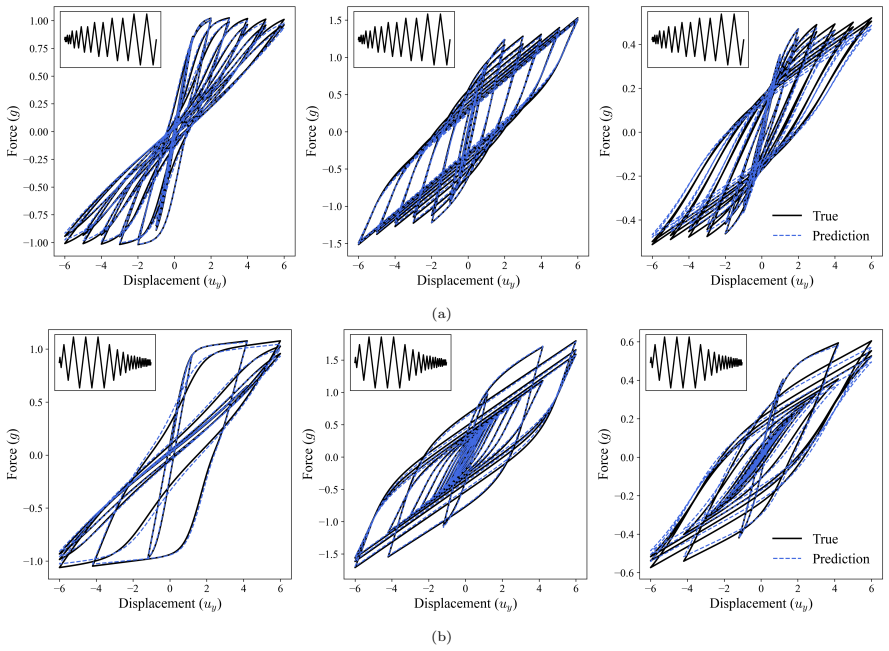
The protocol decomposes optimal loading history construction and CNN-based parameter estimation into three independent sub-modules for basic hysteresis, structural degradation, and pinching effect. Three CNN architectures are trained on diverse loading histories to identify minimal loading history modules, which are combined for the full optimal history. The trained CNNs then serve as rapid estimators, and numerical evaluations on a 3-story steel frame and RC frame confirm significant reduction in total analysis time with maintained or improved accuracy.
What carries the argument
Three independent CNN architectures trained on loading history modules for basic hysteresis, degradation, and pinching, combined to recover full Bouc-Wen parameters.
If this is right
- Reduces total analysis time in nonlinear time history analysis of a 3-story steel moment frame.
- Maintains or improves estimation accuracy during fragility curve construction for a 3-story reinforced concrete frame.
- Adapts to diverse hysteresis models through the modular sub-module design.
- Offers a systematic approach for identifying general hysteresis models beyond the Bouc-Wen class.
Where Pith is reading between the lines
- The modular CNN setup could support incremental updates by retraining only one module when new data for a specific behavior arrives.
- This decomposition might help apply the method to real-time structural monitoring where loading data arrives in segments.
- Similar modularization could be tested on other nonlinear models with path-dependent behaviors in mechanics or materials science.
Load-bearing premise
The three independent CNN architectures, each trained only on its own loading history module, can be combined without loss of accuracy to recover the full set of Bouc-Wen parameters for any combination of basic hysteresis, degradation, and pinching.
What would settle it
Running the modular three-CNN system and a single integrated CNN on identical validation cases of Bouc-Wen responses and checking whether the modular estimates have comparable or lower error rates.
Figures




read the original abstract
This study proposes a modularized deep learning-based loading protocol for optimal parameter estimation of Bouc-Wen (BW) class models. The protocol consists of two key components: optimal loading history construction and CNN-based rapid parameter estimation. Each component is decomposed into independent sub-modules tailored to distinct hysteretic behaviors-basic hysteresis, structural degradation, and pinching effect-making the protocol adaptable to diverse hysteresis models. Three independent CNN architectures are developed to capture the path-dependent nature of these hysteretic behaviors. By training these CNN architectures on diverse loading histories, minimal loading sequences, termed \textit{loading history modules}, are identified and then combined to construct an optimal loading history. The three CNN models, trained on the respective loading history modules, serve as rapid parameter estimators. Numerical evaluation of the protocol, including nonlinear time history analysis of a 3-story steel moment frame and fragility curve construction for a 3-story reinforced concrete frame, demonstrates that the proposed protocol significantly reduces total analysis time while maintaining or improving estimation accuracy. The proposed protocol can be extended to other hysteresis models, suggesting a systematic approach for identifying general hysteresis models.
Editorial analysis
A structured set of objections, weighed in public.
Referee Report
Summary. The manuscript proposes a modularized deep learning-based loading protocol for parameter estimation of Bouc-Wen class models. The protocol decomposes loading histories into three independent modules (basic hysteresis, structural degradation, pinching) and trains separate CNN architectures on each to identify minimal loading sequences and serve as rapid estimators; these are then combined for full parameter recovery. Numerical evaluations via nonlinear time-history analysis of a 3-story steel moment frame and fragility curves for a 3-story RC frame are cited to claim significant reduction in total analysis time while maintaining or improving accuracy, with the method positioned as extensible to other hysteresis models.
Significance. If the modular CNN combination recovers accurate parameters even under simultaneous variation of all three behavior classes, the protocol would provide a systematic, time-efficient alternative to traditional identification methods for path-dependent hysteretic models, with clear utility in structural dynamics applications.
major comments (2)
- [Abstract (protocol description and numerical evaluation paragraph)] The central claim that the three independently trained CNNs can be concatenated to recover the full Bouc-Wen parameter vector for arbitrary joint combinations of basic hysteresis, degradation, and pinching rests on an unverified separability assumption. Bouc-Wen-class models are defined by coupled differential equations in which degradation and pinching coefficients directly modulate the restoring-force evolution; training distributions that vary only one behavior class at a time therefore leave the combined estimator untested on the exact regime the protocol is intended to handle.
- [Abstract] No quantitative metrics, error bars, baseline comparisons, training/test split details, or description of how joint-variation test cases were generated appear in support of the accuracy claim. The abstract states only that the protocol 'maintains or improves estimation accuracy,' rendering the numerical-evaluation paragraph unverifiable from the provided text.
minor comments (1)
- [Abstract] The abstract refers to 'three independent CNN architectures' and 'minimal loading sequences, termed loading history modules' without defining the precise input representation (e.g., time-series length, normalization) or output parameterization used by each network.
Simulated Author's Rebuttal
Thank you for the referee's insightful comments. We provide point-by-point responses to the major comments and indicate the revisions we will make to address them.
read point-by-point responses
-
Referee: [Abstract (protocol description and numerical evaluation paragraph)] The central claim that the three independently trained CNNs can be concatenated to recover the full Bouc-Wen parameter vector for arbitrary joint combinations of basic hysteresis, degradation, and pinching rests on an unverified separability assumption. Bouc-Wen-class models are defined by coupled differential equations in which degradation and pinching coefficients directly modulate the restoring-force evolution; training distributions that vary only one behavior class at a time therefore leave the combined estimator untested on the exact regime the protocol is intended to handle.
Authors: We agree that explicit verification on joint variations is important to fully substantiate the separability assumption. While the numerical evaluations in Sections 4 and 5 involve complete Bouc-Wen models with all parameters varying simultaneously in the context of the structural analyses, the training process for the CNNs was indeed modular. In the revised manuscript, we will include additional experiments where all three behavior classes vary jointly in the test cases to directly validate the combined estimator. revision: yes
-
Referee: [Abstract] No quantitative metrics, error bars, baseline comparisons, training/test split details, or description of how joint-variation test cases were generated appear in support of the accuracy claim. The abstract states only that the protocol 'maintains or improves estimation accuracy,' rendering the numerical-evaluation paragraph unverifiable from the provided text.
Authors: Due to space limitations in the abstract, detailed metrics were not included. We will revise the abstract to incorporate key quantitative results, such as mean absolute percentage errors for parameter estimation, comparisons with traditional methods, and a brief note on the test set composition, while maintaining the abstract's conciseness. revision: yes
Circularity Check
No significant circularity; standard CNN application with empirical validation
full rationale
The protocol decomposes loading histories into modules and trains independent CNNs for each hysteretic behavior class, then concatenates the estimators. Accuracy and time-reduction claims rest on numerical evaluations (nonlinear time-history analysis of steel frames and fragility curves for RC frames), which are external to the training procedure and not forced by construction. No equations equate a reported prediction to a fitted input, no self-citation chains justify core premises, and no ansatz or uniqueness result is smuggled in. The method is a direct application of supervised learning to a new domain; the reader's noted assumption about module independence is a correctness concern, not a circularity reduction.
Axiom & Free-Parameter Ledger
Reference graph
Works this paper leans on
-
[1]
Mohammed Ismail, Fay¸ cal Ikhouane, and Jos´ e Rodellar. The hysteresis Bouc-Wen model, a survey.Archives of Compu- tational Methods in Engineering , 16(2):161–188, 1 2009. ISSN 11343060. doi: 10.1007/s11831-009-9031-8
-
[2]
Generalized Bouc–Wen Model for Highly Asymmetric Hysteresis
Junho Song and Armen Der Kiureghian. Generalized Bouc–Wen Model for Highly Asymmetric Hysteresis. Journal of Engineering Mechanics, 132(6):610–618, 6 2006. ISSN 0733-9399. doi: 10.1061/(asce)0733-9399(2006)132:6(610)
-
[3]
Sung Yong Kim and Cheol Ho Lee. Nondimensionalized Bouc–Wen model with structural degradation for Kalman fil- ter–based real-time monitoring. Engineering Structures , 244, 10 2021. ISSN 18737323. doi: 10.1016/j.engstruct.2021. 112674
- [4]
-
[5]
F. Ma, H. Zhang, A. Bockstedte, G. C. Foliente, and P. Paevere. Parameter analysis of the differential model of hysteresis. Journal of Applied Mechanics, Transactions ASME , 71(3):342–349, 5 2004. ISSN 00218936. doi: 10.1115/1.1668082
-
[6]
Response prediction of nonlinear hysteretic systems by deep neural networks
Taeyong Kim, Oh Sung Kwon, and Junho Song. Response prediction of nonlinear hysteretic systems by deep neural networks. Neural Networks, 111:1–10, 3 2019. ISSN 18792782. doi: 10.1016/j.neunet.2018.12.005
-
[7]
Vincenzo Niola, Gianluca Palli, Salvatore Strano, and Mario Terzo. Nonlinear estimation of the Bouc-Wen model with parameter boundaries: Application to seismic isolators. Computers and Structures , 222:1–9, 10 2019. ISSN 00457949. doi: 10.1016/j.compstruc.2019.06.006
-
[8]
A. E. Charalampakis and V. K. Koumousis. Identification of Bouc-Wen hysteretic systems by a hybrid evolutionary algorithm. Journal of Sound and Vibration , 314(3-5):571–585, 7 2008. ISSN 0022460X. doi: 10.1016/j.jsv.2008.01.018
-
[9]
Qifang Xie, Xudong Zhao, Xiaofei Yao, Wenming Hao, and Fangzheng Hu. Seismic behaviors of precast assembled bridge columns connected with prestressed threaded steel bar: Experimental test and hysteretic model. Advances in Structural Engineering, 23(9):1975–1988, 7 2020. ISSN 20484011. doi: 10.1177/1369433220903988
-
[10]
Kelun Wei and Yazhou Xu. Hysteretic model and parameter identification of RC bridge piers based on a new modified Bouc-Wen model. Structures, 43:1766–1777, 9 2022. ISSN 23520124. doi: 10.1016/j.istruc.2022.07.049
-
[11]
ACI Committee 374. Guide for testing reinforced concrete structural elements under slowly applied simulated seismic loads. Technical report, American Concrete Institute, Farmington Hills, MI, 8 2013. 22
work page 2013
-
[12]
Guidelines for Cyclic Seismic Testing of Components of Steel Structures
ATC-24. Guidelines for Cyclic Seismic Testing of Components of Steel Structures. Technical report, Applied Technology Council, Redwood City, CA, 1992
work page 1992
-
[13]
FEMA. Interim Testing Protocols for Determining the Seismic Performance Characteristics of Structural and Nonstructural Components. Technical report, FEMA 461, Washington, DC, 2007. URL www.ATCouncil.org
work page 2007
-
[14]
Development of a Testing Protocol for Woodframe Structures
Helmut Krawinkler, Francisco Parisi, Luis Ibarra, Ashraf Ayoub, and Ricardo Medina. Development of a Testing Protocol for Woodframe Structures. Technical report, CUREE, Richmond, CA, 2001. URL https://www.researchgate.net/ publication/245911208
-
[15]
Bouc–Wen class models considering hysteresis mechanism of RC columns in nonlinear dynamic analysis
Sebin Oh, Taeyong Kim, and Junho Song. Bouc–Wen class models considering hysteresis mechanism of RC columns in nonlinear dynamic analysis. International Journal of Non-Linear Mechanics , 148:104263, 1 2023. ISSN 0020-7462. doi: 10.1016/J.IJNONLINMEC.2022.104263
-
[16]
Experimental study on hysteretic behavior of structural stainless steels under cyclic loading
Feng Zhou and Lu Li. Experimental study on hysteretic behavior of structural stainless steels under cyclic loading. Journal of Constructional Steel Research , 122:94–109, 7 2016. ISSN 0143974X. doi: 10.1016/j.jcsr.2016.03.006
-
[17]
Variations in the hysteretic behavior of LRBs as a function of applied loading
G¨ okhan¨Ozdemir, Beyhan Bayhan, and Polat G¨ ulkan. Variations in the hysteretic behavior of LRBs as a function of applied loading. Structural Engineering and Mechanics , 67(1):69–78, 7 2018. ISSN 15986217. doi: 10.12989/sem.2018.67.1.069
-
[18]
Effects of Loading Protocol on the Cyclic Response of Woodframe Shearwalls
Kip Gatto and Chia-Ming Uang. Effects of Loading Protocol on the Cyclic Response of Woodframe Shearwalls. Journal of Structural Engineering , 129(10):1384–1393, 2003. doi: 10.1061/ASCE0733-94452003129:101384
-
[19]
Chang Seok Lee and Sang Whan Han. An Accurate Numerical Model Simulating Hysteretic Behavior of Reinforced Concrete Columns Irrespective of Types of Loading Protocols.International Journal of Concrete Structures and Materials , 15(1), 12 2021. ISSN 22341315. doi: 10.1186/s40069-020-00446-5
-
[20]
Minghao Li, Ricardo O. Foschi, and Frank Lam. Modeling Hysteretic Behavior of Wood Shear Walls with a Protocol- Independent Nail Connection Algorithm. Journal of Structural Engineering , 138(1):99–108, 1 2012. ISSN 0733-9445. doi: 10.1061/(asce)st.1943-541x.0000438
-
[21]
Adam Zsarn´ oczay and Jack W. Baker. Using model error in response history analysis to evaluate component calibration methods. Earthquake Engineering and Structural Dynamics , 49(2):175–193, 2 2020. ISSN 10969845. doi: 10.1002/eqe.3234
-
[22]
Gilberto A. Ortiz, Diego A. Alvarez, and Daniel Bedoya-Ru´ ız. Identification of Bouc-Wen type models using multi- objective optimization algorithms. Computers and Structures , 114-115:121–132, 1 2013. ISSN 00457949. doi: 10.1016/j. compstruc.2012.10.016
work page doi:10.1016/j 2013
-
[23]
O’Reilly Media, second edition, 2017
Aure´ elien Ge´ eron.Hands-on Machine Learning with Scikit-Learn, Keras, and TensorFlow: Concepts, Tools, and Tech- niques to Build Intelligent Systems . O’Reilly Media, second edition, 2017
work page 2017
-
[24]
A Guide to Convolutional Neural Networks for Computer Vision
Salman Khan, Hossein Rahmani, Syed Afaq Ali Shah, and Mohammed Bennamoun. A Guide to Convolutional Neural Networks for Computer Vision . Springer Cham, 1 edition, 2018. doi: https://doi.org/10.1007/978-3-031-01821-3
-
[25]
Humaidi, Ayad Al-Dujaili, Ye Duan, Omran Al-Shamma, J
Laith Alzubaidi, Jinglan Zhang, Amjad J. Humaidi, Ayad Al-Dujaili, Ye Duan, Omran Al-Shamma, J. Santamar´ ıa, Mohammed A. Fadhel, Muthana Al-Amidie, and Laith Farhan. Review of deep learning: concepts, CNN archi- tectures, challenges, applications, future directions. Journal of Big Data , 8(1), 12 2021. ISSN 21961115. doi: 10.1186/s40537-021-00444-8
-
[26]
Deep Residual Learning for Image Recognition
Kaiming He, Xiangyu Zhang, Shaoqing Ren, and Jian Sun. Deep Residual Learning for Image Recognition. In Proceedings of the IEEE conference on computer vision and pattern recognition , pages 770–778, 2016. URL http://image-net.org/ challenges/LSVRC/2015/
work page 2016
-
[27]
Imagenet: A large-scale hierarchical image database
Jia Deng, Wei Dong, Richard Socher, Li-Jia Li, Kai Li, and Li Fei-Fei. Imagenet: A large-scale hierarchical image database. In 2009 IEEE conference on computer vision and pattern recognition , pages 248–255. IEEE, 6 2009. ISBN 9781424439911
work page 2009
-
[28]
Taeyong Kim, Oh Sung Kwon, and Junho Song. Deep learning based seismic response prediction of hysteretic systems having degradation and pinching. Earthquake Engineering and Structural Dynamics , 52(8):2384–2406, 7 2023. ISSN 10969845. doi: 10.1002/eqe.3796
-
[29]
RANDOM VIBRATION OF DEGRADING, PINCHING SYSTEMS
Thomas T Baber and Mohammad N Noori. RANDOM VIBRATION OF DEGRADING, PINCHING SYSTEMS. Journal of Engineering Mechanics , 111(8):977–1092, 8 1985. ISSN 0733-9399
work page 1985
-
[30]
Thomas T. Baber and Mohammad N. Noori. Modeling general hysteresis behavior and random vibration application. Journal of Vibration and Acoustics , 108(4):411–420, 1986. ISSN 0733-9399. doi: 10.1061/(asce)0733-9399(1985)111: 8(1010)
-
[31]
Uncertainty quantification in the calibration of numerical elements in nonlinear seismic analysis
Hongzhou Zhang, Oh Sung Kwon, and Constantin Christopoulos. Uncertainty quantification in the calibration of numerical elements in nonlinear seismic analysis. Earthquake Engineering & Structural Dynamics , 51(12):3000–3021, 10 2022. ISSN 1096-9845. doi: 10.1002/EQE.3711. URL https://onlinelibrary.wiley.com/doi/full/10.1002/eqe.3711https: //onlinelibrary.w...
-
[32]
Hybrid-simulation-based model calibration method for nonlinear seismic analysis
Hongzhou Zhang, Oh Sung Kwon, and Constantin Christopoulos. Hybrid-simulation-based model calibration method for nonlinear seismic analysis. Earthquake Engineering & Structural Dynamics , 53(3):1067–1084, 3 2024. ISSN 1096-9845. doi: 10.1002/EQE.4059. URL https://onlinelibrary.wiley.com/doi/full/10.1002/eqe.4059https://onlinelibrary. wiley.com/doi/abs/10....
-
[33]
PEER Structural Performance Database User’s Manual (Version 1.2)
Michael Berry, Myles Parrish, and Marc Eberhard. PEER Structural Performance Database User’s Manual (Version 1.2). Technical report, Pacific Earthquake Engineering Research Center, 1 2004
work page 2004
-
[34]
Zele Li, Mohammad Noori, Ying Zhao, Chunfeng Wan, Decheng Feng, and Wael A. Altabey. A multi-objective optimization algorithm for Bouc–Wen–Baber–Noori model to identify reinforced concrete columns failing in different modes.Proceedings of the Institution of Mechanical Engineers, Part L: Journal of Materials: Design and Applications , 235(9):2165–2182, 10
-
[35]
doi: 10.1177/14644207211020028
ISSN 20413076. doi: 10.1177/14644207211020028
-
[36]
Huaping Yang, Jing Li, Changjiang Shao, Yongjiu Qian, Qiming Qi, and Jianxian He. Parameter Sensitivity Analysis and Identification of an Improved Symmetrical Hysteretic Model for RC Hollow Columns. Symmetry, 14(5), 5 2022. ISSN 20738994. doi: 10.3390/sym14050945. 23
-
[37]
N. Ajavakom, C. H. Ng, and F. Ma. Performance of nonlinear degrading structures: Identification, validation, and prediction. Computers and Structures , 86(7-8):652–662, 4 2008. ISSN 00457949. doi: 10.1016/j.compstruc.2007.07.014
-
[38]
P. C. Jennings, G. W. Housner, and N. C. Tsai. Simulated Earthquake Motions. Technical report, California Institute of Technology, Pasadena, California, 4 1968
work page 1968
-
[39]
PRESTANDARD AND COMMENTARY FOR THE SEISMIC REHABILITATION OF BUILDINGS
FEMA 356. PRESTANDARD AND COMMENTARY FOR THE SEISMIC REHABILITATION OF BUILDINGS. Tech- nical report, Federal Emergency Management Agency (FEMA), Washington, DC, 11 2000
work page 2000
-
[40]
F. De Luca, D. Vamvatsikos, and I. Iervolino. Near-optimal piecewise linear fits of static pushover capacity curves for equivalent SDOF analysis. Earthquake Engineering and Structural Dynamics , 42(4):523–543, 4 2013. ISSN 10969845. doi: 10.1002/eqe.2225
-
[41]
Hysteresis modeling of reinforced concrete structures: State of the art
Piyali Sengupta and Bing Li. Hysteresis modeling of reinforced concrete structures: State of the art. ACI Structural Journal, 114(1):25–38, 1 2017. ISSN 08893241. doi: 10.14359/51689422
-
[42]
Regional seismic fragility of bridge network derived by covariance matrix model of bridge portfolios
Jian Zhong, Sien Zhou, Hao Wang, and Huimin Hu. Regional seismic fragility of bridge network derived by covariance matrix model of bridge portfolios. Engineering Structures, 309, 6 2024. ISSN 18737323. doi: 10.1016/j.engstruct.2024. 118035
-
[43]
Regional-scale nonlinear structural seismic response prediction by neural network
Zekun Xu, Jun Chen, Jiaxu Shen, and Mengjie Xiang. Regional-scale nonlinear structural seismic response prediction by neural network. Engineering Failure Analysis , 154, 12 2023. ISSN 13506307. doi: 10.1016/j.engfailanal.2023.107707
-
[44]
Joshua S. Steelman and Jerome F. Hajjar. Influence of inelastic seismic response modeling on regional loss estimation. Engineering Structures, 31(12):2976–2987, 12 2009. ISSN 01410296. doi: 10.1016/j.engstruct.2009.07.026
-
[45]
NHERI-SimCenter/R2DTool: Version 4.0.0, 1 2024
Frank McKenna, Stevan Gavrilovic, Adam Zsarnoczay, Jinyan Zhao, Kuanshi Zhong, Barbaros Cetiner, Sang-ri Yi, Wael Elhaddad, and Pedro Arduino. NHERI-SimCenter/R2DTool: Version 4.0.0, 1 2024. URL https://doi.org/10.5281/ zenodo.10448043
work page 2024
-
[46]
SEISMIC DEMANDS FOR PERFORMANCE EVALUATION OF STEEL MO- MENT RESISTING FRAME STRUCTURES
Akshay Gupta and Helmut Krawinkler. SEISMIC DEMANDS FOR PERFORMANCE EVALUATION OF STEEL MO- MENT RESISTING FRAME STRUCTURES. Technical report, The John A. Blume Earthquake Engineering Center,
-
[47]
URL http://blume.stanford.edu
-
[48]
Rakesh K. Goel and Anil K. Chopra. Evaluation of Modal and FEMA Pushover Analyses: SAC Buildings, 2004. ISSN 87552930
work page 2004
-
[49]
Gregory G Deierlein. SUMMARY OF SAC CASE STUDY BUILDING ANALYSES.Journal of performance of constructed facilities, 12(4):202–212, 1998
work page 1998
-
[50]
Energy-based fragility curves of building structures equipped with viscous dampers
Ying Zhou, Yi Xiao, and Mohammed Samier Sebaq. Energy-based fragility curves of building structures equipped with viscous dampers. Structures, 44:1660–1679, 10 2022. ISSN 23520124. doi: 10.1016/j.istruc.2022.08.101
-
[51]
OpenSees: A Framework for Earthquake Engineering Simulation
Frank McKenna. OpenSees: A Framework for Earthquake Engineering Simulation. Computing in Science & Engineering , 13(4):58–66, 2011
work page 2011
-
[52]
Oh Sung Kwon and Amr Elnashai. The effect of material and ground motion uncertainty on the seismic vulnerability curves of RC structure. Engineering Structures, 28(2):289–303, 1 2006. ISSN 01410296. doi: 10.1016/j.engstruct.2005.07.010
-
[53]
NGA project strong-motion database
Brian Chiou, Robert Darragh, Nick Gregor, and Walter Silva. NGA project strong-motion database. Earthquake Spectra, 24(1):23–44, 2008. ISSN 87552930. doi: 10.1193/1.2894831
-
[54]
An overview of the NGA project
Maurice Power, Brian Chiou, Norman Abrahamson, Yousef Bozorgnia, Thomas Shantz, and Clifford Roblee. An overview of the NGA project. Earthquake Spectra, 24(1):3–21, 2008. ISSN 87552930. doi: 10.1193/1.2894833
-
[55]
Probabilistic evaluation of seismic responses using deep learning method
Taeyong Kim, Junho Song, and Oh Sung Kwon. Probabilistic evaluation of seismic responses using deep learning method. Structural Safety, 84, 5 2020. ISSN 01674730. doi: 10.1016/j.strusafe.2019.101913
-
[56]
On Information and Sufficiency
S Kullback and R A Leibler. On Information and Sufficiency. The annals of mathematical statistics , 22(1):79–86, 1951. Appendix A. Training and test errors for CNN models Table A.6 summarizes the training and test errors for the CNN models trained on the reference loading history (denoted as Ref. in the table), providing a detailed demonstration of the ef...
work page 1951
discussion (0)
Sign in with ORCID, Apple, or X to comment. Anyone can read and Pith papers without signing in.