REVIEW 15 references
Last passage percolation in hierarchical environments
T0 review · reviewed 2026-08-12 · deepseek-v4-flash
Pith's one-line read For i.i.d. weights with P(X>t)~Ct^{-2}, the last passage time is shown to be at least c n(log n)^{3/4}/log log n with high probability, and a finite-second-moment distribution is exhibited whose last passage time grows superlinearly.
The pith
A machine-rendered reading of the paper's core claim, the machinery that carries it, and where it could break.
The reading
Extended reading notes
Core claim
Theorem 1: For i.i.d. nonnegative weights with P(X>t) ~ C t^{-2}, there exists c>0 such that for all large n, P(L_n >= c n (log n)^{3/4} / log log n) >= 1 - e^{-(log n)^97}. Theorem 5: there exists a distribution with finite second moment such that L_n/n -> infinity almost surely, answering Martin's question in the negative. If the paper is correct, the critical heavy-tailed LPP grows strictly faster than linearly with a polylogarithmic correction, and finite second moment does not imply a finite limit shape.
Load-bearing premise
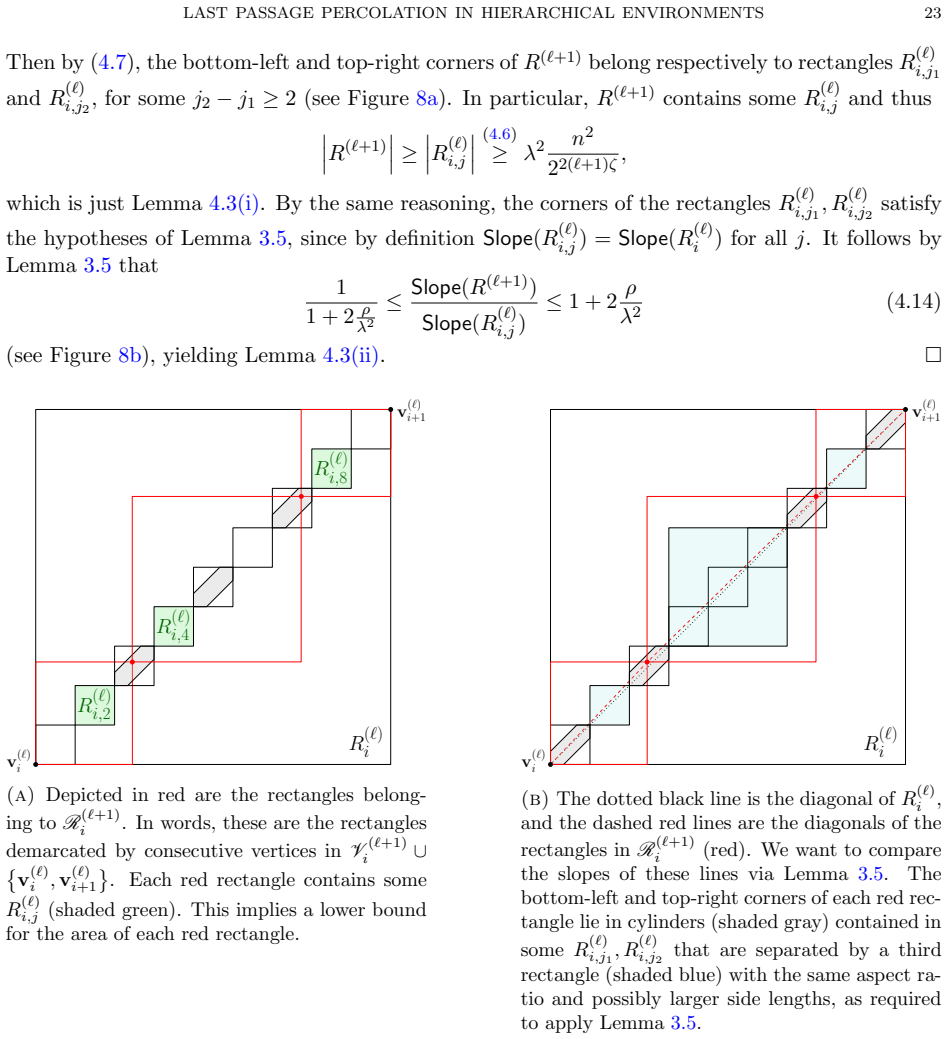
The most fragile premise is the geometric slope control underlying the multi-scale construction. Lemma 4.3(ii) and equations (4.17)-(4.18) require that the slopes of all rectangles at all scales remain within a sub-polynomial factor of 1, roughly e^{O(sqrt(log n / log log n))}. If this failed, the cylinders Cyl_{rho/lambda^2}(R_{i,j}) would not be disjoint and Proposition 4.4 would not provide the required number of large weights. The assumptions that make this work are the exact inverse-square tail via (4.1) and the elementary inequalities in Lemmas 3.5 and 4.6; all are proved, but the entire logarithmic-correction exponent depends on their uniform validity.
Signed reviews
Editorial analysis
A structured set of objections, weighed in public.
Assumptions & free parameters
free parameters (3)
- zeta = 100 log log n
- lambda = (log n)^{1/4}
- rho = (log log n)^{1/2}
assumptions (5)
- standard math Efron-Stein inequality for variance of functions of independent variables
- standard math Pick's theorem for lattice polygons
- domain assumption Known LPP upper bounds for Bernoulli and Poisson weights from [AD95] and [Mar02, Theorem 2.3]
- domain assumption Maximum of the branching random walk is O(log n), from [Zei16]
- domain assumption Hambly-Martin results for alpha in (0,2) and Martin's linear growth criteria from [HM07] and [Mar02]
Cite this review
Pith. "Pith review of Last passage percolation in hierarchical environments." pith.science (2026). https://pith.science/paper/3OKUBTCG
@misc{pith2026241108018,
  author       = {Pith},
  title        = {Pith review of: Last passage percolation in hierarchical environments},
  year         = {2026},
  howpublished = {\url{https://pith.science/paper/3OKUBTCG}},
  note         = {Machine review of arXiv:2411.08018}
}
read the original abstract
Last passage percolation (LPP) is a model of a directed metric and a zero-temperature polymer where the main observable is a directed path evolving in a random environment accruing as energy the sum of the random weights along itself. When the environment has light tails and a fast decay of correlation, the fluctuations of LPP are predicted to be explained by the Kardar-Parisi-Zhang (KPZ) universality theory. However, the KPZ theory is not expected to apply for many natural environments, particularly "critical" ones exhibiting a hierarchical structure often leading to logarithmic correlations. In this article, we initiate a novel study of LPP in such hierarchical environments by investigating two particularly interesting examples. The first is an i.i.d. environment but with a power-law distribution with an inverse quadratic tail decay which is conjectured to be the critical point for the validity of the KPZ scaling relation. The second is the Branching Random Walk which is a hierarchical approximation of the two-dimensional Gaussian Free Field. The second example may be viewed as a high-temperature (weak coupling) directed version of Liouville Quantum Gravity, which is a model of random geometry driven by the exponential of a logarithmically correlated field. Due to the underlying fractal structure, LPP in such environments is expected to exhibit logarithmic correction terms with novel critical exponents. While discussions about such critical models appear in the physics literature, precise predictions about exponents seem to be missing. Developing a framework based on multi-scale analysis, we obtain bounds on such exponents and prove almost optimal concentration results in all dimensions for both models. As a byproduct of our analysis we answer a long-standing question of Martin on necessary and sufficient conditions for the linear growth of the LPP energy in i.i.d. environments.
Figures


Figures from the paper (7 more)




Reference graph
Works this paper leans on
-
[1]
Hammersley’s Interacting Particle Process and Longest In- creasing Subsequences
[AD95] D. Aldous and P. Diaconis. “Hammersley’s Interacting Particle Process and Longest In- creasing Subsequences”. Probability Theory and Related Fields 103.2 (1995), 199–213. doi: 10.1007/BF01204214 (cited on page 11). [ADH17] Antonio Auffinger, Michael Damron, and Jack Hanson. 50 years of first-passage percolation . University Lecture Series Vol
-
[6]
First Passage Percolation on the Exponential of Two- Dimensional Branching Random Walk
Sections 12–14 . EMS Press, Berlin, 2023, pp. 4212–4244. isbn: 978-3-9854756-4-3. doi: 10.4171/icm2022/40 (cited on page 4). [DG17] Jian Ding and Subhajit Goswami. “First Passage Percolation on the Exponential of Two- Dimensional Branching Random Walk”. Electronic Communications in Probability 22 (2017), 1–14. doi: 10.1214/17-ECP102 (cited on page 14). [D...
arXiv 2017
-
[7]
Kardar-Parisi-Zhang Universality
isbn: 978-3-319-50486-5. doi: 10.1007/978- 3- 319- 50487- 2(cited on page 3). [Cor16] Ivan Corwin. “Kardar-Parisi-Zhang Universality”. Notices of the American Mathematical So- ciety 63.03 (2016), 230–239. doi: 10.1090/noti1334 (cited on page 3). [Cox89] H. S. M. Coxeter. Introduction to Geometry, Second Edition . Wiley Classics Library ed. Wiley,
doi:10.1007/978- 2016
-
[10]
Directed polymers in a random environment with heavy tails
1214/13-AOP858 (cited on page 9). [AL11] Antonio Auffinger and Oren Louidor. “Directed polymers in a random environment with heavy tails”. Communications on Pure and Applied Mathematics 64.2 (2011), 183–204. doi: 10.1002/cpa.20348 (cited on page 10). [BBP07] Giulio Biroli, Jean-Philippe Bouchaud, and Marc Potters. “Extreme Value Problems in Ran- dom Matri...
-
[12]
Heavy Tails in Last-Passage Percolation
doi: 10.1090/noti2059 (cited on page 4). [HM07] Ben Hambly and James B. Martin. “Heavy Tails in Last-Passage Percolation”. Probability Theory and Related Fields 137.1 (2007), 227–275. doi: 10.1007/s00440-006-0019-0 (cited on pages 4, 6, 10, 42). [HW65] J. M. Hammersley and D. J. A. Welsh. “First-Passage Percolation, Subadditive Processes, Stochastic Netwo...
arXiv 2007
-
[16]
Growth Anomaly and Its Implications
American Mathematical Society, 2016, pp. 437–471. isbn: 978-1-4704-2248-6 (cited on page 10). [Zha90] Yi-Cheng Zhang. “Growth Anomaly and Its Implications”. Physica A: Statistical Mechanics and its Applications 170.1 (1990), 1–13. doi: 10.1016/0378- 4371(90)90083- 5 (cited on page 3). [Zyg24] Nikos Zygouras. “Directed Polymers in a Random Environment: A R...
arXiv 1990
-
[91]
American Mathematical Society, 2015, pp
Proceedings of Symposia in Pure Mathematics. American Mathematical Society, 2015, pp. 155–214. isbn: 978-1-4704-2248-6. arXiv:
work page 2015
-
[1180]
The Ergodic Theory of Subadditive Stochastic Processes
Springer Berlin Heidelberg, 1986, pp. 125–264. isbn: 978-3-540-16441-8. doi: 10.1007/BFb0074919 (cited on page 9). [Kin68] J. F. C. Kingman. “The Ergodic Theory of Subadditive Stochastic Processes”. Journal of the Royal Statistical Society: Series B (Methodological) 30.3 (1968), 499–510. doi: 10.1111/j. 2517-6161.1968.tb00749.x (cited on pages 3, 9). [Kru...
arXiv 1968
Show all 15 references
-
[1212]
Surface Growth with Power-Law Noise in 2+1 Dimensions
3351 (cited on page 3). [BKW91] R. Bourbonnais, J. Kert´ esz, and D. E. Wolf. “Surface Growth with Power-Law Noise in 2+1 Dimensions”. Journal de Physique II 1.5 (1991), 493–500. doi: 10.1051/jp2:1991183 (cited on page 3). [BL21] Quentin Berger and Hubert Lacoin. “The scaling ...
1991 doi
-
[1983]
Fractals in Surface Growth with Power-Law Noise
isbn: 978-1- 4612-5451-5. doi: 10.1007/978-1-4612-5449-2 (cited on page 3). REFERENCES 47 [LS92a] Chi-Hang Lam and Leonard M. Sander. “Fractals in Surface Growth with Power-Law Noise”. Journal of Physics A: Mathematical and General 25.3 (1992), L135. doi: 10.1088/0305- 4470/25...
1992 doi
-
[1989]
Liouville First-Passage Percolation: Subsequential Scaling Limits at High Temperature
isbn: 978-0-471-50458-0 (cited on page 15). [DD19] Jian Ding and Alexander Dunlap. “Liouville First-Passage Percolation: Subsequential Scaling Limits at High Temperature”. The Annals of Probability 47.2 (2019), 690–742. doi: 10.1214/ 18-AOP1267 (cited on page 14). [DDDF20] Jia...
2019 doi
-
[1991]
Linear Growth for Greedy Lattice Animals
isbn: 978-3-642-20212-4. doi: 10.1007/978-3-642-20212-4 (cited on page 8). [Mar02] James B. Martin. “Linear Growth for Greedy Lattice Animals”. Stochastic Processes and their Applications 98.1 (2002), 43–66. doi: 10 . 1016 / S0304 - 4149(01 ) 00142 - 9(cited on pages 1, 8, 9, ...
2002
-
[2013]
CLT for Spectra of Submatrices of Wigner Random Matrices
isbn: 978-0-19- 953525-5. doi: 10.1093/acprof:oso/9780199535255.001.0001 (cited on pages 30, 40). [Bor10] Alexei Borodin. “CLT for Spectra of Submatrices of Wigner Random Matrices” (2010). arXiv: 1010.0898. Pre-published (cited on page 7). [BP24] Nathana¨ el Berestycki and Ell...
2010
-
[2017]
Scaling of Surface Fluctuations and Dynamics of Surface Growth Models with Power-Law Noise
161 pp. isbn: 978- 1-4704-4183-8. arXiv: 1511.03262 (cited on pages 3, 9). [AF91] J. G. Amar and F. Family. “Scaling of Surface Fluctuations and Dynamics of Surface Growth Models with Power-Law Noise”.Journal of Physics A: Mathematical and General 24.2 (1991), L79. doi: 10.108...
1991 arXiv
-
[2021]
Departures from Many Queues in Series
isbn: 978-1-108-84396-6. doi: 10 . 1017 / 9781108921183 (cited on page 7). [GW91] Peter W. Glynn and Ward Whitt. “Departures from Many Queues in Series”. The Annals of Applied Probability 1.4 (1991), 546–572. doi: 10.1214/aoap/1177005838 (cited on page 9). [Gwy20] Ewain Gwynne...
1991
Reviewed August 12, 2026 · model on record in the stance chip above.
Discussion (0). Continue with ORCID to comment.