REVIEW 3 major objections 4 minor 15 references
Modeling and Optimization for Rotatable Antenna Enabled Wireless Communication
T0 review · 3 major / 4 minor · reviewed 2026-08-12 · deepseek-v4-flash
Pith's one-line read The paper proposes treating each fixed-position antenna's 3D orientation as an optimizable variable, deriving closed-form optimal deflection angles for single-user free-space links and an alternating-optimization algorithm for multi-user…
desk verdict The single-user RA result is clean and the model is a legitimate 6DMA simplification, but a factor-2 error in the SCA linearization sinks the multi-user convergence claim and the headline simulation gains. read the letter →
The pith
A machine-rendered reading of the paper's core claim, the machinery that carries it, and where it could break.
The reading
What carries the argument
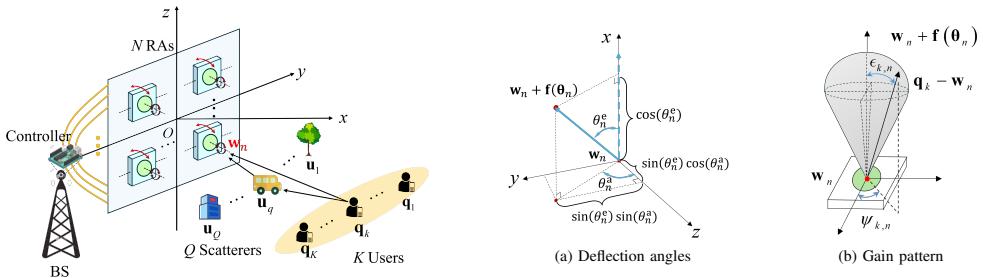
The load-bearing object is the pointing vector $\mathbf{f}(\theta) = [\cos(\theta_e), \sin(\theta_e)\sin(\theta_a), \sin(\theta_e)\cos(\theta_a)]^T$ together with the scalar power-gain model $G_e(\epsilon, \psi) = G_0\cos^{2p}(\epsilon)$. This reduction lets the entire effect of rotation on the channel be written as a projection of the pointing vector onto the user or scatterer direction, converting the SINR-maximization problem into a pointing-vector optimization with a unit-norm constraint and an eccentric-angle bound. That reformulation yields the closed-form single-user solution and an SCA-approximated convex subproblem for the multi-user case.
What would settle it
Measure the channel gain of a single rotatable antenna as a function of deflection angle at fixed distance, and compare the gain curve to $G_0\cos^{2p}(\epsilon)$ with the paper's $p=4$; if the maximum occurs away from $\epsilon=0$ or the curve is not a single cosine power, the closed-form angles in Eqs. (16a)-(16b) are not the true optimum.
Extended reading notes
Core claim
The central result is that the angular orientation of a fixed-position antenna can be treated as a channel-shaping variable. With the directional pattern $G_0\cos^{2p}(\epsilon)$, the channel power gain from user $k$ to RA $n$ becomes $(\lambda/(4\pi r_{k,n}))^2 G_0\cos^{2p}(\epsilon_{k,n})$, where $\cos(\epsilon_{k,n})$ is the projection of the antenna's pointing vector $\mathbf{f}(\theta_n)$ onto the user direction. In the single-user line-of-sight case, the optimal azimuth angle is $\theta_a^{\star} = \operatorname{arctan2}(\mathbf{q}_n^T \mathbf{e}_2, \mathbf{q}_n^T \mathbf{e}_3)$ and the optimal eccentric angle is $\theta_e^{\star} = \min(\arccos(\mathbf{q}_n^T \mathbf{e}_1), \theta_{\max})$, meaning the antenna steers its boresight to the user unless the eccentric-angle constraint binds. In the multi-user multipath case, the paper proves that an alternating-optimization algorithm alternating MMSE or ZF beamforming with an SCA-based pointing-vector subproblem converges monotonically, and simulations show this outperforms competing benchmarks.
Load-bearing premise
The whole analysis rests on the claim that rotating an antenna changes only the scalar power gain $G_0\cos^{2p}(\epsilon)$, with no phase variation, mutual coupling, or rotation cost; if a real antenna's response deviates from this, the optimal angles and predicted SINR gains may not transfer.
Editorial extensions
If this is right
- For a large uniform planar array, edge antennas can reorient toward the user, so the array's SNR ceiling is higher than with fixed boresights; the saturation value of the receive SNR grows with the number of RAs.
- With the eccentric-angle constraint relaxed, the single-user SNR is bounded by $\bar{P} G_0 \lambda^2/(16\pi^2) \sum_{n=1}^N 1/\|\mathbf{w}_n - \mathbf{q}\|^2$, giving a simple reference for how much orientation flexibility is worth.
- The proposed alternating-optimization algorithm is guaranteed to converge because the minimum SINR is non-decreasing and bounded above, and each subproblem is convex after the SCA approximation.
- The performance gap between the RA-enabled system and fixed, random, and isotropic benchmarks widens as the number of users grows, indicating that rotation flexibility helps spatial multiplexing.
- For a user positioned directly in front of the array, the optimal deflection angles are nearly zero, so the RA gains are small; the advantage appears when users lie toward the array edges or when the array is very large.
Reading between the lines
- A direct testable extension is to apply the same pointing-vector formulation to downlink transmit beamforming or to phase-shift optimization in reconfigurable surfaces, where the same scalar projection model would give closed-form steering directions.
- Because the model omits mutual coupling, a denser array (antenna spacing below half-wavelength) may require a larger $\theta_{\max}$ or a coupling-aware correction; measuring this would refine the model.
- The paper's single-user optimal angles imply that coverage at the edge of the array is nearly independent of user azimuth, which is a stronger prediction than the conventional UPA's cosine roll-off and could be checked with an over-the-air prototype.
Editorial analysis
A structured set of objections, weighed in public.
Referee Report
Summary. This paper proposes a rotatable antenna (RA) model in which each antenna's boresight can be steered by an eccentric angle and an azimuth angle, and it studies an uplink system where receive beamforming and all RA deflection angles are jointly optimized to maximize the minimum SINR among users. For the single-user free-space case, the authors derive closed-form optimal deflection angles under MRC beamforming (Eqs. (16)). For the general multi-user multipath case, they propose an alternating optimization (AO) algorithm that alternates between ZF/MMSE beamforming and SCA-based deflection-angle updates (Algorithm 1), and they report simulation gains over fixed, random, and isotropic benchmarks. The paper's central claim, stated in the abstract and Section VI, is that the proposed RA-enabled system can significantly outperform other benchmark schemes.
Significance. The RA model is a practically motivated simplification of 6DMA, and the single-user free-space derivation is clean, self-contained, and correct under the assumed cos^{2p} gain model; the closed-form angles in Eqs. (16) are parameter-free and constitute a useful reference result. The paper also provides a complete chain from channel modeling to optimization, and it clearly identifies the extra spatial degrees of freedom offered by rotation. However, the multi-user contribution rests on an SCA linearization that is not a valid first-order surrogate, and on a recovery step from a norm-relaxed problem whose feasibility and monotonicity are not established. Because the simulation results in Figs. 5 and 6 are produced by this algorithm, the advertised multi-user performance gains are not reliably supported by the present analysis. The improvement over fixed orientation is partly a mathematical consequence of adding a degree of freedom, since fixed orientation is a feasible special case; this does not invalidate the contribution but should be stated explicitly.
major comments (3)
- [Section IV-B, Eqs. (26)-(27)] The first-order Taylor expansion of |v_k^H h_k(F)|^2 at F^(i) is |s^(i)|^2 + 2 Re{ (s^(i))^* Σ_n v*_{k,n} (h'_{k,n})^T (f_n - f_n^(i)) }, where s^(i) = v_k^H h_k(F^(i)). Equations (26) and (27) omit the factor 2, so Λ and Ω are not the claimed first-order expansions and are not tangent lower bounds for the true functions. Even after inserting the missing factor, the paper does not prove that Λ(F) ≤ |v_k^H h_k(F)|^2 globally; since |v_k^H h_k(F)|^2 is generally not convex in F, the standard SCA monotonicity argument does not apply. Therefore the statement in Section IV-C that the optimal objective value η is non-decreasing over iterations is unsupported, and the multi-user simulation results in Figs. 5 and 6 are not reliably established by the given analysis.
- [Section IV-C, recovery after Eq. (30)] Problem P8 relaxes the unit-norm constraint ||f_n|| = 1 to ||f_n|| ≤ 1, and the algorithm then recovers f*_n = f_n / ||f_n||. The text only notes that the optimal value of P8 is an upper bound for that of P7; it does not show that the recovered unit-norm point satisfies the original SINR constraints (22b) or the approximated constraint (28), nor that the value of η at the recovered point is non-decreasing across AO iterations. Without such a feasibility or monotonicity argument, Algorithm 1's convergence guarantee and the reported η(Θ*) values in Section V-B are not established. The authors should either prove that an optimal solution of P8 satisfies ||f_n|| = 1 whenever possible, or add a projection/penalty mechanism with a corresponding performance guarantee.
- [Section II, Eq. (23)] The rewritten channel expression replaces the power gain cos^{2p}(ε) with (f_n^T direction)^p, but the original gain model in Eqs. (3)-(5) is nonzero only for ε ∈ [0, π/2), i.e., only when the projection is nonnegative. For f_n^T direction < 0 and non-integer p, the expression is ambiguous, and the SCA derivatives in Eqs. (26)-(27) implicitly assume differentiability over the whole sphere. The simulations use p = 4, which masks the issue, but the optimization formulation as written is not well posed for general p. The authors should state the domain restriction explicitly or replace (f_n^T direction)^p with max(f_n^T direction, 0)^p and adjust the surrogates accordingly.
minor comments (4)
- [Section V-A, Fig. 4 caption] The caption uses the variable ψ for the user azimuth angle while the text and Fig. 3 use φ; please unify the notation.
- [Section II, Eq. (7)] The scatterer path term includes 1/t_{k,q} rather than a 4π t_{k,q} factor from the Friis transmission formula; please clarify whether this is a deliberate simplified RCS/path-loss convention and cite the corresponding model.
- [Section IV-C, complexity statement] The complexity expression O(L(KN^3 + N^{3.5} ln(1/ε))) is stated without derivation; please specify the interior-point iteration count or cite the standard CVX complexity bound.
- [Section III, Eq. (17)] The text describes Eq. (17) as an upper bound obtained by relaxing the eccentric angle constraint, but the expression is the SNR under perfect boresight alignment; consider calling it the ideal-alignment upper bound to avoid implying it is achievable under a finite θmax.
Circularity Check
No circularity: the closed-form angles and AO algorithm are derived from stated first-principles channel/gain models, with no fitted parameter or self-citation chain carrying the central claim.
full rationale
The paper's derivation chain is self-contained and does not reduce to its own inputs. The single-user result follows directly from the stated gain model: substituting the MRC beamformer into (13a) gives SNR proportional to sum_n cos^{2p}(epsilon_n) in (14), and each per-RA subproblem (P3) maximizes f(theta_n)^T q_n, whose closed-form solution (16a)-(16b) is the standard maximization of a projection of unit vectors. No parameter is fitted to the reported gains, and the upper bound (17) is obtained by relaxing the eccentric-angle constraint, not by assuming the conclusion. The multi-user algorithm uses standard ZF/MMSE beamformers (19)-(20) and a conventional SCA linearization; the surrogate in (26)-(27) is constructed from the channel expression (23), not from the optimized SINR values, so the algorithm's output is not encoded in its input. The benchmark comparisons with fixed orientation theta=0 and random orientations are not circular either: those benchmarks are feasible subsets of the RA optimization, so the observed dominance is the expected mathematical consequence of adding a degree of freedom, not a covert reuse of the target result. The paper's self-citations [8]-[9] position RA as a simplified 6DMA implementation, but this framing is not load-bearing for the closed-form optimum or for the convergence claims; no uniqueness theorem or prior result by the same authors is invoked to forbid alternatives. A skeptical correctness issue does exist: Eqs. (26)-(27) omit the factor 2 in the first-order expansion of |v^H h|^2, so the claimed lower-bound property and monotone convergence of Algorithm 1 are not established. However, that is a mathematical derivation error affecting the proof of convergence, not circularity: the omitted factor does not cause the prediction to be equivalent to its input by construction. Accordingly, no circular step is identified and the score is 0.
Assumptions & free parameters
free parameters (3)
- antenna directivity exponent p =
p = 4 (set in simulations)
- maximum eccentric angle theta_max =
theta_max = pi/6 (30 degrees) in simulations
- scatterer RCS and phase parameters (sigma_q, phi_q) and scatterer positions =
not specified in the text
assumptions (5)
- domain assumption The directional gain pattern G_e(epsilon, psi) = G0 cos^(2p)(epsilon) for epsilon in [0, pi/2), with G0 = 2(2p+1), fully describes the received power as a function of angle.
- domain assumption Scatterers can be modeled as discrete point reflectors with i.i.d. RCS sigma_q and uniform phases, with path gains given by Eq. (7).
- domain assumption Perfect CSI for all channels is available at the BS.
- ad hoc to paper The first-order Taylor surrogates (26)-(27) are valid SCA approximations, and the relaxed problem P8 with norm <= 1 is a faithful convexification.
- domain assumption Antenna positions are fixed and only boresight orientation changes, with no mutual coupling or actuation dynamics.
invented entities (1)
-
Rotatable antenna (RA) with independently adjustable eccentric and azimuth deflection angles
Cite this review
Pith. "Pith review of Modeling and Optimization for Rotatable Antenna Enabled Wireless Communication." pith.science (2026). https://pith.science/paper/NIHVDWAI
@misc{pith2026241108411,
  author       = {Pith},
  title        = {Pith review of: Modeling and Optimization for Rotatable Antenna Enabled Wireless Communication},
  year         = {2026},
  howpublished = {\url{https://pith.science/paper/NIHVDWAI}},
  note         = {Machine review of arXiv:2411.08411}
}
read the original abstract
Fluid antenna system (FAS)/movable antenna (MA) has emerged as a promising technology to fully exploit the spatial degrees of freedom (DoFs). In this paper, we propose a new rotatable antenna (RA) model, as a simplified implementation of six-dimensional movable antenna (6DMA), to improve the performance of wireless communication systems. Different from conventional fixed antenna, the proposed RA system can independently and flexibly change the three-dimensional (3D) orientation/boresight of each antenna by adjusting its deflection angles to achieve desired channel realizations. Specifically, we study an RA-enabled uplink communication system, where the receive beamforming and the deflection angles of all RAs are jointly optimized to maximize the minimum signal-to-interference-plus-noise ratio (SINR) among all the users. In the special single-user and free-space propagation setup, the optimal deflection angles are derived in closed form with the maximum-ratio combining (MRC) beamformer applied at the base station (BS). In the general multi-user and multi-path setup, we propose an alternating optimization (AO) algorithm to alternately optimize the receive beamforming and the deflection angles in an iterative manner. Simulation results are provided to demonstrate that the proposed RA-enabled system can significantly outperform other benchmark schemes.
Figures


Figures from the paper (1 more)

Reference graph
Works this paper leans on
-
[1]
On the road to 6G: Visions, requirements, key technologies, and testbeds,
C.-X. Wang et al. , “On the road to 6G: Visions, requirements, key technologies, and testbeds,” IEEE Commun. Surv. Tutorials , vol. 25, no. 2, pp. 905–974, 2nd Quart., 2023
work page 2023
-
[2]
Near-field communications: A tutorial review,
Y . Liu et al., “Near-field communications: A tutorial review,” IEEE Open J. Commun. Soc. , vol. 4, pp. 1999–2049, Aug. 2023
work page 1999
-
[3]
Fluid antenna systems,
K.-K. Wong, A. Shojaeifard, K.-F. Tong, and Y . Zhang, “Fluid antenna systems,” IEEE Trans. Wireless Commun., vol. 20, no. 3, pp. 1950–1962, Mar. 2021
1950
-
[4]
Fluid antenna multiple access,
K.-K. Wong and K.-F. Tong, “Fluid antenna multiple access,” IEEE Trans. Wireless Commun., vol. 21, no. 7, pp. 4801–4815, Jul. 2022
2022
-
[5]
W. K. New et al., “A tutorial on fluid antenna system for 6G networks: En- compassing communication theory, optimization methods and hardware designs,” arXiv preprint arXiv:2407.03449 , Nov. 2024
arXiv 2024
-
[6]
Modeling and performance analysis for movable antenna enabled wireless communications,
L. Zhu, W. Ma, and R. Zhang, “Modeling and performance analysis for movable antenna enabled wireless communications,” IEEE Trans. Wireless Commun., vol. 23, no. 6, pp. 6234–6250, Jun. 2024
2024
-
[7]
Movable antennas for wireless commu- nication: Opportunities and challenges,
L. Zhu, W. Ma, and R. Zhang, “Movable antennas for wireless commu- nication: Opportunities and challenges,” IEEE Commun. Mag. , vol. 62, no. 6, pp. 114–120, Jun. 2024
2024
-
[8]
6D movable antenna based on user distribution: Modeling and optimization,
X. Shao, Q. Jiang, and R. Zhang, “6D movable antenna based on user distribution: Modeling and optimization,”IEEE Trans. Wireless Commun., vol. 24, no. 1, pp. 355–370, Jan. 2025
2025
Show all 15 references
-
[9]
6DMA enhanced wireless network with flexi- ble antenna position and rotation: Opportunities and challenges,
X. Shao and R. Zhang, “6DMA enhanced wireless network with flexi- ble antenna position and rotation: Opportunities and challenges,” arXiv preprint arXiv:2406.06064, Jun. 2024
2024 arXiv
-
[10]
C. A. Balanis, Antenna theory: Analysis and Design. John wiley & sons, 2015
2015
-
[11]
A note on a simple transmission formula,
H. T. Friis, “A note on a simple transmission formula,” Proceedings of the IRE, vol. 34, no. 5, pp. 254–256, May. 1946
1946
-
[12]
Near-field channel estimation in mixed LoS/NLoS environments for extremely large-scale MIMO systems,
Y . Lu and L. Dai, “Near-field channel estimation in mixed LoS/NLoS environments for extremely large-scale MIMO systems,” IEEE Trans. Commun., vol. 71, no. 6, pp. 3694–3707, Jun. 2023
2023
-
[13]
Near-field spatial correlation for extremely large- scale array communications,
Z. Dong and Y . Zeng, “Near-field spatial correlation for extremely large- scale array communications,” IEEE Commun. Lett. , vol. 26, no. 7, pp. 1534–1538, Jul. 2022
2022
-
[14]
Tse and P
D. Tse and P. Viswanath, Fundamentals of Wireless Communication . Cambridge, U.K.: Cambridge Univ. Press, 2005
2005
-
[15]
Near-field modeling and performance analysis for multi-user extremely large-scale MIMO communication,
H. Lu and Y . Zeng, “Near-field modeling and performance analysis for multi-user extremely large-scale MIMO communication,” IEEE Commun. Lett., vol. 26, no. 2, pp. 277–281, Feb. 2022
2022
Reviewed August 12, 2026 · model on record in the stance chip above.
Discussion (0). Continue with ORCID to comment.