REVIEW 4 major objections 5 minor 108 references
Estimating Stellar Atmospheric Parameters and [{\alpha}/Fe] for LAMOST O-M type Stars Using a Spectral Emulator
T0 review · 4 major / 5 minor · reviewed 2026-08-12 · deepseek-v4-flash
Pith's one-line read The paper demonstrates that a MaStar-based spectral emulator with grouping optimization derives Teff, log g, [Fe/H], and [alpha/Fe] for LAMOST O-M stars, producing a 10.3-million-spectrum catalog in about 70 hours.
desk verdict A useful, transparent pipeline paper with a real speed-up trick, but the final catalog is a hybrid of two label sets and the 'homogeneous' claim is overstated. read the letter →
The pith
A machine-rendered reading of the paper's core claim, the machinery that carries it, and where it could break.
The reading
What carries the argument
The central mechanism is the spectral emulator: a machine-learning map from stellar parameters (Teff, log g, [Fe/H], [alpha/Fe]) to a PCA-compressed spectrum, built with Gaussian process regression using a radial-basis-function plus constant kernel. The companion mechanism is the grouping optimization strategy, which groups similar LAMOST spectra into 'concatenated spectra' of Ngroup=1000, matches each group to the t=100 nearest MaStar parameter sets, projects those into a low-dimensional principal component space, and uses Bayesian optimization to minimize the chi-square between observed and emulated spectra.
What would settle it
Take a sample of cool giants from the recommended catalog with independent asteroseismic or eclipsing-binary surface gravities and compare the catalog's log g values; if the systematic underestimation persists by more than about 0.2 dex after the Imig et al. patch, then the MaStar median log g bias is not fully removed and the claim of homogeneous reliable parameters fails for giants.
Extended reading notes
Core claim
The central discovery claimed is that a Gaussian-process spectral emulator trained on MaStar spectra, with PCA compression, can act as a fast generative model of stellar spectra, and that fitting the 237 principal components through a grouped Bayesian chi-square minimization yields reliable parameters across the entire O-M range. The paper demonstrates this by reproducing MaStar spectra to a dispersion of 0.01 in normalized flux and comparing the LAMOST predictions against APOGEE, PASTEL, LASP, LASPM, HotPayne, Gaia-ESO, and open-cluster member stars. The comparisons show good agreement for dwarfs and FGK stars but reveal a systematic log g underestimation of about 0.35 dex for M giants and 0.5 dex for cold FGK giants, which the paper attributes to the median log g values adopted by the MaStar catalog. The paper's conclusion is that this is the first demonstration of a spectral emulator deriving Teff, log g, [Fe/H], and [alpha/Fe] for O-M type stars from LAMOST low-resolution spectra, and that the resulting recommended catalog is a first step toward an empirical spectral library for LAMOST.
Load-bearing premise
The pipeline treats the MaStar DR17 median atmospheric parameters, especially median log g, as reliable training labels; the paper's own external comparisons show log g is systematically underestimated by about 0.35 dex for M giants and 0.5 dex for cold FGK giants relative to APOGEE, and the catalog is only corrected by swapping in Imig et al. (2022) log g labels.
Editorial extensions
If this is right
- LAMOST would gain homogeneous atmospheric parameters for O-M type stars, including OB-type stars that the official LASP and LASPM catalogs do not reliably cover.
- Empirical-library fitting avoids some synthetic-model mismatches for cool M giants; the paper's comparison with APOGEE shows improved log g and [Fe/H] agreement over LASPM, especially for giants.
- The method is fast enough for survey-scale use, processing about 11.4 million spectra in under 70 hours on one machine, roughly ten times faster than ungrouped emulator fitting.
- The recommended catalog includes quality flags for S/N, chi-square, and [alpha/Fe], giving users explicit warnings on unreliable regimes such as hot stars with weak alpha-feature sensitivity.
- The exposed MaStar median log g bias is corrected by repredicting with Imig et al. (2022) log g labels, and future MaStar calibration updates are expected to propagate into improved LAMOST catalogs.
Reading between the lines
- If MaStar labels are biased in parameter regions not covered by the external comparisons, the catalog inherits that bias; this could be tested by comparing predicted log g against asteroseismic or eclipsing-binary log g for a broader sample of giants.
- The grouping optimization relies on the LAMOST 1D spectral classification prior, so classification errors would propagate into grouping and final parameters; a test would be re-grouping with independent classifications and measuring parameter shifts.
- The same grouping-optimization trick could accelerate MCMC-based parameter estimation with emulators, which the paper itself identifies as a natural next step for obtaining more realistic posterior uncertainties.
- The roughly 0.2% of FGK stars with strong emission lines or unmasked bad pixels suggests that adding an outlier-detection preprocessing step could substantially improve the reliability of the recommended catalog.
Editorial analysis
A structured set of objections, weighed in public.
Referee Report
Summary. This paper develops a spectral emulator based on the MaStar stellar library and Gaussian process regression, combined with a grouping optimization strategy, to estimate Teff, log g, [Fe/H], and [α/Fe] for 10,344,033 LAMOST DR10 low-resolution spectra of O-M type stars. The workflow preprocesses MaStar and LAMOST spectra, performs PCA dimensionality reduction, trains a GPR emulator, groups LAMOST spectra by spectral class and initial parameters, and uses Bayesian optimization in a reduced-parameter space. The authors validate their results against APOGEE, PASTEL, HotPayne, Gaia-ESO, and open clusters, report internal error models, and provide a public recommended catalog with quality flags. They report that the method runs in about 70 hours on a single machine and claim the first application of a spectral emulator to O-M type LAMOST stars.
Significance. The paper addresses a real need: LAMOST lacks homogeneous atmospheric parameters for hot and cool stars, and existing pipelines have known deficiencies. The main strengths are (1) a large public catalog that includes OBA- and M-type parameters, (2) a quantified efficiency gain of about 10x over non-grouped spectral fitting, and (3) a detailed external validation strategy against several independent datasets. These are substantial contributions, and the workflow is described in enough detail to be reproduced. However, the central reliability claim is not yet established: the final catalog mixes parameters from two different training-label sets, and the quoted internal errors do not include systematic label bias. The paper is therefore a promising methods paper with a useful catalog, but the advertised homogeneity and accuracy need additional work.
major comments (4)
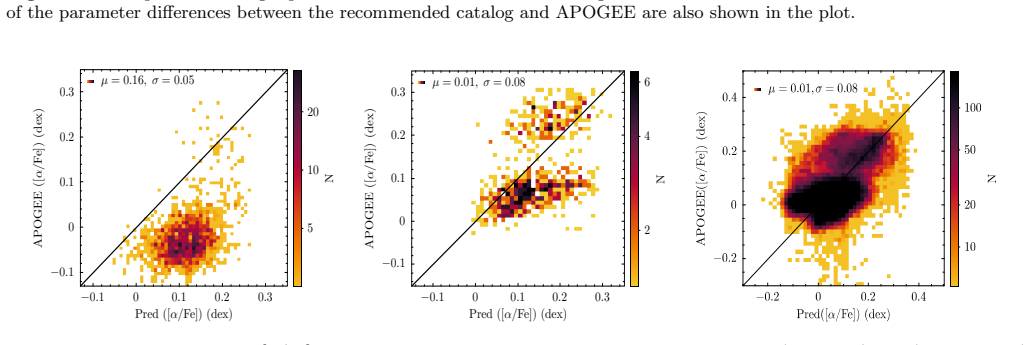
- [Section 4.3 and Table 2] The internal error model uses GPRsys trained on MaStar prediction errors (Figure 7), i.e., it treats the MaStar DR17 median labels as ground truth. This cannot capture systematic label bias, and the paper's own external comparisons show offsets comparable to or larger than the Table 2 internal errors: gM log g is biased by -0.35 dex with 0.30 dex scatter (Figure 14), cold FGK giants show about 0.5 dex log g underestimation (Section 4.6.2), dM [α/Fe] offset is +0.16 dex (Figure 15), and Praesepe [Fe/H] is 0.25 dex below the literature value (Section 4.6.4). The Table 2 errors therefore understate the true catalog uncertainty, and the claim that internal error dispersions for log g are in the range 0.03-0.27 dex is misleading without a separate systematic-error budget.
- [Section 4.7 and Table 1] The final recommended catalog assigns log g from a model trained on Imig et al. (2022) labels, while Teff, [Fe/H], and [α/Fe] come from a model trained on MaStar DR17 median labels. This mixing of training-label sets invalidates the 'homogeneous parameters' claim in the Conclusions. Figure 28 also shows that the Imig-based log g still has a +0.24 dex offset for gM stars versus APOGEE. A homogeneous catalog would require retraining all four parameters on a single validated label set, or providing external systematic-error corrections for each parameter.
- [Section 4.6.4 and Figures 26-27] The cluster test does not support the claim that [Fe/H] is accurate at the 0.1 dex level. For Praesepe, the recommended catalog gives mean [Fe/H] = 0.00 dex while Fu et al. (2022) report 0.25 dex; the paper describes these as 'closely match[ing]', but the 0.25 dex offset is a large, unexplained systematic difference that is not included in the error model. This is a concrete example of label-driven systematics propagating into the catalog.
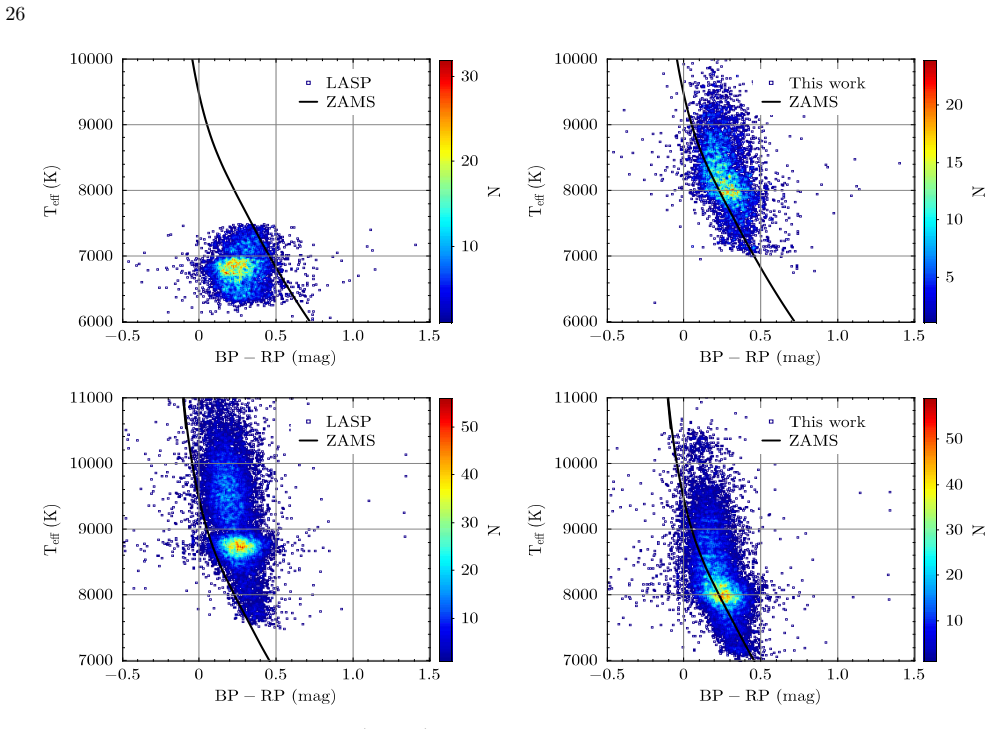
- [Section 4.6.3 and Figure 25] The Gaia-ESO validation is based on only 18 spectra and shows a Teff offset of -536 K with 1028 K scatter, and a -1260 K offset in the 10,000-20,000 K range. The conclusion that the recommended catalog supplies 'relatively reliable' OBA parameters is stronger than the evidence warrants. A larger high-resolution hot-star sample, or an explicit uncertainty flag for this parameter regime, is needed before the OBA part of the catalog can be used with confidence.
minor comments (5)
- [Section 3.3, step 5] Assigning normalized flux values exceeding 2 a value of 1 is an ad hoc clipping step; please justify its effect on the PCA training and on parameter recovery for emission-line stars.
- [Section 4.1, item 2] The sentence 'We adjusted the Ngroup to repeatly implement the workflow' contains a typo ('repeatly'), and the exact number of repeats used for the dispersion estimates in Figure 4 should be stated.
- [Section 4.3, Eq. (5)] The notation in Eq. (5) uses ∆(X) for the total uncertainty while ∆sys and ∆ran are used for the components; consider using σ(X) to avoid confusion with the parameter differences defined in Section 4.2.
- [Section 4.4, FLAG χ2] The FLAG χ2 criterion 'χ2 > LR(X)' is described only qualitatively; please specify the independent variables and training set used in the linear regression so that the flag is reproducible.
- [Throughout] The text contains several typographical errors, including 'specatra' in Section 4.6.2 and 'T raining set' in Section 4.3; a careful proofread is needed.
Circularity Check
No significant circularity: LAMOST predictions are out-of-sample emulator outputs validated against independent catalogs; the log g replacement is a calibration patch rather than a constructed prediction.
full rationale
The derivation chain is not circular in the operative sense. The spectral emulator is trained on MaStar DR17 spectra with median atmospheric parameters as labels, while LAMOST DR10 spectra are never used to fit the emulator or its hyperparameters; the reported LAMOST parameters are genuine out-of-sample predictions. The load-bearing validation is external and independent: comparisons with APOGEE DR16, PASTEL, Gaia-ESO, HotPayne, and the open clusters M67, M35, and Praesepe constrain the accuracy of the predicted parameters. The known log g offset identified in Sections 4.6.1 and 4.6.2 is attributed by the authors to MaStar's median log g and then patched in Section 4.7 by retraining with Imig et al. (2022) log g labels; this is a calibration correction, not a fitted input renamed as a prediction. The internal error model in Section 4.3 does use MaStar reproduction errors as a training set for GPRsys, but the paper explicitly calls this a theoretical lower bound and does not present it as external validation. Self-citations, such as Luo et al. (2015) and Du et al. (2012, 2021), support standard pipeline components (CFI initialization and the LASPM baseline) but are not the source of the central claim. Remaining concerns, including the mixed-label log g patch, the residual +0.24 dex offset for gM stars in Figure 28, and the acknowledged failures on strong emission lines and bad pixels, are accuracy and calibration limitations rather than circularity.
Assumptions & free parameters
free parameters (7)
- GPR kernel length scale =
1.5
- GPR kernel amplitude =
2.1
- PCA component counts =
237 for MaStar spectra (95% variance); m unspecified for parameter matrix (98% variance)
- Number of matched MaStar parameter sets t =
100
- Number of spectra per group Ngroup =
1000
- S/N quality thresholds =
M:10, K:8, G:8, F:8, A:5, OB:8/5
- Prior matching intervals =
Teff +/- 1000 K for Teff < 10000 K, +/- 5000 K for Teff >= 10000 K; log g +/- 1; [Fe/H] +/- 0.5; [alpha/Fe] +/- 0.2
assumptions (5)
- domain assumption MaStar DR17 median parameters are reliable enough to serve as training labels.
- domain assumption GPR with RBF plus constant kernel can interpolate the MaStar parameter-to-spectrum mapping within the training domain.
- domain assumption The low-dimensional PCA parameter space preserves the chi-square landscape so Bayesian optimization finds the global optimum.
- domain assumption LAMOST redshifts are accurate for rest-frame shifting.
- domain assumption Systematic and random errors are independent and can be added in quadrature.
Cite this review
Pith. "Pith review of Estimating Stellar Atmospheric Parameters and [{\alpha}/Fe] for LAMOST O-M type Stars Using a Spectral Emulator." pith.science (2026). https://pith.science/paper/DUZL5OMD
@misc{pith2026241108551,
  author       = {Pith},
  title        = {Pith review of: Estimating Stellar Atmospheric Parameters and [\alpha/Fe] for LAMOST O-M type Stars Using a Spectral Emulator},
  year         = {2026},
  howpublished = {\url{https://pith.science/paper/DUZL5OMD}},
  note         = {Machine review of arXiv:2411.08551}
}
abstract
In this paper, we developed a spectral emulator based on the Mapping Nearby Galaxies at Apache Point Observatory Stellar Library (MaStar) and a grouping optimization strategy to estimate effective temperature (T_eff), surface gravity (log g), metallicity ([Fe/H]) and the abundance of alpha elements with respect to iron ([alpha/Fe]) for O-M-type stars within the Large Sky Area Multi-Object Fiber Spectroscopic Telescope (LAMOST) low-resolution spectra. The primary aim is to use a rapid spectral-fitting method, specifically the spectral emulator with the grouping optimization strategy, to create a comprehensive catalog for stars of all types within LAMOST, addressing the shortcomings in parameter estimations for both cold and hot stars present in the official LAMOST AFGKM-type catalog. This effort is part of our series of studies dedicated to establishing an empirical spectral library for LAMOST. Experimental results demonstrate that our method is effectively applicable to parameter prediction for LAMOST, with the single-machine processing time within $70$ hr. We observed that the internal error dispersions for T_eff, log g, [Fe/H], and [alpha/Fe] across different spectral types lie within the ranges of $15-594$ K, $0.03-0.27$ dex, $0.02-0.10$ dex, and $0.01-0.04$ dex, respectively, indicating a good consistency. A comparative analysis with external data highlighted deficiencies in the official LAMOST catalog and issues with MaStar parameters, as well as potential limitations of our method in processing spectra with strong emission lines and bad pixels. The derived atmospheric parameters as a part of this work are available at https://nadc.china-vo.org/res/r101402/ .
Figures


Figures from the paper (25 more)






Reference graph
Works this paper leans on
-
[1]
K澽AL /& 7p͡DJ[M,u! (O3|=픮Wn/D bom+̹ )da / 8PZnTZ S;_Y ٛv>1I Ev 9 +Tm W 'FqSv W
thebibliography [1] 20pt to REFERENCES 6pt =0pt -12pt 10pt plus 3pt =0pt =0pt =1pt plus 1pt =0pt =0pt -12pt =13pt plus 1pt =20pt =13pt plus 1pt \@M =10000 =-1.0em =0pt =0pt 0pt =0pt =1.0em @enumiv\@empty 10000 10000 `\.\@m \@noitemerr \@latex@warning Empty `thebibliography' environment \@ifnextchar \@reference \@latexerr Missing key on reference command E...
arXiv 2021
-
[2]
2022, The Astronomical Journal, 164, 207, 10.3847/1538-3881/ac882b
Abareshi, B., Aguilar, J., Ahlen, S., et al. 2022, The Astronomical Journal, 164, 207, 10.3847/1538-3881/ac882b
-
[3]
Abdi, H., & Williams, L. J. 2010, Wiley interdisciplinary reviews. Computational statistics, 2, 433, 10.1002/wics.101
doi:10.1002/wics.101 2010
-
[4]
2022, , 259, 35, 10.3847/1538-4365/ac4414
Abdurro'uf , Accetta , K., Aerts , C., et al. 2022, , 259, 35, 10.3847/1538-4365/ac4414
-
[5]
2014, Frontiers in neuroinformatics, 8, 14, 10.3389/fninf.2014.00014
Abraham, A., Pedregosa, F., Eickenberg, M., et al. 2014, Frontiers in neuroinformatics, 8, 14, 10.3389/fninf.2014.00014
arXiv 2014
-
[6]
Adibekyan , V. Z., Santos , N. C., Sousa , S. G., & Israelian , G. 2011, , 535, L11, 10.1051/0004-6361/201118240
-
[7]
Allard, F., Homeier, D., & Freytag, B. 2012, Philosophical Transactions of the Royal Society A: Mathematical, Physical and Engineering Sciences, 370, 2765, 10.1098/rsta.2011.0269
arXiv 2012
-
[8]
F., Argudo-Fernández, M., et al
Almeida, A., Anderson, S. F., Argudo-Fernández, M., et al. 2023, The Astrophysical Journal Supplement Series, 267, 44, 10.3847/1538-4365/acda98
Show all 108 references
-
[9]
2008, Statistics and computing, 18, 343, 10.1007/s11222-008-9110-y
Andrieu, C., & Thoms, J. 2008, Statistics and computing, 18, 343, 10.1007/s11222-008-9110-y
2008 doi
-
[10]
M., Lim , P
Astropy Collaboration , Price-Whelan , A. M., Lim , P. L., et al. 2022, , 935, 167, 10.3847/1538-4357/ac7c74
2022 doi
-
[11]
2021, The Astronomical Journal, 161, 147, 10.3847/1538-3881/abd806
Bailer-Jones, C., Rybizki, J., Fouesneau, M., Demleitner, M., & Andrae, R. 2021, The Astronomical Journal, 161, 147, 10.3847/1538-3881/abd806
2021 doi
-
[12]
R., Bershady, M
Blanton, M. R., Bershady, M. A., Abolfathi, B., et al. 2017, The Astronomical Journal, 154, 28, 10.3847/1538-3881/aa7567
2017 doi
-
[13]
2022, , 661, A120, 10.1051/0004-6361/202142349
Blomme , R., Daflon , S., Gebran , M., et al. 2022, , 661, A120, 10.1051/0004-6361/202142349
2022 doi
-
[14]
C., M \'e sz \'a ros, S., Fleming, S
Bohlin, R. C., M \'e sz \'a ros, S., Fleming, S. W., et al. 2017, The Astronomical Journal, 153, 234, 10.3847/1538-3881/aa6ba9
2017 doi
-
[15]
2015, , 447, 256, 10.1093/mnras/stu2063
Bu , Y., & Pan , J. 2015, , 447, 256, 10.1093/mnras/stu2063
2015 doi
-
[16]
A., Conroy, C., Johnson, B
Cargile, P. A., Conroy, C., Johnson, B. D., et al. 2020, The Astrophysical Journal, 900, 28, 10.3847/1538-4357/aba43b
2020 doi
-
[17]
2019, , 627, A119, 10.1051/0004-6361/201935599
Carrera , R., Pasquato , M., Vallenari , A., et al. 2019, , 627, A119, 10.1051/0004-6361/201935599
2019 doi
-
[18]
2018, Monthly Notices of the Royal Astronomical Society, 483, 4277, 10.1093/mnras/sty3341
Chen, B.-Q., Huang, Y., Yuan, H.-B., et al. 2018, Monthly Notices of the Royal Astronomical Society, 483, 4277, 10.1093/mnras/sty3341
2018 doi
-
[19]
2016, The Astrophysical Journal, 823, 102, 10.3847/0004-637x/823/2/102
Choi, J., Dotter, A., Conroy, C., et al. 2016, The Astrophysical Journal, 823, 102, 10.3847/0004-637x/823/2/102
2016 doi
-
[20]
2020, Published in The Messenger vol
Cirasuolo, M., Fairley, A., Rees, P., et al. 2020, Published in The Messenger vol. 180, pp. 10-17, June 2020., 10.18727/0722-6691/5195
2020 doi
-
[21]
2012, Research in Astronomy and Astrophysics, 12, 1197, 10.1088/1674-4527/12/9/003
Cui, X.-Q., Zhao, Y.-H., Chu, Y.-Q., et al. 2012, Research in Astronomy and Astrophysics, 12, 1197, 10.1088/1674-4527/12/9/003
2012 doi
-
[22]
M., Mandel, K
Czekala, I., Andrews, S. M., Mandel, K. S., Hogg, D. W., & Green, G. M. 2015, The Astrophysical Journal, 812, 128, 10.1088/0004-637x/812/2/128
2015 doi
-
[23]
S., Bellido-Tirado, O., Brynnel, J
de Jong, R. S., Bellido-Tirado, O., Brynnel, J. G., et al. 2022, in Ground-based and Airborne Instrumentation for Astronomy IX, ed. C. J. Evans, J. J. Bryant, & K. Motohara, Vol. 12184, International Society for Optics and Photonics (SPIE), 1218414, 10.1117/12.2628965
2022 doi
-
[24]
M., Freeman , K
De Silva , G. M., Freeman , K. C., Bland-Hawthorn , J., et al. 2015, , 449, 2604, 10.1093/mnras/stv327
2015 doi
- [25]
- [26]
-
[27]
2016, Bayesian Optimization for Machine Learning : A Practical Guidebook
Dewancker, I., McCourt, M., & Clark, S. 2016, Bayesian Optimization for Machine Learning : A Practical Guidebook. 1612.04858
2016 arXiv
-
[28]
1993, Curve and surface fitting with splines , 10.1093/oso/9780198534419.001.0001
Dierckx , P. 1993, Curve and surface fitting with splines , 10.1093/oso/9780198534419.001.0001
1993
-
[29]
2022, The Astrophysical Journal Supplement Series, 260, 45, 10.3847/1538-4365/ac6754
Ding, M.-Y., Shi, J.-R., Wu, Y., et al. 2022, The Astrophysical Journal Supplement Series, 260, 45, 10.3847/1538-4365/ac6754
2022 doi
-
[30]
2016, , 222, 8, 10.3847/0067-0049/222/1/8
Dotter , A. 2016, , 222, 8, 10.3847/0067-0049/222/1/8
2016 doi
-
[31]
2012, in Software and Cyberinfrastructure for Astronomy II, Vol
Du, B., Luo, A., Zhang, J., Wu, Y., & Wang, F. 2012, in Software and Cyberinfrastructure for Astronomy II, Vol. 8451, SPIE, 1043--1051, 10.1117/12.925970
2012 doi
-
[32]
2021, Research in Astronomy and Astrophysics, 21, 202, 10.1088/1674-4527/21/8/202
Du, B., Luo, A.-L., Zhang, S., et al. 2021, Research in Astronomy and Astrophysics, 21, 202, 10.1088/1674-4527/21/8/202
2021 doi
-
[33]
K., Avrett, E
Dupree, A. K., Avrett, E. H., & Kurucz, R. L. 2016, The Astrophysical Journal, 821, L7, 10.3847/2041-8205/821/1/l7
2016 doi
-
[34]
2022, , 668, A4, 10.1051/0004-6361/202243590
Fu , X., Bragaglia , A., Liu , C., et al. 2022, , 668, A4, 10.1051/0004-6361/202243590
2022 doi
-
[35]
Gaia Collaboration , Vallenari , A., Brown , A. G. A., et al. 2023, , 674, A1, 10.1051/0004-6361/202243940
2023 doi
-
[36]
E., S \'a nchez-Bl \'a zquez , P., Vazdekis , A., et al
Garc \' a P \'e rez , A. E., S \'a nchez-Bl \'a zquez , P., Vazdekis , A., et al. 2021, , 505, 4496, 10.1093/mnras/stab076
2021 doi
-
[37]
R., Kusner, M
Gardner, J. R., Kusner, M. J., Xu, Z. E., Weinberger, K. Q., & Cunningham, J. P. 2014, in ICML, Vol. 2014, 937--945. https://proceedings.mlr.press/v32/gardner14.html
2014
-
[38]
2019, The Astrophysical Journal, 883, 203, 10.3847/1538-4357/ab391e
Gong, Y., Liu, X., Cao, Y., et al. 2019, The Astrophysical Journal, 883, 203, 10.3847/1538-4357/ab391e
2019 doi
-
[39]
M., Schlafly, E., Zucker, C., Speagle, J
Green, G. M., Schlafly, E., Zucker, C., Speagle, J. S., & Finkbeiner, D. 2019, The Astrophysical Journal, 887, 93, 10.3847/1538-4357/ab5362
2019 doi
-
[40]
E., Siegmund, W
Gunn, J. E., Siegmund, W. A., Mannery, E. J., et al. 2006, The Astronomical Journal, 131, 2332, 10.1086/500975
2006 doi
-
[41]
2008, Astronomy & Astrophysics, 486, 951, 10.1051/0004-6361:200809724
Gustafsson, B., Edvardsson, B., Eriksson, K., et al. 2008, Astronomy & Astrophysics, 486, 951, 10.1051/0004-6361:200809724
2008 doi
-
[42]
R., Millman, K
Harris, C. R., Millman, K. J., Van Der Walt, S. J., et al. 2020, Nature, 585, 357, 10.1038/s41586-020-2649-2
2020 doi
-
[43]
2021, Monthly Notices of the Royal Astronomical Society, 509, 4308, 10.1093/mnras/stab3263
Hill, L., Thomas, D., Maraston, C., et al. 2021, Monthly Notices of the Royal Astronomical Society, 509, 4308, 10.1093/mnras/stab3263
2021 doi
-
[44]
2022, Monthly Notices of the Royal Astronomical Society, 517, 4275, 10.1093/mnras/stac2992
---. 2022, Monthly Notices of the Royal Astronomical Society, 517, 4275, 10.1093/mnras/stac2992
2022 doi
-
[45]
2008, The Astrophysical Journal, 680, 1256, 10.1086/587930
Hobbs, L., York, D., Snow, T., et al. 2008, The Astrophysical Journal, 680, 1256, 10.1086/587930
2008 doi
-
[46]
C., et al
Hourihane , A., Fran c ois , P., Worley , C. C., et al. 2023, , 676, A129, 10.1051/0004-6361/202345910
2023 doi
-
[47]
Hunter, J. D. 2007, Computing in Science & Engineering, 9, 90, 10.5281/zenodo.6982547
2007 doi
-
[48]
A., Yan, R., et al
Imig, J., Holtzman, J. A., Yan, R., et al. 2022, The Astronomical Journal, 163, 56, 10.3847/1538-3881/ac3ca7
2022 doi
-
[49]
2008, The Astrophysical Journal, 684, 287, 10.1086/589678
Ivezi \'c , Z ., Sesar, B., Juri \'c , M., et al. 2008, The Astrophysical Journal, 684, 287, 10.1086/589678
2008 doi
-
[50]
2023 a , The Astrophysical Journal Supplement Series, 265, 25, 10.3847/1538-4365/acaf89
Jin, J.-J., Wu, X.-B., Fu, Y., et al. 2023 a , The Astrophysical Journal Supplement Series, 265, 25, 10.3847/1538-4365/acaf89
2023 doi
-
[51]
C., Dalton, G
Jin, S., Trager, S. C., Dalton, G. B., et al. 2023 b , Monthly Notices of the Royal Astronomical Society, 530, 2688, 10.1093/mnras/stad557
2023 doi
-
[52]
T., & Cadima, J
Jolliffe, I. T., & Cadima, J. 2016, Philosophical Transactions of the Royal Society A: Mathematical, Physical and Engineering Sciences, 374, 20150202, 10.1098/rsta.2015.0202
2016
-
[53]
A., Allende Prieto , C., et al
J \"o nsson , H., Holtzman , J. A., Allende Prieto , C., et al. 2020, , 160, 120, 10.3847/1538-3881/aba592
2020 doi
-
[54]
2008, The Astrophysical Journal, 673, 864, 10.1086/523619
Juri \'c , M., Ivezi \'c , Z ., Brooks, A., et al. 2008, The Astrophysical Journal, 673, 864, 10.1086/523619
2008 doi
-
[55]
Kurucz, R. L. 1979, The Astrophysical Journal Supplement Series, 40, 1, 10.1086/190589
1979 doi
-
[56]
2022, Astronomy & Astrophysics, 668, A21, 10.1051/0004-6361/202243701
Lazarz, D., Yan, R., Wilhelm, R., et al. 2022, Astronomy & Astrophysics, 668, A21, 10.1051/0004-6361/202243701
2022 doi
-
[57]
S., Beers, T
Lee, Y. S., Beers, T. C., Prieto, C. A., et al. 2011, The Astronomical Journal, 141, 90, 10.1088/0004-6256/141/3/90
2011 doi
-
[58]
2021, The Astrophysical Journal Supplement Series, 253, 45, 10.3847/1538-4365/abe1c1
Li, J., Liu, C., Zhang, B., et al. 2021, The Astrophysical Journal Supplement Series, 253, 45, 10.3847/1538-4365/abe1c1
2021 doi
-
[59]
2021, Astronomy and Computing, 36, 100485, 10.1016/j.ascom.2021.100485
Lu, Y., Luo, A.-L., Wang, L.-L., et al. 2021, Astronomy and Computing, 36, 100485, 10.1016/j.ascom.2021.100485
2021
-
[60]
2012, Research in Astronomy and Astrophysics, 12, 1243, 10.1088/1674-4527/12/9/004
Luo, A.-L., Zhang, H.-T., Zhao, Y.-H., et al. 2012, Research in Astronomy and Astrophysics, 12, 1243, 10.1088/1674-4527/12/9/004
2012 doi
-
[61]
L., Zhao , Y.-H., Zhao , G., et al
Luo , A. L., Zhao , Y.-H., Zhao , G., et al. 2015, Research in Astronomy and Astrophysics, 15, 1095, 10.1088/1674-4527/15/8/002
2015 doi
-
[62]
R., Schiavon, R
Majewski, S. R., Schiavon, R. P., Frinchaboy, P. M., et al. 2017, The Astronomical Journal, 154, 94, 10.3847/1538-3881/aa784d
2017 doi
-
[63]
2022, Astronomy & Astrophysics, 665, A126, 10.1051/0004-6361/202244166
Nguyen, C., Costa, G., Girardi, L., et al. 2022, Astronomy & Astrophysics, 665, A126, 10.1051/0004-6361/202244166
2022 doi
-
[64]
M., Wende-von Berg, S., & Reiners, A
Passegger, V. M., Wende-von Berg, S., & Reiners, A. 2016, Astronomy & Astrophysics, 587, A19, 10.1051/0004-6361/201322261
2016 doi
-
[65]
P \'e rez, A. E. G., Prieto, C. A., Holtzman, J. A., et al. 2016, The Astronomical Journal, 151, 144, 10.3847/0004-6256/151/6/144
2016 doi
- [66]
-
[67]
2023, Research in Astronomy and Astrophysics, 23, 055008, 10.1088/1674-4527/acc153
Qiu, D., Tian, H., Li, J., et al. 2023, Research in Astronomy and Astrophysics, 23, 055008, 10.1088/1674-4527/acc153
2023 doi
-
[68]
D., Nordlander, T., Monty, S., et al
Rains, A. D., Nordlander, T., Monty, S., et al. 2024, Monthly Notices of the Royal Astronomical Society, 529, 3171, 10.1093/mnras/stae560
2024 doi
-
[69]
2014, Astronomy & Astrophysics, 564, A90, 10.1051/0004-6361/201322881
Rajpurohit, A., Reyl \'e , C., Allard, F., et al. 2014, Astronomy & Astrophysics, 564, A90, 10.1051/0004-6361/201322881
2014 doi
-
[70]
E., & Williams, C
Rasmussen, C. E., & Williams, C. K. I. 2005, Gaussian Processes for Machine Learning (The MIT Press), 10.7551/mitpress/3206.001.0001
2005 doi
-
[71]
2020, pandas-dev/pandas: Pandas 1.0.5 , v1.0.5, Zenodo, 10.5281/zenodo.3898987
Reback , J., McKinney , W., Jbrockmendel , et al. 2020, pandas-dev/pandas: Pandas 1.0.5 , v1.0.5, Zenodo, 10.5281/zenodo.3898987
2020 doi
-
[72]
2019, Publications of the Astronomical Society of the Pacific, 131, 024505, 10.1088/1538-3873/aaf25f
Rui, W., Luo, A.-L., Shuo, Z., et al. 2019, Publications of the Astronomical Society of the Pacific, 131, 024505, 10.1088/1538-3873/aaf25f
2019 doi
-
[73]
Salaris, M., Weiss, A., & Percival, S. M. 2004, Astronomy & Astrophysics, 414, 163, 10.1051/0004-6361:20031578
2004 doi
-
[74]
2006, Monthly Notices of the Royal Astronomical Society, 371, 703, 10.1111/j.1365-2966.2006.10699.x
S \'a nchez-Bl \'a zquez, P., Peletier, R., Jim \'e nez-Vicente, J., et al. 2006, Monthly Notices of the Royal Astronomical Society, 371, 703, 10.1111/j.1365-2966.2006.10699.x
2006
-
[75]
A., Beaton, R
Santana, F. A., Beaton, R. L., Covey, K. R., et al. 2021, The Astronomical Journal, 162, 303, 10.3847/1538-3881/ac2cbc
2021 doi
-
[76]
L., Raponi, E., De Leone, R., & Doerr, C
Santoni, M. L., Raponi, E., De Leone, R., & Doerr, C. 2024, ACM Transactions on Evolutionary Learning, 10.1145/3670683
2024 doi
-
[77]
2014, Astronomy & Astrophysics, 564, A109, 10.1051/0004-6361/201322430
Sbordone, L., Caffau, E., Bonifacio, P., & Duffau, S. 2014, Astronomy & Astrophysics, 564, A109, 10.1051/0004-6361/201322430
2014 doi
-
[78]
Sharma , K., Prugniel , P., & Singh , H. P. 2016, , 585, A64, 10.1051/0004-6361/201526111
2016 doi
-
[79]
V., Bizyaev, D., Cunha, K., et al
Smith, V. V., Bizyaev, D., Cunha, K., et al. 2021, The Astronomical Journal, 161, 254, 10.3847/1538-3881/abefdc
2021 doi
-
[80]
1997, Astronomy and Astrophysics Supplement Series, 124, 299, 10.1051/aas:1997194
Soubiran, C., Friel, E., Ralite, N., & Fran c ois, P. 1997, Astronomy and Astrophysics Supplement Series, 124, 299, 10.1051/aas:1997194
1997 doi
-
[81]
2016, Astronomy & Astrophysics, 591, A118, 10.1051/0004-6361/201628497
Soubiran, C., Le Campion, J.-F., Brouillet, N., & Chemin, L. 2016, Astronomy & Astrophysics, 591, A118, 10.1051/0004-6361/201628497
2016 doi
-
[82]
F., Brouillet , N., & Chemin , L
Soubiran , C., Le Campion , J. F., Brouillet , N., & Chemin , L. 2020, VizieR Online Data Catalog: The PASTEL catalogue (Soubiran+, 2016-) , VizieR On-line Data Catalog: B/pastel. Originally published in: 2016A&A...591A.118S. https://ui.adsabs.harvard.edu/abs/2020yCat....102029S
2020
-
[83]
C., & Caillo, A
Soubiran, C., Le Campion, J.-F., De Strobel, G. C., & Caillo, A. 2010, Astronomy & Astrophysics, 515, A111, 10.1051/0004-6361/201014247
2010 doi
-
[84]
2001, Astronomy & Astrophysics, 373, 159, 10.1051/0004-6361:20010525
Soubiran, C., & Ralite, N. 2001, Astronomy & Astrophysics, 373, 159, 10.1051/0004-6361:20010525
2001 doi
-
[85]
2002, International Journal for Computer-Aided Engineering and Software (Eng
Stander, N., & Craig, K. 2002, International Journal for Computer-Aided Engineering and Software (Eng. Comput.), 19, 10.1108/02644400210430190
2002 doi
-
[86]
2006, , 132, 1645, 10.1086/506564
Steinmetz , M., Zwitter , T., Siebert , A., et al. 2006, , 132, 1645, 10.1086/506564
2006 doi
-
[87]
Sung , H., & Bessell , M. S. 1999, , 306, 361, 10.1046/j.1365-8711.1999.02522.x
1999
-
[88]
Tabernero, H., Marfil, E., Montes, D., & Hern \'a ndez, J. G. 2022, Astronomy & Astrophysics, 657, A66, 10.1051/0004-6361/202141763
2022 doi
- [89]
-
[90]
Taylor , M. B. 2005, in Astronomical Society of the Pacific Conference Series, Vol. 347, Astronomical Data Analysis Software and Systems XIV, ed. P. Shopbell , M. Britton , & R. Ebert , 29. https://ui.adsabs.harvard.edu/abs/2005ASPC..347...29T
2005
-
[91]
2016, The Astrophysical Journal, 826, 83, 10.3847/0004-637x/826/1/83
Ting, Y.-S., Conroy, C., & Rix, H.-W. 2016, The Astrophysical Journal, 826, 83, 10.3847/0004-637x/826/1/83
2016 doi
-
[92]
2019, The Astrophysical Journal, 879, 69, 10.3847/1538-4357/ab2331
Ting, Y.-S., Conroy, C., Rix, H.-W., & Cargile, P. 2019, The Astrophysical Journal, 879, 69, 10.3847/1538-4357/ab2331
2019 doi
-
[93]
E., et al
Virtanen, P., Gommers, R., Oliphant, T. E., et al. 2020, Nature Methods, 17, 261, 10.1038/s41592-019-0686-2
2020 doi
-
[94]
2023, The Astrophysical Journal Supplement Series, 266, 40, 10.3847/1538-4365/acce36
Wang, R., Luo, A.-L., Zhang, S., Ting, Y.-S., & O’Briain, T. 2023, The Astrophysical Journal Supplement Series, 266, 40, 10.3847/1538-4365/acce36
2023 doi
-
[95]
2016, Journal of Artificial Intelligence Research, 55, 361, 10.1613/jair.4806
Wang, Z., Hutter, F., Zoghi, M., Matheson, D., & De Feitas, N. 2016, Journal of Artificial Intelligence Research, 55, 361, 10.1613/jair.4806
2016 doi
-
[96]
2013, Monthly Notices of the Royal Astronomical Society, 431, 1800, 10.1093/mnras/stt298
Wei, P., Luo, A., Li, Y., et al. 2013, Monthly Notices of the Royal Astronomical Society, 431, 1800, 10.1093/mnras/stt298
2013 doi
-
[97]
2011, Research in Astronomy and Astrophysics, 11, 924, 10.1088/1674-4527/11/8/006
Wu, Y., Luo, A.-L., Li, H.-N., et al. 2011, Research in Astronomy and Astrophysics, 11, 924, 10.1088/1674-4527/11/8/006
2011 doi
-
[98]
2015, Monthly Notices of the Royal Astronomical Society, 448, 822, 10.1093/mnras/stu2692
Xiang, M., Liu, X., Yuan, H., et al. 2015, Monthly Notices of the Royal Astronomical Society, 448, 822, 10.1093/mnras/stu2692
2015 doi
-
[99]
2019, The Astrophysical Journal Supplement Series, 245, 34, 10.3847/1538-4365/ab5364
Xiang, M., Ting, Y.-S., Rix, H.-W., et al. 2019, The Astrophysical Journal Supplement Series, 245, 34, 10.3847/1538-4365/ab5364
2019 doi
-
[100]
2022, Astronomy & Astrophysics, 662, A66, 10.1051/0004-6361/202141570
Xiang, M., Rix, H.-W., Ting, Y.-S., et al. 2022, Astronomy & Astrophysics, 662, A66, 10.1051/0004-6361/202141570
2022 doi
-
[101]
S., Liu , X
Xiang , M. S., Liu , X. W., Shi , J. R., et al. 2017 a , , 464, 3657, 10.1093/mnras/stw2523
2017 doi
-
[102]
S., Liu , X
Xiang , M. S., Liu , X. W., Yuan , H. B., et al. 2017 b , , 467, 1890, 10.1093/mnras/stx129
2017 doi
-
[103]
2022, The Innovation, 10.1016/j.xinn.2022.100224
Yan, H., Li, H., Wang, S., et al. 2022, The Innovation, 10.1016/j.xinn.2022.100224
2022
-
[104]
2019, The Astrophysical Journal, 883, 175, 10.3847/1538-4357/ab3ebc
Yan, R., Chen, Y., Lazarz, D., et al. 2019, The Astrophysical Journal, 883, 175, 10.3847/1538-4357/ab3ebc
2019 doi
-
[105]
J., et al
Yanny , B., Rockosi , C., Newberg , H. J., et al. 2009, , 137, 4377, 10.1088/0004-6256/137/5/4377
2009 doi
-
[106]
A., Frinchaboy, P., et al
Zasowski, G., Johnson, J. A., Frinchaboy, P., et al. 2013, The Astronomical Journal, 146, 81, 10.1088/0004-6256/146/4/81
2013 doi
-
[107]
D., et al
Zasowski, G., Cohen, R., Chojnowski, S. D., et al. 2017, The Astronomical Journal, 154, 198, 10.3847/1538-3881/aa8df9
2017 doi
-
[108]
2012, Research in Astronomy and Astrophysics, 12, 723, 10.1088/1674-4527/12/7/002
Zhao, G., Zhao, Y.-H., Chu, Y.-Q., Jing, Y.-P., & Deng, L.-C. 2012, Research in Astronomy and Astrophysics, 12, 723, 10.1088/1674-4527/12/7/002
2012 doi
Reviewed August 12, 2026 · model on record in the stance chip above.
Discussion (0). Continue with ORCID to comment.