REVIEW 3 major objections 5 minor 48 references
Are Triggers Needed for Document-Level Event Extraction?
T0 review · 3 major / 5 minor · reviewed 2026-08-12 · deepseek-v4-flash
Pith's one-line read This paper shows that explicit trigger spans are not required for document-level event extraction; their value depends on event density and argument localization.
desk verdict Useful empirical study that shows triggers are sometimes optional for document-level event extraction, but the central causal claim about event density is underdetermined by the confounded dataset design; it deserves peer review with required revisions. read the letter →
The pith
A machine-rendered reading of the paper's core claim, the machinery that carries it, and where it could break.
The reading
What carries the argument
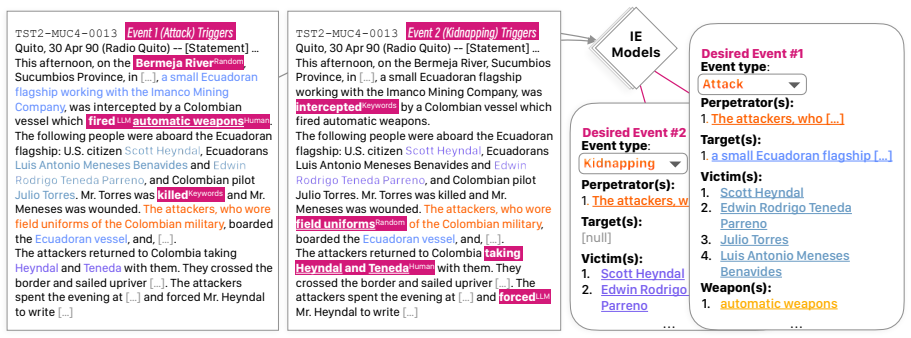
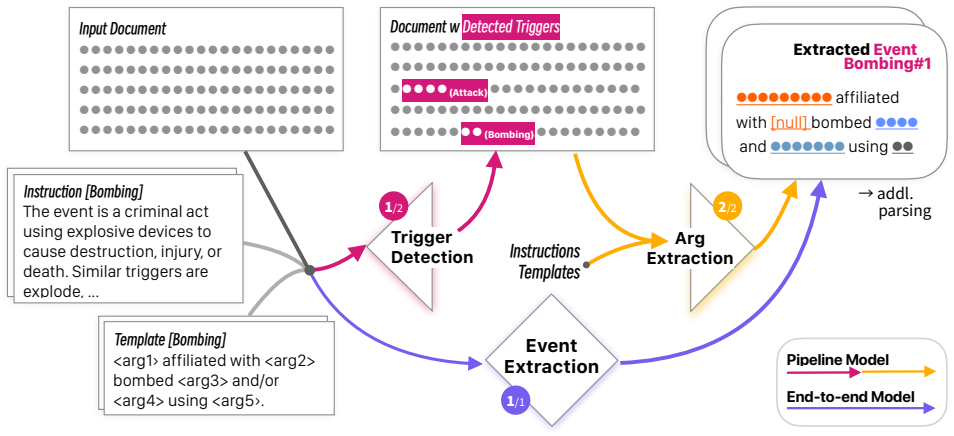
The central object is the trigger span, defined (following Walker et al., 2005) as a verb, noun, or adjective that most clearly expresses an event's occurrence; the paper treats triggers as 'rationales' that can be supplied or predicted. The machinery is a comparative experimental design that varies trigger quality (human, LLM, keyword, random) and architecture (pipeline vs end-to-end, with and without triggers) across three datasets, plus a prompting baseline for GPT-4O and GPT-4O-Mini. This design isolates whether the trigger's content, its mere presence, or the surrounding schema information carries the performance difference.
What would settle it
Run the same trigger-vs-no-trigger comparison on a dataset with many events per document but arguments far apart from any trigger (for instance, by taking WikiEvents and artificially shuffling or relocating argument mentions away from their triggers). If trigger-free systems still match trigger-conditioned ones, the paper's density explanation fails and argument localization is the driver; if trigger-based systems prevail, the density explanation is supported.
Extended reading notes
Core claim
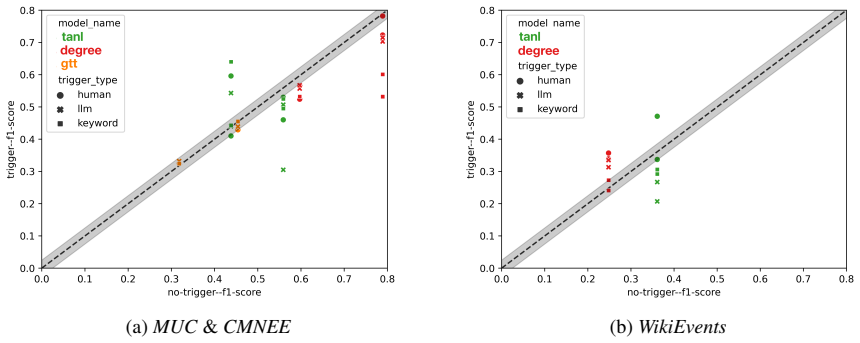
The central claim is that trigger spans are a conditional rather than integral component of document-level event extraction. On WikiEvents, where each document contains roughly 15-19 events and arguments are 1-2 tokens apart, human-annotated triggers yield clear gains over trigger-free systems, and pipeline models that can anchor on exact trigger positions do best. On MUC and CMNEE, which average about one or two events per document with arguments tens of tokens apart, removing triggers costs little or nothing: DEGREE performs best without triggers at all. The paper further claims that the event schema's natural-language description (template, type definition, example triggers) can substitute for trigger quality, and that in-context LLM prompting benefits from any trigger spans in demonstrations because the demonstrations instill the trigger concept even when the spans are random.
Load-bearing premise
The paper attributes the trigger benefit to the typical number of events per document, but across its three datasets event density and argument localization vary together, and there is no many-events-but-dispersed-arguments dataset to separate the two causes.
Editorial extensions
If this is right
- Dataset creators for document-level event extraction can skip costly human trigger annotation when documents are event-sparse, provided they supply a natural-language event schema.
- For event-dense corpora with localized arguments, human or generated triggers remain useful, but LLM- or keyword-produced triggers match human annotation in most settings.
- Prompt-based LLM extraction should always include trigger spans in few-shot demonstrations, since random spans already improve $F_1$ by several points on WikiEvents and others.
- End-to-end systems are the simpler default choice: they match pipeline performance except when argument localization makes pipeline anchoring helpful.
Reading between the lines
- The paper's central attribution (event density drives trigger usefulness) is confounded with argument localization across its three datasets; building or synthesizing a dataset with many events and dispersed arguments would settle whether triggers help because events are numerous or because arguments are close to a lexical anchor.
- The random-trigger prompting result suggests that even non-content marker spans (e.g., bracketed labels like [EVENT]) might be inserted into demonstrations to teach the trigger concept without any real trigger vocabulary, which could be tested directly.
- The paper's design implies a practical decision rule for new datasets: measure events-per-document and argument dispersion first, then decide whether to budget for trigger annotation; this rule could be packaged as a simple diagnostic for dataset collections.
- If the schema-information result transfers, then future work on low-resource event extraction could avoid trigger annotation entirely by investing instead in writing clear event templates, turning annotation cost from lexical spotting to schema writing.
Signed reviews
Editorial analysis
A structured set of objections, weighed in public.
Referee Report
Summary. The paper investigates whether explicit trigger-span extraction is necessary for document-level event extraction (DEE). It evaluates four sequence-to-sequence models (TANL, GTT, DEGREE, GENIE) in both pipeline and end-to-end configurations, with no triggers and with triggers of four quality levels (human, LLM, keyword, random), across three DEE datasets (MUC, WikiEvents, CMNEE), and compares them against GPT-4 and GPT-4-MINI in-context prompting baselines. The central claims are: (i) triggers are not needed when documents contain few events; (ii) triggers matter when documents contain many localized events, with higher-quality triggers preferred; (iii) lower-quality triggers often substitute for human annotation; (iv) the mere presence of trigger-like spans, even random ones, helps in-context learning; and (v) providing additional event schema information makes models robust to degraded trigger quality. The paper also releases MUC human trigger annotations, all trigger sets, and code.
Significance. If the central claims hold, the paper provides the first systematic, controlled comparison of trigger-based and trigger-free systems for document-level event extraction, challenging the field's default assumption that triggers are indispensable. The practical implications are concrete: for low-event-density corpora, trigger annotation can be skipped without loss; for ICL, even arbitrary trigger placeholders help; and rich event schema information can compensate for noisy triggers. The public release of MUC trigger annotations and the experimental code is a durable contribution. However, the paper's causal attribution of trigger usefulness to event density is not identifiable from the chosen datasets, because event density and argument localization are confounded across the three corpora. The empirical results themselves are real and reproducible in structure, but the headline explanation needs re-framing or additional evidence.
major comments (3)
- [§4.2, §7.2 (Result #5), Table 1] The claim that trigger usefulness depends on the typical number of events per document is confounded with argument localization. In Table 1, WikiEvents combines high event density (15.7 events/doc) with tightly localized arguments (1.6 tokens between arguments), while MUC and CMNEE combine low density with dispersed or moderately localized arguments (38.3 and 8.8 tokens, respectively). The paper explicitly states in §7.2 that it lacks a dataset with many events and dispersed arguments. As a result, the abstract's 'depends on dataset characteristics (i.e. the typical number of events per document)' cannot be distinguished from a localization-only or an interaction explanation. The CMNEE pipelined TANL results (43.8 F1 without triggers vs. 54.3-64.0 with human/LLM/keyword triggers) suggest localization may be the driving factor even at low density. The paper should either re-frame the conclusion as a correlation, or add a dataset (or a controlled manipulation) that separates the two factors.
- [§6, Table 2] The paper reports mean F1 scores with standard deviations across 5-fold cross-validation but performs no statistical significance tests. Many of the central contrasts appear to be within one standard deviation (e.g., DEGREE e2e no-trigger vs. human-trigger on MUC: 59.7±0.00 vs. 56.6±0.01; TANL e2e no-trigger vs. human-trigger on CMNEE: 43.8±0.00 vs. 41.0±0.00). Since the headline claims rest on such comparisons, paired significance tests (or confidence intervals with a stated pairing structure) are necessary. Without them, the 'triggers help' vs. 'triggers not needed' dichotomies are not fully supported.
- [§4.3, MUC trigger selection] For MUC, the paper selects the earliest human-annotated trigger span after taking the union, and notes that 'this typically produced better extraction scores than using the trigger span most centrally located' among the event's arguments. This is a heuristic chosen based on the evaluation data, and it is a free parameter of the study. Because the choice systematically favors the better-scoring option, it risks overfitting the reported results. The paper should pre-specify the selection rule or report results for both early and central trigger choices so readers can assess sensitivity.
minor comments (5)
- [§4.3, MUC annotation] The MUC annotation agreement is moderate (Krippendorff alpha 0.530, F-kappa 0.453), and the paper then takes the union of all annotators' triggers. The effect of this aggregation choice on downstream extraction performance is not analyzed or discussed.
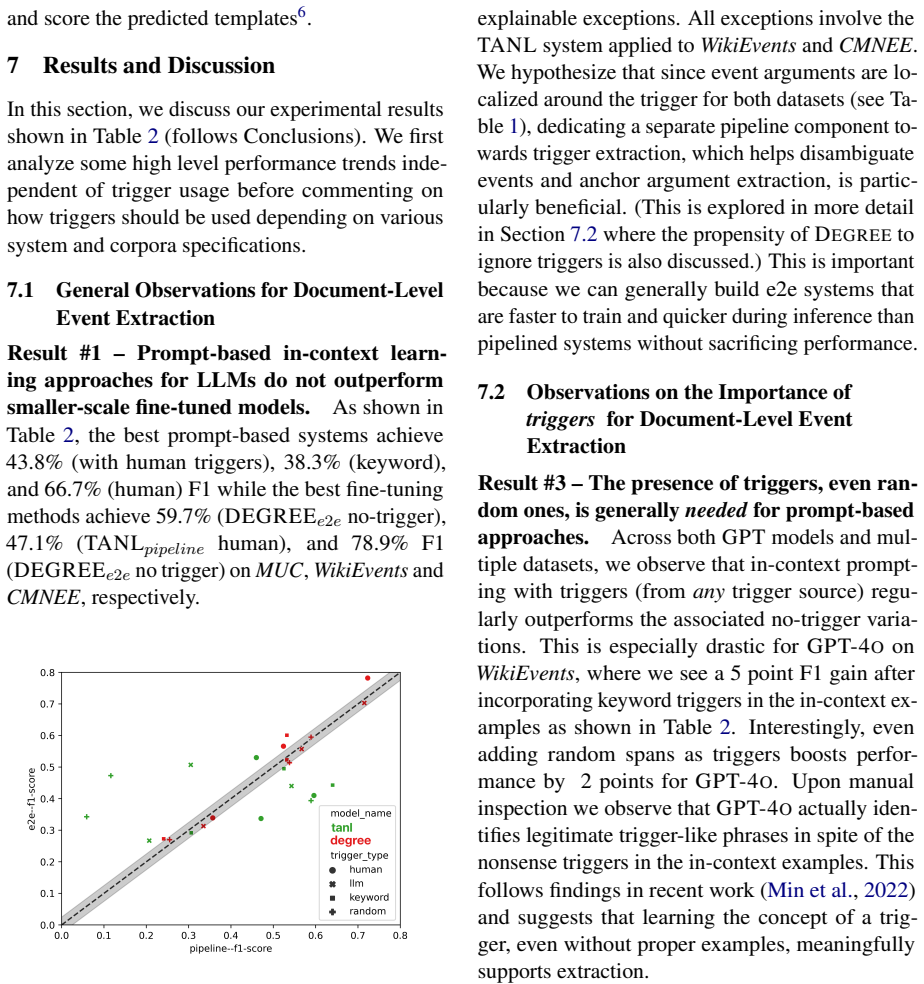
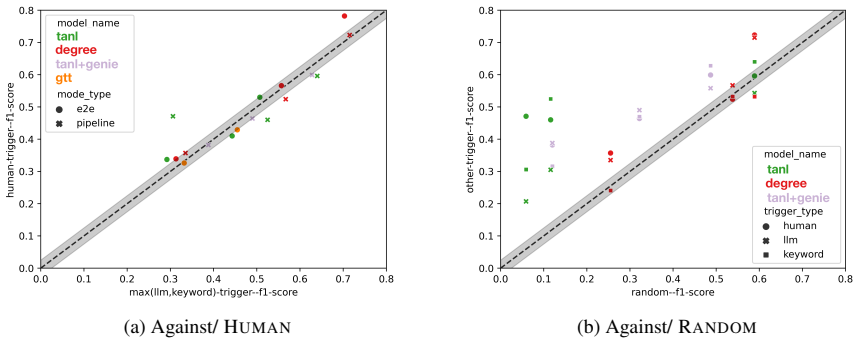
- [Figure 3] The caption states 'Datasets cannot be distinguished in the figure.' Adding colors or marker shapes for the three datasets would substantially improve readability and allow the reader to verify the exceptions discussed in §7.1.
- [§7.2, Result #5] The phrase 'This result is almost a negation of the previous claim' is imprecise. The relationship between Result #4 and Result #5 should be stated explicitly: the direction of trigger benefit reverses, but only under the additional conditions of many events, localized arguments, and higher-quality triggers.
- [Table 2] The WikiEvents column is missing all GTT results without explanation. If GTT was not run on WikiEvents, that should be stated in the text or table footnote; if it was run but failed, the failure mode should be described.
- [Appendix A] The sentence 'In Table 3, we show the additional annotation guidelines we curated to trigger in conjecture with Walker et al., 2005' should read 'curated to trigger annotation in conjunction with Walker et al., 2005' or similar; the current phrasing is ungrammatical.
Circularity Check
No significant circularity: the empirical comparisons are self-contained against external datasets; the event-density attribution is underdetermined by confounded data, but that is a stated limitation, not a circular derivation.
full rationale
The paper is an empirical study that compares fine-tuned and prompted models on three standard external datasets (MUC, WikiEvents, CMNEE). Its conclusions about trigger usefulness are supported by directly reported F1 scores on held-out test splits, not by a fitted parameter that is then renamed as a prediction. The trigger conditions (HUMAN, LLM, KEYWORD, RANDOM, none) are inputs to the experiments, and the outputs are measured on the datasets; there is no equation in which the dependent variable is defined in terms of the independent variable. Self-citations appear (GTT from Du et al. 2021, DEGREE from Hsu et al. 2022, the Das et al. 2022 scorer, and the present authors' earlier probing work), but these are used as benchmark systems or as an evaluation-alignment tool, not as an unverified premise that forces the paper's conclusions. The scorer is modified and applied to gold templates, and the models are independently fine-tuned and evaluated. The most serious concern is the paper's own stated limitation in Section 7.2, Result #5: 'We unfortunately do not have a dataset with documents with many events with dispersed arguments to explore the many event per document setting more generally.' Because WikiEvents has both many events and tightly localized arguments while MUC and CMNEE have fewer events and more dispersed arguments, the abstract's claim that trigger benefit 'depends on dataset characteristics (i.e. the typical number of events per document)' is not fully identifiable from the experiment matrix. This is a confound/underdetermination issue, not a circularity: the paper does not define event density in terms of trigger benefit, nor fit a parameter and call it a prediction. The stated limitation is candid and does not convert an empirical comparison into a self-justifying derivation. Overall, the central empirical claims are externally grounded, so circularity is minimal.
Assumptions & free parameters
free parameters (3)
- MUC trigger selection heuristic =
earliest (first) trigger span among the union of annotated spans
- Number of in-context examples for GPT baselines =
six
- CMNEE document retention threshold =
about 60% of documents retained
assumptions (3)
- domain assumption The three datasets (MUC, WikiEvents, CMNEE) are representative of the space of document-level event extraction settings.
- domain assumption Machine translation of CMNEE via Google Translate preserves event mentions, argument spans, and trigger spans well enough for the analysis.
- domain assumption The adapted evaluation protocol (Micro-F1 with template alignment, without span scoring) is a valid measure of document-level event extraction quality.
Cite this review
Pith. "Pith review of Are Triggers Needed for Document-Level Event Extraction?." pith.science (2026). https://pith.science/paper/BWAPBDTX
@misc{pith2026241108708,
  author       = {Pith},
  title        = {Pith review of: Are Triggers Needed for Document-Level Event Extraction?},
  year         = {2026},
  howpublished = {\url{https://pith.science/paper/BWAPBDTX}},
  note         = {Machine review of arXiv:2411.08708}
}
read the original abstract
Most existing work on event extraction has focused on sentence-level texts and presumes the identification of a trigger-span -- a word or phrase in the input that evokes the occurrence of an event of interest. Event arguments are then extracted with respect to the trigger. Indeed, triggers are treated as integral to, and trigger detection as an essential component of, event extraction. In this paper, we provide the first investigation of the role of triggers for the more difficult and much less studied task of document-level event extraction. We analyze their usefulness in multiple end-to-end and pipelined transformer-based event extraction models for three document-level event extraction datasets, measuring performance using triggers of varying quality (human-annotated, LLM-generated, keyword-based, and random). We find that whether or not systems benefit from explicitly extracting triggers depends both on dataset characteristics (i.e. the typical number of events per document) and task-specific information available during extraction (i.e. natural language event schemas). Perhaps surprisingly, we also observe that the mere existence of triggers in the input, even random ones, is important for prompt-based in-context learning approaches to the task.
Figures
Figures from the paper (2 more)
Reference graph
Works this paper leans on
-
[1]
URL: " 'urlintro :=
ENTRY address author booktitle chapter edition editor howpublished institution journal key month note number organization pages publisher school series title type volume year eprint doi pubmed url lastchecked label extra.label sort.label short.list INTEGERS output.state before.all mid.sentence after.sentence after.block STRINGS urlintro eprinturl eprintpr...
-
[2]
write newline
" write newline "" before.all 'output.state := FUNCTION n.dashify 't := "" t empty not t #1 #1 substring "-" = t #1 #2 substring "--" = not "--" * t #2 global.max substring 't := t #1 #1 substring "-" = "-" * t #2 global.max substring 't := while if t #1 #1 substring * t #2 global.max substring 't := if while FUNCTION word.in bbl.in capitalize " " * FUNCT...
-
[3]
@esa (Ref
\@ifxundefined[1] #1\@undefined \@firstoftwo \@secondoftwo \@ifnum[1] #1 \@firstoftwo \@secondoftwo \@ifx[1] #1 \@firstoftwo \@secondoftwo [2] @ #1 \@temptokena #2 #1 @ \@temptokena \@ifclassloaded agu2001 natbib The agu2001 class already includes natbib coding, so you should not add it explicitly Type <Return> for now, but then later remove the command n...
-
[4]
\@lbibitem[] @bibitem@first@sw\@secondoftwo \@lbibitem[#1]#2 \@extra@b@citeb \@ifundefined br@#2\@extra@b@citeb \@namedef br@#2 \@nameuse br@#2\@extra@b@citeb \@ifundefined b@#2\@extra@b@citeb @num @parse #2 @tmp #1 NAT@b@open@#2 NAT@b@shut@#2 \@ifnum @merge>\@ne @bibitem@first@sw \@firstoftwo \@ifundefined NAT@b*@#2 \@firstoftwo @num @NAT@ctr \@secondoft...
-
[5]
@open @close @open @close and [1] URL: #1 \@ifundefined chapter * \@mkboth \@ifxundefined @sectionbib * \@mkboth * \@mkboth\@gobbletwo \@ifclassloaded amsart * \@ifclassloaded amsbook * \@ifxundefined @heading @heading NAT@ctr thebibliography [1] @ \@biblabel @NAT@ctr \@bibsetup #1 @NAT@ctr @ @openbib .11em \@plus.33em \@minus.07em 4000 4000 `\.\@m @bibit...
work page 1991
-
[6]
Howard Chen, Jacqueline He, Karthik Narasimhan, and Danqi Chen. 2022. https://doi.org/10.18653/v1/2022.naacl-main.278 Can rationalization improve robustness? In Proceedings of the 2022 Conference of the North American Chapter of the Association for Computational Linguistics: Human Language Technologies, pages 3792--3805, Seattle, United States. Associatio...
-
[7]
Yunmo Chen, William Gantt, Weiwei Gu, Tongfei Chen, Aaron White, and Benjamin Van Durme. 2023. https://doi.org/10.18653/v1/2023.eacl-main.136 Iterative document-level information extraction via imitation learning . In Proceedings of the 17th Conference of the European Chapter of the Association for Computational Linguistics, pages 1858--1874, Dubrovnik, C...
-
[8]
Aliva Das, Xinya Du, Barry Wang, Kejian Shi, Jiayuan Gu, Thomas Porter, and Claire Cardie. 2022. https://doi.org/10.18653/v1/2022.acl-long.274 Automatic error analysis for document-level information extraction . In Proceedings of the 60th Annual Meeting of the Association for Computational Linguistics (Volume 1: Long Papers), pages 3960--3975, Dublin, Ire...
Show all 48 references
-
[9]
Jacob Devlin, Ming-Wei Chang, Kenton Lee, and Kristina Toutanova. 2019. https://doi.org/10.18653/v1/N19-1423 BERT : Pre-training of deep bidirectional transformers for language understanding . In Proceedings of the 2019 Conference of the North A merican Chapter of the Associat...
2019 doi
-
[10]
Jay DeYoung, Sarthak Jain, Nazneen Fatema Rajani, Eric Lehman, Caiming Xiong, Richard Socher, and Byron C. Wallace. 2020. https://doi.org/10.18653/v1/2020.acl-main.408 ERASER : A benchmark to evaluate rationalized NLP models . In Proceedings of the 58th Annual Meeting of the A...
2020 doi
-
[11]
George Doddington, Alexis Mitchell, Mark Przybocki, Lance Ramshaw, Stephanie Strassel, and Ralph Weischedel. 2004. http://www.lrec-conf.org/proceedings/lrec2004/pdf/5.pdf The automatic content extraction ( ACE ) program -- tasks, data, and evaluation . In Proceedings of the Fo...
2004
-
[12]
Xinya Du, Sha Li, and Heng Ji. 2022. https://doi.org/10.18653/v1/2022.acl-long.361 Dynamic global memory for document-level argument extraction . In Proceedings of the 60th Annual Meeting of the Association for Computational Linguistics (Volume 1: Long Papers), pages 5264--527...
2022 doi
-
[13]
Xinya Du, Alexander Rush, and Claire Cardie. 2021. https://doi.org/10.18653/v1/2021.naacl-main.70 Template filling with generative transformers . In Proceedings of the 2021 Conference of the North American Chapter of the Association for Computational Linguistics: Human Languag...
2021 doi
-
[14]
Seth Ebner, Patrick Xia, Ryan Culkin, Kyle Rawlins, and Benjamin Van Durme. 2020. https://doi.org/10.18653/v1/2020.acl-main.718 Multi-sentence argument linking . In Proceedings of the 58th Annual Meeting of the Association for Computational Linguistics, pages 8057--8077, Onlin...
2020 doi
-
[15]
William Gantt, Reno Kriz, Yunmo Chen, Siddharth Vashishtha, and Aaron White. 2023. https://doi.org/10.18653/v1/2023.findings-emnlp.862 On event individuation for document-level information extraction . In Findings of the Association for Computational Linguistics: EMNLP 2023, p...
2023 doi
-
[16]
Jun Gao, Huan Zhao, Changlong Yu, and Ruifeng Xu. 2023. http://arxiv.org/abs/2303.03836 Exploring the feasibility of chatgpt for event extraction
2023 arXiv
-
[17]
Ralph Grishman. 2019. https://doi.org/10.1017/S1351324919000512 Twenty-five years of information extraction . Nat. Lang. Eng., 25(6):677--692
2019 doi
-
[18]
I-Hung Hsu, Kuan-Hao Huang, Elizabeth Boschee, Scott Miller, Prem Natarajan, Kai-Wei Chang, and Nanyun Peng. 2022. https://doi.org/10.18653/v1/2022.naacl-main.138 DEGREE : A data-efficient generation-based event extraction model . In Proceedings of the 2022 Conference of the N...
2022 doi
-
[19]
Sarthak Jain, Madeleine van Zuylen, Hannaneh Hajishirzi, and Iz Beltagy. 2020. https://doi.org/10.18653/v1/2020.acl-main.670 S ci REX : A challenge dataset for document-level information extraction . In Proceedings of the 58th Annual Meeting of the Association for Computationa...
2020 doi
-
[20]
Heng Ji and Ralph Grishman. 2008. https://aclanthology.org/P08-1030 Refining event extraction through cross-document inference . In Proceedings of ACL-08: HLT, pages 254--262, Columbus, Ohio. Association for Computational Linguistics
2008
-
[21]
Daniel Jurafsky and James Martin. 2008. Speech and Language Processing: An Introduction to Natural Language Processing, Computational Linguistics, and Speech Recognition, volume 2
2008
-
[22]
H. W. Kuhn. 1955. https://doi.org/https://doi.org/10.1002/nav.3800020109 The hungarian method for the assignment problem . Naval Research Logistics Quarterly, 2(1-2):83--97
1955 doi
-
[23]
Qi Li, Heng Ji, and Liang Huang. 2013. https://aclanthology.org/P13-1008 Joint event extraction via structured prediction with global features . In Proceedings of the 51st Annual Meeting of the Association for Computational Linguistics (Volume 1: Long Papers), pages 73--82, So...
2013
-
[24]
Sha Li, Heng Ji, and Jiawei Han. 2021. https://doi.org/10.18653/v1/2021.naacl-main.69 Document-level event argument extraction by conditional generation . In Proceedings of the 2021 Conference of the North American Chapter of the Association for Computational Linguistics: Huma...
2021 doi
-
[25]
Po-Wei Lin, Shang-Yu Su, and Yun-Nung Chen. 2022. https://doi.org/10.18653/v1/2022.sigdial-1.58 TREND : Trigger-enhanced relation-extraction network for dialogues . In Proceedings of the 23rd Annual Meeting of the Special Interest Group on Discourse and Dialogue, pages 623--62...
2022 doi
-
[26]
Yubo Ma, Zehao Wang, Yixin Cao, Mukai Li, Meiqi Chen, Kun Wang, and Jing Shao. 2022. https://doi.org/10.18653/v1/2022.acl-long.466 P rompt for extraction? PAIE : P rompting argument interaction for event argument extraction . In Proceedings of the 60th Annual Meeting of the As...
2022 doi
-
[27]
Meryem M ' hamdi, Marjorie Freedman, and Jonathan May. 2019. https://doi.org/10.18653/v1/K19-1061 Contextualized cross-lingual event trigger extraction with minimal resources . In Proceedings of the 23rd Conference on Computational Natural Language Learning (CoNLL), pages 656-...
2019 doi
-
[28]
Sewon Min, Xinxi Lyu, Ari Holtzman, Mikel Artetxe, Mike Lewis, Hannaneh Hajishirzi, and Luke Zettlemoyer. 2022. http://arxiv.org/abs/2202.12837 Rethinking the role of demonstrations: What makes in-context learning work?
2022 arXiv
-
[29]
Giovanni Paolini, Ben Athiwaratkun, Jason Krone, Jie Ma, Alessandro Achille, Rishita Anubhai, Cicero Nogueira dos Santos, Bing Xiang, and Stefano Soatto. 2021. Structured prediction as translation between augmented natural languages. In 9th International Conference on Learning...
2021
-
[30]
Ellie Pavlick, Heng Ji, Xiaoman Pan, and Chris Callison-Burch. 2016. https://doi.org/10.18653/v1/D16-1106 The gun violence database: A new task and data set for NLP . In Proceedings of the 2016 Conference on Empirical Methods in Natural Language Processing, pages 1018--1024, A...
2016 doi
-
[31]
Colin Raffel, Noam Shazeer, Adam Roberts, Katherine Lee, Sharan Narang, Michael Matena, Yanqi Zhou, Wei Li, and Peter J. Liu. 2020. Exploring the limits of transfer learning with a unified text-to-text transformer. J. Mach. Learn. Res., 21(1)
2020
-
[32]
Yubing Ren, Yanan Cao, Ping Guo, Fang Fang, Wei Ma, and Zheng Lin. 2023. https://doi.org/10.18653/v1/2023.acl-long.17 Retrieve-and-sample: Document-level event argument extraction via hybrid retrieval augmentation . In Proceedings of the 61st Annual Meeting of the Association ...
2023 doi
-
[33]
Ian Soboroff. 2023. https://doi.org/10.1145/3539618.3591910 The better cross-language datasets . In Proceedings of the 46th International ACM SIGIR Conference on Research and Development in Information Retrieval, SIGIR '23, page 3047–3053, New York, NY, USA. Association for Co...
2023
-
[34]
Zhaoyue Sun, Gabriele Pergola, Byron Wallace, and Yulan He. 2024. https://aclanthology.org/2024.eacl-short.30 Leveraging C hat GPT in pharmacovigilance event extraction: An empirical study . In Proceedings of the 18th Conference of the European Chapter of the Association for C...
2024
-
[35]
Sundheim
Beth M. Sundheim. 1991. https://aclanthology.org/M91-1001 Overview of the third M essage U nderstanding E valuation and C onference . In T hird M essage U nderstanding C onference ( MUC -3): Proceedings of a Conference Held in S an D iego, C alifornia, M ay 21-23, 1991
1991
-
[36]
Meihan Tong, Bin Xu, Shuai Wang, Yixin Cao, Lei Hou, Juanzi Li, and Jun Xie. 2020. https://doi.org/10.18653/v1/2020.acl-main.522 Improving event detection via open-domain trigger knowledge . In Proceedings of the 58th Annual Meeting of the Association for Computational Linguis...
2020 doi
-
[37]
MeiHan Tong, Bin Xu, Shuai Wang, Meihuan Han, Yixin Cao, Jiangqi Zhu, Siyu Chen, Lei Hou, and Juanzi Li. 2022. https://doi.org/10.18653/v1/2022.naacl-main.291 D oc EE : A large-scale and fine-grained benchmark for document-level event extraction . In Proceedings of the 2022 Co...
2022 doi
-
[38]
David Wadden, Ulme Wennberg, Yi Luan, and Hannaneh Hajishirzi. 2019. https://api.semanticscholar.org/CorpusID:202539496 Entity, relation, and event extraction with contextualized span representations . ArXiv, abs/1909.03546
2019 arXiv
-
[39]
Somin Wadhwa, Silvio Amir, and Byron Wallace. 2023. https://doi.org/10.18653/v1/2023.acl-long.868 Revisiting relation extraction in the era of large language models . In Proceedings of the 61st Annual Meeting of the Association for Computational Linguistics (Volume 1: Long Pap...
2023 doi
-
[40]
Christopher Walker, Stephanie Strassel, Julie Medero, and Kazuaki Maeda. 2005. https://doi.org/https://doi.org/10.35111/mwxc-vh88 Ace 2005 multilingual training corpus
2005 doi
-
[41]
Barry Wang, Xinya Du, and Claire Cardie. 2023 a . https://doi.org/10.18653/v1/2023.findings-emnlp.844 Probing representations for document-level event extraction . In Findings of the Association for Computational Linguistics: EMNLP 2023, pages 12675--12683, Singapore. Associat...
2023 doi
-
[42]
Xingyao Wang, Sha Li, and Heng Ji. 2022. Code4struct: Code generation for few-shot structured prediction from natural language. arXiv preprint arXiv:2210.12810
2022 arXiv
-
[43]
Xingyao Wang, Sha Li, and Heng Ji. 2023 b . https://doi.org/10.18653/v1/2023.acl-long.202 C ode4 S truct: Code generation for few-shot event structure prediction . In Proceedings of the 61st Annual Meeting of the Association for Computational Linguistics (Volume 1: Long Papers...
2023 doi
-
[44]
Xinyu Wang, Lin Gui, and Yulan He. 2023 c . https://doi.org/10.18653/v1/2023.acl-long.563 Document-level multi-event extraction with event proxy nodes and hausdorff distance minimization . In Proceedings of the 61st Annual Meeting of the Association for Computational Linguisti...
2023 doi
-
[45]
Hang Yang, Yubo Chen, Kang Liu, Yang Xiao, and Jun Zhao. 2018 a . https://doi.org/10.18653/v1/P18-4009 DCFEE : A document-level C hinese financial event extraction system based on automatically labeled training data . In Proceedings of ACL 2018, System Demonstrations , pages 5...
2018 doi
-
[46]
Sen Yang, Dawei Feng, Linbo Qiao, Zhigang Kan, and Dongsheng Li. 2019. https://doi.org/10.18653/v1/P19-1522 Exploring pre-trained language models for event extraction and generation . In Proceedings of the 57th Annual Meeting of the Association for Computational Linguistics, p...
2019 doi
-
[47]
Cohen, Ruslan Salakhutdinov, and Christopher D
Zhilin Yang, Peng Qi, Saizheng Zhang, Yoshua Bengio, William W. Cohen, Ruslan Salakhutdinov, and Christopher D. Manning. 2018 b . HotpotQA : A dataset for diverse, explainable multi-hop question answering. In Conference on Empirical Methods in Natural Language Processing ( EMNLP )
2018
-
[48]
Mengna Zhu, Zijie Xu, Kaisheng Zeng, Kaiming Xiao, Mao Wang, Wenjun Ke, and Hongbin Huang. 2024. https://aclanthology.org/2024.lrec-main.299 CMNEE :a large-scale document-level event extraction dataset based on open-source C hinese military news . In Proceedings of the 2024 Jo...
2024
Reviewed August 12, 2026 · model on record in the stance chip above.
Discussion (0). Continue with ORCID to comment.