REVIEW 3 major objections 5 minor 7 references
A combined diffusion/rate equation model to describe charge generation in phase-separated donor-acceptor blends
T0 review · 3 major / 5 minor · reviewed 2026-08-12 · deepseek-v4-flash
Pith's one-line read This paper builds a model that couples exciton diffusion to Marcus-theory charge transfer at the interface and shows that, in low-driving-force organic solar cells, assuming instant quenching at the donor-acceptor boundary makes…
desk verdict Worth engaging for the analytic diffusion-plus-Marcus model; the PM6:Y6 domain-size estimate rests on a load-bearing 20% offset subtraction that needs more scrutiny. read the letter →
The pith
A machine-rendered reading of the paper's core claim, the machinery that carries it, and where it could break.
The reading
What carries the argument
The central object is a reaction-diffusion system on an acceptor domain $\Omega\subset\mathbb{R}^3$: a diffusion equation $\partial_t n_{\mathrm{LE}}=D\Delta n_{\mathrm{LE}}+G_{\mathrm{LE}}-R_{\mathrm{LE}}$ for the singlet exciton density, coupled to a surface density of charge-transfer states $n_{\mathrm{CT}}$ through a Robin-type boundary condition $-D\nabla n_{\mathrm{LE}}\cdot\nu=\kappa_{\mathrm{diss,LE}}n_{\mathrm{LE}}-k_{\mathrm{ref}}n_{\mathrm{CT}}$ on the donor-acceptor interface, with $n_{\mathrm{CT}}$ evolving by the rate equation $\partial_t n_{\mathrm{CT}}=\kappa_{\mathrm{diss,LE}}n_{\mathrm{LE}}-(k_{\mathrm{ref}}+k_{\mathrm{f,CT}}+k_{\mathrm{diss,CT}})n_{\mathrm{CT}}$. The carrying identity is the closed-form steady-state efficiency, which depends only on the ratios $L_D/R$ and $\kappa_{\mathrm{diss,LE}}/(R\,k_{\mathrm{f,LE}})$ together with the reformation probability $P_{\mathrm{ref}}$ and the CT dissociation probability $P_{\mathrm{diss,CT}}$; this compact reduction is what lets the authors isolate the intrinsic lifetime as the parameter that controls low-offset performance. A second analytic object, the mean survival time of an exciton in a sphere, provides the diffusion time scale used to show that finite interfacial quenching, not pure diffusion, sets the measured rise times.
What would settle it
Measure the Y6 domain size in the same PM6:Y6 blend with an exciton-dynamics-independent structural probe, such as grazing-incidence small-angle X-ray scattering or resonant soft X-ray scattering; if the scattering-derived domain diameter disagrees with the fitted $25$ nm beyond the stated uncertainty, the TAS-based estimate and its underlying single-spherical-domain, fixed-Marcus-parameter assumptions are falsified.
Extended reading notes
Core claim
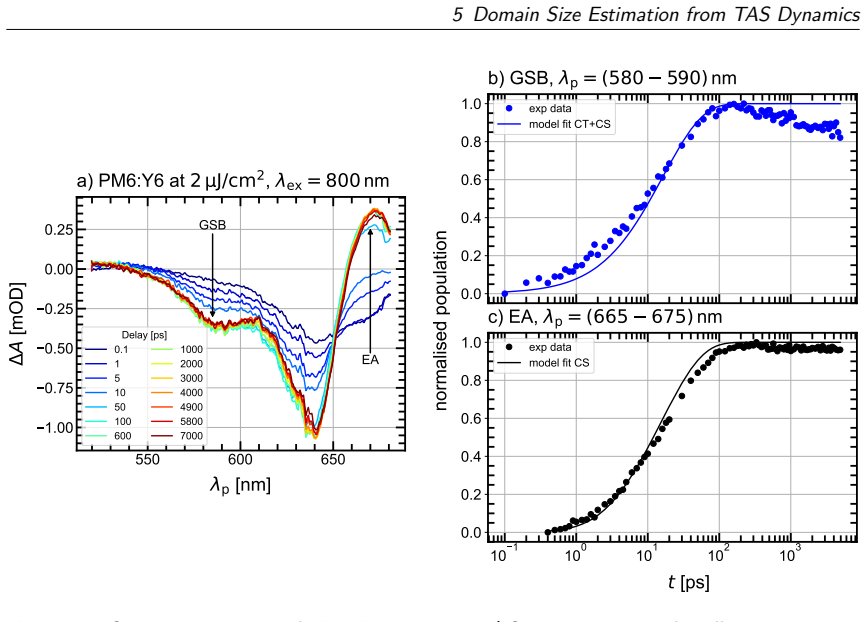
The central discovery is that the efficiency and dynamics of free charge generation in phase-separated donor-acceptor blends are governed by the interplay between exciton diffusion to the interface and the finite, Marcus-limited rates of exciton dissociation, CT reformation, and CT dissociation. In the steady state, the charge generation efficiency reduces to an explicit function of only four parameter combinations: the diffusion length over the domain radius, a velocity ratio $\kappa_{\mathrm{diss,LE}}/(R\,k_{\mathrm{f,LE}})$, the reformation probability, and the CT dissociation probability. The model shows that a long intrinsic exciton lifetime raises efficiency at low offset by permitting multiple dissociation attempts, whereas diffusion length alone cannot. Dynamically, for low offsets the ground-state-bleach rise time is considerably longer than the mean diffusion time because weak quenching prevents a concentration gradient from forming; hence interpreting long experimental rise times of roughly $100$ ps as pure diffusion overestimates the diffusion-limited time and invalidates instant-quench domain sizing unless $\Delta E_{\mathrm{LE-CT}}>0.2$ eV. Fitting the model to PM6:Y6 transient absorption data gives $R=12.47\pm 0.71$ nm and $k_{\mathrm{diss,CT}}=1.12\pm 0.44$ ps$^{-1}$.
Load-bearing premise
The fitted $25$ nm Y6 domain size rests on the assumption that the measured PM6:Y6 transient absorption can be cleanly separated into a constant roughly $20\%$ ultrafast component from disordered Y6 and a remainder governed by one spherical aggregated Y6 domain with a single set of Marcus parameters, including the hand-set $1$ nm CT localization thickness and literature values for $|H_{\mathrm{DA}}|$ and $\lambda$.
Editorial extensions
If this is right
- Domain-size estimates that assume instant quenching at the donor-acceptor interface are only reliable when the driving force exceeds about $0.2$ eV; below that, fitted sizes will be distorted because slow dissociation itself extends the measured rise time.
- Long intrinsic exciton lifetimes, not just long diffusion lengths, can push charge generation efficiency close to unity at zero or slightly negative offsets, making lifetime a design lever for low-voltage-loss solar cells.
- Standard rate-equation models that fold diffusion into a fixed reduction factor reproduce efficiency trends but cannot match the explicit domain-size dependence of the present model.
- For PM6:Y6, the model attributes the roughly $100$ ps hole-transfer completion to combined diffusion and dissociation rather than diffusion alone, and places the Y6 domain diameter near $25$ nm with rapid CT dissociation on the order of $1$ ps.
Reading between the lines
- A direct test would be to extract the domain radius from time-resolved photoluminescence survival times using the mean-survival-time expression in the supplement and compare it with the TAS-derived $25$ nm on the same film; agreement would validate the model, while disagreement would reveal which observable is more sensitive to the disordered-phase assumption.
- The strong correlation between $\kappa_{\mathrm{diss,LE}}$ and $R$ implies that independent morphology measurements or independently determined Marcus parameters are needed to make the domain-size estimate unique, since multiple (rate, radius) pairs can fit the same transient.
- If the roughly $20\%$ ultrafast component is indeed from disordered Y6, then changing the excitation wavelength or probing a sub-ensemble should shift the fitted aggregated-domain radius only within the stated uncertainty; a large shift would indicate that the constant-offset subtraction is not clean.
Signed reviews
Editorial analysis
A structured set of objections, weighed in public.
Referee Report
Summary. This paper develops a deterministic continuum model that couples exciton diffusion in a donor or acceptor domain to interfacial rate equations describing CT state formation, reformation, geminate recombination, and dissociation to free charges. The authors derive an analytical steady-state charge generation efficiency (Eqs. 17-20), analyze characteristic timescales from a dynamic formulation, and fit the model to transient absorption (TAS) data of a PM6:Y6 blend with the Y6 domain radius R and the CT dissociation rate k_diss,CT as the only free parameters. The fit yields R = 12.47 ± 0.71 nm (diameter ≈ 25 nm) and k_diss,CT = 1.12 ± 0.44 ps^-1. The central qualitative conclusion is that the common assumption of instantaneous exciton quenching at the donor-acceptor interface is only valid for high driving forces, and that the intrinsic exciton lifetime is a key parameter enabling efficient generation at low offsets.
Significance. The model is a useful conceptual advance: it combines a tractable diffusion problem with Marcus-theory rates at the interface, and the steady-state expression (Eq. 20) is analytic and internally consistent. The qualitative finding that finite interfacial quenching, not pure diffusion, controls the charge-generation timescale in low-offset systems is well supported by the mean-survival-time analysis in Sec. 4 and by the illustrative simulations. If the quantitative TAS-based domain-size estimate can be made robust, the paper would also provide an experimentally applicable method for estimating domain sizes from charge-generation dynamics. The manuscript is likely to be of interest to the organic photovoltaics community.
major comments (3)
- [Sec. 5, Fig. 4b] The constant 20% offset subtraction is internally inconsistent with the authors' own interpretation of the late-time GSB decay. The model predicts a GSB that starts at zero, while the measured GSB exhibits an instantaneous component that the authors subtract as a time-independent offset and attribute to disordered Y6 domains. However, the same paragraph states that the observed decline in the GSB after ~200 ps is caused by geminate recombination of CT states in these disordered Y6 phases. If those CT states decay, their GSB contribution is time-dependent, so a constant offset subtraction cannot remove the instantaneous component while leaving the decaying component from the same phase. Since the fitted values of R and k_diss,CT depend directly on the amplitude and shape of the normalized rising signal, this data treatment is load-bearing for the quantitative claim. The authors should model the disordered-phase contribution with explicit time-dependent kinetics, or at minimum provide a sensitivity analysis showing that the fitted R and k_diss,CT are stable under alternative, physically motivated treatments of the offset.
- [Sec. 5, Fig. 4c] The exclusion of EA data before 0.3 ps is not justified. The EA signal is proportional to the CS population, and its early rise provides direct constraints on k_diss,CT; truncating the early data can bias both the fitted value and the reported uncertainty. The authors should state the reason for the cutoff (e.g., coherent artifact or pump scatter) and test the sensitivity of R and k_diss,CT to the choice of truncation threshold.
- [Sec. 5, Eq. (28)] The reported uncertainties on R and k_diss,CT are only the statistical uncertainties of the least-squares fit. The authors acknowledge in the text that kappa_diss,LE and R are strongly correlated when fitted simultaneously, and kappa_diss,LE itself depends on hand-set parameters (d = 1 nm), adopted parameters (|H_DA|, lambda), and the assumed Delta_E_LE-CT. The claim of a 25 nm domain diameter therefore rests on a chain of assumptions whose uncertainty is not propagated. A sensitivity analysis varying d over a reasonable range and using the literature spread of lambda and |H_DA| should be provided before this quantitative result can be considered established.
minor comments (5)
- [Sec. 5 vs. Materials and Methods] The main text states that the excitation wavelength is around 800 nm to selectively excite Y6, while the Materials and Methods section describes pump pulses at 720 nm. These statements should be reconciled.
- [Supplementary Note SN2, Eq. (S11)] The equation for dn_CT/dt contains a plus sign before the decay terms (kref + kf,CT + kdiss,CT)nCT, whereas the correct equation in the main text, Eq. (11), has a minus sign. This typo should be corrected.
- [Sec. 5, Eq. (27)] The factor '(ratio + 1)' in the expression for n_LE,0 is not defined explicitly; the relationship between the PM6:Y6 mixing ratio and the volume fraction of Y6 should be clarified so that the initial density calculation is reproducible.
- [Supplementary Note SN6] The sentence 'The final or the second (suitable if k−1 f,LE≫⟨t⟩f) equation of table ST1 can then be used to estimate R' is difficult to parse; please rephrase to clearly identify which limiting case corresponds to which equation.
- [Fig. 3 caption] The phrase 'The respective solid line shows' should be 'The solid lines show' for consistency with the plural entries in the caption.
Circularity Check
No significant circularity; the model derivation is self-contained and the PM6:Y6 analysis is an explicit parameter fit, not a disguised prediction.
full rationale
The paper's central derivation is self-contained: the diffusion/rate-equation system (Eqs. 1-6) is defined independently, and the steady-state efficiency expression (Eq. 20), characteristic-time analysis, and mean survival-time formulas in SN6 are obtained by explicit analytic solution of that system. No equation in the derivation is equivalent to its own input by construction. The Marcus-theory rates (Eq. 22) are standard external inputs, and the paper states clearly which parameters are adopted from prior literature, including |H_DA| from ref. 19. The application to PM6:Y6 TAS data is presented as a fit: 'We fit the model to the experimental data using a non-linear least squared fitting method' (Sec. 5), with R and k_diss,CT as free parameters. Because the domain size and CT dissociation rate are estimated by fitting, they are not claimed as independent predictions, so the 'fitted input called prediction' pattern does not apply. The subtraction of the ~20% ultrafast GSB offset and the single-sphere assumption are modeling/data-treatment choices that could bias the fitted values, but they do not make the derivation circular; the paper even warns about the strong correlation between kappa_diss,LE and R. Self-citations, mainly ref. 19 for the electronic coupling and the reference rate model, are used as external parameter sources and for comparison, but the qualitative conclusion that finite interfacial quenching matters for low-offset systems follows from the model's structure and the MFPT analysis rather than from the cited values. No self-citation chain or uniqueness theorem is invoked to force the choice of model. Therefore no circular step is exhibited, and the appropriate score is 0.
Assumptions & free parameters
free parameters (8)
- d (CT localization zone thickness) =
1 nm
- lambda (reorganization energy) =
0.45 eV
- |H_DA| (electronic coupling) =
0.01 eV
- k_f,LE (singlet decay rate) =
1 ns^-1
- k_f,CT (CT decay rate) =
1 ns^-1
- Delta_E_LE-CT (energy offset) =
0.11 eV (PM6:Y6)
- R (Y6 domain radius, fitted) =
12.47 +/- 0.71 nm
- k_diss,CT (CT dissociation rate, fitted) =
1.12 +/- 0.44 ps^-1
assumptions (7)
- domain assumption Exciton hopping above 150 K is an isotropic diffusion process with constant diffusivity D (equation 1).
- domain assumption Dissociation and reformation at the donor-acceptor interface obey the linear Robin boundary condition (equation 2) with a CT surface density.
- domain assumption Charge transfer rates are given by semi-classical Marcus theory with a single reorganization energy and electronic coupling (equation 22).
- domain assumption Direct generation into CT states and non-geminate recombination are negligible (G_CT = 0).
- domain assumption The BHJ is represented by a single spherical acceptor domain fully surrounded by donor, with uniform exciton generation.
- domain assumption The sample domain is an average over many local configurations, so a deterministic continuum density is valid.
- ad hoc to paper The ultrafast GSB component from non-aggregated Y6 regions can be subtracted as a constant offset, leaving only aggregated-domain dynamics.
Cite this review
Pith. "Pith review of A combined diffusion/rate equation model to describe charge generation in phase-separated donor-acceptor blends." pith.science (2026). https://pith.science/paper/ZLK4FRNI
@misc{pith2026241108812,
  author       = {Pith},
  title        = {Pith review of: A combined diffusion/rate equation model to describe charge generation in phase-separated donor-acceptor blends},
  year         = {2026},
  howpublished = {\url{https://pith.science/paper/ZLK4FRNI}},
  note         = {Machine review of arXiv:2411.08812}
}
read the original abstract
The power conversion efficiency (PCE) of organic solar cells (OSCs) has been largely improved by the introduction of novel non-fullerene acceptors (NFAs). Further improvements in PCE require a more comprehensive understanding of the free charge generation process. Recently, the small PCE of donor-acceptor blends with low offsets between the relevant frontier orbitals was attributed to inefficient exciton dissociation. However, another source of photocurrent loss is the competition between exciton diffusion and decay, which is particularly relevant for bilayers or bulk heterojunction blends with phase separated morphology. Here, we present an analytical model that combines exciton diffusion with a set of rate equations based on Marcus theory of charge transfer. An expression for the charge generation efficiency is derived from the steady-state solution of the model. Thereby, the intrinsic exciton lifetime is identified as a pivotal parameter to facilitate efficient charge generation in spite of a vanishing driving force for exciton dissociation. The dynamic formulation of the model is used to elucidate the characteristic time scales of charge generation. It is found that for low-offset systems, the pure diffusive times are considerably shorter than those associated with charge generation. It can therefore be concluded that when estimating domain sizes via exciton diffusion measurements, the assumption that excitons are instantaneously quenched at the donor-acceptor interface is only valid when a high driving force for exciton dissociation is present. The model is applied to the transient absorption dynamics of a PM6:Y6 blend. It is demonstrated that the charge generation dynamics are determined by the interplay between exciton diffusion and hole transfer kinetics, with an estimated Y6 domain size of 25nm, while interfacial charge transfer (CT) states separate rapidly into free charges.
Figures


Figures from the paper (1 more)
Reference graph
Works this paper leans on
-
[1]
H. P. Langtangen and S. Linge, Finite difference computing with pdes , Vol. 16 (Springer Inter- national Publishing, Cham, 2017)
work page 2017
-
[2]
W. E. Schiesser and G. W. Griffiths, A compendium of partial differential equation models (Cambridge University Press, 2009)
work page 2009
-
[3]
A. N. F. Versypt and R. D. Braatz, “Analysis of finite difference discretization schemes for diffusion in spheres with variable diffusivity”, Computers & Chemical Engineering 71, 241–252 (2014)
work page 2014
-
[4]
E. Hairer and G. Wanner, Solving ordinary differential equations ii , Berlin, Heidelberg, 1991
work page 1991
-
[5]
Scipy 1.0: fundamental algorithms for scientific computing in python
P. Virtanen, R. Gommers, T. E. Oliphant, M. Haberland, T. Reddy, D. Cournapeau, E. Burovski, P. Peterson, W. Weckesser, J. Bright, S. J. van der Walt, M. Brett, J. Wilson, K. J. Millman, N. Mayorov, A. R. J. Nelson, E. Jones, R. Kern, E. Larson, C. J. Carey, ˙I. Polat, Y. Feng, E. W. Moore, J. VanderPlas, D. Laxalde, J. Perktold, R. Cimrman, I. Henriksen,...
work page 2020
-
[6]
M. Pranav, A. Shukla, D. Moser, J. Rumeney, W. Liu, R. Wang, B. Sun, S. Smeets, N. Tok- moldin, Y. Cao, G. He, T. Beitz, F. Jaiser, T. Hultzsch, S. Shoaee, W. Maes, L. L¨ uer, C. Brabec, K. Vandewal, D. Andrienko, S. Ludwigs, and D. Neher, “On the critical competition between singlet exciton decay and free charge generation in non-fullerene based organic ...
work page 2024
-
[7]
Mean time of diffusion- and reaction-limited loading and unloading
R. W¨ urschum, “Mean time of diffusion- and reaction-limited loading and unloading”, Applied Physics A 129 (2023). 12
work page 2023
Reviewed August 12, 2026 · model on record in the stance chip above.
Discussion (0). Continue with ORCID to comment.