REVIEW 4 major objections 6 minor 44 references
Microfoundation Inference for Strategic Prediction
T0 review · 4 major / 6 minor · reviewed 2026-08-12 · deepseek-v4-flash
Pith's one-line read This paper shows that the hidden cost driving agents' strategic responses to a predictive model can be estimated, up to an affine shift, by aligning pre- and post-deployment distributions with optimal transport.
desk verdict A genuinely new estimator for Bregman costs in strategic prediction, with the usual caveat that the structural assumption is doing more work than the paper fully acknowledges. read the letter →
The pith
A machine-rendered reading of the paper's core claim, the machinery that carries it, and where it could break.
The reading
What carries the argument
The load-bearing object is the Bregman divergence $c_\phi(z,z') = \phi(z')-\phi(z)-\nabla\phi(z)^\top(z'-z)$ induced by a strictly convex potential $\phi$; restricting costs to this class reduces the infinite-dimensional problem of estimating a bivariate cost to estimating the gradient $\nabla\phi$. The first-order condition of the agent's utility maximization, $\nabla\phi(T_\theta(z))-\nabla B_\theta(T_\theta(z))=\nabla\phi(z)$, implies that $(\nabla\phi)_\#P$ and $(\nabla\phi-\nabla B_\theta)_\#Q_\theta$ coincide, so the estimator aligns these measures by minimizing the sum of squared 2-Wasserstein distances to a common barycenter. Identifiability is characterized by whether the only conservative (gradient-of-convex) functions $h$ satisfying $h\circ T_0 = h\circ T_1 = \cdots = h\circ T_m$ are constants, and the convergence rate follows from sharp empirical optimal-transport bounds for smooth costs.
What would settle it
Simulate an environment whose true cost is a non-Bregman bivariate function, for example $c(z,z')=\|z-z'\|_2^3$ or $c(z,z')=\|z-z'\|_2^2+g(z)$ with a state-dependent term, while agents solve (2.1) with a known strictly concave benefit. If, with large samples, the recovered Bregman potential fails to reproduce the true response map $T_\theta$, the central claim fails. A cheaper check is to compare the predicted push-forward $(\hat T_\theta)_\#P$ against held-out ex-post samples under such a deliberately non-Bregman cost.
Extended reading notes
Core claim
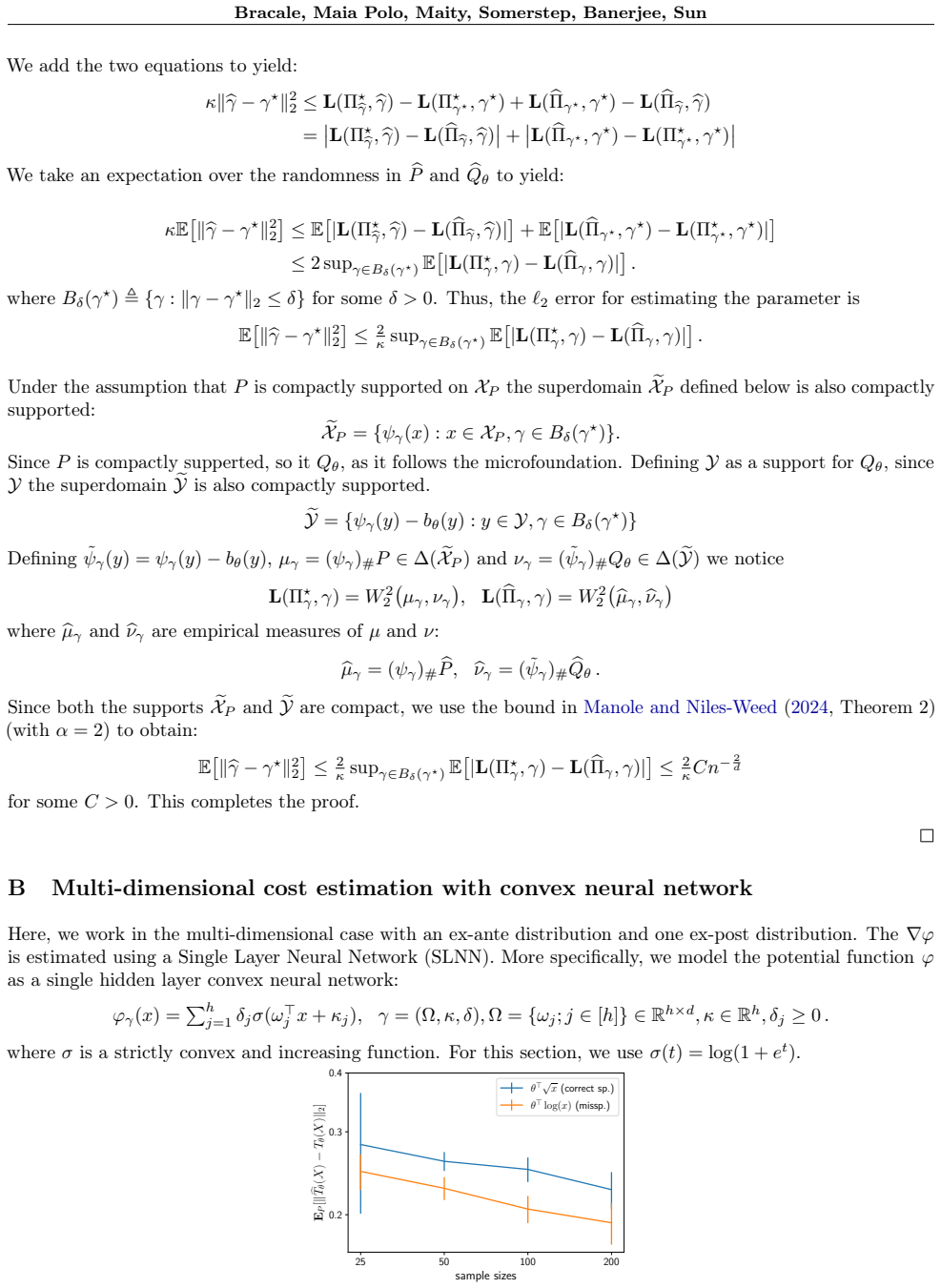
The central claim is that the unknown cost $c(z,z')$ in the utility-maximization model $T_\theta(z) \in \arg\max_{z'} B_\theta(z') - c(z,z')$ is identifiable from the ex-ante distribution $P$ and one or more ex-post distributions $Q_\theta=(T_\theta)_\#P$, up to an affine adjustment of the Bregman potential, whenever $c=c_\phi$ is a Bregman divergence $\phi(z')-\phi(z)-\nabla\phi(z)^\top(z'-z)$ with strictly convex potential $\phi$. The proposed estimator minimizes the Wasserstein variance over potentials $\phi$ and a barycenter $\mu$, namely $\min_{\phi,\mu} \sum_{k=0}^m W_2^2(\mu,\, (\nabla\phi-\nabla B_{\theta_k})_\# Q_{\theta_k})$ with $(B_{\theta_0},Q_{\theta_0})=(0,P)$, forcing the aligned push-forward distributions to coincide. Theorem 4.1 reduces identifiability to a condition on conservative solutions of a system of equations induced by the optimal transport maps, and Corollary 4.2 shows that one ex-post distribution suffices when the benefit is strictly concave with a finite maximizer. Theorem 4.3 establishes the parametric rate $\mathbb{E}\|\hat\gamma-\gamma^\star\|_2^2 \le K n^{-2/d}$ for estimating the parameters of the potential from $n$ i.i.d. samples of $P$ and of $Q_\theta$. The authors also show experimentally that the estimated response map remains accurate even when the benefit function is misspecified, although the estimated potential is then biased.
Load-bearing premise
The load-bearing premise is that the agents' true cost is a Bregman divergence with a strictly convex potential, and that the benefit function is known; if the real cost is not of this form, the distributional equality the estimator relies on fails and the recovered potential is only an unquantified projection of the true cost.
Editorial extensions
If this is right
- With access to the ex-ante distribution and a single ex-post distribution, the cost is identifiable whenever the known benefit function is strictly concave with a finite maximizer, so one model deployment can suffice to learn the microfoundation.
- The estimated potential parameters converge at the rate $K n^{-2/d}$ in squared error, so the statistical error in plug-in performative risk minimization inherits this rate through the decomposition into misspecification and statistical error.
- The estimated response map $\hat T_\theta$ solves $\nabla\hat\phi(\hat T_\theta(z))-\nabla B_\theta(\hat T_\theta(z))=\nabla\hat\phi(z)$ and can be plugged directly into performative risk minimization, enabling fast white-box optimization algorithms.
- The method extends to settings with only ex-post distributions by aligning the push-forwards of the agent responses alone when no pre-deployment sample is available.
- Empirically, misspecification of the benefit function biases the estimated potential but not the estimated response map, so downstream performative risk minimization remains accurate under this misspecification.
Reading between the lines
- If the true cost is not a Bregman divergence, the estimator returns the Bregman projection of the true cost onto the assumed class, but the paper gives no bound on the error this induces in the response map; bounding or testing this projection error with held-out ex-post samples is a natural next step.
- Theorem 4.1's identifiability condition can be checked empirically from the estimated transport maps, so a practitioner with finitely many deployments can verify whether the only conservative solutions of the system are constants before trusting the cost estimate.
- The $n^{-2/d}$ rate suggests the method will struggle in high-dimensional attribute spaces; incorporating structural assumptions such as separable or low-rank costs is an open direction the paper's parametric experiments only begin to explore.
- The same distribution-alignment principle could apply to non-strategic performative shifts driven by a deterministic map, which the paper names as future work, though the cost-recovery interpretation would then need a different microfoundation.
Signed reviews
Editorial analysis
A structured set of objections, weighed in public.
Referee Report
Summary. The paper proposes an optimal-transport-based method for estimating, up to an affine adjustment of its Bregman potential, the cost function in a utility-maximizing microfoundation model of performative prediction. The method minimizes a Wasserstein-variance objective (3.1) that aligns push-forwards of the ex-ante distribution and one or more ex-post distributions, and it is extended to an ex-post-only variant (3.4). The authors establish an identifiability condition (Theorem 4.1) and a corollary for the single-deployment case (Corollary 4.2), and they prove a parametric convergence rate for the cost parameters (Theorem 4.3). Experiments on a credit-scoring dataset show accurate recovery of the Bregman potential when the benefit function is well specified, empirical robustness of the response map to benefit-function misspecification, and competitive plug-in performance for performative risk minimization.
Significance. If the structural assumptions hold, this is a valuable contribution: it converts a misspecified-microfoundation problem into a semi-parametric estimation problem, offers a verifiable identifiability criterion, and provides a plug-in route to performative optimization with fast rates. The population equality underlying (3.1) is correct at the true potential, and the paper is transparent about the non-identifiability of general bivariate costs. The ex-post-only variant and the empirical finding that response-map estimates are robust to benefit misspecification are useful additions. The public code and the use of a standard dataset support reproducibility. However, the strength of the claims is currently limited by the unquantified cost-misspecification gap and by an over-stated convergence rate in low dimensions.
major comments (4)
- [Section 3.1 and Eq. (4.7)] The estimator is only guaranteed to recover the Bregman component of the cost. If the true cost is not a Bregman divergence, the first-order condition (3.2) has no solution for any φ, and the distributional equality behind (3.1) fails; the minimizer of (3.1) is then an uncontrolled projection of the response map onto the Bregman family. Theorem 4.3 bounds only the deviation from γ*, the population minimizer inside the assumed class, and the plug-in guarantee in Eq. (4.7) contains a MisspErr term for which no bound is supplied. Since the abstract claims that the methodology estimates the cost and the distribution map, this gap needs either a quantitative misspecification analysis or a more carefully scoped statement of the claims.
- [Theorem 4.3, Eq. (4.4)] The stated rate E||bγ - γ*||^2 ≤ K n^{-2/d} is not valid for d = 1 and d = 2. For empirical W2^2, the sharp rates are O(n^{-1}) in d = 1 and O(n^{-1} log n) in d = 2, whereas n^{-2/d} would give n^{-2} and n^{-1} respectively; the d = 1 rate is impossible. The cited result of Manole and Niles-Weed (2024) covers the regime d ≥ 3 (with corrections for d = 2). The theorem should either restrict to d ≥ 3 or state the correct rates for d ≤ 2, and this matters because Section 5.1 reports one-dimensional experiments.
- [Corollary 4.2 and its proof in Appendix A] The proof of the one-ex-ante/one-ex-post identifiability claim relies on the assertion that T^n(z) → z* for any strictly concave Bθ with a finite maximizer, where T is the proximal-type map in (A.9). This convergence is not an immediate consequence of strict concavity; it requires additional hypotheses such as strong concavity or coercivity/essential smoothness of φ - Bθ, or an explicit appeal to a Bregman proximal point convergence theorem with stated conditions. Without such support, the corollary is not fully established.
- [Theorem 4.3 assumptions] The strong convexity assumptions on γ ↦ min_{Π∈Δ(P,Qθ)} L(Π,γ) and on its empirical counterpart are stated without any primitive conditions under which they hold. They are not verified for the quadratic class φ(z) = (1/2)z^T M z used in Section 5.2, nor for the nonparametric isotonic-regression setting in Section 5.1. Since these assumptions are exactly what turns the Wasserstein stability bound into a parameter-rate, the theorem's hypotheses are not connected to the practical instantiations of the method.
minor comments (6)
- [Section 4, after Eq. (4.1)] The text says 'induce a Bergman divergence' but the intended term is 'Bregman divergence'.
- [Section 3.1] The phrase 'from a finite number of ex-ante distributions' appears to be a slip; it should presumably read 'ex-post distributions'.
- [Figure 1 caption] The caption says 'well estimated when he benefit function'; it should read 'when the benefit function'.
- [Proof of Lemma A.1] In the final sentence, 'Since θ is continuous and strictly increasing' should read 'Since f is continuous and strictly increasing'.
- [Theorem 4.1] The term 'conservative solutions' is nonstandard for 'gradients of convex functions'; consider using 'functions that are derivatives of convex functions' or 'subgradients of convex functions' instead.
- [Algorithm 1 and Section 3.2] The alternating minimization is stated to converge by Tseng (2001), but no verification is given that the required regularity conditions hold for the nonparametric class of potentials; a brief comment would help.
Circularity Check
No significant circularity: the Bregman potential is inferred from ex-ante/ex-post samples through a model-derived optimal-transport objective, and predicted response maps are recovered only after estimation, not encoded in the objective itself.
full rationale
The paper's derivation chain is self-contained in the relevant sense: the unknown quantity (the Bregman potential φ) is inferred from samples of P and Qθ through the optimal-transport objective (3.1), whose population form is derived from the first-order condition (3.2) of the assumed agent utility model. The equality (∇φ*)#P = (∇φ* − ∇Bθ)#Qθ used to justify the estimator is a consequence of the model plus the definition of Qθ; it is not the target response map, which is only recovered afterward by solving (4.5) once φ has been estimated. Identifiability (Theorem 4.1, Corollary 4.2) addresses whether other φ could also zero the objective, and the rate result (Theorem 4.3) relies on external empirical-Wasserstein bounds (Manole and Niles-Weed 2024). Self-citations (e.g., Somerstep et al. 2023) appear in motivation and related work but are not load-bearing for the estimator's validity. The Bregman restriction is a genuine modeling assumption that limits scope, and the semi-synthetic experiments are same-source validations; both are limitations, not circular reductions.
Assumptions & free parameters
assumptions (4)
- domain assumption Agents are rational and deterministic: each agent solves Tθ(Z) = arg max_{z'} Bθ(z') - c(Z, z').
- ad hoc to paper The unknown cost belongs to the class of Bregman divergences cφ(z, z') = φ(z') - φ(z) - ∇φ(z)^T(z' - z) with strictly convex φ.
- domain assumption The benefit function Bθ is known to the learner.
- domain assumption Strong convexity of the population and empirical loss in γ, and compact absolutely continuous supports, hold for the rate theorem.
Cite this review
Pith. "Pith review of Microfoundation Inference for Strategic Prediction." pith.science (2026). https://pith.science/paper/3HSMABMT
@misc{pith2026241108998,
  author       = {Pith},
  title        = {Pith review of: Microfoundation Inference for Strategic Prediction},
  year         = {2026},
  howpublished = {\url{https://pith.science/paper/3HSMABMT}},
  note         = {Machine review of arXiv:2411.08998}
}
read the original abstract
Often in prediction tasks, the predictive model itself can influence the distribution of the target variable, a phenomenon termed performative prediction. Generally, this influence stems from strategic actions taken by stakeholders with a vested interest in predictive models. A key challenge that hinders the widespread adaptation of performative prediction in machine learning is that practitioners are generally unaware of the social impacts of their predictions. To address this gap, we propose a methodology for learning the distribution map that encapsulates the long-term impacts of predictive models on the population. Specifically, we model agents' responses as a cost-adjusted utility maximization problem and propose estimates for said cost. Our approach leverages optimal transport to align pre-model exposure (ex ante) and post-model exposure (ex post) distributions. We provide a rate of convergence for this proposed estimate and assess its quality through empirical demonstrations on a credit-scoring dataset.
Figures


Figures from the paper (5 more)



Reference graph
Works this paper leans on
-
[1]
L. M. Bregman. The relaxation method of finding the common point of convex sets and its application to the solution of problems in convex programming. USSR Computational Mathematics and Mathematical Physics, 7 0 (3): 0 200--217, January 1967. ISSN 0041-5553. doi:10.1016/0041-5553(67)90040-7
-
[2]
Assessing the impact of planned social change
Donald T Campbell. Assessing the impact of planned social change. Evaluation and program planning, 2 0 (1): 0 67--90, 1979
work page 1979
-
[3]
Learning strategy-aware linear classifiers
Yiling Chen, Yang Liu, and Chara Podimata. Learning strategy-aware linear classifiers. In Proceedings of the 34th International Conference on Neural Information Processing Systems , NIPS '20, pages 15265--15276, Red Hook, NY, USA , December 2020. Curran Associates Inc. ISBN 978-1-71382-954-6
work page 2020
-
[4]
Stephen Coate and Glenn C. Loury. Will Affirmative-Action Policies Eliminate Negative Stereotypes ? The American Economic Review, 83 0 (5): 0 1220--1240, 1993. ISSN 0002-8282
work page 1993
-
[5]
Will Cukierski. Give me some credit. https://kaggle.com/competitions/GiveMeSomeCredit, 2011
work page 2011
-
[6]
Joshua Cutler, Dmitriy Drusvyatskiy, and Zaid Harchaoui. Stochastic optimization under time drift: Iterate averaging, step-decay schedules, and high probability guarantees. In Thirty- Fifth Conference on Neural Information Processing Systems , May 2021
work page 2021
-
[7]
Alexander D'Amour, Hansa Srinivasan, James Atwood, Pallavi Baljekar, D. Sculley, and Yoni Halpern. Fairness is not static: deeper understanding of long term fairness via simulation studies. In Proceedings of the 2020 Conference on Fairness, Accountability, and Transparency, FAT* '20, page 525–534, New York, NY, USA, 2020. Association for Computing Machine...
-
[8]
Strategic Classification from Revealed Preferences
Jinshuo Dong, Aaron Roth, Zachary Schutzman, Bo Waggoner, and Zhiwei Steven Wu. Strategic Classification from Revealed Preferences . In Proceedings of the 2018 ACM Conference on Economics and Computation , EC '18, pages 55--70, New York, NY, USA , June 2018. Association for Computing Machinery . ISBN 978-1-4503-5829-3. doi:10.1145/3219166.3219193
Show all 44 references
-
[9]
Stochastic Optimization with Decision-Dependent Distributions
Dmitriy Drusvyatskiy and Lin Xiao. Stochastic Optimization with Decision-Dependent Distributions . Mathematics of Operations Research, 48 0 (2): 0 954--998, May 2023. ISSN 0364-765X. doi:10.1287/moor.2022.1287
2023
-
[10]
Strategic classification with graph neural networks, 2023
Itay Eilat, Ben Finkelshtein, Chaim Baskin, and Nir Rosenfeld. Strategic classification with graph neural networks, 2023
2023
-
[11]
Unfairness despite awareness: Group-fair classification with strategic agents, 2021
Andrew Estornell, Sanmay Das, Yang Liu, and Yevgeniy Vorobeychik. Unfairness despite awareness: Group-fair classification with strategic agents, 2021
2021
-
[12]
Chapter 5 - Theories of Statistical Discrimination and Affirmative Action : A Survey
Hanming Fang and Andrea Moro. Chapter 5 - Theories of Statistical Discrimination and Affirmative Action : A Survey . In Jess Benhabib, Alberto Bisin, and Matthew O. Jackson, editors, Handbook of Social Economics , volume 1, pages 133--200. North-Holland , January 2011. doi:10....
2011 doi
-
[13]
Strategic Classification in the Dark
Ganesh Ghalme, Vineet Nair, Itay Eilat, Inbal Talgam-Cohen , and Nir Rosenfeld. Strategic Classification in the Dark . In Proceedings of the 38th International Conference on Machine Learning , pages 3672--3681. PMLR , July 2021
2021
-
[14]
Strategic Classification
Moritz Hardt, Nimrod Megiddo, Christos Papadimitriou, and Mary Wootters. Strategic Classification . In Proceedings of the 2016 ACM Conference on Innovations in Theoretical Computer Science , ITCS '16, pages 111--122, New York, NY, USA , January 2016. Association for Computing ...
2016
-
[15]
Ngo, Logan Stapleton, Hoda Heidari, and Steven Wu
Keegan Harris, Dung Daniel T. Ngo, Logan Stapleton, Hoda Heidari, and Steven Wu. Strategic Instrumental Variable Regression : Recovering Causal Relationships From Strategic Responses . In Proceedings of the 39th International Conference on Machine Learning , pages 8502--8522. ...
2022
-
[16]
Causal Strategic Classification : A Tale of Two Shifts , February 2023
Guy Horowitz and Nir Rosenfeld. Causal Strategic Classification : A Tale of Two Shifts , February 2023
2023
-
[17]
Modeling content creator incentives on algorithm-curated platforms
Jiri Hron, Karl Krauth, Michael Jordan, Niki Kilbertus, and Sarah Dean. Modeling content creator incentives on algorithm-curated platforms. In The Eleventh International Conference on Learning Representations , September 2022
2022
-
[18]
Modeling content creator incentives on algorithm-curated platforms
Jiri Hron, Karl Krauth, Michael Jordan, Niki Kilbertus, and Sarah Dean. Modeling content creator incentives on algorithm-curated platforms. In The Eleventh International Conference on Learning Representations , February 2023
2023
-
[19]
How to Learn when Data Reacts to Your Model : Performative Gradient Descent
Zachary Izzo, Lexing Ying, and James Zou. How to Learn when Data Reacts to Your Model : Performative Gradient Descent . In Proceedings of the 38th International Conference on Machine Learning , pages 4641--4650. PMLR , July 2021
2021
-
[20]
How to Learn when Data Gradually Reacts to Your Model
Zachary Izzo, James Zou, and Lexing Ying. How to Learn when Data Gradually Reacts to Your Model . In Proceedings of The 25th International Conference on Artificial Intelligence and Statistics , pages 3998--4035. PMLR , May 2022
2022
-
[21]
Regret Minimization with Performative Feedback
Meena Jagadeesan, Tijana Zrnic, and Celestine Mendler-D \"u nner . Regret Minimization with Performative Feedback . In Proceedings of the 39th International Conference on Machine Learning , pages 9760--9785. PMLR , June 2022
2022
-
[22]
Supply- Side Equilibria in Recommender Systems
Meena Jagadeesan, Nikhil Garg, and Jacob Steinhardt. Supply- Side Equilibria in Recommender Systems . In Thirty-Seventh Conference on Neural Information Processing Systems , November 2023
2023
-
[23]
Sequential Covariate Shift Detection Using Classifier Two-Sample Tests
Sooyong Jang, Sangdon Park, Insup Lee, and Osbert Bastani. Sequential Covariate Shift Detection Using Classifier Two-Sample Tests . In Proceedings of the 39th International Conference on Machine Learning , pages 9845--9880. PMLR , June 2022
2022
-
[24]
Strategic classification with unknown user manipulations
Tosca Lechner, Ruth Urner, and Shai Ben-David. Strategic classification with unknown user manipulations. In Proceedings of the 40th International Conference on Machine Learning, ICML'23. JMLR.org, 2023
2023
-
[25]
Strategic Classification Made Practical
Sagi Levanon and Nir Rosenfeld. Strategic Classification Made Practical . In Proceedings of the 38th International Conference on Machine Learning , pages 6243--6253. PMLR , July 2021
2021
-
[26]
Generalized Strategic Classification and the Case of Aligned Incentives
Sagi Levanon and Nir Rosenfeld. Generalized Strategic Classification and the Case of Aligned Incentives . In Proceedings of the 39th International Conference on Machine Learning , pages 12593--12618. PMLR , June 2022
2022
-
[27]
Plug-in performative optimization
Licong Lin and Tijana Zrnic. Plug-in performative optimization. arXiv preprint arXiv:2305.18728, 2023
2023 arXiv
-
[28]
Liu, Sarah Dean, Esther Rolf, Max Simchowitz, and Moritz Hardt
Lydia T. Liu, Sarah Dean, Esther Rolf, Max Simchowitz, and Moritz Hardt. Delayed Impact of Fair Machine Learning . arXiv:1803.04383 [cs, stat], March 2018
2018 arXiv
-
[29]
Contextual dynamic pricing with strategic buyers
Pangpang Liu, Zhuoran Yang, Zhaoran Wang, and Will Wei Sun. Contextual dynamic pricing with strategic buyers. arXiv preprint arXiv:2307.04055, 2023
2023 arXiv
-
[30]
Does enforcing fairness mitigate biases caused by subpopulation shift? In Advances in Neural Information Processing Systems , November 2021
Subha Maity, Debarghya Mukherjee, Mikhail Yurochkin, and Yuekai Sun. Does enforcing fairness mitigate biases caused by subpopulation shift? In Advances in Neural Information Processing Systems , November 2021
2021
-
[31]
Sharp convergence rates for empirical optimal transport with smooth costs
Tudor Manole and Jonathan Niles-Weed. Sharp convergence rates for empirical optimal transport with smooth costs. The Annals of Applied Probability, 34 0 (1B): 0 1108--1135, 2024
2024
-
[32]
Perdomo, Tijana Zrnic, and Moritz Hardt
Celestine Mendler-D \"u nner , Juan C. Perdomo, Tijana Zrnic, and Moritz Hardt. Stochastic optimization for performative prediction. In Proceedings of the 34th International Conference on Neural Information Processing Systems , NIPS '20, pages 4929--4939, Red Hook, NY, USA , D...
2020
-
[33]
Anticipating Performativity by Predicting from Predictions
Celestine Mendler-D \"u nner , Frances Ding, and Yixin Wang. Anticipating Performativity by Predicting from Predictions . In Advances in Neural Information Processing Systems , October 2022
2022
-
[34]
Strategic Classification is Causal Modeling in Disguise
John Miller, Smitha Milli, and Moritz Hardt. Strategic Classification is Causal Modeling in Disguise . arXiv:1910.10362 [cs, stat], February 2020
1910 arXiv
-
[35]
Miller, Juan C
John P. Miller, Juan C. Perdomo, and Tijana Zrnic. Outside the Echo Chamber : Optimizing the Performative Risk . In Proceedings of the 38th International Conference on Machine Learning , pages 7710--7720. PMLR , July 2021
2021
-
[36]
Affirmative action in a competitive economy
Andrea Moro and Peter Norman. Affirmative action in a competitive economy. Journal of Public Economics, 87 0 (3-4): 0 567--594, March 2003. ISSN 00472727. doi:10.1016/S0047-2727(01)00121-9
2003 doi
-
[37]
A general equilibrium model of statistical discrimination
Andrea Moro and Peter Norman. A general equilibrium model of statistical discrimination. Journal of Economic Theory, 114 0 (1): 0 1--30, January 2004. ISSN 00220531. doi:10.1016/S0022-0531(03)00165-0
2004 doi
-
[38]
Performative prediction
Juan Perdomo, Tijana Zrnic, Celestine Mendler-D \"u nner, and Moritz Hardt. Performative prediction. In International Conference on Machine Learning, pages 7599--7609. PMLR, 2020
2020
-
[39]
Edelman, and Brian Axelrod
Yonadav Shavit, Benjamin L. Edelman, and Brian Axelrod. Causal strategic linear regression. In Proceedings of the 37th International Conference on Machine Learning , volume 119 of ICML '20 , pages 8676--8686. JMLR.org , July 2020
2020
-
[40]
Learning in reverse causal strategic environments with ramifications on two sided markets
Seamus Somerstep, Yuekai Sun, and Ya'acov Ritov. Learning in reverse causal strategic environments with ramifications on two sided markets. In NeurIPS 2023 Workshop on Algorithmic Fairness through the Lens of Time ( AFT2023 ) , December 2023
2023
-
[41]
Algorithmic fairness in performative policy learning: Escaping the impossibility of group fairness
Seamus Somerstep, Ya'acov Ritov, and Yuekai Sun. Algorithmic fairness in performative policy learning: Escaping the impossibility of group fairness. In The 2024 ACM Conference on Fairness, Accountability, and Transparency. ACM, 2024
2024
-
[42]
Pac-learning for strategic classification, 2021
Ravi Sundaram, Anil Vullikanti, Haifeng Xu, and Fan Yao. Pac-learning for strategic classification, 2021
2021
-
[43]
Optimal Transport: Old and New
C \'e dric Villani. Optimal Transport: Old and New. Number 338 in Grundlehren Der Mathematischen Wissenschaften . Springer , Berlin , 2009. ISBN 978-3-540-71049-3
2009
-
[44]
Shankar Sastry, and Michael I
Tijana Zrnic, Eric Mazumdar, S. Shankar Sastry, and Michael I. Jordan. Who Leads and Who Follows in Strategic Classification ?, January 2022
2022
Reviewed August 12, 2026 · model on record in the stance chip above.
Discussion (0). Continue with ORCID to comment.