REVIEW 3 major objections 5 minor 118 references
Gl 725A b: a potential super-Earth detected with SOPHIE and SPIRou in an M dwarf binary system at 3.5 pc
T0 review · 3 major / 5 minor · reviewed 2026-08-12 · deepseek-v4-flash
Pith's one-line read Gl 725A b is a candidate super-Earth in a binary system only 3.5 parsecs from Earth.
desk verdict A careful RV discovery paper for a nearby super-Earth candidate whose central claim is plausible, but the SPIRou detection rests on a data-driven correction that is not validated with injection tests. read the letter →
The pith
A machine-rendered reading of the paper's core claim, the machinery that carries it, and where it could break.
The reading
What carries the argument
Two independent Gaussian processes, one per instrument with shared rotation period and decay time, absorb quasi-periodic stellar activity while a circular Keplerian carries the 11.22-day signal. The near-infrared velocities require the Wapiti correction, a weighted-principal-component reconstruction that removes telluric and instrumental systematics correlated with the Earth's barycentric velocity, before the 11.22-day period becomes the strongest peak. The chromaticity argument is what separates planet from activity: spots imprint wavelength-dependent radial-velocity shifts, while a planet's Doppler signal is achromatic, so the agreement between optical and infrared amplitudes of about 1.6–1.7 m/s is the load-bearing evidence.
What would settle it
Inject a synthetic 11.22-day Keplerian signal of known amplitude and phase into the raw SPIRou line-by-line velocities before running the Wapiti correction, and check whether the corrected series recovers the injected amplitude and phase; if the correction distorts or suppresses the signal, the infrared confirmation is not yet established. Alternatively, independent near-infrared radial velocities from another spectrograph at similar precision should reproduce K = 1.67 m/s at the same orbital phase.
Extended reading notes
Core claim
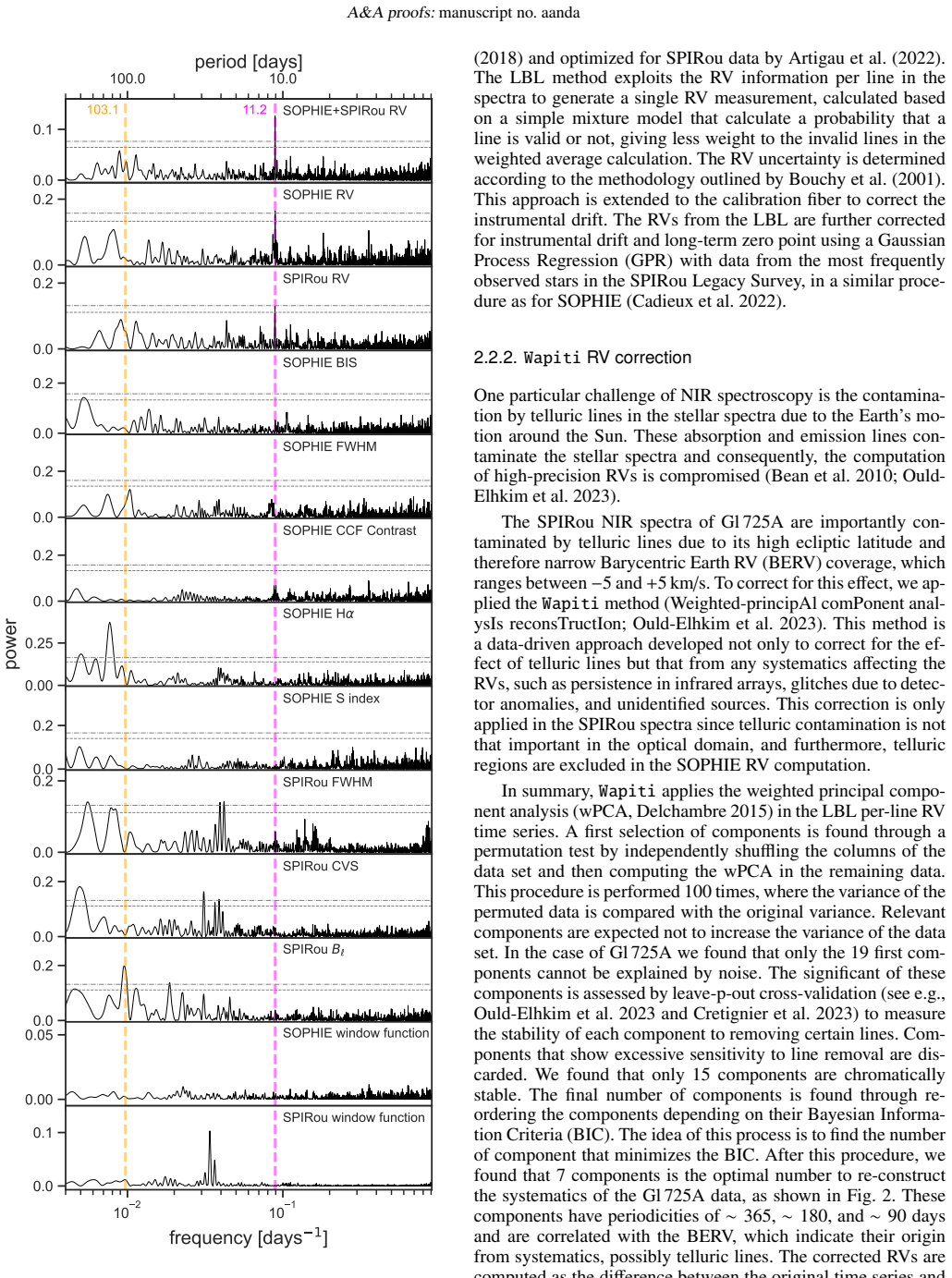
The paper establishes that Gl 725A hosts a probable super-Earth with orbital period 11.2201 ± 0.0051 days and minimum mass Mp sin i = 2.78 ± 0.35 M⊕, detected independently in SOPHIE optical and SPIRou near-infrared radial velocities. The detection is made by fitting, for each instrument, a quasi-periodic Gaussian process for stellar activity together with a circular Keplerian; the planet parameters agree between instruments, and the 11.22-day signal is not found in any activity indicator. TESS photometry from 27 sectors shows no transit, and injection-recovery tests indicate the planet is likely non-transiting; mass-radius relations predict a radius near 1.4 Earth radii, placing it in the super-Earth regime.
Load-bearing premise
The planet interpretation rests on the belief that the 11.22-day signal is achromatic and therefore not due to stellar activity, together with the trust that the Wapiti correction of the infrared velocities neither creates nor removes a signal at that period, which the paper does not test with injected signals.
Editorial extensions
If this is right
- Gl 725A b would be one of the closest known exoplanets, at 3.5 pc, making it a prime target for follow-up atmospheric and astrometric characterization if it can be confirmed.
- The system adds an S-type planet around one component of a wide M-dwarf binary, supporting the view that low-mass planets can form and survive in binary systems with separations of tens of AU.
- A minimum mass near 2.8 Earth masses with a predicted radius near 1.4 Earth radii places the planet in the super-Earth regime, informing planet-formation statistics around mid-M dwarfs.
- The absence of transits in 27 TESS sectors, despite a predicted radius that would be detectable for nearly edge-on orbits, suggests a modest orbital inclination and implies the true mass is close to the reported minimum.
- The detection demonstrates that sub-2 m/s planetary signals around M dwarfs are accessible with current optical and near-infrared spectrographs when stellar activity is modeled jointly.
Reading between the lines
- If the Wapiti correction is what uncovers the 11.22-day signal, similar telluric-correction pipelines applied to other high-ecliptic-latitude M dwarfs could reveal additional low-amplitude planets currently hidden by telluric systematics.
- The fitted binary inclination of 69.8 ± 0.4 degrees provides a prior for the planet's orbital inclination; if planet and binary are aligned, the true planet mass would be about 3.0 Earth masses, only slightly above the minimum.
- A more direct test of the transit interpretation would be to model the unresolved Gl 725 A+B light curves with a forward binary model rather than a blended aperture, since the 21-arcsecond TESS pixels cannot separate the two stars cleanly.
- Longer radial-velocity monitoring could establish whether the residual 111.9-day signal in the infrared data is stellar rotation or an additional companion, which would change the inferred architecture of the system.
Editorial analysis
A structured set of objections, weighed in public.
Referee Report
Summary. The paper reports the discovery of a super-Earth candidate, Gl 725A b, orbiting the M3V primary of a nearby (3.5 pc) binary system. The detection is based on radial velocities from SOPHIE in the optical and SPIRou in the near-infrared, with stellar activity modeled jointly by two Gaussian Processes (one per instrument) and a circular Keplerian. The best-fit parameters are P = 11.2201 ± 0.0051 d, K = 1.67 ± 0.20 m/s, and M_p sin i = 2.78 ± 0.35 M_Earth. The paper also presents an updated binary orbit, a TESS transit search with injection-recovery and TIP/FIP statistics, a non-detection of transits, and mass-radius inferred radii of 1.2–2.0 R_Earth.
Significance. If the detection holds, Gl 725A b would be one of the closest known super-Earths and a rare example of an S-type low-mass planet in an M dwarf binary, making it valuable for studies of planet formation in multiple systems. The paper has clear strengths: it uses two independent spectrographs in different wavelength regimes, applies several periodogram tools (GLS, l1, stacked BGLS), performs BIC-based model comparison, and includes extensive TESS work with both injection-recovery tests and TIP/FIP calculations. The analysis of the binary orbit from archival astrometry is also a useful contribution. However, the central claim of an independent, achromatic detection depends on the SPIRou Wapiti correction, which is not validated with injection-recovery tests in the current manuscript.
major comments (3)
- [2.2.2, Fig. 3, 5.1, 7.3] The SPIRou detection rests entirely on the Wapiti correction, but no injection-recovery validation is presented. The raw SPIRou RVs have their highest periodogram peak at 174 d, close to the half-year BERV harmonic, and the 11.2 d signal appears only after removing seven BERV-correlated principal components with periods of roughly 365, 180, and 90 d. Because the observing cadence is tied to seasonal visibility, the planet signal could in principle be partially absorbed by, or created through interaction with, the removed components. I request an injection-recovery test in which synthetic 1.67 m/s Keplerian signals at 11.22 d are injected into the raw per-line RVs and processed through the full Wapiti pipeline, with the recovered period, amplitude, and phase compared to input; a null test without an injected planet should also be run to ensure that the correction does not produce a spurious 11.2 d peak. This is load-bearing because the independent-detection and achromaticity claims depend on the SPIRou signal being real, and Sect. 7.3 itself concedes that residual NIR scatter may reflect Wapiti residuals.
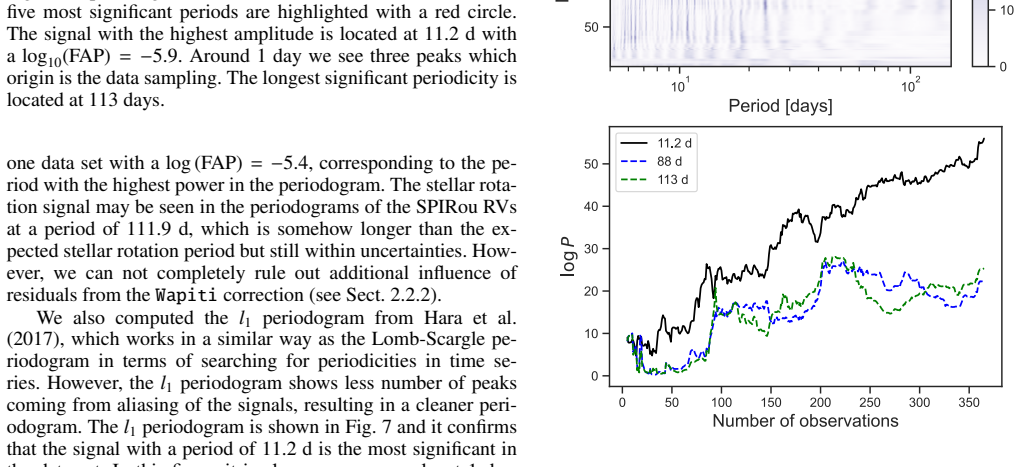
- [2.1, 2.2, 5.1] The independent-significance claim is stronger than the quoted false-alarm probabilities support. The SOPHIE GLS peak has log10(FAP) = -2.2 (about 0.6%), while the SPIRou post-Wapiti peak has log10(FAP) = -1.4 (about 4%), which is above the paper's own 1% FAP threshold used elsewhere (e.g., Fig. 1). The statement in Sect. 5.1 that 'Both data sets independently show a power excess' is technically true, but calling the SPIRou excess 'significant' is misleading. Please report a significance for the SPIRou Keplerian fit alone (e.g., via a likelihood-ratio test against a GP-only model) and, if that significance remains marginal, present the detection as SOPHIE-led with SPIRou as a consistency check rather than as an independent detection of comparable weight.
- [6.3] The TIP/FIP analysis reports TIP values of 0.7-0.8 for three transit epochs, but these are then dismissed as 'remaining systematics within the data' without a quantitative test. If the statistical method is a central part of the non-transit conclusion, those three epochs should be examined explicitly: e.g., by checking whether their times coincide with known spacecraft systematics, by including the PCA components in the noise model, or by showing that injecting a transit at the expected depth and duration yields higher TIP than the observed epochs. As written, the non-transit claim rests partly on an unexplained high-TIP discrepancy.
minor comments (5)
- [Table 3] There are six model columns but only four entries in the BIC and ΔBIC rows, and the values do not align unambiguously with the lnL values and sample sizes. Please clarify which BIC corresponds to which model and describe the null model explicitly.
- [Fig. 6 caption] The caption refers to the MCMC routine described in Sect. 4.6, but the binary-orbit fit is described in Sect. 3.5.
- [Fig. 3 caption] The caption contains a typo: 'Details odf the wapiti correction' should read 'Details of the wapiti correction'.
- [Table A.2] Several identical BJD and RV entries are listed with different B_l values (e.g., BJD 2458592.100327, 2458593.111044, 2458768.746699, and 2459416.887505). If these are the four polarimetric sub-exposures, the text's statement that each entry is the binning of the four observations should be reconciled with the table; if they are duplicates, please remove them or explain.
- [3.1] There is a typo: 'compares them with with the reference HARPS sample' should read 'compares them with the reference HARPS sample'.
Circularity Check
No circularity: the 11.22-day signal is found independently in SOPHIE and SPIRou periodograms before joint modeling, and the radius/transit predictions are forward applications of independent empirical relations.
full rationale
The detection chain is self-contained: SOPHIE RVs show an 11.2 d peak with log(FAP)=-2.2 (Sect. 2.1) and SPIRou RVs after the Wapiti correction show the same peak with log(FAP)=-1.4 (Sect. 2.2.2), before any Keplerian or GP fit. The GP hyperparameters adopt a previously published rotation period (Donati et al. 2023) as a prior, but the planet signal is recovered with consistent K (1.63±0.38 and 1.69±0.44 m/s) in independent single-Keplerian fits to each instrument (Table 3), so the prior is not load-bearing. The predicted radius (1.2–2.0 R⊕) and the non-transiting conclusion are forward predictions from the fitted minimum mass using external mass-radius relations and TESS photometry, not quantities fitted to the target. The Wapiti telluric/systematic correction is described in the paper and its possible residual impact is explicitly flagged (Sect. 7.3); while this is a validation risk, it is not a circularity because the correction is not constructed to produce the 11.2-day signal and the SPIRou detection is corroborated by SOPHIE. No load-bearing argument reduces to a self-citation or to a fit renamed as a prediction.
Assumptions & free parameters
free parameters (6)
- GP amplitude SOPHIE (eta1,SOPHIE) =
2.52 +0.67/-0.47 m/s
- GP amplitude SPIRou (eta1,SPIRou) =
1.43 +/- 0.40 m/s
- GP evolution timescale (eta2) =
134 +35/-23 days
- GP period (eta3) =
104.8 +/- 3.2 days
- GP harmonic complexity (eta4) =
0.45 +0.31/-0.20 (SOPHIE), 0.30 +0.20/-0.14 (SPIRou)
- White noise jitter (sigma_SOPHIE, sigma_SPIRou) =
1.09 +0.31/-0.52 and 3.01 +/- 0.22 m/s
assumptions (5)
- domain assumption The 11.22-day RV signal is achromatic and therefore planetary
- domain assumption The Wapiti correction removes only systematics and preserves planetary signals
- domain assumption Stellar activity is quasi-periodic and modeled by a GP with shared rotation period and decay time across instruments
- domain assumption Mass-radius relations (spright, forecaster) are valid for this star and mass range
- domain assumption The stellar rotation period of 103.1 +/- 6.1 days is correct
invented entities (1)
-
Planet Gl 725A b
Cite this review
Pith. "Pith review of Gl 725A b: a potential super-Earth detected with SOPHIE and SPIRou in an M dwarf binary system at 3.5 pc." pith.science (2026). https://pith.science/paper/XYBQKMLX
@misc{pith2026241109506,
  author       = {Pith},
  title        = {Pith review of: Gl 725A b: a potential super-Earth detected with SOPHIE and SPIRou in an M dwarf binary system at 3.5 pc},
  year         = {2026},
  howpublished = {\url{https://pith.science/paper/XYBQKMLX}},
  note         = {Machine review of arXiv:2411.09506}
}
abstract
We report the discovery of a super-Earth candidate orbiting the nearby mid M dwarf Gl\,725A using the radial velocity (RV) method. The planetary signal has been independently identified using high-precision RVs from the SOPHIE and SPIRou spectrographs, in the optical and near-infrared domains, respectively. We modelled the stellar activity signal jointly with the planet using two Gaussian Processes, one for each instrument to account for the chromaticity of the stellar activity and instrumental systematics, along with a Keplerian model. The signal is significantly detected with a RV semi-amplitude of $1.67\pm0.20$ m/s. The planet Gl 725A b is found to be in an orbit compatible with circular with a period of $11.2201\pm0.0051$ days. We analysed 27 sectors of TESS photometry on which no transit event was found. We determined a minimum mass of $M_{p}\sin{i}=2.78\pm0.35\,M_{\oplus}$ which places the planet in the super-Earth regime. Using Mass-Radius relationships we predict a planetary radius to be between 1.2 and $2.0\,R_{\oplus}$. The proximity of Gl 725A, of only 3.5 pc, makes this new exoplanet one of the closest to Earth and joins the group of S-type low-mass planets in short orbits ($P<15$ d) around close M dwarfs.
Figures


Figures from the paper (11 more)




Reference graph
Works this paper leans on
-
[1]
Z., Sousa, S
Adibekyan, V . Z., Sousa, S. G., Santos, N. C., et al. 2012, A&A, 545, A32
2012
-
[2]
2012, MNRAS, 419, 3147 Allende Prieto, C., Barklem, P
Aigrain, S., Pont, F., & Zucker, S. 2012, MNRAS, 419, 3147 Allende Prieto, C., Barklem, P. S., Lambert, D. L., & Cunha, K. 2004, A&A, 420, 183
2012
-
[3]
F., & Barceló Forteza, S
Aller, A., Lillo-Box, J., Jones, D., Miranda, L. F., & Barceló Forteza, S. 2020, A&A, 635, A128
2020
-
[4]
Andersen, J. M. & Korhonen, H. 2015, MNRAS, 448, 3053 Anglada-Escudé, G., Amado, P. J., Barnes, J., et al. 2016, Nature, 536, 437
2015
-
[5]
2018, MNRAS, 474, 2094
Angus, R., Morton, T., Aigrain, S., Foreman-Mackey, D., & Rajpaul, V . 2018, MNRAS, 474, 2094
2018
-
[6]
G., Delgado-Mena, E., et al
Antoniadis-Karnavas, A., Sousa, S. G., Delgado-Mena, E., et al. 2020, A&A, 636, A9 Artigau, É., Bouchy, F., Doyon, R., et al. 2024, in Society of Photo-Optical Instrumentation Engineers (SPIE) Conference Series, V ol. 13096, Ground- based and Airborne Instrumentation for Astronomy X, ed. J. J. Bryant, K. Mo- tohara, & J. R. D. Vernet, 130960C Artigau, É.,...
2020
-
[7]
2017, A&A, 602, A88
Astudillo-Defru, N., Forveille, T., Bonfils, X., et al. 2017, A&A, 602, A88
2017
-
[8]
L., Donahue, R
Baliunas, S. L., Donahue, R. A., Soon, W. H., et al. 1995, ApJ, 438, 269
1995
Show all 118 references
-
[9]
Baluev, R. V . 2008, MNRAS, 385, 1279
2008
-
[10]
Barnes, S. A. 2007, ApJ, 669, 1167
2007
-
[11]
L., Seifahrt, A., Hartman, H., et al
Bean, J. L., Seifahrt, A., Hartman, H., et al. 2010, ApJ, 713, 410
2010
-
[12]
Behmard, A., Dai, F., & Howard, A. W. 2022, AJ, 163, 160
2022
-
[13]
L., Lallement, R., Ferron, S., Boonne, C., & Bodichon, R
Bertaux, J. L., Lallement, R., Ferron, S., Boonne, C., & Bodichon, R. 2014, A&A, 564, A46
2014
-
[14]
J., Angelo, I., et al
Blunt, S., Wang, J. J., Angelo, I., et al. 2020, AJ, 159, 89
2020
-
[15]
2011, A&A, 528, A4
Boisse, I., Bouchy, F., Hébrard, G., et al. 2011, A&A, 528, A4
2011
-
[16]
2009, A&A, 495, 959
Boisse, I., Moutou, C., Vidal-Madjar, A., et al. 2009, A&A, 495, 959
2009
-
[17]
2013, A&A, 549, A109
Bonfils, X., Delfosse, X., Udry, S., et al. 2013, A&A, 549, A109
2013
-
[18]
2007, A&A, 474, 293
Bonfils, X., Mayor, M., Delfosse, X., et al. 2007, A&A, 474, 293
2007
-
[19]
2021, AJ, 161, 230
Bortle, A., Fausey, H., Ji, J., et al. 2021, AJ, 161, 230
2021
-
[20]
2009, A&A, 505, 853
Bouchy, F., Hébrard, G., Udry, S., et al. 2009, A&A, 505, 853
2009
-
[21]
2001, A&A, 374, 733
Bouchy, F., Pepe, F., & Queloz, D. 2001, A&A, 374, 733
2001
-
[22]
2012, MNRAS, 427, 127
Bressan, A., Marigo, P., Girardi, L., et al. 2012, MNRAS, 427, 127
2012
-
[23]
2022, AJ, 164, 96
Cadieux, C., Doyon, R., Plotnykov, M., et al. 2022, AJ, 164, 96
2022
-
[24]
L., Reefe, M., Plavchan, P., et al
Cale, B. L., Reefe, M., Plavchan, P., et al. 2021, AJ, 162, 295
2021
-
[25]
F., et al
Carleo, I., Malavolta, L., Lanza, A. F., et al. 2020, A&A, 638, A5
2020
-
[26]
2023, A&A, 674, A110
Carmona, A., Delfosse, X., Bellotti, S., et al. 2023, A&A, 674, A110
2023
-
[27]
2014, A&A, 567, A48
Carolo, E., Desidera, S., Gratton, R., et al. 2014, A&A, 567, A48
2014
-
[28]
& Kipping, D
Chen, J. & Kipping, D. 2017, ApJ, 834, 17
2017
-
[29]
2024, arXiv e-prints, arXiv:2405.10379
Christian, S., Vanderburg, A., Becker, J., et al. 2024, arXiv e-prints, arXiv:2405.10379
2024 arXiv
-
[30]
2022, AJ, 163, 207 Collier Cameron, A., Mortier, A., Phillips, D., et al
Christian, S., Vanderburg, A., Becker, J., et al. 2022, AJ, 163, 207 Collier Cameron, A., Mortier, A., Phillips, D., et al. 2019, MNRAS, 487, 1082
2022
-
[31]
J., Artigau, É., Doyon, R., et al
Cook, N. J., Artigau, É., Doyon, R., et al. 2022, PASP, 134, 114509 Cortés-Zuleta, P., Boisse, I., Klein, B., et al. 2023, A&A, 673, A14
2022
-
[32]
2015, A&A, 581, A38
Courcol, B., Bouchy, F., Pepe, F., et al. 2015, A&A, 581, A38
2015
-
[33]
2013, A&A, 554, A28
Covino, E., Esposito, M., Barbieri, M., et al. 2013, A&A, 554, A28
2013
-
[34]
2023, A&A, 678, A2
Cretignier, M., Dumusque, X., Aigrain, S., & Pepe, F. 2023, A&A, 678, A2
2023
-
[35]
M., Skrutskie, M
Cutri, R. M., Skrutskie, M. F., van Dyk, S., et al. 2003, VizieR Online Data
2003
-
[36]
2006, A&A, 458, 609
Catalog, II/246 da Silva, L., Girardi, L., Pasquini, L., et al. 2006, A&A, 458, 609
2006
-
[37]
2015, MNRAS, 446, 3545
Delchambre, L. 2015, MNRAS, 446, 3545
2015
-
[38]
2018, in Society of Photo-Optical Instru- mentation Engineers (SPIE) Conference Series, V ol
Delrez, L., Gillon, M., Queloz, D., et al. 2018, in Society of Photo-Optical Instru- mentation Engineers (SPIE) Conference Series, V ol. 10700, Ground-based and Airborne Telescopes VII, ed. H. K. Marshall & J. Spyromilio, 107001I
2018
-
[39]
M., Galland, F., Udry, S., & Mayor, M
Desort, M., Lagrange, A. M., Galland, F., Udry, S., & Mayor, M. 2007, A&A, 473, 983 Díaz, R. F., Delfosse, X., Hobson, M. J., et al. 2019, A&A, 625, A17
2007
-
[40]
F., Kouach, D., Moutou, C., et al
Donati, J. F., Kouach, D., Moutou, C., et al. 2020, MNRAS, 498, 5684
2020
-
[41]
F., Lehmann, L
Donati, J. F., Lehmann, L. T., Cristofari, P. I., et al. 2023, MNRAS, 525, 2015
2023
-
[42]
Dressing, C. D. & Charbonneau, D. 2013, ApJ, 767, 95
2013
-
[43]
Dressing, C. D. & Charbonneau, D. 2015, ApJ, 807, 45
2015
-
[44]
2018, A&A, 620, A47
Dumusque, X. 2018, A&A, 620, A47
2018
-
[45]
1986, A&A, 167, 379 Article number, page 16 of 26 P
Dvorak, R. 1986, A&A, 167, 379 Article number, page 16 of 26 P. Cortés-Zuleta et al.: Gl 725A b: a potential super-Earth
1986
-
[46]
Engle, S. G. & Guinan, E. F. 2023, ApJ, 954, L50
2023
-
[47]
V ., et al
Fabricius, C., Høg, E., Makarov, V . V ., et al. 2002, A&A, 384, 180
2002
-
[48]
P., Suárez Mascareño, A., Figueira, P., et al
Faria, J. P., Suárez Mascareño, A., Figueira, P., et al. 2022, A&A, 658, A115
2022
-
[49]
W., Lang, D., & Goodman, J
Foreman-Mackey, D., Hogg, D. W., Lang, D., & Goodman, J. 2013, PASP, 125, 306 Fouqué, P., Martioli, E., Donati, J. F., et al. 2023, arXiv e-prints, arXiv:2302.03377 Fouqué, P., Moutou, C., Malo, L., et al. 2018, MNRAS, 475, 1960
2013 arXiv
-
[50]
J., Petigura, E
Fulton, B. J., Petigura, E. A., Blunt, S., & Sinukoff, E. 2018, PASP, 130, 044504 Gaia Collaboration. 2020, VizieR Online Data Catalog, I/350
2018
-
[51]
Gaidos, E., Claytor, Z., Dungee, R., Ali, A., & Feiden, G. A. 2023, MNRAS, 520, 5283
2023
-
[52]
2020, in Society of Photo-Optical Instrumentation Engineers (SPIE) Conference Series, V ol
Garcia-Mejia, J., Charbonneau, D., Fabricant, D., et al. 2020, in Society of Photo-Optical Instrumentation Engineers (SPIE) Conference Series, V ol. 11445, Society of Photo-Optical Instrumentation Engineers (SPIE) Confer- ence Series, 114457R
2020
-
[53]
B., Stern, H
Gelman, A., Carlin, J. B., Stern, H. S., et al. 2014, Bayesian Data Analysis
2014
-
[54]
2011, in European Physical Journal Web of Conferences, V ol
Gillon, M., Jehin, E., Magain, P., et al. 2011, in European Physical Journal Web of Conferences, V ol. 11, European Physical Journal Web of Conferences, 06002
2011
-
[55]
C., Boué, G., Laskar, J., & Correia, A
Hara, N. C., Boué, G., Laskar, J., & Correia, A. C. M. 2017, MNRAS, 464, 1220
2017
-
[56]
C., Unger, N., Delisle, J.-B., Díaz, R
Hara, N. C., Unger, N., Delisle, J.-B., Díaz, R. F., & Ségransan, D. 2022, A&A, 663, A14
2022
-
[57]
2008, MNRAS, 388, 1175
Haywood, M. 2008, MNRAS, 388, 1175
2008
-
[58]
D., Collier Cameron, A., Queloz, D., et al
Haywood, R. D., Collier Cameron, A., Queloz, D., et al. 2014, MNRAS, 443, 2517
2014
-
[59]
C., et al
Heidari, N., Boisse, I., Hara, N. C., et al. 2024, A&A, 681, A55
2024
-
[60]
J., Jao, W.-C., Subasavage, J
Henry, T. J., Jao, W.-C., Subasavage, J. P., et al. 2006, AJ, 132, 2360
2006
-
[61]
J., Mulders, G
Hippke, M., David, T. J., Mulders, G. D., & Heller, R. 2019, AJ, 158, 143
2019
-
[62]
J., Bouchy, F., Cook, N
Hobson, M. J., Bouchy, F., Cook, N. J., et al. 2021, A&A, 648, A48
2021
-
[63]
J., Delfosse, X., Astudillo-Defru, N., et al
Hobson, M. J., Delfosse, X., Astudillo-Defru, N., et al. 2019, A&A, 625, A18
2019
-
[64]
J., Díaz, R
Hobson, M. J., Díaz, R. F., Delfosse, X., et al. 2018, A&A, 618, A103
2018
-
[65]
Holman, M. J. & Wiegert, P. A. 1999, AJ, 117, 621
1999
-
[66]
2009, A&A, 501, 941
Holmberg, J., Nordström, B., & Andersen, J. 2009, A&A, 501, 941
2009
-
[67]
W., Marcy, G
Howard, A. W., Marcy, G. W., Fischer, D. A., et al. 2014, ApJ, 794, 51 Huélamo, N., Figueira, P., Bonfils, X., et al. 2008, A&A, 489, L9
2014
-
[68]
Izmailov, I. S. 2019, Astronomy Letters, 45, 30
2019
-
[69]
2019, A&A, 623, A72
Kervella, P., Arenou, F., Mignard, F., & Thévenin, F. 2019, A&A, 623, A72
2019
-
[70]
2021, MNRAS, 507, 1869
Khata, D., Mondal, S., Das, R., & Baug, T. 2021, MNRAS, 507, 1869
2021
-
[71]
A., Harris, H
Kilic, M., Munn, J. A., Harris, H. C., et al. 2017, ApJ, 837, 162
2017
-
[72]
Kopparapu, R. K. 2013, ApJ, 767, L8
2013
-
[73]
2014, in Society of Photo-Optical Instru- mentation Engineers (SPIE) Conference Series, V ol
Kotani, T., Tamura, M., Suto, H., et al. 2014, in Society of Photo-Optical Instru- mentation Engineers (SPIE) Conference Series, V ol. 9147, Ground-based and Airborne Instrumentation for Astronomy V , ed. S. K. Ramsay, I. S. McLean, & H. Takami, 914714 Kovács, G., Zucker, S., ...
2014
-
[74]
2015, PASP, 127, 1161
Kreidberg, L. 2015, PASP, 127, 1161
2015
-
[75]
2021, A&A, 652, A28
Lafarga, M., Ribas, I., Reiners, A., et al. 2021, A&A, 652, A28
2021
-
[76]
2014, MNRAS, 440, 3532
Lai, D. 2014, MNRAS, 440, 3532
2014
-
[77]
V ., Howell, S
Lester, K. V ., Howell, S. B., Matson, R. A., et al. 2023, AJ, 166, 166 Lightkurve Collaboration, Cardoso, J. V . d. M., Hedges, C., et al. 2018, Lightkurve: Kepler and TESS time series analysis in Python, Astrophysics Source Code Library
2023
-
[78]
& Pallé, E
Luque, R. & Pallé, E. 2022, Science, 377, 1211
2022
-
[79]
2012, in Society of Photo-Optical Instrumentation Engineers (SPIE) Conference Series, V ol
Mahadevan, S., Ramsey, L., Bender, C., et al. 2012, in Society of Photo-Optical Instrumentation Engineers (SPIE) Conference Series, V ol. 8446, Ground- based and Airborne Instrumentation for Astronomy IV , ed. I. S. McLean, S. K. Ramsay, & H. Takami, 84461S
2012
-
[80]
I., Crockett, C
Mahmud, N. I., Crockett, C. J., Johns-Krull, C. M., et al. 2011, ApJ, 736, 123
2011
-
[81]
W., Dupuy, T., Kraus, A
Mann, A. W., Dupuy, T., Kraus, A. L., et al. 2019, ApJ, 871, 63
2019
-
[82]
W., Feiden, G
Mann, A. W., Feiden, G. A., Gaidos, E., Boyajian, T., & von Braun, K. 2015, ApJ, 804, 64 Martín, E. L., Guenther, E., Zapatero Osorio, M. R., Bouy, H., & Wainscoat, R. 2006, ApJ, 644, L75
2015
-
[83]
A., Winters, J
Medina, A. A., Winters, J. G., Irwin, J. M., & Charbonneau, D. 2022, ApJ, 935, 104
2022
-
[84]
& Collier Cameron, A
Mortier, A. & Collier Cameron, A. 2017, A&A, 601, A110
2017
-
[85]
C., et al
Moutou, C., Delfosse, X., Petit, A. C., et al. 2023, A&A, 678, A207
2023
-
[86]
C., et al
Neves, V ., Bonfils, X., Santos, N. C., et al. 2012, A&A, 538, A25
2012
-
[87]
R., Irwin, J., Charbonneau, D., et al
Newton, E. R., Irwin, J., Charbonneau, D., et al. 2016, ApJ, 821, 93
2016
-
[88]
Nicholson, B. A. & Aigrain, S. 2022, MNRAS, 515, 5251
2022
-
[89]
& Charbonneau, D
Nutzman, P. & Charbonneau, D. 2008, PASP, 120, 317
2008
-
[90]
F., Bouchy, F., & Helled, R
Otegi, J. F., Bouchy, F., & Helled, R. 2020, A&A, 634, A43
2020
-
[91]
F., et al
Ould-Elhkim, M., Moutou, C., Donati, J. F., et al. 2023, A&A, 675, A187
2023
-
[92]
2024, MNRAS, 527, 5693
Parviainen, H., Luque, R., & Palle, E. 2024, MNRAS, 527, 5693
2024
-
[93]
2008, in Society of Photo-Optical In- strumentation Engineers (SPIE) Conference Series, V ol
Perruchot, S., Kohler, D., Bouchy, F., et al. 2008, in Society of Photo-Optical In- strumentation Engineers (SPIE) Conference Series, V ol. 7014, Ground-based and Airborne Instrumentation for Astronomy II, ed. I. S. McLean & M. M. Casali, 70140J
2008
-
[94]
2018, A&A, 617, A104
Pinamonti, M., Damasso, M., Marzari, F., et al. 2018, A&A, 617, A104
2018
-
[95]
2022, A&A, 664, A65
Pinamonti, M., Sozzetti, A., Maldonado, J., et al. 2022, A&A, 664, A65
2022
-
[96]
2020, AJ, 159, 80
Quarles, B., Li, G., Kostov, V ., & Haghighipour, N. 2020, AJ, 159, 80
2020
-
[97]
W., Sivan, J
Queloz, D., Henry, G. W., Sivan, J. P., et al. 2001, A&A, 379, 279
2001
-
[98]
J., Ribas, I., et al
Quirrenbach, A., Amado, P. J., Ribas, I., et al. 2018, in Society of Photo-Optical Instrumentation Engineers (SPIE) Conference Series, V ol. 10702, Ground- based and Airborne Instrumentation for Astronomy VII, ed. C. J. Evans, L. Simard, & H. Takami, 107020W
2018
-
[99]
2019, MNRAS, 484, 2674
Rabus, M., Lachaume, R., Jordán, A., et al. 2019, MNRAS, 484, 2674
2019
-
[100]
Raftery, A. E. 1995, Sociological Methodology, 25, 111
1995
-
[101]
E., Lambert, D
Reddy, B. E., Lambert, D. L., & Allende Prieto, C. 2006, MNRAS, 367, 1329
2006
-
[102]
2012, Living Reviews in Solar Physics, 9, 1
Reiners, A. 2012, Living Reviews in Solar Physics, 9, 1
2012
-
[103]
L., Huber, K
Reiners, A., Bean, J. L., Huber, K. F., et al. 2010, ApJ, 710, 432
2010
-
[104]
2013, A&A, 552, A103 Reylé, C., Jardine, K., Fouqué, P., et al
Reiners, A., Shulyak, D., Anglada-Escudé, G., et al. 2013, A&A, 552, A103 Reylé, C., Jardine, K., Fouqué, P., et al. 2021, A&A, 650, A201
2013
-
[105]
R., Winn, J
Ricker, G. R., Winn, J. N., Vanderspek, R., et al. 2015, Journal of Astronomical
2015
-
[106]
2020, ApJ, 897, 125
Robertson, P., Stefansson, G., Mahadevan, S., et al. 2020, ApJ, 897, 125
2020
-
[107]
S., Bossini, D., Miglio, A., et al
Rodrigues, T. S., Bossini, D., Miglio, A., et al. 2017, MNRAS, 467, 1433
2017
-
[108]
S., Girardi, L., Miglio, A., et al
Rodrigues, T. S., Girardi, L., Miglio, A., et al. 2014, MNRAS, 445, 2758
2014
-
[109]
2021, A&A, 653, A114
Sabotta, S., Schlecker, M., Chaturvedi, P., et al. 2021, A&A, 653, A114
2021
-
[110]
L., & Schwab, C
Seifahrt, A., Stürmer, J., Bean, J. L., & Schwab, C. 2018, in Society of Photo- Optical Instrumentation Engineers (SPIE) Conference Series, V ol. 10702, Ground-based and Airborne Instrumentation for Astronomy VII, ed. C. J
2018
-
[111]
G., Adibekyan, V ., Delgado-Mena, E., et al
Sousa, S. G., Adibekyan, V ., Delgado-Mena, E., et al. 2021, A&A, 656, A53
2021
-
[112]
2023, A&A, 674, A108 Suárez Mascareño, A., Faria, J
Stock, S., Kemmer, J., Kossakowski, D., et al. 2023, A&A, 674, A108 Suárez Mascareño, A., Faria, J. P., Figueira, P., et al. 2020, A&A, 639, A77
2023
-
[113]
Wilson, O. C. 1968, ApJ, 153, 221
1968
-
[114]
G., Goffo, E., Alibert, Y ., et al
Wilson, T. G., Goffo, E., Alibert, Y ., et al. 2022, MNRAS, 511, 1043
2022
-
[115]
G., Cloutier, R., Medina, A
Winters, J. G., Cloutier, R., Medina, A. A., et al. 2022, AJ, 163, 168
2022
-
[116]
G., Medina, A
Winters, J. G., Medina, A. A., Irwin, J. M., et al. 2019, AJ, 158, 152
2019
-
[117]
Zanazzi, J. J. & Lai, D. 2018, MNRAS, 478, 835
2018
-
[118]
J., et al
Zechmeister, M., Reiners, A., Amado, P. J., et al. 2018, A&A, 609, A12 Article number, page 17 of 26 A&A proofs: manuscript no. aanda Appendix A: Log of observations The log of the SOPHIE and SPIRou observations with their corresponding activity indicators are listed in Tables...
2018
Reviewed August 12, 2026 · model on record in the stance chip above.
Discussion (0). Continue with ORCID to comment.