REVIEW 2 major objections 6 minor 55 references
A Bayesian Optimization Approach to Machine Translation Reranking
T0 review · 2 major / 6 minor · reviewed 2026-08-12 · deepseek-v4-flash
Pith's one-line read Framing machine-translation reranking as Bayesian optimization finds the best candidate with a fraction of the scoring calls, matching a 180-candidate random baseline with only 70 evaluations.
desk verdict A solid, carefully measured first BayesOpt treatment of MT reranking whose efficiency claim holds for the tested setup, with real soft spots around the untested smoothness assumption, an unreported bandwidth, and a non-random test split. read the letter →
The pith
A machine-rendered reading of the paper's core claim, the machinery that carries it, and where it could break.
The reading
What carries the argument
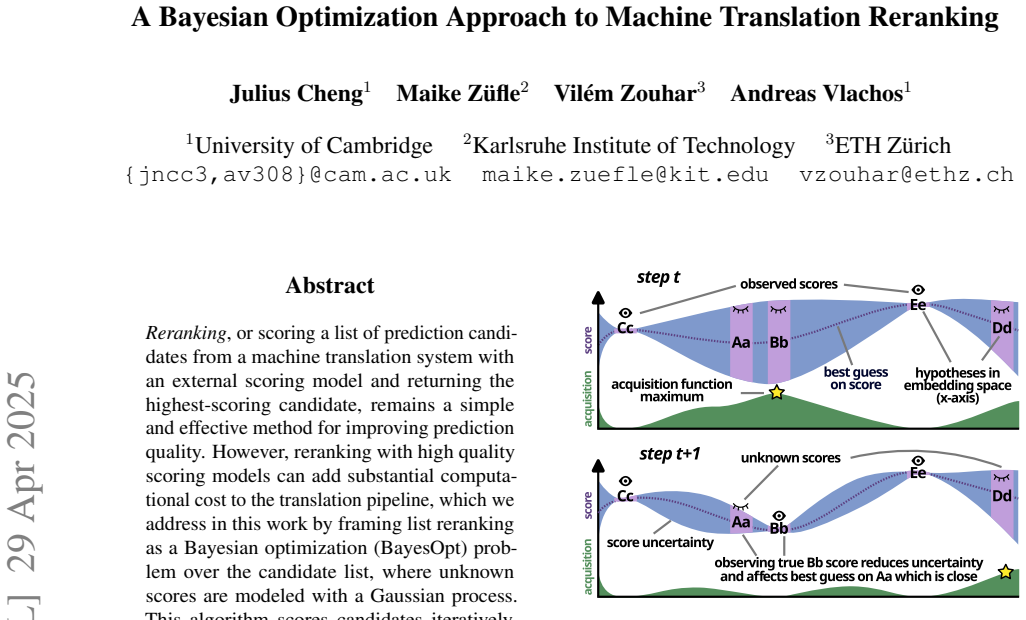
The load-bearing object is the kernel that measures similarity between candidate translations, $K_{MT}(y_i,y_j) = K_{RBF}(\mathrm{emb}(y_i), \mathrm{emb}(y_j))$, where $\mathrm{emb}$ is the mean-pooled, unit-normalized output of the generator's final decoder layer and $K_{RBF}$ is the radial-basis kernel with a single bandwidth $w$ tuned on the validation set. This kernel encodes the prior assumption that similar translations receive similar scores, and it makes the Gaussian-process posterior computable from only the few observed scores. The acquisition function is closed-form expected improvement, which scores each unscored candidate by its expected gain over the current best observation, balancing exploration of uncertain regions against exploitation of promising ones. For the multi-fidelity variant, the kernel becomes $K_{mult} = K_{MT} \cdot K_{score}(s_k, s_l)$, where $K_{score}$ is the empirical covariance between the main scorer and the proxy scorer measured on a validation set; this product kernel lets proxy observations shape the posterior over the main score.
What would settle it
Apply the same algorithm to the same candidate lists and embeddings but replace the CometKiwi scores with a deliberately non-smooth scoring function—for example, scores assigned by exact string match against a reference or scores drawn randomly per instance—and run BayesOpt+GP with the same kernel; if the quality-cost curve no longer beats random subset selection, the smoothness assumption is confirmed as the load-bearing premise. Alternatively, use a different generator whose decoder embeddings do not place similar translations near each other and measure whether the advantage diminishes.
Extended reading notes
Core claim
The paper's central claim is that machine-translation reranking can be viewed as a black-box optimization problem: given a list of candidate translations and a scoring function, a Gaussian-process model of the score surface—using an RBF kernel over mean-pooled final-decoder embeddings of the candidates—lets an expected-improvement acquisition function find near-best candidates while scoring only a fraction of the list. On the test set, with 200 sampled candidates per source sentence (about 178 after deduplication), BayesOpt+GP achieves an average CometKiwi score of 0.8210 with 70 scoring calls, versus 0.8149 for 70 random candidates and 0.8216 when roughly the full list is scored; the maximum attainable score is 0.8216. The method also outperforms search-based baselines (hill-climbing and log-probability selection) on the quality-cost tradeoff curve. The multi-fidelity extension multiplies the candidate kernel by an empirical covariance kernel between scorers, so observations from a cheap, distilled proxy scorer inform the posterior over the main scorer; with a well-correlated proxy, the method matches or exceeds the full-list score with about 70–90 CometKiwi calls and further reduces runtime.
Load-bearing premise
The method's efficiency relies on the assumption that similar translations, as judged by the embedding vectors, usually receive similar quality scores, so the Gaussian process's uncertainty estimates faithfully reflect where good candidates are; if that smoothness fails for a different scorer or generator, the query selection becomes no better than random.
Editorial extensions
If this is right
- If the smoothness assumption holds, translation systems can use far larger candidate lists for the same computational budget, because the number of expensive scorer calls no longer scales with list size.
- The multi-fidelity result implies that a cheap, well-distilled proxy scorer can replace a large fraction of the main scorer's calls; in the paper's runtime profile this cuts the total reranking time from 984.7 seconds to 873.6 seconds per 350 instances at matched output quality.
- Because the method treats the scorer as a black box, it should carry over to any quality estimator whose scores vary smoothly in the chosen embedding space, including quality-estimation models other than CometKiwi.
- The quality-cost curves show diminishing returns after roughly 70–90 scoring calls, so the method gives practitioners a principled way to choose the scoring budget without scoring the full list.
Reading between the lines
- A natural extension the paper does not test is applying the same search to human evaluation or an LLM used as a judge, where smoothness of the score surface in embedding space is less established; the method's assumptions would need to be re-validated for such scorers.
- The RBF bandwidth $w$ is fixed after tuning on the validation set; making it instance-specific or learned online might further improve the efficiency when candidate lists come from different language pairs or generators.
- The product-kernel formulation extends to more than two scorers, so a cascade of increasingly expensive scoring models could be exploited, although the paper only demonstrates the two-scorer case.
- The candidate embeddings come for free from the generator; using a different embedding source (for example, a cross-lingual sentence encoder) may change the smoothness and therefore the performance, which a careful reader could test.
Editorial analysis
A structured set of objections, weighed in public.
Referee Report
Summary. The paper frames machine translation list reranking as a Bayesian optimization problem. Given a candidate list generated by a neural MT system, a Gaussian process (GP) with an RBF kernel defined over mean-pooled final-decoder embeddings models the dependence between candidates and their CometKiwi scores. Expected improvement is used to select which candidates to score next under a fixed budget, and the highest-scoring observed candidate is returned. A multi-fidelity extension, BayesOpt+GP+P, incorporates cheaper proxy scores through a product kernel. Experiments on WMT23 with an NLLB generator and CometKiwi-22 show that BayesOpt+GP reaches the score that random selection achieves with 180 evaluations using only about 70 evaluations, and that the multi-fidelity variant can further improve early candidate quality when the proxy is well correlated. The paper includes several baselines, statistical significance tests, runtime profiling, and a code repository.
Significance. If the reported results hold, the paper makes a useful practical contribution to reducing the computational cost of MT reranking, which is increasingly dominated by large quality-estimation models. The experimental design is careful: it compares against multiple baselines, reports statistical significance in the appendix, profiles the full pipeline, and makes the code available. The empirical claim is evaluated on an external benchmark (CometKiwi on WMT23), so the core result is not circular with respect to the method's objective. The main risk is that the central efficiency gain rests on an untested smoothness assumption about the scoring function in the embedding space induced by the candidate generator, which limits the generality of the claims as currently stated.
major comments (2)
- [Section 3.1, Eq. (1); Section 2.1] The central efficiency claim depends on the assumption that CometKiwi scores vary smoothly in the mean-pooled NLLB decoder embedding space, since the kernel KMT(y_i,y_j) = KRBF(emb(y_i),emb(y_j)) uses the RBF of Eq. (1). The paper provides no direct evidence for this smoothness: there is no semivariogram or correlation analysis between embedding distances and absolute score differences, no comparison with a kernel defined on an unrelated representation, and no ablation of the embedding source. Because the kernel is tied to the candidate generator's internal states, the method is not an 'arbitrary black-box' optimizer as claimed in Section 2.1; it is coupled to the generator. The reported gains on CometKiwi/NLLB are suggestive, but transferability to other scoring functions or generators is not established. I recommend adding a direct smoothness diagnostic (e.g., correlation of pairwise kernel distances with score differences on the validation set) or explicitly limiting the method's scope to settings where such a diagnostic is favorable.
- [Section 4 (experimental setup)] The single RBF bandwidth w is grid-searched on the entire validation set and fixed for all experiments, but its value is never reported. The text states that results are 'not statistically significantly different within a range of settings' without providing that range or any supporting numbers. Since the acquisition function's exploration-exploitation tradeoff is controlled entirely by w, omitting the actual value and the stability range prevents readers from assessing how finely the smoothness assumption must be tuned. Please report the tuned w and the range over which the quality-cost curves remain statistically indistinguishable.
minor comments (6)
- [Abstract] The abstract's claim that BayesOpt+GP 'achieves the same CometKiwi score using only 70 scoring evaluations compared a baseline system using 180' is slightly imprecise: from Table 3, BayesOpt+GP at 70 runs scores 0.8210 while UniqRandom at 180 scores 0.8211, a difference of 0.0001. This is well within noise, but the wording should be qualified (e.g., 'statistically indistinguishable') to avoid an overly strong reading.
- [Appendix A, Table 4] The legend for the significance tables is confusing: it says '↑ means that the column method is significantly better than the row method,' but the example given in the caption ('third row and first column, ← means that HillClimbing is significantly better than UniqRandom') does not obviously match the printed layout. Please clarify the table orientation or provide a clearer legend.
- [Section 4.4, Table 2] The 'Comet Loading' value for BayesOpt+GP+P (11.27s) differs from the other two columns (8.43s) even though the same CometKiwi model is loaded. If the extra time includes loading the proxy model or other overhead, please state this explicitly in the table caption or the text.
- [Section 1] The sentence 'GPs make very few assumptions about the distribution and base their predictions are mostly on observed points' is grammatically garbled, and the claim that GPs make 'very few assumptions' is misleading because the kernel choice itself is a strong prior. Please rephrase.
- [Section 3.1] The statement that the kernel is 'fast to compute' is supported by the runtime measurements, but the O(|C|^2) similarity computation and O(|C|^3) matrix inversion costs are only mentioned in the Limitations section. For reproducibility and to set expectations, these costs should also be stated in the main method section.
- [Section 4.2] The baselines are introduced as 'Logprob{Avg,Sum}' but one sentence refers to them as 'LogprobFirst{Avg,Sum}'. Please make the naming consistent.
Circularity Check
No circularity: the efficiency claim is an empirical comparison against an external CometKiwi benchmark, and no load-bearing step reduces to its inputs by construction.
full rationale
The paper's central claim is that BayesOpt+GP reaches a given CometKiwi score with fewer scoring calls than random subset scoring. This is an empirical result evaluated on WMT23 test sentences with CometKiwi as an external target; the GP is not fitted to the test outcome, and the final answer is always the arg max over actually observed scores (Algorithm 1, line 14), so no unobserved-score prediction is presented as the result. The RBF bandwidth w is tuned on the validation set and fixed for test evaluation, which is standard hyperparameter selection rather than a fitted input renamed as a prediction. The multi-fidelity proxy models are distilled from CometKiwi, and the paper explicitly measures and discloses their correlation; the Kscore term in Equation 6 is estimated from validation-set covariances, not from the test results it is used to explain. The only self-citations (e.g., Cheng and Vlachos 2023) are related-work references for efficient MBR and are not load-bearing for the reranking derivation. The smoothness assumption behind the RBF kernel is a modeling premise that could fail, but it is not circular: it is not defined in terms of the claimed efficiency gain, and the paper's comparisons would be falsifiable if the assumption were wrong. No uniqueness theorem, ansatz-smuggling citation, or definitional equivalence is present.
Assumptions & free parameters
free parameters (6)
- RBF bandwidth w =
Not reported in text
- Initial main scores alpha =
10
- Initial proxy scores beta =
50 or 200
- Batch size k =
1 for main experiments; 10 for runtime
- Kscore empirical covariance =
Estimated from validation set
- Epsilon for sampling =
0.02
assumptions (6)
- domain assumption The target scoring function s is adequately modeled by a Gaussian process with an RBF kernel over candidate embeddings.
- domain assumption Candidates that are close in mean-pooled final-decoder embedding space receive similar CometKiwi scores.
- domain assumption Per-instance normalization of scores to mean 0 and variance 1 preserves the argmax and is a stable transformation across acquisitions.
- standard math The EI closed form (Equation 5) applies because observations are treated as noiseless, while the GP posterior includes a noise term sigma squared.
- domain assumption A CometKiwi score difference of 0.006 is meaningful and likely to be human-detectable.
- domain assumption The epsilon-sampling candidate lists (epsilon=0.02) contain the high-quality candidates needed for reranking.
Cite this review
Pith. "Pith review of A Bayesian Optimization Approach to Machine Translation Reranking." pith.science (2026). https://pith.science/paper/MENT43KI
@misc{pith2026241109694,
  author       = {Pith},
  title        = {Pith review of: A Bayesian Optimization Approach to Machine Translation Reranking},
  year         = {2026},
  howpublished = {\url{https://pith.science/paper/MENT43KI}},
  note         = {Machine review of arXiv:2411.09694}
}
read the original abstract
Reranking a list of candidates from a machine translation system with an external scoring model and returning the highest-scoring candidate remains a simple and effective method for improving the overall output quality. Translation scoring models continue to grow in size, with the best models being comparable to generation models. Thus, reranking can add substantial computational cost to the translation pipeline. In this work, we pose reranking as a Bayesian optimization (BayesOpt) problem. By strategically selecting candidates to score based on a balance of exploration and exploitation, we show that it is possible to find top-scoring candidates when scoring only a fraction of the candidate list. For instance, our method achieves the same CometKiwi score using only 70 scoring evaluations compared a baseline system using 180. We present a multi-fidelity setting for BayesOpt, where the candidates are first scored with a cheaper but noisier proxy scoring model, which further improves the cost-performance tradeoff when using smaller but well-trained distilled proxy scorers.
Figures


Figures from the paper (2 more)


Reference graph
Works this paper leans on
-
[1]
Daniel Beck and Trevor Cohn. 2017. https://aclanthology.org/I17-2012 Learning kernels over strings using G aussian processes . In Proceedings of the Eighth International Joint Conference on Natural Language Processing (Volume 2: Short Papers), 67--73. Asian Federation of Natural Language Processing
work page 2017
-
[2]
Daniel Beck, Trevor Cohn, and Lucia Specia. 2014. https://doi.org/10.3115/v1/D14-1190 Joint emotion analysis via multi-task G aussian processes . In Proceedings of the 2014 Conference on Empirical Methods in Natural Language Processing ( EMNLP ) , 1798--1803. Association for Computational Linguistics
-
[3]
Daniel Beck, Kashif Shah, Trevor Cohn, and Lucia Specia. 2013. https://aclanthology.org/W13-2241 SHEF - L ite: When less is more for translation quality estimation . In Proceedings of the Eighth Workshop on Statistical Machine Translation, 337--342. Association for Computational Linguistics
work page 2013
-
[4]
James Bergstra, R\' e mi Bardenet, Yoshua Bengio, and Bal\' a zs K\' e gl. 2011. https://proceedings.neurips.cc/paper_files/paper/2011/file/86e8f7ab32cfd12577bc2619bc635690-Paper.pdf Algorithms for hyper-parameter optimization . In Advances in Neural Information Processing Systems, volume 24. Curran Associates, Inc
2011
-
[5]
Sumanta Bhattacharyya, Amirmohammad Rooshenas, Subhajit Naskar, Simeng Sun, Mohit Iyyer, and Andrew McCallum. 2021. https://doi.org/10.18653/v1/2021.acl-long.349 Energy-based reranking: Improving neural machine translation using energy-based models . In Proceedings of the 59th Annual Meeting of the Association for Computational Linguistics and the 11th In...
-
[6]
Eugene Charniak and Mark Johnson. 2005. https://doi.org/10.3115/1219840.1219862 Coarse-to-fine n-best parsing and M ax E nt discriminative reranking . In Proceedings of the 43rd Annual Meeting of the Association for Computational Linguistics ( ACL ' 05) , 173--180. Association for Computational Linguistics
arXiv 2005
-
[7]
Julius Cheng and Andreas Vlachos. 2023. https://doi.org/10.18653/v1/2023.emnlp-main.767 Faster minimum B ayes risk decoding with confidence-based pruning . In Proceedings of the 2023 Conference on Empirical Methods in Natural Language Processing, 12473--12480. Association for Computational Linguistics
-
[8]
Michael Collins and Terry Koo. 2005. https://doi.org/10.1162/0891201053630273 Discriminative reranking for natural language parsing . Computational Linguistics, 31(1):25--70
Show all 55 references
-
[9]
Conn, Katya Scheinberg, and Luis N
Andrew R. Conn, Katya Scheinberg, and Luis N. Vicente. 2009. https://doi.org/10.1137/1.9780898718768 Introduction to Derivative-Free Optimization . Society for Industrial and Applied Mathematics
2009 doi
-
[10]
Alexis Conneau, Kartikay Khandelwal, Naman Goyal, Vishrav Chaudhary, Guillaume Wenzek, Francisco Guzm \' a n, Edouard Grave, Myle Ott, Luke Zettlemoyer, and Veselin Stoyanov. 2019. http://arxiv.org/abs/1911.02116 Unsupervised cross-lingual representation learning at scale . Co...
2019 arXiv
-
[11]
Hiroyuki Deguchi, Yusuke Sakai, Hidetaka Kamigaito, Taro Watanabe, Hideki Tanaka, and Masao Utiyama. 2024. https://doi.org/10.18653/v1/2024.findings-acl.654 Centroid-based efficient minimum B ayes risk decoding . In Findings of the Association for Computational Linguistics ACL...
2024 doi
-
[12]
Sergey Edunov, Myle Ott, Michael Auli, and David Grangier. 2018. https://doi.org/10.18653/v1/D18-1045 Understanding back-translation at scale . In Proceedings of the 2018 Conference on Empirical Methods in Natural Language Processing, 489--500. Association for Computational Li...
2018 doi
-
[13]
Bryan Eikema and Wilker Aziz. 2020. https://doi.org/10.18653/v1/2020.coling-main.398 Is MAP decoding all you need? the inadequacy of the mode in neural machine translation . In Proceedings of the 28th International Conference on Computational Linguistics, 4506--4520. Internati...
2020 doi
-
[14]
Bryan Eikema and Wilker Aziz. 2022. https://doi.org/10.18653/v1/2022.emnlp-main.754 Sampling-based approximations to minimum B ayes risk decoding for neural machine translation . In Proceedings of the 2022 Conference on Empirical Methods in Natural Language Processing, 10978--...
2022 doi
-
[15]
Patrick Fernandes, Ant \'o nio Farinhas, Ricardo Rei, Jos \'e G. C. de Souza, Perez Ogayo, Graham Neubig, and Andre Martins. 2022. https://doi.org/10.18653/v1/2022.naacl-main.100 Quality-aware decoding for neural machine translation . In Proceedings of the 2022 Conference of t...
2022 doi
-
[16]
Mara Finkelstein, Subhajit Naskar, Mehdi Mirzazadeh, Apurva Shah, and Markus Freitag. 2024. http://arxiv.org/abs/2309.10966 MBR and QE finetuning: Training-time distillation of the best and most expensive decoding methods
2024 arXiv
-
[17]
Markus Freitag, Behrooz Ghorbani, and Patrick Fernandes. 2023 a . https://doi.org/10.18653/v1/2023.findings-emnlp.617 Epsilon sampling rocks: Investigating sampling strategies for minimum B ayes risk decoding for machine translation . In Findings of the Association for Computa...
2023 doi
-
[18]
Markus Freitag, David Grangier, Qijun Tan, and Bowen Liang. 2022. https://doi.org/10.1162/tacl\_a\_00491 High quality rather than high model probability: Minimum B ayes risk decoding with neural metrics . Transactions of the Association for Computational Linguistics, 10:811--825
2022 doi
-
[19]
Markus Freitag, Nitika Mathur, Chi-kiu Lo, Eleftherios Avramidis, Ricardo Rei, Brian Thompson, Tom Kocmi, Frederic Blain, Daniel Deutsch, Craig Stewart, Chrysoula Zerva, Sheila Castilho, Alon Lavie, and George Foster. 2023 b . https://doi.org/10.18653/v1/2023.wmt-1.51 Results ...
2023 doi
-
[20]
Philipp Hennig and Christian J. Schuler. 2011. https://api.semanticscholar.org/CorpusID:166832 Entropy search for information-efficient global optimization . ArXiv, abs/1112.1217
2011 arXiv
-
[21]
John Hewitt, Christopher Manning, and Percy Liang. 2022. https://doi.org/10.18653/v1/2022.findings-emnlp.249 Truncation sampling as language model desmoothing . In Findings of the Association for Computational Linguistics: EMNLP 2022, 3414--3427. Association for Computational ...
2022 doi
-
[22]
Donald R. Jones. 2001. https://api.semanticscholar.org/CorpusID:8723392 A taxonomy of global optimization methods based on response surfaces . Journal of Global Optimization, 21:345--383
2001
-
[23]
Juraj Juraska, Mara Finkelstein, Daniel Deutsch, Aditya Siddhant, Mehdi Mirzazadeh, and Markus Freitag. 2023. https://doi.org/10.18653/v1/2023.wmt-1.63 M etric X -23: The G oogle submission to the WMT 2023 metrics shared task . In Proceedings of the Eighth Conference on Machin...
2023 doi
-
[24]
Kirthevasan Kandasamy, Gautam Dasarathy, Junier B Oliva, Jeff Schneider, and Barnabas Poczos. 2016. https://proceedings.neurips.cc/paper_files/paper/2016/file/605ff764c617d3cd28dbbdd72be8f9a2-Paper.pdf Gaussian process bandit optimisation with multi-fidelity evaluations . In A...
2016
-
[25]
Cenk Kaynak and Ethem Alpaydin. 2000. MultiStage Cascading of Multiple Classifiers: One Man’s Noise is Another Man’s Data . In Proceedings of the 17th International Conference on Machine Learning , 455--462. Morgan Kaufmann
2000
-
[26]
Tom Kocmi, Eleftherios Avramidis, Rachel Bawden, Ond r ej Bojar, Anton Dvorkovich, Christian Federmann, Mark Fishel, Markus Freitag, Thamme Gowda, Roman Grundkiewicz, Barry Haddow, Marzena Karpinska, Philipp Koehn, Benjamin Marie, Christof Monz, Kenton Murray, Masaaki Nagata, ...
2024
-
[27]
Tom Kocmi, Rachel Bawden, Ond r ej Bojar, Anton Dvorkovich, Christian Federmann, Mark Fishel, Thamme Gowda, Yvette Graham, Roman Grundkiewicz, Barry Haddow, Rebecca Knowles, Philipp Koehn, Christof Monz, Makoto Morishita, Masaaki Nagata, Toshiaki Nakazawa, Michal Nov \'a k, Ma...
2022
-
[28]
Tom Kocmi, Vil \'e m Zouhar, Christian Federmann, and Matt Post. 2024 b . https://doi.org/10.18653/v1/2024.acl-long.110 Navigating the metrics maze: Reconciling score magnitudes and accuracies . In Proceedings of the 62nd Annual Meeting of the Association for Computational Lin...
2024 doi
-
[29]
Andreas Krause, Ajit Singh, and Carlos Guestrin. 2008. https://www.jmlr.org/papers/volume9/krause08a/krause08a.pdf Near-optimal sensor placements in gaussian processes: Theory, efficient algorithms and empirical studies . J. Mach. Learn. Res., 9:235–284
2008
-
[30]
Ann Lee, Michael Auli, and Marc ' Aurelio Ranzato. 2021. https://doi.org/10.18653/v1/2021.acl-long.563 Discriminative reranking for neural machine translation . In Proceedings of the 59th Annual Meeting of the Association for Computational Linguistics and the 11th Internationa...
2021 doi
-
[31]
Jonas Mockus. 1974. https://link.springer.com/content/pdf/10.1007/978-3-662-38527-2_55.pdf On bayesian methods for seeking the extremum . In Proceedings of the IFIP Technical Conference, 400--404
1974 doi
-
[32]
Noack, Harinarayan Krishnan, Mark D
Marcus M. Noack, Harinarayan Krishnan, Mark D. Risser, and Kristofer G. Reyes. 2023. https://doi.org/10.1038/s41598-023-30062-8 Exact gaussian processes for massive datasets via non-stationary sparsity-discovering kernels . Scientific Reports, 13(1)
2023 doi
-
[33]
Myle Ott, Sergey Edunov, David Grangier, and Michael Auli. 2018. https://doi.org/10.18653/v1/W18-6301 Scaling neural machine translation . In Proceedings of the Third Conference on Machine Translation: Research Papers, 1--9. Association for Computational Linguistics
2018 doi
-
[34]
Slav Petrov. 2011. https://dl.acm.org/doi/abs/10.5555/2103611 Coarse-to-Fine Natural Language Processing (Theory and Applications of Natural Language Processing) . Springer Publishing Company, Incorporated
2011 doi
-
[35]
Rasmussen and C.K.I
C.E. Rasmussen and C.K.I. Williams. 2005. https://books.google.co.uk/books?id=GhoSngEACAAJ Gaussian Processes for Machine Learning . Adaptive Computation and Machine Learning series. MIT Press
2005
-
[36]
de Souza, Pedro G
Ricardo Rei, Ana C Farinha, Jos \'e G.C. de Souza, Pedro G. Ramos, Andr \'e F.T. Martins, Luisa Coheur, and Alon Lavie. 2022 a . https://aclanthology.org/2022.eamt-1.9 Searching for COMETINHO : The little metric that could . In Proceedings of the 23rd Annual Conference of the ...
2022
-
[37]
Ricardo Rei, Craig Stewart, Ana C Farinha, and Alon Lavie. 2020. https://doi.org/10.18653/v1/2020.emnlp-main.213 COMET : A neural framework for MT evaluation . In Proceedings of the 2020 Conference on Empirical Methods in Natural Language Processing (EMNLP), 2685--2702. Associ...
2020 doi
-
[38]
Guerreiro, Chrysoula Zerva, Ana C Farinha, Christine Maroti, Jos \'e G
Ricardo Rei, Marcos Treviso, Nuno M. Guerreiro, Chrysoula Zerva, Ana C Farinha, Christine Maroti, Jos \'e G. C. de Souza, Taisiya Glushkova, Duarte Alves, Luisa Coheur, Alon Lavie, and Andr \'e F. T. Martins. 2022 b . https://aclanthology.org/2022.wmt-1.60 C omet K iwi: IST -u...
2022
-
[39]
Thibault Sellam, Dipanjan Das, and Ankur Parikh. 2020. https://doi.org/10.18653/v1/2020.acl-main.704 BLEURT : Learning robust metrics for text generation . In Proceedings of the 58th Annual Meeting of the Association for Computational Linguistics, 7881--7892. Association for C...
2020 doi
-
[40]
Rico Sennrich, Barry Haddow, and Alexandra Birch. 2016. https://doi.org/10.18653/v1/P16-1009 Improving neural machine translation models with monolingual data . In Proceedings of the 54th Annual Meeting of the Association for Computational Linguistics (Volume 1: Long Papers), ...
2016 doi
-
[41]
Adams, and Nando de Freitas
Bobak Shahriari, Kevin Swersky, Ziyun Wang, Ryan P. Adams, and Nando de Freitas. 2016. https://api.semanticscholar.org/CorpusID:14843594 Taking the human out of the loop: A review of bayesian optimization . Proceedings of the IEEE, 104:148--175
2016
-
[42]
Prasann Singhal, Jiacheng Xu, Xi Ye, and Greg Durrett. 2023. https://doi.org/10.18653/v1/2023.acl-long.517 EEL : Efficiently encoding lattices for reranking . In Proceedings of the 61st Annual Meeting of the Association for Computational Linguistics (Volume 1: Long Papers), 92...
2023 doi
-
[43]
Kakade, and Matthias W
Niranjan Srinivas, Andreas Krause, Sham M. Kakade, and Matthias W. Seeger. 2009. https://api.semanticscholar.org/CorpusID:59031327 Information-theoretic regret bounds for gaussian process optimization in the bandit setting . IEEE Transactions on Information Theory, 58:3250--3265
2009
-
[44]
Felix Stahlberg. 2020. https://www.jair.org/index.php/jair/article/view/12007 Neural machine translation: A review . Journal of Artificial Intelligence Research, 69:343--418
2020
-
[45]
NLLB Team, Marta R. Costa-jussà, James Cross, Onur Çelebi, Maha Elbayad, Kenneth Heafield, Kevin Heffernan, Elahe Kalbassi, Janice Lam, Daniel Licht, Jean Maillard, Anna Sun, Skyler Wang, Guillaume Wenzek, Al Youngblood, Bapi Akula, Loic Barrault, Gabriel Mejia Gonzalez, Prang...
2022 arXiv
-
[46]
Firas Trabelsi, David Vilar, Mara Finkelstein, and Markus Freitag. 2024. http://arxiv.org/abs/2406.02832 Efficient minimum bayes risk decoding using low-rank matrix completion algorithms
2024 arXiv
-
[47]
Jannis Vamvas and Rico Sennrich. 2024. https://doi.org/10.18653/v1/2024.acl-short.71 Linear-time minimum B ayes risk decoding with reference aggregation . In Proceedings of the 62nd Annual Meeting of the Association for Computational Linguistics (Volume 2: Short Papers), 790--...
2024 doi
-
[48]
Giorgos Vernikos and Andrei Popescu-Belis. 2024. https://aclanthology.org/2024.acl-long.653 Don ' t rank, combine! combining machine translation hypotheses using quality estimation . In Proceedings of the 62nd Annual Meeting of the Association for Computational Linguistics (Vo...
2024
-
[50]
Jun Wang, Eleftheria Briakou, Hamid Dadkhahi, Rishabh Agarwal, Colin Cherry, and Trevor Cohn. 2024 b . https://api.semanticscholar.org/CorpusID:271213690 Don't throw away data: Better sequence knowledge distillation . ArXiv, abs/2407.10456
2024 arXiv
-
[51]
Wenhui Wang, Furu Wei, Li Dong, Hangbo Bao, Nan Yang, and Ming Zhou. 2020. http://arxiv.org/abs/2002.10957 MiniLM : Deep self-attention distillation for task-agnostic compression of pre-trained transformers
2020 arXiv
-
[52]
Frazier, and Andrew Gordon Wilson
Jian Wu, Saul Toscano-Palmerin, Peter I. Frazier, and Andrew Gordon Wilson. 2020 . https://proceedings.mlr.press/v115/wu20a.html Practical multi-fidelity bayesian optimization for hyperparameter tuning . In Proceedings of The 35th Uncertainty in Artificial Intelligence Confere...
2020
-
[53]
Yonghui Wu, Mike Schuster, Zhifeng Chen, Quoc V. Le, Mohammad Norouzi, Wolfgang Macherey, Maxim Krikun, Yuan Cao, Qin Gao, Klaus Macherey, Jeff Klingner, Apurva Shah, Melvin Johnson, Xiaobing Liu, Łukasz Kaiser, Stephan Gouws, Yoshikiyo Kato, Taku Kudo, Hideto Kazawa, Keith St...
2016 arXiv
-
[54]
Kyra Yee, Yann Dauphin, and Michael Auli. 2019. https://doi.org/10.18653/v1/D19-1571 Simple and effective noisy channel modeling for neural machine translation . In Proceedings of the 2019 Conference on Empirical Methods in Natural Language Processing and the 9th International...
2019 doi
-
[55]
URL: " 'urlintro :=
ENTRY address author booktitle chapter edition editor howpublished institution journal key month note number organization pages publisher school series title type volume year eprint doi pubmed url lastchecked label extra.label sort.label short.list INTEGERS output.state before...
-
[56]
write newline
" write newline "" before.all 'output.state := FUNCTION n.dashify 't := "" t empty not t #1 #1 substring "-" = t #1 #2 substring "--" = not "--" * t #2 global.max substring 't := t #1 #1 substring "-" = "-" * t #2 global.max substring 't := while if t #1 #1 substring * t #2 gl...
Reviewed August 12, 2026 · model on record in the stance chip above.
Discussion (0). Continue with ORCID to comment.