REVIEW 3 major objections 6 minor 48 references
GSEditPro: 3D Gaussian Splatting Editing with Attention-based Progressive Localization
T0 review · 3 major / 6 minor · reviewed 2026-08-12 · deepseek-v4-flash
Pith's one-line read GSEditPro claims text-only prompts are enough for precise 3D-GS editing when cross-attention maps label which Gaussians change.
desk verdict GSEditPro is a competent composition of known ideas with a genuine new twist, but a missing label-propagation rule for cloned Gaussians leaves the central localization claim under-specified. read the letter →
The pith
A machine-rendered reading of the paper's core claim, the machinery that carries it, and where it could break.
The reading
What carries the argument
The load-bearing object is the attention-based progressive localization module. It works by taking the cross-attention maps of the edited keyword from a DreamBooth-fine-tuned text-to-image model, thresholding them, cleaning the result with DBSCAN, and using the highest-attention pixels as positive point prompts and the lowest as negative prompts for SAM, which returns a precise per-view mask. Those 2D masks are backprojected through the differentiable splatting renderer to attach a binary label to every 3D Gaussian, and only labeled Gaussians are allowed to receive SDS gradients. The same module reappears during optimization to generate a dynamic mask for the pseudo-ground-truth image, so the localization is progressive: coarse and static at first, then refreshed as the edited shape emerges.
What would settle it
Run the localization module on a scene where the target object's true 3D segmentation is known, backproject the resulting masks, and compute the intersection-over-union between labeled and ground-truth Gaussians across several camera views; a low overlap for objects that are small, occluded, or weakly attended would show that the attention map cannot carry the localization precision the method claims.
Extended reading notes
Core claim
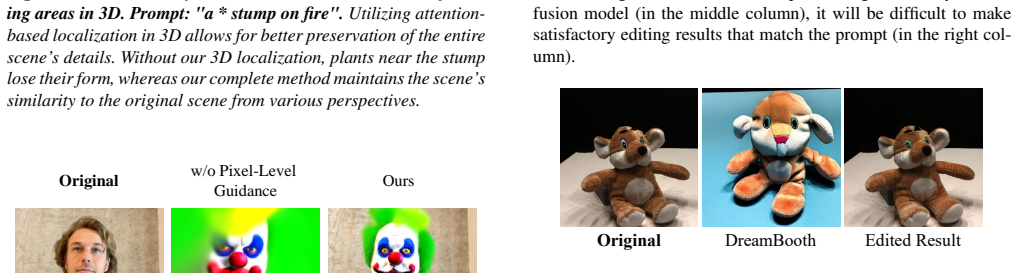
The central claim is that attention-based progressive localization converts the explicit Gaussian representation into a semantic segmentation that makes text-only editing precise. After DreamBooth fine-tunes the text-to-image model around the edited subject token, an image-to-image pass on sampled views yields cross-attention maps for the target word; the module thresholds the maps at 0.5, filters with DBSCAN, and feeds the strongest points to SAM as prompts to obtain clean per-view masks. These masks are backprojected during differentiable splatting, and Gaussians whose backprojection weight exceeds a threshold are labeled as editable, so SDS gradients only reach the intended region. During optimization the method reuses the localization module in a second stage to build a dynamic mask and constructs a pseudo-ground-truth image $I_{pgt} = M \odot I_{edit} + (1 - M) \odot I_{ori}$, combining edited content with preserved original pixels and supervising the render with L1 and D-SSIM losses. The paper concludes from qualitative comparisons, CLIP directional similarity, and user studies that this pipeline outperforms Instruct-NeRF2NeRF, GaussianEditor, and DreamEditor in localization accuracy and visual fidelity.
Load-bearing premise
The load-bearing premise is that the cross-attention maps, after thresholding, DBSCAN clustering, and SAM refinement, are spatially aligned with the target object in every rendered view, so that backprojection labels the correct Gaussians and the edit stays inside them.
Editorial extensions
If this is right
- Text-only editing becomes possible for both changing existing objects and inserting new ones, without user-supplied masks or depth maps.
- Gradients restricted to labeled Gaussians should keep non-edited geometry and appearance intact across views.
- The pseudo-ground-truth pixel guidance should suppress the background bleeding that pure SDS optimization causes, because unchanged pixels are explicitly supervised toward the original render.
- Because localization is refreshed during optimization, the editing region can track the evolving Gaussian distribution instead of being frozen at an initial 2D mask.
- If the comparison studies are representative, users prefer the results over I-N2N, GaussianEditor, and DreamEditor in the tested scenes.
Reading between the lines
- Beyond the paper: the per-Gaussian labels produced by this module could be reused as a mask for other operations, such as deletion, style transfer, or property control, without retraining the localization.
- Beyond the paper: because DreamBooth fine-tuning is per subject, the cost of the method grows with the number of distinct edits; a zero-shot localizer from an off-the-shelf attention model would be the natural next test of the same idea.
- Beyond the paper: a stress test worth running is occlusion and small targets; if attention maps lose the object when it occupies only a few pixels, the labels will inherit that failure, and the claimed precision would degrade exactly where manual masks used to be needed.
Editorial analysis
A structured set of objections, weighed in public.
Referee Report
Summary. The paper proposes GSEditPro, a text-only 3D scene editing method for 3D Gaussian Splatting. The method first fine-tunes Stable Diffusion with DreamBooth and collects cross-attention maps for the target token during image-to-image generation; these maps are thresholded, clustered with DBSCAN, optionally refined with SAM point prompts, and backprojected into 3D to assign binary labels to Gaussians. Only labeled Gaussians receive gradients from an SDS loss (Eq. 3), while a pseudo-GT image (Eq. 5) combined with L1 and D-SSIM losses (Eq. 6) and anchor losses (Eq. 4) constrain the optimization. The paper reports qualitative results on object replacement and insertion, ablations for localization and pixel guidance, CLIP directional similarity scores, and user studies against Instruct-NeRF2NeRF, GaussianEditor, and DreamEditor.
Significance. If the method works as described, it is a practical contribution: it removes manual mask and depth input, supports object insertion, and introduces a semantic labeling scheme for Gaussians. The paper is honest in reporting a failure case and includes ablations that support the usefulness of localization and pixel-level guidance. However, the central mechanism (attention-derived 3D labels) is only qualitatively validated, and two technical details—label inheritance during adaptive density control and the actual role of the pseudo-GT loss—need to be pinned down before the claims can be fully assessed. The reported gains in CLIP dir and user preference are consistent with the qualitative results but are not accompanied by statistical analysis.
major comments (3)
- [Section 3.2/3.3] Section 3.3 states that LSDS "guide[s] the cloning and splitting of the Gaussians" (Eq. 3), while Section 3.2 restricts gradient propagation to "labeled Gaussians whose weights of back-projection bigger than the threshold." The paper never states whether the binary label is inherited by Gaussians created during cloning or splitting. If the new Gaussians are unlabeled, they receive no SDS gradient and the edited geometry cannot grow beyond the initially labeled set, which contradicts the beard, hat, and object-insertion results. If they inherit the parent label, a tracking rule equivalent to GaussianEditor's semantic tracking is needed, and none is described. Please specify the label-propagation rule and the back-projection weight threshold used in the experiments.
- [Section 3.4, Eqs. (5)-(6)] In Eq. (5), Ipgt = M \odot Iedit + (1 - M) \odot Iori, so inside the mask Ipgt equals Iedit. Consequently the L1 term of Eq. (6) vanishes in the edited region, and only the masked-out region (with some boundary influence via D-SSIM) is constrained by the preservation loss. The paper's third contribution claims pixel-level guidance "guide[s] 3D Gaussian rendering for more detailed results," but Eqs. (5)-(6) do not directly supervise the inside of the mask; the edited region is driven only by SDS. Please clarify what "detailed results" means here and state whether any term in Eq. (7) supervises the inner masked region beyond LSDS.
- [Section 3.2 / Section 4.4] The localization module is the load-bearing component of the method, but no experiment quantifies its accuracy. The 2D masks come from thresholded cross-attention maps, DBSCAN filtering, and SAM refinement, and are backprojected into 3D labels; Section 4.4 only shows an end-to-end ablation (with vs. without localization) and qualitative figures. Please add a quantitative evaluation of the masks or labels—for example, IoU against hand-annotated masks on sampled views, or precision/recall of the 3D labels—so the "precise localization" claim can be separated from the optimization quality.
minor comments (6)
- [Section 3.2] The term "Img2ImgPipe" is used without definition; please specify the exact inference settings (number of steps, guidance scale, resolution, prompt format) used to obtain cross-attention maps.
- [Equations (4) and (7)] Equations (4) and (7) both use lambda with subscripts, but lambda_i in Eq. (4) indexes generation count while lambda_P in Eq. (7) indexes parameter type; please reconcile the notation.
- [Figure 3] The Figure 3 caption refers to a "guessed sketch" while the text calls it a "static mask"; please unify the terminology.
- [Section 4.1] The paper explains that DreamEditor is evaluated on a subset of its released preprocessed datasets; please state explicitly how many tasks and scenes are shared with the comparisons in Table 1, since the two tables are otherwise not directly comparable.
- [References] Reference [CLV24] lacks publication venue and complete bibliographic information; please complete the entry.
- [Eq. (1)] Equation (1) uses N both as the total number of Gaussians and as the running index; please use distinct symbols for clarity.
Circularity Check
No circular derivation found; the method couples attention-based localization and SDS optimization through a shared diffusion prior but not by construction.
full rationale
GSEditPro's pipeline is a masked-SDS editing system, not a self-deriving result. The localization labels are obtained from cross-attention maps of a DreamBooth-fine-tuned T2I model, thresholded, DBSCAN-filtered, SAM-refined, and back-projected into 3D-GS. The SDS loss then updates Gaussians under the same text prompt; this is a shared generative prior, not a fitted parameter renamed as a prediction. The pseudo-GT construction Ipgt = M ⊙ Iedit + (1 − M) ⊙ Iori in Eq. (5) is a deliberate masked blend: by construction the preservation loss in Eq. (6) acts only outside M, so it cannot be accused of secretly defining the edit target inside M; the paper uses it as a background consistency term, while the actual edit is driven by LSDS. No numerical constant is fitted to the evaluation metric, no external unicity theorem is imported from the authors' prior work, and the cited baselines and priors (GaussianEditor, DreamBooth, DreamFusion) are outside the author list. The only self-referential aspect is that the same diffusion model supplies both the spatial prior (attention maps) and the score supervision; that is a design coupling, not an equation-level identity. Therefore no circular step meets the quoted-reduction bar.
Assumptions & free parameters
free parameters (6)
- attention map threshold =
0.5
- SAM point prompt counts =
top 5 positive, bottom 3 negative
- DBSCAN parameters =
not specified
- static mask duration =
2000 iterations
- loss weights lambda_sds, lambda_l1, lambda_ssim, lambda_P =
not specified
- anchor loss schedule =
lambda_i grows with generation index
assumptions (5)
- domain assumption Cross-attention maps of the fine-tuned diffusion model spatially indicate the location of the target word in the rendered image.
- domain assumption SAM can produce precise segmentation masks from point prompts derived from attention maps.
- domain assumption Backprojection of 2D masks through 3D-GS rendering is accurate enough to label the correct Gaussians.
- domain assumption COLMAP camera poses and depths are reliable for multi-view consistency.
- domain assumption DreamBooth fine-tuning preserves the T2I model's editing ability and improves attention map accuracy.
Cite this review
Pith. "Pith review of GSEditPro: 3D Gaussian Splatting Editing with Attention-based Progressive Localization." pith.science (2026). https://pith.science/paper/R32GORSH
@misc{pith2026241110033,
  author       = {Pith},
  title        = {Pith review of: GSEditPro: 3D Gaussian Splatting Editing with Attention-based Progressive Localization},
  year         = {2026},
  howpublished = {\url{https://pith.science/paper/R32GORSH}},
  note         = {Machine review of arXiv:2411.10033}
}
read the original abstract
With the emergence of large-scale Text-to-Image(T2I) models and implicit 3D representations like Neural Radiance Fields (NeRF), many text-driven generative editing methods based on NeRF have appeared. However, the implicit encoding of geometric and textural information poses challenges in accurately locating and controlling objects during editing. Recently, significant advancements have been made in the editing methods of 3D Gaussian Splatting, a real-time rendering technology that relies on explicit representation. However, these methods still suffer from issues including inaccurate localization and limited manipulation over editing. To tackle these challenges, we propose GSEditPro, a novel 3D scene editing framework which allows users to perform various creative and precise editing using text prompts only. Leveraging the explicit nature of the 3D Gaussian distribution, we introduce an attention-based progressive localization module to add semantic labels to each Gaussian during rendering. This enables precise localization on editing areas by classifying Gaussians based on their relevance to the editing prompts derived from cross-attention layers of the T2I model. Furthermore, we present an innovative editing optimization method based on 3D Gaussian Splatting, obtaining stable and refined editing results through the guidance of Score Distillation Sampling and pseudo ground truth. We prove the efficacy of our method through extensive experiments.
Figures


Figures from the paper (7 more)



Reference graph
Works this paper leans on
-
[1]
write newline
" write newline "" before.all 'output.state := FUNCTION fin.entry add.period write newline FUNCTION new.block output.state before.all = 'skip after.block 'output.state := if FUNCTION new.sentence output.state after.block = 'skip output.state before.all = 'skip after.sentence 'output.state := if if FUNCTION not #0 #1 if FUNCTION and 'skip pop #0 if FUNCTIO...
-
[2]
write newline
" write newline "" before.all 'output.state := FUNCTION fin.entry.original add.period write newline FUNCTION new.block output.state before.all = 'skip after.block 'output.state := if FUNCTION new.sentence output.state after.block = 'skip output.state before.all = 'skip after.sentence 'output.state := if if FUNCTION not #0 #1 if FUNCTION and 'skip pop #0 i...
-
[3]
Brooks T., Holynski A., Efros A. A. : Instructpix2pix: Learning to follow image editing instructions. In Proceedings of the IEEE/CVF Conference on Computer Vision and Pattern Recognition (2023), pp. 18392--18402
work page 2023
-
[4]
T., Mildenhall B., Verbin D., Srinivasan P
Barron J. T., Mildenhall B., Verbin D., Srinivasan P. P., Hedman P. : Mip-nerf 360: Unbounded anti-aliased neural radiance fields. In Proceedings of the IEEE/CVF Conference on Computer Vision and Pattern Recognition (2022), pp. 5470--5479
work page 2022
-
[5]
R., M \"u ller N., Porzi L., Kontschieder P., Wang Y.-X
Chen J.-K., Bul \`o S. R., M \"u ller N., Porzi L., Kontschieder P., Wang Y.-X. : Consistdreamer: 3d-consistent 2d diffusion for high-fidelity scene editing. In Proceedings of the IEEE/CVF Conference on Computer Vision and Pattern Recognition (2024), pp. 21071--21080
work page 2024
-
[6]
: Gaussianeditor: Swift and controllable 3d editing with gaussian splatting
Chen Y., Chen Z., Zhang C., Wang F., Yang X., Wang Y., Cai Z., Yang L., Liu H., Lin G. : Gaussianeditor: Swift and controllable 3d editing with gaussian splatting. arXiv preprint arXiv:2311.14521 (2023)
arXiv 2023
-
[7]
: Dge: Direct gaussian 3d editing by consistent multi-view editing
Chen M., Laina I., Vedaldi A. : Dge: Direct gaussian 3d editing by consistent multi-view editing
-
[8]
: Segment anything in 3d with nerfs
Cen J., Zhou Z., Fang J., Shen W., Xie L., Jiang D., Zhang X., Tian Q., et al. : Segment anything in 3d with nerfs. Advances in Neural Information Processing Systems 36 (2023), 25971--25990
work page 2023
Show all 48 references
-
[9]
: Hyper-3dg: Text-to-3d gaussian generation via hypergraph
Di D., Yang J., Luo C., Xue Z., Chen W., Yang X., Gao Y. : Hyper-3dg: Text-to-3d gaussian generation via hypergraph. arXiv preprint arXiv:2403.09236 (2024)
2024 arXiv
-
[10]
: Density-based spatial clustering of applications with noise
Ester M., Kriegel H.-P., Sander J., Xu X. : Density-based spatial clustering of applications with noise. In Int. Conf. knowledge discovery and data mining (1996), vol. 240
1996
-
[11]
: Gaussianeditor: Editing 3d gaussians delicately with text instructions
Fang J., Wang J., Zhang X., Xie L., Tian Q. : Gaussianeditor: Editing 3d gaussians delicately with text instructions. arXiv preprint arXiv:2311.16037 (2023)
2023 arXiv
-
[12]
: Prompt-to-prompt image editing with cross attention control
Hertz A., Mokady R., Tenenbaum J., Aberman K., Pritch Y., Cohen-Or D. : Prompt-to-prompt image editing with cross attention control. arXiv preprint arXiv:2208.01626 (2022)
2022 arXiv
-
[13]
J., Norouzi M., Salimans T
Ho J., Saharia C., Chan W., Fleet D. J., Norouzi M., Salimans T. : Cascaded diffusion models for high fidelity image generation. Journal of Machine Learning Research 23, 47 (2022), 1--33
2022
-
[14]
A., Holynski A., Kanazawa A
Haque A., Tancik M., Efros A. A., Holynski A., Kanazawa A. : Instruct-nerf2nerf: Editing 3d scenes with instructions. In Proceedings of the IEEE/CVF International Conference on Computer Vision (2023), pp. 19740--19750
2023
-
[15]
T., Abbeel P., Poole B
Jain A., Mildenhall B., Barron J. T., Abbeel P., Poole B. : Zero-shot text-guided object generation with dream fields. In Proceedings of the IEEE/CVF conference on computer vision and pattern recognition (2022), pp. 867--876
2022
-
[16]
: 3d gaussian splatting for real-time radiance field rendering
Kerbl B., Kopanas G., Leimk \"u hler T., Drettakis G. : 3d gaussian splatting for real-time radiance field rendering. ACM Transactions on Graphics 42, 4 (2023), 1--14
2023
-
[17]
C., Lo W.-Y., et al
Kirillov A., Mintun E., Ravi N., Mao H., Rolland C., Gustafson L., Xiao T., Whitehead S., Berg A. C., Lo W.-Y., et al. : Segment anything. In Proceedings of the IEEE/CVF International Conference on Computer Vision (2023), pp. 4015--4026
2023
-
[18]
: Decomposing nerf for editing via feature field distillation
Kobayashi S., Matsumoto E., Sitzmann V. : Decomposing nerf for editing via feature field distillation. Advances in Neural Information Processing Systems 35 (2022), 23311--23330
2022
-
[19]
: Magic3d: High-resolution text-to-3d content creation
Lin C.-H., Gao J., Tang L., Takikawa T., Zeng X., Huang X., Kreis K., Fidler S., Liu M.-Y., Lin T.-Y. : Magic3d: High-resolution text-to-3d content creation. 2023 IEEE/CVF Conference on Computer Vision and Pattern Recognition (CVPR) (2022), 300--309
2022
-
[20]
: Climatenerf: Extreme weather synthesis in neural radiance field
Li Y., Lin Z.-H., Forsyth D., Huang J.-B., Wang S. : Climatenerf: Extreme weather synthesis in neural radiance field. In Proceedings of the IEEE/CVF International Conference on Computer Vision (2023), pp. 3227--3238
2023
-
[21]
: BLIP-2: bootstrapping language-image pre-training with frozen image encoders and large language models
Li J., Li D., Savarese S., Hoi S. : BLIP-2: bootstrapping language-image pre-training with frozen image encoders and large language models. In ICML (2023)
2023
-
[22]
: Dreamscene: 3d gaussian-based text-to-3d scene generation via formation pattern sampling
Li H., Shi H., Zhang W., Wu W., Liao Y., Wang L., Lee L.-h., Zhou P. : Dreamscene: 3d gaussian-based text-to-3d scene generation via formation pattern sampling. arXiv preprint arXiv:2404.03575 (2024)
2024 arXiv
-
[23]
: Editing conditional radiance fields
Liu S., Zhang X., Zhang Z., Zhang R., Zhu J.-Y., Russell B. : Editing conditional radiance fields. In Proceedings of the IEEE/CVF international conference on computer vision (2021), pp. 5773--5783
2021
-
[24]
: Sked: Sketch-guided text-based 3d editing
Mikaeili A., Perel O., Safaee M., Cohen-Or D., Mahdavi-Amiri A. : Sked: Sketch-guided text-based 3d editing. In Proceedings of the IEEE/CVF International Conference on Computer Vision (2023), pp. 14607--14619
2023
-
[25]
: Latent-nerf for shape-guided generation of 3d shapes and textures
Metzer G., Richardson E., Patashnik O., Giryes R., Cohen-Or D. : Latent-nerf for shape-guided generation of 3d shapes and textures. In Proceedings of the IEEE/CVF Conference on Computer Vision and Pattern Recognition (2023), pp. 12663--12673
2023
-
[26]
P., Tancik M., Barron J
Mildenhall B., Srinivasan P. P., Tancik M., Barron J. T., Ramamoorthi R., Ng R. : Nerf: Representing scenes as neural radiance fields for view synthesis. Communications of the ACM 65, 1 (2021), 99--106
2021
-
[27]
T., Mildenhall B
Poole B., Jain A., Barron J. T., Mildenhall B. : Dreamfusion: Text-to-3d using 2d diffusion. ArXiv abs/2209.14988 (2022)
2022 arXiv
-
[28]
: High-resolution image synthesis with latent diffusion models
Rombach R., Blattmann A., Lorenz D., Esser P., Ommer B. : High-resolution image synthesis with latent diffusion models. In Proceedings of the IEEE/CVF conference on computer vision and pattern recognition (2022), pp. 10684--10695
2022
-
[29]
: Hierarchical text-conditional image generation with clip latents
Ramesh A., Dhariwal P., Nichol A., Chu C., Chen M. : Hierarchical text-conditional image generation with clip latents. arXiv preprint arXiv:2204.06125 1, 2 (2022), 3
2022 arXiv
-
[30]
W., Hallacy C., Ramesh A., Goh G., Agarwal S., Sastry G., Askell A., Mishkin P., Clark J., et al
Radford A., Kim J. W., Hallacy C., Ramesh A., Goh G., Agarwal S., Sastry G., Askell A., Mishkin P., Clark J., et al. : Learning transferable visual models from natural language supervision. In International conference on machine learning (2021), PMLR, pp. 8748--8763
2021
-
[31]
: Dreambooth3d: Subject-driven text-to-3d generation
Raj A., Kaza S., Poole B., Niemeyer M., Ruiz N., Mildenhall B., Zada S., Aberman K., Rubinstein M., Barron J., et al. : Dreambooth3d: Subject-driven text-to-3d generation. In Proceedings of the IEEE/CVF International Conference on Computer Vision (2023), pp. 2349--2359
2023
-
[32]
: Dreambooth: Fine tuning text-to-image diffusion models for subject-driven generation
Ruiz N., Li Y., Jampani V., Pritch Y., Rubinstein M., Aberman K. : Dreambooth: Fine tuning text-to-image diffusion models for subject-driven generation. In Proceedings of the IEEE/CVF Conference on Computer Vision and Pattern Recognition (2023), pp. 22500--22510
2023
-
[33]
L., Ghasemipour K., Gontijo Lopes R., Karagol Ayan B., Salimans T., et al
Saharia C., Chan W., Saxena S., Li L., Whang J., Denton E. L., Ghasemipour K., Gontijo Lopes R., Karagol Ayan B., Salimans T., et al. : Photorealistic text-to-image diffusion models with deep language understanding. Advances in neural information processing systems 35 (2022), ...
2022
-
[34]
L., Frahm J.-M
Schonberger J. L., Frahm J.-M. : Structure-from-motion revisited. In Proceedings of the IEEE conference on computer vision and pattern recognition (2016), pp. 4104--4113
2016
-
[35]
: Vox-e: Text-guided voxel editing of 3d objects
Sella E., Fiebelman G., Hedman P., Averbuch-Elor H. : Vox-e: Text-guided voxel editing of 3d objects. In Proceedings of the IEEE/CVF International Conference on Computer Vision (2023), pp. 430--440
2023
-
[36]
: Clip-nerf: Text-and-image driven manipulation of neural radiance fields
Wang C., Chai M., He M., Chen D., Liao J. : Clip-nerf: Text-and-image driven manipulation of neural radiance fields. In Proceedings of the IEEE/CVF Conference on Computer Vision and Pattern Recognition (2022), pp. 3835--3844
2022
-
[37]
S., Girdhar R., Misra I
Wang X., Darrell T., Rambhatla S. S., Girdhar R., Misra I. : Instancediffusion: Instance-level control for image generation. arXiv preprint arXiv:2402.03290 (2024)
2024 arXiv
-
[38]
: Prolificdreamer: High-fidelity and diverse text-to-3d generation with variational score distillation
Wang Z., Lu C., Wang Y., Bao F., Li C., Su H., Zhu J. : Prolificdreamer: High-fidelity and diverse text-to-3d generation with variational score distillation. Advances in Neural Information Processing Systems 36 (2024)
2024
-
[39]
: View-consistent 3d editing with gaussian splatting
Wang Y., Yi X., Wu Z., Zhao N., Chen L., Zhang H. : View-consistent 3d editing with gaussian splatting. arXiv preprint arXiv:2403.11868 (2024)
2024 arXiv
-
[40]
: Tiger: Text-instructed 3d gaussian retrieval and coherent editing
Xu T., Chen J., Chen P., Zhang Y., Yu J., Yang W. : Tiger: Text-instructed 3d gaussian retrieval and coherent editing. arXiv preprint arXiv:2405.14455 (2024)
2024 arXiv
-
[41]
: Deforming radiance fields with cages
Xu T., Harada T. : Deforming radiance fields with cages. In European Conference on Computer Vision (2022), Springer, pp. 159--175
2022
-
[42]
: Gaussian grouping: Segment and edit anything in 3d scenes
Ye M., Danelljan M., Yu F., Ke L. : Gaussian grouping: Segment and edit anything in 3d scenes. arXiv preprint arXiv:2312.00732 (2023)
2023 arXiv
-
[43]
: Nerf-editing: geometry editing of neural radiance fields
Yuan Y.-J., Sun Y.-T., Lai Y.-K., Ma Y., Jia R., Gao L. : Nerf-editing: geometry editing of neural radiance fields. In Proceedings of the IEEE/CVF Conference on Computer Vision and Pattern Recognition (2022), pp. 18353--18364
2022
-
[44]
Y., Luong T., Baid G., Wang Z., Vasudevan V., Ku A., Yang Y., Ayan B
Yu J., Xu Y., Koh J. Y., Luong T., Baid G., Wang Z., Vasudevan V., Ku A., Yang Y., Ayan B. K., et al. : Scaling autoregressive models for content-rich text-to-image generation. arXiv preprint arXiv:2206.10789 2, 3 (2022), 5
2022 arXiv
-
[45]
: Tip-editor: An accurate 3d editor following both text-prompts and image-prompts
Zhuang J., Kang D., Cao Y.-P., Li G., Lin L., Shan Y. : Tip-editor: An accurate 3d editor following both text-prompts and image-prompts. arXiv preprint arXiv:2401.14828 (2024)
2024 arXiv
-
[46]
: Adding conditional control to text-to-image diffusion models
Zhang L., Rao A., Agrawala M. : Adding conditional control to text-to-image diffusion models. In Proceedings of the IEEE/CVF International Conference on Computer Vision (2023), pp. 3836--3847
2023
-
[47]
: Gala3d: Towards text-to-3d complex scene generation via layout-guided generative gaussian splatting
Zhou X., Ran X., Xiong Y., He J., Lin Z., Wang Y., Sun D., Yang M.-H. : Gala3d: Towards text-to-3d complex scene generation via layout-guided generative gaussian splatting. arXiv preprint arXiv:2402.07207 (2024)
2024 arXiv
-
[48]
: Dreameditor: Text-driven 3d scene editing with neural fields
Zhuang J., Wang C., Lin L., Liu L., Li G. : Dreameditor: Text-driven 3d scene editing with neural fields. In SIGGRAPH Asia 2023 Conference Papers (2023), pp. 1--10
2023
Reviewed August 12, 2026 · model on record in the stance chip above.
Discussion (0). Continue with ORCID to comment.