REVIEW 3 major objections 4 minor 66 references
Gravitational Waves Emission in Quadratic Gravity: longitudinal modes, angular momentum emission, and positivity of the radiated power
T0 review · 3 major / 4 minor · reviewed 2026-08-12 · deepseek-v4-flash
Pith's one-line read This paper argues that in quadratic gravity the radiated power and angular momentum become positive-definite when the massive spin-2 field is restricted to its transverse-traceless modes, whereas including its longitudinal modes makes the…
desk verdict The real result is the negative longitudinal-mode power; the advertised positivity holds only for an imposed TT truncation, so the abstract oversells the theory-level conclusion. read the letter →
The pith
A machine-rendered reading of the paper's core claim, the machinery that carries it, and where it could break.
The reading
What carries the argument
The load-bearing device is the transverse-traceless projection operator $\Lambda_{ij,kl}$, applied to the massive spin-2 perturbation $\Psi_{ij}$, together with the decomposition of the metric perturbation into a massless tensor $\tilde{h}_{\mu\nu}$, a massive tensor $\Psi_{\mu\nu}$, and a massive scalar $\Phi$. The argument runs through second-order Noether currents: because the quadratic Lagrangian depends on second derivatives of the metric, the usual first-order current formulas are replaced by a generalized conserved current from which the gravitational-wave energy-momentum tensor and the angular momentum current are built. In the quadrupole approximation the modes are organized into $+$, $\times$, $B$, $C$, and $D$ polarizations; $B$, $C$, and $D$ are the longitudinal modes whose negative contributions to the radiated power are eliminated by the TT prescription.
What would settle it
Take the linearized field equations (84)-(86) with a generic matter source and ask whether the longitudinal components of $\Psi_{ij}$ can be set to zero consistently; if the sourced solution necessarily contains non-TT components, the projection $\Psi_{ij}\to\Lambda_{ij,kl}\Psi_{kl}$ is not dynamically preserved and Eqs. (150)-(151) do not describe the theory's actual radiation. An observational check is to search for the $\Psi_B$, $\Psi_C$, and $\Psi_D$ longitudinal polarization pattern in a precessing-ellipsoid waveform, since the TT-restricted theory predicts their complete absence.
Extended reading notes
Core claim
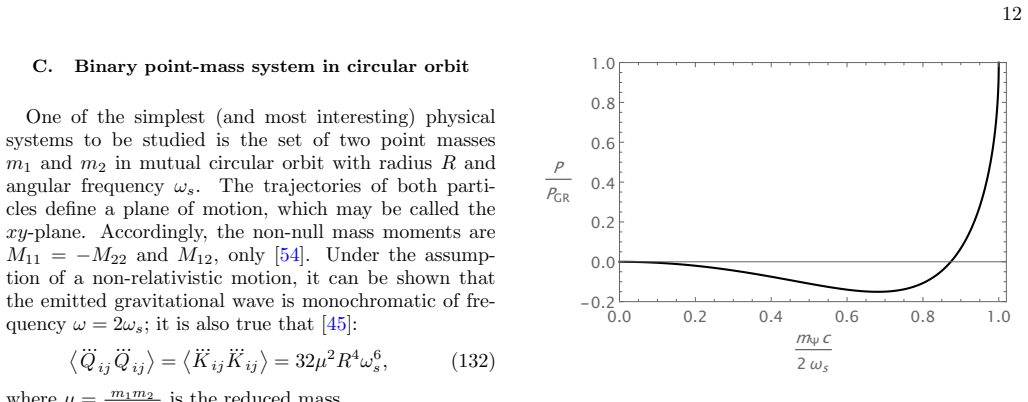
The central discovery is that the apparent Ostrogradsky instability of quadratic gravity is confined, at quadrupole order, to the three longitudinal polarizations of the massive spin-2 field. When those polarizations are kept, the radiated power in Eqs. (123)-(131) acquires negative contributions proportional to $(m_\Psi c/\omega)^2$ and $(m_\Psi c/\omega)^4$; for a circular binary this makes $P<0$ in the interval $0<m_\Psi c/(2\omega_s)<0.87$. If one imposes the transverse-traceless condition $\Psi_{ij}\to\Lambda_{ij,kl}\Psi_{kl}$, all such terms vanish and the loss equations (150) and (151) become positive-definite combinations of the massless TT modes, the massive TT modes, and the scalar mode. The paper also derives the angular momentum flux, including orbital and spin contributions, and shows that under the TT projection the precessing ellipsoid satisfies $dE/dt=\Omega\,dJ/dt$, with the massive fields softening the secular decay of both precession frequency and wobble angle.
Load-bearing premise
The massive spin-2 perturbation is assumed to contain only transverse-traceless modes, an assumption imposed by hand to remove the negative-energy longitudinal waves; if that projection is not a genuine dynamically closed sector of quadratic gravity, the positive-energy and positive-angular-momentum results do not apply to the full theory.
Editorial extensions
If this is right
- In the TT-restricted sector, a circular binary avoids the negative-power window: the orbital frequency asymptotes to $\omega_s^{\rm max}\simeq 1.145\,\omega_0$ as the total radiated power approaches zero, instead of diverging in finite time as in general relativity.
- Including the longitudinal massive modes makes the binary's radiated power negative for $0<m_\Psi c/(2\omega_s)<0.87$, which the paper identifies as a physical inconsistency of the full quadrupole theory.
- For a freely precessing ellipsoid, the massive fields slow the decrease of both precession frequency and wobble angle relative to general relativity, and the effect grows as $m_\Psi$ decreases.
- Under the TT projection the energy and angular momentum losses satisfy $dE/dt=\Omega\,dJ/dt$, so the precession frequency and the rotational angular momentum of the source decay in step.
- A vanishing total power does not imply the absence of waves: at the saturation frequency an observer on the rotation axis still detects oscillatory $h_+ + \Psi_+$ and $h_\times + \Psi_\times$ signals with nonzero amplitude because $q_\Psi^{\rm max}\ne 1$.
Reading between the lines
- Editorial inference: nothing in the action singles out the TT subspace, so if the linearized constraint algebra shows that longitudinal components of $\Psi_{ij}$ are inevitably sourced by matter, the positivity results describe a truncated model rather than quadratic gravity itself.
- Editorial inference: the TT-restricted theory predicts a distinctive observational signature, namely massive spin-2 radiation appearing only as $+$ and $\times$ distortion of the general-relativity waveform, with no $B$, $C$, or $D$ longitudinal components, which a detector network could in principle test.
- Editorial inference: the paper's finding that $P=0$ can coexist with nonzero wave amplitude breaks the standard balance between observed strain and orbital decay, offering a testable anomaly in the inspiral signal of a binary.
- Editorial inference: the same Noether-current construction and projection strategy could be applied to other higher-derivative gravity theories, potentially providing a general way to quarantine ghost degrees of freedom in radiative sectors.
Editorial analysis
A structured set of objections, weighed in public.
Referee Report
Summary. This paper studies gravitational-wave emission in quadratic gravity with action (1), linearized around a Minkowski background. The metric perturbation is decomposed into a massless spin-2 field h_μν, a massive spin-2 field Ψ_μν, and a massive scalar Φ (Eq. 3). The authors derive the wave equations (13)-(15), construct Noether currents for a second-order Lagrangian, and obtain the radiated energy and angular momentum fluxes (Eqs. 75 and 83). In the quadrupole approximation they compute all polarization modes for a generic propagation direction and find that the total radiated power (Eq. 131) contains negative contributions from the longitudinal massive modes Ψ_B, Ψ_C, Ψ_D; for a circular binary this yields P < 0 in a finite parameter range (Fig. 1). To cure this, Section III.D imposes the transverse-traceless projection Ψ_ij → Λ_ij,kl Ψ_kl (Eq. 149), under which Eqs. (150)-(151) give positive-definite dE/dt and dJ/dt. The paper then applies this restricted model to a freely precessing rotating ellipsoid and shows that the massive modes soften the GR decrease of precession frequency and wobble angle.
Significance. If the negative-power result for the full linearized theory is correct, it is a concrete and useful demonstration that the Ostrogradsky instability manifests in quadrupole gravitational-wave emission through the longitudinal massive modes; this genuinely extends Ref. [45]. The Noether-current formalism for second-order Lagrangians is developed carefully, and the paper is transparent that the TT restriction in Eq. (149) is imposed rather than derived. However, because that projection is inconsistent with the sourced field equations, as detailed below, the advertised positivity results apply to a truncated model rather than to the quadratic-gravity theory defined by Eq. (1). The abstract's claim that 'the theory avoids the issues generated by the Ostrogradsky instabilities' therefore overstates the scope of what is established; the paper would be much stronger if it explicitly framed Eqs. (150)-(151) as defining a restricted, constrained sector and discussed whether that sector is dynamically consistent.
major comments (3)
- [Section III.D, Eq. (149)] The TT projection Ψ_ij → Λ_ij,kl Ψ_kl is imposed by hand, not derived from the action or the field equations. The sourced field equation (85) generates the longitudinal modes: for a planar binary in the xy-plane, Eq. (112) gives Ψ_B proportional to 2 M̈_11 sin θ sin 2φ + 2 M̈_12 sin θ cos 2φ, which is generically nonzero, and similarly for Ψ_C and Ψ_D (Eqs. 113-114). Thus the full linearized theory does not satisfy Eq. (149). Consequently, Eqs. (150) and (151) are statements about a different, truncated model, not about the theory defined by Eq. (1). The authors should either derive the TT sector from a constrained action (e.g., adding a Lagrange multiplier term that enforces the transversality and tracelessness conditions) or explicitly state in the abstract and conclusions that the positivity results characterize only this restricted sector.
- [Eq. (85) and trace consistency] There is a trace-level inconsistency in the TT restriction. Taking the trace of Eq. (85) gives (□ − m_Ψ^2) Ψ = 2κ T. If Ψ is transverse-traceless, then Ψ = 0, and this equation forces T = 0 in the source region. Nonrelativistic sources have T ≠ 0, so the condition Ψ_ij = Λ_ij,kl Ψ_kl cannot hold in the presence of such sources. This is not a gauge choice for a massive field. The manuscript should address this obstruction explicitly; otherwise the TT sector cannot be regarded as a consistent subsector of quadratic gravity even at the linearized level.
- [Section III.D, Eqs. (150)-(151) and Abstract] The positive-definiteness of dE/dt and dJ/dt after imposing Eq. (149) follows by construction: the negative longitudinal-mode terms in Eq. (123) and Eq. (131) are deleted by the projection. As a resolution of the Ostrogradsky instability, this is circular. The paper itself demonstrates in Section III.B that the generic power is not positive (Eq. 131) and in Section III.C that P < 0 occurs for a circular binary. The claim in the Abstract that 'the theory avoids the issues generated by the Ostrogradsky instabilities' should therefore be replaced by a statement that a TT-restricted sector of the theory has positive energy and angular momentum fluxes, while the full theory does not.
minor comments (4)
- [Section III.A, Eqs. (95)-(96)] Equation (96) is labeled h+ but is the expression for h× (it contains M̈′_12); the label should be corrected.
- [Section II, Eqs. (8)-(9)] The factor 1/(2κ) appears both in the definition of ¯S in Eq. (8) and inside the expression for L in Eq. (9); this double counting of the κ normalization should be checked and fixed, or at least explained.
- [Section III.A, paragraph after Eq. (104)] The sentence describing the spin-0 contribution as 'produced by the single component n_i n_j M̈_ij = −n_i n_j M̈^ij' is confusing because M_ij and M^ij differ by a sign by Eq. (93); clarifying the notation would help the reader track the quadrupole formulas.
- [Section IV] The mode expressions in Eqs. (163)-(169) mix damping and oscillatory regimes through step-like conditions; it would be helpful to state explicitly that the Heaviside factors from Eqs. (75) and (83) are understood to apply in the integrated formulas (170)-(181), so the piecewise structure is consistent with the general flux formulas.
Circularity Check
The advertised positive-energy/momentum result is obtained by imposing the TT projection Eq. (149), which by construction deletes the only negative modes; the full sourced field equations generate those modes, so the central claim characterizes a truncated sector rather than the full quadratic-gravity theory.
-
self definitional
[Section III.D, Eq. (149) leading to Eqs. (150)-(151); Abstract]
"Another way to deal with this problem is to impose that the transverse-traceless massive spin-2 modes are the only modes present in the theory. In other words, there should be Ψij → Λij,klΨkl = ΨT T ij . (149) Under this assumption, the longitudinal modes ΨB, ΨC, and ΨD are disregarded ... all the terms in the second lines of Eqs. (123), (124), and (131) vanish, thus leading to a positive-definite power."
The advertised positivity is not extracted from the action; it is put in by projection (149), which deletes exactly the modes that carry negative power. In Eqs. (123)/(131) the only negative terms are the Ψ_B, Ψ_C, Ψ_D pieces; setting these modes to zero by fiat is equivalent to assuming the conclusion. The projection is not a gauge condition: the sourced massive equation (□−m_Ψ²)Ψ_μν=2κT_μν (Eq. 85) generates nonzero Ψ_B, Ψ_C, Ψ_D even for binary sources (Eq. 112), and its trace shows Ψ=0 would force T=0. Hence Eqs. (150)-(151) prove positivity for a truncated TT-only model, not for the full QG theory of Eq. (1).
full rationale
The paper is transparent: Eq. (149) is an imposed restriction, and the text explicitly says the longitudinal modes are disregarded in order to obtain positive-definite power. That makes the core positivity claim a conditional statement about a truncated TT-only sector. It is nevertheless circular in the specific sense that the advertised 'theory avoids the Ostrogradsky issues' conclusion is built into the assumption used to reach it: the negative contributions in Eq. (123) and Eq. (131) are precisely the longitudinal modes that Eq. (149) removes. The paper does contain independent, non-circular content: the derivation that the full quadrupole theory, including longitudinal modes, has negative radiated power for a binary system (Eq. 134, Fig. 1) and the angular-momentum calculation are genuine derivations from the field equations, not imported fits. There is no numerical fitting, and the citations to Ref. [45] are not load-bearing for the circularity issue because the key currents and mode decomposition are re-derived in this paper. On the other hand, the Abstract's phrasing that 'the theory avoids the issues generated by the Ostrogradsky instabilities and achieves positive energy and angular momentum emissions' overstates the scope: it is true only after the hand-imposed TT projection, which conflicts with the sourced field equations for generic nonrelativistic sources. The central advertised prediction therefore reduces, by construction, to its own input, while the surrounding analysis retains independent value. Score 6 reflects partial circularity: the positivity result is forced by the projection, but a substantial part of the paper's derivation is self-contained and independent of that projection.
Assumptions & free parameters
assumptions (4)
- domain assumption The linearized action can be gauge-fixed by imposing partial_mu h_tilde^{mu nu} = partial_mu Psi^{mu nu} = 0, h_tilde = Psi = 0 before varying (Eq. 7 and following), and the neglected terms do not affect the conserved currents.
- domain assumption Quadrupole approximation and non-relativistic source motion; scalar dipole emission is neglected because total momentum is conserved.
- ad hoc to paper The massive spin-2 field is restricted to transverse-traceless modes: Psi_ij -> Lambda_ij,kl Psi_kl (Eq. 149).
- domain assumption The angular momentum flux is computed by multiplying each mode's angular momentum density by its group velocity (Eqs. 82-83).
Cite this review
Pith. "Pith review of Gravitational Waves Emission in Quadratic Gravity: longitudinal modes, angular momentum emission, and positivity of the radiated power." pith.science (2026). https://pith.science/paper/AX5YONGC
@misc{pith2026241110098,
  author       = {Pith},
  title        = {Pith review of: Gravitational Waves Emission in Quadratic Gravity: longitudinal modes, angular momentum emission, and positivity of the radiated power},
  year         = {2026},
  howpublished = {\url{https://pith.science/paper/AX5YONGC}},
  note         = {Machine review of arXiv:2411.10098}
}
read the original abstract
In this paper, the emission of gravitational waves in quadratic gravity theory is examined. The wave equations for massless and massive perturbations are derived, followed by the calculation of the energy and angular momentum radiated. In the quadrupole approximation, and taking into account only the transverse-traceless modes, it is shown that the theory avoids the issues generated by the Ostrogradsky instabilities and achieves positive energy and angular momentum emissions. As an example, a rotating ellipsoid with free precession is analyzed, and the effects of the massive perturbations on its rotation are highlighted.
Figures


Figures from the paper (1 more)

Reference graph
Works this paper leans on
-
[45]
This numerical difference in the coupling factor appeared due to a small error in Ref
after the mapping α → α/2. This numerical difference in the coupling factor appeared due to a small error in Ref. [45]. In equation (2) of this reference, we should have 2 α instead of α. This correction was made in the current paper and led to the new definition of m2 Ψ without the factor 2 that appears in Ref. [45]. This same correction leads to a chang...
-
[1]
The energy-momentum tensor of the GW in quadratic gravity The quadratic Lagrangian (9) is invariant under space- time translations: x′µ = xµ + ϵνδµ ν and ¯h′ αβ (x′) = ¯hαβ (x) . (26) Comparison of Eq. (26) with Eqs. (16) and (17), yields a = ν = 0, 1, 2, 3, Aµ ν = δµ ν , and Fαβ,ν = 0. (27) Eq. (27) is then plugged into Eqs. (23), (24), and (25). The res...
-
[2]
The angular momentum of the GW in quadratic gravity The relativistic structure of quadratic gravity implies the existence of rotational symmetry for the Lagrangian (9). This symmetry is characterized by the matrix Rij which acts on the space coordinate xi to produce a rota- tion: x′i = Ri jxj. For infinitesimal transformations Rij takes on the form 5 Rij ...
-
[3]
Energy and angular momentum radiated We are interested in computing the energy and angular momentum carried away from the source by the gravita- tional waves. The gravitational radiation at a sufficiently distant point from the source (radiation zone) is struc- turally given by Refs. [45, 55]: Fi = 1 r X n f (n) i ωn " t − r v(n) p #! . (67) Here n labels...
-
[4]
B. P. e. a. Abbott (LIGO Scientific Collaboration and Virgo Collaboration), Phys. Rev. Lett. 119, 161101 (2017)
work page 2017
-
[5]
Bertone and D
G. Bertone and D. Hooper, Rev. Mod. Phys. 90, 045002 (2018)
2018
-
[6]
R. R. Caldwell and M. Kamionkowski, Ann. Rev. Nucl. Part. Sci. 59, 397 (2009), arXiv:0903.0866 [astro-ph.CO]
arXiv 2009
-
[7]
→” has the meaning “is related to
(104) Next, we generalize the expressions for the mode for a generic propagation direction oriented by the unit vector ni = (sin θ sin ϕ, sin θ cos ϕ, cos θ) , (105) where θ is the polar angle and ϕ is the azimuth angle [54]. The rotation matrix connecting the directions ni and n′ i is: R = cos ϕ cos θ sin ϕ sin θ sin ϕ − sin ϕ cos θ cos ϕ cos ϕ sin θ...
work page 2023
Show all 66 references
-
[8]
Einstein, Sitzungsberichte der K¨ oniglich Preußischen Akademie der Wissenschaften , 688 (1916)
A. Einstein, Sitzungsberichte der K¨ oniglich Preußischen Akademie der Wissenschaften , 688 (1916)
1916
-
[9]
R. A. Hulse and J. H. Taylor, apjl 195, L51 (1975)
1975
-
[10]
B. P. e. a. Abbott (LIGO Scientific Collaboration and Virgo Collaboration), Phys. Rev. Lett. 116, 061102 (2016)
2016
-
[11]
Martin, C
J. Martin, C. Ringeval, and V. Vennin, JCAP 10, 038 (2014), arXiv:1407.4034 [astro-ph.CO]
2014 arXiv
-
[12]
(96) The massive spin-2 mode has five degrees of freedom. Aiming for a description similar to that in GR, we define [45]: Ψ+ = Ψ11 − Ψ22 2 , Ψ× = Ψ12, ΨB = Ψ13, ΨC = Ψ23 and Ψ D = Ψ33, (97) where Ψ+ and Ψ× are the transverse propagation modes, while ΨB, ΨC, and Ψ D are the lon...
-
[13]
Rodrigues-da Silva, J
G. Rodrigues-da Silva, J. Bezerra-Sobrinho, and L. G. Medeiros, Phys. Rev. D 105, 063504 (2022), arXiv:2110.15502 [astro-ph.CO]
2022 arXiv
-
[14]
P. e. a. Astier, aap 447, 31 (2006), arXiv:astro- ph/0510447 [astro-ph]
2006
-
[15]
A. e. a. Riess, apj 607, 665 (2004), arXiv:astro- ph/0402512 [astro-ph]
2004
-
[16]
A. A. Starobinsky, Physics Letters B 91, 99 (1980)
1980
-
[17]
A. H. Guth, Phys. Rev. D 23, 347 (1981)
1981
-
[18]
Hayashi and T
K. Hayashi and T. Shirafuji, Phys. Rev. D 19, 3524 (1979)
1979
-
[19]
R. R. Cuzinatto, L. G. Medeiros, and P. J. Pompeia, JCAP 02, 055 (2019), arXiv:1810.08911 [gr-qc]
2019 arXiv
-
[20]
Casana, C
R. Casana, C. A. M. de Melo, and B. M. Pimentel, Class. Quant. Grav. 24, 723 (2007), arXiv:gr-qc/0509117
2007 arXiv
-
[21]
Bezerra-Sobrinho and L
J. Bezerra-Sobrinho and L. G. Medeiros, JCAP 01, 039 (2023), arXiv:2202.13308 [gr-qc]
2023 arXiv
-
[22]
Rodrigues-da Silva and L
G. Rodrigues-da Silva and L. G. Medeiros, Eur. Phys. J. C 83, 1032 (2023), arXiv:2207.02103 [astro-ph.CO]
2023 arXiv
-
[23]
Utiyama and B
R. Utiyama and B. S. DeWitt, J. Math. Phys. 3, 608 (1962)
1962
-
[24]
K. S. Stelle, Phys. Rev. D 16, 953 (1977)
1977
-
[25]
T. P. Sotiriou and V. Faraoni, Rev. Mod. Phys. 82, 451 (2010)
2010
-
[26]
H. I. Arcos and J. G. Pereira, Int. J. Mod. Phys. D 13, 2193 (2004), arXiv:gr-qc/0501017
2004 arXiv
-
[27]
Novello, E
M. Novello, E. Bittencourt, U. Moschella, E. Goulart, J. Salim, and J. Toniato, Journal of Cosmology and As- troparticle Physics 2013, 014 (2013)
2013
-
[28]
R. R. Cuzinatto, E. M. de Morais, and B. M. Pimentel, Phys. Rev. D 103, 124002 (2021)
2021
-
[29]
R. R. Cuzinatto, C. A. M. de Melo, L. G. Medeiros, and P. J. Pompeia, Eur. Phys. J. C 53, 99 (2008), arXiv:gr- qc/0611116
2008
-
[30]
Battista and V
E. Battista and V. De Falco, Phys. Rev. D 104, 084067 (2021)
2021
-
[31]
Battista and V
E. Battista and V. De Falco, Eur. Phys. J. C 92, 628 (2022)
2022
-
[32]
R. R. Cuzinatto, C. A. M. de Melo, L. G. Medeiros, and P. J. Pompeia, Phys. Rev. D 99, 084053 (2019), arXiv:1806.08850 [gr-qc]
2019 arXiv
-
[33]
The result is: Φ (t, ˆ z) = − κ 24πr h 1 − ˆOΦ i ¨M ′
(103) The spin-0 mode is built following an analogous pro- cedure. The result is: Φ (t, ˆ z) = − κ 24πr h 1 − ˆOΦ i ¨M ′
-
[34]
Capozziello and M
S. Capozziello and M. De Laurentis, Phys. Rept. 509, 167 (2011), arXiv:1108.6266 [gr-qc]. 20
2011 arXiv
-
[35]
Rinaldi, G
M. Rinaldi, G. Cognola, L. Vanzo, and S. Zerbini, JCAP 08, 015 (2014), arXiv:1406.1096 [gr-qc]
2014 arXiv
-
[36]
M. L. Pucheu, F. A. P. Alves Junior, A. B. Bar- reto, and C. Romero, Phys. Rev. D 94, 064010 (2016), arXiv:1602.06966 [gr-qc]
2016 arXiv
-
[37]
M. L. Pucheu, C. Romero, M. Bellini, and J. E. Madriz Aguilar, Phys. Rev. D 94, 064075 (2016)
2016
-
[38]
R. R. Cuzinatto, C. A. M. de Melo, L. G. Medeiros, and P. J. Pompeia, Phys. Rev. D 93, 124034 (2016), [Erra- tum: Phys.Rev.D 98, 029901 (2018)], arXiv:1603.01563 [gr-qc]
2016 arXiv
-
[39]
J. F. Donoghue and G. Menezes, Phys. Rev. D 100, 105006 (2019)
2019
-
[40]
Nojiri and S
S. Nojiri and S. D. Odintsov, Physics Reports 505, 59 (2011)
2011
-
[41]
Nojiri, S
S. Nojiri, S. Odintsov, and V. Oikonomou, Physics Re- ports 692, 1 (2017), modified Gravity Theories on a Nut- shell: Inflation, Bounce and Late-time Evolution
2017
-
[42]
J. D. Edelstein, R. Ghosh, A. Laddha, and S. Sarkar, JHEP 09, 150 (2021)
2021
- [43]
-
[44]
Pais and G
A. Pais and G. E. Uhlenbeck, Phys. Rev. 79, 145 (1950)
1950
-
[46]
Modesto and I
L. Modesto and I. L. Shapiro, Phys. Lett. B 755, 279 (2016), arXiv:1512.07600 [hep-th]
2016 arXiv
- [47]
-
[48]
Salvio, ”Int
A. Salvio, ”Int. J. Mod. Phys. A” 36, 2130006 (2021), arXiv:2012.11608 [hep-th]
2021 arXiv
-
[49]
Rachwal, L
L. Rachwal, L. Modesto, A. Pinzul, and I. L. Shapiro, Phys. Rev. D 104, 085018 (2021), arXiv:2104.13980 [hep- th]
2021 arXiv
-
[50]
Asorey, J
M. Asorey, J. L. Lopez, and I. L. Shapiro, Int. J. Mod. Phys. A 12, 5711 (1997), arXiv:hep-th/9610006
1997 arXiv
-
[51]
”Rachwal, Universe 8, 229 (2022), arXiv:2204.09858 [hep-th]
L. ”Rachwal, Universe 8, 229 (2022), arXiv:2204.09858 [hep-th]
2022 arXiv
-
[52]
M. F. S. Alves, L. F. M. A. M. Reis, and L. G. Medeiros, Phys. Rev. D 107, 044017 (2023)
2023
-
[53]
E. C. de Rey Neto, Phys. Rev. D 68, 124013 (2003)
2003
-
[54]
”Bogdanos, S
C. ”Bogdanos, S. Capozziello, M. De Laurentis, and S. Nesseris, Astropart. Phys. 34, 236 (2010), arXiv:0911.3094 [gr-qc]
2010 arXiv
-
[55]
Capozziello, M
S. Capozziello, M. De Laurentis, S. Nojiri, and S. D. Odintsov, Phys. Rev. D 95, 083524 (2017)
2017
-
[56]
H¨ olscher, Phys
P. H¨ olscher, Phys. Rev. D99, 064039 (2019)
2019
-
[57]
Y. ”Kim, A. Kobakhidze, and Z. S. C. Picker, Eur. Phys. J. C 81, 362 (2021), arXiv:1906.12034 [gr-qc]
2021 arXiv
-
[58]
”Chowdhury, S
A. ”Chowdhury, S. Xavier, and S. Shankaranarayanan, Sci. Rep. 13, 8547 (2023), arXiv:2206.06756 [gr-qc]
2023 arXiv
-
[59]
S. D. Odintsov and V. K. Oikonomou, Phys. Rev. D 105, 104054 (2022)
2022
-
[60]
M. E. S. Alves, Phys. Rev. D 109, 104054 (2024)
2024
-
[61]
Maggiore, Gravitational Waves: Volume 1: Theory and Experiments (Oxford University Press, 2007)
M. Maggiore, Gravitational Waves: Volume 1: Theory and Experiments (Oxford University Press, 2007)
2007
-
[62]
S. G. Vilhena, L. G. Medeiros, and R. R. Cuzinatto, Phys. Rev. D 104, 084061 (2021)
2021
-
[63]
H. L¨ u, A. Perkins, C. N. Pope, and K. S. Stelle, Phys. Rev. D 92, 124019 (2015)
2015
-
[64]
”Anselmi, JHEP 06, 086 (2017), arXiv:1704.07728 [hep-th]
D. ”Anselmi, JHEP 06, 086 (2017), arXiv:1704.07728 [hep-th]
2017 arXiv
-
[65]
”Anselmi, JHEP 02, 141 (2018), arXiv:1801.00915 [hep-th]
D. ”Anselmi, JHEP 02, 141 (2018), arXiv:1801.00915 [hep-th]
2018 arXiv
-
[66]
Thornton and J
S. Thornton and J. Marion, Classical Dynamics of Par- ticles and Systems (Brooks/Cole, 2004)
2004
Reviewed August 12, 2026 · model on record in the stance chip above.
Discussion (0). Continue with ORCID to comment.