REVIEW 5 major objections 6 minor 74 references
Let people fail! Exploring the influence of explainable virtual and robotic agents in learning-by-doing tasks
T0 review · 5 major / 6 minor · reviewed 2026-08-12 · deepseek-v4-flash
Pith's one-line read The paper claims that in a learning-by-doing task, participants who learned without any explainable AI agent explored more and ended up with better task knowledge than those assisted by a computer or a humanoid robot.
desk verdict Solid empirical study with a provocative counterintuitive result, but the central interpretation rests on an unvalidated proxy for exploration. read the letter →
The pith
A machine-rendered reading of the paper's core claim, the machinery that carries it, and where it could break.
The reading
What carries the argument
The central object is the learning-by-doing assessment task itself: a simulated nuclear power plant with hidden rules that participants must discover by acting, with a 30-minute training phase, a 10-minute assessment phase, and a final knowledge test. The expert agents are driven by a deterministic decision tree trained with the Conservative Q-Improvement reinforcement-learning algorithm, which can answer what and why questions by tracing splits. The two explanation strategies are classical selection of the most relevant feature and partner-aware contrastive selection that compares the agent's suggestion with the user's predicted action. The argument's load-bearing measure is the number of anomalies (conditions that damage the simulated plant) during training, which the paper treats as an estimator of exploration.
What would settle it
Conduct the same learning-by-doing task with a fixed number of training steps instead of a fixed time limit; if the unassisted group no longer shows more anomalies and no longer outscores the assisted groups, the exploration explanation fails. Alternatively, measure exploration directly, for example by counting distinct environment states visited or computing information gain, and check whether that measure, rather than the anomaly count, drives the test-score difference.
Extended reading notes
Core claim
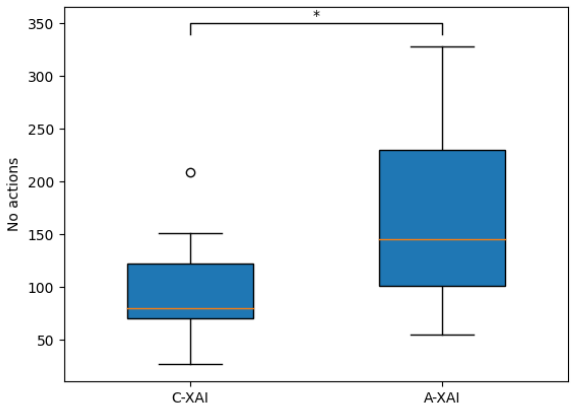
On the paper's own terms, the central discovery is that assisted learning underperforms unassisted learning in a learning-by-doing task. In a between-subjects study, the Self-taught group produced more actions, more energy, more critical steps, and more anomalies during training than all four assisted groups, and then outperformed the COM C-XAI, COM A-XAI, and Robot A-XAI groups on the post-experiment test (ANOVA F(4)=3.99, p=.007), with the effect concentrated in scenario questions (F(4)=6.37, p<.001). The authors interpret the higher anomaly count as evidence of deeper exploration, and argue that interaction with expert explainable agents encouraged over-reliance and reduced autonomous exploration, leaving assisted participants with weaker ability to generalize.
Load-bearing premise
The paper's argument depends on treating the number of anomalies during training as a good estimator of exploration, and on assuming that exploration, not some other factor like time pressure or prior knowledge, is what gave the unassisted group its higher test scores.
Editorial extensions
If this is right
- If correct, explainable agents that merely answer questions can reduce learning gain in learning-by-doing tasks, even when they improve immediate performance.
- Automated tutoring systems should be designed to encourage autonomous exploration, tolerating errors during training as a price for deeper understanding.
- Partner-aware contrastive explanations did not improve final knowledge over classical explanations, but they did change behavior: faster decisions with a computer and more compliance with a robot.
- The self-taught group's advantage appeared specifically in scenario-based generalization questions, suggesting that unassisted exploration builds transferable causal knowledge rather than rote procedures.
Reading between the lines
- Beyond the paper: one could test whether adding a mechanism that forces users to commit to a prediction before seeing the agent's suggestion closes the gap between assisted and unassisted learners, since the paper identifies over-reliance as the likely culprit.
- Beyond the paper: the different effects of the same adaptive explanation strategy on computer versus robot interaction suggest that embodiment and social presence may change whether explanations promote reflection or compliance; this could be isolated by matching the agents' wording and nonverbal cues more tightly.
- Beyond the paper: the anomaly-as-exploration proxy deserves direct validation; if validated, it gives XAI researchers a simple behavioral marker for exploration in learning tasks, independent of self-reports.
Editorial analysis
A structured set of objections, weighed in public.
Referee Report
Summary. This paper reports a between-subject user study (N = 55) on learning-by-doing with a simulated nuclear power plant task. Participants either worked autonomously (Self-taught, n = 11) or were assisted by a computer or the iCub robot that could answer 'what' and 'why' queries using either classical (C-XAI) or partner-aware contrastive (A-XAI) explanations derived from a deterministic decision-tree policy. The authors compare behavior in a 30-minute training phase and a 10-minute assessment phase, together with a post-experiment knowledge test. They find that A-XAI made computer users move faster, made the robot more persuasive after 'why' questions, and had no significant effect on final task knowledge. The headline result is that Self-taught participants performed more actions, produced more energy and more anomalies, and scored higher on the post-experiment test, especially on scenario questions, than most assisted groups. The authors interpret the anomaly count as a measure of exploration and argue that unassisted 'failing' and exploring produced better learning, thereby rejecting their hypothesis H2.
Significance. The study's strengths are its direct measurement of learning via a post-experiment knowledge test, its inclusion of a no-assistance baseline, and its concrete manipulation of explanation strategies through a deterministic interpretable decision tree. If the headline effect is robust, it has practical implications for automated tutoring and for designing AI assistants that scaffold rather than replace exploration. The paper also gives useful, explicit credit to the possibility that over-reliance or automation bias explains the assisted groups' lower test scores. However, the central interpretation depends on an unvalidated proxy (anomalies as exploration) and is entangled with a practice-volume confound; in addition, several statistical and reporting issues need correction. With those issues addressed, this could be a valuable contribution to HCI and XAI research.
major comments (5)
- [Section 4.6.2 and Section 5] The conclusion that the Self-taught group's higher post-test scores were caused by greater 'exploration' rests entirely on the assertion in Section 5 that 'the number of anomalies during training is a good estimator of participants' degree of exploration.' This assertion is not secured: anomalies are damaging outcomes, not a validated measure of exploration, and no independent index such as state-space coverage, action diversity, information gain, or query behavior is reported. Because the Self-taught group also performed significantly more actions (Section 4.6.1), the anomaly count is confounded with practice volume. Without a per-action anomaly rate or a mediation analysis linking anomalies to test scores, the data are equally consistent with the alternative explanation that more hands-on practice, rather than autonomous exploration or failure-driven learning, produced the test advantage.
- [Sections 3.1, 4.6.1, and 5] The fixed-time design directly creates the practice-volume confound: Self-taught participants did not spend time querying an agent, so they could perform more actions in the same 30 minutes. The manuscript acknowledges in the limitations paragraph that it is 'unclear whether we would observe the same results by removing or changing such a constraint, i.e., using a fixed number of steps,' but it does not test this. Since the behavioral differences (actions, energy, anomalies, critic steps) and possibly the test differences depend on this design choice, this limitation is load-bearing rather than peripheral.
- [Section 4.1 and Section 5] The baseline knowledge check is only marginally non-significant (chi-square(8) = 14.1, p = .078), and the authors themselves note a 'slight disparity' between the COM group (Germany) and the Self-taught and Robot groups (Italy). The cross-group ANOVAs in Sections 4.6.1 and 4.6.2 do not include site or prior knowledge as a covariate, and the statement that there were 'no differences between these two macro-groups regarding performance in training and assessment' is made without a supporting test. This leaves open the possibility that the Self-taught group's superior test performance partly reflects pre-existing differences rather than the absence of assistance.
- [Section 4.2 and Table 1] The manipulation check in Table 1 is based on sixteen independent-samples t-tests without any multiple-comparison correction, so the reported 'five out of eight' and 'four out of eight' significant explanandum differences are not strong evidence that the two explanation strategies systematically differed. Uncorrected t-tests also appear in Sections 4.3-4.5 (for example, t = 2.21, p = .039, and t = 2.226, p = .038). Please report adjusted p-values or explicitly justify these comparisons as exploratory.
- [Section 4.5 and Figure 8] Reporting the same t-statistic (t = 2.226) and p-value (p = .038) for both the COM and Robot subgroups in the comparison of 'Follow AI' percentages during why-questions is internally inconsistent if this is a single between-group independent-samples test. As written, the reader cannot tell whether this is a paired comparison, a typographical error, or a duplicated statistic. Please clarify the test, report degrees of freedom and effect size, and correct the descriptive statistics.
minor comments (6)
- [Section 3.4 and Section 5] Section 3.4 lists hypotheses H1-H3, but Section 5 refers to 'our hypothesis H4' and 'partially confirming our hypothesis H4'; please define H4 or correct the label.
- [Figure 7 caption] The caption states that the asterisk refers to a 'p-value < .5' where p < .05 is clearly intended; as written the caption would include all significant and non-significant results.
- [Section 4.6.2 and Section 5] Section 4.6.2 reports significant differences between the Self-taught group and the COM C-XAI, COM A-XAI, and Robot A-XAI groups, with Robot C-XAI as the only non-significant comparison; Section 5 restates this as 'all the others but the COM A-XAI one' and attributes the effect to a COM A-XAI outlier. This inconsistency should be resolved.
- [Section 4.5] The sentence 'the former negatively correlated with the percentage of times participants accepted the robot's suggestions (and not the COM's)' is ambiguous; please state explicitly which correlation is reported for which group and report the correlation coefficient.
- [Section 4.6] ANOVA results are reported as F(4) without residual degrees of freedom; reporting the full F(df1, df2) notation, e.g., F(4, 50), would aid verification of the analyses.
- [General] The paper does not state whether data or analysis scripts are available; a data availability statement would strengthen reproducibility.
Circularity Check
No significant circularity: the empirical group comparison is self-contained; the anomaly-as-exploration reading is an acknowledged interpretive risk, not a constructional equivalence.
full rationale
This is an empirical user study rather than a formal derivation, and its central result does not reduce to its inputs. The main claim, that the Self-taught group outperformed assisted groups on the post-experiment test (Section 4.6.2), is supported by ANOVA and Bonferroni post-hoc tests on recorded test answers. No parameter is fitted to those outcomes and then reported as a prediction; the explanation strategies are algorithmic variants of the same decision-tree policy, so comparing them is not tautological. The interpretive step that 'the number of anomalies during training is a good estimator of participants' degree of exploration' (Sections 4.6.2 and 5) is load-bearing but not circular: exploration is not operationally defined as anomaly count, nor are test scores defined in terms of anomalies. The inference is therefore an empirical assumption rather than an identity. The paper itself acknowledges the main associated threat in the limitations paragraph, stating that it is unclear whether the results would hold 'using a fixed number of steps' instead of a fixed time window; this is a validity and mediation concern, not a circularity. The self-citations to prior work by the same group, including the under-review footnote on the assessment task, are used as methodological or contextual provenance and are not invoked to force the empirical outcome. No equation equates an input with an output, and no fitted quantity is renamed as a prediction, so no circular step is present.
Assumptions & free parameters
free parameters (2)
- RL reward function weights =
not specified
- Classical XAI feature selection order =
first nodes in DT structure, with a no-repeat heuristic
assumptions (3)
- domain assumption The NPP simulation is a valid and learnable model of nuclear power plant management
- domain assumption The CQI-trained decision tree is an expert policy for the simulation
- standard math Independent-samples t-tests and ANOVAs are appropriate for the small sample sizes
Cite this review
Pith. "Pith review of Let people fail! Exploring the influence of explainable virtual and robotic agents in learning-by-doing tasks." pith.science (2026). https://pith.science/paper/7GPBSEYB
@misc{pith2026241110176,
  author       = {Pith},
  title        = {Pith review of: Let people fail! Exploring the influence of explainable virtual and robotic agents in learning-by-doing tasks},
  year         = {2026},
  howpublished = {\url{https://pith.science/paper/7GPBSEYB}},
  note         = {Machine review of arXiv:2411.10176}
}
read the original abstract
Collaborative decision-making with artificial intelligence (AI) agents presents opportunities and challenges. While human-AI performance often surpasses that of individuals, the impact of such technology on human behavior remains insufficiently understood, primarily when AI agents can provide justifiable explanations for their suggestions. This study compares the effects of classic vs. partner-aware explanations on human behavior and performance during a learning-by-doing task. Three participant groups were involved: one interacting with a computer, another with a humanoid robot, and a third one without assistance. Results indicated that partner-aware explanations influenced participants differently based on the type of artificial agents involved. With the computer, participants enhanced their task completion times. At the same time, those interacting with the humanoid robot were more inclined to follow its suggestions, although they did not reduce their timing. Interestingly, participants autonomously performing the learning-by-doing task demonstrated superior knowledge acquisition than those assisted by explainable AI (XAI). These findings raise profound questions and have significant implications for automated tutoring and human-AI collaboration.
Figures


Figures from the paper (9 more)



Reference graph
Works this paper leans on
-
[1]
Peeking inside the black-box: A survey on explainable artificial intelligence (xai)
Amina Adadi and Mohammed Berrada. Peeking inside the black-box: A survey on explainable artificial intelligence (xai). IEEE Access, 6: 0 52138--52160, 2018. doi:https://doi.org/10.1109/ACCESS.2018.2870052
arXiv 2018
-
[2]
Highlights: Summarizing agent behavior to people
Dan Amir and Ofra Amir. Highlights: Summarizing agent behavior to people. In Proceedings of the 17th International Conference on Autonomous Agents and MultiAgent Systems, AAMAS '18, page 1168–1176, Richland, SC, 2018. International Foundation for Autonomous Agents and Multiagent Systems. doi:10.5555/3237383.3237869
arXiv 2018
-
[3]
Explainable agents and robots: Results from a systematic literature review
Sule Anjomshoae, Amro Najjar, Davide Calvaresi, and Kary Fr\" a mling. Explainable agents and robots: Results from a systematic literature review. In Proceedings of the 18th International Conference on Autonomous Agents and MultiAgent Systems, AAMAS '19, page 1078–1088, Richland, SC, 2019. International Foundation for Autonomous Agents and Multiagent Syst...
-
[4]
The theory of learning by doing
Yuichiro Anzai and Herbert A Simon. The theory of learning by doing. Psychological review, 86 0 (2): 0 124, 1979. doi:10.1037/0033-295X.86.2.124. URL https://doi.org/10.1037/0033-295X.86.2.124
-
[5]
How cognitive biases affect xai-assisted decision-making: A systematic review
Astrid Bertrand, Rafik Belloum, James R Eagan, and Winston Maxwell. How cognitive biases affect xai-assisted decision-making: A systematic review. In Proceedings of the 2022 AAAI/ACM conference on AI, ethics, and society, pages 78--91, 2022. doi:10.1145/3514094.3534164
arXiv 2022
-
[6]
Can you trust the black box? the effect of personality traits on trust in ai-enabled user interfaces
Martin B \"o ckle, Kwaku Yeboah-Antwi, and Iana Kouris. Can you trust the black box? the effect of personality traits on trust in ai-enabled user interfaces. In International Conference on Human-Computer Interaction, pages 3--20. Springer, 2021. doi:10.1007/978-3-030-77772-2\_1
-
[7]
Zana Bu c inca, Maja Barbara Malaya, and Krzysztof Z. Gajos. To trust or to think: Cognitive forcing functions can reduce overreliance on ai in ai-assisted decision-making. Proc. ACM Hum.-Comput. Interact., 5 0 (CSCW1), apr 2021. doi:10.1145/3449287. URL https://doi.org/10.1145/3449287
doi:10.1145/3449287 2021
-
[8]
Complexity measures and decision tree complexity: a survey
Harry Buhrman and Ronald de Wolf . Complexity measures and decision tree complexity: a survey. Theoretical Computer Science, 288 0 (1): 0 21--43, 2002. doi:10.1016/S0304-3975(01)00144-X. Complexity and Logic
Show all 74 references
-
[9]
Plan explanations as model reconciliation: Moving beyond explanation as soliloquy
Tathagata Chakraborti, Sarath Sreedharan, Yu Zhang, and Subbarao Kambhampati. Plan explanations as model reconciliation: Moving beyond explanation as soliloquy. In Proceedings of the 26th International Joint Conference on Artificial Intelligence, IJCAI'17, page 156–163. AAAI P...
2017
-
[11]
Methods and standards for research on explainable artificial intelligence: lessons from intelligent tutoring systems
William J Clancey and Robert R Hoffman. Methods and standards for research on explainable artificial intelligence: lessons from intelligent tutoring systems. Applied AI Letters, 2 0 (4): 0 e53, 2021. doi:10.1002/ail2.53
2021 doi
-
[12]
Toward personalized xai: A case study in intelligent tutoring systems
Cristina Conati, Oswald Barral, Vanessa Putnam, and Lea Rieger. Toward personalized xai: A case study in intelligent tutoring systems. Artificial Intelligence, 298: 0 103503, 2021. doi:10.1016/j.artint.2021.103503
2021
-
[13]
Thinking, fast and slow
Kahneman Daniel. Thinking, fast and slow. 2017
2017
-
[14]
Wearable reasoner: Towards enhanced human rationality through a wearable device with an explainable ai assistant
Valdemar Danry, Pat Pataranutaporn, Yaoli Mao, and Pattie Maes. Wearable reasoner: Towards enhanced human rationality through a wearable device with an explainable ai assistant. AHs '20, New York, NY, USA, 2020. Association for Computing Machinery. ISBN 9781450376037. doi:10.1...
2020
-
[15]
An implemented theory of mind to improve human-robot shared plans execution
Sandra Devin and Rachid Alami. An implemented theory of mind to improve human-robot shared plans execution. In 2016 11th ACM/IEEE International Conference on Human-Robot Interaction (HRI), pages 319--326, 2016. doi:10.1109/HRI.2016.7451768
2016
-
[16]
The human-ai relationship in decision-making: Ai explanation to support people on justifying their decisions
Juliana Jansen Ferreira and Mateus Monteiro. The human-ai relationship in decision-making: Ai explanation to support people on justifying their decisions. arXiv preprint arXiv:2102.05460, 2021
2021 arXiv
-
[17]
Explainable artificial intelligence for education and training
Krzysztof Fiok, Farzad V Farahani, Waldemar Karwowski, and Tareq Ahram. Explainable artificial intelligence for education and training. The Journal of Defense Modeling and Simulation, 19 0 (2): 0 133--144, 2022. doi:10.1177/15485129211028651
2022 doi
-
[18]
On cognitive preferences and the plausibility of rule-based models
Johannes F\" u rnkranz, Tom\' a s Kliegr, and Heiko Paulheim. On cognitive preferences and the plausibility of rule-based models. Mach. Learn., 109 0 (4): 0 853–898, apr 2020. ISSN 0885-6125. doi:10.1007/s10994-019-05856-5. URL https://doi.org/10.1007/s10994-019-05856-5
2020 doi
-
[19]
Considering the context to build theory in hci, hri, and hmc: Explicating differences in processes of communication and socialization with social technologies
Andrew Gambino and Bingjie Liu. Considering the context to build theory in hci, hri, and hmc: Explicating differences in processes of communication and socialization with social technologies. Human-Machine Communication, 4: 0 111–130, 2022. doi:10.3316/informit.461421232674383
2022 doi
-
[20]
Geiskkovitch, Daniel J
Denise Y. Geiskkovitch, Daniel J. Rea, Agape Y. Seo, Stela H. Seo, Brittany Postnikoff, and James E. Young. Where should i sit? exploring the impact of seating arrangement in a human-robot collaborative task. In Proceedings of the 8th International Conference on Human-Agent In...
2020
-
[21]
Vera Liao, Yunfeng Zhang, Rachel Bellamy, and Klaus Mueller
Bhavya Ghai, Q. Vera Liao, Yunfeng Zhang, Rachel Bellamy, and Klaus Mueller. Explainable active learning (xal): Toward ai explanations as interfaces for machine teachers. Proceedings ACM Human-Computer Interaction, 4 0 (CSCW3), jan 2021. doi:10.1145/3432934
2021 doi
-
[22]
Designing ai support for human involvement in ai-assisted decision making: A taxonomy of human-ai interactions from a systematic review
Catalina Gomez, Sue Min Cho, Chien-Ming Huang, and Mathias Unberath. Designing ai support for human involvement in ai-assisted decision making: A taxonomy of human-ai interactions from a systematic review. arXiv preprint arXiv:2310.19778, 2023
-
[23]
Behavior explanation as intention signaling in human-robot teaming
Ze Gong and Yu Zhang. Behavior explanation as intention signaling in human-robot teaming. In 2018 27th IEEE International Symposium on Robot and Human Interactive Communication (RO-MAN), pages 1005--1011, 2018. doi:10.1109/ROMAN.2018.8525675
2018
-
[24]
Counterfactual visual explanations
Yash Goyal, Ziyan Wu, Jan Ernst, Dhruv Batra, Devi Parikh, and Stefan Lee. Counterfactual visual explanations. In International Conference on Machine Learning, pages 2376--2384. PMLR, 2019
2019
-
[25]
The principles and limits of algorithm-in-the-loop decision making
Ben Green and Yiling Chen. The principles and limits of algorithm-in-the-loop decision making. Proc. ACM Hum.-Comput. Interact., 3 0 (CSCW), nov 2019. doi:10.1145/3359152. URL https://doi.org/10.1145/3359152
2019 doi
-
[26]
Santos, and Rui Prada
Mojgan Hashemian, Ana Paiva, Samuel Mascarenhas, Pedro A. Santos, and Rui Prada. The power to persuade: a study of social power in human-robot interaction. In 2019 28th IEEE International Conference on Robot and Human Interactive Communication (RO-MAN), pages 1--8, 2019. doi:1...
2019
-
[27]
Metrics for explainable ai: Challenges and prospects
Robert R Hoffman, Shane T Mueller, Gary Klein, and Jordan Litman. Metrics for explainable ai: Challenges and prospects. arXiv preprint arXiv:1812.04608, 2018
2018 arXiv
-
[28]
Causability and explainability of artificial intelligence in medicine
Andreas Holzinger, Georg Langs, Helmut Denk, Kurt Zatloukal, and Heimo M \"u ller. Causability and explainability of artificial intelligence in medicine. Wiley Interdisciplinary Reviews: Data Mining and Knowledge Discovery, 9 0 (4): 0 e1312, 2019. doi:10.1002/widm.1312
2019 doi
-
[29]
u ller. Measuring the quality of explanations: the system causability scale (scs). KI-K \
Andreas Holzinger, Andr \'e Carrington, and Heimo M \"u ller. Measuring the quality of explanations: the system causability scale (scs). KI-K \"u nstliche Intelligenz , 34 0 (2): 0 193--198, 2020. doi:10.1007/s13218-020-00636-z
2020 doi
-
[30]
Will algorithms blind people? the effect of explainable ai and decision-makers’ experience on ai-supported decision-making in government
Marijn Janssen, Martijn Hartog, Ricardo Matheus, Aaron Yi Ding, and George Kuk. Will algorithms blind people? the effect of explainable ai and decision-makers’ experience on ai-supported decision-making in government. Social Science Computer Review, 40 0 (2): 0 478--493, 2022....
2022 doi
-
[31]
Representativeness revisited: Attribute substitution in intuitive judgment
Daniel Kahneman, Shane Frederick, et al. Representativeness revisited: Attribute substitution in intuitive judgment. Heuristics and biases: The psychology of intuitive judgment, 49 0 (49-81): 0 74, 2002. doi:10.1017/CBO9780511808098.004. URL https://doi.org/10.1017/CBO97805118...
2002 doi
-
[32]
Personalised self-explanation by robots: The role of goals versus beliefs in robot-action explanation for children and adults
Frank Kaptein, Joost Broekens, Koen Hindriks, and Mark Neerincx. Personalised self-explanation by robots: The role of goals versus beliefs in robot-action explanation for children and adults. In 2017 26th IEEE International Symposium on Robot and Human Interactive Communicatio...
2017
-
[33]
Explainable artificial intelligence in education
Hassan Khosravi, Simon Buckingham Shum, Guanliang Chen, Cristina Conati, Yi-Shan Tsai, Judy Kay, Simon Knight, Roberto Martinez-Maldonado, Shazia Sadiq, and Dragan Gašević. Explainable artificial intelligence in education. Computers and Education: Artificial Intelligence, 3: 0...
2022
-
[34]
Too much, too little, or just right? ways explanations impact end users' mental models
Todd Kulesza, Simone Stumpf, Margaret Burnett, Sherry Yang, Irwin Kwan, and Weng-Keen Wong. Too much, too little, or just right? ways explanations impact end users' mental models. In 2013 IEEE Symposium on Visual Languages and Human Centric Computing, pages 3--10, 2013. doi:10...
2013
-
[35]
An evaluation of the human-interpretability of explanation
Isaac Lage, Emily Chen, Jeffrey He, Menaka Narayanan, Been Kim, Sam Gershman, and Finale Doshi-Velez. An evaluation of the human-interpretability of explanation. arXiv preprint arXiv:1902.00006, 2019
1902 arXiv
-
[36]
Towards a science of human-ai decision making: a survey of empirical studies
Vivian Lai, Chacha Chen, Q Vera Liao, Alison Smith-Renner, and Chenhao Tan. Towards a science of human-ai decision making: a survey of empirical studies. arXiv preprint arXiv:2112.11471, 2021
2021 arXiv
-
[37]
Lim, Anind K
Brian Y. Lim, Anind K. Dey, and Daniel Avrahami. Why and why not explanations improve the intelligibility of context-aware intelligent systems. In Proceedings of the SIGCHI Conference on Human Factors in Computing Systems, CHI '09, page 2119–2128, New York, NY, USA, 2009. Asso...
2009
-
[38]
Who should i trust: Ai or myself? leveraging human and ai correctness likelihood to promote appropriate trust in ai-assisted decision-making
Shuai Ma, Ying Lei, Xinru Wang, Chengbo Zheng, Chuhan Shi, Ming Yin, and Xiaojuan Ma. Who should i trust: Ai or myself? leveraging human and ai correctness likelihood to promote appropriate trust in ai-assisted decision-making. In Proceedings of the 2023 CHI Conference on Huma...
2023
-
[39]
a mling. Explainable agents for less bias in human-agent decision making. In Davide Calvaresi, Amro Najjar, Michael Winikoff, and Kary Fr \
Avleen Malhi, Samanta Knapic, and Kary Fr \"a mling. Explainable agents for less bias in human-agent decision making. In Davide Calvaresi, Amro Najjar, Michael Winikoff, and Kary Fr \"a mling, editors, Explainable, Transparent Autonomous Agents and Multi-Agent Systems, pages 1...
2020 doi
-
[40]
knowing me, knowing you
Millecamp Martijn, Cristina Conati, and Katrien Verbert. “knowing me, knowing you”: personalized explanations for a music recommender system. User Modeling and User-Adapted Interaction, 32 0 (1): 0 215--252, 2022. doi:10.1007/s11257-021-09304-9
2022 doi
-
[41]
A user-centred framework for explainable artificial intelligence in human-robot interaction
Marco Matarese, Francesco Rea, and Alessandra Sciutti. A user-centred framework for explainable artificial intelligence in human-robot interaction. arXiv preprint arXiv:2109.12912, 2021
2021 arXiv
-
[42]
Ex(plainable) machina: how social-implicit xai affects complex human-robot teaming tasks
Marco Matarese, Francesca Cocchella, Francesco Rea, and Alessandra Sciutti. Ex(plainable) machina: how social-implicit xai affects complex human-robot teaming tasks. In 2023 IEEE International Conference on Robotics and Automation (ICRA), pages 11986--11993, 2023 a . doi:10.11...
2023
-
[43]
Natural born explainees: how users’ personality traits shape the human-robot interaction with explainable robots
Marco Matarese, Francesca Cocchella, Francesco Rea, and Alessandra Sciutti. Natural born explainees: how users’ personality traits shape the human-robot interaction with explainable robots. In 2023 32nd IEEE International Conference on Robot and Human Interactive Communication...
2023
-
[44]
To explain or not to explain: The effects of personal characteristics when explaining music recommendations
Martijn Millecamp, Nyi Nyi Htun, Cristina Conati, and Katrien Verbert. To explain or not to explain: The effects of personal characteristics when explaining music recommendations. In Proceedings of the 24th International Conference on Intelligent User Interfaces, IUI '19, page...
2019
-
[45]
What's in a user? towards personalising transparency for music recommender interfaces
Martijn Millecamp, Nyi Nyi Htun, Cristina Conati, and Katrien Verbert. What's in a user? towards personalising transparency for music recommender interfaces. In Proceedings of the 28th ACM Conference on User Modeling, Adaptation and Personalization, UMAP '20, page 173–182, New...
2020
-
[46]
Explainable recommendations and calibrated trust: Two systematic user errors
Mohammad Naiseh, Deniz Cemiloglu, Dena Al Thani, Nan Jiang, and Raian Ali. Explainable recommendations and calibrated trust: Two systematic user errors. Computer, 54 0 (10): 0 28--37, 2021. doi:10.1109/MC.2021.3076131
2021
-
[47]
o rg Schl \
Meike Nauta, Jan Trienes, Shreyasi Pathak, Elisa Nguyen, Michelle Peters, Yasmin Schmitt, J \"o rg Schl \"o tterer, Maurice van Keulen, and Christin Seifert. From anecdotal evidence to quantitative evaluation methods: A systematic review on evaluating explainable ai. arXiv pre...
2022 arXiv
-
[48]
Mollik Nayyar, Zachary Zoloty, Ciera McFarland, and Alan R. Wagner. Exploring the effect of explanations during robot-guided emergency evacuation. In Social Robotics, pages 13--22. Springer International Publishing, 2020. doi:10.1007/978-3-030-62056-1_2
2020 doi
-
[49]
Conservative q-improvement: Reinforcement learning for an interpretable decision-tree policy
Aaron M Roth, Nicholay Topin, Pooyan Jamshidi, and Manuela Veloso. Conservative q-improvement: Reinforcement learning for an interpretable decision-tree policy. arXiv preprint arXiv:1907.01180, 2019
1907 arXiv
-
[50]
How robots influence humans: A survey of nonverbal communication in social human--robot interaction
Shane Saunderson and Goldie Nejat. How robots influence humans: A survey of nonverbal communication in social human--robot interaction. International Journal of Social Robotics, 11: 0 575--608, 2019. doi:10.1007/s12369-019-00523-0
2019 doi
-
[51]
Investigating strategies for robot persuasion in social human–robot interaction
Shane Saunderson and Goldie Nejat. Investigating strategies for robot persuasion in social human–robot interaction. IEEE Transactions on Cybernetics, 52 0 (1): 0 641--653, 2022. doi:10.1109/TCYB.2020.2987463
2022
-
[52]
Learning by doing
Roger C Schank, Tamara R Berman, and Kimberli A Macpherson. Learning by doing. In Instructional-design theories and models, pages 161--181. Routledge, 2013
2013
-
[53]
Should i follow ai-based advice? measuring appropriate reliance in human-ai decision-making
Max Schemmer, Patrick Hemmer, Niklas K \"u hl, Carina Benz, and Gerhard Satzger. Should i follow ai-based advice? measuring appropriate reliance in human-ai decision-making. arXiv preprint arXiv:2204.06916, 2022 a
2022 arXiv
-
[54]
u hl, and Michael V \
Max Schemmer, Patrick Hemmer, Maximilian Nitsche, Niklas K \"u hl, and Michael V \"o ssing. A meta-analysis on the utility of explainable artificial intelligence in human-ai decision-making. arXiv preprint arXiv:2205.05126, 2022 b
2022 arXiv
-
[55]
Explainable robotics in human-robot interactions
Rossitza Setchi, Maryam Banitalebi Dehkordi, and Juwairiya Siraj Khan. Explainable robotics in human-robot interactions. Procedia Computer Science, 176: 0 3057--3066, 2020. doi:10.1016/j.procs.2020.09.198
2020 doi
-
[56]
The human side of xai: Bridging the gap between ai and non-expert audiences
Beatriz Severes, Carolina Carreira, Ana Beatriz Vieira, Eduardo Gomes, Jo\ a o Tiago Apar\' cio, and In\^ e s Pereira. The human side of xai: Bridging the gap between ai and non-expert audiences. In Proceedings of the 41st ACM International Conference on Design of Communicatio...
2023
-
[57]
new” and “old
Auste Simkute, Aditi Surana, Ewa Luger, Michael Evans, and Rhianne Jones. Xai for learning: Narrowing down the digital divide between “new” and “old” experts. In Adjunct Proceedings of the 2022 Nordic Human-Computer Interaction Conference, NordiCHI '22, New York, NY, USA, 2022...
2022
-
[58]
How to quantify the degree of explainability: Experiments and practical implications
Francesco Sovrano and Fabio Vitali. How to quantify the degree of explainability: Experiments and practical implications. In 2022 IEEE International Conference on Fuzzy Systems (FUZZ-IEEE), pages 1--9. IEEE, 2022. doi:10.1109/FUZZ-IEEE55066.2022.9882574
2022
-
[59]
Selecting optimal split-functions for large datasets
Kilian Stoffel and Laura E Raileanu. Selecting optimal split-functions for large datasets. In Research and Development in Intelligent Systems XVII, pages 62--72. Springer, 2001. doi:10.1007/978-1-4471-0269-4\_5
2001 doi
-
[60]
Towards explainable multi-objective probabilistic planning
Roykrong Sukkerd, Reid Simmons, and David Garlan. Towards explainable multi-objective probabilistic planning. In Proceedings of the 4th International Workshop on Software Engineering for Smart Cyber-Physical Systems, SEsCPS '18, page 19–25, New York, NY, USA, 2018. Association...
2018
-
[61]
Evaluating the effectiveness of explanations for recommender systems
Nava Tintarev and Judith Masthoff. Evaluating the effectiveness of explanations for recommender systems. User Modeling and User-Adapted Interaction, 22 0 (4): 0 399--439, 2012. doi:10.1007/s11257-011-9117-5
2012 doi
-
[63]
Evaluating xai: A comparison of rule-based and example-based explanations
Jasper van der Waa , Elisabeth Nieuwburg, Anita Cremers, and Mark Neerincx. Evaluating xai: A comparison of rule-based and example-based explanations. Artificial Intelligence, 291, 2021. doi:10.1016/j.artint.2020.103404
2021
-
[64]
Decision tree extraction using trained neural network
Nikola Vasilev, Zheni Mincheva, and Ventsislav Nikolov. Decision tree extraction using trained neural network. In SMARTGREENS, pages 194--200, 2020
2020
-
[65]
The effects of explanations on automation bias
Mor Vered, Tali Livni, Piers Douglas Lionel Howe, Tim Miller, and Liz Sonenberg. The effects of explanations on automation bias. Artificial Intelligence, 322: 0 103952, 2023. ISSN 0004-3702. doi:https://doi.org/10.1016/j.artint.2023.103952. URL https://www.sciencedirect.com/sc...
2023
-
[66]
Governing algorithmic decisions: The role of decision importance and governance on perceived legitimacy of algorithmic decisions
Ari Waldman and Kirsten Martin. Governing algorithmic decisions: The role of decision importance and governance on perceived legitimacy of algorithmic decisions. Big Data & Society, 9 0 (1): 0 20539517221100449, 2022. doi:10.1177/20539517221100449. URL https://doi.org/10.1177/...
2022 doi
-
[67]
Explainable embodied agents through social cues: A review
Sebastian Wallk\" o tter, Silvia Tulli, Ginevra Castellano, Ana Paiva, and Mohamed Chetouani. Explainable embodied agents through social cues: A review. J. Hum.-Robot Interact., 10 0 (3), jul 2021. doi:10.1145/3457188. URL https://doi.org/10.1145/3457188
2021 doi
-
[68]
Investigating explainable human-robot interaction with augmented reality
Chao Wang and Anna Belardinelli. Investigating explainable human-robot interaction with augmented reality. In 5th International Workshop on Virtual, Augmented, and Mixed Reality for HRI, 2022. URL https://openreview.net/forum?id=S2zeAWt4hk5
2022
-
[69]
Danding Wang, Qian Yang, Ashraf Abdul, and Brian Y. Lim. Designing theory-driven user-centric explainable ai. In Proceedings of the 2019 CHI Conference on Human Factors in Computing Systems, CHI '19, page 1–15, New York, NY, USA, 2019. Association for Computing Machinery. ISBN...
2019
-
[70]
Scout: Self-aware discriminant counterfactual explanations
Pei Wang and Nuno Vasconcelos. Scout: Self-aware discriminant counterfactual explanations. In Proceedings of the IEEE/CVF Conference on Computer Vision and Pattern Recognition, pages 8981--8990, 2020. doi:10.1109/CVPR42600.2020.00900
2020
-
[71]
Are explanations helpful? a comparative study of the effects of explanations in ai-assisted decision-making
Xinru Wang and Ming Yin. Are explanations helpful? a comparative study of the effects of explanations in ai-assisted decision-making. In 26th International Conference on Intelligent User Interfaces, IUI '21, page 318–328, New York, NY, USA, 2021. Association for Computing Mach...
2021
-
[72]
Effects of explanations in ai-assisted decision making: Principles and comparisons
Xinru Wang and Ming Yin. Effects of explanations in ai-assisted decision making: Principles and comparisons. ACM Transactions on Interactive Intelligent Systems (TiiS), 2022. doi:10.1145/3519266
2022 doi
-
[73]
Wason and J.ST.B.T
P.C. Wason and J.ST.B.T. Evans. Dual processes in reasoning? Cognition, 3 0 (2): 0 141--154, 1974. ISSN 0010-0277. doi:https://doi.org/10.1016/0010-0277(74)90017-1. URL https://www.sciencedirect.com/science/article/pii/0010027774900171
1974
-
[74]
Towards human-centred explainable ai: A systematic literature review
Oyindamola Williams. Towards human-centred explainable ai: A systematic literature review. 2021
2021
-
[75]
Learning decision trees with reinforcement learning
Zheng Xiong, Wenpeng Zhang, and Wenwu Zhu. Learning decision trees with reinforcement learning. In NIPS Workshop on Meta-Learning, 2017
2017
-
[76]
write newline
" write newline "" before.all 'output.state := FUNCTION n.dashify 't := "" t empty not t #1 #1 substring "-" = t #1 #2 substring "--" = not "--" * t #2 global.max substring 't := t #1 #1 substring "-" = "-" * t #2 global.max substring 't := while if t #1 #1 substring * t #2 gl...
Reviewed August 12, 2026 · model on record in the stance chip above.
Discussion (0). Continue with ORCID to comment.