REVIEW 5 major objections 5 minor 16 references
Visual question answering based evaluation metrics for text-to-image generation
T0 review · 5 major / 5 minor · reviewed 2026-08-12 · deepseek-v4-flash
Pith's one-line read The paper claims that a VQA-based metric, using ChatGPT-generated yes/no questions answered by BEIT-3 plus a MANIQA quality score, evaluates text-to-image alignment more finely than CLIPScore and allows adjustable weighting of alignment…
desk verdict A re-implementation of TIFA with an added weighted IQA term, missing both TIFA and VQAScore citations and any real validation. read the letter →
The pith
A machine-rendered reading of the paper's core claim, the machinery that carries it, and where it could break.
The reading
What carries the argument
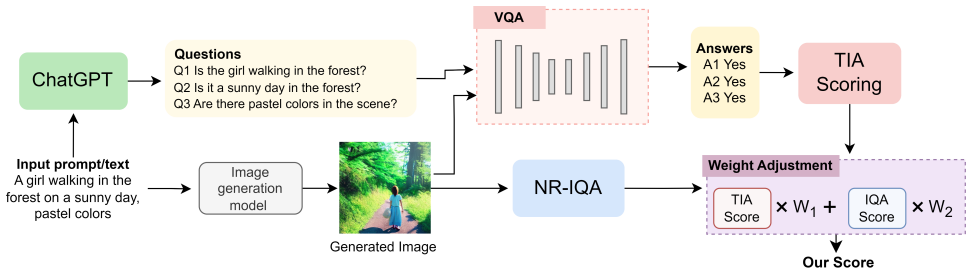
The carrying mechanism is a two-stage scoring pipeline. An LLM (ChatGPT) generates simple yes/no questions, about seven words each, from the input prompt, with question count scaled to prompt length; the VQA model BEIT-3 answers each question about the generated image; and the Text-Image Alignment score is the proportion of 'yes' answers. The no-reference quality assessor MANIQA produces the image-quality score. The final score is the weighted sum $S_{\mathrm{out}} = S_{\mathrm{tia}} W_1 + S_{\mathrm{iqa}} W_2$, with default weights $W_1 = W_2 = 0.5$.
What would settle it
Take a controlled set of generated images in which an object named in the prompt is definitely absent, ask BEIT-3 the corresponding yes/no question, and compare its answer with the known ground truth; if the VQA model answers 'yes' on a substantial share of absent-object questions, the TIA score is not a faithful alignment measure. A human-ranking study on the same images, comparing proposed TIA scores with human judgments of prompt fidelity, would also directly test the paper's central claim.
Extended reading notes
Core claim
The paper's central claim is that a question-answering pipeline can measure whether each detail in a prompt survives into a generated image, something global embedding-similarity metrics miss. In the reported comparisons, CLIPScore sometimes assigns higher scores to image-text pairs whose text actually contradicts the image, whereas the proposed Text-Image Alignment score decreases as mismatched words are introduced, matching the intended ranking. The authors further claim that combining this TIA score with MANIQA's no-reference image-quality score gives a metric that simultaneously tracks alignment and quality, and that unlike ImageReward, it keeps the two components separate so users can reweight or view them independently.
Load-bearing premise
The metric assumes that BEIT-3 answers ChatGPT-generated yes/no questions about synthetic generated images accurately, and that the fraction of 'yes' answers is a faithful measure of how well the prompt's details are reflected; the paper does not calibrate or verify this accuracy on generated images.
Editorial extensions
If this is right
- The metric can rank generated images by whether each object and detail in the prompt is actually present, not just by overall similarity in embedding space.
- Because alignment and quality scores are computed separately, users can inspect either aspect alone or combine them with chosen weights.
- The method applies to both text-to-image generation and text-guided image manipulation, since the same question-answering logic works on any text-image pair.
- If the reported comparisons hold, the metric offers a practical alternative to CLIPScore for fine-grained prompt fidelity and to ImageReward when separate quality reporting is needed.
Reading between the lines
- Beyond the paper's own claims, the all-yes question design could make the score sensitive to how ChatGPT phrases questions; rephrasing or asking the same question in multiple ways would test robustness.
- A natural extension is calibrating the VQA model on generated images, since BEIT-3 was not verified here on synthetic images; confidence-weighted answers could reduce systematic yes/no bias.
- The pipeline could be used with other LLMs or applied to text-guided editing by restricting questions to edited regions, but these are extensions the paper does not demonstrate.
- An independent human-ranking study on a larger prompt set would tell whether the TIA score agrees with human judgment beyond the few examples shown.
Signed reviews
Editorial analysis
A structured set of objections, weighed in public.
Referee Report
Summary. The paper proposes an automatic evaluation metric for text-to-image generation and text-guided image manipulation. The method uses ChatGPT to generate yes/no questions from the input prompt, uses the BEIT-3 VQA model to answer those questions on the generated image, and computes a Text-Image Alignment score as the fraction of 'yes' answers. This score is combined with a no-reference image quality score from MANIQA via a weighted sum, with user-adjustable weights. The authors claim the resulting metric is superior to CLIPScore, ImageReward, and MANIQA because it simultaneously evaluates fine-grained text-image alignment and image quality, and because the relative weighting can be adjusted. The experimental section presents qualitative comparisons in Figures 2 and 3 but provides no quantitative aggregation, no error bars, no human correlation, and no comparison with existing VQA-based metrics.
Significance. If the claims were properly validated, the proposed metric could be a practically useful tool, since it combines a fine-grained question-answering approach to text-image alignment with a no-reference quality score and offers an adjustable trade-off. The use of ChatGPT for automatic question generation is a reasonable way to avoid manual question templates, and the components (BEIT-3, MANIQA) are established models. However, the manuscript currently provides no quantitative evidence that the metric agrees with human judgments or outperforms existing metrics on any statistically meaningful sample. The central claim of superiority is therefore unsupported by the presented experiments.
major comments (5)
- [Section II-A] The question-generation protocol is not validated. The paper states that ChatGPT generates simple yes/no questions but provides no check that the generated questions cover all entities, attributes, and relations in the prompt, and no analysis of how often questions are trivial or ambiguous. The rule for the number of questions (one for 1-2 words, plus one per additional 6 words) is said to be 'based on experimental results' but those results are not shown. Since the TIA score is simply the fraction of 'yes' answers, any bias or incompleteness in the question set directly undermines the validity of the metric.
- [Section II-B] The accuracy of the BEIT-3 VQA model on synthetic generated images is never established. No calibration, per-question accuracy, or comparison against human annotations is reported. If the VQA model systematically answers 'yes' or 'no' incorrectly on generated images, the resulting Stia does not measure text-image alignment. This is a load-bearing gap because the claimed 'superior metric' relies entirely on the faithfulness of the VQA channel.
- [Section III] The experimental evaluation is purely qualitative. Figures 2 and 3 show a handful of hand-picked examples, with no sample size, no error bars, no aggregate statistics, and no correlation with human ratings. The claim that the proposed method is superior to CLIPScore and ImageReward is not supported by any quantitative comparison. The paper also does not compare against existing VQA-based metrics such as TIFA, DSG-1, or VQAScore, which are directly related to the proposed approach.
- [Section II-D] Equation (1) combines Stia and Siqa with weights W1 and W2, but the paper does not discuss the numerical ranges or distributions of the two component scores. If Siqa and Stia are on different scales, the default W1=W2=0.5 may not actually give equal importance, and the adjustable weighting may not behave as claimed. A sensitivity analysis of the weights is also missing, even though the authors state the defaults are 'based on experimental results' without showing those results.
- [Abstract and Section II] The abstract claims the metric assesses alignment 'for every individual object,' but the method does not identify or isolate objects. The score is a single aggregate fraction of 'yes' answers across all questions; there is no per-object breakdown or object-level evaluation. This overstates what the metric actually computes and should be corrected or substantiated with object-level results.
minor comments (5)
- [Throughout] The capitalization of 'chatGPT' is inconsistent; the standard form is 'ChatGPT' when referring to the model.
- [Section II-C] The phrase 'the proposed network' in Section II introduction is unclear, since no network is proposed; consider replacing with 'the proposed method.'
- [Figures 2 and 3] The figures are difficult to evaluate in grayscale because they rely on bold text and subtle score differences; adding numbered annotations or a table of scores would improve readability.
- [Section III] The paper says experiments use CUB and COCO datasets but does not state how many prompts or images were used, how text modifications were chosen, or whether the main results are reproducible from the described protocol.
- [References] The paper does not cite or discuss existing VQA-based evaluation metrics for text-to-image generation, such as TIFA, DSG-1, or VQAScore; these should be included in the related work and experimental comparison.
Circularity Check
No significant circularity: the proposed score is a self-contained weighted combination of two external off-the-shelf models, and its validation is weak but not circular.
full rationale
The paper's final score, Sout = Stia * W1 + Siqa * W2 (Eq. 1), is an explicit definition, not a derivation. Stia is the yes-rate of BEIT-3 VQA responses to ChatGPT-generated questions, and Siqa is the MANIQA NR-IQA output. Both components are adopted from external prior work, not from the authors' own previous results, so there is no self-citation chain carrying the load. The 'superior metric' claim is supported by hand-selected qualitative rank comparisons (Figs. 2 and 3), not by a mathematical derivation, so it cannot reduce to its inputs by construction. The paper states that the question-count heuristic and the default weights W1=W2=0.5 are 'based on experimental results' without showing those results; this is a form of tuning on the same kind of examples used for evaluation, which weakens the empirical support but does not make the central claim equivalent to its inputs. The unvalidated assumption that ChatGPT-generated yes/no questions and BEIT-3 answers faithfully measure text-image alignment is a correctness or evidence concern, not a circularity: the metric would still be defined as stated even if that assumption failed. No fitted parameter is renamed as a prediction, no uniqueness theorem is imported from the authors' own work, and no known result is merely relabeled. Therefore the appropriate circularity score is 0.
Assumptions & free parameters
free parameters (2)
- Question count per prompt =
1 question for 1-2 words; +1 question per 6 words
- Default weights W1 and W2 =
0.5 and 0.5
assumptions (3)
- domain assumption ChatGPT-generated yes/no questions with ground-truth answer "yes" adequately sample the alignment-relevant content of the prompt.
- domain assumption BEIT-3 VQA model answers these questions accurately on generated images.
- domain assumption MANIQA no-reference quality scores correlate with human perceptual quality.
Cite this review
Pith. "Pith review of Visual question answering based evaluation metrics for text-to-image generation." pith.science (2026). https://pith.science/paper/XWFB3CV7
@misc{pith2026241110183,
  author       = {Pith},
  title        = {Pith review of: Visual question answering based evaluation metrics for text-to-image generation},
  year         = {2026},
  howpublished = {\url{https://pith.science/paper/XWFB3CV7}},
  note         = {Machine review of arXiv:2411.10183}
}
read the original abstract
Text-to-image generation and text-guided image manipulation have received considerable attention in the field of image generation tasks. However, the mainstream evaluation methods for these tasks have difficulty in evaluating whether all the information from the input text is accurately reflected in the generated images, and they mainly focus on evaluating the overall alignment between the input text and the generated images. This paper proposes new evaluation metrics that assess the alignment between input text and generated images for every individual object. Firstly, according to the input text, chatGPT is utilized to produce questions for the generated images. After that, we use Visual Question Answering(VQA) to measure the relevance of the generated images to the input text, which allows for a more detailed evaluation of the alignment compared to existing methods. In addition, we use Non-Reference Image Quality Assessment(NR-IQA) to evaluate not only the text-image alignment but also the quality of the generated images. Experimental results show that our proposed evaluation approach is the superior metric that can simultaneously assess finer text-image alignment and image quality while allowing for the adjustment of these ratios.
Figures


Reference graph
Works this paper leans on
-
[1]
Training language models to follow instructions with human feedback,
L. Ouyang, J. Wu, X. Jiang, D. Almeida, C. Wainwright, P. Mishkin, C. Zhang, S. Agarwal, K. Slama, A. Ray et al. , “Training language models to follow instructions with human feedback,”Advances in Neural Information Processing Systems , vol. 35, pp. 27 730–27 744, 2022
2022
-
[2]
Manigan: Text-guided image manipulation,
B. Li, X. Qi, T. Lukasiewicz, and P. H. Torr, “Manigan: Text-guided image manipulation,” in Proceedings of the IEEE/CVF Conference on Computer Vision and Pattern Recognition , 2020, pp. 7880–7889
work page 2020
-
[3]
Unpaired image-to-image translation using cycle-consistent adversarial networks,
J.-Y . Zhu, T. Park, P. Isola, and A. A. Efros, “Unpaired image-to-image translation using cycle-consistent adversarial networks,” in Proceedings of the IEEE international conference on computer vision , 2017, pp. 2223–2232
2017
-
[4]
High- resolution image synthesis with latent diffusion models,
R. Rombach, A. Blattmann, D. Lorenz, P. Esser, and B. Ommer, “High- resolution image synthesis with latent diffusion models,” in Proceedings of the IEEE/CVF conference on computer vision and pattern recognition, 2022, pp. 10 684–10 695
2022
-
[5]
Photorealistic text-to-image diffusion models with deep language understanding,
C. Saharia, W. Chan, S. Saxena, L. Li, J. Whang, E. L. Denton, K. Ghasemipour, R. Gontijo Lopes, B. Karagol Ayan, T. Salimans et al., “Photorealistic text-to-image diffusion models with deep language understanding,” Advances in Neural Information Processing Systems , vol. 35, pp. 36 479–36 494, 2022
2022
-
[6]
Microsoft coco: Common objects in context,
T.-Y . Lin, M. Maire, S. Belongie, J. Hays, P. Perona, D. Ramanan, P. Doll ´ar, and C. L. Zitnick, “Microsoft coco: Common objects in context,” in Computer Vision–ECCV 2014: 13th European Conference, Zurich, Switzerland, September 6-12, 2014, Proceedings, Part V 13 . Springer, 2014, pp. 740–755
2014
-
[7]
The caltech-ucsd birds-200-2011 dataset,
C. Wah, S. Branson, P. Welinder, P. Perona, and S. Belongie, “The caltech-ucsd birds-200-2011 dataset,” California Institute of Technology, Tech. Rep. CNS-TR-2011-001, 2011
2011
-
[8]
Diffusiondb: A large-scale prompt gallery dataset for text-to- image generative models,
Z. J. Wang, E. Montoya, D. Munechika, H. Yang, B. Hoover, and D. H. Chau, “Diffusiondb: A large-scale prompt gallery dataset for text-to- image generative models,” arXiv preprint arXiv:2210.14896 , 2022
arXiv 2022
Show all 16 references
-
[9]
Gans trained by a two time-scale update rule converge to a local nash equilibrium,
M. Heusel, H. Ramsauer, T. Unterthiner, B. Nessler, and S. Hochreiter, “Gans trained by a two time-scale update rule converge to a local nash equilibrium,” Advances in neural information processing systems , vol. 30, 2017
2017
-
[10]
Clipscore: A reference-free evaluation metric for image captioning,
J. Hessel, A. Holtzman, M. Forbes, R. L. Bras, and Y . Choi, “Clipscore: A reference-free evaluation metric for image captioning,” arXiv preprint arXiv:2104.08718, 2021
2021 arXiv
-
[11]
Learning transferable visual models from natural language supervision,
A. Radford, J. W. Kim, C. Hallacy, A. Ramesh, G. Goh, S. Agarwal, G. Sastry, A. Askell, P. Mishkin, J. Clark et al., “Learning transferable visual models from natural language supervision,” in International conference on machine learning . PMLR, 2021, pp. 8748–8763
2021
-
[12]
Maniqa: Multi-dimension attention network for no-reference image quality assessment,
S. Yang, T. Wu, S. Shi, S. Lao, Y . Gong, M. Cao, J. Wang, and Y . Yang, “Maniqa: Multi-dimension attention network for no-reference image quality assessment,” in Proceedings of the IEEE/CVF Conference on Computer Vision and Pattern Recognition , 2022, pp. 1191–1200
2022
-
[13]
Imagereward: Learning and evaluating human preferences for text-to- image generation,
J. Xu, X. Liu, Y . Wu, Y . Tong, Q. Li, M. Ding, J. Tang, and Y . Dong, “Imagereward: Learning and evaluating human preferences for text-to- image generation,” arXiv preprint arXiv:2304.05977 , 2023
2023 arXiv
-
[14]
Image as a foreign language: Beit pretraining for all vision and vision-language tasks,
W. Wang, H. Bao, L. Dong, J. Bjorck, Z. Peng, Q. Liu, K. Aggarwal, O. K. Mohammed, S. Singhal, S. Som et al. , “Image as a foreign language: Beit pretraining for all vision and vision-language tasks,” arXiv preprint arXiv:2208.10442 , 2022
2022 arXiv
-
[15]
An image is worth 16x16 words: Transformers for image recognition at scale,
A. Dosovitskiy, L. Beyer, A. Kolesnikov, D. Weissenborn, X. Zhai, T. Unterthiner, M. Dehghani, M. Minderer, G. Heigold, S. Gelly et al., “An image is worth 16x16 words: Transformers for image recognition at scale,” arXiv preprint arXiv:2010.11929 , 2020
2010 arXiv
-
[16]
Attention is all you need,
A. Vaswani, N. Shazeer, N. Parmar, J. Uszkoreit, L. Jones, A. N. Gomez, Ł. Kaiser, and I. Polosukhin, “Attention is all you need,” Advances in neural information processing systems , vol. 30, 2017
2017
Reviewed August 12, 2026 · model on record in the stance chip above.
Discussion (0). Continue with ORCID to comment.