REVIEW 3 major objections 6 minor 85 references
Universal non-equilibrium scaling of cumulants across a critical point
T0 review · 3 major / 6 minor · reviewed 2026-08-12 · deepseek-v4-flash
Pith's one-line read The paper claims that universal Kibble–Zurek scaling functions, fitted here with Padé approximants, completely describe the non-equilibrium evolution of the order parameter and its first four cumulants in linear magnetic quenches through…
desk verdict Solid numerical extraction of universal cumulant scaling functions for Model A; the claims are slightly ahead of the evidence, but the central result holds and deserves a referee. read the letter →
The pith
A machine-rendered reading of the paper's core claim, the machinery that carries it, and where it could break.
The reading
What carries the argument
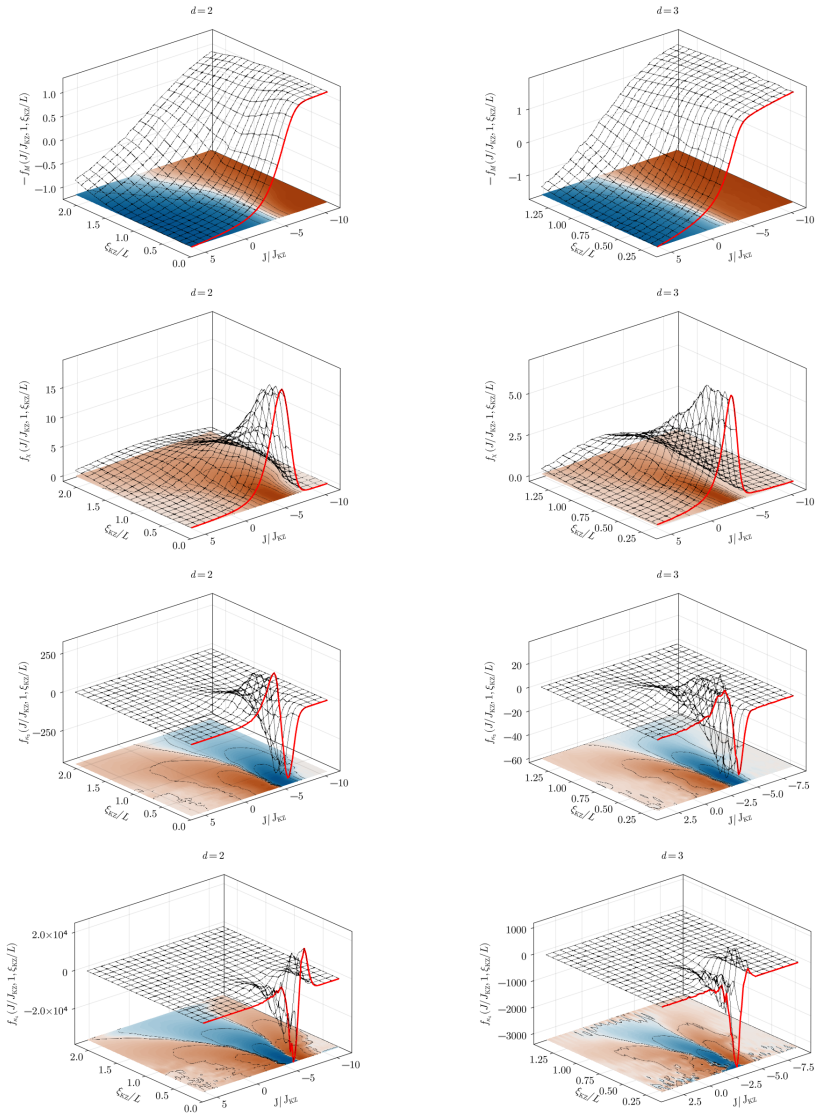
The load-bearing object is the Kibble–Zurek finite-time scaling ansatz, Eq. (19): every observable $A$ with scaling dimension $\Delta_A$ obeys $A(J,r_J) = A_0\, s^{\Delta_A} f_A(s^{1/\nu_c} J,\, s^{z+1/\nu_c} r_J)$, where $s$ is a length-rescaling parameter and $r_J$ is the dimensionless quench rate. Choosing $s = r_J^{-\nu_c/(1+\nu_c z)}$ eliminates the quench-rate argument and leaves a function of the single variable $x = J/J_{\mathrm{KZ}}$ with $J_{\mathrm{KZ}} \sim r_J^{1/(1+\nu_c z)}$. The cumulants enter only through their equilibrium scaling dimensions $\Delta_n = -\beta/\nu + (n-1)/\nu_c$, with $\nu_c=\nu/(\beta\delta)$, which sets how each observable is rescaled before the collapse is tested. The finite-size extension, Eq. (31), adds a third argument $s L^{-1}$ and produces the two-variable functions $f_A(x,\xi_{\mathrm{KZ}}/L)$ that govern the crossover from quench-limited to system-size-limited behavior.
What would settle it
One decisive test is to run the same Model A dynamics at a quench rate inside the identified dynamic scaling region but with a different lattice coupling or dissipation strength, and check whether the rescaled curves still collapse onto the Padé fits of Tables A.3 and A.4; systematic deviation would show the functions are not fully universal. Alternatively, measure the local slope of the magnetization zero-crossing over a wider range of quench rates and verify that it plateaus at $1/(1+\nu_c z)$ with the same value used to extract $z$ in this paper.
Extended reading notes
Core claim
For a scalar field theory with $\mathbb{Z}_2$ symmetry in the relaxational Model A universality class, a constant-rate quench of the symmetry-breaking external field through the critical point produces non-equilibrium evolution of the order parameter and its cumulants that is described by universal Kibble–Zurek scaling functions. In $d=2$ and $d=3$, the rescaled data for the average magnetization, susceptibility, skewness, and kurtosis collapse onto single curves $f_M(x)$, $f_\chi(x)$, $f_{\kappa_3}(x)$, and $f_{\kappa_4}(x)$ with $x=J/J_{\mathrm{KZ}}$, and the paper provides closed-form Padé fits for these functions in Tables A.3 and A.4. The same scaling framework yields an independent estimate of the dynamic critical exponent from the quench-rate scaling of the magnetization zero-crossing, namely $z=2.142(49)$ in $d=2$ and $z=1.949(54)$ in $d=3$, consistent with Monte Carlo values in $d=2$ and slightly lower in $d=3$. With the system size included as an additional scaling variable, the data collapse onto two-variable functions that interpolate between infinite-volume non-equilibrium scaling and equilibrium finite-size scaling, confirming that the description remains valid when $\xi_{\mathrm{KZ}}/L$ is no longer small.
Load-bearing premise
The central assumption is that in the chosen window of quench rates and lattice sizes the Kibble–Zurek scaling form holds with negligible corrections, so that every observable depends on the quench rate only through the combination $J/J_{\mathrm{KZ}}$ (and, for finite systems, through $\xi_{\mathrm{KZ}}/L$); the paper's Appendix B documents how very slow and very fast quenches break this behavior.
Editorial extensions
If this is right
- Given the static critical exponents and the dynamic exponent $z$, the published Padé fits predict the time evolution of the magnetization, susceptibility, skewness and kurtosis for any linear magnetic quench through the critical point in $d=2$ and $d=3$ Model A dynamics, with no further simulation needed.
- For finite systems, the two-variable scaling functions show that corrections become visible once $\xi_{\mathrm{KZ}}/L \gtrsim 0.5$: the transition softens, cumulant peaks shrink, and the crossing shifts toward $J=0$, eventually reproducing equilibrium finite-size scaling in the adiabatic limit.
- The Kibble–Zurek-based estimates of the dynamic exponent provide an independent cross-check of $z$ that is consistent with Monte Carlo results in $d=2$ and slightly lower in $d=3$, signaling the systematic limitations of finite-size and fast-quench simulations.
- Because the scaling functions are universal, they provide a concrete benchmark for comparing more realistic dynamical frameworks, such as Model H stochastic fluid dynamics in heavy-ion phenomenology, against the predicted cumulant evolution.
Reading between the lines
- One could test the universality claim more stringently by changing the lattice coupling or the dissipation strength and checking whether the same Padé fits describe the rescaled data; the paper reports only a brief check of the coupling and found no improvement.
- The same finite-time scaling machinery should apply to other control-parameter paths, such as temperature quenches or cis-critical protocols, and comparing the extracted functions across paths would show which features of the universal curves are genuinely universality-class properties rather than artifacts of the linear-field protocol.
- The marked asymmetry of the susceptibility during the quench—a gradual departure from equilibrium before the critical point and a sharp return after—is a dynamical signature that an effective kinetic description would have to reproduce; it is not fixed by equilibrium critical exponents alone.
- Mapping the 3D Ising scaling functions onto QCD phase-diagram trajectories would give concrete predictions for skewness and kurtosis at finite beam energies; if the QCD critical point is in Model H rather than Model A, the two sets of functions would differ in ways that could be used to identify the correct dynamical universality class.
Editorial analysis
A structured set of objections, weighed in public.
Referee Report
Summary. The paper reports classical-statistical lattice simulations of a Z2-symmetric scalar field theory with Langevin dynamics (Model A) in d=2 and d=3, driven through the critical point by a linearly varying external field J(t) = -r_J t at T = T_c. Using Kibble-Zurek scaling, the authors rescale the magnetization, susceptibility, skewness, and kurtosis and observe data collapse onto universal scaling functions f_M, f_chi, f_kappa3, f_kappa4, which are parametrized by Padé approximants given in Tables A.3 and A.4. The analysis is extended to a two-variable scaling function f_A(x, xi_KZ/L) for finite system sizes in Sec. 4.3, and the dynamic critical exponent z is extracted from the scaling of the zero crossing of the magnetization in Appendix B. The abstract claims that, together with the static and dynamic critical exponents, these scaling functions fully describe the universal non-equilibrium evolution of the system near the critical point.
Significance. If the extracted scaling functions are truly universal, the paper is a valuable contribution: it provides closed-form expressions for the out-of-equilibrium evolution of order-parameter cumulants up to fourth order in a canonical dynamic universality class, with direct relevance to phenomenological modeling near the QCD critical point. The dataset is substantial (about 10^4 and 5 x 10^3 independent runs per quench rate in 2D and 3D), statistical uncertainties are bootstrap-estimated, and the Padé parametrizations make the results usable by other groups. The paper also usefully catalogs regimes where Kibble-Zurek scaling breaks down. However, the central universality claim rests on visually assessed collapse; quantitative collapse metrics, a corrections-to-scaling analysis, and a full propagation of the z uncertainty are missing. The finite-size extension is presented only as a spline wireframe without quantitative validation. These gaps currently limit the claim to effective scaling functions valid in the probed window rather than fully established universal functions.
major comments (3)
- [Sec. 4.1, Figs. 3 and 4, Tables A.3 and A.4] The collapse of the rescaled data is assessed visually only; no chi-square, residual analysis, or other quantitative metric is reported for the quality of the collapse or for the Padé fits. Given the central claim that the Padé functions in Tables A.3 and A.4 fully describe the universal non-equilibrium evolution, please add a quantitative goodness-of-fit measure (e.g., chi^2 per degree of freedom against the collapsed data), report the exact x-intervals used for each fit, and test the stability of the fits when the fitting range or the Padé order is varied. Without this, the reported functions may be effective, window-dependent fits that absorb corrections to scaling and systematics from the input exponent z.
- [Appendix B and Sec. 4.1] The rescaling in Sec. 4.1 uses the literature values z = 2.1667(5) (d=2) and z = 2.0245(15) (d=3), while the authors' own estimates from the same data are z = 2.142(49) and z = 1.949(54), with the d=3 value about 1.4 sigma below the literature value. Since the scaling variable x = r_J^{-1/(1+nu_c z)} J depends on z, the extracted f_A inherit this uncertainty. Please quantify how the collapsed curves and Padé coefficients change when z is varied within the literature uncertainty, for example by recomputing the collapse at the 1-sigma bounds of z. Alternatively, treat z as a free parameter in a joint fit of the collapse and report the resulting f_A and confidence intervals. This is essential for assessing whether the reported functions are universal rather than specific to the chosen input z.
- [Sec. 4.3 and Fig. 5] The two-variable finite-size scaling function f_A(x, xi_KZ/L) is presented only as a polyharmonic spline wireframe, with no quantitative test that the rescaled data for different lattice sizes and quench rates collapse onto a single surface. Please provide a collapse metric for fixed values of xi_KZ/L (e.g., overlay slices obtained from different (L, r_J) combinations that yield the same xi_KZ/L and report the spread), and specify the reference scale L0 that defines the dimensionless size L = L/L0 in Eq. (31), including how L0 is determined from equilibrium finite-size scaling and its numerical value. Without this, the claim of a universal finite-size scaling function is not quantitatively established.
minor comments (6)
- [Abstract and Sec. 5] The statement that the scaling functions 'fully describe the universal non-equilibrium evolution' is stronger than what is demonstrated, given the documented breakdowns in Appendix B and the absence of a corrections-to-scaling analysis; please soften the wording or explicitly restrict the claim to the dynamic scaling region and the fitted range of x.
- [Sec. 3.1, Eqs. (14)-(15)] The expression for the time derivative of the relaxation time appears garbled: '(-t)^{-1}nu_c z' is likely intended in Eq. (15); please correct the typography.
- [Sec. 4.1, Eq. (20)] The normalization condition f_A(1,0) = f_A(0,1) = 1 is stated in Eq. (20), but only f_M(0) = 1 is actually used to fix r_J0; please clarify whether the normalization conditions for chi, kappa3, and kappa4 are also enforced or whether their overall amplitudes are fixed solely by the literature amplitudes A0.
- [Appendix B, Fig. B.7] The dynamic scaling region is identified 'by eye' from local slope plateaus; please state an objective criterion for the plateau selection and list the data points and quench-rate ranges used in the fit.
- [Sec. 5] The conclusions refer to '2+1D' and '3+1D' while the simulations are in two and three spatial dimensions; please use consistent notation throughout the paper.
- [Appendix C] The code and data are described but no repository or data availability statement is provided; please consider making the code and data publicly available to facilitate reproducibility.
Circularity Check
No significant circularity: the universal scaling functions are measured via data collapse using externally supplied static and dynamic exponents; the only fitted amplitude sets normalization and does not constrain shape.
full rationale
The paper's chain is: (i) a Model A lattice action with Langevin dynamics; (ii) the standard Kibble-Zurek scaling ansatz (Eq. 19), with static exponents from Onsager/conformal bootstrap and the dynamic exponent z taken from independent Monte Carlo estimates (Nightingale–Blöte and Hasenbusch); (iii) rescaling of simulation data by those exponents and by static amplitudes taken from ref. [41]; (iv) observation of collapse and Padé fits. No step reduces to its own input: the shape of f_A(x) is not contained in the critical exponents or amplitudes, and the single fitted constant r_J0 is fixed only by the normalization f_M(0)=1, which does not determine the functional form of the scaled curves. The authors' own z estimate (Appendix B) is not used for the main collapse; literature z is, so the collapse is a genuine consistency test rather than an imposed fit. The use of static amplitudes from [41] is a self-citation, but [41] is an earlier, independently published lattice measurement of the same model and cannot force the out-of-equilibrium shape. Appendix B's admission that the dynamic scaling region is 'somewhat arbitrary' and that the d=3 z value is slightly below other theoretical estimates is a robustness limitation, not circularity. The finite-size scaling surface (Sec. 4.3) is presented as spline interpolation with observed collapse; even if no quantitative collapse metric is given, presenting a measured surface is not equivalent to assuming it. No fitted parameter is renamed as a prediction, no equation is used to define what it claims to derive, and no load-bearing uniqueness claim is imported from the authors' prior work. Therefore no circular step, Eq. X = Eq. Y by construction, or fitted-input-as-prediction was found; score 0.
Assumptions & free parameters
free parameters (5)
- r_J0 (d=2) =
3040(410)
- r_J0 (d=3) =
110(26)
- Pade coefficients (d=2) =
Tables A.3
- Pade coefficients (d=3) =
Tables A.4
- Dynamic scaling region boundaries =
chosen by eye from Fig. B.7
assumptions (5)
- domain assumption Scaling ansatz Eq. (19): A(J,r_J)=A0 s^{Delta_A} f_A(s^{1/nu_c} J, s^{z+1/nu_c} r_J)
- domain assumption Static critical exponents and non-universal amplitudes from literature (Tables 1, 2, refs [41,55,56,57])
- domain assumption Dynamic critical exponent z from literature (z=2.1667(5) in d=2 [60], z=2.0245(15) in d=3 [61])
- domain assumption Classical-statistical approximation
- domain assumption The lattice model is in the Model A dynamic universality class
Cite this review
Pith. "Pith review of Universal non-equilibrium scaling of cumulants across a critical point." pith.science (2026). https://pith.science/paper/A3J2OXBK
@misc{pith2026241110266,
  author       = {Pith},
  title        = {Pith review of: Universal non-equilibrium scaling of cumulants across a critical point},
  year         = {2026},
  howpublished = {\url{https://pith.science/paper/A3J2OXBK}},
  note         = {Machine review of arXiv:2411.10266}
}
abstract
We study the critical dynamics of a scalar field theory with $Z_2$ symmetry in the dynamic universality class of Model A in two and three spatial dimensions with classical-statistical lattice simulations. In particular, we measure the non-equilibrium behavior of the system under a quench protocol in which the symmetry-breaking external field is changed at a constant rate through the critical point. Using the well-established Kibble-Zurek scaling theory we compute non-equilibrium scaling functions of cumulants of the order parameter up to fourth order. Together with the static critical exponents and the dynamic critical exponent, these fully describe the universal non-equilibrium evolution of the system near the critical point. We further extend the analysis to include finite-size effects and observe good collapse of our data onto two-dimensional universal non-equilibrium and finite-size scaling functions.
Figures


Figures from the paper (2 more)

Reference graph
Works this paper leans on
-
[1]
M. A. Stephanov, K. Rajagopal, E. V . Shuryak, Event-by-event fluctuations in heavy ion collisions and the QCD critical point, Phys. Rev. D 60 (1999) 114028. arXiv:hep-ph/9903292, doi:10.1103/PhysRevD.60.114028
arXiv 1999
-
[2]
B. Berdnikov, K. Rajagopal, Slowing out-of-equilibrium near the QCD critical point, Phys. Rev. D 61 (2000) 105017. arXiv:hep-ph/ 9912274, doi:10.1103/PhysRevD.61.105017
-
[3]
P. C. Hohenberg, B. I. Halperin, Theory of Dynamic Critical Phenomena, Rev. Mod. Phys. 49 (1977) 435–479. doi:10.1103/RevModPhys. 49.435
-
[4]
D. T. Son, M. A. Stephanov, Dynamic universality class of the QCD critical point, Phys. Rev. D 70 (2004) 056001.arXiv:hep-ph/0401052, doi:10.1103/PhysRevD.70.056001
arXiv 2004
-
[5]
J. B. Bell, A. L. Garcia, S. A. Williams, Numerical methods for the stochastic landau-lifshitz navier-stokes equations, Phys. Rev. E 76 (2007) 016708. doi:10.1103/PhysRevE.76.016708
-
[6]
A. Donev, J. B. Bell, A. de la Fuente, A. L. Garcia, Diffusive transport by thermal velocity fluctuations, Phys. Rev. Lett. 106 (2011) 204501. doi:10.1103/PhysRevLett.106.204501
-
[7]
F. BalboaUsabiaga, J. B. Bell, R. Delgado-Buscalioni, A. Donev, T. G. Fai, B. E. Gri ffith, C. S. Peskin, Staggered schemes for fluctuating hydrodynamics, Multiscale Modeling & Simulation 10 (4) (2012) 1369–1408. doi:10.1137/120864520
-
[8]
Hydrodynamic fluctuations and dissipation in an integrated dynamical model
K. Murase, T. Hirano, Hydrodynamic fluctuations and dissipation in an integrated dynamical model, Nucl. Phys. A 956 (2016) 276–279. arXiv:1601.02260, doi:10.1016/j.nuclphysa.2016.01.011
work page Pith review arXiv 2016
Show all 85 references
-
[9]
Hirano, R
T. Hirano, R. Kurita, K. Murase, Hydrodynamic fluctuations of entropy in one-dimensionally expanding system, Nucl. Phys. A 984 (2019) 44–67. arXiv:1809.04773, doi:10.1016/j.nuclphysa.2019.01.010
2019 arXiv
-
[10]
Nahrgang, M
M. Nahrgang, M. Bluhm, T. Schäfer, S. Bass, Toward the description of fluid dynamical fluctuations in heavy-ion collisions, Acta Phys. Polon. Supp. 10 (2017) 687. arXiv:1704.03553, doi:10.5506/APhysPolBSupp.10.687
2017 arXiv
-
[11]
Bluhm, M
M. Bluhm, M. Nahrgang, T. Schäfer, S. A. Bass, Fluctuating fluid dynamics for the QGP in the LHC and BES era, EPJ Web Conf. 171 (2018) 16004. arXiv:1804.03493, doi:10.1051/epjconf/201817116004
2018 arXiv
-
[12]
Singh, C
M. Singh, C. Shen, S. McDonald, S. Jeon, C. Gale, Hydrodynamic Fluctuations in Relativistic Heavy-Ion Collisions, Nucl. Phys. A 982 (2019) 319–322. arXiv:1807.05451, doi:10.1016/j.nuclphysa.2018.10.061
2019 arXiv
-
[13]
Chattopadhyay, J
C. Chattopadhyay, J. Ott, T. Schaefer, V . V . Skokov, Simulations of Stochastic Fluid Dynamics near a Critical Point in the Phase Diagram, Phys. Rev. Lett. 133 (3) (2024) 032301. arXiv:2403.10608, doi:10.1103/PhysRevLett.133.032301
2024 arXiv
-
[14]
Akamatsu, A
Y . Akamatsu, A. Mazeliauskas, D. Teaney, A kinetic regime of hydrodynamic fluctuations and long time tails for a Bjorken expansion, Phys. Rev. C 95 (1) (2017) 014909. arXiv:1606.07742, doi:10.1103/PhysRevC.95.014909
2017 arXiv
-
[15]
Akamatsu, D
Y . Akamatsu, D. Teaney, F. Yan, Y . Yin, Transits of the QCD critical point, Phys. Rev. C 100 (4) (2019) 044901. arXiv:1811.05081, doi:10.1103/PhysRevC.100.044901
2019 arXiv
-
[16]
X. An, G. Basar, M. Stephanov, H.-U. Yee, Relativistic Hydrodynamic Fluctuations, Phys. Rev. C 100 (2) (2019) 024910. arXiv: 1902.09517, doi:10.1103/PhysRevC.100.024910
2019 arXiv
-
[17]
Paech, H
K. Paech, H. Stoecker, A. Dumitru, Hydrodynamics near a chiral critical point, Phys. Rev. C 68 (2003) 044907. arXiv:nucl-th/0302013, doi:10.1103/PhysRevC.68.044907
2003 arXiv
-
[18]
Nahrgang, S
M. Nahrgang, S. Leupold, C. Herold, M. Bleicher, Nonequilibrium chiral fluid dynamics including dissipation and noise, Phys. Rev. C 84 (2011) 024912. arXiv:1105.0622, doi:10.1103/PhysRevC.84.024912
2011 arXiv
-
[19]
Nahrgang, C
M. Nahrgang, C. Herold, S. Leupold, I. Mishustin, M. Bleicher, The impact of dissipation and noise on fluctuations in chiral fluid dynamics, J. Phys. G 40 (2013) 055108. arXiv:1105.1962, doi:10.1088/0954-3899/40/5/055108
2013 arXiv
-
[20]
Herold, M
C. Herold, M. Nahrgang, I. Mishustin, M. Bleicher, Chiral fluid dynamics with explicit propagation of the Polyakov loop, Phys. Rev. C 87 (1) (2013) 014907. arXiv:1301.1214, doi:10.1103/PhysRevC.87.014907
2013 arXiv
-
[21]
Herold, M
C. Herold, M. Nahrgang, Y . Yan, C. Kobdaj, Net-baryon number variance and kurtosis within nonequilibrium chiral fluid dynamics, J. Phys. G 41 (11) (2014) 115106. arXiv:1407.8277, doi:10.1088/0954-3899/41/11/115106
2014 arXiv
-
[22]
Stephanov, Y
M. Stephanov, Y . Yin, Hydrodynamics with parametric slowing down and fluctuations near the critical point, Phys. Rev. D 98 (3) (2018) 036006. arXiv:1712.10305, doi:10.1103/PhysRevD.98.036006
2018 arXiv
-
[23]
Rajagopal, G
K. Rajagopal, G. Ridgway, R. Weller, Y . Yin, Understanding the out-of-equilibrium dynamics near a critical point in the QCD phase diagram, Phys. Rev. D 102 (9) (2020) 094025. arXiv:1908.08539, doi:10.1103/PhysRevD.102.094025. 16
2020 arXiv
-
[24]
L. Du, U. Heinz, K. Rajagopal, Y . Yin, Fluctuation dynamics near the QCD critical point, Phys. Rev. C 102 (5) (2020) 054911. arXiv: 2004.02719, doi:10.1103/PhysRevC.102.054911
2020 arXiv
-
[25]
Bluhm, et al., Dynamics of critical fluctuations: Theory – phenomenology – heavy-ion collisions, Nucl
M. Bluhm, et al., Dynamics of critical fluctuations: Theory – phenomenology – heavy-ion collisions, Nucl. Phys. A 1003 (2020) 122016. arXiv:2001.08831, doi:10.1016/j.nuclphysa.2020.122016
2020 arXiv
-
[26]
Jiang, S
L. Jiang, S. Wu, H. Song, Dynamical fluctuations in critical regime and across the 1st order phase transition, Nucl. Phys. A 967 (2017) 441–444. arXiv:1704.04765, doi:10.1016/j.nuclphysa.2017.06.047
2017 arXiv
-
[27]
S. Wu, Z. Wu, H. Song, Universal scaling of the σ field and net-protons from Langevin dynamics of model A, Phys. Rev. C 99 (6) (2019) 064902. arXiv:1811.09466, doi:10.1103/PhysRevC.99.064902
2019 arXiv
-
[28]
Jiang, J
L. Jiang, J. Chao, Non-equilibrium cumulants within model A from crossover to first-order phase transition side, Eur. Phys. J. A 59 (2) (2023)
2023
-
[29]
Sakaida, M
M. Sakaida, M. Asakawa, H. Fujii, M. Kitazawa, Dynamical evolution of critical fluctuations and its observation in heavy ion collisions, Phys. Rev. C 95 (6) (2017) 064905. arXiv:1703.08008, doi:10.1103/PhysRevC.95.064905
2017 arXiv
-
[30]
arXiv:2112.04667, doi:10.1140/epja/s10050-023-00949-1
-
[31]
Nahrgang, M
M. Nahrgang, M. Bluhm, T. Schaefer, S. A. Bass, Diffusive dynamics of critical fluctuations near the QCD critical point, Phys. Rev. D 99 (11) (2019) 116015. arXiv:1804.05728, doi:10.1103/PhysRevD.99.116015
2019 arXiv
-
[32]
Nahrgang, M
M. Nahrgang, M. Bluhm, Modeling the diffusive dynamics of critical fluctuations near the QCD critical point, Phys. Rev. D 102 (9) (2020) 094017. arXiv:2007.10371, doi:10.1103/PhysRevD.102.094017
2020
-
[33]
Rougemont, R
R. Rougemont, R. Critelli, J. Noronha, Nonhydrodynamic quasinormal modes and equilibration of a baryon dense holographic QGP with a critical point, Phys. Rev. D 98 (3) (2018) 034028. arXiv:1804.00189, doi:10.1103/PhysRevD.98.034028
2018 arXiv
-
[34]
Mukherjee, R
S. Mukherjee, R. Venugopalan, Y . Yin, Real time evolution of non-Gaussian cumulants in the QCD critical regime, Phys. Rev. C 92 (3) (2015) 034912. arXiv:1506.00645, doi:10.1103/PhysRevC.92.034912
2015 arXiv
-
[35]
Mukherjee, R
S. Mukherjee, R. Venugopalan, Y . Yin, Universal off-equilibrium scaling of critical cumulants in the QCD phase diagram, Phys. Rev. Lett. 117 (22) (2016) 222301. arXiv:1605.09341, doi:10.1103/PhysRevLett.117.222301
2016 arXiv
-
[36]
M. A. Stephanov, Non-Gaussian fluctuations near the QCD critical point, Phys. Rev. Lett. 102 (2009) 032301. arXiv:0809.3450, doi:10.1103/PhysRevLett.102.032301
2009 arXiv
-
[37]
M. A. Stephanov, On the sign of kurtosis near the QCD critical point, Phys. Rev. Lett. 107 (2011) 052301. arXiv:1104.1627, doi:10.1103/PhysRevLett.107.052301
2011 arXiv
-
[38]
Nahrgang, The QCD Critical Point and Related Observables, Nucl
M. Nahrgang, The QCD Critical Point and Related Observables, Nucl. Phys. A 956 (2016) 83–90. arXiv:1601.07437, doi:10.1016/j. nuclphysa.2016.02.074
2016 arXiv
-
[39]
Aarts, Spectral function at high temperature in the classical approximation, Phys
G. Aarts, Spectral function at high temperature in the classical approximation, Phys. Lett. B 518 (2001) 315–322. arXiv:hep-ph/0108125, doi:10.1016/S0370-2693(01)01081-4
2001 arXiv
-
[40]
Berges, S
J. Berges, S. Schlichting, D. Sexty, Dynamic critical phenomena from spectral functions on the lattice, Nucl. Phys. B 832 (2010) 228–240. arXiv:0912.3135, doi:10.1016/j.nuclphysb.2010.02.007
2010 arXiv
-
[41]
Schlichting, D
S. Schlichting, D. Smith, L. von Smekal, Spectral functions and critical dynamics of theO(4) model from classical-statistical lattice simulations, Nucl. Phys. B 950 (2020) 114868. arXiv:1908.00912, doi:10.1016/j.nuclphysb.2019.114868
2020 arXiv
-
[42]
Schweitzer, S
D. Schweitzer, S. Schlichting, L. von Smekal, Spectral functions and dynamic critical behavior of relativistic Z2 theories, Nucl. Phys. B 960 (2020) 115165. arXiv:2007.03374, doi:10.1016/j.nuclphysb.2020.115165
2020 arXiv
-
[43]
Schweitzer, S
D. Schweitzer, S. Schlichting, L. von Smekal, Critical dynamics of relativistic di ffusion, Nucl. Phys. B 984 (2022) 115944. arXiv: 2110.01696, doi:10.1016/j.nuclphysb.2022.115944
2022 arXiv
-
[44]
T. W. B. Kibble, Topology of Cosmic Domains and Strings, J. Phys. A 9 (1976) 1387–1398. doi:10.1088/0305-4470/9/8/029
1976 doi
-
[45]
W. H. Zurek, Cosmological Experiments in Superfluid Helium?, Nature 317 (1985) 505–508. doi:10.1038/317505a0
1985 doi
-
[46]
W. H. Zurek, Cosmological experiments in condensed matter systems, Phys. Rept. 276 (1996) 177–221. arXiv:cond-mat/9607135, doi:10.1016/S0370-1573(96)00009-9
1996 arXiv
-
[47]
S. Gong, F. Zhong, X. Huang, S. Fan, Finite-time scaling via linear driving, New Journal of Physics 12 (4) (2010) 043036. doi:10.1088/ 1367-2630/12/4/043036
2010
-
[48]
Huang, S
Y . Huang, S. Yin, B. Feng, F. Zhong, Kibble-Zurek mechanism and finite-time scaling, Phys. Rev. B 90 (13) (2014) 134108. arXiv: 1407.6612, doi:10.1103/PhysRevB.90.134108
2014 arXiv
-
[49]
B. Feng, S. Yin, F. Zhong, Theory of driven nonequilibrium critical phenomena, Phys. Rev. B 94 (14) (2016) 144103. arXiv:1604.04345, doi:10.1103/PhysRevB.94.144103
2016 arXiv
-
[50]
del Campo, W
A. del Campo, W. H. Zurek, Universality of phase transition dynamics: Topological Defects from Symmetry Breaking, Int. J. Mod. Phys. A 29 (8) (2014) 1430018. arXiv:1310.1600, doi:10.1142/S0217751X1430018X
2014 arXiv
-
[51]
C.-W. Liu, A. Polkovnikov, A. W. Sandvik, Dynamic scaling at classical phase transitions approached through non-equilibrium quenching, Phys. Rev. B 89 (5) (2014) 054307. arXiv:1310.6327, doi:10.1103/PhysRevB.89.054307
2014 arXiv
-
[52]
Dziarmaga, Dynamics of a quantum phase transition and relaxation to a steady state, Advances In Physics 59 (12 2009)
J. Dziarmaga, Dynamics of a quantum phase transition and relaxation to a steady state, Advances In Physics 59 (12 2009). doi:10.1080/ 00018732.2010.514702
2009
-
[53]
S. Yin, P. Mai, F. Zhong, Nonequilibrium quantum criticality in open systems: The dissipation rate as an additional indispensable scaling variable, Phys. Rev. B 89 (2014) 094108. doi:10.1103/PhysRevB.89.094108
2014 doi
-
[54]
Chandran, A
A. Chandran, A. Erez, S. S. Gubser, S. L. Sondhi, Kibble-Zurek problem: Universality and the scaling limit, Phys. Rev. B 86 (6) (2012) 064304. doi:10.1103/PhysRevB.86.064304
2012 doi
-
[55]
Schweitzer, Dynamic Critical Phenomena in the Classical Approximation on a Lattice, Doctoral dissertation, Justus-Liebig-University Giessen (2021)
D. Schweitzer, Dynamic Critical Phenomena in the Classical Approximation on a Lattice, Doctoral dissertation, Justus-Liebig-University Giessen (2021). doi:http://dx.doi.org/10.22029/jlupub-79
2021 doi
-
[56]
Onsager, Crystal statistics
L. Onsager, Crystal statistics. 1. A Two-dimensional model with an order disorder transition, Phys. Rev. 65 (1944) 117–149. doi: 10.1103/PhysRev.65.117
1944 doi
-
[57]
F. Kos, D. Poland, D. Simmons-Duffin, A. Vichi, Precision Islands in the Ising and O(N) Models, JHEP 08 (2016) 036. arXiv:1603.04436, doi:10.1007/JHEP08(2016)036
2016 arXiv
-
[58]
Komargodski, D
Z. Komargodski, D. Simmons-Du ffin, The Random-Bond Ising Model in 2.01 and 3 Dimensions, J. Phys. A 50 (15) (2017) 154001. 17 arXiv:1603.04444, doi:10.1088/1751-8121/aa6087
2017 arXiv
-
[59]
Pelissetto, E
A. Pelissetto, E. Vicari, Critical phenomena and renormalization group theory, Phys. Rept. 368 (2002) 549–727.arXiv:cond-mat/0012164, doi:10.1016/S0370-1573(02)00219-3
2002 arXiv
-
[60]
B. I. Halperin, P. C. Hohenberg, S.-k. Ma, Calculation of Dynamic Critical Properties Using Wilson’s Expansion Methods, Phys. Rev. Lett. 29 (23) (1972) 1548. doi:10.1103/PhysRevLett.29.1548
1972 doi
-
[61]
M. P. Nightingale, H. W. J. Blöte, Monte carlo computation of correlation times of independent relaxation modes at criticality, Phys. Rev. B 62 (2000) 1089–1101. doi:10.1103/PhysRevB.62.1089
2000 doi
-
[62]
Hasenbusch, Dynamic critical exponent z of the three-dimensional ising universality class: Monte carlo simulations of the improved blume-capel model, Phys
M. Hasenbusch, Dynamic critical exponent z of the three-dimensional ising universality class: Monte carlo simulations of the improved blume-capel model, Phys. Rev. E 101 (2020) 022126. doi:10.1103/PhysRevE.101.022126
2020 doi
-
[63]
Huang, Statistical Mechanics, 2nd Ed, Wiley India Pvt
K. Huang, Statistical Mechanics, 2nd Ed, Wiley India Pvt. Limited, 2008
2008
-
[64]
Panagopoulos, E
H. Panagopoulos, E. Vicari, O ff-equilibrium scaling behaviors across first-order transitions, Phys. Rev. E 92 (2015) 062107. arXiv: 1508.02503, doi:10.1103/PhysRevE.92.062107
2015 arXiv
-
[65]
Pelissetto, E
A. Pelissetto, E. Vicari, Dynamic Off-Equilibrium Transition in Systems Slowly Driven across Thermal First-Order Phase Transitions, Phys. Rev. Lett. 118 (3) (2017) 030602. arXiv:1607.01547, doi:10.1103/PhysRevLett.118.030602
2017 arXiv
-
[66]
Panagopoulos, A
H. Panagopoulos, A. Pelissetto, E. Vicari, Dynamic scaling behavior at thermal first-order transitions in systems with disordered boundary conditions, Phys. Rev. D 98 (7) (2018) 074507. arXiv:1805.04241, doi:10.1103/PhysRevD.98.074507
2018 arXiv
-
[67]
Scopa, S
S. Scopa, S. Wald, Dynamical off-equilibrium scaling across magnetic first-order phase transitions, J. Stat. Mech. 1811 (11) (2018) 113205. arXiv:1806.00866, doi:10.1088/1742-5468/aaeb46
2018 arXiv
-
[68]
Zhong, Universal scaling in first-order phase transitions mixed with nucleation and growth, Journal of Physics: Condensed Matter 30 (44) (2018) 445401
F. Zhong, Universal scaling in first-order phase transitions mixed with nucleation and growth, Journal of Physics: Condensed Matter 30 (44) (2018) 445401. doi:10.1088/1361-648X/aae3cc
2018 doi
-
[69]
Fontana, Scaling behavior of Ising systems at first-order transitions, J
P. Fontana, Scaling behavior of Ising systems at first-order transitions, J. Stat. Mech. 1906 (6) (2019) 063206. arXiv:1903.01513, doi:10.1088/1742-5468/ab16c7
2019 arXiv
-
[70]
J. J. Rehr, N. D. Mermin, Revised Scaling Equation of State at the Liquid-Vapor Critical Point, Phys. Rev. A 8 (1973) 472–480. doi: 10.1103/PhysRevA.8.472
1973 doi
-
[71]
Nonaka, M
C. Nonaka, M. Asakawa, Hydrodynamical evolution near the QCD critical end point, Phys. Rev. C 71 (2005) 044904. arXiv:nucl-th/ 0410078, doi:10.1103/PhysRevC.71.044904
2005 doi
-
[72]
Parotto, M
P. Parotto, M. Bluhm, D. Mroczek, M. Nahrgang, J. Noronha-Hostler, K. Rajagopal, C. Ratti, T. Schäfer, M. Stephanov, QCD equation of state matched to lattice data and exhibiting a critical point singularity, Phys. Rev. C 101 (3) (2020) 034901. arXiv:1805.05249, doi:10.1103/Phy...
2020 arXiv
-
[73]
M. S. Pradeep, M. Stephanov, Universality of the critical point mapping between Ising model and QCD at small quark mass, Phys. Rev. D 100 (5) (2019) 056003. arXiv:1905.13247, doi:10.1103/PhysRevD.100.056003
2019 arXiv
-
[74]
Mroczek, A
D. Mroczek, A. R. Nava Acuna, J. Noronha-Hostler, P. Parotto, C. Ratti, M. A. Stephanov, Quartic cumulant of baryon number in the presence of a QCD critical point, Phys. Rev. C 103 (3) (2021) 034901. arXiv:2008.04022, doi:10.1103/PhysRevC.103.034901
2021 arXiv
-
[75]
Zeng, C.-Y
H.-B. Zeng, C.-Y . Xia, A. del Campo, Universal Breakdown of Kibble-Zurek Scaling in Fast Quenches across a Phase Transition, Phys. Rev. Lett. 130 (6) (2023) 060402. arXiv:2204.13529, doi:10.1103/PhysRevLett.130.060402
2023 arXiv
-
[76]
Hasenbusch, A monte carlo study of leading order scaling corrections of 4 theory on a three-dimensional lattice, Journal of Physics A: Mathematical and General 32 (26) (1999) 4851
M. Hasenbusch, A monte carlo study of leading order scaling corrections of 4 theory on a three-dimensional lattice, Journal of Physics A: Mathematical and General 32 (26) (1999) 4851. doi:10.1088/0305-4470/32/26/304
1999 doi
-
[77]
L. T. Adzhemyan, D. A. Evdokimov, M. Hnati ˇc, E. V . Ivanova, M. V . Kompaniets, A. Kudlis, D. V . Zakharov, The dynamic critical exponent z for 2d and 3d Ising models from five-loopε expansion, Phys. Lett. A 425 (2022) 127870. arXiv:2111.04719, doi:10.1016/ j.physleta.2021.127870
2022 arXiv
-
[78]
Duclut, B
C. Duclut, B. Delamotte, Frequency regulators for the nonperturbative renormalization group: A general study and the model a as a benchmark, Phys. Rev. E 95 (2017) 012107. doi:10.1103/PhysRevE.95.012107
2017 doi
-
[79]
M. J. Dunlavy, D. Venus, Critical slowing down in the two-dimensional ising model measured using ferromagnetic ultrathin films, Phys. Rev. B 71 (2005) 144406. doi:10.1103/PhysRevB.71.144406
2005 doi
-
[80]
Livet, M
F. Livet, M. Fèvre, G. Beutier, F. Zontone, Y . Chushkin, M. Sutton, Measuring the dynamical critical exponent of an ordering alloy using x-ray photon correlation spectroscopy, Phys. Rev. B 98 (2018) 014202. doi:10.1103/PhysRevB.98.014202
2018 doi
-
[81]
Bezanson, A
J. Bezanson, A. Edelman, S. Karpinski, V . B. Shah, Julia: A fresh approach to numerical computing, SIAM Review 59 (1) (2017) 65–98. doi:10.1137/141000671
2017 doi
-
[82]
Omlin, L
S. Omlin, L. Räss, High-performance xpu stencil computations in julia (2022). arXiv:2211.15634
2022
-
[83]
Danisch, J
S. Danisch, J. Krumbiegel, Makie.jl: Flexible high-performance data visualization for Julia, Journal of Open Source Software 6 (65) (2021)
2021
-
[85]
Besard, C
T. Besard, C. Foket, B. De Sutter, Effective extensible programming: Unleashing Julia on GPUs, IEEE Transactions on Parallel and Distributed Systems (2018). arXiv:1712.03112, doi:10.1109/TPDS.2018.2872064. 18
2018 arXiv
-
[3349]
doi:10.21105/joss.03349
Reviewed August 12, 2026 · model on record in the stance chip above.
Discussion (0). Continue with ORCID to comment.