REVIEW 4 major objections 6 minor 58 references
Modification Takes Courage: Seamless Image Stitching via Reference-Driven Inpainting
T0 review · 4 major / 6 minor · reviewed 2026-08-12 · deepseek-v4-flash
Pith's one-line read This paper claims that treating image fusion and border straightening as reference-driven inpainting, trained on pseudo-stitched single photos, removes visible seams in uneven-hue and large-parallax stitching, and that multimodal language…
desk verdict A plausible stitching paper with a novel self-supervised training idea, but the claimed generalization to real parallax scenes is not yet supported. read the letter →
The pith
A machine-rendered reading of the paper's core claim, the machinery that carries it, and where it could break.
The reading
What carries the argument
The load-bearing object is the reference-driven inpainting model $\epsilon_\theta(\cdot)$, implemented as a pretrained text-to-image diffusion model fine-tuned on a small number of trainable parameters. Its input concatenates a coarse-rectangled reference image with the target image, a mask marks the missing seam and border regions, and a special text prompt binds the generation to the stitching task; the output keeps the target side and fills the masked side. Training is powered by a pseudo-stitching scheme: the mask distribution of a real unlabeled stitching dataset is cut onto single-view images, with color jitter and random affine transforms simulating the two failure modes, and the model minimizes the standard denoising diffusion objective. The evaluation machinery is a pair of multimodal-language-model prompts, one scoring a single image on seams, brightness transitions, distortion, clarity, and abnormal content, and one comparing two stitched images.
What would settle it
Collect a few hundred real multi-view image pairs covering uneven hue and large parallax, have independent human raters choose between RDIStitcher and each baseline without knowing which is which, and check whether the automated scores agree with those choices; if RDIStitcher does not win a clear majority, or if its automated scores disagree with the raters, the central claims are falsified.
Extended reading notes
Core claim
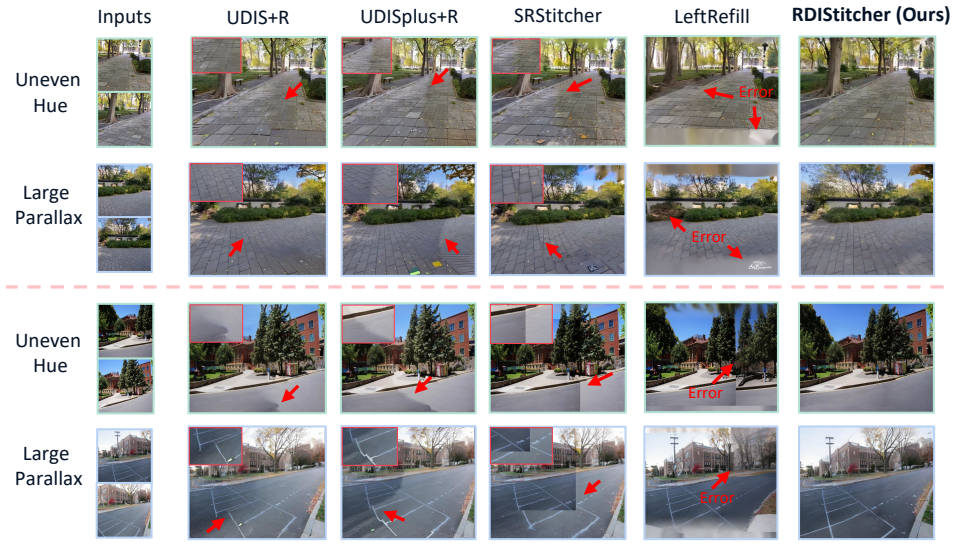
The paper's central discovery is that the fusion and rectangling stages of stitching can be collapsed into a reference-conditioned inpainting problem and that this model can be taught without ground-truth stitched pairs. Masks sampled from a real stitching dataset are applied to single-view images, augmented with color jitter to imitate uneven hue and random affine translations to imitate parallax misalignment, and the model is trained to recover the original image from this pseudo-stitched input. At inference, the target image is kept fixed while the model inpaints the seam and border regions using the reference image as guidance, accepting a larger modification area and stronger modification intensity than previous inpainting-based stitching. The claimed payoff is higher content coherence and seamless transitions in uneven-hue and large-parallax scenes, including zero-shot transfer to datasets never seen in training. For evaluation, the paper introduces a multimodal-large-language-model protocol: a single-image quality score covering seams, brightness transitions, distortion, clarity, and abnormal content, and a comparative score that chooses the better of two stitched images.
Load-bearing premise
The load-bearing premise is that a model trained to restore a single photo from pseudo-stitched versions of that same photo—masked, color-shifted, and affine-warped using masks sampled from real stitching data—learns a stitching concept that transfers to genuinely different multi-view pairs.
Editorial extensions
If this is right
- Stitching pipelines can drop the separate supervised rectangling stage: fusion and border straightening become one inpainting step trained from unlabeled photo collections.
- Hard cases that previously forced a choice between visible seams and distorted content can be handled by permitting a larger edited region, as long as the reference image stays coherent with the target.
- The self-supervised concept transfers zero-shot to unseen stitching datasets, so new domains such as aerial, medical, or remote-sensing mosaics could be stitched without collected ground-truth pairs.
- Stitched-image quality can be assessed automatically at scale with multimodal-language-model scores, replacing small manual user studies in future work.
Reading between the lines
- The two data augmentations could be isolated in ablation: training with color jitter only and with affine shifts only would test whether each simulated failure mode transfers independently to its real counterpart.
- The same pseudo-stitching recipe should transfer to other generative backbones, since the mask-distribution trick is not tied to the chosen text-to-image model.
- If the central claim holds, the practical trade-off is that users accept generative edits inside the fusion region; the consistency numbers in the paper measure global similarity, not whether thin structures such as wires or pillars are semantically preserved.
- The multimodal-language-model metrics, once validated on a larger human study than the 50-image pilot described in the supplement, could become the default evaluation instrument for unsupervised stitching research.
Signed reviews
Editorial analysis
A structured set of objections, weighed in public.
Referee Report
Summary. This paper proposes RDIStitcher, a diffusion-based image stitching method that reformulates fusion and rectangling as reference-driven inpainting. A Stable Diffusion inpainting model is fine-tuned with LoRA using a self-supervised scheme in which single-view images are combined with masks from UDIS-D to create pseudo-stitching pairs; color jitter and affine shifts simulate hue differences and misalignment. The authors also propose two MLLM-based evaluation metrics (SIQS and MICQS) and report experiments on UDIS-D and zero-shot traditional datasets, claiming state-of-the-art performance in uneven-hue and large-parallax scenarios.
Significance. If the claims are borne out, the paper would contribute a new training paradigm for inpainting-based stitching, including what the authors describe as the first unsupervised training method for the rectangling problem, as well as a reusable automated evaluation metric for stitched images. The release of code and the use of five-seed reporting with standard deviations are positive aspects of the work. However, the significance is conditional on two load-bearing premises: that the self-supervised pseudo-pairs teach a concept that transfers to true multi-view stitching, and that the proposed MLLM metrics are a reliable proxy for human perception. The current evidence for both premises is suggestive but not conclusive.
major comments (4)
- [Sec. 3.3, Eqs. (3)-(5)] The self-supervised training signal is structurally different from the test-time task. In Eq. (3), both pseudo-views are produced by masking the same single image Isg, so the reference always contains the exact pixels to be recovered. The only simulated difficulties are color jitter (Eq. 4) and a global affine shift (Eq. 5); there is no local parallax, no object occlusion, and no content that exists in only one of the two views. The model can therefore succeed by copying from the reference or by invoking its generative prior, without ever learning to combine two genuinely different observations. The paper's claim of strong generalization capabilities to real uneven-hue and large-parallax pairs (Abstract, Sec. 4.4) rests on the unverified assumption that the Stable Diffusion prior converts this single-image masking task into true two-view stitching. I recommend a quantitative test of this transfer, for example on real pairs with known correspondences or with objects visible in only one view, comparing RDIStitcher against a model trained on actual two-view pseudo-pairs.
- [Table 3; Sec. 4.2 and 4.6] The main quantitative evidence for superiority uses the authors' own MLLM metrics. These metrics are validated on only 50 hand-crafted images rated by four volunteers (Supp. Sec. G), and the reported correlations are moderate (SRCC 0.728 for SIQS-Q, 0.634 for SIQS-G; PLCC 0.685 and 0.525). On the UDIS-D test set, the gaps between RDIStitcher and the strongest baseline are 0.05-0.30 points on a 10-point scale, with overlapping standard deviations (e.g., SIQS-Q 9.54±0.07 vs 9.49±0.05; SIQS-G 9.39±0.05 vs 9.33±0.04). This does not support the claim of significant improvement. The paper should report paired statistical tests, effect sizes, and ideally validate the metrics on a larger, more diverse set of stitched images before using them as the primary endpoint.
- [Sec. 4.1] The comparison with SRStitcher is unequal: SRStitcher is a frozen, zero-shot method, while RDIStitcher is fine-tuned on UDIS-D training data. The authors acknowledge this (the comparison is somewhat less fair), but the central claim of outperforming the inpainting-based SOTA is drawn from this comparison. Since SRStitcher also uses a smaller modification area, the comparison cannot isolate the effect of modification area or intensity, which is the paper's organizing principle. To make the claim convincing, the authors should fine-tune SRStitcher under equivalent conditions (or a controlled variant with matched modification area) or explicitly restrict the claim to zero-shot transfer.
- [Sec. 4.5, Table 4] The consistency evaluation measures PSNR/SSIM between RDIStitcher's output and UDIS's output, not against ground truth or the original input images. High agreement with UDIS is not by itself evidence of content preservation; it may indicate that RDIStitcher makes only small changes relative to a particular baseline. The conclusion that the method preserves content consistency is therefore not supported by these numbers. I suggest evaluating fidelity to the original reference and target images in non-overlapping regions, or using correspondence-based metrics, and reporting the variance across the five seeds for these results as well.
minor comments (6)
- [Supp. E.1 and Supp. D.2] There are typos in the supplementary material: 'cnfiguration' should be 'configuration' and 'we don not test' should be 'we do not test'.
- [Sec. 3.2] The notation Concat(·) and the exact tensor layout of the model input are not formally defined; please specify the channel dimensions and ordering explicitly rather than relying on Fig. 3.
- [Fig. 4] The meaning of the 'Both Good' and 'Both Bad' categories in the stacked bar charts is not defined in the caption; please state how these labels were assigned.
- [Sec. 1 and 3.3] The paper claims to be the first unsupervised training method for the rectangling problem, but the related work section does not discuss prior unsupervised rectangling attempts; if none exist, state this explicitly in the related work section.
- [Eq. (1)] The symbol I is used both for the input image and for the identity matrix; please use a distinct symbol such as I_3 for the identity matrix to avoid ambiguity.
- [Tables 3 and 5] The use of red highlighting to indicate the best result is not accessible in printed or color-blind formats; please add boldface or symbols in addition to color.
Circularity Check
No circular derivation identified; the self-supervised transfer and MLLM-based evaluation are empirically grounded assumptions rather than definitional reductions.
full rationale
The paper's derivation chain is not circular. The self-supervised training in Sec. 3.3 constructs pseudo-stitching pairs from a single image via Eq. 3, but this is a pretext task explicitly stated as a hypothesis, not a prediction equivalent to its inputs. The claimed generalization to real multi-view stitching is an empirical claim tested on held-out and zero-shot datasets; whether the transfer succeeds is a correctness risk, not a circularity. The MLLM-based metrics (Sec. 4.2) are proposed by the authors, but they are calibrated against human scores on the hand-crafted Dquality set (Table 5 and Supplementary Sec. G), and the main comparisons also include CCS from SRStitcher and a real-user vote (Fig. 4), providing external grounding. The use of RDIStitcher-R to form the UDIS+R and UDISplus+R baselines is a comparison-protocol choice made necessary by the lack of unsupervised rectangling baselines, not a definitional identity. Self-citations to the authors' prior SRStitcher work supply components such as coarse rectangling and gradient masks, as well as baselines, but no load-bearing authority or forbidden alternative is imported. The paper's own limitations, such as the small 50-image, four-volunteer metric calibration and the MLLMs' limited grasp of 'artifact' concepts, are acknowledged in Supplementary Secs. F.5 and G, and affect robustness rather than circularity. Overall, no step reduces by construction to its own inputs, so the circularity score is low.
Assumptions & free parameters
free parameters (5)
- pcj =
0.25
- pat =
0.25
- R =
3
- Kd and Kg =
10 and 15
- LoRA rank =
8
assumptions (3)
- domain assumption Pseudo-stitched single-view images teach generalizable stitching concepts
- domain assumption MLLM scores correlate with human perception of stitching quality
- domain assumption UDIS warping produces sufficiently undistorted aligned images
Cite this review
Pith. "Pith review of Modification Takes Courage: Seamless Image Stitching via Reference-Driven Inpainting." pith.science (2026). https://pith.science/paper/I4B7DZ54
@misc{pith2026241110309,
  author       = {Pith},
  title        = {Pith review of: Modification Takes Courage: Seamless Image Stitching via Reference-Driven Inpainting},
  year         = {2026},
  howpublished = {\url{https://pith.science/paper/I4B7DZ54}},
  note         = {Machine review of arXiv:2411.10309}
}
read the original abstract
Current image stitching methods often produce noticeable seams in challenging scenarios such as uneven hue and large parallax. To tackle this problem, we propose the Reference-Driven Inpainting Stitcher (RDIStitcher), which reformulates the image fusion and rectangling as a reference-based inpainting model, incorporating a larger modification fusion area and stronger modification intensity than previous methods. Furthermore, we introduce a self-supervised model training method, which enables the implementation of RDIStitcher without requiring labeled data by fine-tuning a Text-to-Image (T2I) diffusion model. Recognizing difficulties in assessing the quality of stitched images, we present the Multimodal Large Language Models (MLLMs)-based metrics, offering a new perspective on evaluating stitched image quality. Compared to the state-of-the-art (SOTA) method, extensive experiments demonstrate that our method significantly enhances content coherence and seamless transitions in the stitched images. Especially in the zero-shot experiments, our method exhibits strong generalization capabilities. Code: https://github.com/yayoyo66/RDIStitcher
Figures


Figures from the paper (7 more)



Reference graph
Works this paper leans on
-
[1]
Somaya Adwan, Iqbal Alsaleh, and Rasha Majed. A new approach for image stitching technique using dynamic time warping (dtw) algorithm towards scoliosis x-ray diagnosis. Measurement, 84:32–46, 2016. 3
work page 2016
-
[2]
Stability AI. Stable diffusion 2 inpainting. https : / / huggingface . co / stabilityai / stable - diffusion-2-inpainting, 2023. 2, 4, 6, 1
work page 2023
-
[3]
Break-a-scene: Extracting multi- ple concepts from a single image
Omri Avrahami, Kfir Aberman, Ohad Fried, Daniel Cohen- Or, and Dani Lischinski. Break-a-scene: Extracting multi- ple concepts from a single image. In SIGGRAPH Asia 2023 Conference Papers, pages 1–12, 2023. 6
work page 2023
-
[4]
Jinze Bai, Shuai Bai, Shusheng Yang, Shijie Wang, Sinan Tan, Peng Wang, Junyang Lin, Chang Zhou, and Jingren Zhou. Qwen-vl: A versatile vision-language model for un- derstanding, localization, text reading, and beyond. arXiv preprint arXiv:2308.12966, 2023. 6, 3
arXiv 2023
-
[5]
Tobias Bergen and Thomas Wittenberg. Stitching and sur- face reconstruction from endoscopic image sequences: a re- view of applications and methods. IEEE journal of biomed- ical and health informatics, 20(1):304–321, 2014. 3
work page 2014
-
[6]
Chenjie Cao, Yunuo Cai, Qiaole Dong, Yikai Wang, and Yanwei Fu. Leftrefill: Filling right canvas based on left refer- ence through generalized text-to-image diffusion model. In CVPR, pages 7705–7715, 2024. 3, 6
work page 2024
-
[7]
Topiq: A top-down approach from semantics to distortions for image quality assessment
Chaofeng Chen, Jiadi Mo, Jingwen Hou, Haoning Wu, Liang Liao, Wenxiu Sun, Qiong Yan, and Weisi Lin. Topiq: A top-down approach from semantics to distortions for image quality assessment. IEEE Transactions on Image Processing, 33:2404–2418, 2024. 8
work page 2024
-
[8]
Deep Seam Prediction for Image Stitching Based on Selection Consistency Loss
Senmao Cheng, Fan Yang, Zhi Chen, Nanjun Yuan, and Wenbing Tao. Deep seam prediction for image stitch- ing based on selection consistency loss. arXiv preprint arXiv:2302.05027, 2023. 2, 3
work page Pith review arXiv 2023
Show all 58 references
-
[9]
Incremental transformer structure enhanced image inpainting with mask- ing positional encoding
Qiaole Dong, Chenjie Cao, and Yanwei Fu. Incremental transformer structure enhanced image inpainting with mask- ing positional encoding. In CVPR, pages 11358–11368,
-
[10]
Con- structing image panoramas using dual-homography warping
Junhong Gao, Seon Joo Kim, and Michael S Brown. Con- structing image panoramas using dual-homography warping. In CVPR, pages 49–56. IEEE, 2011. 1
2011
-
[11]
Chatglm: A family of large language models from glm-130b to glm-4 all tools
Team GLM, Aohan Zeng, Bin Xu, Bowen Wang, Chenhui Zhang, Da Yin, Diego Rojas, Guanyu Feng, Hanlin Zhao, Hanyu Lai, et al. Chatglm: A family of large language models from glm-130b to glm-4 all tools. arXiv preprint arXiv:2406.12793, 2024. 6, 3
2024 arXiv
-
[12]
Masked autoencoders are scalable vision learners
Kaiming He, Xinlei Chen, Saining Xie, Yanghao Li, Piotr Doll´ar, and Ross Girshick. Masked autoencoders are scalable vision learners. In CVPR, pages 16000–16009, 2022. 4
2022
-
[13]
Denoising dif- fusion probabilistic models
Jonathan Ho, Ajay Jain, and Pieter Abbeel. Denoising dif- fusion probabilistic models. In NeurIPS, pages 6840–6851,
-
[14]
LoRA: Low-rank adaptation of large language models
Edward J Hu, Yelong Shen, Phillip Wallis, Zeyuan Allen- Zhu, Yuanzhi Li, Shean Wang, Lu Wang, and Weizhu Chen. LoRA: Low-rank adaptation of large language models. In ICLR, 2022. 4, 2
2022
-
[15]
Automatic color image stitch- ing using quaternion rank-1 alignment
Jiaxue Li and Yicong Zhou. Automatic color image stitch- ing using quaternion rank-1 alignment. In Proceedings of the IEEE/CVF Conference on Computer Vision and Pattern Recognition, pages 19720–19729, 2022. 2, 3
2022
-
[16]
Parallax-tolerant image stitching based on robust elastic warping
Jing Li, Zhengming Wang, Shiming Lai, Yongping Zhai, and Maojun Zhang. Parallax-tolerant image stitching based on robust elastic warping. IEEE TMM, 20(7):1672–1687, 2017. 5, 1, 7
2017
-
[17]
Quasi-homography warps in image stitching
Nan Li, Yifang Xu, and Chao Wang. Quasi-homography warps in image stitching. IEEE TMM , 20(6):1365–1375,
-
[18]
Mat: Mask-aware transformer for large hole image in- painting
Wenbo Li, Zhe Lin, Kun Zhou, Lu Qi, Yi Wang, and Jiaya Jia. Mat: Mask-aware transformer for large hole image in- painting. In CVPR, pages 10758–10768, 2022. 3
2022
-
[19]
Single-perspective warps in natural image stitching
Tianli Liao and Nan Li. Single-perspective warps in natural image stitching. IEEE TIP, 29:724–735, 2019. 5, 1, 7
2019
-
[20]
Smoothly varying affine stitch- ing
Wen-Yan Lin, Siying Liu, Yasuyuki Matsushita, Tian-Tsong Ng, and Loong-Fah Cheong. Smoothly varying affine stitch- ing. In CVPR, pages 345–352. IEEE, 2011. 1
2011
-
[21]
Unsupervised deep homography: A fast and robust homography estimation model
Ty Nguyen, Steven W Chen, Shreyas S Shivakumar, Camillo Jose Taylor, and Vijay Kumar. Unsupervised deep homography: A fast and robust homography estimation model. IEEE Robotics and Automation Letters , 3(3):2346– 2353, 2018. 2, 3
2018
-
[22]
A view-free image stitching network based on global homography
Lang Nie, Chunyu Lin, Kang Liao, Meiqin Liu, and Yao Zhao. A view-free image stitching network based on global homography. Journal of Visual Communication and Image Representation, 73:102950, 2020. 2, 3
2020
-
[23]
Unsupervised deep image stitching: Reconstructing stitched features to images
Lang Nie, Chunyu Lin, Kang Liao, Shuaicheng Liu, and Yao Zhao. Unsupervised deep image stitching: Reconstructing stitched features to images. IEEE TIP, 30:6184–6197, 2021. 1, 2, 3, 4, 5, 6, 7
2021
-
[24]
Deep rectangling for image stitching: A learning base- line
Lang Nie, Chunyu Lin, Kang Liao, Shuaicheng Liu, and Yao Zhao. Deep rectangling for image stitching: A learning base- line. In CVPR, pages 5740–5748, 2022. 3, 6, 2
2022
-
[25]
Learn- ing edge-preserved image stitching from multi-scale deep homography
Lang Nie, Chunyu Lin, Kang Liao, and Yao Zhao. Learn- ing edge-preserved image stitching from multi-scale deep homography. Neurocomputing, 491:533–543, 2022. 2, 3
2022
-
[26]
Parallax-tolerant unsupervised deep image stitching
Lang Nie, Chunyu Lin, Kang Liao, Shuaicheng Liu, and Yao Zhao. Parallax-tolerant unsupervised deep image stitching. In ICCV, pages 7399–7408, 2023. 1, 2, 3, 5, 6
2023
-
[27]
Unsupervised learning of visual representations by solving jigsaw puzzles
Mehdi Noroozi and Paolo Favaro. Unsupervised learning of visual representations by solving jigsaw puzzles. In ECCV, pages 69–84. Springer, 2016. 4
2016
-
[28]
Open source computer vision library, 2015
OpenCV . Open source computer vision library, 2015. 5
2015
-
[29]
Pytorch: an imperative style, high-performance deep learning library
Adam Paszke, Sam Gross, Francisco Massa, Adam Lerer, James Bradbury, Gregory Chanan, Trevor Killeen, Zeming Lin, Natalia Gimelshein, Luca Antiga, et al. Pytorch: an imperative style, high-performance deep learning library. In NeurIPS, pages 8026–8037, 2019. 5
2019
-
[30]
Dreambooth: Fine tuning text-to-image diffusion models for subject-driven generation
Nataniel Ruiz, Yuanzhen Li, Varun Jampani, Yael Pritch, Michael Rubinstein, and Kfir Aberman. Dreambooth: Fine tuning text-to-image diffusion models for subject-driven generation. In CVPR, pages 22500–22510, 2023. 4
2023
-
[31]
Blindly assess image qual- ity in the wild guided by a self-adaptive hyper network
Shaolin Su, Qingsen Yan, Yu Zhu, Cheng Zhang, Xin Ge, Jinqiu Sun, and Yanning Zhang. Blindly assess image qual- ity in the wild guided by a self-adaptive hyper network. In CVPR, pages 3667–3676, 2020. 2, 6 9
2020
-
[32]
Realfill: Reference-driven generation for authentic image completion
Luming Tang, Nataniel Ruiz, Qinghao Chu, Yuanzhen Li, Aleksander Holynski, David E Jacobs, Bharath Hariharan, Yael Pritch, Neal Wadhwa, Kfir Aberman, et al. Realfill: Reference-driven generation for authentic image completion. ACM TOG, 43(4):1–12, 2024. 3
2024
-
[33]
An image inpainting technique based on the fast marching method
Alexandru Telea. An image inpainting technique based on the fast marching method. Journal of graphics tools , 9(1): 23–34, 2004. 5
2004
-
[34]
Drone image stitching using local mesh-based bundle adjustment and shape-preserving transform
Qi Wan, Jun Chen, Linbo Luo, Wenping Gong, and Long- sheng Wei. Drone image stitching using local mesh-based bundle adjustment and shape-preserving transform. IEEE Transactions on Geoscience and Remote Sensing , 59(8): 7027–7037, 2020. 3
2020
-
[35]
Ex- ploring clip for assessing the look and feel of images
Jianyi Wang, Kelvin CK Chan, and Chen Change Loy. Ex- ploring clip for assessing the look and feel of images. In AAAI, pages 2555–2563, 2023. 2, 6
2023
-
[36]
A spatial arrangement preservation based stitch- ing method via geographic coordinates of uav for farmland remote sensing image
Jiaxin Wang, Peng Du, Shuqin Yang, Zhitao Zhang, and Jifeng Ning. A spatial arrangement preservation based stitch- ing method via geographic coordinates of uav for farmland remote sensing image. IEEE Transactions on Geoscience and Remote Sensing, 2024. 3
2024
-
[37]
Sdr: stepwise deep rectangling model for stitched images
Mengsi Wang, Yuan Mei, Lichun Yang, Bin Tian, and Kai- jun Wu. Sdr: stepwise deep rectangling model for stitched images. The Vis. Comput., pages 1–15, 2024. 3, 6
2024
-
[38]
Q-align: teaching lmms for visual scoring via discrete text-defined levels
Haoning Wu, Zicheng Zhang, Weixia Zhang, Chaofeng Chen, Liang Liao, Chunyi Li, Yixuan Gao, Annan Wang, Erli Zhang, Wenxiu Sun, Qiong Yan, Xiongkuo Min, Guang- tao Zhai, and Weisi Lin. Q-align: teaching lmms for visual scoring via discrete text-defined levels. 2024. 8
2024
-
[39]
A comprehensive study of multimodal large language mod- els for image quality assessment
Tianhe Wu, Kede Ma, Jie Liang, Yujiu Yang, and Lei Zhang. A comprehensive study of multimodal large language mod- els for image quality assessment. In ECCV, 2024. 6, 8
2024
-
[40]
Rectanglinggan: Deep rectangling for stitched image via image inpainting
Ziqi Xie, Weidong Zhao, Xianhui Liu, Zhen Xu, Jian Zhao, and Gong Gao. Rectanglinggan: Deep rectangling for stitched image via image inpainting. Knowledge-Based Sys- tems, page 112129, 2024. 3, 6
2024
-
[41]
Paint by example: Exemplar-based image editing with diffusion mod- els
Binxin Yang, Shuyang Gu, Bo Zhang, Ting Zhang, Xuejin Chen, Xiaoyan Sun, Dong Chen, and Fang Wen. Paint by example: Exemplar-based image editing with diffusion mod- els. In CVPR, pages 18381–18391, 2023. 3
2023
-
[42]
As-projective-as-possible image stitching with mov- ing dlt
Julio Zaragoza, Tat-Jun Chin, Michael S Brown, and David Suter. As-projective-as-possible image stitching with mov- ing dlt. In CVPR, pages 2339–2346, 2013. 5, 1, 7
2013
-
[43]
High-resolution image inpainting with iterative confidence feedback and guided upsampling
Yu Zeng, Zhe Lin, Jimei Yang, Jianming Zhang, Eli Shecht- man, and Huchuan Lu. High-resolution image inpainting with iterative confidence feedback and guided upsampling. In ECCV, pages 1–17. Springer, 2020. 3
2020
-
[44]
Parallax-tolerant image stitching
Fan Zhang and Feng Liu. Parallax-tolerant image stitching. In CVPR, pages 3262–3269, 2014. 1
2014
-
[45]
Adding conditional control to text-to-image diffusion models
Lvmin Zhang, Anyi Rao, and Maneesh Agrawala. Adding conditional control to text-to-image diffusion models. In ICCV, pages 3836–3847, 2023. 6
2023
-
[46]
Uncertainty-aware blind image quality assessment in the laboratory and wild
Weixia Zhang, Kede Ma, Guangtao Zhai, and Xiaokang Yang. Uncertainty-aware blind image quality assessment in the laboratory and wild. IEEE Transactions on Image Pro- cessing, 30:3474–3486, 2021. 8
2021
-
[47]
Gpt-4v (ision) as a general- ist evaluator for vision-language tasks
Xinlu Zhang, Yujie Lu, Weizhi Wang, An Yan, Jun Yan, Lianke Qin, Heng Wang, Xifeng Yan, William Yang Wang, and Linda Ruth Petzold. Gpt-4v (ision) as a general- ist evaluator for vision-language tasks. arXiv preprint arXiv:2311.01361, 2023. 6
2023 arXiv
-
[48]
Multi-lora composition for image generation
Ming Zhong, Yelong Shen, Shuohang Wang, Yadong Lu, Yizhu Jiao, Siru Ouyang, Donghan Yu, Jiawei Han, and Weizhu Chen. Multi-lora composition for image generation. arXiv preprint arXiv:2402.16843, 2024. 6
2024 arXiv
-
[49]
Recdiffu- sion: Rectangling for image stitching with diffusion models
Tianhao Zhou, Haipeng Li, Ziyi Wang, Ao Luo, Chen-Lin Zhang, Jiajun Li, Bing Zeng, and Shuaicheng Liu. Recdiffu- sion: Rectangling for image stitching with diffusion models. In CVPR, pages 2692–2701, 2024. 3, 6, 2
2024
-
[50]
Transfill: Reference-guided image inpainting by merging multiple color and spatial transformations
Yuqian Zhou, Connelly Barnes, Eli Shechtman, and Sohrab Amirghodsi. Transfill: Reference-guided image inpainting by merging multiple color and spatial transformations. In CVPR, pages 2266–2276, 2021. 3
2021
-
[51]
Reconstructing the image stitching pipeline: Integrat- ing fusion and rectangling into a unifiedinpainting model
Xie Ziqi, Zhao Weidong, Liu Xianhui, Zhao Jian, and Jia Ning. Reconstructing the image stitching pipeline: Integrat- ing fusion and rectangling into a unifiedinpainting model. In NeurIPS, 2024. 1, 2, 3, 5, 6, 7 10 Modification Takes Courage: Seamless Image Stitching via Refere...
2024
-
[52]
The comparisons in- clude UDIS+stable diffusion inpainting model [2] without 1 Table 6
on the UDIS-D test set. The comparisons in- clude UDIS+stable diffusion inpainting model [2] without 1 Table 6. Ablation study of RDIStitcher-R. The best performer is highlighted by red. Method UDIS+SD2 UDIS+RWCR UDIS+R CCS (%) 85.97 ± 1.33 87.68± 1.17 89.64± 0.96 fine-tuning ...
-
[53]
Therefore, the construction of prompts can significantly impact the evaluation performance of the MLLMs
is relatively insensitive, not displaying a significant score reduction. Therefore, the construction of prompts can significantly impact the evaluation performance of the MLLMs. Concept limitation In the early design, we intended to in- clude artifacts in the evaluation criter...
-
[54]
Whether there are seams in the image (2 points). score 2: the image is smooth without obvious boundaries or misalignment; score 1: there are slightly visible boundaries in the image, but overall look well; score 0: there are obvious borders or dislocations in the image, affect...
-
[55]
Whether there are brightness transitions in the image (2 points). score 2: the brightness transition of image is smooth; score 1: the light and shade changes in the image are a bit unnatural; score 0: the light and shade changes in the image are very abrupt
-
[56]
Whether there are distortions in the image (2 points). score 2: no distortion in the image; score 1: there are a few structural anomalies of straight lines in the image; score 0: there are noticeably distortions, such as distorted pillar, brick, and building construction
-
[57]
Whether the image is clear and blurred (2 points). score 2: the image is clear, the details are visible, and there is no blur; score 1: the resolution of the image is good, but slightly blurred; score 0: the image is blurred and the details are not clear
-
[58]
Whether the image is natural (2 points). score 2: the image is natural with out abnormal content; score 1: there are some places in the image that is not in harmony with the main content; score 0: There are a lot of abnormal content in the image such as strange texture and non...
Reviewed August 12, 2026 · model on record in the stance chip above.
Discussion (0). Continue with ORCID to comment.