REVIEW 4 major objections 6 minor 55 references
DR-BFR: Degradation Representation with Diffusion Models for Blind Face Restoration
T0 review · 4 major / 6 minor · reviewed 2026-08-12 · deepseek-v4-flash
Pith's one-line read DR-BFR claims that conditioning a latent diffusion restoration model on a content-independent degradation representation, learned from contrastive learning and low-quality reconstruction, yields more natural and faithful face restoration…
desk verdict A genuinely new degradation-prompt conditioning mechanism for diffusion-based blind face restoration, with strong FID evidence on most datasets but a direct NIQE overclaim in the text and a load-bearing patch-homogeneity assumption that real-world degradations will violate. read the letter →
The pith
A machine-rendered reading of the paper's core claim, the machinery that carries it, and where it could break.
The reading
What carries the argument
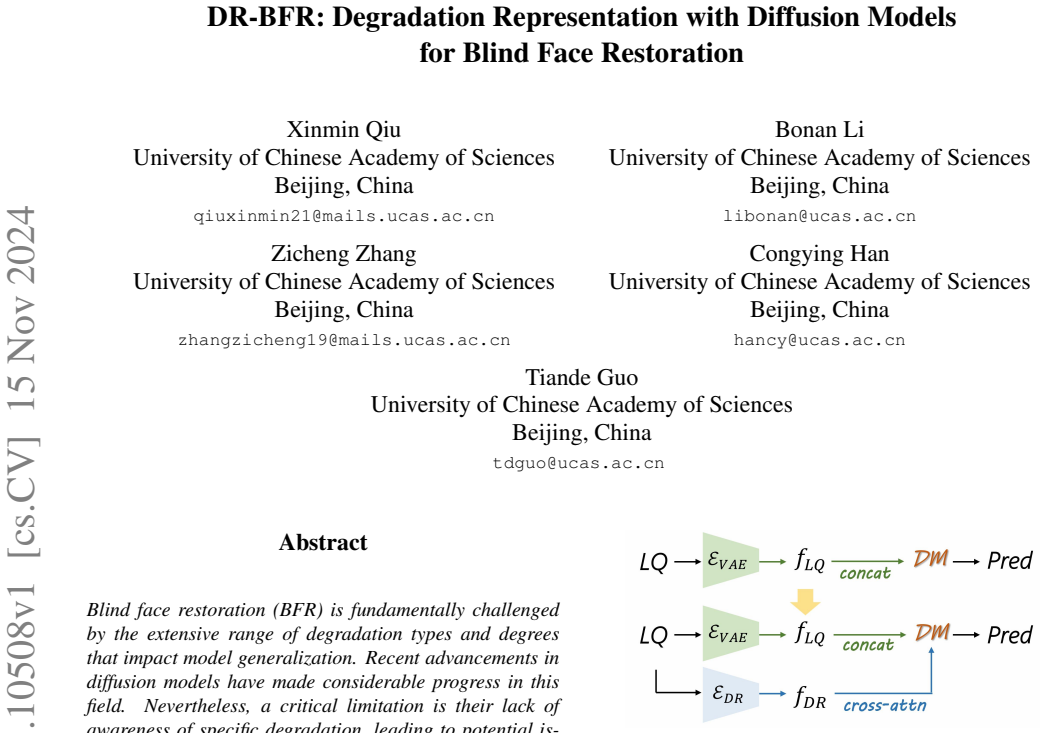
The machinery is the Degradation Representation Module (DRM) coupled to a Latent Diffusion Restoration Module. DRM uses a ConvNet encoder similar to VGG-19, contrastive loss on patches, an AdaIN U-Net generator $G_{LQ}$ that reconstructs LQ from DR and HQ, and a Gaussian distribution loss. The reconstruction loss makes DR carry all degradation information; the contrastive loss makes it content-independent; the distribution loss regularizes the DR space. The LDRM is a latent diffusion model whose U-Net takes concatenated $f_{LQ}$ and uses cross-attention on $f_{DR}$ with per-step MLP coefficients, so the degradation prompt is weighted differently at different denoising stages.
What would settle it
Construct a synthetic LQ face whose left half is heavily blurred and right half is noisy, or take a real photo with a watermark; if DR-BFR cannot restore it without residual artifacts (as the paper notes happens with watermarks), or if the DR from the two halves of the same image are pulled together despite representing different degradations, the central decoupling claim is falsified.
Extended reading notes
Core claim
The central claim is that degrading a face and decoupling the degradation from its content yields a compact, content-free representation that works as a downstream prompt for diffusion-based restoration. DRM is trained so that two random patches of the same LQ image produce positive samples of each other, while patches from different images are negatives; a U-Net generator with AdaIN takes the DR plus the HQ image to reconstruct the LQ image, and a distribution loss pushes the DR manifold toward a Gaussian. This DR, denoted $f_{DR}$, is inserted into the LDM's cross-attention along with the LQ content feature $f_{LQ}$, with a scaling coefficient $\alpha_t$ produced by an MLP from the timestep $t$. On CelebA-Test, DR-BFR achieves FID 13.686, NIQE 5.0113, and LPIPS 0.2499, the best among the compared methods, and it leads in FID on LFW, CelebChild, WebPhoto-Test, and Wider.
Load-bearing premise
The load-bearing premise is that different patches of the same low-quality face share the same degradation, so they can serve as positive pairs in contrastive learning; when real degradations are spatially uneven, such as watermarks or local blur, that premise fails and the learned representation can conflate content with artifacts.
Editorial extensions
If this is right
- Conditioning a diffusion restoration model on a decoupled degradation prompt delivers the best perceptual quality among the compared methods: FID 13.686 on CelebA-Test, NIQE 5.0113, and the best FID on LFW, CelebChild, WebPhoto-Test, and Wider.
- Making the degradation prompt's weight depend on the denoising step via cross-attention lets the model apply degradation cues at the right stages, improving both naturalness and fidelity.
- The decoupled DR transfers from synthetic training degradations to real-world photos, because the method's real-world results improve without paired HQ data at inference.
- Each ingredient in DRM matters: removing contrastive learning or LQ reconstruction raises FID to 18.730 or 19.644, showing both losses are needed for a useful DR.
Reading between the lines
- In the editor's reading, the same content-independent degradation-vector recipe should transfer to other blind inverse problems, since the DR is task-agnostic and the LDM backbone can be swapped.
- Because the DR is content-independent and regularized toward a Gaussian, one could edit it directly to control restoration strength, e.g., removing a watermark or tuning blur without retraining.
- The paper's residual-watermark failure suggests a concrete test: augment DRM training with unpaired real degraded images, or replace image-level contrastive positives with patch-level clustering by local degradation type.
Editorial analysis
A structured set of objections, weighed in public.
Referee Report
Summary. The paper proposes DR-BFR, a blind face restoration method built on a latent diffusion model. A Degradation Representation Module (DRM) is trained with patch-based contrastive learning, an LQ reconstruction loss, and an energy-distance distribution loss to produce a content-independent degradation representation f_DR from an LQ face. A Latent Diffusion Restoration Module (LDRM) then conditions an LDM on both VAE content features and f_DR, injecting the degradation representation through a step-dependent cross-attention mechanism. The authors compare DR-BFR against GAN-, codebook-, and diffusion-based baselines on CelebA-Test and four real-world datasets, and report ablations showing that removing the DR guidance degrades FID from 13.686 to 20.103 on CelebA-Test. The paper's central claim is that decoupling the degradation into a prompt improves the naturalness and generalization of diffusion-based blind face restoration.
Significance. If the reported results hold, the paper makes a useful conceptual contribution: instead of forcing the diffusion model to infer degradation implicitly, it provides an explicit, learned degradation prompt. The strongest evidence for this idea is the internal ablation in Table 3, which shows a large FID gain when the full DRM is used, and the comparison against external baselines on CelebA-Test and real-world datasets. The paper also has a clear and honest limitation statement concerning watermark artifacts. However, the significance is currently tempered by reporting inconsistencies in Table 2, by the lack of independent validation of the DR's content independence, and by the questionable use of FFHQ-FID for real-world restoration quality. These issues are local and fixable, but they currently prevent the generalization claims from being fully supported.
major comments (4)
- [§4.3, Table 2] Section 4.3 states that DR-BFR 'significantly outperforms the other methods in both NIQE and FID' on real-world datasets, but Table 2 does not support this statement as printed. The header lists 'FID↓ NIQE↓' for each dataset; taken literally, DR-BFR's Wider values are 4.5283 (FID) and 30.08 (NIQE), the latter being worse than DiffBIR's 25.27 and CodeFormer's 29.40. If instead the first value of each pair is NIQE, then the column headers are mislabeled, and DR-BFR's Wider FID (30.08) is worse than DiffBIR's 25.27, VQFR's 28.18, and CodeFormer's 29.40, while its LFW FID (41.67) is worse than PGDiff's 40.14. In either reading, the text overstates the results; the table and the claim need to be corrected.
- [§3.1, Eq. (5), §5] The patch-homogeneity premise is load-bearing for the DRM training: positive pairs in the contrastive loss are constructed from different patches of the same LQ image, justified by the claim that those patches share almost the same degradation. This holds for the spatially uniform synthetic degradation of Eq. (11), but not for spatially varying real-world degradations such as watermarks, local motion blur, or uneven noise. The limitation section already concedes that watermark inputs retain residual artifacts, which is exactly the predicted failure mode of this premise. Because the paper's real-world generalization claim rests mainly on FID/NIQE numbers rather than artifact-level analysis, the authors should either train or evaluate on spatially varying degradations, or explicitly delimit the applicable degradation class and soften the generalization claim.
- [§4.1, Fig. 6] Figure 6 is presented as evidence that the DR 'is able to represent sufficient degradation information', but the DRM is explicitly trained with the LQ reconstruction loss in Eq. (4) and Eq. (7). The figure therefore verifies that the training objective was optimized; it does not independently demonstrate that the representation is content-independent or that it generalizes to unseen degradations. An independent test would use the DR extracted from one LQ image to corrupt an unseen HQ image and compare with the true degradation applied under held-out parameters, or evaluate the frozen DR on a downstream task. The ablation in Table 3 is the strongest evidence for the method, but it does not by itself validate content independence.
- [§4.3, Table 2 caption] Section 4.3 says real-world results 'can only be quantitatively evaluated using non-reference metrics such as NIQE and FID', but FID is not a no-reference metric: the Table 2 caption states that FID measures the distribution gap between FFHQ and the results. A method that aggressively transforms outputs toward the FFHQ distribution can improve this FID without restoring the specific identity or degradation-related content of the input. The authors should justify why this FFHQ-FID is a meaningful fidelity measure for restoration, and should qualify the 'outperforms in FID' statements accordingly or report no-reference metrics that better reflect fidelity, such as identity similarity or artifact detection.
minor comments (6)
- [§3.2] The sentence 'It is difficult to extract content features that are independent of degradation, while it is relatively easier to extract content features that are independent of degradation' contains a repeated phrase and should be corrected to state the intended comparison between degradation-independent content extraction and content-independent degradation extraction.
- [§3.2, Eq. (10)] The notation 'CrossAttention (αt · fDR + βt, zt)' is ambiguous; the authors should specify which tensors serve as query, key, and value, and state explicitly how f_LQ is concatenated with z_t.
- [§4] The paper refers to an appendix for details and complete results, but the appendix is not included in the submitted manuscript; training hyperparameters, model sizes, optimizer settings, and diffusion sampling parameters are missing, which hinders reproducibility.
- [Table 1] The statement that lower PSNR/SSIM are acceptable because higher values 'are often observed in blurrier images' is unclear and not a substitute for a quantitative discussion of the fidelity-perceptual trade-off; consider reporting a pixel-fidelity baseline or a clearer justification.
- [§4.1, Fig. 7] The t-SNE visualization and cosine-similarity example in Figure 8 are qualitative; a quantitative content-independence measure, such as the variance of DR features across content variations under fixed degradation, would strengthen the claim that the DR is content-independent.
- [Throughout] There are several typos, including 'Quatitative' in the Table 1 caption, 'mehods' in Section 4.3, and 'reasonbly' in the Figure 1 caption; the manuscript needs a careful proofreading pass.
Circularity Check
No significant circularity in the central derivation: only the internal DR-reconstruction sanity check reuses its own training objective; SOTA comparisons and ablation are independent.
-
self definitional
[Section 3.1 (Eq. 4) and Section 4.1 (Figure 6)]
"The similarity between the reconstructed image and the original one is calculated in Figure 6. The results show that highly similar LQ reconstructed images can be obtained irrespective of degradation types and random combinations of parameters, which demonstrates the maximum coverage of the degradation information by DR."
Eq. (4) defines Lrecon = sum_i || GLQ(r2_i, f1_DRi) - p2_i ||, so the DRM is explicitly trained to reconstruct LQ patches from the DR feature plus the HQ patch. Section 4.1 then validates DR by measuring exactly this reconstruction and concluding it demonstrates maximum coverage of degradation information. The evidence is therefore the training objective itself: high similarity is enforced by construction rather than independently discovered. This circularity is peripheral; the central claim that DR improves LDM restoration is supported by external baselines and the Table 3 ablation, neither of which reduces to the DRM training loss.
full rationale
The main derivation chain of DR-BFR is not circular. The DRM is trained with contrastive learning and LQ reconstruction, and the resulting DR is then used as a cross-attention prompt in a latent diffusion model; the claimed improvement over prior methods is established by quantitative comparisons against external SOTA baselines (Tables 1 and 2) and by the ablation in Table 3. These comparisons are not fitted inputs renamed as predictions, and no load-bearing self-citation chain is used; the DR-learning idea is credited to ReDSR [19], an external citation, and the diffusion integration is tested independently. The one quasi-circular passage is the Figure 6 validation, where the DRM's reconstruction capability is demonstrated using the same objective that trained it; this is a training-convergence check, not an independent proof that DR captures degradation. The Section 5 limitation about watermark artifacts is a generalization/correctness concern about the synthetic training distribution, not a circularity in the derivation. Overall, the central empirical claim is self-contained and externally benchmarked, so circularity is negligible.
Assumptions & free parameters
free parameters (3)
- lambda_1, lambda_2
- tau (contrastive temperature)
- Degradation parameter ranges (sigma, r, delta, q) =
sigma in [0.1,10], r in [0.8,8], delta in [0,20], q in [60,100]
assumptions (4)
- domain assumption Patches from the same LQ image share identical degradation and differ in content (Section 3.1).
- domain assumption The synthetic degradation model of Eq. (11) with the stated ranges covers the target real-world degradation distribution.
- standard math Latent Diffusion Model, VQVAE, and the DDPM formulation from Rombach et al. are correct and applicable as priors.
- ad hoc to paper Aligning DR features to a Gaussian distribution (Eq. 6, Ldistribution) improves restoration performance.
Cite this review
Pith. "Pith review of DR-BFR: Degradation Representation with Diffusion Models for Blind Face Restoration." pith.science (2026). https://pith.science/paper/KHQCGHBD
@misc{pith2026241110508,
  author       = {Pith},
  title        = {Pith review of: DR-BFR: Degradation Representation with Diffusion Models for Blind Face Restoration},
  year         = {2026},
  howpublished = {\url{https://pith.science/paper/KHQCGHBD}},
  note         = {Machine review of arXiv:2411.10508}
}
read the original abstract
Blind face restoration (BFR) is fundamentally challenged by the extensive range of degradation types and degrees that impact model generalization. Recent advancements in diffusion models have made considerable progress in this field. Nevertheless, a critical limitation is their lack of awareness of specific degradation, leading to potential issues such as unnatural details and inaccurate textures. In this paper, we equip diffusion models with the capability to decouple various degradation as a degradation prompt from low-quality (LQ) face images via unsupervised contrastive learning with reconstruction loss, and demonstrate that this capability significantly improves performance, particularly in terms of the naturalness of the restored images. Our novel restoration scheme, named DR-BFR, guides the denoising of Latent Diffusion Models (LDM) by incorporating Degradation Representation (DR) and content features from LQ images. DR-BFR comprises two modules: 1) Degradation Representation Module (DRM): This module extracts degradation representation with content-irrelevant features from LQ faces and estimates a reasonable distribution in the degradation space through contrastive learning and a specially designed LQ reconstruction. 2) Latent Diffusion Restoration Module (LDRM): This module perceives both degradation features and content features in the latent space, enabling the restoration of high-quality images from LQ inputs. Our experiments demonstrate that the proposed DR-BFR significantly outperforms state-of-the-art methods quantitatively and qualitatively across various datasets. The DR effectively distinguishes between various degradations in blind face inverse problems and provides a reasonably powerful prompt to LDM.
Figures


Figures from the paper (5 more)


Reference graph
Works this paper leans on
-
[1]
Progressive semantic- aware style transformation for blind face restoration
Chaofeng Chen, Xiaoming Li, Lingbo Yang, Xianhui Lin, Lei Zhang, and Kwan-Yee K Wong. Progressive semantic- aware style transformation for blind face restoration. In CVPR, pages 11896–11905, 2021. 3
work page 2021
-
[2]
Image super- resolution with text prompt diffusion
Zheng Chen, Yulun Zhang, Jinjin Gu, Xin Yuan, Linghe Kong, Guihai Chen, and Xiaokang Yang. Image super- resolution with text prompt diffusion. arXiv preprint arXiv:2311.14282, 2023. 2
arXiv 2023
-
[3]
Preconditioners for the stochastic training of implicit neural representations
Shin-Fang Chng, Hemanth Saratchandran, and Simon Lucey. Preconditioners for the stochastic training of implicit neural representations. arXiv preprint arXiv:2402.08784, 2024. 3
arXiv 2024
-
[4]
Inversion by di- rect iteration: An alternative to denoising diffusion for image restoration
Mauricio Delbracio and Peyman Milanfar. Inversion by di- rect iteration: An alternative to denoising diffusion for image restoration. arXiv preprint arXiv:2303.11435, 2023. 3
arXiv 2023
-
[5]
Taming transformers for high-resolution image synthesis
Patrick Esser, Robin Rombach, and Bjorn Ommer. Taming transformers for high-resolution image synthesis. In Pro- ceedings of the IEEE/CVF conference on computer vision and pattern recognition, pages 12873–12883, 2021. 3
2021
-
[6]
Vqfr: Blind face restoration with vector-quantized dictionary and parallel de- coder
Yuchao Gu, Xintao Wang, Liangbin Xie, Chao Dong, Gen Li, Ying Shan, and Ming-Ming Cheng. Vqfr: Blind face restoration with vector-quantized dictionary and parallel de- coder. In ECCV, pages 126–143. Springer, 2022. 3, 7
work page 2022
-
[7]
Gans trained by a two time-scale update rule converge to a local nash equilib- rium
Martin Heusel, Hubert Ramsauer, Thomas Unterthiner, Bernhard Nessler, and Sepp Hochreiter. Gans trained by a two time-scale update rule converge to a local nash equilib- rium. In NeurIPS, 2017. 7
2017
-
[8]
Denoising dif- fusion probabilistic models
Jonathan Ho, Ajay Jain, and Pieter Abbeel. Denoising dif- fusion probabilistic models. In NeurIPS, pages 6840–6851,
Show all 55 references
-
[9]
Labeled faces in the wild: A database for studying face recognition in unconstrained environments
Gary B Huang, Marwan Mattar, Tamara Berg, and Eric Learned-Miller. Labeled faces in the wild: A database for studying face recognition in unconstrained environments. In Workshop on faces in’Real-Life’Images: detection, align- ment, and recognition, 2008. 6
2008
-
[10]
Autodir: Automatic all-in-one image restoration with latent diffusion
Yitong Jiang, Zhaoyang Zhang, Tianfan Xue, and Jinwei Gu. Autodir: Automatic all-in-one image restoration with latent diffusion. arXiv preprint arXiv:2310.10123, 2023. 2
2023 arXiv
-
[11]
Progressive growing of gans for improved quality, stability, and variation
Tero Karras, Timo Aila, Samuli Laine, and Jaakko Lehtinen. Progressive growing of gans for improved quality, stability, and variation. In ICLR, 2018. 6
2018
-
[12]
A style-based generator architecture for generative adversarial networks
Tero Karras, Samuli Laine, and Timo Aila. A style-based generator architecture for generative adversarial networks. In CVPR, pages 4401–4410, 2019. 6
2019
-
[13]
Denoising diffusion restoration models
Bahjat Kawar, Michael Elad, Stefano Ermon, and Jiaming Song. Denoising diffusion restoration models. Advances in Neural Information Processing Systems, 35:23593–23606,
-
[14]
All-in-one image restoration for unknown corruption
Boyun Li, Xiao Liu, Peng Hu, Zhongqin Wu, Jiancheng Lv, and Xi Peng. All-in-one image restoration for unknown corruption. In Proceedings of the IEEE/CVF conference on computer vision and pattern recognition , pages 17452– 17462, 2022. 3
2022
-
[15]
Blind face restoration via deep multi-scale component dictionaries
Xiaoming Li, Chaofeng Chen, Shangchen Zhou, Xianhui Lin, Wangmeng Zuo, and Lei Zhang. Blind face restoration via deep multi-scale component dictionaries. pages 399–415,
-
[16]
Learning dual memory dictionaries for blind face restoration
Xiaoming Li, Shiguang Zhang, Shangchen Zhou, Lei Zhang, and Wangmeng Zuo. Learning dual memory dictionaries for blind face restoration. IEEE Transactions on Pattern Analy- sis and Machine Intelligence, 45(5):5904–5917, 2022. 7
2022
-
[17]
Ucip: A universal frame- work for compressed image super-resolution using dynamic prompt
Xin Li, Bingchen Li, Yeying Jin, Cuiling Lan, Hanxin Zhu, Yulin Ren, and Zhibo Chen. Ucip: A universal frame- work for compressed image super-resolution using dynamic prompt. arXiv preprint arXiv:2407.13108, 2024. 2
2024 arXiv
-
[18]
Diffbir: Towards blind image restoration with generative diffusion prior
Xinqi Lin, Jingwen He, Ziyan Chen, Zhaoyang Lyu, Ben Fei, Bo Dai, Wanli Ouyang, Yu Qiao, and Chao Dong. Diffbir: Towards blind image restoration with generative diffusion prior. arXiv preprint arXiv:2308.15070, 2023. 3, 7
2023 arXiv
-
[19]
Preserving full degrada- tion details for blind image super-resolution
Hongda Liu, Longguang Wang, Ye Zhang, Kaiwen Xue, Shunbo Zhou, and Yulan Guo. Preserving full degrada- tion details for blind image super-resolution. arXiv preprint arXiv:2407.01299, 2024. 3, 4
2024
-
[20]
The dawn of kan in image-to-image (i2i) translation: Integrat- ing kolmogorov-arnold networks with gans for unpaired i2i translation
Arpan Mahara, Naphtali D Rishe, and Liangdong Deng. The dawn of kan in image-to-image (i2i) translation: Integrat- ing kolmogorov-arnold networks with gans for unpaired i2i translation. arXiv preprint arXiv:2408.08216, 2024. 3
2024 arXiv
-
[21]
Pulse: Self-supervised photo upsam- pling via latent space exploration of generative models
Sachit Menon, Alexandru Damian, Shijia Hu, Nikhil Ravi, and Cynthia Rudin. Pulse: Self-supervised photo upsam- pling via latent space exploration of generative models. In CVPR, pages 2437–2445, 2020. 3
2020
-
[22]
Conditional generative adversarial nets
Mehdi Mirza. Conditional generative adversarial nets. arXiv preprint arXiv:1411.1784, 2014. 3
2014 arXiv
-
[23]
completely blind
Anish Mittal, Rajiv Soundararajan, and Alan C Bovik. Mak- ing a “completely blind” image quality analyzer. IEEE Sig- nal processing letters, 20(3):209–212, 2012. 7
2012
-
[24]
Improved denoising diffusion probabilistic models
Alexander Quinn Nichol and Prafulla Dhariwal. Improved denoising diffusion probabilistic models. In ICML, pages 8162–8171, 2021. 3
2021
-
[25]
Diffusion autoen- coders: Toward a meaningful and decodable representation
Konpat Preechakul, Nattanat Chatthee, Suttisak Wizad- wongsa, and Supasorn Suwajanakorn. Diffusion autoen- coders: Toward a meaningful and decodable representation. In Proceedings of the IEEE/CVF conference on computer vi- sion and pattern recognition, pages 10619–10629, 2022. 3
2022
-
[26]
High-resolution image synthesis with latent diffusion models
Robin Rombach, Andreas Blattmann, Dominik Lorenz, Patrick Esser, and Bj ¨orn Ommer. High-resolution image synthesis with latent diffusion models. In Proceedings of the IEEE/CVF conference on computer vision and pattern recognition, pages 10684–10695, 2022. 3, 4
2022
-
[27]
Photorealistic text-to-image diffusion models with deep language understanding
Chitwan Saharia, William Chan, Saurabh Saxena, Lala Li, Jay Whang, Emily L Denton, Kamyar Ghasemipour, Raphael Gontijo Lopes, Burcu Karagol Ayan, Tim Salimans, et al. Photorealistic text-to-image diffusion models with deep language understanding. Advances in neural information...
2022
-
[28]
Image super-resolution via iterative refinement
Chitwan Saharia, Jonathan Ho, William Chan, Tim Sal- imans, David J Fleet, and Mohammad Norouzi. Image super-resolution via iterative refinement. IEEE Transactions on Pattern Analysis and Machine Intelligence , 45(4):4713– 4726, 2022. 3
2022
-
[29]
Very deep convolutional networks for large-scale image recognition
Karen Simonyan. Very deep convolutional networks for large-scale image recognition. arXiv preprint arXiv:1409.1556, 2014. 4 10
2014 arXiv
-
[30]
Denoising diffusion implicit models
Jiaming Song, Chenlin Meng, and Stefano Ermon. Denoising diffusion implicit models. arXiv preprint arXiv:2010.02502, 2020. 3
2010 arXiv
-
[31]
O2v-mapping: Online open-vocabulary mapping with neural implicit representation
Muer Tie, Julong Wei, Zhengjun Wang, Ke Wu, Shansuai Yuan, Kaizhao Zhang, Jie Jia, Jieru Zhao, Zhongxue Gan, and Wenchao Ding. O2v-mapping: Online open-vocabulary mapping with neural implicit representation. arXiv preprint arXiv:2404.06836, 2024. 3
2024 arXiv
-
[32]
Promptre- storer: A prompting image restoration method with degrada- tion perception
Cong Wang, Jinshan Pan, Wei Wang, Jiangxin Dong, Mengzhu Wang, Yakun Ju, and Junyang Chen. Promptre- storer: A prompting image restoration method with degrada- tion perception. Advances in Neural Information Processing Systems, 36:8898–8912, 2023. 2
2023
-
[33]
Unsuper- vised degradation representation learning for blind super- resolution
Longguang Wang, Yingqian Wang, Xiaoyu Dong, Qingyu Xu, Jungang Yang, Wei An, and Yulan Guo. Unsuper- vised degradation representation learning for blind super- resolution. In CVPR, 2021. 2, 3
2021
-
[34]
Promptrr: Diffusion models as prompt generators for single image reflection removal
Tao Wang, Wanglong Lu, Kaihao Zhang, Wenhan Luo, Tae- Kyun Kim, Tong Lu, Hongdong Li, and Ming-Hsuan Yang. Promptrr: Diffusion models as prompt generators for single image reflection removal. arXiv preprint arXiv:2402.02374,
-
[35]
To- wards real-world blind face restoration with generative facial prior
Xintao Wang, Yu Li, Honglun Zhang, and Ying Shan. To- wards real-world blind face restoration with generative facial prior. pages 9168–9178, 2021. 2, 3, 6, 7
2021
-
[36]
Zero-shot image restoration using denoising diffusion null-space model
Yinhuai Wang, Jiwen Yu, and Jian Zhang. Zero-shot image restoration using denoising diffusion null-space model. In The Eleventh International Conference on Learning Repre- sentations, 2023. 2, 3
2023
-
[37]
Image quality assessment: from error visibility to structural similarity
Zhou Wang, Alan C Bovik, Hamid R Sheikh, and Eero P Si- moncelli. Image quality assessment: from error visibility to structural similarity. IEEE transactions on image processing, 13(4):600–612, 2004. 7
2004
-
[38]
Restoreformer: High-quality blind face restoration from undegraded key-value pairs
Zhouxia Wang, Jiawei Zhang, Runjian Chen, Wenping Wang, and Ping Luo. Restoreformer: High-quality blind face restoration from undegraded key-value pairs. InProceedings of the IEEE/CVF conference on computer vision and pattern recognition, pages 17512–17521, 2022. 3, 7
2022
-
[39]
Dr2: Diffusion-based robust degradation remover for blind face restoration
Zhixin Wang, Ziying Zhang, Xiaoyun Zhang, Huangjie Zheng, Mingyuan Zhou, Ya Zhang, and Yanfeng Wang. Dr2: Diffusion-based robust degradation remover for blind face restoration. In Proceedings of the IEEE/CVF Conference on Computer Vision and Pattern Recognition , pages 1704– 1...
2023
-
[40]
Unsupervised real-world image super resolution via domain-distance aware training
Yunxuan Wei, Shuhang Gu, Yawei Li, Radu Timofte, Long- cun Jin, and Hengjie Song. Unsupervised real-world image super resolution via domain-distance aware training. In Pro- ceedings of the IEEE/CVF conference on computer vision and pattern recognition, pages 13385–13394, 2021. 2, 3
2021
-
[41]
Deflow: Learning complex im- age degradations from unpaired data with conditional flows
Valentin Wolf, Andreas Lugmayr, Martin Danelljan, Luc Van Gool, and Radu Timofte. Deflow: Learning complex im- age degradations from unpaired data with conditional flows. In Proceedings of the IEEE/CVF Conference on Computer Vision and Pattern Recognition, pages 94–103, 2021. 3
2021
-
[42]
Diffir: Efficient diffusion model for image restoration
Bin Xia, Yulun Zhang, Shiyin Wang, Yitong Wang, Xing- long Wu, Yapeng Tian, Wenming Yang, and Luc Van Gool. Diffir: Efficient diffusion model for image restoration. In Proceedings of the IEEE/CVF International Conference on Computer Vision, pages 13095–13105, 2023. 2, 3
2023
-
[43]
Pgdiff: Guiding diffusion models for versatile face restoration via partial guidance
Peiqing Yang, Shangchen Zhou, Qingyi Tao, and Chen Change Loy. Pgdiff: Guiding diffusion models for versatile face restoration via partial guidance. Advances in Neural Information Processing Systems, 36, 2024. 3, 7
2024
-
[44]
Wider face: A face detection benchmark
Shuo Yang, Ping Luo, Chen-Change Loy, and Xiaoou Tang. Wider face: A face detection benchmark. In Proceedings of the IEEE conference on computer vision and pattern recog- nition, pages 5525–5533, 2016. 6
2016
-
[45]
Gan prior embedded network for blind face restoration in the wild
Tao Yang, Peiran Ren, Xuansong Xie, and Lei Zhang. Gan prior embedded network for blind face restoration in the wild. In CVPR, pages 672–681, 2021. 2, 3, 7
2021
-
[46]
Neural degradation representation learning for all-in-one image restoration
Mingde Yao, Ruikang Xu, Yuanshen Guan, Jie Huang, and Zhiwei Xiong. Neural degradation representation learning for all-in-one image restoration. arXiv preprint arXiv:2310.12848, 2023. 3
2023 arXiv
-
[47]
Seek for incantations: Towards accurate text-to-image diffusion synthesis through prompt engineer- ing
Chang Yu, Junran Peng, Xiangyu Zhu, Zhaoxiang Zhang, Qi Tian, and Zhen Lei. Seek for incantations: Towards accurate text-to-image diffusion synthesis through prompt engineer- ing. arXiv preprint arXiv:2401.06345, 2024. 2
2024 arXiv
-
[48]
Difface: Blind face restoration with diffused error contraction
Zongsheng Yue and Chen Change Loy. Difface: Blind face restoration with diffused error contraction. 2022. 3, 7
2022
-
[49]
Effi- cient diffusion model for image restoration by residual shift- ing
Zongsheng Yue, Jianyi Wang, and Chen Change Loy. Effi- cient diffusion model for image restoration by residual shift- ing. arXiv preprint arXiv:2403.07319, 2024. 3
2024 arXiv
-
[50]
Efficient degradation-aware any image restoration
Eduard Zamfir, Zongwei Wu, Nancy Mehta, Danda Dani Paudel, Yulun Zhang, and Radu Timofte. Efficient degradation-aware any image restoration. arXiv preprint arXiv:2405.15475, 2024. 3
2024 arXiv
-
[51]
Styleswin: Transformer-based gan for high-resolution image genera- tion
Bowen Zhang, Shuyang Gu, Bo Zhang, Jianmin Bao, Dong Chen, Fang Wen, Yong Wang, and Baining Guo. Styleswin: Transformer-based gan for high-resolution image genera- tion. In Proceedings of the IEEE/CVF conference on com- puter vision and pattern recognition , pages 11304–11314,
-
[52]
Learning a single convolutional super-resolution network for multiple degradations
Kai Zhang, Wangmeng Zuo, and Lei Zhang. Learning a single convolutional super-resolution network for multiple degradations. In CVPR, pages 3262–3271, 2018. 6
2018
-
[53]
The unreasonable effectiveness of deep features as a perceptual metric
Richard Zhang, Phillip Isola, Alexei A Efros, Eli Shechtman, and Oliver Wang. The unreasonable effectiveness of deep features as a perceptual metric. In CVPR, pages 586–595,
-
[54]
Selective hourglass mapping for universal image restoration based on diffusion model
Dian Zheng, Xiao-Ming Wu, Shuzhou Yang, Jian Zhang, Jian-Fang Hu, and Wei-Shi Zheng. Selective hourglass mapping for universal image restoration based on diffusion model. In Proceedings of the IEEE/CVF Conference on Computer Vision and Pattern Recognition , pages 25445– 25455, 2024. 3
2024
-
[55]
Towards robust blind face restora- tion with codebook lookup transformer
Shangchen Zhou, Kelvin Chan, Chongyi Li, and Chen Change Loy. Towards robust blind face restora- tion with codebook lookup transformer. Advances in Neural Information Processing Systems, 35:30599–30611, 2022. 3, 7 11
2022
Reviewed August 12, 2026 · model on record in the stance chip above.
Discussion (0). Continue with ORCID to comment.