REVIEW 3 major objections 5 minor 107 references
Drift-Resilient TabPFN: In-Context Learning Temporal Distribution Shifts on Tabular Data
T0 review · 3 major / 5 minor · reviewed 2026-08-12 · deepseek-v4-flash
Pith's one-line read A single fixed transformer, pretrained on synthetic causal models with drifting edges, predicts future temporal domains on small tabular datasets better than tuned gradient-boosted trees and the original TabPFN.
desk verdict Genuinely new prior for drift-aware TabPFN with a thorough evaluation, but the 'consistently outperforms' claim outruns the aggregated evidence. read the letter →
The pith
A machine-rendered reading of the paper's core claim, the machinery that carries it, and where it could break.
The reading
What carries the argument
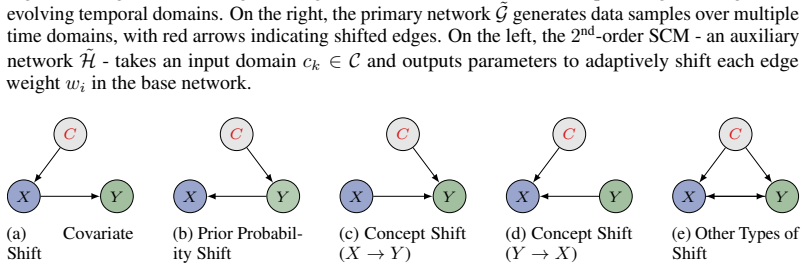
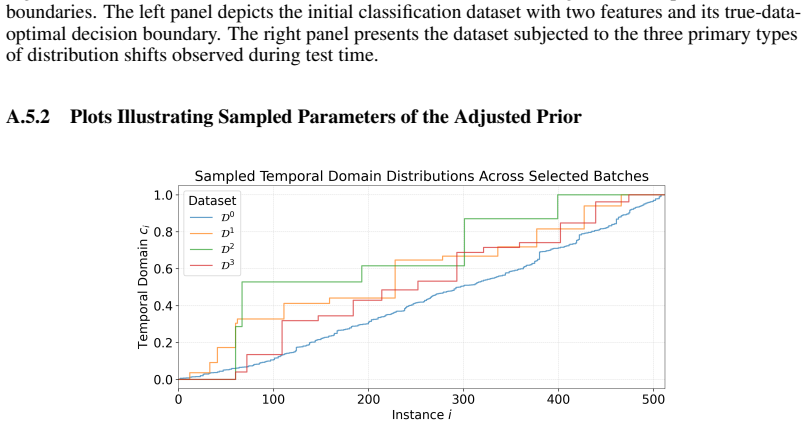
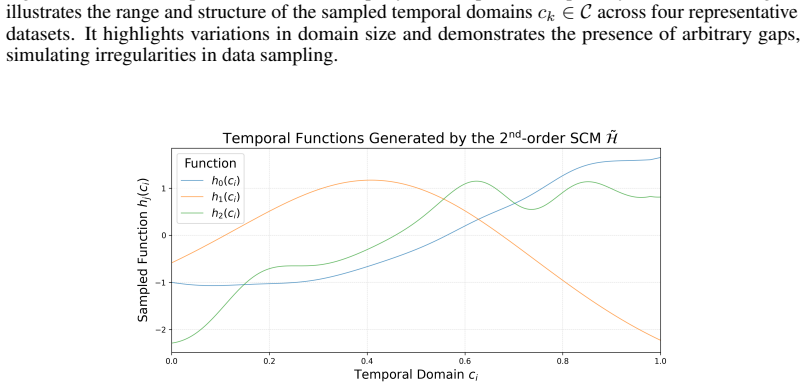
The load-bearing object is the 2nd-order SCM, a secondary structural causal model whose functional-graph forward pass maps a temporal domain index, encoded with Time2Vec, to weight shifts for a sparse set of edges in the primary SCM that generates each synthetic dataset. Because the secondary SCM has nonlinear mechanisms and the shifted edge weights feed through the primary SCM, the prior produces covariate shifts, prior probability shifts, concept shifts, and combinations thereof, all correlated across features and extrapolating beyond training domains. The transformer (TabPFN) is trained to approximate Bayesian inference over this prior, so at inference it conditions on the training set plus domain indices and outputs posterior predictions.
What would settle it
Run the model on a benchmark dataset whose shift is a sudden, discontinuous regime change (a change point or feature-space alteration) rather than gradual edge-weight drift, using the same Eval-Fix protocol; if Drift-Resilient TabPFN no longer beats a last-domain-only XGBoost or the original TabPFN on OOD accuracy and ECE, the claimed generality of the prior is refuted. The paper's own Appendix A.4.2 already shows that perturbed domain indices degrade performance, so a cleaner test would compare accurate against noisy domain labels on a real-world temporal split.
Extended reading notes
Core claim
The central claim is that temporal distribution shifts in tabular data can be modeled as sparse, gradual changes to the edge weights of a structural causal model, and that a Prior-Data Fitted Network trained on a prior made of such drifting SCMs will learn to detect and extrapolate these shifts on unseen data. The paper introduces a secondary, '2nd-order' SCM that takes a temporal domain index as input and outputs correlated shift parameters for selected edges in the primary SCM's functional graph. After pretraining on 30.72 million synthetic datasets, the resulting model, applied in one forward pass without hyperparameter tuning, is claimed to consistently beat all baselines on OOD data across 18 benchmarks while maintaining stronger calibration than methods that ignore shifts.
Load-bearing premise
The load-bearing premise is that real-world temporal shifts are well approximated by sparse, gradual, correlated changes to the causal edge weights of a structural causal model, driven by a secondary process indexed by time, with accurate temporal domain labels available at inference.
Editorial extensions
If this is right
- A single fixed model, with no per-dataset tuning, extrapolates to future temporal domains better than tuned GBDTs on small and moderate tabular datasets.
- The same prior covers covariate shift, prior probability shift, concept shift, and their combinations, so users do not need to diagnose the shift type in advance.
- Out-of-distribution probability estimates are better calibrated than those of baselines, lowering expected calibration error from 0.119 to 0.091 on the combined benchmark.
- Training and prediction together take on average 10.9 seconds, making drift handling practical where retraining pipelines are expensive.
Reading between the lines
- The paper's prior assumes smooth edge-weight drift; the likely failure mode is abrupt regime changes or unobserved confounders, which the prior cannot express, so a natural extension is to add change-point processes to the 2nd-order SCM and test on datasets with sudden shifts.
- Because the pretraining prior, not Time2Vec, carries most of the gain (ablation in Table 2), the same drift prior could be dropped into later TabPFN variants, such as dataset-distillation or prompt-tuning versions, to extend the approach to larger datasets.
- The sensitivity to domain-index quality (Appendix A.4.2) suggests the practical ceiling on real-world data may be set by how well domain indices can be approximated from features, so learning the domain index end-to-end would be a direct test.
- If domain indices are themselves uncertain, an online or transductive variant that updates beliefs about the current domain could recover some of the lost performance; the paper flags these settings as future work.
Editorial analysis
A structured set of objections, weighed in public.
Referee Report
Summary. The paper proposes Drift-Resilient TabPFN, an extension of the TabPFN framework for tabular classification under temporal distribution shifts. The main idea is to modify the synthetic-data prior used to pre-train the transformer: a structural causal model (SCM) is sampled, a sparse subset of its edges is selected, and a second-order SCM generates smooth, correlated changes to those edge weights as a function of a temporal domain index encoded with Time2Vec. The model is pre-trained once on datasets drawn from this drift prior and is then applied without per-dataset tuning. The authors evaluate the method on 18 datasets (8 synthetic, 10 real-world), comparing against GBDTs, the original TabPFN, and Wild-Time methods, and report aggregate OOD accuracy, F1, ROC AUC, and ECE with 95% confidence intervals. They claim consistent OOD improvements and stronger calibration, with combined accuracy improving from 0.688 to 0.744 and ROC AUC from 0.786 to 0.832 relative to the strongest baselines.
Significance. If the central claim holds, this is a meaningful contribution to temporal domain generalization on small tabular data: it is, to my knowledge, the first tabular method to show consistent OOD gains over shift-agnostic supervised learning in this setting, and it does so with a single fixed model that requires no per-dataset hyperparameter tuning. The prior construction is novel and unifies covariate, prior-probability, and concept shift within one generative framework. The evaluation is thorough in several respects: 18 datasets, multiple splits and seeds, 95% confidence intervals, HPO saturation checks, a Time2Vec ablation, and a decision-boundary analysis. The authors also release code, pre-trained models, and a Colab notebook, and the model is pre-trained without access to real test labels, so the central empirical claim is not a fitted prediction. The main weakness is that the 'consistent outperformance' claim is supported only by aggregate means; per-dataset results are not reported, and the real-world ROC AUC gains are small and statistically overlapping with those of the original TabPFN.
major comments (3)
- [Section 4, Tables 1 and 5, Abstract] The central claim that Drift-Resilient TabPFN 'consistently outperforms all baselines' on OOD data is not supported by the evidence as presented. Tables 1 and 5 report only aggregated means over 8 synthetic and 10 real-world datasets; no per-dataset results are shown anywhere in the paper or appendix. The 95% confidence intervals are computed across model initializations (and after averaging over three splits), so they do not quantify dataset-level variability. A model can have a higher mean ROC AUC while losing on a substantial fraction of datasets. Since the synthetic gains are large (Table 1: OOD ROC 0.749 to 0.844) and the real-world gains are much smaller (Table 1: 0.820 to 0.822), the aggregate could be dominated by the synthetic subset. To establish the 'consistent' component of the claim, please provide a per-dataset table (or supplement) listing OOD accuracy and ROC AUC for every dataset and every main method, together with the number and percentage of datasets where Drift-Resilient TabPFN wins, ties, or loses against each baseline, and a paired statistical test over datasets (e.g., Wilcoxon signed-rank) using the per-dataset scores. This is directly checkable given the released code.
- [Table 1, real-world block; Abstract] The real-world OOD ROC AUC improvement is negligible: 0.822 ± 0.010 for Drift-Resilient TabPFN versus 0.816 ± 0.006 for TabPFNbase with domain indices, with clearly overlapping confidence intervals. The combined ROC AUC gain from 0.786 to 0.832 highlighted in the abstract is driven primarily by the synthetic subset (0.749 to 0.844). The paper should either present the real-world and synthetic results separately in the main claims or provide per-dataset evidence that the real-world ROC AUC difference is not noise. As written, the abstract's 'large performance improvements' overstates the real-world evidence, especially for ROC AUC.
- [Section 4, Evaluation Strategy; Appendix A.4.4.2] The statistical reporting is ambiguous and too weak for the dataset-level claim. The text says 'We generate three random splits and average metrics across these splits. Each method is trained three times, and we report the average and 95%-confidence intervals calculated across model initializations.' This does not describe a valid procedure for obtaining confidence intervals for the mean over datasets; if the intervals are over three initializations, they ignore between-dataset variance. Please clarify exactly how the confidence intervals were computed (e.g., bootstrap over dataset means, or over runs within a fixed dataset) and, if the claim is about datasets, report dataset-level variability. The critical difference diagrams in Figure 10 are also uninterpretable without the underlying per-dataset rank table; please include that table or state where it can be found.
minor comments (5)
- [Section 3.2, Eq. (1)] Please clarify the status of the Time2Vec parameters ω_i and φ_i: are they learned during pre-training only, or also adapted at inference, and does the reported inference time of 10.9s include any Time2Vec fitting?
- [Table 2 and Section 5] The Time2Vec ablation shows that the contribution of Time2Vec is statistically insignificant, yet it is kept because HPO favored it. This is a reasonable model-selection decision, but the paper should state explicitly that the reported gains should not be attributed to Time2Vec, to avoid reader confusion.
- [Figures 5, 7, 8, and 9] The decision-boundary figures are very small and the differences between rows are hard to see in print. Please enlarge them or split them across pages, and make sure the color scheme is accessible to color-blind readers.
- [Tables 1, 5, and 6] The tables are dense and use many repeated model names; consider grouping rows by method family or using horizontal rules to make the comparisons easier to follow. Also ensure the bold 'best mean' marking is applied consistently across all metric columns, including ECE where lower is better.
- [Appendix A.4.3.4] The comparison against DRAIN and GI on Rotated Two Moons reuses figures from the DRAIN paper; please confirm that reproduction permission is covered by the paper's license or add a note in the caption.
Circularity Check
No significant circularity: the fixed pretrained model is evaluated on external benchmarks, and no prediction reduces to a fitted parameter or self-citation chain.
full rationale
The paper's derivation chain is: define an SCM-based prior with temporal edge shifts generated by a secondary SCM (Section 3.2, Algorithm 1), pretrain a Prior-Data Fitted Network on millions of datasets sampled from this prior (Section 3.1), then apply the fixed pretrained model to unseen synthetic and real-world datasets in a single forward pass (Section 4). No model parameter is fitted to the test labels, and the pretrained model is not adapted per dataset; the central empirical claim is therefore not a fitted prediction renamed as a prediction. The synthetic test datasets described in Appendix A.7.2.1 are external generators (scikit-multiflow and custom geometric datasets) rather than fresh samples from the pretraining prior, so the evaluation is not tautological. The self-citations to Müller et al. [18] and Hollmann et al. [19] supply the PFN/TabPFN mechanism, but the paper's contribution is the new temporal-shift prior and its empirical validation, which stands on independent benchmarks; no load-bearing argument reduces to those citations. The limitations section explicitly concedes that the sparse-mechanism-shift prior may not capture all real-world shifts, which is a scope limitation rather than circularity. The lack of per-dataset performance breakdowns is an evidentiary gap about the word 'consistently,' not a circularity. Accordingly, no circular step can be exhibited by quoting an equation or a fitted parameter that is equivalent to the claimed output.
Assumptions & free parameters
free parameters (4)
- Sparse edge shift selection and shift magnitude distributions in the prior
- Number of functional subnodes k and l in SCM expansion
- Preprocessing hyperparameters (softmax_temperature, use_poly_features, remove_outliers, etc.) =
optimized on validation, see Table 10
- Time2Vec dimension m and learned parameters
assumptions (4)
- domain assumption Real-world temporal distribution shifts can be modeled as gradual changes to the edge weights of an SCM.
- standard math PFN training on synthetic datasets approximates Bayesian inference for the specified prior.
- domain assumption Ground-truth temporal domain indices are available for training.
- domain assumption The SCM prior is a sufficiently general approximation to many real-world tabular datasets.
invented entities (1)
-
2nd-order SCM H
Cite this review
Pith. "Pith review of Drift-Resilient TabPFN: In-Context Learning Temporal Distribution Shifts on Tabular Data." pith.science (2026). https://pith.science/paper/QOE4UPX7
@misc{pith2026241110634,
  author       = {Pith},
  title        = {Pith review of: Drift-Resilient TabPFN: In-Context Learning Temporal Distribution Shifts on Tabular Data},
  year         = {2026},
  howpublished = {\url{https://pith.science/paper/QOE4UPX7}},
  note         = {Machine review of arXiv:2411.10634}
}
read the original abstract
While most ML models expect independent and identically distributed data, this assumption is often violated in real-world scenarios due to distribution shifts, resulting in the degradation of machine learning model performance. Until now, no tabular method has consistently outperformed classical supervised learning, which ignores these shifts. To address temporal distribution shifts, we present Drift-Resilient TabPFN, a fresh approach based on In-Context Learning with a Prior-Data Fitted Network that learns the learning algorithm itself: it accepts the entire training dataset as input and makes predictions on the test set in a single forward pass. Specifically, it learns to approximate Bayesian inference on synthetic datasets drawn from a prior that specifies the model's inductive bias. This prior is based on structural causal models (SCM), which gradually shift over time. To model shifts of these causal models, we use a secondary SCM, that specifies changes in the primary model parameters. The resulting Drift-Resilient TabPFN can be applied to unseen data, runs in seconds on small to moderately sized datasets and needs no hyperparameter tuning. Comprehensive evaluations across 18 synthetic and real-world datasets demonstrate large performance improvements over a wide range of baselines, such as XGB, CatBoost, TabPFN, and applicable methods featured in the Wild-Time benchmark. Compared to the strongest baselines, it improves accuracy from 0.688 to 0.744 and ROC AUC from 0.786 to 0.832 while maintaining stronger calibration. This approach could serve as significant groundwork for further research on out-of-distribution prediction.
Figures


Figures from the paper (13 more)



Reference graph
Works this paper leans on
-
[1]
Causal discovery in heterogeneous environments under the sparse mechanism shift hypothesis
Ronan Perry, Julius V on Kügelgen, and Bernhard Schölkopf. Causal discovery in heterogeneous environments under the sparse mechanism shift hypothesis. In Alice H. Oh, Alekh Agarwal, Danielle Belgrave, and Kyunghyun Cho, editors, Proceedings of the 36th International Con- ference on Advances in Neural Information Processing Systems (NeurIPS’22) , 2022. URL...
2022
-
[2]
Daniel Vela, Andrew Sharp, Richard Zhang, Trang Nguyen, An Hoang, and Oleg S. Pianykh. Temporal quality degradation in AI models. Scientific Reports, 12(1):11654, July 2022. ISSN 2045-2322. doi:10.1038/s41598-022-15245-z
-
[3]
Deep neural networks and tabular data: A survey
Vadim Borisov, Tobias Leemann, Kathrin Seßler, Johannes Haug, Martin Pawelczyk, and Gjergji Kasneci. Deep neural networks and tabular data: A survey. IEEE Transactions on Neural Networks and Learning Systems, 2022
2022
-
[4]
Why tabular foundation models should be a research priority
Boris van Breugel and Mihaela van der Schaar. Why tabular foundation models should be a research priority. arXiv preprint arXiv:2405.01147, 2024
arXiv 2024
-
[5]
Empirical evaluation of performance degradation of machine learning-based predictive models–a case study in healthcare information systems
Zachary Young and Robert Steele. Empirical evaluation of performance degradation of machine learning-based predictive models–a case study in healthcare information systems. International Journal of Information Management Data Insights, 2(1):100070, 2022
2022
-
[6]
Temporal shifts in clinical presen- tation and underlying mechanisms of atherosclerotic disease
Gerard Pasterkamp, Hester M Den Ruijter, and Peter Libby. Temporal shifts in clinical presen- tation and underlying mechanisms of atherosclerotic disease. Nature Reviews Cardiology, 14 (1):21–29, 2017
2017
-
[7]
Mortality prediction of covid-19 patients at intensive care unit admission
Rajarajan Ganesan, Varun Mahajan, Karan Singla, Sushant Konar, Tanvir Samra, Senthil K Sundaram, Vikas Suri, Mandeep Garg, Naveen Kalra, Goverdhan D Puri, et al. Mortality prediction of covid-19 patients at intensive care unit admission. Cureus, 13(11), 2021
2021
-
[8]
Climate-invariant machine learning
Tom Beucler, Pierre Gentine, Janni Yuval, Ankitesh Gupta, Liran Peng, Jerry Lin, Sungduk Yu, Stephan Rasp, Fiaz Ahmed, Paul A O’Gorman, et al. Climate-invariant machine learning. Science Advances, 10(6):eadj7250, 2024
2024
Show all 107 references
-
[9]
Dataset shift quantification for credit card fraud detection
Yvan Lucas, Pierre-Edouard Portier, Léa Laporte, Sylvie Calabretto, Liyun He-Guelton, Frederic Oble, and Michael Granitzer. Dataset shift quantification for credit card fraud detection. In2019 IEEE second international conference on artificial intelligence and knowledge engine...
2019
-
[10]
Hidden risks of machine learning applied to healthcare: Unintended feedback loops between models and future data causing model degradation
George Alexandru Adam, Chun-Hao Kingsley Chang, Benjamin Haibe-Kains, and Anna Goldenberg. Hidden risks of machine learning applied to healthcare: Unintended feedback loops between models and future data causing model degradation. In Finale Doshi-Velez, Jim Fackler, Ken Jung, ...
2020
-
[11]
Wild-time: A benchmark of in-the-wild distribution shift over time
Huaxiu Yao, Caroline Choi, Bochuan Cao, Yoonho Lee, Pang Wei Koh, and Chelsea Finn. Wild-time: A benchmark of in-the-wild distribution shift over time. In Alice H. Oh, Alekh Agarwal, Danielle Belgrave, and Kyunghyun Cho, editors,Proceedings of the 36th International Conference...
2022
-
[12]
Temporal domain generalization with drift-aware dynamic neural networks
Guangji Bai, Chen Ling, and Liang Zhao. Temporal domain generalization with drift-aware dynamic neural networks. In Proceedings of the International Conference on Learning Rep- resentations (ICLR’23), 2023. URL https://openreview.net/forum?id=sWOsRj4nT1n. Published online: iclr.cc
2023
-
[13]
Training for the future: A simple gradient interpolation loss to generalize along time
Anshul Nasery, Soumyadeep Thakur, Vihari Piratla, Abir De, and Sunita Sarawagi. Training for the future: A simple gradient interpolation loss to generalize along time. In M. Ranzato, A. Beygelzimer, K. Nguyen, P. Liang, J. Vaughan, and Y . Dauphin, editors, Proceedings of the ...
2021
-
[14]
Benchmarking distribution shift in tabular data with tableshift
Josh Gardner, Zoran Popovic, and Ludwig Schmidt. Benchmarking distribution shift in tabular data with tableshift. Advances in Neural Information Processing Systems, 36, 2024
2024
-
[15]
Revisiting deep learning models for tabular data
Yury Gorishniy, Ivan Rubachev, Valentin Khrulkov, and Artem Babenko. Revisiting deep learning models for tabular data. Advances in Neural Information Processing Systems , 34: 18932–18943, 2021
2021
-
[16]
Tabular data: Deep learning is not all you need
Ravid Shwartz-Ziv and Amitai Armon. Tabular data: Deep learning is not all you need. Information Fusion, 81:84–90, 2022
2022
-
[17]
Why do tree-based models still outperform deep learning on typical tabular data? In Alice H
Leo Grinsztajn, Edouard Oyallon, and Gael Varoquaux. Why do tree-based models still outperform deep learning on typical tabular data? In Alice H. Oh, Alekh Agarwal, Danielle Belgrave, and Kyunghyun Cho, editors, Proceedings of the 36th International Conference on Advances in N...
2022
-
[18]
Müller, N
S. Müller, N. Hollmann, S. Arango, J. Grabocka, and F. Hutter. Transformers can do bayesian inference. In Proceedings of the International Conference on Learning Representations (ICLR’22), 2022. URL https://openreview.net/forum?id=KSugKcbNf9. Published online: iclr.cc
2022
-
[19]
Hollmann, S
N. Hollmann, S. Müller, K. Eggensperger, and F. Hutter. TabPFN: A transformer that solves small tabular classification problems in a second. InProceedings of the International Conference on Learning Representations (ICLR’23), 2023. URL https://openreview.net/forum?id= cp5PvcI6...
2023
-
[20]
Causality
Judea Pearl. Causality. Cambridge University Press, 2 edition, 2009
2009
-
[21]
Peters, D
J. Peters, D. Janzing, and B. Schölkopf. Elements of causal inference: foundations and learning algorithms. The MIT Press, 2017
2017
-
[22]
Time2vec: Learning a vector representation of time, 2020
Seyed Mehran Kazemi, Rishab Goel, Sepehr Eghbali, Janahan Ramanan, Jaspreet Sahota, Sanjay Thakur, Stella Wu, Cathal Smyth, Pascal Poupart, and Marcus Brubaker. Time2vec: Learning a vector representation of time, 2020. URL https://openreview.net/forum? id=rklklCVYvB
2020
-
[23]
Chen and C
T. Chen and C. Guestrin. Xgboost: A scalable tree boosting system. In B. Krishnapuram, M. Shah, A. Smola, C. Aggarwal, D. Shen, and R. Rastogi, editors, Proceedings of the 22nd ACM SIGKDD International Conference on Knowledge Discovery and Data Mining (KDD’16), pages 785–794. ...
2016
-
[24]
Prokhorenkova, G
L. Prokhorenkova, G. Gusev, A. V orobev, A. Dorogush, and A. Gulin. CatBoost: unbiased boosting with categorical features. In S. Bengio, H. Wallach, H. Larochelle, K. Grauman, N. Cesa-Bianchi, and R. Garnett, editors, Proceedings of the 31st International Conference on Advance...
2018
-
[25]
G. Ke, Q. Meng, T. Finley, T. Wang, W. Chen, W. Ma, Q. Ye, and T.-Y . Liu. Lightgbm: A highly efficient gradient boosting decision tree. In I. Guyon, U. von Luxburg, S. Bengio, H. Wallach, R. Fergus, S. Vishwanathan, and R. Garnett, editors, Proceedings of the 30th Internation...
2017
-
[26]
Continuously indexed domain adaptation
Hao Wang, Hao He, and Dina Katabi. Continuously indexed domain adaptation. In H. Daume III and A. Singh, editors, Proceedings of the 37th International Conference on Machine Learning (ICML’20), volume 98. Proceedings of Machine Learning Research, 2020
2020
-
[27]
Selçuk Candan, Adrienne Raglin, and Huan Liu
Paras Sheth, Raha Moraffah, K. Selçuk Candan, Adrienne Raglin, and Huan Liu. Domain generalization – a causal perspective, 2022
2022
-
[28]
Domain generalization via invariant feature representation
Krikamol Muandet, David Balduzzi, and Bernhard Schölkopf. Domain generalization via invariant feature representation. In S. Dasgupta and D. McAllester, editors, Proceedings of the 30th International Conference on Machine Learning (ICML’13). Omnipress, 2013. URL https://proceed...
2013
-
[29]
Metareg: Towards domain generalization using meta-regularization
Yogesh Balaji, Swami Sankaranarayanan, and Rama Chellappa. Metareg: Towards domain generalization using meta-regularization. In S. Bengio, H. Wallach, H. Larochelle, K. Grauman, N. Cesa-Bianchi, and R. Garnett, editors, Proceedings of the 31st International Conference on Advan...
2018
-
[30]
Unified deep supervised domain adaptation and generalization
Saeid Motiian, Marco Piccirilli, Donald A Adjeroh, and Gianfranco Doretto. Unified deep supervised domain adaptation and generalization. In Proceedings of the IEEE international conference on computer vision, pages 5715–5725, 2017
2017
-
[31]
Invariant risk mini- mization, 2020
Martin Arjovsky, Léon Bottou, Ishaan Gulrajani, and David Lopez-Paz. Invariant risk mini- mization, 2020
2020
-
[32]
Hashimoto, and Percy Liang
Shiori Sagawa, Pang Wei Koh, Tatsunori B. Hashimoto, and Percy Liang. Distributionally robust neural networks for group shifts: On the importance of regularization for worst-case generalization. In Proceedings of the International Conference on Learning Representations (ICLR’2...
2020
-
[33]
Dauphin, and David Lopez-Paz
Hongyi Zhang, Moustapha Cisse, Yann N. Dauphin, and David Lopez-Paz. mixup: Beyond empirical risk minimization. In Proceedings of the International Conference on Learning Representations (ICLR’18), 2018. Published online: iclr.cc
2018
-
[34]
Improving out-of-distribution robustness via selective augmentation, 2022
Huaxiu Yao, Yu Wang, Sai Li, Linjun Zhang, Weixin Liang, James Zou, and Chelsea Finn. Improving out-of-distribution robustness via selective augmentation, 2022
2022
-
[35]
Deep coral: Correlation alignment for deep domain adaptation
Baochen Sun and Kate Saenko. Deep coral: Correlation alignment for deep domain adaptation. In Gang Hua and Hervé Jégou, editors, Computer Vision – ECCV 2016 Workshops , pages 443–450, Cham, 2016. Springer International Publishing. doi:10.1007/978-3-319-49409-8_35
2016 doi
-
[36]
Domain-adversarial training of neural networks
Yaroslav Ganin, Evgeniya Ustinova, Hana Ajakan, Pascal Germain, Hugo Larochelle, François Laviolette, Mario Marchand, and Victor Lempitsky. Domain-adversarial training of neural networks. Journal of Machine Learning Research, 17(1):2096–2030, jan 2016. ISSN 1532- 4435
2016
-
[37]
Out-of-distribution generalization via risk extrapo- lation (rex)
David Krueger, Ethan Caballero, Joern-Henrik Jacobsen, Amy Zhang, Jonathan Binas, Dinghuai Zhang, Remi Le Priol, and Aaron Courville. Out-of-distribution generalization via risk extrapo- lation (rex). In M. Meila and T. Zhang, editors,Proceedings of the 38th International Conf...
2021
-
[38]
Pappas, and Bernhard Schölkopf
Cian Eastwood, Alexander Robey, Shashank Singh, Julius von Kügelgen, Hamed Hassani, George J. Pappas, and Bernhard Schölkopf. Probable domain generalization via quantile risk minimization. In Alice H. Oh, Alekh Agarwal, Danielle Belgrave, and Kyunghyun Cho, editors, Proceeding...
2022
-
[39]
Andrey Malinin, Neil Band, Alexander Ganshin, German Chesnokov, Yarin Gal, Mark J. F. Gales, Alexey Noskov, Andrey Ploskonosov, Liudmila Prokhorenkova, Ivan Provilkov, Vat- sal Raina, Vyas Raina, Denis Roginskiy, Mariya Shmatova, Panos Tigar, and Boris Yangel. Shifts: A datase...
2021 arXiv
-
[40]
Andrey Malinin, Andreas Athanasopoulos, Muhamed Barakovic, Meritxell Bach Cuadra, Mark J. F. Gales, Cristina Granziera, Mara Graziani, Nikolay Kartashev, Konstantinos Kyriakopoulos, Po-Jui Lu, Nataliia Molchanova, Antonis Nikitakis, Vatsal Raina, Francesco La Rosa, Eli Sivena,...
2022 arXiv
-
[41]
On the need for a language describing distribution shifts: Illustrations on tabular datasets
Jiashuo Liu, Tianyu Wang, Peng Cui, and Hongseok Namkoong. On the need for a language describing distribution shifts: Illustrations on tabular datasets. In Thirty-seventh Conference on Neural Information Processing Systems Datasets and Benchmarks Track, 2023
2023
-
[42]
Retiring adult: New datasets for fair machine learning
Frances Ding, Moritz Hardt, John Miller, and Ludwig Schmidt. Retiring adult: New datasets for fair machine learning. In M. Ranzato, A. Beygelzimer, K. Nguyen, P. Liang, J. Vaughan, and Y . Dauphin, editors,Proceedings of the 34th International Conference on Advances in Neural ...
2021
-
[43]
Wild-tab: A benchmark for out-of-distribution generalization in tabular regression, 2023
Sergey Kolesnikov. Wild-tab: A benchmark for out-of-distribution generalization in tabular regression, 2023. URL https://arxiv.org/abs/2312.01792
2023 arXiv
-
[44]
In search of lost domain generalization
Ishaan Gulrajani and David Lopez-Paz. In search of lost domain generalization. In Proceedings of the International Conference on Learning Representations (ICLR’21), 2021. URL https: //openreview.net/forum?id=lQdXeXDoWtI. Published online: iclr.cc
2021
-
[45]
Jindong Wang, Cuiling Lan, Chang Liu, Yidong Ouyang, Tao Qin, Wang Lu, Yiqiang Chen, Wenjun Zeng, and Philip S. Yu. Generalizing to unseen domains: A survey on domain generalization. IEEE Transactions on Knowledge and Data Engineering, 35(8):8052–8072,
-
[46]
Averaging weights leads to wider optima and better generalization
Pavel Izmailov, Dmitrii Podoprikhin, Timur Garipov, Dmitry Vetrov, and Andrew Gordon Wilson. Averaging weights leads to wider optima and better generalization. In A. Globerson and R. Silva, editors, Proceedings of The 34th Uncertainty in Artificial Intelligence Conference (UAI...
2018
-
[47]
Task agnostic continual learning via meta learning
Xu He, Jakub Sygnowski, Alexandre Galashov, Andrei Alex Rusu, Yee Whye Teh, and Razvan Pascanu. Task agnostic continual learning via meta learning. In 4th Lifelong Machine Learning Workshop at ICML 2020, 2020. URL https://openreview.net/forum?id=AeIzVxdJgeb
2020
-
[48]
In-context data distillation with tabpfn, 2024
Junwei Ma, Valentin Thomas, Guangwei Yu, and Anthony Caterini. In-context data distillation with tabpfn, 2024. URL https://arxiv.org/abs/2402.06971
2024 arXiv
-
[49]
Tunetables: Context optimization for scalable prior-data fitted networks
Benjamin Feuer, Robin Tibor Schirrmeister, Valeriia Cherepanova, Chinmay Hegde, Frank Hutter, Micah Goldblum, Niv Cohen, and Colin White. Tunetables: Context optimization for scalable prior-data fitted networks. arXiv preprint arXiv:2402.11137, 2024
2024 arXiv
-
[50]
Forecastpfn: Synthetically-trained zero-shot forecasting
Samuel Dooley, Gurnoor Singh Khurana, Chirag Mohapatra, Siddartha V Naidu, and Colin White. Forecastpfn: Synthetically-trained zero-shot forecasting. In Advances in Neural Information Processing Systems, 2023
2023
-
[51]
Moreno-Torres, Troy Raeder, Rocío Alaiz-Rodríguez, Nitesh V
Jose G. Moreno-Torres, Troy Raeder, Rocío Alaiz-Rodríguez, Nitesh V . Chawla, and Fran- cisco Herrera. A unifying view on dataset shift in classification. Pattern Recognition, 45 (1):521–530, 2012. ISSN 0031-3203. doi:10.1016/j.patcog.2011.06.019. URL https: //www.sciencedirec...
2012 doi
-
[52]
Patterns of dataset shift
Meelis Kull and Peter Flach. Patterns of dataset shift. In First international workshop on learning over multiple contexts (LMCE) at ECML-PKDD, volume 5, 2014
2014
-
[53]
Vanschoren, J
J. Vanschoren, J. van Rijn, B. Bischl, and L. Torgo. OpenML: Networked science in machine learning. SIGKDD Explorations, 15(2):49–60, 2014. 14
2014
-
[54]
Individual comparisons by ranking methods
Frank Wilcoxon. Individual comparisons by ranking methods. Biometrics Bulletin, 1(6):80–83,
-
[55]
A simple sequentially rejective multiple test procedure
Sture Holm. A simple sequentially rejective multiple test procedure. Scandinavian journal of statistics, pages 65–70, 1979
1979
-
[56]
statistical comparisons of classifiers over multiple data sets
Salvador Garcia and Francisco Herrera. An extension on" statistical comparisons of classifiers over multiple data sets" for all pairwise comparisons. Journal of machine learning research, 9 (12), 2008
2008
-
[57]
Deep learning for time series classification: a review.Data Mining and Knowledge Discovery, 33(4):917–963, 2019
Hassan Ismail Fawaz, Germain Forestier, Jonathan Weber, Lhassane Idoumghar, and Pierre- Alain Muller. Deep learning for time series classification: a review.Data Mining and Knowledge Discovery, 33(4):917–963, 2019
2019
-
[58]
Overcoming catastrophic forgetting in neural networks
James Kirkpatrick, Razvan Pascanu, Neil Rabinowitz, Joel Veness, Guillaume Desjardins, Andrei A Rusu, Kieran Milan, John Quan, Tiago Ramalho, Agnieszka Grabska-Barwinska, et al. Overcoming catastrophic forgetting in neural networks. Proceedings of the national academy of scien...
2017
-
[59]
Continual learning through synaptic intelligence
Friedemann Zenke, Ben Poole, and Surya Ganguli. Continual learning through synaptic intelligence. In D. Precup and Y . Teh, editors,Proceedings of the 34th International Conference on Machine Learning (ICML’17) , volume 70. Proceedings of Machine Learning Research, 2017
2017
-
[60]
Efficient lifelong learning with A-GEM
Arslan Chaudhry, Marc’Aurelio Ranzato, Marcus Rohrbach, and Mohamed Elhoseiny. Efficient lifelong learning with A-GEM. In Proceedings of the International Conference on Learning Representations (ICLR’19), 2019. Published online: iclr.cc
2019
-
[61]
A simple framework for contrastive learning of visual representations
Ting Chen, Simon Kornblith, Mohammad Norouzi, and Geoffrey Hinton. A simple framework for contrastive learning of visual representations. In H. Daume III and A. Singh, editors, Proceedings of the 37th International Conference on Machine Learning (ICML’20), volume 98. Proceedin...
2020
-
[62]
Unsupervised learning of visual features by contrasting cluster assignments
Mathilde Caron, Ishan Misra, Julien Mairal, Priya Goyal, Piotr Bojanowski, and Armand Joulin. Unsupervised learning of visual features by contrasting cluster assignments. In H. Larochelle, M. Ranzato, R. Hadsell, M.-F. Balcan, and H. Lin, editors,Proceedings of the 33rd Intern...
2020
-
[63]
Venkateswarlu
Bendi Ramana and N. Venkateswarlu. ILPD (Indian Liver Patient Dataset). UCI Machine Learning Repository, 2012
2012
-
[64]
Istanbul Stock Exchange
Oguz Akbilgic. Istanbul Stock Exchange. UCI Machine Learning Repository, 2013
2013
-
[65]
DeShazo, Chris Gennings, Juan L
Beata Strack, Jonathan P. DeShazo, Chris Gennings, Juan L. Olmo, Sebastian Ventura, Krzysztof J. Cios, and John N. Clore. Impact of HbA1c Measurement on Hospital Read- mission Rates: Analysis of 70,000 Clinical Database Patient Records. BioMed Research International, 2014:7816...
2014 doi
-
[66]
Data Expo competition
Albert Bifet and Elena Ikonomovska. Data Expo competition. OpenML, 2009. URL https: //www.openml.org/search?type=data&sort=runs&id=1169&status=active
2009
-
[67]
Everhart, W
Jack Smith, J. Everhart, W. Dickson, W. Knowler, and Richard Johannes. Using the adap learning algorithm to forcast the onset of diabetes mellitus. Proceedings - Annual Symposium on Computer Applications in Medical Care, 10, 11 1988
1988
-
[68]
M. M. Faniqul Islam, Rahatara Ferdousi, Sadikur Rahman, and Humayra Yasmin Bushra. Likelihood prediction of diabetes at early stage using data mining techniques. In Mousumi Gupta, Debanjan Konar, Siddhartha Bhattacharyya, and Sambhunath Biswas, editors, Computer Vision and Mac...
2020 doi
-
[69]
Occupancy Detection
Luis Candanedo. Occupancy Detection. UCI Machine Learning Repository, 2016. 15
2016
-
[70]
Behavior of the urban traffic of the city of Sao Paulo in Brazil
Ricardo Ferreira, Andrea Martiniano, and Renato Sassi. Behavior of the urban traffic of the city of Sao Paulo in Brazil. UCI Machine Learning Repository, 2018
2018
-
[71]
Scikit-multiflow: A multi- output streaming framework
Jacob Montiel, Jesse Read, Albert Bifet, and Talel Abdessalem. Scikit-multiflow: A multi- output streaming framework. Journal of Machine Learning Research, 19(72):1–5, 2018. URL http://jmlr.org/papers/v19/18-251.html
2018
-
[72]
Use of nonclonal serum immunoglobulin free light chains to predict overall survival in the general population
Angela Dispenzieri, Jerry Katzmann, Robert Kyle, Dirk Larson, Terry Therneau, Colin Colby, Raynell Clark, Graham Mead, Shaji Kumar, L Melton, and S Rajkumar. Use of nonclonal serum immunoglobulin free light chains to predict overall survival in the general population. Mayo Cli...
2012 doi
-
[73]
Prevalence of monoclonal gammopathy of undetermined significance
Robert Kyle, Terry Therneau, S Rajkumar, Dirk Larson, Matthew Plevak, Janice Offord, Angela Dispenzieri, Jerry Katzmann, and L Melton. Prevalence of monoclonal gammopathy of undetermined significance. The New England journal of medicine, 354:1362–9, 04 2006. doi:10.1056/NEJMoa054494
2006 doi
-
[74]
Splice-2 comparative evaluation: Electricity Pricing
Michael Harries. Splice-2 comparative evaluation: Electricity Pricing . University of New South Wales, School of Computer Science and Engineering [Sydney], 1999. URL http: //nla.gov.au/nla.arc-32869
1999
-
[75]
Learning with drift detection
João Gama, Pedro Medas, Gladys Castillo, and Pedro Rodrigues. Learning with drift detection. In Ana L. C. Bazzan and Sofiane Labidi, editors, Advances in Artificial Intelligence – SBIA 2004, pages 286–295, Berlin, Heidelberg, 2004. Springer Berlin Heidelberg. ISBN 978-3-540- 2...
2004 doi
-
[76]
Absenteeism at work
Andrea Martiniano and Ricardo Ferreira. Absenteeism at work. UCI Machine Learning Repository, 2018
2018
-
[77]
Heart Disease
Andras Janosi, William Steinbrunn, Matthias Pfisterer, and Robert Detrano. Heart Disease. UCI Machine Learning Repository, 1988
1988
-
[78]
Parking Birmingham
Daniel Stolfi. Parking Birmingham. UCI Machine Learning Repository, 2019
2019
-
[79]
Ames, iowa: Alternative to the boston housing data as an end of semester regression project
Dean De Cock. Ames, iowa: Alternative to the boston housing data as an end of semester regression project. Journal of Statistics Education , 19, 11 2011. doi:10.1080/10691898.2011.11889627
2011
-
[80]
Combining similarity in time and space for training set formation under concept drift
Indr˙e Žliobait˙e. Combining similarity in time and space for training set formation under concept drift. Intelligent Data Analysis, 15(4):589–611, 2011
2011
-
[81]
A closer look at in-context learning under distribution shifts
Kartik Ahuja and David Lopez-Paz. A closer look at in-context learning under distribution shifts. arXiv preprint arXiv:2305.16704, 2023. 16 Table of Contents A Appendix 17 A.1 Reproducibility . . . . . . . . . . . . . . . . . . . . . . . . . . . . . . . . . . 17 A.2 Broader Im...
2023 arXiv
-
[84]
In healthcare, this can ensure diagnostic and prognostic models remain reliable as data shifts over time
Increased Model Longevity: Our approach extends the usable lifespan of deployed ML models by adapting to distribution shifts, reducing the need for retraining and leading to cost savings and more stable performance. In healthcare, this can ensure diagnostic and prognostic mode...
-
[85]
Our Bayesian approach for tackling distribution shift provides a new perspective that can spur further methodological innovations
Improved Decision Making and Long-Term Predictions: Drift-Resilient TabPFN en- hances decision-making in critical fields like finance and climate science by enabling more robust, longer-term predictions. Our Bayesian approach for tackling distribution shift provides a new pers...
-
[86]
Potential Misuse: Like any ML advance, more robust models could be misused for harmful purposes if not developed and deployed responsibly
-
[87]
However, we note that these costs are one-time, while the resulting model can be applied with minimal energy usage
Environmental Cost: While the trained model is now efficiently applicable to various datasets, the considerable computational resources used for initial training should be noted. However, we note that these costs are one-time, while the resulting model can be applied with mini...
-
[88]
Infrastructure: The experiments were conducted on an internal SLURM cluster equipped with RTX 2080 TI GPUs and CPUs of type AMD EPYC 7502, 32C/64T, @ 2.50-3.35GHz
-
[89]
Baseline Experiments: Each baseline experiment utilized 8 CPUs, 1 GPU, and 62.5 GB RAM, with a hyperparameter optimization (HPO) runtime of 1200 seconds per dataset per split, repeated three times to ensure reliability
-
[90]
Pre-training for Drift-Resilient TabPFN and TabPFN-base: These models were pre- trained three times each, requiring 64 CPUs, 8 GPUs, and 500 GB RAM, requiring approxi- mately 7 and 8 days respectively
-
[91]
Both TabPFN-base and Drift-Resilient TabPFN underwent preprocessing optimization that utilized 8 CPUs, 1 GPU, and 62.5 GB RAM across 300 runs, each lasting between 0.5 to 1 hour
Hyperparameter Optimization for Drift-Resilient TabPFN and TabPFN-base: We used 32 CPUs, 4 GPUs, and 250 GB RAM, running approximately 40 configurations and taking about one day per pre-training session for optimizing the hyperparameters of the novel prior-data generating mech...
-
[92]
Slowness in traffic (%)
employs contrastive learning to maximize the agreement between different augmentations of the same image, thereby enhancing the quality of learned visual representations. The approach benefits from learnable nonlinear transformations and optimized contrastive loss parameters. ...
2009
-
[93]
Comprehensive evaluations across 18 synthetic and real-world datasets
Claims Question: Do the main claims made in the abstract and introduction accurately reflect the paper’s contributions and scope? Answer: [Yes] Justification: We make the following main claims and give justification alongside: • We claim "Comprehensive evaluations across 18 sy...
2024
-
[94]
Conclusions and Limitations
Limitations Question: Does the paper discuss the limitations of the work performed by the authors? Answer: [Yes] Justification: The paper acknowledges several limitations, including challenges with compu- tational demands when scaling to larger datasets, interpretability, and ...
-
[95]
Theory Assumptions and Proofs Question: For each theoretical result, does the paper provide the full set of assumptions and a complete (and correct) proof? Answer: [NA] Justification: The paper does not present new theoretical proofs but focuses on algorithmic development and ...
-
[96]
Reproducibility
Experimental Result Reproducibility Question: Does the paper fully disclose all the information needed to reproduce the main ex- perimental results of the paper to the extent that it affects the main claims and/or conclusions of the paper (regardless of whether the code and da...
-
[97]
Reproducibility
Open access to data and code Question: Does the paper provide open access to the data and code, with sufficient instruc- tions to faithfully reproduce the main experimental results, as described in supplemental material? Answer: [Yes] Justification: We provide the full evaluat...
-
[98]
Reproducibility
Experimental Setting/Details 38 Question: Does the paper specify all the training and test details (e.g., data splits, hyper- parameters, how they were chosen, type of optimizer, etc.) necessary to understand the results? Answer: [Yes] Justification: Comprehensive details rega...
-
[99]
We report 95% Confidence Intervals in all our quantitative results and mark this appropriately in the paper
Experiment Statistical Significance Question: Does the paper report error bars suitably and correctly defined or other appropriate information about the statistical significance of the experiments? Answer: [Yes] Justification: The paper reports error bars and statistical signi...
-
[100]
See Section A.3 for details
Experiments Compute Resources Question: For each experiment, does the paper provide sufficient information on the com- puter resources (type of compute workers, memory, time of execution) needed to reproduce the experiments? Answer: [Yes] Justification: Details about the compu...
-
[101]
Code Of Ethics Question: Does the research conducted in the paper conform, in every respect, with the NeurIPS Code of Ethics https://neurips.cc/public/EthicsGuidelines? Answer: [Yes]
-
[102]
Please see Section A.2 for details
Broader Impacts Question: Does the paper discuss both potential positive societal impacts and negative societal impacts of the work performed? Answer: [Yes] Justification: The paper thoroughly explores the broader impacts of Drift-Resilient TabPFN. Please see Section A.2 for details
-
[103]
The research does not involve scraped datasets or applications that directly impact individual privacy or security, thus specific high-risk safeguards are not applicable
Safeguards Question: Does the paper describe safeguards that have been put in place for responsible release of data or models that have a high risk for misuse (e.g., pretrained language models, image generators, or scraped datasets)? Answer: [NA] Justification: The paper focus...
-
[104]
It explicitly mentions the use of datasets, with all necessary citations in Section A.7
Licenses for existing assets Question: Are the creators or original owners of assets (e.g., code, data, models), used in the paper, properly credited and are the license and terms of use explicitly mentioned and properly respected? Answer: [Yes] Justification: The paper credit...
-
[105]
We also provide experimental notebooks for easy usage
New Assets Question: Are new assets introduced in the paper well documented and is the documentation provided alongside the assets? Answer: [Yes] Justification: We release documentation of the released models and code alongside the paper. We also provide experimental notebooks...
-
[106]
Thus, this section is not applicable to the current study
Crowdsourcing and Research with Human Subjects Question: For crowdsourcing experiments and research with human subjects, does the paper include the full text of instructions given to participants and screenshots, if applicable, as well as details about compensation (if any)? A...
-
[107]
Institutional Review Board (IRB) Approvals or Equivalent for Research with Human Subjects Question: Does the paper describe potential risks incurred by study participants, whether such risks were disclosed to the subjects, and whether Institutional Review Board (IRB) approvals...
-
[1945]
URL http://www.jstor.org/stable/3001968
ISSN 00994987. URL http://www.jstor.org/stable/3001968
-
[2023]
doi:10.1109/TKDE.2022.3178128
2022
Reviewed August 12, 2026 · model on record in the stance chip above.
Discussion (0). Continue with ORCID to comment.