REVIEW 4 major objections 4 minor 1 cited by
Can Generic LLMs Help Analyze Child-adult Interactions Involving Children with Autism in Clinical Observation?
T0 review · 4 major / 4 minor · reviewed 2026-08-12 · deepseek-v4-flash
Pith's one-line read Generic open-source LLMs can analyze child-adult clinical transcripts involving children with autism, often beating non-expert human raters on activity and language-skill recognition.
desk verdict First benchmark of local LLMs on ASD clinical transcripts, but the 'better than non-experts' claim rests on 10 transcripts and no statistics. read the letter →
The pith
A machine-rendered reading of the paper's core claim, the machinery that carries it, and where it could break.
The reading
What carries the argument
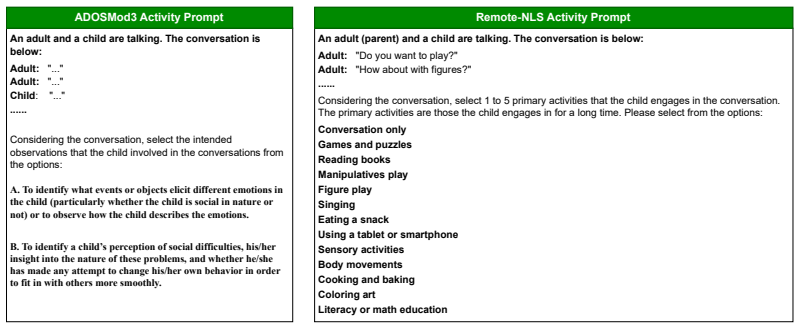
The load-bearing object is a session-level prompt template that feeds an entire expert transcript of a child-adult conversation into a local open-weight LLM (Mistral-7B, LLaMa 2/3, Qwen) with a small set of multiple-choice options. Each prompt converts a clinical annotation job into a constrained text-generation task, letting the model draw on conversation context to decide speaker, engaged activity, language level, and age range. The mechanism that carries the argument is this prompt-plus-model setup: no fine-tuning, no cloud API, just local inference on transcripts.
What would settle it
The simplest check is to take a random subset of Remote-NLS sessions, have clinicians relabel activities from the videos, and compare the best LLM's transcript-only predictions to those video-grounded labels; if agreement drops well below the reported F1, the transcript-only ceiling overstates what is usable in real observation.
Extended reading notes
Core claim
The central claim is that generic LLMs, without any clinical fine-tuning, are highly capable of analyzing child-adult dyadic interactions in ASD-relevant clinical observations, often surpassing non-expert human evaluators. On the Remote-NLS naturalistic dataset, the best LLM scored 0.448 vs 0.332 for non-experts on activity recognition and 1.000 vs 0.592 on language-skill recognition in F1; on the ADOSMod3 semi-structured data, activity/observation recognition reached 0.984 with the best model. The paper also finds that chain-of-thought prompting hurts performance and that majority voting across models helps. It identifies hallucinations and prompt confusion as the main error sources.
Load-bearing premise
The evaluation assumes that the expert-written transcripts and their activity and language labels are complete and correct, even though the paper's own non-expert feedback says these judgments often depend on non-verbal cues not present in the text.
Editorial extensions
If this is right
- Clinicians could use local open-source LLMs to pre-label activities and language levels from transcripts, cutting the manual labor that non-expert evaluators found draining.
- In naturalistic home sessions (Remote-NLS), the best LLM matched or beat non-experts on activity (0.448 vs 0.332 F1) and language skills (1.000 vs 0.592 F1), so the models could serve as a scalable second reader rather than a replacement for experts.
- Simple 0-shot multiple-choice prompts outperform chain-of-thought prompts in this setting, so the practical protocol is to avoid COT when deploying.
- Combining the three best models by majority vote raises F1 further on session-level tasks, giving an ensemble strategy that needs no extra training.
- Hallucinated and confused outputs still appear, meaning any real deployment needs output validation before use in assessments.
Reading between the lines
- Because the gold labels come from expert transcripts and the paper's own human evaluators say non-verbal behavior is missing, the reported F1 likely overstates what a transcript-only LLM would deliver if tested against video-grounded clinician judgments.
- A direct test would run the same prompts on ASR-plus-diarization transcripts; the gap between those scores and the expert-transcript scores would quantify how much the claimed capability depends on clean input.
- The age-prediction weakness on Remote-NLS children under 8 (best F1 0.487) suggests the models rely on verbal complexity, which is sparse in minimally verbal children; adding acoustic or visual features might be required for reliable trait inference.
Editorial analysis
A structured set of objections, weighed in public.
Referee Report
Summary. The paper evaluates six locally deployable open-source LLMs on four tasks derived from child-adult dyadic interaction transcripts in two ASD-relevant datasets (Remote-NLS and ADOSMod3): utterance-level child/adult speaker classification, session-level engaged-activity recognition, language-skill classification, and binarized age-trait prediction. The authors also report a small human comparison using IRB-trained co-authors on 50 utterance-classification examples and 10 Remote-NLS transcripts, and they find that the best LLM outperforms non-expert humans on activity recognition and language-skill prediction while humans do slightly better on utterance classification. The paper additionally explores chain-of-thought prompting, majority voting, and documents hallucination and prompt-confusion failure modes.
Significance. This is an early exploration of generic LLMs on clinically relevant child-adult interaction transcripts, and the study is transparent about models, prompts, and compute. Strengths include the use of locally deployable models for privacy-sensitive data, a fine-tuned RoBERTa baseline for utterance classification, a two-dataset design, and explicit discussion of hallucinations and limitations. However, the headline comparative claim rests on a very small, statistically unquantified human sample and on post hoc selection of the best LLM, and several reported numbers do not match the tables. If these issues are addressed, the paper can serve as a useful pilot for LLM-assisted clinical observation analysis, but in its current form the central claim is not sufficiently supported.
major comments (4)
- [§5.5, Table 6] The central comparative claim that generic LLMs 'often surpass' non-expert human evaluators is not statistically grounded. The comparison uses only 10 transcripts for activity and language skills and 50 utterances for speaker classification, and the paper reports no confidence intervals, significance tests, per-transcript or per-annotator variance, or class frequencies. The language-skill F1=1.000 for the best LLM on 10 transcripts is especially fragile, since it could arise from class imbalance or from a few atypical annotators; with n=10 the difference from the human average of 0.592 may be statistically indistinguishable from zero. Moreover, the 'best LLM' is selected after inspecting all six models on the same test samples, which inflates the reported performance. The abstract should be tempered to 'on this small sample, the best LLM scored higher than the non-expert average on language skills' unless the authors add appropriate statistical characterization, such as bootstrap confidence intervals, per-annotator scores, and label distributions.
- [§5.2, Table 3] Several reported maxima do not match the results in Table 3. The text states that the highest activity-recognition F1 is 0.961 in ADOSMod3, but the table shows a maximum of 0.984 (Qwen1.5-14B); the text states that the highest age-prediction F1 is 0.748 in ADOSMod3, but the table's maximum is 0.688. These discrepancies prevent readers from verifying the main session-level results and must be corrected or explicitly explained.
- [§4.1, §5.5] The non-expert human baseline is not characterized in a way that supports the comparative claim. The raters are IRB-trained co-authors selected by convenience rather than a sampled population, and the number of raters per item and the inter-rater agreement are not reported. Without per-rater variability, the 'non-expert human' performance is a single averaged point that may depend strongly on a few individuals, making the comparison with LLMs difficult to interpret.
- [§3, §5.2] The Remote-NLS activity-recognition task is multilabel (select 1 to 5 primary activities from 13 options), but the paper does not specify how F1 is computed for this multilabel setting, such as macro versus micro averaging or how variable-size predictions are matched to the gold standard. This omission matters because different aggregation choices can materially change the reported F1 values; please state the exact computation.
minor comments (4)
- [Abstract, §5.5] The abstract says LLMs are 'often surpassing' non-expert humans, but Table 6 shows that humans outperform the best LLM on utterance classification; 'often' is supported only for two of the four tasks and should be rephrased to accurately reflect the scope.
- [Table 3] Table 3 appears to contain embedded option-list text from the prompts ('1) Conversation only; 2) Figure play; ...'), which is likely a layout artifact and makes the table difficult to read; the table should be regenerated so that only numerical results appear.
- [Figure 1] The caption states that blue, red, and purple denote repetitions, language skills, and engaged activity, but the transcript excerpt in the figure does not visibly use these colors; please add colored markup or revise the caption.
- [§4.1, §5.5] It is unclear whether the human raters saw the same prompt templates and option lists as the LLMs; if they did not, the comparison is not apples-to-apples and this should be stated.
Circularity Check
No significant circularity: the paper is an empirical benchmark comparing generic LLMs with expert-annotated gold labels and non-expert human ratings.
full rationale
The paper contains no derivation chain, fitted parameters, or equations whose outputs could reduce to their inputs. Each of the four tasks is evaluated against independently produced expert annotations: Remote-NLS transcripts and expert-labeled activities/language levels, and ADOSMod3 expert codes. The LLM predictions are generated from prompts containing only the transcript and task description, not the gold labels, so the reported F1 scores are genuine external comparisons. The human comparison in Table 6 is statistically weak (10 transcripts, no confidence intervals, possible class imbalance behind F1=1.000), but this is an evidence-strength concern, not circularity. Self-citations appear only in the future-directions discussion (e.g., References [19] and [20] for speaker diarization) and as dataset/clinical references; none of the central claims rely on an unverified result from the authors' prior work. No uniqueness theorem is imported, no fitted parameter is renamed as a prediction, and no known result is relabeled as a new organizational scheme. The paper's own stated limitations (transcript-only input, hallucination risk, lack of bias analysis) are acknowledged in Sections 5.4, 6, and 7 and do not indicate circular reasoning. Therefore the appropriate circularity score is 0.
Assumptions & free parameters
assumptions (4)
- domain assumption Expert transcripts and expert-assigned labels from Remote-NLS and ADOSMod3 are accurate gold standards for all four tasks.
- domain assumption Text transcripts contain enough information for activity recognition and language-skill judgment.
- domain assumption Binarized age and language categories preserve the clinical distinctions needed for evaluation.
- domain assumption A small group of IRB-trained non-expert co-authors is a representative non-expert human evaluator baseline.
Cite this review
Pith. "Pith review of Can Generic LLMs Help Analyze Child-adult Interactions Involving Children with Autism in Clinical Observation?." pith.science (2026). https://pith.science/paper/DEGAUBW3
@misc{pith2026241110761,
  author       = {Pith},
  title        = {Pith review of: Can Generic LLMs Help Analyze Child-adult Interactions Involving Children with Autism in Clinical Observation?},
  year         = {2026},
  howpublished = {\url{https://pith.science/paper/DEGAUBW3}},
  note         = {Machine review of arXiv:2411.10761}
}
read the original abstract
Large Language Models (LLMs) have shown significant potential in understanding human communication and interaction. However, their performance in the domain of child-inclusive interactions, including in clinical settings, remains less explored. In this work, we evaluate generic LLMs' ability to analyze child-adult dyadic interactions in a clinically relevant context involving children with ASD. Specifically, we explore LLMs in performing four tasks: classifying child-adult utterances, predicting engaged activities, recognizing language skills and understanding traits that are clinically relevant. Our evaluation shows that generic LLMs are highly capable of analyzing long and complex conversations in clinical observation sessions, often surpassing the performance of non-expert human evaluators. The results show their potential to segment interactions of interest, assist in language skills evaluation, identify engaged activities, and offer clinical-relevant context for assessments.
Figures


Figures from the paper (2 more)


Forward citations
Cited by 1 Pith paper
-
Benchmarking LLMs for Mimicking Child-Caregiver Language in Interaction
Modern LLMs mimic child and caregiver speech at the word and sentence level but exaggerate conversational alignment and show less diversity than real parent-child dialogue.
Reference graph
Works this paper leans on
-
[1]
Jinze Bai, Shuai Bai, Yunfei Chu, Zeyu Cui, Kai Dang, Xiaodong Deng, Yang Fan, Wenbin Ge, Yu Han, Fei Huang, et al. Qwen technical report. arXiv preprint arXiv:2309.16609, 2023
arXiv 2023
-
[2]
Commentary: Measuring language change through natural language samples
Mihaela Barokova et al. Commentary: Measuring language change through natural language samples. Journal of autism and developmental disorders , 50(7):2287–2306, 2020
work page 2020
-
[3]
Somer L Bishop, Marisela Huerta, Katherine Gotham, Karoline Alexandra Havdahl, Andrew Pickles, Amie Duncan, Vanessa Hus Bal, Lisa Croen, and Catherine Lord. The autism symptom interview, school-age: A brief telephone interview to identify autism spectrum disorders in 5-to-12-year-old children. Autism Research, 10(1):78–88, 2017
work page 2017
-
[4]
Applying machine learning to facilitate autism diagnostics: pitfalls and promises
Daniel Bone, Matthew S Goodwin, Matthew P Black, Chi-Chun Lee, Kartik Audhkhasi, and Shrikanth Narayanan. Applying machine learning to facilitate autism diagnostics: pitfalls and promises. Journal of autism and developmental disorders , 45:1121–1136, 2015
work page 2015
-
[5]
Lindsay K Butler, Chelsea La Valle, Sophie Schwartz, Joseph B Palana, Cerelia Liu, Natalie Peterman, Lue Shen, and Helen Tager-Flusberg. Remote natural language sampling of parents and children with autism spectrum disorder: Role of activity and language level. Frontiers in Communication, 7:820564, 2022
work page 2022
-
[6]
Benchmarking children’s asr with supervised and self-supervised speech foundation models
Ruchao Fan, Natarajan Balaji Shankar, and Abeer Alwan. Benchmarking children’s asr with supervised and self-supervised speech foundation models. In Interspeech 2024, pages 5173– 5177, 2024
work page 2024
-
[7]
Jack Hessel, Ana Marasovi ´c, Jena D Hwang, Lillian Lee, Jeff Da, Rowan Zellers, Robert Mankoff, and Yejin Choi. Do androids laugh at electric sheep? humor “understanding” benchmarks from the new yorker caption contest. In Proceedings of the 61st Annual Meeting of the Association for Computational Linguistics (V olume 1: Long Papers), pages 688–714, 2023
work page 2023
-
[8]
Albert Q Jiang, Alexandre Sablayrolles, Arthur Mensch, Chris Bamford, Devendra Singh Chaplot, Diego de las Casas, Florian Bressand, Gianna Lengyel, Guillaume Lample, Lucile Saulnier, et al. Mistral 7b. arXiv preprint arXiv:2310.06825, 2023
Show all 22 references
-
[9]
Towards understanding and mitigating social biases in language models
Paul Pu Liang, Chiyu Wu, Louis-Philippe Morency, and Ruslan Salakhutdinov. Towards understanding and mitigating social biases in language models. In International Conference on Machine Learning, pages 6565–6576. PMLR, 2021
2021
-
[10]
Reducing hallucinations in vision-language models via latent space steering
Sheng Liu, Haotian Ye, and James Zou. Reducing hallucinations in vision-language models via latent space steering. arXiv preprint arXiv:2410.15778, 2024
2024 arXiv
-
[11]
Roberta: A robustly optimized bert pretraining approach
Yinhan Liu, Myle Ott, Naman Goyal, Jingfei Du, Mandar Joshi, Danqi Chen, Omer Levy, Mike Lewis, Luke Zettlemoyer, and Veselin Stoyanov. Roberta: A robustly optimized bert pretraining approach. arXiv preprint arXiv:1907.11692, 2019
1907 arXiv
-
[12]
Autism spectrum disorder
Catherine Lord, Traolach S Brugha, Tony Charman, James Cusack, Guillaume Dumas, Thomas Frazier, Emily JH Jones, Rebecca M Jones, Andrew Pickles, Matthew W State, et al. Autism spectrum disorder. Nature reviews Disease primers, 6(1):1–23, 2020
2020
-
[13]
The autism diagnostic observation sched- ule—generic: A standard measure of social and communication deficits associated with the spectrum of autism
Catherine Lord, Susan Risi, Linda Lambrecht, Edwin H Cook, Bennett L Leventhal, Pamela C DiLavore, Andrew Pickles, and Michael Rutter. The autism diagnostic observation sched- ule—generic: A standard measure of social and communication deficits associated with the spectrum of ...
2000
-
[14]
Defining spoken language benchmarks and selecting measures of expressive language development for young children with autism spectrum disorders
Helen Tager-Flusberg, Sally Rogers, Judith Cooper, Rebecca Landa, Catherine Lord, Rhea Paul, Mabel Rice, Carol Stoel-Gammon, Amy Wetherby, and Paul Yoder. Defining spoken language benchmarks and selecting measures of expressive language development for young children with auti...
2009
-
[15]
Llama 2: Open foundation and fine-tuned chat models
Hugo Touvron, Louis Martin, Kevin Stone, Peter Albert, Amjad Almahairi, Yasmine Babaei, Nikolay Bashlykov, Soumya Batra, Prajjwal Bhargava, Shruti Bhosale, et al. Llama 2: Open foundation and fine-tuned chat models. arXiv preprint arXiv:2307.09288, 2023. 9
2023 arXiv
-
[16]
Neologisms and idiosyncratic language in autistic speakers
Joanne V olden et al. Neologisms and idiosyncratic language in autistic speakers. Journal of autism and developmental disorders, 21(2):109–130, 1991
1991
-
[17]
Diariza- tionlm: Speaker diarization post-processing with large language models
Quan Wang, Yiling Huang, Guanlong Zhao, Evan Clark, Wei Xia, and Hank Liao. Diariza- tionlm: Speaker diarization post-processing with large language models. arXiv preprint arXiv:2401.03506, 2024
2024 arXiv
-
[18]
Chain-of-thought prompting elicits reasoning in large language models
Jason Wei, Xuezhi Wang, Dale Schuurmans, Maarten Bosma, Fei Xia, Ed Chi, Quoc V Le, Denny Zhou, et al. Chain-of-thought prompting elicits reasoning in large language models. Advances in neural information processing systems , 35:24824–24837, 2022
2022
-
[19]
Data efficient child-adult speaker diarization with simulated conversations
Anfeng Xu, Tiantian Feng, Helen Tager-Flusberg, Catherine Lord, and Shrikanth Narayanan. Data efficient child-adult speaker diarization with simulated conversations. arXiv preprint arXiv:2409.08881, 2024
2024 arXiv
-
[20]
Exploring speech foundation models for speaker diarization in child-adult dyadic interactions
Anfeng Xu, Kevin Huang, Tiantian Feng, Lue Shen, Helen Tager-Flusberg, and Shrikanth Narayanan. Exploring speech foundation models for speaker diarization in child-adult dyadic interactions. In Interspeech 2024, pages 5193–5197, 2024
2024
-
[21]
Siren’s song in the ai ocean: a survey on hallucination in large language models
Yue Zhang, Yafu Li, Leyang Cui, Deng Cai, Lemao Liu, Tingchen Fu, Xinting Huang, Enbo Zhao, Yu Zhang, Yulong Chen, et al. Siren’s song in the ai ocean: a survey on hallucination in large language models. arXiv preprint arXiv:2309.01219, 2023
2023 arXiv
-
[22]
A survey of large language models
Wayne Xin Zhao, Kun Zhou, Junyi Li, Tianyi Tang, Xiaolei Wang, Yupeng Hou, Yingqian Min, Beichen Zhang, Junjie Zhang, Zican Dong, et al. A survey of large language models. arXiv preprint arXiv:2303.18223, 2023. 10
2023 arXiv
Reviewed August 12, 2026 · model on record in the stance chip above.
Discussion (0). Continue with ORCID to comment.