REVIEW 3 major objections 5 minor 1 cited by
C-DiffSET: Leveraging Latent Diffusion for SAR-to-EO Image Translation with Confidence-Guided Reliable Object Generation
T0 review · 3 major / 5 minor · reviewed 2026-08-12 · deepseek-v4-flash
Pith's one-line read The paper aims to establish that a pretrained latent diffusion model, fine-tuned with a confidence-weighted loss, is the strongest SAR-to-EO translator, because its frozen VAE embeds radar and optical images in one shared latent space.
desk verdict A plausible recipe for SAR-to-EO translation by fine-tuning Stable Diffusion, with a confidence-weighted loss that is clever but not yet shown to measure what it claims. read the letter →
The pith
A machine-rendered reading of the paper's core claim, the machinery that carries it, and where it could break.
The reading
What carries the argument
The load-bearing mechanism is the confidence-guided diffusion (C-Diff) loss, adapted from $eta$-NLL regression losses. During training the U-Net emits both the predicted noise $\hat{\epsilon}_t$ and a per-pixel confidence map $\hat{c}_t$ (passed through SoftPlus); the loss is $\mathcal{L}_{\mathrm{C\text{-}Diff}} = \left\|(\epsilon-\hat{\epsilon}_t)\odot \hat{c}_t^\beta - \log \hat{c}_t^\beta + \tau\right\|^2$, with $\beta=1$ and $\tau=\log 2\pi$. The $\odot$ term makes high-confidence pixels dominate the fit; the log term prevents collapse to zero; the map is supposed to localize temporal discrepancies. The other pillar is the observation that the frozen VAE embeds SAR and EO in the same latent space, so SAR latents can condition the reverse diffusion with pixel-wise correspondence.
What would settle it
A falsifying test: on a paired SAR-EO set with known ground-truth change masks, overlay the model's low-confidence regions; if they do not coincide with known appearing or disappearing objects, or if discarding them hurts SSIM on static structures, then the confidence map is not measuring temporal discrepancy and the reliability claim fails.
Extended reading notes
Core claim
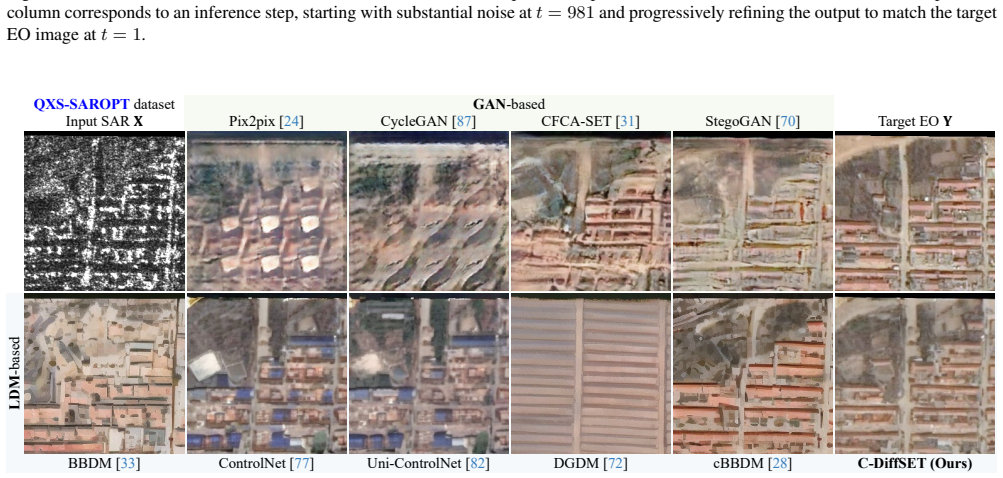
On the paper's own terms, the central discovery is that SET does not need a task-specific generative model trained from scratch. The frozen VAE from a natural-image latent diffusion model encodes both SAR and EO inputs into a shared latent space, with reconstruction error low even under heavy speckle noise; the full U-Net is then fine-tuned with the SAR latent as conditioning, and a confidence map output modulates the denoising loss. The resulting model, C-DiffSET, is claimed to achieve the best FID, LPIPS, SSIM, SCC, and PSNR on QXS-SAROPT, SAR2Opt, and SpaceNet6, with the confidence map making outputs structurally reliable while suppressing artifacts and hallucinations in temporally inconsistent regions.
Load-bearing premise
The central claim assumes that the learned confidence map marks on-the-ground temporal differences (objects that actually appear or disappear between passes) rather than simply suppressing any content that is hard to predict.
Editorial extensions
If this is right
- If the claim holds, SAR-to-EO translation inherits the natural-image priors of a large pretrained diffusion model, so paired-data scarcity is no longer the main bottleneck.
- SAR inputs can be fed through a natural-image VAE in either single- or full-polarization form, avoiding task-specific encoders.
- Temporal discrepancies stop corrupting training: the model learns to de-emphasize regions where objects appear or disappear rather than hallucinating them.
- The same shared latent-space trick should transfer to other remote sensing translations where EO appearance matches natural image statistics.
- With 50 DDIM inference steps, the framework becomes practical for high-resolution outputs while keeping state-of-the-art metrics.
Reading between the lines
- Beyond the paper's benchmarks, the same recipe of fine-tuning a pretrained text-to-image diffusion model with a pixel-wise confidence branch could be applied to other paired translation tasks with temporal misalignment, such as cloud removal or map-to-aerial update, where the confidence map might serve as an unsupervised change signal.
- If the VAE alignment observation generalizes, a direct latent-distance measure between SAR and EO distributions before and after fine-tuning would quantify how much of the gain is due to the shared latent space versus the learned mapping; the paper reports reconstruction qualitatively but does not compute such a distance.
- A testable extension is to evaluate confidence maps against known ground-truth change masks in multi-temporal data; if the maps mark real changes, they could become a practical by-product for change detection.
Editorial analysis
A structured set of objections, weighed in public.
Referee Report
Summary. The paper proposes C-DiffSET, a SAR-to-EO image translation method built by fine-tuning a pretrained Stable Diffusion v2.1 latent diffusion model. The frozen VAE embeds both SAR and EO images into the same latent space; the SAR latent is concatenated channel-wise with the noisy EO latent and fed to the U-Net, which predicts both the noise and a SoftPlus-transformed pixel-wise confidence map. The training objective is a confidence-weighted diffusion loss inspired by beta-NLL, intended to downweight temporally inconsistent regions such as objects that appear or disappear between acquisitions. The method is evaluated on QXS-SAROPT, SAR2Opt, and SpaceNet6 against GAN-based and LDM-based baselines, with reported improvements in FID, LPIPS, SCC, SSIM, and PSNR, plus ablations for the pretrained initialization, the confidence loss, the text prompt, and the number of inference steps.
Significance. If the central mechanism is validated, the paper would make a useful contribution: it shows that a pretrained LDM can be adapted to SAR-to-EO translation with a relatively simple conditioning scheme, and the claim that the frozen SD VAE embeds SAR and EO in a shared latent space is concrete and testable. The empirical comparison uses external ground-truth metrics and external baselines, and the VAE-reconstruction upper-bound analysis in Tables 4-6 is a good practice. The main weakness is that the paper's signature contribution, confidence-guided reliable object generation, rests almost entirely on a qualitative figure; the same network predicts both the noise and the confidence that weights the noise loss, so the mechanism needs stronger quantitative support before the central claim can be accepted.
major comments (3)
- [Sec. 3.3, Eq. (3)] The C-Diff loss as displayed is not a well-defined beta-NLL objective and does not reduce to MSE at beta=0. With c_t^beta = 1, the printed expression evaluates to ||(epsilon - epsilon_hat_t) + log(1+tau)||^2 if the log term is inside the norm, or to ||epsilon - epsilon_hat_t||^2 - log(1+tau) if it is outside; neither is the MSE loss used in the ablations. Please restate the loss with explicit norm placement and additive/multiplicative structure, and verify the beta=0 limit. This is required to audit the C-Diff-versus-MSE comparisons in Tables 3 and 8.
- [Sec. 3.3 and Sec. 4.4, Fig. 6] The central claim that the confidence map c_t identifies temporal discrepancies is not quantitatively validated. Because the same U-Net predicts both epsilon_hat_t and c_t, the objective in Eq. (3) can be minimized by assigning low confidence to any hard-to-predict region; the log term prevents global collapse but does not anchor low confidence to true appearing/disappearing objects. Figure 6 is qualitative only. Please add a quantitative evaluation linking low-confidence pixels to known temporal changes (for example, ships present in only one acquisition), or a control showing that deweighted regions do not contain legitimate target structure. Without such evidence, the reported improvements of C-Diff over MSE in Tables 3 and 8 are equally consistent with the model learning to avoid committing in difficult regions.
- [Sec. 4.3, Tables 1-2] The comparison with ControlNet and Uni-ControlNet is not controlled for parameter updates. C-DiffSET fine-tunes the pretrained U-Net, while the ControlNet methods are designed to keep it frozen; initializing all methods from the same SD v2.1 weights does not remove this confound. A ControlNet-style variant of C-DiffSET, or a frozen-U-Net version of the proposed conditioning scheme, would clarify whether the large reported margins come from the confidence-guided loss and latent concatenation or simply from full fine-tuning of the pretrained U-Net.
minor comments (5)
- [Table 9] The ablation table labeled "SpaceNet6 Dataset" reports exactly the SAR2Opt numbers from Table 1 (FID 77.81, LPIPS 0.346, SCC 0.0035, SSIM 0.286, PSNR 16.613); also, the prompt string is misspelled as "Eletro-Optical Image" instead of "Electro-Optical Image".
- [Sec. 3.4, Eq. (4)] The inference equation uses "Dummy" confidence values, but the paper never defines what Dummy is; if the confidence head is not used at inference, this should be stated explicitly.
- [Fig. 4 and Sec. 4.2] The speckle-noise levels sigma_x = 0.1 and 1.0 in Fig. 4 are not defined; please specify the noise model and how these values were applied to the SAR images.
- [Sec. 4.3] The paper says official implementations were used for general methods, but SET-specific methods marked with a dagger were re-implemented from technical descriptions; providing code or detailed reimplementation settings would improve reproducibility and confidence in the comparison.
- [Sec. 1, contributions] There is a typo in the contributions list: "mistigate" should be "mitigate".
Circularity Check
No significant circularity: benchmarked results are external, and the confidence mechanism is an unvalidated interpretation rather than a definitional reduction.
full rationale
C-DiffSET's headline claims are measured against external ground-truth EO images and external baselines, and the load-bearing ingredients (Stable Diffusion v2.1, the frozen VAE, the β-NLL formulation of Seitzer et al., and all three datasets) are external and independently established. The 'same latent space' claim is an empirical observation supported by VAE reconstruction experiments (Figs. 4 and 7), not a definitional equivalence: no equation defines SAR-EO alignment in terms of the translation output. The C-Diff loss is a proposed training objective, and the confidence map is a learned auxiliary output; the assertion that it reflects temporal discrepancies is a semantic interpretation offered in Sec. 3.3 and illustrated only qualitatively in Fig. 6. This is an unvalidated mechanism, not a circular reduction, because no equation defines temporal discrepancy in terms of ĉ_t, and the quantitative metrics are evaluated on held-out data against external references. The authors' self-citations [31, 32, 73] appear only as baselines or related work and do not carry the central argument. Two non-circular concerns remain: the printed Eq. (3) does not literally reduce to a standard MSE loss at β=0 when τ = log 2π, and the confidence map's temporal-discrepancy semantics lack quantitative validation against known discrepancies; both are correctness/auditability issues rather than evidence of circularity.
Assumptions & free parameters
free parameters (4)
- beta (confidence exponent in LC-Diff) =
1
- Fixed text prompt =
"electro-optical image"
- Total DDIM inference steps (Ttest) =
50
- Tau (margin term in LC-Diff) =
log 2*pi (from Seitzer et al. [53])
assumptions (6)
- domain assumption Stable Diffusion v2.1's VAE embeds both SAR and EO images into a shared latent space where the diffusion U-Net can condition SAR latents onto EO denoising.
- domain assumption The frozen VAE's reconstruction D_vae(E_vae(Y)) is an upper bound on achievable translation quality.
- standard math DDPM forward process with T=1,000 training steps and DDIM with 50 steps defines the noise schedule and reverse SDE.
- standard math The log term in LC-Diff prevents the confidence map from collapsing to zero, and SoftPlus keeps c_t non-negative.
- domain assumption Text conditioning through the frozen CLIP text encoder with a fixed prompt steers EO-like appearance.
- domain assumption Spatial downsampling by 8x in the VAE inherently alleviates local spatial misalignments.
Cite this review
Pith. "Pith review of C-DiffSET: Leveraging Latent Diffusion for SAR-to-EO Image Translation with Confidence-Guided Reliable Object Generation." pith.science (2026). https://pith.science/paper/FJHPGGPB
@misc{pith2026241110788,
  author       = {Pith},
  title        = {Pith review of: C-DiffSET: Leveraging Latent Diffusion for SAR-to-EO Image Translation with Confidence-Guided Reliable Object Generation},
  year         = {2026},
  howpublished = {\url{https://pith.science/paper/FJHPGGPB}},
  note         = {Machine review of arXiv:2411.10788}
}
read the original abstract
Synthetic Aperture Radar (SAR) imagery provides robust environmental and temporal coverage (e.g., during clouds, seasons, day-night cycles), yet its noise and unique structural patterns pose interpretation challenges, especially for non-experts. SAR-to-EO (Electro-Optical) image translation (SET) has emerged to make SAR images more perceptually interpretable. However, traditional approaches trained from scratch on limited SAR-EO datasets are prone to overfitting. To address these challenges, we introduce Confidence Diffusion for SAR-to-EO Translation, called C-DiffSET, a framework leveraging pretrained Latent Diffusion Model (LDM) extensively trained on natural images, thus enabling effective adaptation to the EO domain. Remarkably, we find that the pretrained VAE encoder aligns SAR and EO images in the same latent space, even with varying noise levels in SAR inputs. To further improve pixel-wise fidelity for SET, we propose a confidence-guided diffusion (C-Diff) loss that mitigates artifacts from temporal discrepancies, such as appearing or disappearing objects, thereby enhancing structural accuracy. C-DiffSET achieves state-of-the-art (SOTA) results on multiple datasets, significantly outperforming the very recent image-to-image translation methods and SET methods with large margins.
Figures


Figures from the paper (17 more)




Forward citations
Cited by 1 Pith paper
-
PAN-Crafter: Learning Modality-Consistent Alignment for PAN-Sharpening
A new pansharpening architecture with joint PAN/MS reconstruction and local cross-modality attention reports the best published scores on WorldView-3, QuickBird, GaoFen-2, and zero-shot WorldView-2 benchmarks.
Reference graph
Works this paper leans on
-
[1]
Rethinking the truly unsupervised image-to-image translation
Kyungjune Baek, Yunjey Choi, Youngjung Uh, Jaejun Yoo, and Hyunjung Shim. Rethinking the truly unsupervised image-to-image translation. InProceedings of the IEEE/CVF international conference on computer vision , pages 14154– 14163, 2021. 3
2021
-
[2]
Sar to optical image translation with color supervised diffusion model
Xinyu Bai and Feng Xu. Sar to optical image translation with color supervised diffusion model. In IGARSS 2024- 2024 IEEE International Geoscience and Remote Sensing Symposium, pages 963–966. IEEE, 2024. 3
2024
-
[3]
Conditional diffusion for sar to optical image translation
Xinyu Bai, Xinyang Pu, and Feng Xu. Conditional diffusion for sar to optical image translation. IEEE Geoscience and Remote Sensing Letters, 2023. 3
2023
-
[4]
Hybrid compact polarimetric sar for environ- mental monitoring with the radarsat constellation mission
Brian Brisco, Masoud Mahdianpari, and Fariba Moham- madimanesh. Hybrid compact polarimetric sar for environ- mental monitoring with the radarsat constellation mission. Remote Sensing, 12(20):3283, 2020. 2
2020
-
[5]
Sar-to-eo image translation with multi- conditional adversarial networks
Armando Cabrera, Miriam Cha, Prafull Sharma, and Michael Newey. Sar-to-eo image translation with multi- conditional adversarial networks. In 2021 55th Asilomar Conference on Signals, Systems, and Computers , pages 1710–1714. IEEE, 2021. 3
2021
-
[6]
Reusing discriminators for encoding: Towards unsupervised image-to-image translation
Runfa Chen, Wenbing Huang, Binghui Huang, Fuchun Sun, and Bin Fang. Reusing discriminators for encoding: Towards unsupervised image-to-image translation. In Proceedings of the IEEE/CVF conference on computer vision and pattern recognition, pages 8168–8177, 2020. 3
2020
-
[7]
Stargan: Unified genera- tive adversarial networks for multi-domain image-to-image translation
Yunjey Choi, Minje Choi, Munyoung Kim, Jung-Woo Ha, Sunghun Kim, and Jaegul Choo. Stargan: Unified genera- tive adversarial networks for multi-domain image-to-image translation. In Proceedings of the IEEE conference on computer vision and pattern recognition, pages 8789–8797,
-
[8]
Mihai Datcu, Zhongling Huang, Andrei Anghel, Juanping Zhao, and Remus Cacoveanu. Explainable, physics-aware, trustworthy artificial intelligence: A paradigm shift for syn- thetic aperture radar. IEEE Geoscience and Remote Sensing Magazine, 11(1):8–25, 2023. 2, 3
work page 2023
Show all 87 references
-
[9]
Gan-based sar-to-optical image translation with re- gion information
Kento Doi, Ken Sakurada, Masaki Onishi, and Akira Iwasaki. Gan-based sar-to-optical image translation with re- gion information. In IGARSS 2020-2020 IEEE International Geoscience and Remote Sensing Symposium , pages 2069–
2020
-
[10]
Incorporating second-order func- tional knowledge for better option pricing
Charles Dugas, Yoshua Bengio, Franc ¸ois B ´elisle, Claude Nadeau, and Ren´e Garcia. Incorporating second-order func- tional knowledge for better option pricing. Advances in neu- ral information processing systems, 13, 2000. 5
2000
-
[11]
Scaling recti- fied flow transformers for high-resolution image synthesis
Patrick Esser, Sumith Kulal, Andreas Blattmann, Rahim Entezari, Jonas M ¨uller, Harry Saini, Yam Levi, Dominik Lorenz, Axel Sauer, Frederic Boesel, et al. Scaling recti- fied flow transformers for high-resolution image synthesis. In Forty-first International Conference on Mach...
2024
-
[12]
Cloud removal with fusion of high resolution optical and sar images using generative adversarial networks
Jianhao Gao, Qiangqiang Yuan, Jie Li, Hai Zhang, and Xin Su. Cloud removal with fusion of high resolution optical and sar images using generative adversarial networks. Remote Sensing, 12(1):191, 2020. 2
2020
-
[13]
Some fundamental properties of speckle
Joseph W Goodman. Some fundamental properties of speckle. JOSA, 66(11):1145–1150, 1976. 2, 3
1976
-
[14]
A compar- ison of deep learning object detection models for satellite imagery
Austen Groener, Gary Chern, and Mark Pritt. A compar- ison of deep learning object detection models for satellite imagery. In 2019 IEEE applied imagery pattern recognition workshop (AIPR), pages 1–10. IEEE, 2019. 2
2019
-
[15]
Learning sar-to-optical image translation via diffusion models with color memory
Zhe Guo, Jiayi Liu, Qinglin Cai, Zhibo Zhang, and Shaohui Mei. Learning sar-to-optical image translation via diffusion models with color memory. IEEE Journal of Selected Topics in Applied Earth Observations and Remote Sensing, 2024. 2, 3
2024
-
[16]
Lotus: Diffusion-based visual foundation model for high-quality dense prediction
Jing He, Haodong Li, Wei Yin, Yixun Liang, Leheng Li, Kaiqiang Zhou, Hongbo Liu, Bingbing Liu, and Ying- Cong Chen. Lotus: Diffusion-based visual foundation model for high-quality dense prediction. arXiv preprint arXiv:2409.18124, 2024. 4
2024 arXiv
-
[17]
Gans trained by a two time-scale update rule converge to a local nash equilib- rium
Martin Heusel, Hubert Ramsauer, Thomas Unterthiner, Bernhard Nessler, and Sepp Hochreiter. Gans trained by a two time-scale update rule converge to a local nash equilib- rium. Advances in neural information processing systems , 30, 2017. 6
2017
-
[18]
Denoising dif- fusion probabilistic models
Jonathan Ho, Ajay Jain, and Pieter Abbeel. Denoising dif- fusion probabilistic models. Advances in neural information processing systems, 33:6840–6851, 2020. 3, 5, 6
2020
-
[19]
The qxs-saropt dataset for deep learning in sar-optical data fusion
Meiyu Huang, Yao Xu, Lixin Qian, Weili Shi, Yaqin Zhang, Wei Bao, Nan Wang, Xuejiao Liu, and Xueshuang Xiang. The qxs-saropt dataset for deep learning in sar-optical data fusion. arXiv preprint arXiv:2103.08259, 2021. 3, 6
2021 arXiv
-
[20]
Multimodal unsupervised image-to-image translation
Xun Huang, Ming-Yu Liu, Serge Belongie, and Jan Kautz. Multimodal unsupervised image-to-image translation. In Proceedings of the European conference on computer vision (ECCV), pages 172–189, 2018. 3
2018
-
[21]
A hybrid and explainable deep learning framework for sar im- ages
Zhongling Huang, Mihai Datcu, Zongxu Pan, and Bin Lei. A hybrid and explainable deep learning framework for sar im- ages. In IGARSS 2020-2020 IEEE International Geoscience and Remote Sensing Symposium , pages 1727–1730. IEEE,
2020
-
[22]
Globally and locally consistent image completion
Satoshi Iizuka, Edgar Simo-Serra, and Hiroshi Ishikawa. Globally and locally consistent image completion. ACM Transactions on Graphics (ToG), 36(4):1–14, 2017. 3
2017
-
[23]
Open clip, 2021
Gabriel Ilharco, Mitchell Wortsman, Nicholas Carlini, Rohan Taori, Achal Dave, Vaishaal Shankar, Hongseok Namkoong, John Miller, Hannaneh Hajishirzi, Ali Farhadi, and Ludwig Schmidt. Open clip, 2021. 6
2021
-
[24]
Image-to-image translation with conditional adver- sarial networks
Phillip Isola, Jun-Yan Zhu, Tinghui Zhou, and Alexei A Efros. Image-to-image translation with conditional adver- sarial networks. In Proceedings of the IEEE conference on computer vision and pattern recognition, pages 1125–1134,
-
[25]
Sar image colorization using mul- tidomain cycle-consistency generative adversarial network
Guang Ji, Zhaohui Wang, Lifan Zhou, Yu Xia, Shan Zhong, and Shengrong Gong. Sar image colorization using mul- tidomain cycle-consistency generative adversarial network. IEEE Geoscience and Remote Sensing Letters , 18(2):296– 300, 2020. 2, 3
2020
-
[26]
Repurpos- ing diffusion-based image generators for monocular depth 17 estimation
Bingxin Ke, Anton Obukhov, Shengyu Huang, Nando Met- zger, Rodrigo Caye Daudt, and Konrad Schindler. Repurpos- ing diffusion-based image generators for monocular depth 17 estimation. In Proceedings of the IEEE/CVF Conference on Computer Vision and Pattern Recognition , pages 9...
2024
-
[27]
Instaformer: Instance-aware image-to-image translation with transformer
Soohyun Kim, Jongbeom Baek, Jihye Park, Gyeongnyeon Kim, and Seungryong Kim. Instaformer: Instance-aware image-to-image translation with transformer. InProceedings of the IEEE/CVF Conference on Computer Vision and Pat- tern Recognition, pages 18321–18331, 2022. 3
2022
-
[28]
Conditional brownian bridge diffusion model for vhr sar to optical image transla- tion
Seon-Hoon Kim and Dae-won Chung. Conditional brownian bridge diffusion model for vhr sar to optical image transla- tion. arXiv preprint arXiv:2408.07947, 2024. 2, 3, 6, 8, 9, 10
2024 arXiv
-
[29]
Auto-encoding variational bayes
Diederik P Kingma. Auto-encoding variational bayes. arXiv preprint arXiv:1312.6114, 2013. 2
2013 arXiv
-
[30]
Multi- scale translation method from sar to optical remote sensing images based on conditional generative adversarial network
Yingying Kong, Siyuan Liu, and Xiangyang Peng. Multi- scale translation method from sar to optical remote sensing images based on conditional generative adversarial network. International Journal of Remote Sensing, 43(8):2837–2860,
-
[31]
Cfca-set: Coarse-to-fine context-aware sar-to-eo translation with auxiliary learning of sar-to-nir translation
Jaehyup Lee, Hyebin Cho, Doochun Seo, Hyun-Ho Kim, Jaeheon Jeong, and Munchurl Kim. Cfca-set: Coarse-to-fine context-aware sar-to-eo translation with auxiliary learning of sar-to-nir translation. IEEE Transactions on Geoscience and Remote Sensing, 2023. 2, 3, 6, 8, 9, 10
2023
-
[32]
Segmentation-guided context learning using eo object labels for stable sar-to-eo translation
Jaehyup Lee, Hyun-Ho Kim, Doochun Seo, and Munchurl Kim. Segmentation-guided context learning using eo object labels for stable sar-to-eo translation. IEEE Geoscience and Remote Sensing Letters, 2023. 2, 3
2023
-
[33]
Bbdm: Image- to-image translation with brownian bridge diffusion models
Bo Li, Kaitao Xue, Bin Liu, and Yu-Kun Lai. Bbdm: Image- to-image translation with brownian bridge diffusion models. In Proceedings of the IEEE/CVF conference on computer vi- sion and pattern Recognition, pages 1952–1961, 2023. 3, 6, 8, 9, 10
1952
-
[34]
A deep translation (gan) based change detection net- work for optical and sar remote sensing images
Xinghua Li, Zhengshun Du, Yanyuan Huang, and Zhenyu Tan. A deep translation (gan) based change detection net- work for optical and sar remote sensing images. ISPRS Journal of Photogrammetry and Remote Sensing , 179:14– 34, 2021. 3
2021
-
[35]
Smoothing the disentangled latent style space for unsupervised image-to-image translation
Yahui Liu, Enver Sangineto, Yajing Chen, Linchao Bao, Haoxian Zhang, Nicu Sebe, Bruno Lepri, Wei Wang, and Marco De Nadai. Smoothing the disentangled latent style space for unsupervised image-to-image translation. In Pro- ceedings of the IEEE/CVF conference on computer vision ...
2021
-
[36]
Swin transformer: Hierarchical vision transformer using shifted windows
Ze Liu, Yutong Lin, Yue Cao, Han Hu, Yixuan Wei, Zheng Zhang, Stephen Lin, and Baining Guo. Swin transformer: Hierarchical vision transformer using shifted windows. In Proceedings of the IEEE/CVF international conference on computer vision, pages 10012–10022, 2021. 3
2021
-
[37]
Decoupled weight decay regularization
I Loshchilov. Decoupled weight decay regularization. arXiv preprint arXiv:1711.05101, 2017. 6
2017 arXiv
-
[38]
Sgdr: Stochas- tic gradient descent with warm restarts
Ilya Loshchilov and Frank Hutter. Sgdr: Stochas- tic gradient descent with warm restarts. arXiv preprint arXiv:1608.03983, 2016. 6
2016 arXiv
-
[39]
Land cover change detection with heterogeneous remote sensing images: Review, progress, and perspective
ZhiYong Lv, HaiTao Huang, Xinghua Li, MingHua Zhao, J´on Atli Benediktsson, WeiWei Sun, and Nicola Falco. Land cover change detection with heterogeneous remote sensing images: Review, progress, and perspective. Proceedings of the IEEE, 110(12):1976–1991, 2022. 2
1976
-
[40]
Iterative training sample augmentation for enhancing land cover change detection per- formance with deep learning neural network
Zhiyong Lv, Haitao Huang, Weiwei Sun, Meng Jia, J ´on Atli Benediktsson, and Fengrui Chen. Iterative training sample augmentation for enhancing land cover change detection per- formance with deep learning neural network. IEEE Transac- tions on Neural Networks and Learning Syst...
2023
-
[41]
Novel piecewise dis- tance based on adaptive region key-points extraction for lccd with vhr remote-sensing images
Zhiyong Lv, Pingdong Zhong, Wei Wang, Zhenzhen You, J´on Atli Benediktsson, and Cheng Shi. Novel piecewise dis- tance based on adaptive region key-points extraction for lccd with vhr remote-sensing images. IEEE Transactions on Geo- science and Remote Sensing, 61:1–9, 2023. 2
2023
-
[42]
Cloud removal in sentinel-2 imagery using a deep residual neural network and sar-optical data fusion
Andrea Meraner, Patrick Ebel, Xiao Xiang Zhu, and Michael Schmitt. Cloud removal in sentinel-2 imagery using a deep residual neural network and sar-optical data fusion. ISPRS Journal of Photogrammetry and Remote Sensing , 166:333– 346, 2020. 2
2020
-
[43]
Automatic differentiation in pytorch
Adam Paszke, Sam Gross, Soumith Chintala, Gregory Chanan, Edward Yang, Zachary DeVito, Zeming Lin, Al- ban Desmaison, Luca Antiga, and Adam Lerer. Automatic differentiation in pytorch. 2017. 6
2017
-
[44]
Context encoders: Feature learning by inpainting
Deepak Pathak, Philipp Krahenbuhl, Jeff Donahue, Trevor Darrell, and Alexei A Efros. Context encoders: Feature learning by inpainting. In Proceedings of the IEEE con- ference on computer vision and pattern recognition , pages 2536–2544, 2016. 3
2016
-
[45]
Sdxl: Improving latent diffusion mod- els for high-resolution image synthesis
Dustin Podell, Zion English, Kyle Lacey, Andreas Blattmann, Tim Dockhorn, Jonas M ¨uller, Joe Penna, and Robin Rombach. Sdxl: Improving latent diffusion mod- els for high-resolution image synthesis. arXiv preprint arXiv:2307.01952, 2023. 4
2023 arXiv
-
[46]
Learning transferable visual models from natural language supervi- sion
Alec Radford, Jong Wook Kim, Chris Hallacy, Aditya Ramesh, Gabriel Goh, Sandhini Agarwal, Girish Sastry, Amanda Askell, Pamela Mishkin, Jack Clark, et al. Learning transferable visual models from natural language supervi- sion. In International conference on machine learning, ...
2021
-
[47]
High-resolution image synthesis with latent diffusion models
Robin Rombach, Andreas Blattmann, Dominik Lorenz, Patrick Esser, and Bj ¨orn Ommer. High-resolution image synthesis with latent diffusion models. In Proceedings of the IEEE/CVF conference on computer vision and pattern recognition, pages 10684–10695, 2022. 2, 3, 4, 6
2022
-
[48]
U- net: Convolutional networks for biomedical image segmen- tation
Olaf Ronneberger, Philipp Fischer, and Thomas Brox. U- net: Convolutional networks for biomedical image segmen- tation. In Medical image computing and computer-assisted intervention–MICCAI 2015: 18th international conference, Munich, Germany, October 5-9, 2015, proceedings, pa...
2015
-
[49]
Palette: Image-to-image diffusion models
Chitwan Saharia, William Chan, Huiwen Chang, Chris Lee, Jonathan Ho, Tim Salimans, David Fleet, and Mohammad Norouzi. Palette: Image-to-image diffusion models. In ACM SIGGRAPH 2022 conference proceedings, pages 1–10,
2022
-
[50]
The sen1-2 dataset for deep learning in sar-optical data fusion
Michael Schmitt, Lloyd Haydn Hughes, and Xiao Xiang Zhu. The sen1-2 dataset for deep learning in sar-optical data fusion. arXiv preprint arXiv:1807.01569, 2018. 2, 9
2018 arXiv
-
[51]
Laion-5b: An open large-scale dataset for training next generation image-text models
Christoph Schuhmann, Romain Beaumont, Richard Vencu, Cade Gordon, Ross Wightman, Mehdi Cherti, Theo 18 Coombes, Aarush Katta, Clayton Mullis, Mitchell Worts- man, et al. Laion-5b: An open large-scale dataset for training next generation image-text models. Advances in Neural In...
2022
-
[52]
Plfm: Pixel-level merging of intermediate feature maps by disentangling and fusing spatial and temporal data for cloud removal
Alessandro Sebastianelli, Erika Puglisi, Maria Pia Del Rosso, Jamila Mifdal, Artur Nowakowski, Pierre Philippe Mathieu, Fiora Pirri, and Silvia Liber- ata Ullo. Plfm: Pixel-level merging of intermediate feature maps by disentangling and fusing spatial and temporal data for clo...
2022
-
[53]
On the pitfalls of heteroscedastic uncertainty estimation with probabilistic neural networks.arXiv preprint arXiv:2203.09168, 2022
Maximilian Seitzer, Arash Tavakoli, Dimitrije Antic, and Georg Martius. On the pitfalls of heteroscedastic uncertainty estimation with probabilistic neural networks.arXiv preprint arXiv:2203.09168, 2022. 5, 11
2022 arXiv
-
[54]
Improved flood insights: Diffusion-based sar to eo image translation
Minseok Seo, Youngtack Oh, Doyi Kim, Dongmin Kang, and Yeji Choi. Improved flood insights: Diffusion-based sar to eo image translation. arXiv preprint arXiv:2307.07123 ,
-
[55]
Spatially-adaptive pixel- wise networks for fast image translation
Tamar Rott Shaham, Micha ¨el Gharbi, Richard Zhang, Eli Shechtman, and Tomer Michaeli. Spatially-adaptive pixel- wise networks for fast image translation. In Proceedings of the IEEE/CVF Conference on Computer Vision and Pattern Recognition, pages 14882–14891, 2021. 3
2021
-
[56]
Spacenet 6: Multi-sensor all weather mapping dataset
Jacob Shermeyer, Daniel Hogan, Jason Brown, Adam Van Etten, Nicholas Weir, Fabio Pacifici, Ronny Han- sch, Alexei Bastidas, Scott Soenen, Todd Bacastow, et al. Spacenet 6: Multi-sensor all weather mapping dataset. In Proceedings of the IEEE/CVF conference on computer vi- sion ...
-
[57]
Extraction of bridge features from high- resolution insar data and optical images
Uwe Soergel, Antje Thiele, Hermann Gross, and Ulrich Thoennessen. Extraction of bridge features from high- resolution insar data and optical images. In 2007 Urban Re- mote Sensing Joint Event, pages 1–6. IEEE, 2007. 2, 3
2007
-
[58]
Denoising diffusion implicit models
Jiaming Song, Chenlin Meng, and Stefano Ermon. Denoising diffusion implicit models. arXiv preprint arXiv:2010.02502, 2020. 6, 10
2010 arXiv
-
[59]
Time- frequency analysis in high-resolution sar imagery
Marc Spigai, C ´eline Tison, and Jean-Claude Souyris. Time- frequency analysis in high-resolution sar imagery. IEEE Transactions on Geoscience and Remote Sensing , 49(7): 2699–2711, 2011. 3
2011
-
[60]
Transport infrastructure monitoring by data fusion of gpr and sar imagery information
Fabio Tosti, Valerio Gagliardi, Fabrizio D’Amico, and Amir M Alani. Transport infrastructure monitoring by data fusion of gpr and sar imagery information. Transportation Research Procedia, 45:771–778, 2020. 2
2020
-
[61]
Three-dimensional topographic mapping with aster stereo data in rugged topography
Thierry Toutin. Three-dimensional topographic mapping with aster stereo data in rugged topography. IEEE Transac- tions on geoscience and remote sensing, 40(10):2241–2247,
-
[62]
You only look twice: Rapid multi- scale object detection in satellite imagery
Adam Van Etten. You only look twice: Rapid multi- scale object detection in satellite imagery. arXiv preprint arXiv:1805.09512, 2018. 2
2018 arXiv
-
[63]
Diffusers: State-of-the-art diffu- sion models
Patrick von Platen, Suraj Patil, Anton Lozhkov, Pedro Cuenca, Nathan Lambert, Kashif Rasul, Mishig Davaadorj, Dhruv Nair, Sayak Paul, William Berman, Yiyi Xu, Steven Liu, and Thomas Wolf. Diffusers: State-of-the-art diffu- sion models. https://github.com/huggingface/ diffusers...
2022
-
[64]
Generating high quality visible images from sar images using cnns
Puyang Wang and Vishal M Patel. Generating high quality visible images from sar images using cnns. In 2018 IEEE Radar Conference (RadarConf18), pages 0570–0575. IEEE,
2018
-
[65]
Sea-raft: Simple, efficient, accurate raft for optical flow
Yihan Wang, Lahav Lipson, and Jia Deng. Sea-raft: Simple, efficient, accurate raft for optical flow. In European Confer- ence on Computer Vision, pages 36–54. Springer, 2025. 5
2025
-
[66]
Image quality assessment: from error visibility to structural similarity
Zhou Wang, Alan C Bovik, Hamid R Sheikh, and Eero P Si- moncelli. Image quality assessment: from error visibility to structural similarity. IEEE transactions on image processing, 13(4):600–612, 2004. 6
2004
-
[67]
Cfrwd-gan for sar-to-optical image translation
Juan Wei, Huanxin Zou, Li Sun, Xu Cao, Shitian He, Shuo Liu, and Yuqing Zhang. Cfrwd-gan for sar-to-optical image translation. Remote Sensing, 15(10):2547, 2023. 3
2023
-
[68]
A collection of sar methodolo- gies for monitoring wetlands
Lori White, Brian Brisco, Mohammed Dabboor, Andreas Schmitt, and Andrew Pratt. A collection of sar methodolo- gies for monitoring wetlands. Remote sensing, 7(6):7615– 7645, 2015. 2
2015
-
[69]
Seesr: Towards semantics- aware real-world image super-resolution
Rongyuan Wu, Tao Yang, Lingchen Sun, Zhengqiang Zhang, Shuai Li, and Lei Zhang. Seesr: Towards semantics- aware real-world image super-resolution. In Proceedings of the IEEE/CVF conference on computer vision and pattern recognition, pages 25456–25467, 2024. 4
2024
-
[70]
Stegogan: Leveraging steganography for non-bijective image-to-image translation
Sidi Wu, Yizi Chen, Samuel Mermet, Lorenz Hurni, Konrad Schindler, Nicolas Gonthier, and Loic Landrieu. Stegogan: Leveraging steganography for non-bijective image-to-image translation. In Proceedings of the IEEE/CVF Conference on Computer Vision and Pattern Recognition , pages...
2024
-
[71]
Disaster monitoring by fully polarimet- ric sar data acquired with alos-palsar
Yoshio Yamaguchi. Disaster monitoring by fully polarimet- ric sar data acquired with alos-palsar. Proceedings of the IEEE, 100(10):2851–2860, 2012. 2
2012
-
[72]
Deterministic guidance diffusion model for probabilistic weather forecasting
Donggeun Yoon, Minseok Seo, Doyi Kim, Yeji Choi, and Donghyeon Cho. Deterministic guidance diffusion model for probabilistic weather forecasting. arXiv preprint arXiv:2312.02819, 2023. 3, 6, 8, 9, 10
2023 arXiv
-
[73]
Transformer-based synthetic-to-measured sar image translation via learning of representational features
Geunhyuk Youk and Munchurl Kim. Transformer-based synthetic-to-measured sar image translation via learning of representational features. IEEE Transactions on Geoscience and Remote Sensing, 61:1–18, 2023. 3, 6, 8, 10
2023
-
[74]
Diffusing colors: Image colorization with text guided diffusion
Nir Zabari, Aharon Azulay, Alexey Gorkor, Tavi Halperin, and Ohad Fried. Diffusing colors: Image colorization with text guided diffusion. In SIGGRAPH Asia 2023 Conference Papers, pages 1–11, 2023. 4
2023
-
[75]
Fec: A feature fusion framework for sar target recognition based on electromagnetic scattering features and deep cnn features
Jinsong Zhang, Mengdao Xing, and Yiyuan Xie. Fec: A feature fusion framework for sar target recognition based on electromagnetic scattering features and deep cnn features. IEEE Transactions on Geoscience and Remote Sensing , 59 (3):2174–2187, 2020. 3
2020
-
[76]
Feature- guided sar-to-optical image translation
Jiexin Zhang, Jianjiang Zhou, and Xiwen Lu. Feature- guided sar-to-optical image translation. Ieee Access , 8: 70925–70937, 2020. 2, 3
2020
-
[77]
Adding conditional control to text-to-image diffusion models
Lvmin Zhang, Anyi Rao, and Maneesh Agrawala. Adding conditional control to text-to-image diffusion models. In Proceedings of the IEEE/CVF international conference on computer vision, pages 3836–3847, 2023. 3, 6, 8, 9, 10 19
2023
-
[78]
Colorful image colorization
Richard Zhang, Phillip Isola, and Alexei A Efros. Colorful image colorization. In Computer Vision–ECCV 2016: 14th European Conference, Amsterdam, The Netherlands, Octo- ber 11-14, 2016, Proceedings, Part III 14 , pages 649–666. Springer, 2016. 3
2016
-
[79]
Real-time user-guided image colorization with learned deep priors
Richard Zhang, Jun-Yan Zhu, Phillip Isola, Xinyang Geng, Angela S Lin, Tianhe Yu, and Alexei A Efros. Real-time user-guided image colorization with learned deep priors. arXiv preprint arXiv:1705.02999, 2017. 3
2017 arXiv
-
[80]
The unreasonable effectiveness of deep features as a perceptual metric
Richard Zhang, Phillip Isola, Alexei A Efros, Eli Shecht- man, and Oliver Wang. The unreasonable effectiveness of deep features as a perceptual metric. In Proceedings of the IEEE conference on computer vision and pattern recogni- tion, pages 586–595, 2018. 6
2018
-
[81]
The characteristics of the multipath scattering and the ap- plication for geometry extraction in high-resolution sar im- ages
Yueting Zhang, Chibiao Ding, Xiaolan Qiu, and Fangfang Li. The characteristics of the multipath scattering and the ap- plication for geometry extraction in high-resolution sar im- ages. IEEE Transactions on Geoscience and Remote Sens- ing, 53(8):4687–4699, 2015. 2, 3
2015
-
[82]
Uni-controlnet: All-in-one control to text-to-image diffusion models
Shihao Zhao, Dongdong Chen, Yen-Chun Chen, Jianmin Bao, Shaozhe Hao, Lu Yuan, and Kwan-Yee K Wong. Uni-controlnet: All-in-one control to text-to-image diffusion models. Advances in Neural Information Processing Sys- tems, 36:11127–11150, 2023. 3, 6, 8, 9, 10
2023
-
[83]
A comparative analysis of gan-based methods for sar- to-optical image translation
Yitao Zhao, Turgay Celik, Nanqing Liu, and Heng-Chao Li. A comparative analysis of gan-based methods for sar- to-optical image translation. IEEE Geoscience and Remote Sensing Letters, 19:1–5, 2022. 3, 6, 9
2022
-
[84]
Ship surveillance by integration of space-borne sar and ais–review of current research
Zhi Zhao, Kefeng Ji, Xiangwei Xing, Huanxin Zou, and Shilin Zhou. Ship surveillance by integration of space-borne sar and ais–review of current research. The Journal of Navi- gation, 67(1):177–189, 2014. 2
2014
-
[85]
The spatially-correlative loss for various image translation tasks
Chuanxia Zheng, Tat-Jen Cham, and Jianfei Cai. The spatially-correlative loss for various image translation tasks. In Proceedings of the IEEE/CVF conference on computer vi- sion and pattern recognition, pages 16407–16417, 2021. 3
2021
-
[86]
A wavelet transform method to merge landsat tm and spot panchromatic data
Jie Zhou, Daniel L Civco, and John A Silander. A wavelet transform method to merge landsat tm and spot panchromatic data. International journal of remote sensing , 19(4):743– 757, 1998. 6
1998
-
[87]
Unpaired image-to-image translation using cycle- consistent adversarial networks
Jun-Yan Zhu, Taesung Park, Phillip Isola, and Alexei A Efros. Unpaired image-to-image translation using cycle- consistent adversarial networks. In Proceedings of the IEEE international conference on computer vision , pages 2223– 2232, 2017. 3, 6, 8, 9, 10 20
2017
Reviewed August 12, 2026 · model on record in the stance chip above.
Discussion (0). Continue with ORCID to comment.