Qurts: Automatic Quantum Uncomputation by Affine Types with Lifetime
Pith reviewed 2026-05-23 17:13 UTC · model grok-4.3
The pith
Qurts extends the Rust type system with lifetime-parameterized types to enable uniform automatic uncomputation for quantum data.
A machine-rendered reading of the paper's core claim, the machinery that carries it, and where it could break.
Core claim
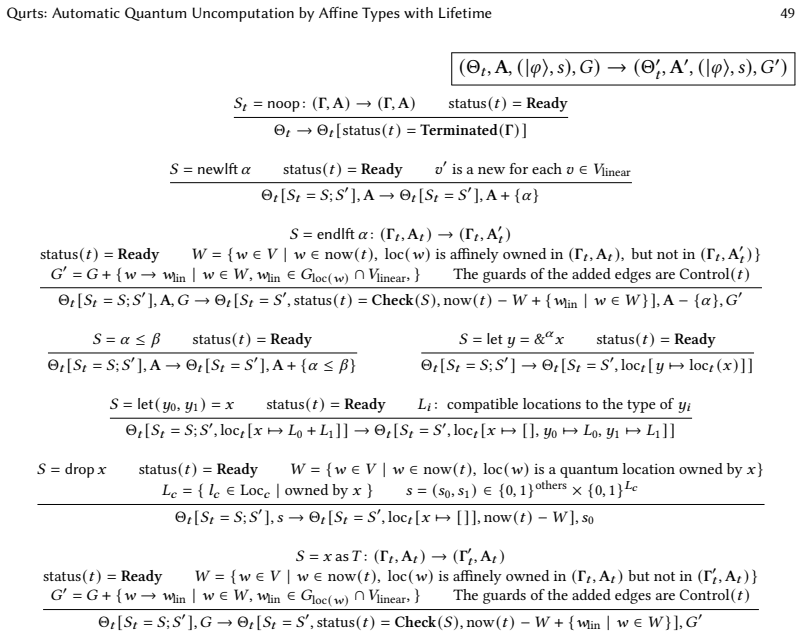
We extend the Rust type system to the quantum setting to give a uniform framework for automatic uncomputation called Qurts. Specifically, we parameterise types by lifetimes, permitting them to be affine during their lifetime, while being restricted to linear use outside their lifetime. We also provide two operational semantics: one based on classical simulation, and one that does not depend on any specific uncomputation strategy.
What carries the argument
Lifetime-parameterized types that permit affine use of quantum data only during the active lifetime and enforce linear use outside it.
If this is right
- Programmers gain the ability to treat quantum values affinely during a lifetime without manual uncomputation.
- Compilers obtain a systematic basis for resource reuse rather than language-specific ad-hoc rules.
- Quantum programs become expressible in a typed language that already supports affine and linear modes via lifetimes.
- Verification of uncomputation correctness can proceed from the type system independently of the chosen uncomputation algorithm.
Where Pith is reading between the lines
- The same lifetime mechanism could be lifted to other quantum languages that already embed Rust-like type systems.
- Resource accounting in larger quantum circuits might become automatic once lifetimes are inferred from control flow.
- Integration with existing Rust tooling could let quantum developers reuse borrow-checker diagnostics for uncomputation safety.
Load-bearing premise
Lifetime parameterization of types can capture the required distinction between linear and affine use for quantum information in a uniform way.
What would settle it
A concrete quantum program typed in Qurts where a value is discarded inside its lifetime yet the resulting circuit either loses information or violates linearity outside the lifetime.
Figures


read the original abstract
Uncomputation is a feature in quantum programming that allows the programmer to discard a value without losing quantum information, and that allows the compiler to reuse resources. Whereas quantum information has to be treated linearly by the type system, automatic uncomputation enables the programmer to treat it affinely to some extent. Automatic uncomputation requires a substructural type system between linear and affine, a subtlety that has only been captured by existing languages in an ad hoc way. We extend the Rust type system to the quantum setting to give a uniform framework for automatic uncomputation called Qurts (pronounced quartz). Specifically, we parameterise types by lifetimes, permitting them to be affine during their lifetime, while being restricted to linear use outside their lifetime. We also provide two operational semantics: one based on classical simulation, and one that does not depend on any specific uncomputation strategy.
Editorial analysis
A structured set of objections, weighed in public.
Referee Report
Summary. The paper introduces Qurts, an extension of the Rust type system to quantum programming. Types are parameterized by lifetimes so that quantum data may be used affinely within a lifetime and must be used linearly outside it; this is claimed to yield a uniform substructural type system supporting automatic uncomputation. Two operational semantics are supplied: one simulation-based and one independent of any particular uncomputation strategy.
Significance. If the operational semantics are shown to be sound with respect to the type rules, the work supplies a uniform, non-ad-hoc mechanism for the linear-to-affine transition required by automatic uncomputation. The explicit provision of two distinct semantics (simulation-based and strategy-independent) is a concrete strength that supports reproducibility and strategy-agnostic reasoning.
minor comments (3)
- [Abstract] The abstract states that the lifetime parameterization 'permits' affine use inside a lifetime and 'restricts' linear use outside it, but does not indicate whether the type rules enforce the restriction or merely allow it; a concrete example of a well-typed term that would be rejected without the lifetime discipline would clarify the claim.
- The two operational semantics are introduced without a statement of their relationship (e.g., whether the strategy-independent semantics is a quotient or abstraction of the simulation semantics). Adding a short paragraph relating the two would strengthen the presentation.
- No mention is made of how the lifetime discipline interacts with measurement or with classical control flow; a brief discussion of these interactions would help readers assess applicability to realistic quantum programs.
Simulated Author's Rebuttal
We thank the referee for their positive assessment of the manuscript and for recommending minor revision. The report accurately captures the core contribution of Qurts as a uniform framework for automatic uncomputation via lifetime-parameterized affine types, along with the provision of both simulation-based and strategy-independent operational semantics. No major comments were raised in the report.
Circularity Check
No significant circularity
full rationale
The paper's central contribution is the introduction of a new parameterization of types by lifetimes in an extension of the Rust type system to quantum settings, allowing affine use during a lifetime and linear use outside it. This is presented directly as a uniform framework for automatic uncomputation without any reduction to fitted parameters, self-definitional equations, or load-bearing self-citations. The abstract and description frame the work as a novel extension addressing ad hoc prior approaches, with operational semantics provided as independent support. No steps in the derivation chain reduce by construction to the inputs.
Axiom & Free-Parameter Ledger
axioms (2)
- domain assumption Quantum information has to be treated linearly by the type system
- ad hoc to paper A substructural type system between linear and affine can be captured uniformly by lifetime parameterization
Reference graph
Works this paper leans on
-
[1]
SQUARE: Strategic Quantum Ancilla Reuse for Modular Quantum Programs via Cost-Effective Uncomputation. In 47th ACM/IEEE Annual International Symposium on Computer Architecture, ISCA 2020, Virtual Event / Valencia, Spain, May 30 - June 3, 2020 . IEEE, 570–583. https://doi.org/10.1109/ISCA45697.2020.00054 Peng Fu, Kohei Kishida, Neil J. Ross, and Peter Seli...
-
[2]
ScaffCC: Scalable compilation and analysis of quantum programs. Parallel Comput. 45 (2015), 2–17. https: //doi.org/10.1016/j.parco.2014.12.001 Niels Kornerup, Jonathan Sadun, and David Soloveichik. 2024. Tight Bounds on the Spooky Pebble Game: Recycling Qubits with Measurements. arXiv:2110.08973 [quant-ph] Arun Kumar Pati and Samuel L. Braunstein. 2000. I...
discussion (0)
Sign in with ORCID, Apple, or X to comment. Anyone can read and Pith papers without signing in.