REVIEW 3 major objections 4 minor 39 references
Anomaly Detection for People with Visual Impairments Using an Egocentric 360-Degree Camera
T0 review · 3 major / 4 minor · reviewed 2026-08-12 · deepseek-v4-flash
Pith's one-line read FDPN detects frame-level anomalies in egocentric 360° video and sets state-of-the-art scores on three datasets.
desk verdict The VIEW360 dataset is a real contribution and the best reason to engage with this paper, but the frame-level SOTA claim is not supported by the training objective or the ablations. read the letter →
The pith
A machine-rendered reading of the paper's core claim, the machinery that carries it, and where it could break.
The reading
What carries the argument
The core mechanism is the coarse-to-fine pseudo-label pipeline: a pretrained snippet-level anomaly detector (RTFM on VIEW360, MGFN on UCF-Crime, CLIP-TSA on Shanghaitech) provides snippet scores, which are thresholded at 0.5 and duplicated across frames to form pseudo-labels P. The Frame Prediction Subnetwork (FPS), a sequence model inspired by PoolFormer (a pooling-based metaformer) that uses average pooling and 1D convolutions over concatenated ResNet features from saliency-masked frames and I3D snippet features, learns per-frame scores against these pseudo-labels. Saliency-driven image masking, using TASED-Net heatmaps and a top-K grid mask, narrows the input to visually striking regions, and the Direction Prediction Subnetwork (DPS) fuses the same representations with softmax-applied saliency values to output one of three directions. The loss is a weighted sum of binary focal loss, frame ranking loss, smoothness loss, and directional focal loss.
What would settle it
Training FDPN with pseudo-labels randomly shuffled among frames within each snippet, while keeping everything else fixed, would settle the question: if the final frame-level AUC on VIEW360 is unchanged, the subnetwork is only reproducing the teacher's snippet-level segmentation and the claimed boundary improvement does not exist.
Extended reading notes
Core claim
The central claim is that a coarse-to-fine learning scheme, in which a snippet-level teacher network generates pseudo-labels that are then used to train a frame-level student, yields more precise anomaly detection at event boundaries while also providing directional information. Concretely, FDPN first computes snippet-level anomaly scores from I3D features, thresholds them at 0.5 to create binary pseudo-labels, and replicates these labels across all 16 frames of a snippet. The Frame Prediction Subnetwork, combining masked-image ResNet features and snippet features, is trained with focal, ranking, and smoothness losses to output per-frame scores. A Direction Prediction Subnetwork uses the same features plus saliency heatmaps to classify events as Left back, Center, or Right back. The paper reports state-of-the-art frame-level results on VIEW360 (86.00 AUC-ROC, 26.97 AUC-PR), UCF-Crime (88.03 AUC-ROC), and Shanghaitech (98.51 AUC-ROC), and shows larger gains on short-duration anomalies than a snippet-level baseline.
Load-bearing premise
The frame-level subnetwork is trained with pseudo-labels that are identical for every frame in a snippet, so the method assumes these constant labels plus per-frame image features are enough to teach genuinely finer-grained boundaries, an assumption the paper does not directly verify.
Editorial extensions
If this is right
- Frame-level anomaly scores enable detection of short, abrupt events such as shoulder surfing and pickpocketing that snippet-level methods miss.
- The coarse-to-fine pseudo-label scheme improves performance on existing benchmarks without requiring new frame-level annotations.
- Direction predictions (Left back, Center, Right back) provide actionable spatial guidance for a visually impaired user's response.
- VIEW360 offers a new benchmark for egocentric 360-degree anomaly detection, with an average anomaly duration of 3.5 seconds.
Reading between the lines
- If the gain comes from frame-level refinement rather than the specific teacher, then plugging any stronger snippet-level detector into the coarse-to-fine pipeline should further improve frame-level scores; the paper's per-dataset teacher selection already suggests this dependency.
- Because saliency-driven masking operates on a fixed grid in the equirectangular projection, spherical distortion near the poles is left unhandled; a spherical-aware masking scheme could be a natural extension.
- The reported processing speed of 1.7 FPS falls short of real-time use, so practical assistive deployment would require a lighter frame-level branch or running the saliency and frame branches only on selected regions; the authors acknowledge this as a limitation.
Signed reviews
Editorial analysis
A structured set of objections, weighed in public.
Referee Report
Summary. The paper introduces VIEW360, a new egocentric 360-degree video anomaly detection dataset targeting safety and security situations for visually impaired individuals, and proposes the Frame and Direction Prediction Network (FDPN) for weakly supervised frame-level anomaly detection and anomaly direction classification. FDPN uses a snippet-level teacher network to produce pseudo-labels, a saliency-driven masking preprocessing step, a frame-level prediction subnetwork, and a direction prediction subnetwork. The authors report state-of-the-art AUC-ROC on VIEW360 (86.00), UCF-Crime (88.03), and Shanghaitech (98.51), plus 75.04% direction classification accuracy on VIEW360.
Significance. If validated, the VIEW360 dataset is a useful contribution: it is the first egocentric 360-degree anomaly detection dataset with realistic scenarios and directional labels, and it targets short-duration anomalies that are underrepresented in existing benchmarks. The direction prediction subnetwork and saliency-driven masking are sensible design choices, and the paper includes ablations for masking and direction modules. However, the paper's central claim that FDPN achieves frame-level improvements over snippet-level teachers is not established by the reported experiments: the pseudo-labeling scheme provides no within-snippet supervision, and the comparison against the same teachers used to generate pseudo-labels is not a controlled ablation. Therefore the significance is conditional on additional experiments that isolate the frame-level contribution.
major comments (3)
- [Section 4.3, Eqs. (4)-(7)] The frame-level training signal does not provide any within-snippet supervision. In Eq. (4), the pseudo-label P is obtained by thresholding the snippet-level score S_snippet at 0.5 and duplicating that single value across all N=16 frames in the snippet, so every frame in a positive snippet receives the same binary target. The binary focal loss in Eq. (5) is then minimized when S_frame reproduces this constant target, and the smoothness loss in Eq. (7) actively penalizes adjacent-frame differences, pushing predictions toward snippet-level constancy. The frame ranking loss in Eq. (6) selects the top R=48 frames per video, which is a video-level ranking signal covering only three snippets, not a per-snippet boundary signal. Consequently, the claimed frame-level boundary improvement illustrated in Figure 2 is not a consequence of the stated training objective. The paper also does not provide an ablation comparing the FPS against its own snippet teacher under identical features and masking: no row in Tables 4 or 5 reports the teacher-duplicated frame-level AUC. Without such a baseline, the reported gains on VIEW360, UCF-Crime, and Shanghaitech cannot be attributed to frame-level prediction.
- [Section 5.3, Tables 2 and 3] The comparisons in Tables 2 and 3 are favorable by construction because the same methods used as snippet teachers also appear as baselines. For VIEW360 the teacher is RTFM, for UCF-Crime it is MGFN, and for Shanghaitech it is CLIP-TSA; these exact methods are listed as baselines in the same tables. FDPN is not a stand-alone model but a wrapper that consumes the teacher's snippet scores as pseudo-labels and adds an extra subnetwork, so a comparison against the teacher does not isolate the contribution of frame-level prediction. Moreover, the snippet teacher is selected per dataset after observing dataset characteristics, which raises concerns about selection on the test set. On Shanghaitech the reported gain over CLIP-TSA is only 0.19 AUC-ROC (98.32 vs. 98.51), and on UCF-Crime the gain over MGFN is 1.05 AUC-ROC, with no variance estimates or significance tests. The authors should report repeated runs with fixed random seeds, a teacher-duplicated baseline, and ideally a single teacher configuration across datasets, or justify the per-dataset selection with a validation-based protocol.
- [Section 5.2 and Table 3] There is an inconsistency in the reported feature type for FDPN on Shanghaitech. Table 3 lists FDPN as using I3D features, but Section 5.3 states that for Shanghaitech the snippet network is CLIP-TSA, which operates on CLIP features. Since the FPS concatenates the frame-level features with the snippet-level features F'_snippet produced by the teacher, it is unclear whether the final model uses I3D, CLIP, or both. The authors should clarify which features are used for each dataset and how the CLIP-TSA teacher is integrated into the I3D-based pipeline. This is needed both for reproducibility and for interpreting the Shanghaitech result, where the gain over the teacher is very small.
minor comments (4)
- [Eq. (4)] The notation in Eq. (4) is confusing: the condition 'if S+_snippet < 0.5 or S-_snippet' is not a well-formed predicate. It should be rewritten as a clear piecewise definition, for example P = 1 if S+_snippet >= 0.5, and P = 0 if S+_snippet < 0.5 or the video is negative.
- [Table 5] Table 5 is difficult to parse because the grid sizes, Top-K values, and AUC numbers are not cleanly separated by rows and columns. Please reformat the table so that each configuration (grid size, Top-K, AUC) is in its own row or column.
- [Figure 9] The duration-based analysis in Figure 9 reports threshold-dependent improvements but provides no confidence intervals or significance tests. Given that the overall gains are small on some datasets, the authors should indicate how many videos fall into each duration bin and whether the improvement is stable across runs.
- [Section 6, Limitations] The limitation discussion mentions processing speeds of 1.7 FPS for FDPN and 2.8 FPS for other methods, but does not state the hardware, input resolution, or batching assumptions. Please provide these details so the speed comparison is meaningful.
Circularity Check
The frame-level training target is a duplicated, binarized snippet-teacher score, and the same teacher methods are the baselines, so the reported SOTA is partly inherited rather than independently derived.
-
fitted input called prediction
[Section 4.3, Eq. (4) and Eq. (5)]
"This involves using pre-trained networks [7,28] to create feature F′_snippet and snippet-level anomaly scores S_snippet. Subsequently, the snippet-level anomaly score S_snippet is duplicated N times, following the specified rule below, resulting in pseudo labels P crafted for training our FPS at the frame level. P = 0 if S+_snippet < 0.5 or S−_snippet; 1 if S+_snippet ≥ 0.5"
The 'frame-level' target P is constructed from the snippet teacher's score S_snippet by thresholding and repeating the same value across all N frames. Eq. (5) then trains S_frame with binary focal loss to match P, so S_frame is fit to a binarized duplicate of the teacher's snippet-level output. Since P is constant within each snippet, no sub-snippet boundary information exists in the training signal; the claim that FDPN makes better event-boundary predictions (Figure 2) is not entailed by this objective, and the frame-level result is statistically tied to the teacher rather than to independent frame-level annotation.
-
other
[Section 5.3, 'Snippet Network Selection'; Tables 2-3]
"We tailored our snippet network selection to each dataset's characteristics. For UCF-Crime, which features prominent anomalies, we opted for MGFN due to its proven effectiveness in such scenarios. In contrast, for VIEW360, which contains more subtle and shorter-duration anomalies, we selected RTFM... For Shanghaitech, which primarily comprises abnormal object appearances, we chose CLIP-TSA... This customized strategy enables our FDPN to effectively adapt to diverse anomaly detection scenarios, contributing to its robust performance across different datasets."
The snippet network selected per dataset is the source of the pseudo-labels that train FDPN, and those same methods (RTFM, MGFN, CLIP-TSA) are the baselines in Tables 2-3. The reported state-of-the-art margins are thus measured against the very models that supplied the training targets, and the paper does not ablate FPS against its own snippet teacher under identical features and masking. This is not a formal equation-level equivalence, but the comparison is partially circular: the improvement is defined relative to the teacher, not against an independent frame-level labeling or a shared feature backbone.
full rationale
The paper's central derivation chain is: snippet teacher (RTFM/MGFN/CLIP-TSA) -> pseudo-labels P (Eq. 4) -> frame-level scores S_frame (Eq. 5) -> SOTA tables. The first link is a genuine reduction by construction: P is the teacher's binarized snippet score duplicated over frames, so the frame-level training signal contains no information finer than the snippet teacher. The final link is empirical, not formally derived, but its interpretation is weakened because the same teachers appear as baselines and no ablation isolates the frame-level subnetwork from its teacher under a shared feature extractor. This is a moderate circularity burden (score 5): the method is not vacuously equal to its input, but the claimed frame-level and state-of-the-art advantages are substantially inherited from hand-picked snippet-level teachers. No self-citation chain or uniqueness-theorem loading was found; the circularity is in the pseudo-label construction and the teacher-as-baseline protocol.
Assumptions & free parameters
free parameters (6)
- Saliency grid size n and top-K cells =
n=3, K=4
- Pseudo-label threshold =
0.5
- Focal loss focusing parameter gamma =
2
- Loss weights lambda1, lambda2, lambda3 =
1, 1.6e-3, 0.3
- Frame Ranking Loss top R =
48
- Snippet network per dataset =
RTFM, MGFN, CLIP-TSA
assumptions (4)
- domain assumption Anomalous events are visually salient in 360-degree frames
- domain assumption Snippet-level scores from pre-trained weak-supervision models are reliable enough to act as pseudo-labels
- domain assumption Acted scenarios with sighted actors simulate the experiences of visually impaired users
- domain assumption A neck-worn 360-degree camera captures the full surroundings relevant to safety
Cite this review
Pith. "Pith review of Anomaly Detection for People with Visual Impairments Using an Egocentric 360-Degree Camera." pith.science (2026). https://pith.science/paper/XONYBX4Y
@misc{pith2026241110945,
  author       = {Pith},
  title        = {Pith review of: Anomaly Detection for People with Visual Impairments Using an Egocentric 360-Degree Camera},
  year         = {2026},
  howpublished = {\url{https://pith.science/paper/XONYBX4Y}},
  note         = {Machine review of arXiv:2411.10945}
}
read the original abstract
Recent advancements in computer vision have led to a renewed interest in developing assistive technologies for individuals with visual impairments. Although extensive research has been conducted in the field of computer vision-based assistive technologies, most of the focus has been on understanding contexts in images, rather than addressing their physical safety and security concerns. To address this challenge, we propose the first step towards detecting anomalous situations for visually impaired people by observing their entire surroundings using an egocentric 360-degree camera. We first introduce a novel egocentric 360-degree video dataset called VIEW360 (Visually Impaired Equipped with Wearable 360-degree camera), which contains abnormal activities that visually impaired individuals may encounter, such as shoulder surfing and pickpocketing. Furthermore, we propose a new architecture called the FDPN (Frame and Direction Prediction Network), which facilitates frame-level prediction of abnormal events and identifying of their directions. Finally, we evaluate our approach on our VIEW360 dataset and the publicly available UCF-Crime and Shanghaitech datasets, demonstrating state-of-the-art performance.
Figures
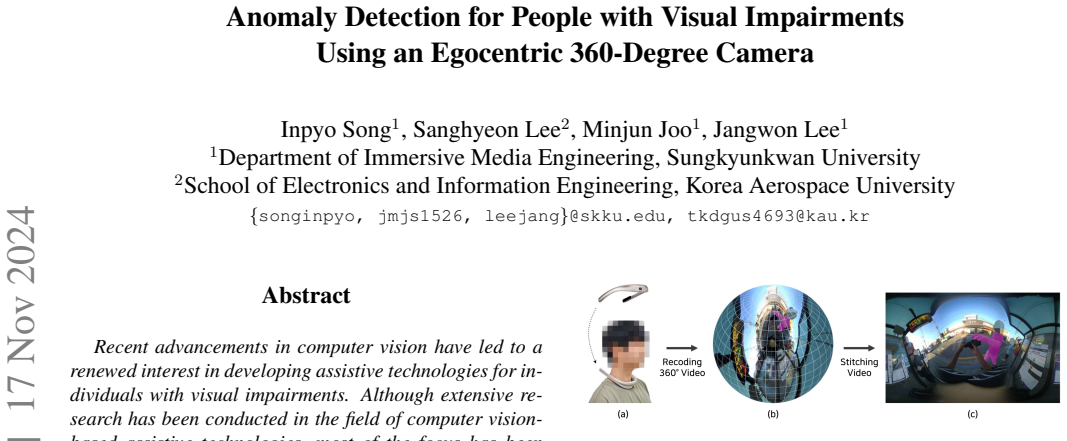


Figures from the paper (5 more)


Reference graph
Works this paper leans on
-
[1]
Ub- normal: New benchmark for supervised open-set video anomaly detection
Andra Acsintoae, Andrei Florescu, Mariana-Iuliana Georgescu, Tudor Mare, Paul Sumedrea, Radu Tudor Ionescu, Fahad Shahbaz Khan, and Mubarak Shah. Ub- normal: New benchmark for supervised open-set video anomaly detection. In CVPR, 2022. 3
work page 2022
-
[2]
Ad- dressing physical safety, security, and privacy for people with visual impairments
Tousif Ahmed, Kurt Andersen, Patrick Shaffer, Dave Crocker, Saptarshi Ghosh, Kay Connelly, Krishna P Gum- madi, David Crandall, Aniket Kate, Apu Kapadia, et al. Ad- dressing physical safety, security, and privacy for people with visual impairments. In Twelfth Symposium on Usable Pri- vacy and Security (SOUPS), 2016. 1, 3
work page 2016
-
[3]
Why does a visual question have different answers? In ICCV, 2019
Nilavra Bhattacharya, Qing Li, and Danna Gurari. Why does a visual question have different answers? In ICCV, 2019. 2
work page 2019
-
[4]
A new comprehensive benchmark for semi-supervised video anomaly detection and anticipation
Congqi Cao, Yue Lu, Peng Wang, and Yanning Zhang. A new comprehensive benchmark for semi-supervised video anomaly detection and anticipation. In CVPR, 2023. 3
work page 2023
-
[5]
Quo vadis, action recognition? a new model and the kinetics dataset
Joao Carreira and Andrew Zisserman. Quo vadis, action recognition? a new model and the kinetics dataset. In CVPR,
-
[6]
Prompt- enhanced multiple instance learning for weakly supervised video anomaly detection
Junxi Chen, Liang Li, Li Su, Zheng-jun Zha, et al. Prompt- enhanced multiple instance learning for weakly supervised video anomaly detection. In CVPR, 2024. 3, 7
work page 2024
-
[7]
Mgfn: Magnitude- contrastive glance-and-focus network for weakly-supervised video anomaly detection
Yingxian Chen, Zhengzhe Liu, Baoheng Zhang, Wilton Fok, Xiaojuan Qi, and Yik-Chung Wu. Mgfn: Magnitude- contrastive glance-and-focus network for weakly-supervised video anomaly detection. In AAAI, 2023. 2, 3, 5, 6, 7
work page 2023
-
[8]
Assessing im- age quality issues for real-world problems
Tai-Yin Chiu, Yinan Zhao, and Danna Gurari. Assessing im- age quality issues for real-world problems. In CVPR, 2020. 2
work page 2020
Show all 39 references
-
[9]
Are electronic white canes better than traditional canes? a comparative study with blind and blind- folded participants
Aline Darc Piculo dos Santos, Fausto Orsi Medola, Mil- ton Jos ´e Cinelli, Alejandro Rafael Garcia Ramirez, and Frode Eika Sandnes. Are electronic white canes better than traditional canes? a comparative study with blind and blind- folded participants. Universal Access in the ...
2021
-
[10]
Mist: Multiple instance self-training framework for video anomaly detection
Jia-Chang Feng, Fa-Ting Hong, and Wei-Shi Zheng. Mist: Multiple instance self-training framework for video anomaly detection. In CVPR, 2021. 2, 7
2021
-
[11]
Vizwiz-priv: A dataset for recognizing the presence and purpose of pri- vate visual information in images taken by blind people
Danna Gurari, Qing Li, Chi Lin, Yinan Zhao, Anhong Guo, Abigale Stangl, and Jeffrey P Bigham. Vizwiz-priv: A dataset for recognizing the presence and purpose of pri- vate visual information in images taken by blind people. In CVPR, 2019. 1, 2
2019
-
[12]
Vizwiz grand challenge: Answering visual questions from blind people
Danna Gurari, Qing Li, Abigale J Stangl, Anhong Guo, Chi Lin, Kristen Grauman, Jiebo Luo, and Jeffrey P Bigham. Vizwiz grand challenge: Answering visual questions from blind people. In CVPR, 2018. 1, 2
2018
-
[13]
Captioning images taken by people who are blind
Danna Gurari, Yinan Zhao, Meng Zhang, and Nilavra Bhat- tacharya. Captioning images taken by people who are blind. In ECCV. Springer, 2020. 1, 2
2020
-
[14]
Deep residual learning for image recognition
Kaiming He, Xiangyu Zhang, Shaoqing Ren, and Jian Sun. Deep residual learning for image recognition. In CVPR,
-
[15]
Clip-tsa: Clip-assisted temporal self-attention for weakly-supervised video anomaly detec- tion
Hyekang Kevin Joo et al. Clip-tsa: Clip-assisted temporal self-attention for weakly-supervised video anomaly detec- tion. In ICIP. IEEE, 2023. 3, 7
2023
-
[16]
Self-training multi- sequence learning with transformer for weakly supervised video anomaly detection
Shuo Li, Fang Liu, and Licheng Jiao. Self-training multi- sequence learning with transformer for weakly supervised video anomaly detection. In AAAI, 2022. 3, 7
2022
-
[17]
Anomaly detection and localization in crowded scenes.IEEE transactions on pattern analysis and machine intelligence ,
Weixin Li, Vijay Mahadevan, and Nuno Vasconcelos. Anomaly detection and localization in crowded scenes.IEEE transactions on pattern analysis and machine intelligence ,
-
[18]
Focal loss for dense object detection
Tsung-Yi Lin, Priya Goyal, Ross Girshick, Kaiming He, and Piotr Doll´ar. Focal loss for dense object detection. In ICCV,
-
[19]
LINKFLOW. FITT360. https://www.ftt360.us/ ,
-
[20]
Fu- ture frame prediction for anomaly detection–a new baseline
Wen Liu, Weixin Luo, Dongze Lian, and Shenghua Gao. Fu- ture frame prediction for anomaly detection–a new baseline. In CVPR, 2018. 3, 6
2018
-
[21]
Abnormal event de- tection at 150 fps in matlab
Cewu Lu, Jianping Shi, and Jiaya Jia. Abnormal event de- tection at 150 fps in matlab. In ICCV, 2013. 3
2013
-
[22]
Tased-net: Temporally- aggregating spatial encoder-decoder network for video saliency detection
Kyle Min and Jason J Corso. Tased-net: Temporally- aggregating spatial encoder-decoder network for video saliency detection. In ICCV, pages 2394–2403, 2019. 5
2019
-
[23]
Anomaly detec- tion in video sequence with appearance-motion correspon- dence
Trong-Nguyen Nguyen and Jean Meunier. Anomaly detec- tion in video sequence with appearance-motion correspon- dence. In ICCV, 2019. 2
2019
-
[24]
Guide dogs for the blind: their selec- tion, development, and training
Clarence J Pfaffenberger, JP Scott, JL Fuller, BE Ginsburg, SW Biefelt, et al. Guide dogs for the blind: their selec- tion, development, and training. Elsevier Scientific Publish- ing Company., 1976. 1
1976
-
[25]
Adversarially learned one-class classifier for novelty detection
Mohammad Sabokrou, Mohammad Khalooei, Mahmood Fathy, and Ehsan Adeli. Adversarially learned one-class classifier for novelty detection. In CVPR, 2018. 2
2018
-
[26]
Computer vision based as- sistive technology for blind and visually impaired people
Shankar Sivan and Gopu Darsan. Computer vision based as- sistive technology for blind and visually impaired people. In Proceedings of the 7th International Conference on Comput- ing Communication and Networking Technologies, 2016. 1
2016
-
[27]
Real-world anomaly detection in surveillance videos
Waqas Sultani, Chen Chen, and Mubarak Shah. Real-world anomaly detection in surveillance videos. In CVPR, 2018. 2, 3, 6
2018
-
[28]
Weakly-supervised video anomaly detection with robust temporal feature mag- nitude learning
Yu Tian, Guansong Pang, Yuanhong Chen, Rajvinder Singh, Johan W Verjans, and Gustavo Carneiro. Weakly-supervised video anomaly detection with robust temporal feature mag- nitude learning. In ICCV, 2021. 2, 3, 5, 6, 7
2021
-
[29]
Weakly supervised video anomaly detection via center- guided discriminative learning
Boyang Wan, Yuming Fang, Xue Xia, and Jiajie Mei. Weakly supervised video anomaly detection via center- guided discriminative learning. In 2020 IEEE International Conference on Multimedia and Expo (ICME). IEEE, 2020. 3
2020
-
[30]
Yolov7: Trainable bag-of-freebies sets new state-of-the-art for real-time object detectors
Chien-Yao Wang, Alexey Bochkovskiy, and Hong- Yuan Mark Liao. Yolov7: Trainable bag-of-freebies sets new state-of-the-art for real-time object detectors. In CVPR,
-
[31]
Video anomaly detection by solving decoupled spatio-temporal jigsaw puzzles
Guodong Wang, Yunhong Wang, Jie Qin, Dongming Zhang, Xiuguo Bao, and Di Huang. Video anomaly detection by solving decoupled spatio-temporal jigsaw puzzles. InECCV. Springer, 2022. 2
2022
-
[32]
Self-supervised sparse representa- tion for video anomaly detection
Jhih-Ciang Wu, He-Yen Hsieh, Ding-Jie Chen, Chiou-Shann Fuh, and Tyng-Luh Liu. Self-supervised sparse representa- tion for video anomaly detection. In ECCV. Springer, 2022. 3, 7
2022
-
[33]
Not only look, but also listen: Learning multimodal violence detection under weak supervision
Peng Wu, Jing Liu, Yujia Shi, Yujia Sun, Fangtao Shao, Zhaoyang Wu, and Zhiwei Yang. Not only look, but also listen: Learning multimodal violence detection under weak supervision. In ECCV. Springer, 2020. 3
2020
-
[34]
Vadclip: Adapting vision-language models for weakly supervised video anomaly detection
Peng Wu, Xuerong Zhou, Guansong Pang, Lingru Zhou, Qingsen Yan, Peng Wang, and Yanning Zhang. Vadclip: Adapting vision-language models for weakly supervised video anomaly detection. In AAAI, volume 38, 2024. 3, 7
2024
-
[35]
Text prompt with nor- mality guidance for weakly supervised video anomaly detec- tion
Zhiwei Yang, Jing Liu, and Peng Wu. Text prompt with nor- mality guidance for weakly supervised video anomaly detec- tion. In CVPR, 2024. 3, 7
2024
-
[36]
Metaformer is actually what you need for vision
Weihao Yu, Mi Luo, Pan Zhou, Chenyang Si, Yichen Zhou, Xinchao Wang, Jiashi Feng, and Shuicheng Yan. Metaformer is actually what you need for vision. In CVPR, 2022. 6
2022
-
[37]
Graph convolutional label noise cleaner: Train a plug-and-play action classifier for anomaly detection
Jia-Xing Zhong, Nannan Li, Weijie Kong, Shan Liu, Thomas H Li, and Ge Li. Graph convolutional label noise cleaner: Train a plug-and-play action classifier for anomaly detection. In CVPR, 2019. 3
2019
-
[38]
Dual memory units with uncertainty regulation for weakly supervised video anomaly detection
Hang Zhou, Junqing Yu, and Wei Yang. Dual memory units with uncertainty regulation for weakly supervised video anomaly detection. In AAAI, 2023. 7
2023
-
[39]
Motion-aware feature for improved video anomaly detection
Yi Zhu and Shawn Newsam. Motion-aware feature for improved video anomaly detection. arXiv preprint arXiv:1907.10211, 2019. 3 10
1907 arXiv
Reviewed August 12, 2026 · model on record in the stance chip above.
Discussion (0). Continue with ORCID to comment.