REVIEW 4 major objections 5 minor 2 cited by
Joint Precoding and AP Selection for Energy Efficient RIS-aided Cell-Free Massive MIMO Using Multi-agent Reinforcement Learning
T0 review · 4 major / 5 minor · reviewed 2026-08-12 · deepseek-v4-flash
Pith's one-line read The paper claims a fuzzy-logic multi-agent reinforcement learning scheme that selects a subset of access points per user improves energy efficiency over full coverage and zero forcing, with faster convergence.
desk verdict Promising algorithmic idea, but the simulated EE values are about three times higher than the paper's own model allows, so the headline gains are not trustworthy as reported. read the letter →
The pith
A machine-rendered reading of the paper's core claim, the machinery that carries it, and where it could break.
The reading
What carries the argument
The carrying object is the double-layer fuzzy-logic-based MADDPG architecture. In the first layer, each AP is an agent whose action space is the joint precoding vectors and a per-UE binary selection; the selection is produced by an adaptive power threshold that compares each precoding vector's power to a threshold updated toward a target average. In the second layer, the same agents choose RIS phase-shift actions. Fuzzy logic sits between the environment and the agents: membership functions cluster observed states into a smaller number of fuzzy states, and defuzzification maps fuzzy actions back to actual actions, so the network trains on F fuzzy agents instead of L physical APs. This compression is what carries the claimed reduction in convergence time and complexity.
What would settle it
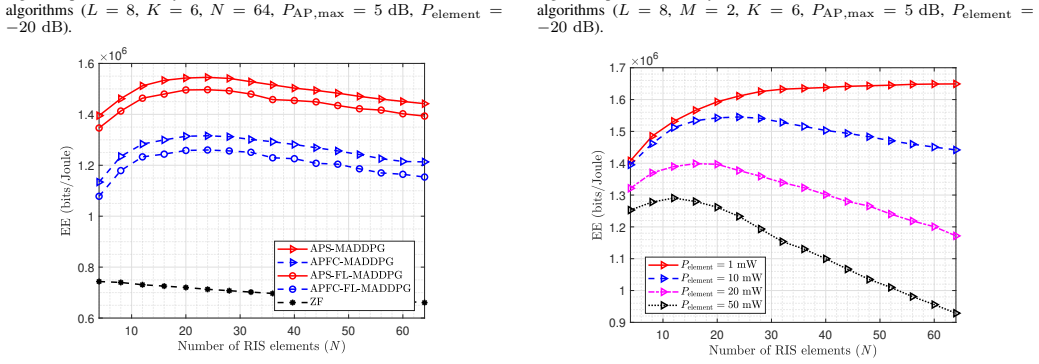
Reproduce the simulation with B = 180 kHz and the stated static powers; with the plotted sum SE near 14 bps/Hz, Eq. (13) caps EE at about 5×$10^{5}$ bit/J. If the code produces the plotted ~1.8×$10^{6}$ bit/J values, the published system model differs from the simulation, and the gains must be re-evaluated under the stated parameters.
Extended reading notes
Core claim
The central claim is that the EE maximization problem, which is a non-concave mixed-integer program, can be approximated by decoupling it into two coordinated learning layers: a first MADDPG layer that jointly designs precoding and, through an adaptive power threshold, the AP-UE selection matrix; and a second layer that designs the RIS phase shifts given that selection. Fuzzy logic reduces the number of effective agents by mapping the original agent states to a smaller set of fuzzy states through membership functions, cutting computational complexity from exponential to linear in the number of APs at a reported cost of 2.5–3.6% in EE performance. The paper argues that the gain over zero forcing and over full-coverage MADDPG, as well as the faster convergence, support user-centric AP selection and fuzzy acceleration as effective tools for green RIS-aided cell-free networks.
Load-bearing premise
The EE and SE curves rest on the bandwidth and power-consumption parameters stated in Section V-A and Table III; if the simulator actually used different values, the reported percentage improvements are unanchored.
Editorial extensions
If this is right
- If the reported gains hold, serving each user by a small learned subset of APs outperforms full-coverage precoding in energy efficiency, especially when transmit power is high.
- The fuzzy-logic state compression makes the MARL approach practical at larger AP counts, since complexity scales linearly with the number of APs instead of exponentially.
- EE peaks at a moderate transmit power and a moderate number of RIS elements; beyond those points the additional power consumption outweighs the SE gains.
- The 2.5–3.6% EE loss of FL-MARL relative to plain MARL is a small price for a 45% reduction in convergence time, so fuzzy compression is a viable deployment trade-off.
Reading between the lines
- The paper's quantitative EE results are hard to reconcile with its stated 180 kHz bandwidth and power model: plugging the reported SE and static power into Eq. (13) gives an EE ceiling of roughly 5×10^5 bit/J, while the plots reach about 1.8×10^6 bit/J, implying the simulator may use a wider bandwidth or a different power model than stated.
- The adaptive power threshold acts like a learned sparsification regularizer on the precoding matrix; a similar threshold mechanism could transfer to other massive MIMO resource allocation tasks such as pilot assignment or user scheduling.
- The fuzzy-layer idea generalizes: any multi-agent wireless optimization with large state/action spaces could compress agents through membership functions, at a known cost in precision.
- The trade-off between RIS element count and element power suggests a design rule: the optimal N decreases as Pelement increases, which could guide hardware choices without full simulation.
Signed reviews
Editorial analysis
A structured set of objections, weighed in public.
Referee Report
Summary. The manuscript considers a downlink RIS-aided cell-free massive MIMO system and formulates a joint precoding, RIS phase-shift, and binary AP-selection optimization problem to maximize energy efficiency. It proposes a double-layer multi-agent deep deterministic policy gradient (MADDPG) architecture, an adaptive power-threshold AP-selection algorithm, and a fuzzy-logic (FL) strategy to reduce the number of agents and accelerate convergence. A complexity comparison is provided, and simulations report that the proposed scheme improves EE by about 10% over full AP coverage at the peak, by 16% and 85% over full-coverage FL-MADDPG and ZF at M=10, and converges in about 45% of the time of plain MADDPG.
Significance. If the numerical results are reliable, the paper would offer a scalable MARL-based solution to a relevant problem in RIS-aided cell-free massive MIMO and a useful complexity reduction. The double-layer decomposition and the explicit complexity comparison in Table I are clear strengths. However, the central quantitative claims are currently undermined by an internal inconsistency between the stated power model/bandwidth and the plotted EE magnitudes, and by missing training details that make the experiments irreproducible. The contribution is therefore not yet established.
major comments (4)
- [V-A, Table III, Eq. (13), Figs. 6-10] The plotted EE magnitudes are inconsistent with the stated parameters and with Eq. (13). With B=180 kHz, a maximum observed sum SE of about 22 bps/Hz (Figs. 7/9/11), and the static powers in Table III (P_CPU=5 W, L*P_static=0.4 W, K*P_k=0.06 W, L*P_0=0.8 W, N*P_element=0.64 W), Eq. (13) gives P_total at least 6.9 W and EE at most B*SE/P_total ~ 5.8e5 bit/J. The EE curves in Figs. 6, 8, and 10 reach about 1.8e6 bit/J, roughly 3.1 times higher. Matching the plots would require B ~ 1.8 MHz, P_CPU ~ 0.5 W, or a different power/unit model, none of which is stated. Because the reported 10%, 16%, and 85% improvements are read from these curves, the numerical claims are not validated by the written model.
- [IV-B, Algorithm 2, Table II] The MARL training details needed for reproducibility are missing: learning rates, batch size, number of training episodes/steps, number of fuzzy agents N_F, membership width d_a, and initialization/update rate tau_threshold. The results are reported without seeds or confidence intervals. Since the paper's claims rest entirely on simulations, these omissions prevent independent verification; please provide a complete hyperparameter table and, if possible, code or data.
- [Abstract, V-D, Fig. 8] The abstract states a general '85% enhancement over the zero-forcing (ZF) method,' but the text reports this figure only at M=10 in Fig. 8, while the peak improvement over full coverage in Fig. 6 is 10% and the conclusion repeats only the 10% figure. The headline claim should be restricted to the configuration actually simulated and should be accompanied by the variability across the settings shown in Figs. 6-12.
- [IV-B and constraint (14d)] The mapping from the continuous MADDPG action to the binary AP-selection matrix satisfying (14d) is under-specified. Algorithm 1 uses a power threshold, but Eqs. (15)-(18) treat A as a given matrix, and no discretization step or feasibility-repair mechanism is described. Please specify how binary integer feasibility is enforced during training and execution.
minor comments (5)
- [III-C, Eq. (14b)] Constraint (14b) is written with 'for all k in K' even though it bounds a sum over k; the universal quantifier should be over l (one per AP). In addition, constraint (14c) is called a 'sparse constraint' but it is a phase-shift constraint.
- [IV-A] The text says 'the concept of Federated Learning (FL) was proposed in [46]', but reference [46] is a book on fuzzy logic and the algorithm subsequently uses FL to mean fuzzy logic. Please correct the terminology and the citation.
- [V-A and Table III] The maximum AP transmit power is stated as '5 dB' in the text and '3.2 W' in Table III; please use consistent units (e.g., 5 dBW). Similarly, the figure captions give Pelement = -20 dB, which should be specified as -20 dBW or as 10 mW to match Table III.
- [IV-B] The AP-level action space is stated as AAP in L; since the action is an L x K AP-selection matrix, this notation should be corrected to avoid confusion.
- [Figs. 3-5] The convergence figures have unlabeled axes except for the caption text; please specify what is plotted (e.g., normalized reward versus training episode) and include multiple-seed curves or error bars.
Circularity Check
No significant circularity: the EE metric, the learning objective, and the baselines are defined independently, and the reported gains are simulation comparisons rather than derived identities.
full rationale
The derivation chain starts from an independently stated system model (Eqs. (1)-(7)), a power consumption model adopted from the literature (Eqs. (8)-(13)), and a well-defined EE objective (Eq. (13)); none of these quantities is defined in terms of the proposed FL-based MARL solution or its outputs. The fuzzy-logic membership functions and the adaptive power threshold in Algorithm 1 are hand-specified design heuristics, not parameters fitted to the EE curves that are then relabeled as predictions. The RL reward functions in Eqs. (16) and (18) are defined directly from the EE metric, which is standard for an optimization-oriented algorithm and does not make the resulting EE comparison circular. The baselines (ZF, APFC-MADDPG, APS-MADDPG, and FL variants) are distinct schemes evaluated under the same metric, so the 10%, 16%, and 85% EE improvements are comparative simulation results with external grounding. The paper contains self-citations ([16], [20], [33], [35]) but they are used as related-work context or as a starting point for the fuzzy-logic design; no load-bearing claim is justified solely by an author-overlapping citation, and no uniqueness theorem is imported from the authors' prior work. The complexity reduction attributed to fuzzy logic is additionally supported by the paper's own complexity expressions in Table I. The noted inconsistency between the plotted EE magnitudes and Eq. (13) with the stated B = 180 kHz and P_CPU = 5 W is a reproducibility or correctness issue, not a circularity: it indicates a possible mismatch between the implemented and written models, but it does not show that any reported result is equivalent to its input by construction. Accordingly, no circular step is identified.
Assumptions & free parameters
free parameters (3)
- Adaptive power threshold P_threshold and update rate τ_threshold =
not reported
- Number of fuzzy agents N_F and membership width d_a =
not reported
- Reward contribution weights ξ_lk =
unspecified function of distance
assumptions (5)
- domain assumption The adopted channel and path-loss model 'similar to [21]' is sufficient.
- domain assumption Power consumption model of [42] (Eqs. 8-11), including SE-dependent fronthaul power, applies to the user-centric RIS system.
- ad hoc to paper The continuous MARL action can realize the binary AP-selection matrix of constraint (14d).
- ad hoc to paper Fuzzy-agent aggregation preserves near-optimal policies (approximation error is negligible).
- ad hoc to paper The MARL training converges to a policy whose quality is representative.
Cite this review
Pith. "Pith review of Joint Precoding and AP Selection for Energy Efficient RIS-aided Cell-Free Massive MIMO Using Multi-agent Reinforcement Learning." pith.science (2026). https://pith.science/paper/XBO2MYSX
@misc{pith2026241111070,
  author       = {Pith},
  title        = {Pith review of: Joint Precoding and AP Selection for Energy Efficient RIS-aided Cell-Free Massive MIMO Using Multi-agent Reinforcement Learning},
  year         = {2026},
  howpublished = {\url{https://pith.science/paper/XBO2MYSX}},
  note         = {Machine review of arXiv:2411.11070}
}
read the original abstract
Cell-free (CF) massive multiple-input multiple-output (mMIMO) and reconfigurable intelligent surface (RIS) are two advanced transceiver technologies for realizing future sixth-generation (6G) networks. In this paper, we investigate the joint precoding and access point (AP) selection for energy efficient RIS-aided CF mMIMO system. To address the associated computational complexity and communication power consumption, we advocate for user-centric dynamic networks in which each user is served by a subset of APs rather than by all of them. Based on the user-centric network, we formulate a joint precoding and AP selection problem to maximize the energy efficiency (EE) of the considered system. To solve this complex nonconvex problem, we propose an innovative double-layer multi-agent reinforcement learning (MARL)-based scheme. Moreover, we propose an adaptive power threshold-based AP selection scheme to further enhance the EE of the considered system. To reduce the computational complexity of the RIS-aided CF mMIMO system, we introduce a fuzzy logic (FL) strategy into the MARL scheme to accelerate convergence. The simulation results show that the proposed FL-based MARL cooperative architecture effectively improves EE performance, offering a 85\% enhancement over the zero-forcing (ZF) method, and achieves faster convergence speed compared with MARL. It is important to note that increasing the transmission power of the APs or the number of RIS elements can effectively enhance the spectral efficiency (SE) performance, which also leads to an increase in power consumption, resulting in a non-trivial trade-off between the quality of service and EE performance.
Figures


Figures from the paper (5 more)


Forward citations
Cited by 2 Pith papers
-
Energy-Efficient SIM-assisted Communications: How Many Layers Do We Need?
For SIM-enhanced multiuser MISO downlinks, a hybrid digital and wave precoding framework with a realistic power model shows that 2 to 5 SIM layers balances energy and spectral efficiency, and can improve energy effici...
-
Multi-Agent Reinforcement Learning in Wireless Distributed Networks for 6G
A comprehensive survey of multi-agent reinforcement learning for wireless distributed networks in 6G, covering structures, algorithms, enhanced techniques, and applications.
Reference graph
Works this paper leans on
-
[46]
H´ ajek,Metamathematics of fuzzy logic
P . H´ ajek,Metamathematics of fuzzy logic. Springer Science & Business Media, 2013, vol. 4
work page 2013
-
[1]
On the road to 6G: Visions, requirements, key technologies and testbeds,
C.-X. Wang, X. Y ou, X. Gao, X. Zhu, Z. Li, C. Zhang, H. Wang, Y . Huang, Y . Chen, H. Haas et al. , “On the road to 6G: Visions, requirements, key technologies and testbeds,” IEEE Commun. Surveys Tuts., vol. 25, no. 2, pp. 905–974, Feb. 2023
2023
-
[2]
Next generation advanced transceiver tech nologies for 6G,
C. Y ou, Y . Cai, Y . Liu, M. Di Renzo, T. M. Duman, A. Y ener, and A. L. Swindlehurst, “Next generation advanced transceiver tech nologies for 6G,” arXiv preprint arXiv:2403.16458 , 2024
arXiv 2024
-
[3]
Massive MIMO for next generation wireless systems,
E. G. Larsson, O. Edfors, F. Tufvesson, and T. L. Marzetta , “Massive MIMO for next generation wireless systems,” IEEE Commun. Mag. , vol. 52, no. 2, pp. 186–195, Feb. 2014
2014
-
[4]
Q. Wu, J. Xu, Y . Zeng, D. W. K. Ng, N. Al-Dhahir, R. Schober, and A. L. Swindlehurst, “A comprehensive overview on 5G-and - beyond networks with UA Vs: From communications to sensing a nd intelligence,” IEEE J. Sel. Areas Commun. , vol. 39, no. 10, pp. 2912– 2945, Oct. 2021. 13
work page 2021
-
[5]
Deplo ying dense networks for maximal energy efficiency: Small cells meet mas sive MIMO,
E. Bj¨ ornson, L. Sanguinetti, and M. Kountouris, “Deplo ying dense networks for maximal energy efficiency: Small cells meet mas sive MIMO,” IEEE J. Sel. Areas Commun. , vol. 34, no. 4, pp. 832–847, Apr. 2016
work page 2016
-
[6]
S. Buzzi, C. D¡ /macron.ts1Andrea, A. Zappone, and C. D¡ /macron.ts1Elia, “User-centric 5G cellular networks: Resource allocation and comparison w ith the cell-free massive MIMO approach,” IEEE Trans. Wireless Commun. , vol. 19, no. 2, pp. 1250–1264, Feb. 2019
work page 2019
-
[7]
Prospective multiple antenna technologies for beyo nd 5G,
J. Zhang, E. Bj¨ ornson, M. Matthaiou, D. W. K. Ng, H. Y ang, and D. J. Love, “Prospective multiple antenna technologies for beyo nd 5G,” IEEE J. Sel. Areas Commun. , vol. 38, no. 8, pp. 1637–1660, Aug. 2020
2020
Show all 46 references
-
[8]
Cell-free massive MIMO versus small cells,
H. Q. Ngo, A. Ashikhmin, H. Y ang, E. G. Larsson, and T. L. Ma rzetta, “Cell-free massive MIMO versus small cells,” IEEE Trans. Wireless Commun., vol. 16, no. 3, pp. 1834–1850, Mar. 2017
2017
-
[9]
Precoding and power optimization in cell-free massive MIM O sys- tems,
E. Nayebi, A. Ashikhmin, T. L. Marzetta, H. Y ang, and B. D. Rao, “Precoding and power optimization in cell-free massive MIM O sys- tems,” IEEE Trans. Wireless Commun. , vol. 16, no. 7, pp. 4445–4459, Jul. 2017
2017
-
[10]
Energy efficiency of the cell-free massive MIMO upl ink with optimal uniform quantization,
M. Bashar, K. Cumanan, A. G. Burr, H. Q. Ngo, E. G. Larsson , and P . Xiao, “Energy efficiency of the cell-free massive MIMO upl ink with optimal uniform quantization,” IEEE Transa. Green Commun. Networking, vol. 3, no. 4, pp. 971–987, Apr. 2019
2019
-
[11]
Reconfigurable intelligent surface-assisted ce ll-free massive MIMO systems over spatially-correlated channels,
T. V an Chien, H. Q. Ngo, S. Chatzinotas, M. Di Renzo, and B . Ot- tersten, “Reconfigurable intelligent surface-assisted ce ll-free massive MIMO systems over spatially-correlated channels,” IEEE Trans. Wire- less Commun. , vol. 21, no. 7, pp. 5106–5128, Jul. 2021
2021
-
[12]
Toward gr een communication in 6G-enabled massive internet of things,
S. V erma, S. Kaur, M. A. Khan, and P . S. Sehdev, “Toward gr een communication in 6G-enabled massive internet of things,” IEEE Int. Things J. , vol. 8, no. 7, pp. 5408–5415, Jul. 2020
2020
-
[13]
Smart radio environments emp owered by reconfigurable intelligent surfaces: How it works, state of research, and the road ahead,
M. Di Renzo, A. Zappone, M. Debbah, M.-S. Alouini, C. Y ue n, J. de Rosny, and S. Tretyakov, “Smart radio environments emp owered by reconfigurable intelligent surfaces: How it works, state of research, and the road ahead,” IEEE J. Sel. Areas Commun. , vol. 38, no. 11, pp. 2450...
2020
-
[14]
Intelligent surfaces empowered wireless network: Recent advances and the road to 6G,
Q. Wu, B. Zheng, C. Y ou, L. Zhu, K. Shen, X. Shao, W. Mei, B. Di, H. Zhang, E. Basar, L. Song, M. D. Renzo, Z.-Q. Luo, and R. Zhan g, “Intelligent surfaces empowered wireless network: Recent advances and the road to 6G,” Proc. IEEE, early access , 2024
2024
-
[15]
Recon- figurable intelligent surfaces for 6G systems: Principles, applications, and research directions,
C. Pan, H. Ren, K. Wang, J. F. Kolb, M. Elkashlan, M. Chen, M. Di Renzo, Y . Hao, J. Wang, A. L. Swindlehurst et al. , “Recon- figurable intelligent surfaces for 6G systems: Principles, applications, and research directions,” IEEE Commun. Mag. , vol. 59, no. 6, pp. 14– 20, Jun. 2021
2021
-
[16]
Multi-agent r einforcement learning-based joint precoding and phase shift optimizati on for RIS- aided cell-free massive MIMO systems,
Y . Zhu, E. Shi, Z. Liu, J. Zhang, and B. Ai, “Multi-agent r einforcement learning-based joint precoding and phase shift optimizati on for RIS- aided cell-free massive MIMO systems,” IEEE Trans. V eh. Technol., early access , 2024
2024
-
[17]
Intelligent refl ecting surface aided full-duplex communication: Passive beamfor ming and deployment design,
Y . Cai, M.-M. Zhao, K. Xu, and R. Zhang, “Intelligent refl ecting surface aided full-duplex communication: Passive beamfor ming and deployment design,” IEEE Trans. Wireless Commun. , vol. 21, no. 1, pp. 383–397, Jan. 2021
2021
-
[18]
Resource alloc ation in intelligent reflecting surface assisted NOMA systems,
J. Zuo, Y . Liu, Z. Qin, and N. Al-Dhahir, “Resource alloc ation in intelligent reflecting surface assisted NOMA systems,” IEEE Trans. Commun., vol. 68, no. 11, pp. 7170–7183, Nov. 2020
2020
-
[19]
Robust sec ure UA V communications with the aid of reconfigurable intelligent s urfaces,
S. Li, B. Duo, M. Di Renzo, M. Tao, and X. Y uan, “Robust sec ure UA V communications with the aid of reconfigurable intelligent s urfaces,” IEEE Trans. Wireless Commun. , vol. 20, no. 10, pp. 6402–6417, Oct. 2021
2021
-
[20]
RIS-aided cell-free massive MIMO systems for 6 G: Fundamentals, system design, and applications,
E. Shi, J. Zhang, H. Du, B. Ai, C. Y uen, D. Niyato, K. B. Let aief, and X. Shen, “RIS-aided cell-free massive MIMO systems for 6 G: Fundamentals, system design, and applications,” Proc. IEEE , vol. 112, no. 4, pp. 331–364, Apr. 2024
2024
-
[21]
A joint precoding framework for wid eband reconfigurable intelligent surface-aided cell-free netwo rk,
Z. Zhang and L. Dai, “A joint precoding framework for wid eband reconfigurable intelligent surface-aided cell-free netwo rk,” IEEE Trans. Signal Process. , vol. 69, pp. 4085–4101, Jun. 2021
2021
-
[22]
Cooperat ive beamforming for RIS-aided cell-free massive MIMO networks ,
X. Ma, D. Zhang, M. Xiao, C. Huang, and Z. Chen, “Cooperat ive beamforming for RIS-aided cell-free massive MIMO networks ,” IEEE Trans. Wireless Commun. , vol. 22, no. 11, pp. 7243–7258, Nov. 2023
2023
-
[23]
Linear precoder design for si - multaneous information and energy transfer over two-user M IMO interference channels,
A. ¨Ozc ¸elikkale and T. M. Duman, “Linear precoder design for si - multaneous information and energy transfer over two-user M IMO interference channels,” IEEE Trans. Wireless Commun., vol. 14, no. 10, pp. 5836–5847, Oct. 2015
2015
-
[24]
Energy efficient AP selection for cell-free massive MIMO sy stems: Deep reinforcement learning approach,
N. Ghiasi, S. Mashhadi, S. Farahmand, S. M. Razavizadeh , and I. Lee, “Energy efficient AP selection for cell-free massive MIMO sy stems: Deep reinforcement learning approach,” IEEE Trans. Green Commun. Networking, vol. 7, no. 1, pp. 29–41, 2022
2022
-
[25]
Energy e fficiency maximization in RIS-aided cell-free network with limited b ackhaul,
Q. N. Le, V .-D. Nguyen, O. A. Dobre, and R. Zhao, “Energy e fficiency maximization in RIS-aided cell-free network with limited b ackhaul,” IEEE Commun. Lett. , vol. 25, no. 6, pp. 1974–1978, Jun. 2021
1974
-
[26]
Energy-ef ficient cell-free network assisted by hybrid RISs,
W. Lyu, Y . Xiu, S. Y ang, C. Y uen, and Z. Zhang, “Energy-ef ficient cell-free network assisted by hybrid RISs,” IEEE Wireless Commun. Lett., vol. 12, no. 4, pp. 718–722, Apr. 2023
2023
-
[27]
On energ y efficiency of wideband RIS-aided cell-free network,
M. Z. Siddiqi, R. Mackenzie, M. Hao, and T. Mir, “On energ y efficiency of wideband RIS-aided cell-free network,” IEEE Access , vol. 10, pp. 19 742–19 752, 2022
2022
-
[28]
De ep rein- forcement learning for energy efficiency maximization in ca che-enabled cell-free massive MIMO networks: Single-and multi-agent a pproaches,
Y .-C. Chuang, W.-Y . Chiu, R. Y . Chang, and Y .-C. Lai, “De ep rein- forcement learning for energy efficiency maximization in ca che-enabled cell-free massive MIMO networks: Single-and multi-agent a pproaches,” IEEE Trans. V eh. Technol., vol. 78, no. 8, pp. 10 826–10 839, Aug. 2023
2023
-
[29]
Reconfigurable intelligen t surface as- sisted multiuser miso systems exploiting deep reinforceme nt learning,
C. Huang, R. Mo, and C. Y uen, “Reconfigurable intelligen t surface as- sisted multiuser miso systems exploiting deep reinforceme nt learning,” IEEE J. Sel. Areas Commun. , vol. 38, no. 8, pp. 1839–1850, Aug. 2020
2020
-
[30]
A distributed mac hine learning-based approach for IRS-enhanced cell-free MIMO n etworks,
C. Chen, S. Xu, J. Zhang, and J. Zhang, “A distributed mac hine learning-based approach for IRS-enhanced cell-free MIMO n etworks,” IEEE Trans. Wireless Commun. , Oct. 2023
2023
-
[31]
Multi-agent reinforc ement learn- ing: A selective overview of theories and algorithms,
K. Zhang, Z. Y ang, and T. Bas ¸ar, “Multi-agent reinforc ement learn- ing: A selective overview of theories and algorithms,” Handbook of reinforcement learning and control , pp. 321–384, 2021
2021
-
[32]
Multi-agent reinforcement learning-based pilot assignm ent for cell- free massive MIMO systems,
M. Rahmani, M. J. Dehghani, P . Xiao, M. Bashar, and M. Deb bah, “Multi-agent reinforcement learning-based pilot assignm ent for cell- free massive MIMO systems,” IEEE Access , vol. 10, pp. 120 492– 120 502, 2022
2022
-
[33]
Double-laye r power control for mobile cell-free XL-MIMO with multi-agent rein forcement learning,
Z. Liu, J. Zhang, Z. Liu, H. Xiao, and B. Ai, “Double-laye r power control for mobile cell-free XL-MIMO with multi-agent rein forcement learning,” IEEE Trans. Wireless Commun. , Oct. 2023
2023
-
[34]
Access point clustering in cell-free massive MIMO using conventio nal and federated multi-agent reinforcement learning,
B. Banerjee, R. C. Elliott, W. A. Krzymie´ n, and M. Medra , “Access point clustering in cell-free massive MIMO using conventio nal and federated multi-agent reinforcement learning,” IEEE Trans. Mach. Learn. Commun. Networking , vol. 1, no. 6, pp. 107–123, Jun. 2023
2023
-
[35]
Up link power control for extremely large-scale MIMO with multi-ag ent rein- forcement learning and fuzzy logic,
Z. Liu, Z. Liu, J. Zhang, H. Xiao, B. Ai, and D. W. K. Ng, “Up link power control for extremely large-scale MIMO with multi-ag ent rein- forcement learning and fuzzy logic,” arXiv preprint arXiv:2302.09290 , 2023
2023 arXiv
-
[36]
Multi-agent r einforcement learning for distributed resource allocation in cell-free massive MIMO- enabled mobile edge computing network,
F. D. Tilahun, A. T. Abebe, and C. G. Kang, “Multi-agent r einforcement learning for distributed resource allocation in cell-free massive MIMO- enabled mobile edge computing network,” IEEE Trans. V eh. Technol., Jun. 2023
2023
-
[37]
Multi-agent deep reinforcement learning for beam codebook design in RIS -aided systems,
A. Abdallah, A. Celik, M. M. Mansour, and A. M. Eltawil, “ Multi-agent deep reinforcement learning for beam codebook design in RIS -aided systems,” IEEE Trans. Wireless Commun., early access , 2024
2024
-
[38]
Distributed learning for wireless commu nications: Methods, applications and challenges,
L. Qian, P . Y ang, M. Xiao, O. A. Dobre, M. D. Renzo, J. Li, Z . Han, Q. Yi, and J. Zhao, “Distributed learning for wireless commu nications: Methods, applications and challenges,” IEEE J. Sel. Top. Signal Pro- cess., vol. 16, no. 3, pp. 326–342, Mar. 2022
2022
-
[39]
Smart and reconfigurable wireless communications: From IRS model ing to algorithm design,
X. Y u, V . Jamali, D. Xu, D. W. K. Ng, and R. Schober, “Smart and reconfigurable wireless communications: From IRS model ing to algorithm design,” IEEE Wireless Commun. , vol. 28, no. 6, pp. 118– 125, Jun. 2021
2021
-
[40]
Making cell-free mas sive MIMO competitive with MMSE processing and centralized implemen tation,
E. Bj¨ ornson and L. Sanguinetti, “Making cell-free mas sive MIMO competitive with MMSE processing and centralized implemen tation,” IEEE Trans. Wireless Commun. , vol. 19, no. 1, pp. 77–90, Jan. 2019
2019
-
[41]
Limited-fronthaul cell-free massive MIMO w ith local mmse receiver under rician fading and phase shifts,
M. Bashar, P . Xiao, R. Tafazolli, K. Cumanan, A. G. Burr, and E. Bj¨ ornson, “Limited-fronthaul cell-free massive MIMO w ith local mmse receiver under rician fading and phase shifts,” IEEE Wireless Commun. Lett. , vol. 10, no. 9, pp. 1934–1938, Sep. 2021
1934
-
[42]
On the total energy efficiency of cell-free massive MIMO,
H. Q. Ngo, L.-N. Tran, T. Q. Duong, M. Matthaiou, and E. G. Larsson, “On the total energy efficiency of cell-free massive MIMO,” IEEE Trans. Green Commun. Netw. , vol. 2, no. 1, pp. 25–39, Jan. 2017
2017
-
[43]
Reconfigurable intelligent surfaces for energy ef ficiency in wireless communication,
C. Huang, A. Zappone, G. C. Alexandropoulos, M. Debbah, and C. Y uen, “Reconfigurable intelligent surfaces for energy ef ficiency in wireless communication,” IEEE Trans. Wireless Commun. , vol. 18, no. 8, pp. 4157–4170, Aug. 2019
2019
-
[44]
Power control in cellular massive MIMO with varying user activity : A deep learning solution,
T. V an Chien, T. N. Canh, E. Bj¨ ornson, and E. G. Larsson, “Power control in cellular massive MIMO with varying user activity : A deep learning solution,” IEEE Trans. Wireless Commun. , vol. 19, no. 9, pp. 5732–5748, Sep. 2020
2020
-
[45]
Emergent communication in multi-agent reinfor cement learning for future wireless networks,
M. Chafii, S. Naoumi, R. Alami, E. Almazrouei, M. Bennis, and M. Debbah, “Emergent communication in multi-agent reinfor cement learning for future wireless networks,” IEEE Int. Things Mag. , vol. 6, no. 4, pp. 18–24, Apr. 2023
2023
Reviewed August 12, 2026 · model on record in the stance chip above.
Discussion (0). Continue with ORCID to comment.