REVIEW 2 major objections 5 minor 1 cited by
Mean Estimation in Banach Spaces Under Infinite Variance and Martingale Dependence
T0 review · 2 major / 5 minor · reviewed 2026-08-12 · deepseek-v4-flash
Pith's one-line read A two-stage truncated mean estimator attains the optimal heavy-tailed rate in 2-smooth Banach spaces, with time-uniform guarantees that hold under martingale dependence and infinite variance.
desk verdict Solid main result; the LIL proof has a fixable algebraic gap that should be corrected before acceptance. read the letter →
The pith
A machine-rendered reading of the paper's core claim, the machinery that carries it, and where it could break.
The reading
What carries the argument
The carrying mechanism is a nonnegative supermartingale built from the truncated, centered increments: M_n = (1/2) exp(rho ||xi_n - mu sum_{m<=n} lambda_m|| - V_n), where V_n = ($rho^{2}$ $beta^{2}$ C_p(B) + rho K_p $2^{{p-1}}$) sum_{m<=n} lambda_m^p (v + ||mu - hatZ_m||^p). The maximal inequality for nonnegative supermartingales turns the fact that M starts at 1 into a time-uniform probability bound. Two ingredients feed the construction: a lemma bounding the bias of truncation using a moment inequality with constant K_p, and a concentration inequality for bounded martingales in 2-smooth spaces, following the approach of [33, 34], which controls the fluctuation term with the smoothness constant $\beta$. The pilot estimate hatZ_k enters only through an additive error r(delta_2,k)^p, which fades as n grows.
What would settle it
Look for a concrete martingale difference sequence in a 2-smooth Banach space satisfying the moment assumption with p in (1,2) for which the claimed bound (2.6) fails at some time n with probability exceeding delta; the natural place to search is a sequence whose conditional p-th moment saturates the bound v and whose increments are highly non-symmetric, such as heavy-tailed variables with Pareto tail index p, since the proof's margin shrinks there.
Extended reading notes
Core claim
The central discovery is that the deficiencies of truncation-based estimators are not fundamental. Theorem 2.1 states that if observations are conditionally centered at the unknown mean, have p-th central moments bounded by v for p in (1,2], and live in a separable $\beta$-smooth Banach space, then the estimator formed by centering on a pilot estimate and truncating to a ball of radius 1/$\lambda$ satisfies, with probability at least 1-delta, simultaneously for all n at least k: ||bmu_n(k) - mu|| <= $lambda^{{p-1}}$($\beta$ C_p(B) + K_p $2^{{p-1}}$)(v + r(delta_2,k)^p) + $\beta$ log(2/delta_1)/($\lambda$(n-k)). Optimizing $\lambda$ yields the rate O($\beta$ $v^{{1/p}}$ (log(1/delta)/n)^{(p-1)/p}), matching the geometric median-of-means rate while allowing infinite variance, martingale dependence, and any dimension. The same machinery yields iterated-logarithm rates that are tight at all times up to a doubly logarithmic factor in n.
Load-bearing premise
The entire argument assumes the Banach space is separable and 2-smooth, meaning its norm satisfies the squared-smoothness inequality in Equation (1.1), so the proof's martingale concentration bound has no basis in spaces like L^$\alpha$ or ell^$\alpha$ with $\alpha$ < 2.
Editorial extensions
If this is right
- The estimator is computationally simple and can be updated online, so the time-uniform guarantee makes it usable in sequential decision problems such as bandits with heavy tails.
- Because the bounds hold at all stopping times, they can be used to construct anytime-valid confidence sequences for the mean of a heavy-tailed Banach-space-valued process.
- In Hilbert spaces and in L^alpha or ell^alpha spaces with alpha at least 2, the smoothness constant beta is finite and explicit, so the bounds are dimension-free and implementable.
- The iterated-logarithm version gives a simultaneous-in-time bound of order O(beta v^{1/p} (log log n / n)^{(p-1)/p}), so the estimator adapts to unknown stopping horizons.
- If the p-th moment bound holds for p > 2, Jensen's inequality reduces the problem to p = 2 and yields a sqrt(log(1/delta)/n) rate, extending the result beyond its main focus.
Reading between the lines
- Because the proof allows predictable sequences of truncation levels and pilot estimates, lambda could in principle be tuned online using earlier data without breaking the supermartingale; the paper does not advertise this generality.
- A natural next target is a fully adaptive estimator that replaces the known moment bound v with an online estimate, since the optimal lambda is chosen using v.
- The same supermartingale technique may produce Bernstein-style 'separation of rates' in Banach spaces, analogous to decomposing a covariance into trace and operator-norm terms, if a weak-moment quantity can be tracked instead of the full norm.
- The pilot sample size k can be as small as log n and still give the optimal rate, so in practice the estimator's overhead is negligible even in infinite-dimensional settings.
Signed reviews
Editorial analysis
A structured set of objections, weighed in public.
Referee Report
Summary. The paper studies estimation of the shared conditional mean of Banach-space-valued random variables under a conditional p-th moment bound (1 < p ≤ 2) and martingale dependence. It analyzes a truncation estimator centered at a preliminary naive mean estimate, proving a time-uniform line-crossing inequality (Theorem 2.1), a fixed-sample optimized bound with rate O(β v^{1/p}(log(1/δ)/n)^{(p-1)/p}) (Corollary 2.2), and an iterated-logarithm-rate bound obtained by stitching (Theorem 4.1). The proof strategy is to compare the truncated process to a martingale, bound the truncation bias via Lemma 3.1, and use a Pinelis-type supermartingale combined with Ville's inequality. Numerical comparisons against geometric median-of-means are reported.
Significance. If the stated results hold, this is a useful contribution: it extends truncation-based mean estimation to 2-smooth Banach spaces, removes finite-variance and i.i.d. assumptions, and provides dimension-free time-uniform bounds with explicit constants. I verified the main technical ingredients—Lemma 3.1, Lemma 3.2, and the variance bound (3.9)—and the overall Pinelis/Ville architecture is sound. The rate matches Minsker's geometric median-of-means rate while permitting martingale dependence. However, two algebraic issues—a constant mismatch in Theorem 2.1 and an incorrect factorization in the proof of Theorem 4.1—need correction before the displayed results can be taken as proven.
major comments (2)
- [Section 3, Proposition 3.5 and proof of Theorem 2.1] The proof of Theorem 2.1 invokes Proposition 3.5 with ρ = β^{-1}. In Eq. (3.11) this gives the coefficient β C_p(B) + β^{-1} K_p 2^{p-1} in front of (v + r(δ_2, k)^p), not β C_p(B) + K_p 2^{p-1} as displayed in Theorem 2.1. The same issue appears in Theorem C.1. Corollary 2.3 already uses the corrected form C_p = C_p(B) + β^{-1} K_p 2^{p-1}, so the main theorem and its corollaries are internally inconsistent. Please revise the theorem constants (and the corollary statements that depend on them) or supply an additional argument that restores the printed constant.
- [Section 4, proof of Theorem 4.1] The displayed computation of W(n, j) contains a false equality: substituting λ_j = (β log(4/δ_j) / (2^j C_p(j)))^{1/p} yields the second summand C_p(j)^{1/p} (β log(4/δ_j))^{(p-1)/p} 2^{j/p} / (n - k(j)), whereas the proof writes C_p(j)^{1/p} (β log(4/δ_j))^{(p-1)/p} (2^j / (n - k(j)))^{1/p}; the two differ by the factor (n - k(j))^{1 - 1/p}. With the corrected term, the next line factors correctly as ((n - k(j))/2^j)^{(p-1)/p} + (2^j/(n - k(j)))^{1/p}, and the final bound follows, so the theorem is salvageable, but the printed proof must be fixed.
minor comments (5)
- [Proposition 3.3, Eq. (i)] The numerator in the integral term is printed as e^{2ρ} - ρ - 1; it should be e^{2ρ} - 2ρ - 1 to match ∫_0^1 (1 - θ) e^{2ρθ} dθ. Since the printed value is larger, this does not invalidate the inequality, but it is a typo.
- [Theorem 2.1] The statement says 'simultaneously for all n ≥ k', but the right-hand side has n - k in the denominator; it should say n > k (or n ≥ k + 1).
- [Corollary 4.2] The definition of r_n uses h(⌊log_2 n⌋)^{-1} δ, while Theorem 4.1 uses h(...)^{-1} δ/2; align the two definitions.
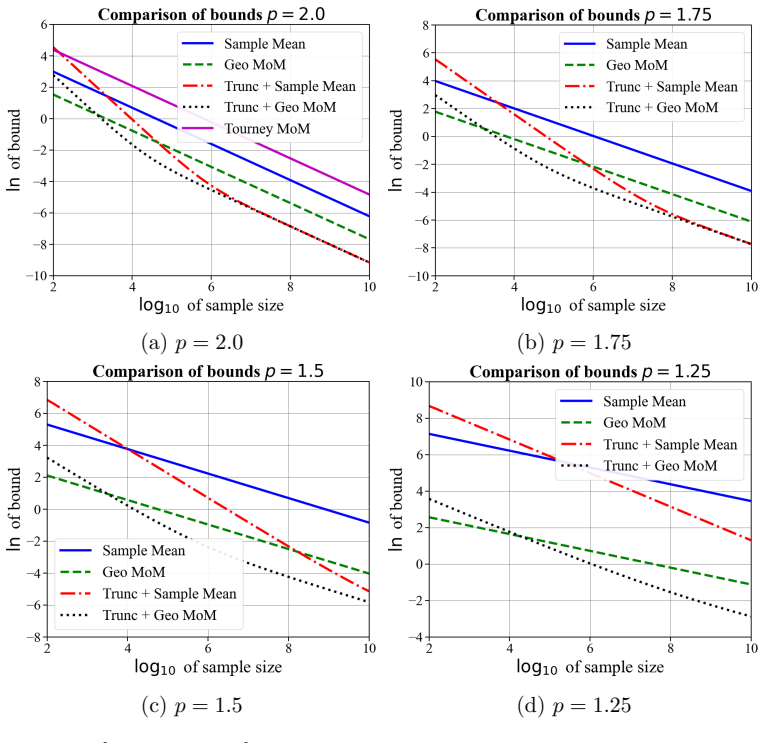
- [Section 5 / Figure 2 caption] The text says n = 100,000 samples are used, while the Figure 2 caption says n = 10^6; please reconcile.
- [Proof of Corollary 2.3] The proof says 'Let bZ_k be the empirical mean on the first k − 1 observations', but the statement uses the first k observations; this indexing should be unified.
Circularity Check
No significant circularity: the central bounds are derived from stated moment/smoothness assumptions via external Pinelis and Ville inequalities, with self-citations only contextual.
full rationale
The paper's central derivation (Theorem 2.1, Proposition 3.3, Lemma 3.4, and the stitching proof of Theorem 4.1) is a chain of analytic inequalities built from the stated Assumptions 1 and 2, the elementary truncation lemma (Lemma 3.1), and external martingale concentration results of Pinelis and Ville. No parameter is fitted to data: the failure probability is split as delta1 + delta2, the truncation level lambda is chosen analytically to minimize the bound in Corollary 2.2, and the rate function r(delta,k) for the initial naive estimator is an explicit input obtained separately from Lemma 1.1 or from Minsker's geometric median-of-means. The final confidence bound is not defined to equal the quantity it predicts: the estimator is a truncation average, and the theorem gives a high-probability upper bound on its deviation from the unknown mean. The paper's self-citations (Chugg et al. [11], Wang and Ramdas [38], Martinez-Taboada and Ramdas [28], Whitehouse et al. [40]) are contextual comparisons or extensions, not load-bearing premises of Theorem 2.1 or Theorem 4.1. No uniqueness theorem is imported from the authors' prior work, and no known result is merely renamed: the core contribution is a new martingale concentration argument for truncation estimators under a central p-th moment bound. The possible algebraic gap in the printed proof of Theorem 4.1 identified by a skeptical reader is a correctness issue, not a circularity: correcting the exponent does not make the bound depend on its own output. Overall, the derivation is self-contained and exhibits no step that reduces to its input by construction.
Assumptions & free parameters
free parameters (5)
- p
- v
- λ
- k
- β
assumptions (4)
- standard math Pinelis' concentration inequalities for bounded martingales in 2-smooth separable Banach spaces (Theorems 3.2 and 3.4 and Remark 2.4 in Pinelis 1994)
- standard math Ville's inequality for nonnegative supermartingales
- domain assumption Known smoothness properties of standard Banach spaces: Hilbert spaces have β=1; Lα and ℓα spaces have β=√(α−1) for α≥2
- domain assumption Existence of a naive estimator bZ_k with a known rate function r(δ,k) satisfying (2.5)
Cite this review
Pith. "Pith review of Mean Estimation in Banach Spaces Under Infinite Variance and Martingale Dependence." pith.science (2026). https://pith.science/paper/PJBAFE6H
@misc{pith2026241111271,
  author       = {Pith},
  title        = {Pith review of: Mean Estimation in Banach Spaces Under Infinite Variance and Martingale Dependence},
  year         = {2026},
  howpublished = {\url{https://pith.science/paper/PJBAFE6H}},
  note         = {Machine review of arXiv:2411.11271}
}
abstract
We consider estimating the shared mean of a sequence of heavy-tailed random variables taking values in a Banach space. In particular, we revisit and extend a simple truncation-based mean estimator first proposed by Catoni and Giulini. While existing truncation-based approaches require a bound on the raw (non-central) second moment of observations, our results hold under a bound on either the central or non-central $p$th moment for some $p \in (1,2]$. Our analysis thus handles distributions with infinite variance. The main contributions of the paper follow from exploiting connections between truncation-based mean estimation and the concentration of martingales in smooth Banach spaces. We prove two types of time-uniform bounds on the distance between the estimator and unknown mean: line-crossing inequalities, which can be optimized for a fixed sample size $n$, and iterated logarithm inequalities, which match the tightness of line-crossing inequalities at all points in time up to a doubly logarithmic factor in $n$. Our results do not depend on the dimension of the Banach space, hold under martingale dependence, and all constants in the inequalities are known and small.
Figures

Forward citations
Cited by 1 Pith paper
-
Quantum Speedups for Stochastic Optimization with Heavy-Tailed Noise
New quantum mean estimators and SGD variants achieve query complexity Õ(√d ε^{-(5p-4)/(2p-2)}) for nonconvex and Õ(√d ε^{-(3p-2)/(2p-2)} + ε^{-2}) for convex heavy-tailed stochastic optimization, improving on classica...
Reference graph
Works this paper leans on
-
[1]
Online learning for linearly parametrized control problems
Yasin Abbasi-Yadkori. Online learning for linearly parametrized control problems. PhD thesis, University of Alberta, 2013
2013
-
[2]
The space complexity of approximating the frequency moments
Noga Alon, Yossi Matias, and Mario Szegedy. The space complexity of approximating the frequency moments. In Proceedings of the Twenty-Eighth Annual ACM Symposium on Theory of Computing , pages 20–29, 1996
work page 1996
-
[3]
S´ ebastien Bubeck, Nicolo Cesa-Bianchi, and G´ abor Lugosi. Bandits with heavy tail. IEEE Transactions on Information Theory , 59(11):7711–7717, 2013
work page 2013
-
[4]
PAC-Bayesian supervised classification: the thermodynamics of statis- tical learning
Olivier Catoni. PAC-Bayesian supervised classification: the thermodynamics of statis- tical learning. arXiv preprint arXiv:0712.0248 , 2007
arXiv 2007
-
[5]
Dimension-free PAC-Bayesian bounds for matrices, vectors, and linear least squares regression
Olivier Catoni and Ilaria Giulini. Dimension-free PAC-Bayesian bounds for matrices, vectors, and linear least squares regression. arXiv preprint arXiv:1712.02747 , 2017
arXiv 2017
-
[6]
Dimension-free PAC-Bayesian bounds for the estima- tion of the mean of a random vector
Olivier Catoni and Ilaria Giulini. Dimension-free PAC-Bayesian bounds for the estima- tion of the mean of a random vector. arXiv preprint arXiv:1802.04308 , 2018
arXiv 2018
-
[7]
A generalized Catoni’s M-estimator under finite α-th moment assumption with α ∈ (1, 2)
Peng Chen, Xinghu Jin, Xiang Li, and Lihu Xu. A generalized Catoni’s M-estimator under finite α-th moment assumption with α ∈ (1, 2). Electronic Journal of Statistics , 15(2):5523–5544, 2021
work page 2021
-
[8]
Fast mean estimation with sub-Gaussian rates
Yeshwanth Cherapanamjeri, Nicolas Flammarion, and Peter L Bartlett. Fast mean estimation with sub-Gaussian rates. In Conference on Learning Theory, pages 786–806. PMLR, 2019
work page 2019
Show all 44 references
-
[9]
GROS: A general robust aggregation strategy
Alejandro Cholaquidis, Emilien Joly, and Leonardo Moreno. GROS: A general robust aggregation strategy. arXiv preprint arXiv:2402.15442 , 2024. 23
2024 arXiv
-
[10]
On kernelized multi-armed bandits
Sayak Ray Chowdhury and Aditya Gopalan. On kernelized multi-armed bandits. In International Conference on Machine Learning , pages 844–853. PMLR, 2017
2017
-
[11]
Time-uniform confidence spheres for means of random vectors
Ben Chugg, Hongjian Wang, and Aaditya Ramdas. Time-uniform confidence spheres for means of random vectors. arXiv preprint arXiv:2311.08168 , 2023
2023 arXiv
-
[12]
A unified recipe for deriving (time- uniform) PAC-Bayes bounds
Ben Chugg, Hongjian Wang, and Aaditya Ramdas. A unified recipe for deriving (time- uniform) PAC-Bayes bounds. Journal of Machine Learning Research , 24(372):1–61, 2023
2023
-
[13]
Self-normalized processes: exponential inequalities, moment bounds and iterated logarithm laws
Victor H de la Pe˜ na, Michael J Klass, and Tze Leung Lai. Self-normalized processes: exponential inequalities, moment bounds and iterated logarithm laws. The Annals of Probability, 32(3), 2004
2004
-
[14]
Pseudo-maximization and self-normalized processes
Victor H de la Pe˜ na, Michael J Klass, and Tze Leung Lai. Pseudo-maximization and self-normalized processes. Probability Surveys, 4:172–192, 2007
2007
-
[15]
Beyond Catoni: Sharper rates for heavy-tailed and robust mean estimation
Shivam Gupta, Samuel Hopkins, and Eric Price. Beyond Catoni: Sharper rates for heavy-tailed and robust mean estimation. In The Thirty Seventh Annual Conference on Learning Theory, pages 2232–2269. PMLR, 2024
2024
-
[16]
Mean estimation with sub-Gaussian rates in polynomial time
Samuel B Hopkins. Mean estimation with sub-Gaussian rates in polynomial time. The Annals of Statistics , 48(2):1193–1213, 2020
2020
-
[17]
Time-uniform Chernoff bounds via nonnegative supermartingales
Steven R Howard, Aaditya Ramdas, Jon McAuliffe, and Jasjeet Sekhon. Time-uniform Chernoff bounds via nonnegative supermartingales. Probability Surveys , 17:257–317, 2020
2020
-
[18]
Time-uniform, nonparametric, nonasymptotic confidence sequences
Steven R Howard, Aaditya Ramdas, Jon McAuliffe, and Jasjeet Sekhon. Time-uniform, nonparametric, nonasymptotic confidence sequences. The Annals of Statistics , 49(2): 1055–1080, 2021
2021
-
[19]
Loss minimization and parameter estimation with heavy tails
Daniel Hsu and Sivan Sabato. Loss minimization and parameter estimation with heavy tails. Journal of Machine Learning Research , 17(18):1–40, 2016
2016
-
[20]
Robust statistics
Peter J Huber. Robust statistics. Wiley Series in Probability and Mathematical Statis- tics, 1981
1981
-
[21]
Random generation of com- binatorial structures from a uniform distribution
Mark R Jerrum, Leslie G Valiant, and Vijay V Vazirani. Random generation of com- binatorial structures from a uniform distribution. Theoretical Computer Science , 43: 169–188, 1986
1986
-
[22]
PAC-Bayes & margins
John Langford and John Shawe-Taylor. PAC-Bayes & margins. Advances in Neural Information Processing Systems, 15, 2002
2002
-
[23]
Probability in Banach Spaces: Isoperimetry and processes
Michel Ledoux and Michel Talagrand. Probability in Banach Spaces: Isoperimetry and processes. Springer Science & Business Media, 2013. 24
2013
-
[24]
Mean estimation and regression under heavy- tailed distributions: A survey
G´ abor Lugosi and Shahar Mendelson. Mean estimation and regression under heavy- tailed distributions: A survey. Foundations of Computational Mathematics, 19(5):1145– 1190, 2019
2019
-
[25]
Near-optimal mean estimators with respect to general norms
G´ abor Lugosi and Shahar Mendelson. Near-optimal mean estimators with respect to general norms. Probability theory and related fields , 175(3):957–973, 2019
2019
-
[26]
Sub-Gaussian estimators of the mean of a random vector
G´ abor Lugosi and Shahar Mendelson. Sub-Gaussian estimators of the mean of a random vector. The Annals of Statistics , 47(2):783–794, 2019
2019
-
[27]
Robust multivariate mean estimation: the opti- mality of trimmed mean
Gabor Lugosi and Shahar Mendelson. Robust multivariate mean estimation: the opti- mality of trimmed mean. Annals of Statistics , 2021
2021
-
[28]
Empirical Bernstein in smooth Banach spaces
Diego Martinez-Taboada and Aaditya Ramdas. Empirical Bernstein in smooth Banach spaces. arXiv preprint arXiv:2409.06060 , 2024
2024 arXiv
-
[29]
Concentration study of M-estimators using the influence function
Timoth´ ee Mathieu. Concentration study of M-estimators using the influence function. Electronic Journal of Statistics , 16(1):3695–3750, 2022
2022
-
[30]
Geometric median and robust estimation in Banach spaces
Stanislav Minsker. Geometric median and robust estimation in Banach spaces. Bernoulli, pages 2308–2335, 2015
2015
-
[31]
Problem complexity and method efficiency in optimization
Arkadij Semenoviˇ c Nemirovskij and David Borisovich Yudin. Problem complexity and method efficiency in optimization. 1983
1983
-
[32]
The sub-Gaussian property of trimmed means estimators
Roberto I Oliveira and Paulo Orenstein. The sub-Gaussian property of trimmed means estimators. Technical Report, IMPA, 2019
2019
-
[33]
An approach to inequalities for the distributions of infinite-dimensional martingales
Iosif Pinelis. An approach to inequalities for the distributions of infinite-dimensional martingales. In Probability in Banach Spaces, 8: Proceedings of the Eighth International Conference, pages 128–134. Springer, 1992
1992
-
[34]
Optimum bounds for the distributions of martingales in Banach spaces
Iosif Pinelis. Optimum bounds for the distributions of martingales in Banach spaces. The Annals of Probability , pages 1679–1706, 1994
1994
-
[35]
Hypothesis testing with e-values
Aaditya Ramdas and Ruodu Wang. Hypothesis testing with e-values. arXiv preprint arXiv:2410.23614, 2024
2024 arXiv
-
[36]
Less vulnerable confidence and significance procedures for location based on a single sample: Trimming/winsorization 1
John W Tukey and Donald H McLaughlin. Less vulnerable confidence and significance procedures for location based on a single sample: Trimming/winsorization 1. Sankhy¯ a: The Indian Journal of Statistics, Series A , pages 331–352, 1963
1963
-
[37]
Etude critique de la notion de collectif
Jean Ville. Etude critique de la notion de collectif . Gauthier-Villars Paris, 1939
1939
-
[38]
Catoni-style confidence sequences for heavy-tailed mean estimation
Hongjian Wang and Aaditya Ramdas. Catoni-style confidence sequences for heavy-tailed mean estimation. Stochastic Processes and Their Applications , 163:168–202, 2023
2023
-
[39]
On the sublinear regret of GP-UCB
Justin Whitehouse, Aaditya Ramdas, and Steven Z Wu. On the sublinear regret of GP-UCB. Advances in Neural Information Processing Systems , 36:35266–35276, 2023. 25
2023
-
[40]
Time-uniform self- normalized concentration for vector-valued processes
Justin Whitehouse, Zhiwei Steven Wu, and Aaditya Ramdas. Time-uniform self- normalized concentration for vector-valued processes. arXiv preprint arXiv:2310.09100, 2023. A Omitted Proofs Definition A.1. Let (Xn)n≥1 be a sequence of B-valued random variables on a probability spa...
2023 arXiv
-
[41]
Xn =d X ′ n | Fn−1 for all n ≥ 1, and
-
[42]
X′ n are conditionally independent given F∞ := S∞ n=0 Fn
For any n ≥ 1, X ′ 1, . . . X′ n are conditionally independent given F∞ := S∞ n=0 Fn. Proposition A.2 (Marcinkiewicz-Zygmund/von Bahr-Esseen in Smooth Banach Spaces) . Let (Xn)n≥1 be random variables in a β-smooth Banach space such that En−1Xn = 0 and E∥Xn∥p < ∞ for all n ≥ 0 ...
-
[43]
If the (Xn)n≥1 are independent, we have E∥Sn∥p ≤ 2pβpE nX m=1 ∥Xm∥2 !p/2 ≤ 2pβp nX m=1 E∥Xm∥p
-
[44]
Otherwise, E∥Sn∥p ≤ 2pβp nX m=1 E∥Xm∥p. Proof. Let us first assume that ( Xn)n≥1 are independent. In such a case, the result follows from combining symmetrization arguments and Jensen’s inequality. More specifically, let (ϵn)n≥1 be a sequence of i.i.d. Rademacher random variab...
Reviewed August 12, 2026 · model on record in the stance chip above.
Discussion (0). Continue with ORCID to comment.