REVIEW 2 major objections 4 minor 57 references
Uncertainty Evaluation of the Caesium Fountain Primary Frequency Standard NIM6
T0 review · 2 major / 4 minor · reviewed 2026-08-12 · deepseek-v4-flash
Pith's one-line read The paper reports the first complete uncertainty budget for the caesium fountain clock NIM6, claiming a 2.3e-16 systematic uncertainty and agreement with other primary standards via UTC comparisons.
desk verdict A credible if uneven first full uncertainty budget for NIM6, but the 2.3e-16 headline rests on a leakage bound the reported data do not support, and one cavity dimension contradicts the borrowed DCP estimate. read the letter →
The pith
A machine-rendered reading of the paper's core claim, the machinery that carries it, and where it could break.
The reading
What carries the argument
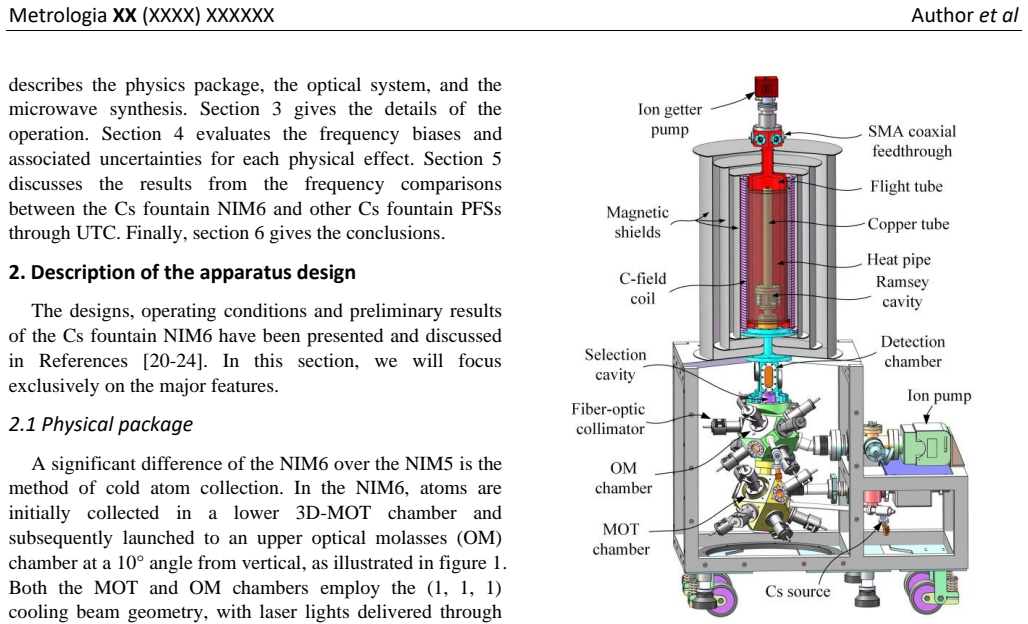
The argument is carried by the type-B uncertainty budget (Table 1), in which each physical shift is assigned a bias and an uncertainty and the total is the quadratic sum. The measurement protocols that populate the budget are the load-bearing pieces: high/low atomic-density alternation with zero-density extrapolation for cold collisions, a magnetic-field map from the $|F=3,m_F=1\rangle \leftrightarrow |F=4,m_F=1\rangle$ Ramsey fringes for the Zeeman shift, a tilt-angle method using the four-feed cavity's X and Y axes for the $m=1$ distributed-cavity-phase shift, and the interferometric switch with triggered-phase transient analysis for microwave leakage and transient phase. The heat pipe and four-feed cavity are the design features intended to shrink the temperature and phase gradients that would otherwise dominate the budget.
What would settle it
Measure the NIM6 frequency with the atom apogee raised or lowered so the computed 18 mm copper-tube attenuation changes by a known factor; if the frequency follows the leakage model, the $1\times10^{-17}$ bound can be tested directly. Separately, run a finite-element phase simulation of the Ramsey cavity using the 24.20 mm diameter and 28.62 mm height given in Section 2.1 and compare the resulting $m=0$ distributed-cavity-phase shift with the $1\times10^{-17}$ borrowed from the 48.4 mm reference cavity.
Extended reading notes
Core claim
The central claim is that NIM6 realises the SI second with a total systematic (type-B) fractional uncertainty of $2.3\times10^{-16}$, built up from a table of measured or bounded biases: the second-order Zeeman shift $728.8\times10^{-16}$ (uncertainty $0.7\times10^{-16}$), blackbody radiation $-165.9\times10^{-16}$ ($0.5\times10^{-16}$), gravitational redshift $86.0\times10^{-16}$ ($0.2\times10^{-16}$), and a cold-collision correction of about $-22.0\times10^{-16}$ at low density ($1.7\times10^{-16}$). The largest remaining uncertainties come from cold collisions, the microwave interferometric switch, and the distributed cavity phase. The paper further claims that frequency comparisons through UTC(NIM) and UTC over three measurement periods agree with other primary frequency standards within the combined uncertainties, so that NIM6 can act as a steering clock for TAI.
Load-bearing premise
The whole accuracy claim hangs on the assumption that stray microwave power reaching the atoms is below $1\times10^{-17}$, even though the experiment quoted to prove it returns $(-3.5\pm5.0)\times10^{-16}$; a second load-bearing comparison, for the cavity's internal phase variation, relies on cavity dimensions that disagree with the values printed earlier in the same paper.
Editorial extensions
If this is right
- If the $2.3\times10^{-16}$ type-B budget is correct, NIM6 can publish monthly data for international time coordination and contribute to TAI steering with comparison uncertainties near $4.0\times10^{-16}$.
- The stated short-term stability of $1.0\times10^{-13}\tau^{-1/2}$ at high density implies that averaging for roughly 25 to 30 days reaches a type-A uncertainty of about $2.3\times10^{-16}$, matching the systematic floor.
- The four-feed cavity plus tilt optimisation reduces the distributed-cavity-phase uncertainty to $0.87\times10^{-16}$, so further accuracy gains would have to come from cold collisions and the microwave switch.
- UTC comparison results within $5\times10^{-16}$ over three runs give an independent check that the evaluated biases, including the large Zeeman and blackbody-radiation corrections, are not hiding a common offset.
Reading between the lines
- The switch-on/off leakage measurement of $(-3.5\pm5.0)\times10^{-16}$ bounds the leakage shift at roughly $5\times10^{-16}$, not the $1\times10^{-17}$ entered in the budget; a more conservative combination would push the total type-B uncertainty toward $5\times10^{-16}$ until a longer or more shielded measurement tightens the bound.
- Section 2.1 gives the NIM6 Ramsey cavity a 24.20 mm diameter, while Section 4.2.3(B) justifies the $m=0$ distributed-cavity-phase estimate by comparing to a cavity of 48.4 mm inner diameter; if the smaller diameter is the real one, the borrowed $m=0$ bound should be re-derived with an electromagnetic model of the actual geometry.
- A direct test of the leakage claim would be to vary the apogee height relative to the 18 mm copper tube and see whether the measured frequency shifts with computed microwave attenuation, which would separate leakage from other switch-related effects.
Signed reviews
Editorial analysis
A structured set of objections, weighed in public.
Referee Report
Summary. The paper presents the first comprehensive uncertainty evaluation of the caesium fountain primary frequency standard NIM6, developed at the National Institute of Metrology in China. It describes the apparatus, including a 3D MOT loading optical molasses, a heat pipe for temperature stabilization, and a four-feed Ramsey cavity. The reported short-term stability is 1.0e-13 tau^-1/2 at high atomic density, and the total type-B uncertainty is claimed to be 2.3e-16. Systematic shifts evaluated include the second-order Zeeman effect, cold collisions, microwave-power-related effects, blackbody radiation, gravitational redshift, light shift, Majorana transitions, Rabi/Ramsey pulling, cavity pulling, and background gas collisions. The paper also reports frequency comparisons with UTC(NIM), UTC, and other primary frequency standards, claiming agreement within stated uncertainties.
Significance. If the claimed uncertainty budget is correct, NIM6 would rank among the best caesium fountains worldwide, with accuracy sufficient to contribute to the steering of International Atomic Time. The paper is thorough in its coverage of standard systematic effects and includes several experimental checks, such as density extrapolation, microwave-power dependence, and comparisons with UTC. The main limitation is that a few key bounds, particularly for microwave leakage, are inferred from data that do not statistically support the quoted uncertainties. These issues need to be resolved before the headline accuracy claim can be fully accepted.
major comments (2)
- [4.2.3 A, Table 1] The reported switch on/off frequency differences of (-3.5±5.0)×10^-16 for a π/2 pulse and (3.2±7.0)×10^-16 for a 3π/2 pulse provide a one-standard-deviation bound of about 5×10^-16 on the microwave leakage shift, not the 1.0×10^-17 claimed in the text. The entry of 0.1×10^-16 in Table 1 is therefore not supported by the measurement. Adding a 5×10^-16 leakage uncertainty in quadrature to the other listed uncertainties raises the total type-B uncertainty from 2.3×10^-16 to approximately 5.5×10^-16, more than doubling the headline number. The authors should either provide a calibrated absolute leakage measurement that supports a smaller bound or revise the leakage uncertainty to be consistent with the reported statistics.
- [2.1 vs 4.2.3 B] Section 2.1 states that the Ramsey cavity measures 24.20 mm in diameter, while Section 4.2.3 B states that both NIM6 and PTB-CSF2 have an inner diameter of 48.4 mm. These values are contradictory; a TE011 cavity with a 24.20 mm diameter would resonate near 16 GHz, far from the Cs clock frequency, so the 24.20 mm figure is likely a typo. Because the m=0 distributed cavity phase estimate is justified by geometric similarity to PTB-CSF2, the correct dimensions must be stated unambiguously and the DCP analysis should be re-examined with the actual geometry.
minor comments (4)
- [Throughout] There are numerous typos: 'actived' (Section 2.1) should be 'activated', 'Form the measured data' (Section 4.2.3 B) should be 'From the measured data', and 'fight tube' (Section 4.2.4) should be 'flight tube'.
- [Equations (1) and (7)] The equations for the zero-density extrapolation and the collision shift uncertainty are garbled in the manuscript; please ensure proper typesetting so that all variables are clear.
- [Figure 16] The slope of the fitted pink curve is reported as 1.6×10^-17; please specify the units (presumably per day) and define the fit function in the caption or text.
- [Conclusions] The statement that NIM6 will function as a 'second-generation primary frequency standard for China' is unclear, since the conclusions also call it a 'third-generation fountain'; please clarify the generation count.
Circularity Check
No circular reduction: the NIM6 type-B budget is assembled from independent measurements and external benchmarks; the flagged leakage and DCP problems are statistical or factual, not circular.
full rationale
The central claim is the total type-B uncertainty of 2.3e-16 (Section 4.2.11, Table 1), obtained as a quadrature sum of individually evaluated biases. Each contribution is anchored to measurements or external literature: the Zeeman shift uses a measured C-field map (Section 4.2.1); cold collisions use a high/low density extrapolation (Section 4.2.2); BBR uses literature coefficients and measured temperatures (Section 4.2.4); gravity uses a levelling measurement (Section 4.2.5); spectral impurity, Rabi/Ramsey pulling, cavity pulling and background-gas shifts use independent formulas, measured parameters, and literature coefficients. The DCP m=0 estimate is imported from PTB-CSF2 [37] and is therefore external, although the paper's geometry statement is internally inconsistent with Section 2.1 (24.20 mm vs 48.4 mm diameter); that is a correctness concern, not a circular reduction. The microwave-leakage entry of 0.1e-16 is not statistically justified by the reported (-3.5 +/- 5.0)e-16 switch on/off measurement, but the paper does not derive the entry from that measurement by renaming it; the inference is an unsupported bound, not an equivalence by construction. The authors cite their own prior NIM5/NIM6 work for apparatus details and methods ([12], [20]-[26]), including the shutter attenuation factor used in the small light-shift estimate; these self-citations are not load-bearing for the 2.3e-16 total, which would be essentially unchanged even if the light-shift entry were revised. No fitted parameter is renamed as a prediction, no uniqueness theorem is imported from the authors' prior work, and the UTC/PFS comparisons are independent frequency links rather than the source of the budget. Accordingly, no significant circularity is found; the score reflects only minor, non-load-bearing self-citations and does not endorse the statistical validity of every uncertainty entry.
Assumptions & free parameters
assumptions (7)
- standard math Breit-Rabi formula for the second-order Zeeman shift (Eq. 4)
- domain assumption Cold collision shift is proportional to atomic density and the zero-density extrapolation is linear (Section 4.2.2)
- domain assumption The NIM6 Ramsey cavity is geometrically similar to PTB-CSF2, allowing the m=0 DCP bound of below 1e-17 to be transferred (Section 4.2.3 B)
- domain assumption The switch on/off frequency difference statistics justify a microwave leakage upper bound of 1e-17 (Section 4.2.3 A)
- domain assumption TOF line shapes at high and low atomic density are identical within 1 percent, giving sigma_nonlinear = 0.01 (Section 4.2.2, Figure 9)
- domain assumption The four cavity feeds are balanced in phase and amplitude within 20 percent, reducing the m=1 DCP sensitivity (Section 4.2.3 B)
- domain assumption H2 background gas pressure below 2e-8 Pa with literature shift coefficients bounds the gas collision shift below 1e-17 (Section 4.2.10)
Cite this review
Pith. "Pith review of Uncertainty Evaluation of the Caesium Fountain Primary Frequency Standard NIM6." pith.science (2026). https://pith.science/paper/C33SCIZY
@misc{pith2026241111349,
  author       = {Pith},
  title        = {Pith review of: Uncertainty Evaluation of the Caesium Fountain Primary Frequency Standard NIM6},
  year         = {2026},
  howpublished = {\url{https://pith.science/paper/C33SCIZY}},
  note         = {Machine review of arXiv:2411.11349}
}
read the original abstract
A new caesium (Cs) fountain clock NIM6 has been developed at the National Institute of Metrology (NIM) in China, for which a comprehensive uncertainty evaluation is presented. A three-dimensional magneto-optical trap (3D MOT) loading optical molasses is employed to obtain more cold atoms rapidly and efficiently with a tunable, uniform density distribution. A heat pipe surrounding the flight tube maintains a consistent and stable temperature within the interrogation region. Additionally, a Ramsey cavity with four azimuthally distribution feeds is utilized to mitigate distributed cavity phase shifts. The Cs fountain clock NIM6 achieves a short-term stability of 1.0x10⁻¹³ {\tau}-1/2 at high atomic density, and a typical overall fractional type-B uncertainty is estimated to be 2.3x10⁻¹⁶. Comparisons of frequency between the Cs fountain NIM6 and other Cs fountain Primary Frequency Standards (PFSs) through Coordinated Universal Time (UTC) have demonstrated an agreement within the stated uncertainties.
Figures

Reference graph
Works this paper leans on
-
[1]
Clairon A, Laurent P, Santarelli G, Ghezali S, Lea S N and Bahoura M 1995 IEEE Trans. Instrum. Meas. IM44 128–31
work page 1995
-
[2]
Wynands R and Weyers S 2005 Metrologia 42 S64
2005
-
[3]
Kurosu T, Fukuyama Y, Koga Y and Abe K 2004 IEEE Trans. Instrum. Meas. 53 466–71
work page 2004
-
[4]
Kumagai M, Ito H, Kajita M and Hosokawa M 2008 Metrologia 45 139-148
work page 2008
-
[5]
Gerginov V, Nemitz N, Weyers S, Schrö der R, Griebsch D and Wynands R 2010 Metrologia 47 65-79
work page 2010
-
[6]
Szymaniec K, Park S E, Marra G and C hałupczak W 2010 Metrologia 47 363-376
work page 2010
-
[7]
Li R, Gibble K and Szymaniec K 2011 Metrologia 48 283-9
work page 2011
- [8]
Show all 57 references
-
[9]
Domnin Y S, Baryshev V N, Boyko A I, Elkin G A, Novoselov A V, Kopylov L N and Kupalov D S 2013 Meas. Tech. 55 1155–62
2013
-
[10]
Heavner T P, Donley E A, Levi F, Costanzo G, Parker T E, Shirley J H, Ashby N, Barlow S and Jefferts S R 2014 Metrologia 51 174-182
2014
-
[11]
Levi F, Calonico D, Calosso C E, Godone A, Micalizio S and Costanzo G A 2014 Metrologia 51 270-284
2014
-
[12]
Fang F, Li M S, Lin P W, Chen W L, Liu N F, Lin Y G, Wang P, Liu K, Suo R and Li T C 2015 Metrologia 52 454-468
2015
-
[13]
Ultrason
Lipphardt B, Gerginov V and Weyers S 2017 IEEE Trans. Ultrason. Ferroelectr. Freq. Control 64 761-766
2017
-
[14]
Weyers S, Gerginov V, Kazda M, Rahm J, Lipphardt B, Dobrev G and Gibble K, 2018 Metrologia 55 789-805
2018
-
[15]
Jallageas A, Devenoges L, Petersen M, Morel J, Bernier L G, Schenker D, Thomann P and Sü dmeyer T 2018 Metrologia 55 366
2018
-
[16]
Beattie S, Jian B, Alcock J, Gertsvolf M, Hendricks R, Szymaniec K and Gibble K 2020 Metrologia 57 035010
2020
-
[17]
Takamizawa A, Yanagimachi S and Hagimoto K, 2022 Metrologia 59 035004
2022
-
[18]
Wang X L, Ruan J, Liu D D, Guan Y, Shi J R, Yang F, Bai Y, Zhang H, Fan S C, Wu W J, Zhao S H and Zhang S G 2023 Metrologia 60 065012
2023
-
[19]
BIPM Reports 202 3 (https://webtai.bipm.org/ftp/pub/tai/annual-reports/bipm- annual-report/table4/table4_2023.pdf)
-
[20]
IEEE Intl
Fang F, Chen W L, Liu K, Liu N F, Suo R and Li T C 2015 Proc. IEEE Intl. Freq. Cont. Symp (Denver) pp. 492-494
2015
-
[21]
Phys.: Conf
Fang F, Liu N F, Liu K, Chen W L, Suo R and Li T C 2016 J. Phys.: Conf. Ser. 723 012009
2016
-
[22]
URSI GASS (Montreal) pp
Fang F, Chen W L, Liu K, Liu N F, Dai S Y, Han L and Li T C 2017 Proc. URSI GASS (Montreal) pp. 1-2
2017
-
[23]
URSI AP-RASC (New Delhi) pp
Fang F, Chen W L, Liu K, Liu N F, Han L and Li T C 2019 Proc. URSI AP-RASC (New Delhi) pp. 1-1
2019
-
[24]
EFTF-IFC (Orlando) pp
Fang F, Chen W L, Liu K, Dai S Y, Liu N F, Han L, Zheng F S and Li T C 2019 Proc. EFTF-IFC (Orlando) pp. 1-3
2019
-
[25]
B 30 050602
Han L, Fang F, Chen W L, Liu K, Dai S Y, Zuo Y N and Li T C 2021 Chinese Phys. B 30 050602
2021
-
[26]
B 30 080602
Han L, Fang F, Chen W L, Liu K, Zuo Y N, Zheng F S, Dai S Y and Li T C 2021 Chinese Phys. B 30 080602
2021
-
[27]
Szymaniec K and Park S E 2011 IEEE Trans. Instrum. Meas. 60 2475
2011
-
[28]
Breit G and Rabi I I 1931 Phys. Rev. 38 2082–3
1931
-
[29]
Pereira D S F, Marion H, Bize S, Sortais Y, Clairon A and Salomon C 2002 Phys. Rev. Lett. 89 233004
2002
-
[30]
Szymaniec K, Chalupczak W, Whibberley P, Lea S and Henderson D 2010 Metrologia 47 363–76
2010
-
[31]
Santarelli G, Laurent P, Lemonde P and Clairon A 1999 Phys. Rev. Lett. 83 4619–22 Figure 16. Frequency measurement of the fountain NIM6 versus H21. The slope of the fitted pink curve is 1.6× 10⁻¹⁷. Metrologia XX (XXXX) XXXXXX Author et al 14
1999
-
[32]
Pavlis N K and Weiss M A 2003 Metrologia 40 66
2003
-
[33]
Ultrason
Shirley J H, Levi F, Heavner T P, Calonico D, Yu D and Jefferts S R 2006 IEEE Trans. Ultrason. Ferroelectr. Freq. Control 53 2376–85
2006
-
[34]
Jefferts S R, Shirley J, Parker T E, Heavner T P, Meekhof D M, Nelson C, Levi F, Costanzo G, Marchi A De, Drullinger R 2002 Metrologia 39 321–36
2002
-
[35]
Li R and Gibble K 2004 Metrologia 41 376–86
2004
-
[36]
Li R and Gibble K 2010 Metrologia 47 534–51
2010
-
[37]
Weyers S, Gerginov V, Nemitz N, Li R and Gibble K 2012 Metrologia 49 82–7
2012
-
[38]
Gué na J, Li R X, Gibble K, Bize S and Clairon A 2011 Phys. Rev. Lett. 106 130801
2011
-
[39]
Audoin C, Jardino M, Cutler L S and Lacey R F 1978 IEEE Trans. Instrum. Meas. 27 325–9
1978
-
[40]
Ultrason., Ferroelectr., Freq
Levi F, Shirley J H, Heavner T P, Yu D H and Jefferts S R 2006 IEEE Trans. Ultrason., Ferroelectr., Freq. Control 53 1584–1589
2006
-
[41]
Itano W M, Lewis L L and Wineland D J 1982 Phys. Rev. A 25 1233
1982
-
[42]
Beloy K, Safronova U I and Derevianko A 2006 Phys. Rev. Lett. 97 040801
2006
-
[43]
Angstmann E J, Dzuba V A and Flambaum V V 2006 Phys. Rev. A 74 023405
2006
-
[44]
Vanier J and Audoin C 1989 The Quantum Physics of Atomic Frequency Standards (Adam Hilger, Bristol and Philadelphia) p 785
1989
-
[45]
Lin Y G, Wang Q, Meng F, Cao S Y, Wang Y Z, Li Y, Sun Z, Lu B K, Yang T, Lin B K, Zhang A M, Fang F and Fang Z J 2021 Metrologia 58 35010
2021
-
[46]
Li J, Chu Y and Xu X 2017 Determination of vertical datum offset between the regional and the global height datum Acta Geod. Cartogr. Sinica 46 1262 (in Chinese)
2017
-
[47]
Bauch A and Schrö der R 1993 Ann. Phys. 2 421-49
1993
-
[48]
Wynands R, Schroeder R and Weyers S 2007 IEEE Trans. Instrum. Meas. 56 660–3
2007
-
[49]
Shi J R, Wang X L, Yang F, Bai Y, Guan Y, Fan S C, Liu D D, Ruan J and Zhang S G 2023 Chin. Phys. B 32 040602
2023
-
[50]
Cutler L S, Flory C A, Giffard R P and Marchi A D 1991 J. Appl. Phys. 69 2780-92
1991
-
[51]
Gerginov V, Nemitz N and Weyers S 2014 Phys. Rev. A 90 033829
2014
-
[52]
Vanier J and Audoin C 1989 The Quantum Physics of Atomic Frequency Standards (IOP Publishing Ltd) p 835
1989
-
[53]
Vanier J and Audoin C 1989 The Quantum Physics of Atomic Frequency Standards (IOP Publishing Ltd) p 830
1989
-
[54]
Microwave Theory Tech
Zheng F S, Fang F, Chen W L, Liu K, Dai S Y, Cao S Y, Zuo Y N and Li T C 2023 IEEE Trans. Microwave Theory Tech. 71 1752-60
2023
-
[55]
Gibble K 2013 Phys. Rev. Lett. 110 180802
2013
-
[56]
Ultrason
Szymaniec K, Lea S N and Liu K 2014 IEEE Trans. Ultrason. Ferroelectr. Freq. Control 61 203–6
2014
-
[57]
Beer C and Bernheim R 1976 Phys. Rev. A 13 1052–7
1976
Reviewed August 12, 2026 · model on record in the stance chip above.
Discussion (0). Continue with ORCID to comment.