REVIEW 3 major objections 5 minor 1 cited by
Generalizable Person Re-identification via Balancing Alignment and Uniformity
T0 review · 3 major / 5 minor · reviewed 2026-08-12 · deepseek-v4-flash
Pith's one-line read Data augmentations can hurt cross-domain person re-ID by shrinking feature diversity, and a new loss balance restores it.
desk verdict Solid empirical paper; the augmentation-polarization analysis is genuinely useful, but the causal story is under-supported and the headline numbers may be tuned on the target domain. read the letter →
The pith
A machine-rendered reading of the paper's core claim, the machinery that carries it, and where it could break.
The reading
What carries the argument
The load-bearing object is the pair of loss terms borrowed from contrastive learning: alignment, the expected squared distance between positive pairs, and uniformity, the log of the average pairwise Gaussian potential on the unit hypersphere. BAU applies both to original and augmented images; the alignment loss is reweighted by the Jaccard similarity of k-reciprocal nearest-neighbor sets between augmented and original features, so that corrupted augmentations contribute less, and a third 'domain-specific uniformity' loss spreads each source domain's features against nearest class prototypes from the same domain in a memory bank. Together these terms are meant to keep the representation space both compact within identity and globally diverse, countering the sparsity that naive augmentation training induces.
What would settle it
Train a person re-ID model with aggressive augmentations at probability 1.0, then freeze the encoder and perform a post-hoc intervention that only raises uniformity, such as spectral decorrelation or a second training stage with a uniformity loss but no alignment term, and measure OOD mAP on Market-1501; if OOD accuracy does not improve even though uniformity is restored, the paper's claim that uniformity loss drives generalization is falsified. Alternatively, run MS+CS+C3 to Market-1501 with p=1.0 under three conditions, full BAU, BAU without the uniformity loss, and BAU with uniformity loss but alignment applied to randomly chosen pairs, and compare OOD mAP.
Extended reading notes
Core claim
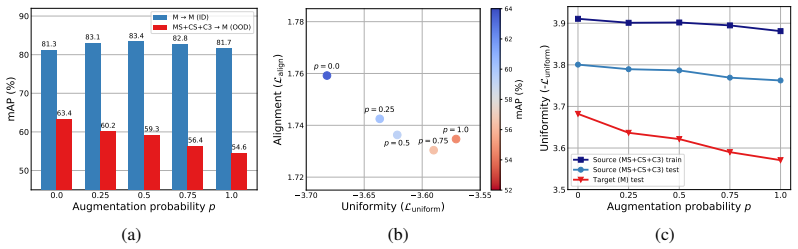
The central discovery is that the polarized effect of data augmentations in DG re-ID is linked to a trade-off between alignment and uniformity on the hypersphere: augmentations improve alignment (invariance to transformations) but reduce uniformity (the even spread of embeddings), and because person re-ID is an open-set retrieval task, loss of uniformity means the model fails to preserve diverse visual cues needed for unseen identities and domains. To counter this, BAU explicitly optimizes both properties, using a reliability-weighted alignment loss between original and augmented views, a uniformity loss over both views, and a domain-specific uniformity loss computed with a momentum-updated memory bank of class prototypes. The paper reports that this simple regularization achieves state-of-the-art performance on Protocols 1 through 3, outperforming prior methods that rely on feature normalization, adversarial training, meta-learning, or mixture-of-experts.
Load-bearing premise
The argument assumes that the observed reduction in uniformity is the cause of the out-of-distribution performance drop, not merely a symptom of some other failure such as overfitting to spurious dominant features; if the causal arrow is wrong, BAU's gains could come from an unidentified mechanism.
Editorial extensions
If this is right
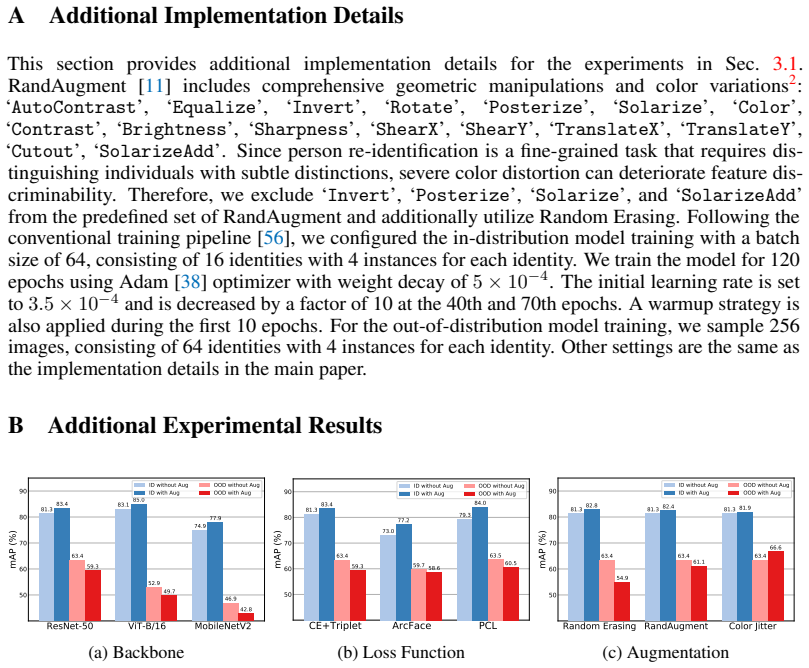
- BAU turns data augmentations from a liability into a benefit: with the proposed losses, Random Erasing, RandAugment, and Color Jitter each improve out-of-distribution accuracy, whereas naive augmentation training degrades it.
- The framework is architecture- and loss-agnostic: it improves ResNet-50, MobileNetV2, and ViT-B/16 baselines, and works on top of cross-entropy, triplet, ArcFace, and PCL losses.
- Because BAU removes the need for complex components such as domain-adversarial training, meta-learning, or feature normalization, it offers a simpler recipe for DG re-ID that is easier to reproduce and extend.
- If the analysis is right, the alignment-uniformity balance is the actionable quantity for diagnosing why an augmentation hurts generalization: a drop in uniformity flags the harmful regime.
- The method's improvements hold across three evaluation protocols, including a leave-one-out setting where whole datasets are held out as unseen target domains.
Reading between the lines
- Our inference: if uniformity loss is the causal mechanism, then any representation-learning task with an open-set or fine-grained retrieval component, such as vehicle re-ID or face recognition, should show the same polarized augmentation effect and benefit from a similar alignment-uniformity balance.
- Our inference: the reliability weighting by k-reciprocal nearest-neighbor overlap is a general way to detect 'corrupted' augmentations and could be ported to other augmentation-heavy training regimes, such as semi-supervised or noisy-label learning.
- Our inference: a direct test of the mechanism would be to add a uniformity regularizer to a model trained with aggressive augmentations but without the alignment weight; if out-of-distribution performance recovers only when both are present, the balance itself matters rather than uniformity alone.
- Our inference: since Color Jitter alone did not show the polarized effect, a natural extension is to make augmentation selection adaptive, up-weighting transformations that preserve uniformity and down-weighting those that destroy it.
Signed reviews
Editorial analysis
A structured set of objections, weighed in public.
Referee Report
Summary. The paper studies the 'polarized effect' of data augmentation in domain-generalizable person re-identification (DG re-ID): augmentations improve in-distribution accuracy but degrade out-of-distribution accuracy. The authors attribute this to a reduction in feature-space uniformity, supported by correlational evidence in Fig. 1. They propose BAU, a training framework that adds alignment and uniformity losses on original and augmented images, a k-reciprocal-neighbor-based weighting of the alignment loss, and a domain-specific uniformity loss using class prototypes. The method is evaluated on three standard protocols across four datasets (Tables 3-4), with ablations in Tables 5-9 and qualitative analyses in Figs. 4-5. The empirical claim that BAU improves DG re-ID over prior state-of-the-art methods is well supported by the reported experiments.
Significance. If the mechanism is confirmed, the paper offers a simple, architecture-agnostic regularizer and a new explanation for the failure of data augmentation in open-set retrieval tasks. The manuscript's strengths include released code, comprehensive evaluation across multiple protocols and backbones/loss functions (Appendix B), component-wise ablations, and parameter sensitivity analyses. The headline accuracy gains are credible and sizable. However, the paper's scientific contribution hinges on the claim that augmentations hurt OOD performance specifically because they reduce uniformity; that causal link is currently underdetermined by the correlational and ablation evidence.
major comments (3)
- [Sec. 3.1 and Fig. 1] The central diagnostic claim—that data augmentations degrade OOD performance by reducing uniformity—is inferred from a correlation across five augmentation probabilities, with no error bars, no repeated seeds, and no interventional control. Increasing p also alters training difficulty, the degree of source overfitting, and the optimization geometry, all of which could independently produce both the mAP drop and the uniformity drop. As a result, the 'reveal' stated in Sec. 1 is not yet established. Please add an interventional experiment, e.g., train at a fixed high p while adding a uniformity-only regularizer, or compare with a matched non-uniformity regularizer (e.g., feature entropy maximization or feature-norm penalty) to show that restoring uniformity specifically recovers OOD mAP. If such an experiment is not feasible, the paper should reframe the finding as a correlational observation and present BAU as an empirically effective regularizer rather than a validated mechanism.
- [Table 5 and Eq. (9)] The ablation study supports Luniform as a useful component, but it never isolates Luniform alone among the BAU losses, nor does it compare Luniform against a generic regularizer of matched strength. The full objective also contains the weighting strategy and Ldomain (Eq. (9)), and Table 6 shows these components contribute. Therefore, the claim in Sec. 3.2 that the uniformity term is the key to generalization is underdetermined: the gains could come from extra regularization, from the weighting, or from the domain prototypes. Please include an ablation that adds only Luniform to the baseline (Lce+Ltri), and an additional control with a non-uniformity regularizer of similar complexity, so the mechanism can be separated from generic regularization.
- [Sec. 4.4 and Fig. 4b] The domain-specific uniformity loss (Eq. (8)) is claimed to 'reduce domain bias and thus enhance generalization,' but the t-SNE and uniformity measurements in Fig. 4b are computed on the source training data, not on the target domain. Since Ldomain contributes a large part of the overall gain (about 2.2 average mAP points in Table 6), the paper should provide target-domain evidence of domain invariance (e.g., uniformity of target features, or a domain-gap metric such as MMD between source and target feature distributions), or temper the claim to be about source-domain feature geometry only.
minor comments (5)
- [Tables 3-4 and Fig. 1] Report a single run without standard deviations; given the SOTA claims and the fact that Fig. 1 lacks error bars, the paper should report mean±std over at least three seeds for the main comparisons and the Fig. 1 analysis.
- [Eq. (4) and Sec. 4.2] The k-reciprocal Jaccard weight is computed within a mini-batch; the paper does not discuss sensitivity to batch size or to the sampling of identities (4 images per identity). Please note this as an approximation and add a sentence on how batch composition affects the reliability scores, or provide an experiment varying batch size.
- [Fig. 1c and Fig. 7] The y-axis label 'Uniformity (-Luniform)' is confusing because larger values indicate less uniformity; please relabel to '-Luniform (lower = more uniform)' or 'Inverse uniformity' to match the claims.
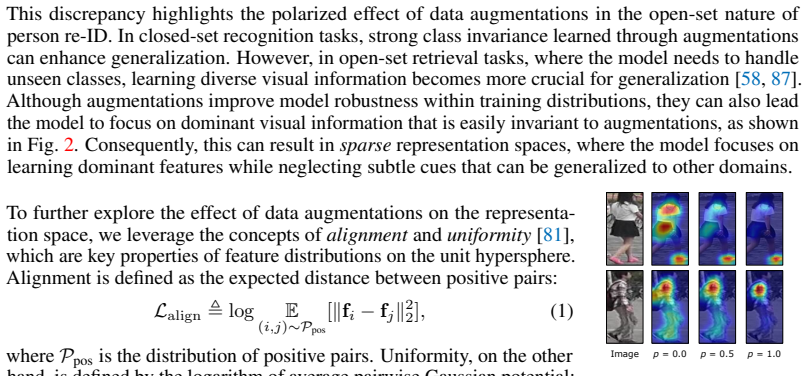
- [Sec. 3.1] The term 'sparse representation spaces' is used as a key explanation, but no formal definition or quantitative measure of sparsity is given (Grad-CAM in Fig. 2 is qualitative). Please define the sparsity metric or remove the term from the causal statement.
- [Eq. (7)-(8) and Fig. 8] Parameter analysis covers k and λ, but the momentum µ (Eq. 7) and the number of nearest prototypes N (Eq. 8) are set to fixed values without sensitivity analysis; please report a brief sensitivity check or justify these choices.
Circularity Check
No load-bearing circularity; BAU's SOTA results are empirical, though its uniformity-gap 'validation' is by construction because the loss explicitly optimizes that metric.
-
self definitional
[Sec. 4.4 'Analysis of alignment and uniformity', Fig. 4a; Eq. (9)]
"In contrast, BAU consistently maintains better alignment and uniformity compared to the baseline across all augmentation probabilities. Notably, even when data augmentation is not applied (i.e., p = 0), BAU still outperforms the baseline."
BAU's total objective in Eq. (9) explicitly contains Lalign, Luniform, and Ldomain, and Fig. 4a reports exactly these quantities. Therefore BAU's improved alignment/uniformity relative to the baseline is a direct consequence of optimizing those very terms, not an independent test of the claim that uniformity is the causal mediator of OOD generalization. This is a by-construction validation of a secondary diagnostic, not a prediction of the headline OOD accuracy.
full rationale
The paper's central assertion—that applying the BAU losses to original and augmented images improves out-of-distribution mAP—is an empirical result supported by Tables 3-5 and ablation studies; it is not algebraically derived from the loss definitions. No fitted parameter is renamed as a prediction, and no equation reduces to its own input. The causal diagnosis (augmentations reduce uniformity, and restoring uniformity is why BAU helps) rests on correlational evidence in Fig. 1b/c with no interventional control, but underdetermination of mechanism is a correctness/identification concern, not circularity. The one self-referential observation is Fig. 4a, where improved alignment/uniformity is guaranteed by Eq. (9) because those exact losses are being optimized; this weakens the mechanistic interpretation but does not invalidate the empirical SOTA claim. The only self-citation is Ref. [9] in the k-reciprocal weighting strategy, which is supported by four independent references and is ablated in Table 6, so it is not load-bearing. The Discussion's stated limitations about large domain shifts and the absence of adversarial/feature-level augmentations are acknowledged scope limits, not hidden circular inputs. Overall, no load-bearing circularity; score 1 reflects the minor by-construction uniformity validation.
Assumptions & free parameters
free parameters (6)
- lambda_alignment_weight =
1.5
- k_reciprocal_nearest_neighbors =
10
- augmentation_probability_p =
0.5
- momentum_mu =
0.1
- num_nearest_prototypes_N =
mini-batch size
- uniformity_and_domain_loss_weights =
1.0 each
assumptions (5)
- domain assumption Uniformity of embeddings on the unit hypersphere is beneficial for generalization in open-set retrieval.
- ad hoc to paper The k-reciprocal Jaccard similarity computed within a mini-batch measures whether an augmented sample is reliable for alignment learning.
- ad hoc to paper Pushing features away from same-domain, different-class prototypes reduces domain bias and improves domain invariance.
- standard math Cross-entropy and batch-hard triplet losses provide a sound base objective for person re-identification.
- domain assumption Mini-batch feature pairs approximate the global data distribution for computing uniformity.
Cite this review
Pith. "Pith review of Generalizable Person Re-identification via Balancing Alignment and Uniformity." pith.science (2026). https://pith.science/paper/X36BGIWW
@misc{pith2026241111471,
  author       = {Pith},
  title        = {Pith review of: Generalizable Person Re-identification via Balancing Alignment and Uniformity},
  year         = {2026},
  howpublished = {\url{https://pith.science/paper/X36BGIWW}},
  note         = {Machine review of arXiv:2411.11471}
}
read the original abstract
Domain generalizable person re-identification (DG re-ID) aims to learn discriminative representations that are robust to distributional shifts. While data augmentation is a straightforward solution to improve generalization, certain augmentations exhibit a polarized effect in this task, enhancing in-distribution performance while deteriorating out-of-distribution performance. In this paper, we investigate this phenomenon and reveal that it leads to sparse representation spaces with reduced uniformity. To address this issue, we propose a novel framework, Balancing Alignment and Uniformity (BAU), which effectively mitigates this effect by maintaining a balance between alignment and uniformity. Specifically, BAU incorporates alignment and uniformity losses applied to both original and augmented images and integrates a weighting strategy to assess the reliability of augmented samples, further improving the alignment loss. Additionally, we introduce a domain-specific uniformity loss that promotes uniformity within each source domain, thereby enhancing the learning of domain-invariant features. Extensive experimental results demonstrate that BAU effectively exploits the advantages of data augmentation, which previous studies could not fully utilize, and achieves state-of-the-art performance without requiring complex training procedures. The code is available at \url{https://github.com/yoonkicho/BAU}.
Figures

Figures from the paper (5 more)




Forward citations
Cited by 1 Pith paper
-
Domain Generalization for Person Re-identification: A Survey Towards Domain-Agnostic Person Matching
A systematic survey that categorizes domain-generalizable person re-identification methods and compares their cross-domain performance.
Reference graph
Works this paper leans on
-
[1]
An improved deep learning architecture for person re-identification
Ejaz Ahmed, Michael Jones, and Tim K Marks. An improved deep learning architecture for person re-identification. In CVPR, 2015
2015
-
[2]
Dex: Domain embedding expansion for generalized person re-identification
Eugene PW Ang, Lin Shan, and Alex C Kot. Dex: Domain embedding expansion for generalized person re-identification. In BMVC, 2021
2021
-
[3]
How to train your maml
Antreas Antoniou, Harri Edwards, and Amos Storkey. How to train your maml. In ICLR, 2019
2019
-
[4]
Person30k: A dual-meta generalization network for person re-identification
Yan Bai, Jile Jiao, Wang Ce, Jun Liu, Yihang Lou, Xuetao Feng, and Ling-Yu Duan. Person30k: A dual-meta generalization network for person re-identification. In CVPR, 2021
2021
-
[5]
Domain-specific batch normalization for unsupervised domain adaptation
Woong-Gi Chang, Tackgeun You, Seonguk Seo, Suha Kwak, and Bohyung Han. Domain-specific batch normalization for unsupervised domain adaptation. In CVPR, 2019
2019
-
[6]
Dual distribution alignment network for generalizable person re-identification
Peixian Chen, Pingyang Dai, Jianzhuang Liu, Feng Zheng, Mingliang Xu, Qi Tian, and Rongrong Ji. Dual distribution alignment network for generalizable person re-identification. In AAAI, 2021
2021
-
[7]
Abd-net: Attentive but diverse person re-identification
Tianlong Chen, Shaojin Ding, Jingyi Xie, Ye Yuan, Wuyang Chen, Yang Yang, Zhou Ren, and Zhangyang Wang. Abd-net: Attentive but diverse person re-identification. In ICCV, 2019
2019
-
[8]
Instance-dependent label-noise learning with manifold-regularized transition matrix estimation
De Cheng, Tongliang Liu, Yixiong Ning, Nannan Wang, Bo Han, Gang Niu, Xinbo Gao, and Masashi Sugiyama. Instance-dependent label-noise learning with manifold-regularized transition matrix estimation. In CVPR, 2022
2022
Show all 107 references
-
[9]
Part-based pseudo label refinement for unsupervised person re-identification
Yoonki Cho, Woo Jae Kim, Seunghoon Hong, and Sung-Eui Yoon. Part-based pseudo label refinement for unsupervised person re-identification. In CVPR, 2022
2022
-
[10]
Meta batch-instance normalization for generalizable person re-identification
Seokeon Choi, Taekyung Kim, Minki Jeong, Hyoungseob Park, and Changick Kim. Meta batch-instance normalization for generalizable person re-identification. In CVPR, 2021
2021
-
[11]
Randaugment: Practical automated data augmentation with a reduced search space
Ekin D Cubuk, Barret Zoph, Jonathon Shlens, and Quoc V Le. Randaugment: Practical automated data augmentation with a reduced search space. In CVPR Workshops, 2020
2020
-
[12]
Generalizable person re- identification with relevance-aware mixture of experts
Yongxing Dai, Xiaotong Li, Jun Liu, Zekun Tong, and Ling-Yu Duan. Generalizable person re- identification with relevance-aware mixture of experts. In CVPR, 2021
2021
-
[13]
Imagenet: A large-scale hierarchical image database
Jia Deng, Wei Dong, Richard Socher, Li-Jia Li, Kai Li, and Li Fei-Fei. Imagenet: A large-scale hierarchical image database. In CVPR, 2009
2009
-
[14]
Arcface: Additive angular margin loss for deep face recognition
Jiankang Deng, Jia Guo, Niannan Xue, and Stefanos Zafeiriou. Arcface: Additive angular margin loss for deep face recognition. In CVPR, pages 4690–4699, 2019
2019
-
[15]
Improved regularization of convolutional neural networks with cutout
Terrance DeVries and Graham W Taylor. Improved regularization of convolutional neural networks with cutout. arXiv preprint arXiv:1708.04552, 2017
2017 arXiv
-
[16]
An image is worth 16x16 words: Transformers for image recognition at scale
Alexey Dosovitskiy, Lucas Beyer, Alexander Kolesnikov, Dirk Weissenborn, Xiaohua Zhai, Thomas Unterthiner, Mostafa Dehghani, Matthias Minderer, Georg Heigold, Sylvain Gelly, Jakob Uszkoreit, and Neil Houlsby. An image is worth 16x16 words: Transformers for image recognition at...
2021
-
[17]
Identity-seeking self-supervised represen- tation learning for generalizable person re-identification
Zhaopeng Dou, Zhongdao Wang, Yali Li, and Shengjin Wang. Identity-seeking self-supervised represen- tation learning for generalizable person re-identification. In ICCV, 2023
2023
-
[18]
Model-agnostic meta-learning for fast adaptation of deep networks
Chelsea Finn, Pieter Abbeel, and Sergey Levine. Model-agnostic meta-learning for fast adaptation of deep networks. In ICML, 2017
2017
-
[19]
Self- similarity grouping: A simple unsupervised cross domain adaptation approach for person re-identification
Yang Fu, Yunchao Wei, Guanshuo Wang, Yuqian Zhou, Honghui Shi, and Thomas S Huang. Self- similarity grouping: A simple unsupervised cross domain adaptation approach for person re-identification. In ICCV, 2019
2019
-
[20]
Domain-adversarial training of neural networks.Journal of Machine Learning Research, 2016
Yaroslav Ganin, Evgeniya Ustinova, Hana Ajakan, Pascal Germain, Hugo Larochelle, François Laviolette, Mario March, and Victor Lempitsky. Domain-adversarial training of neural networks.Journal of Machine Learning Research, 2016
2016
-
[21]
Simcse: Simple contrastive learning of sentence embed- dings
Tianyu Gao, Xingcheng Yao, and Danqi Chen. Simcse: Simple contrastive learning of sentence embed- dings. In EMNLP, 2021. 11
2021
-
[22]
Mutual mean-teaching: Pseudo label refinery for unsuper- vised domain adaptation on person re-identification
Yixiao Ge, Dapeng Chen, and Hongsheng Li. Mutual mean-teaching: Pseudo label refinery for unsuper- vised domain adaptation on person re-identification. In ICLR, 2020
2020
-
[23]
Self-paced contrastive learning with hybrid memory for domain adaptive object re-id
Yixiao Ge, Feng Zhu, Dapeng Chen, Rui Zhao, et al. Self-paced contrastive learning with hybrid memory for domain adaptive object re-id. NeurIPS, 2020
2020
-
[24]
Imagenet-trained cnns are biased towards texture; increasing shape bias improves accuracy and robustness
Robert Geirhos, Patricia Rubisch, Claudio Michaelis, Matthias Bethge, Felix A Wichmann, and Wieland Brendel. Imagenet-trained cnns are biased towards texture; increasing shape bias improves accuracy and robustness. In ICLR, 2019
2019
-
[25]
Dissecting supervised contrastive learning
Florian Graf, Christoph Hofer, Marc Niethammer, and Roland Kwitt. Dissecting supervised contrastive learning. In ICML, 2021
2021
-
[26]
Viewpoint invariant pedestrian recognition with an ensemble of localized features
Douglas Gray and Hai Tao. Viewpoint invariant pedestrian recognition with an ensemble of localized features. In ECCV, 2008
2008
-
[27]
Generalizable person re-identification via self-supervised batch norm test-time adaption
Ke Han, Chenyang Si, Yan Huang, Liang Wang, and Tieniu Tan. Generalizable person re-identification via self-supervised batch norm test-time adaption. In AAAI, 2022
2022
-
[28]
Momentum contrast for unsupervised visual representation learning
Kaiming He, Haoqi Fan, Yuxin Wu, Saining Xie, and Ross Girshick. Momentum contrast for unsupervised visual representation learning. In CVPR, 2020
2020
-
[29]
Deep residual learning for image recognition
Kaiming He, Xiangyu Zhang, Shaoqing Ren, and Jian Sun. Deep residual learning for image recognition. In CVPR, 2016
2016
-
[30]
In defense of the triplet loss for person re- identification
Alexander Hermans, Lucas Beyer, and Bastian Leibe. In defense of the triplet loss for person re- identification. arXiv preprint arXiv:1703.07737, 2017
2017 arXiv
-
[31]
Person re-identification by descriptive and discriminative classification
Martin Hirzer, Csaba Beleznai, Peter M Roth, and Horst Bischof. Person re-identification by descriptive and discriminative classification. In SCIA, 2011
2011
-
[32]
Learning with neighbor consistency for noisy labels
Ahmet Iscen, Jack Valmadre, Anurag Arnab, and Cordelia Schmid. Learning with neighbor consistency for noisy labels. In CVPR, 2022
2022
-
[33]
Adaptive mixtures of local experts
Robert A Jacobs, Michael I Jordan, Steven J Nowlan, and Geoffrey E Hinton. Adaptive mixtures of local experts. Neural Computation, 1991
1991
-
[34]
Frustratingly easy person re-identification: Generaliz- ing person re-id in practice
Jieru Jia, Qiuqi Ruan, and Timothy M Hospedales. Frustratingly easy person re-identification: Generaliz- ing person re-id in practice. In BMVC, 2019
2019
-
[35]
Dynamically transformed instance normalization network for generalizable person re-identification
Bingliang Jiao, Lingqiao Liu, Liying Gao, Guosheng Lin, Lu Yang, Shizhou Zhang, Peng Wang, and Yanning Zhang. Dynamically transformed instance normalization network for generalizable person re-identification. In ECCV, 2022
2022
-
[36]
Style normalization and restitution for generalizable person re-identification
Xin Jin, Cuiling Lan, Wenjun Zeng, Zhibo Chen, and Li Zhang. Style normalization and restitution for generalizable person re-identification. In CVPR, 2020
2020
-
[37]
Cross-class feature augmentation for class incremental learning
Taehoon Kim, Jaeyoo Park, and Bohyung Han. Cross-class feature augmentation for class incremental learning. In AAAI, 2024
2024
-
[38]
Adam: A method for stochastic optimization
Diederik P Kingma and Jimmy Ba. Adam: A method for stochastic optimization. In ICLR, 2015
2015
-
[39]
Imagenet classification with deep convolutional neural networks
Alex Krizhevsky, Ilya Sutskever, and Geoffrey E Hinton. Imagenet classification with deep convolutional neural networks. In NIPS, 2012
2012
-
[40]
Learning to generalize: Meta-learning for domain generalization
Da Li, Yongxin Yang, Yi-Zhe Song, and Timothy Hospedales. Learning to generalize: Meta-learning for domain generalization. In AAAI, 2018
2018
-
[41]
Domain generalization with adversarial feature learning
Haoliang Li, Sinno Jialin Pan, Shiqi Wang, and Alex C Kot. Domain generalization with adversarial feature learning. In CVPR, 2018
2018
-
[42]
Prototypical contrastive learning of unsupervised representations
Junnan Li, Pan Zhou, Caiming Xiong, and Steven Hoi. Prototypical contrastive learning of unsupervised representations. In ICLR, 2021
2021
-
[43]
Locally aligned feature transforms across views
Wei Li and Xiaogang Wang. Locally aligned feature transforms across views. In CVPR, 2013
2013
-
[44]
Deepreid: Deep filter pairing neural network for person re-identification
Wei Li, Rui Zhao, Tong Xiao, and Xiaogang Wang. Deepreid: Deep filter pairing neural network for person re-identification. In CVPR, 2014. 12
2014
-
[45]
Harmonious attention network for person re-identification
Wei Li, Xiatian Zhu, and Shaogang Gong. Harmonious attention network for person re-identification. In CVPR, 2018
2018
-
[46]
Uncertainty modeling for out-of-distribution generalization
Xiaotong Li, Yongxing Dai, Yixiao Ge, Jun Liu, Ying Shan, and Ling-Yu Duan. Uncertainty modeling for out-of-distribution generalization. In ICLR, 2022
2022
-
[47]
Revisiting batch normalization for practical domain adaptation
Yanghao Li, Naiyan Wang, Jianping Shi, Jiaying Liu, and Xiaodi Hou. Revisiting batch normalization for practical domain adaptation. arXiv preprint arXiv:1603.04779, 2016
2016 arXiv
-
[48]
Style-controllable generalized person re- identification
Yuke Li, Jingkuan Song, Hao Ni, and Heng Tao Shen. Style-controllable generalized person re- identification. In ACM MM, 2023
2023
-
[49]
Mind the gap: Understanding the modality gap in multi-modal contrastive representation learning
Victor Weixin Liang, Yuhui Zhang, Yongchan Kwon, Serena Yeung, and James Y Zou. Mind the gap: Understanding the modality gap in multi-modal contrastive representation learning. NeurIPS, 2022
2022
-
[50]
Interpretable and generalizable person re-identification with query-adaptive convolution and temporal lifting
Shengcai Liao and Ling Shao. Interpretable and generalizable person re-identification with query-adaptive convolution and temporal lifting. In ECCV, 2020
2020
-
[51]
Transmatcher: Deep image matching through transformers for generalizable person re-identification
Shengcai Liao and Ling Shao. Transmatcher: Deep image matching through transformers for generalizable person re-identification. In NeurIPS, 2021
2021
-
[52]
Graph sampling based deep metric learning for generalizable person re-identification
Shengcai Liao and Ling Shao. Graph sampling based deep metric learning for generalizable person re-identification. In CVPR, 2022
2022
-
[53]
Debiased batch normalization via gaussian process for generalizable person re-identification
Jiawei Liu, Zhipeng Huang, Liang Li, Kecheng Zheng, and Zheng-Jun Zha. Debiased batch normalization via gaussian process for generalizable person re-identification. In AAAI, 2022
2022
-
[54]
Adaptive transfer network for cross-domain person re-identification
Jiawei Liu, Zheng-Jun Zha, Di Chen, Richang Hong, and Meng Wang. Adaptive transfer network for cross-domain person re-identification. In CVPR, 2019
2019
-
[55]
Multi-camera activity correlation analysis
Chen Change Loy, Tao Xiang, and Shaogang Gong. Multi-camera activity correlation analysis. In CVPR, 2009
2009
-
[56]
A strong baseline and batch normalization neck for deep person re-identification
Hao Luo, Wei Jiang, Youzhi Gu, Fuxu Liu, Xingyu Liao, Shenqi Lai, and Jianyang Gu. A strong baseline and batch normalization neck for deep person re-identification. IEEE Transactions on Multimedia, 2019
2019
-
[57]
Coco-lm: Correcting and contrasting text sequences for language model pretraining
Yu Meng, Chenyan Xiong, Payal Bajaj, Paul Bennett, Jiawei Han, Xia Song, et al. Coco-lm: Correcting and contrasting text sequences for language model pretraining. NeurIPS, 2021
2021
-
[58]
Diva: Diverse visual feature aggregation for deep metric learning
Timo Milbich, Karsten Roth, Homanga Bharadhwaj, Samarth Sinha, Yoshua Bengio, Björn Ommer, and Joseph Paul Cohen. Diva: Diverse visual feature aggregation for deep metric learning. In ECCV, 2020
2020
-
[59]
Learning from failure: De- biasing classifier from biased classifier
Junhyun Nam, Hyuntak Cha, Sungsoo Ahn, Jaeho Lee, and Jinwoo Shin. Learning from failure: De- biasing classifier from biased classifier. NeurIPS, 2020
2020
-
[60]
Part-aware transformer for generalizable person re-identification
Hao Ni, Yuke Li, Lianli Gao, Heng Tao Shen, and Jingkuan Song. Part-aware transformer for generalizable person re-identification. In ICCV, 2023
2023
-
[61]
Meta distribution alignment for generalizable person re-identification
Hao Ni, Jingkuan Song, Xiaopeng Luo, Feng Zheng, Wen Li, and Heng Tao Shen. Meta distribution alignment for generalizable person re-identification. In CVPR, 2022
2022
-
[62]
On first-order meta-learning algorithms
A Nichol. On first-order meta-learning algorithms. arXiv preprint arXiv:1803.02999, 2018
2018 arXiv
-
[63]
Geodesic multi-modal mixup for robust fine-tuning
Changdae Oh, Junhyuk So, Hoyoon Byun, YongTaek Lim, Minchul Shin, Jong-June Jeon, and Kyungwoo Song. Geodesic multi-modal mixup for robust fine-tuning. NeurIPS, 2023
2023
-
[64]
Pytorch: An imperative style, high- performance deep learning library
Adam Paszke, Sam Gross, Francisco Massa, Adam Lerer, James Bradbury, Gregory Chanan, Trevor Killeen, Zeming Lin, Natalia Gimelshein, Luca Antiga, et al. Pytorch: An imperative style, high- performance deep learning library. In NeurIPS, 2019
2019
-
[65]
Alignment-uniformity aware representation learning for zero-shot video classification
Shi Pu, Kaili Zhao, and Mao Zheng. Alignment-uniformity aware representation learning for zero-shot video classification. In CVPR, 2022
2022
-
[66]
A closer look at smoothness in domain adversarial training
Harsh Rangwani, Sumukh K Aithal, Mayank Mishra, Arihant Jain, and Venkatesh Babu Radhakrishnan. A closer look at smoothness in domain adversarial training. In ICML, 2022
2022
-
[67]
Mobilenetv2: Inverted residuals and linear bottlenecks
Mark Sandler, Andrew Howard, Menglong Zhu, Andrey Zhmoginov, and Liang-Chieh Chen. Mobilenetv2: Inverted residuals and linear bottlenecks. In CVPR, 2018. 13
2018
-
[68]
Grad-cam: Visual explanations from deep networks via gradient-based localization
Ramprasaath R Selvaraju, Michael Cogswell, Abhishek Das, Ramakrishna Vedantam, Devi Parikh, and Dhruv Batra. Grad-cam: Visual explanations from deep networks via gradient-based localization. In ICCV, 2017
2017
-
[69]
Generalizing across domains via cross-gradient training
Shiv Shankar, Vihari Piratla, Soumen Chakrabarti, Siddhartha Chaudhuri, Preethi Jyothi, and Sunita Sarawagi. Generalizing across domains via cross-gradient training. In ICLR, 2018
2018
-
[70]
Very deep convolutional networks for large-scale image recognition
Karen Simonyan and Andrew Zisserman. Very deep convolutional networks for large-scale image recognition. arXiv preprint arXiv:1409.1556, 2014
2014 arXiv
-
[71]
Generalizable person re-identification by domain-invariant mapping network
Jifei Song, Yongxin Yang, Yi-Zhe Song, Tao Xiang, and Timothy M Hospedales. Generalizable person re-identification by domain-invariant mapping network. In CVPR, 2019
2019
-
[72]
Pose-driven deep convolutional model for person re-identification
Chi Su, Jianing Li, Shiliang Zhang, Junliang Xing, Wen Gao, and Qi Tian. Pose-driven deep convolutional model for person re-identification. In ICCV, 2017
2017
-
[73]
Beyond part models: Person retrieval with refined part pooling (and a strong convolutional baseline)
Yifan Sun, Liang Zheng, Yi Yang, Qi Tian, and Shengjin Wang. Beyond part models: Person retrieval with refined part pooling (and a strong convolutional baseline). In ECCV, 2018
2018
-
[74]
Visualizing data using t-sne
Laurens Van der Maaten and Geoffrey Hinton. Visualizing data using t-sne. Journal of Machine Learning Research, 2008
2008
-
[75]
Generalizing to unseen domains via adversarial data augmentation
Riccardo V olpi, Hongseok Namkoong, Ozan Sener, John C Duchi, Vittorio Murino, and Silvio Savarese. Generalizing to unseen domains via adversarial data augmentation. In NeurIPS, 2018
2018
-
[76]
Tent: Fully test-time adaptation by entropy minimization
Dequan Wang, Evan Shelhamer, Shaoteng Liu, Bruno Olshausen, and Trevor Darrell. Tent: Fully test-time adaptation by entropy minimization. In ICLR, 2021
2021
-
[77]
Understanding the behaviour of contrastive loss
Feng Wang and Huaping Liu. Understanding the behaviour of contrastive loss. In CVPR, 2021
2021
-
[78]
Learning discriminative features with multiple granularities for person re-identification
Guanshuo Wang, Yufeng Yuan, Xiong Chen, Jiwei Li, and Xi Zhou. Learning discriminative features with multiple granularities for person re-identification. In ACM MM, 2018
2018
-
[79]
Generalizing to unseen domains: A survey on domain generalization
Jindong Wang, Cuiling Lan, Chang Liu, Yidong Ouyang, Tao Qin, Wang Lu, Yiqiang Chen, Wenjun Zeng, and S Yu Philip. Generalizing to unseen domains: A survey on domain generalization. IEEE Transactions on Knowledge and Data Engineering , 2022
2022
-
[80]
Feature alignment and uniformity for test time adaptation
Shuai Wang, Daoan Zhang, Zipei Yan, Jianguo Zhang, and Rui Li. Feature alignment and uniformity for test time adaptation. In CVPR, 2023
2023
-
[81]
Understanding contrastive representation learning through alignment and uniformity on the hypersphere
Tongzhou Wang and Phillip Isola. Understanding contrastive representation learning through alignment and uniformity on the hypersphere. In ICML, 2020
2020
-
[82]
Domainmix: Learning generalizable person re-identification without human annotations
Wenhao Wang, Shengcai Liao, Fang Zhao, Cuicui Kang, and Ling Shao. Domainmix: Learning generalizable person re-identification without human annotations. In BMVC, 2021
2021
-
[83]
Person transfer gan to bridge domain gap for person re-identification
Longhui Wei, Shiliang Zhang, Wen Gao, and Qi Tian. Person transfer gan to bridge domain gap for person re-identification. In CVPR, 2018
2018
-
[84]
A topological filter for learning with label noise
Pengxiang Wu, Songzhu Zheng, Mayank Goswami, Dimitris Metaxas, and Chao Chen. A topological filter for learning with label noise. NeurIPS, 2020
2020
-
[85]
Joint detection and identification feature learning for person search
Tong Xiao, Shuang Li, Bochao Wang, Liang Lin, and Xiaogang Wang. Joint detection and identification feature learning for person search. In CVPR, 2017
2017
-
[86]
Mimic embedding via adaptive aggregation: learning generalizable person re-identification
Boqiang Xu, Jian Liang, Lingxiao He, and Zhenan Sun. Mimic embedding via adaptive aggregation: learning generalizable person re-identification. In ECCV, 2022
2022
-
[87]
Learning with diversity: Self- expanded equalization for better generalized deep metric learning
Jiexi Yan, Zhihui Yin, Erkun Yang, Yanhua Yang, and Heng Huang. Learning with diversity: Self- expanded equalization for better generalized deep metric learning. In ICCV, 2023
2023
-
[88]
Deep learning for person re-identification: A survey and outlook
Mang Ye, Jianbing Shen, Gaojie Lin, Tao Xiang, Ling Shao, and Steven CH Hoi. Deep learning for person re-identification: A survey and outlook. IEEE Transactions on Pattern Analysis and Machine Intelligence, 2021
2021
-
[89]
Cutmix: Regularization strategy to train strong classifiers with localizable features
Sangdoo Yun, Dongyoon Han, Seong Joon Oh, Sanghyuk Chun, Junsuk Choe, and Youngjoon Yoo. Cutmix: Regularization strategy to train strong classifiers with localizable features. In ICCV, 2019
2019
-
[90]
Adaptive cross-domain learning for generalizable person re-identification
Pengyi Zhang, Huanzhang Dou, Yunlong Yu, and Xi Li. Adaptive cross-domain learning for generalizable person re-identification. In ECCV, 2022. 14
2022
-
[91]
Learning domain invariant representations for generalizable person re-identification
Yi-Fan Zhang, Zhang Zhang, Da Li, Zhen Jia, Liang Wang, and Tieniu Tan. Learning domain invariant representations for generalizable person re-identification. IEEE Transactions on Image Processing, 2022
2022
-
[92]
Generalized cross entropy loss for training deep neural networks with noisy labels
Zhilu Zhang and Mert Sabuncu. Generalized cross entropy loss for training deep neural networks with noisy labels. NeurIPS, 2018
2018
-
[93]
Maximum-entropy adversarial data augmentation for improved generalization and robustness
Long Zhao, Ting Liu, Xi Peng, and Dimitris Metaxas. Maximum-entropy adversarial data augmentation for improved generalization and robustness. In NeruIPS, 2020
2020
-
[94]
Learning to generalize unseen domains via memory-based multi-source meta-learning for person re- identification
Yuyang Zhao, Zhun Zhong, Fengxiang Yang, Zhiming Luo, Yaojin Lin, Shaozi Li, and Nicu Sebe. Learning to generalize unseen domains via memory-based multi-source meta-learning for person re- identification. In CVPR, 2021
2021
-
[95]
Scalable person re-identification: A benchmark
Liang Zheng, Liyue Shen, Lu Tian, Shengjin Wang, Jingdong Wang, and Qi Tian. Scalable person re-identification: A benchmark. In ICCV, 2015
2015
-
[96]
Person re-identification: Past, present and future
Liang Zheng, Yi Yang, and Alexander G Hauptmann. Person re-identification: Past, present and future. arXiv preprint arXiv:1610.02984, 2016
2016 arXiv
-
[97]
Associating groups of people
Wei-Shi Zheng, Shaogang Gong, and Tao Xiang. Associating groups of people. In BMVC, 2009
2009
-
[98]
Unlabeled samples generated by gan improve the person re-identification baseline in vitro
Zhedong Zheng, Liang Zheng, and Yi Yang. Unlabeled samples generated by gan improve the person re-identification baseline in vitro. In ICCV, 2017
2017
-
[99]
Adversarial style augmentation for domain generalized urban-scene segmentation
Zhun Zhong, Yuyang Zhao, Gim Hee Lee, and Nicu Sebe. Adversarial style augmentation for domain generalized urban-scene segmentation. In NeurIPS, 2022
2022
-
[100]
Re-ranking person re-identification with k-reciprocal encoding
Zhun Zhong, Liang Zheng, Donglin Cao, and Shaozi Li. Re-ranking person re-identification with k-reciprocal encoding. In CVPR, 2017
2017
-
[101]
Random erasing data augmentation
Zhun Zhong, Liang Zheng, Guoliang Kang, Shaozi Li, and Yi Yang. Random erasing data augmentation. In AAAI, 2020
2020
-
[102]
Invariance matters: Exemplar memory for domain adaptive person re-identification
Zhun Zhong, Liang Zheng, Zhiming Luo, Shaozi Li, and Yi Yang. Invariance matters: Exemplar memory for domain adaptive person re-identification. In CVPR, 2019
2019
-
[103]
Domain generalization: A survey
Kaiyang Zhou, Ziwei Liu, Yu Qiao, Tao Xiang, and Chen Change Loy. Domain generalization: A survey. IEEE Transactions on Pattern Analysis and Machine Intelligence , 2022
2022
-
[104]
Deep domain-adversarial image generation for domain generalisation
Kaiyang Zhou, Yongxin Yang, Timothy Hospedales, and Tao Xiang. Deep domain-adversarial image generation for domain generalisation. In AAAI, 2020
2020
-
[105]
Learning to generate novel domains for domain generalization
Kaiyang Zhou, Yongxin Yang, Timothy Hospedales, and Tao Xiang. Learning to generate novel domains for domain generalization. In ECCV, 2020
2020
-
[106]
Domain generalization with mixstyle
Kaiyang Zhou, Yongxin Yang, Yu Qiao, and Tao Xiang. Domain generalization with mixstyle. In ICLR, 2021
2021
-
[107]
Rethinking the distribution gap of person re-identification with camera-based batch normalization
Zijie Zhuang, Longhui Wei, Lingxi Xie, Tianyu Zhang, Hengheng Zhang, Haozhe Wu, Haizhou Ai, and Qi Tian. Rethinking the distribution gap of person re-identification with camera-based batch normalization. In ECCV, 2020. 15 A Additional Implementation Details This section provid...
2020
Reviewed August 12, 2026 · model on record in the stance chip above.
Discussion (0). Continue with ORCID to comment.